









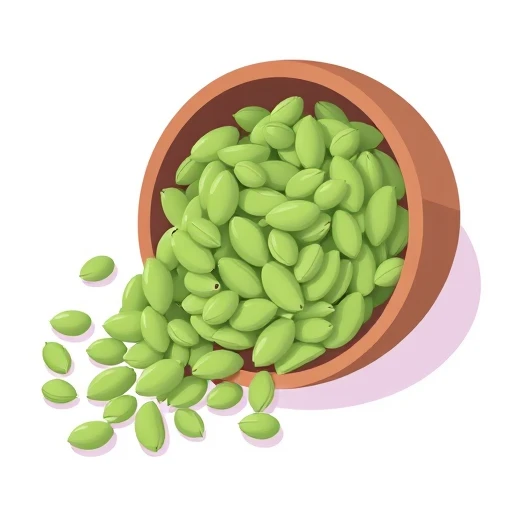
bean in 30 Seconds
- A bean is a versatile, edible seed found in pods, belonging to the legume family, and is a global staple for protein and fiber.
- The word can refer to the seed, the pod, or the entire plant, and it is used in both literal culinary and metaphorical contexts.
- Common varieties include kidney, black, and green beans, while 'coffee beans' and 'cocoa beans' are colloquially named for their similar appearance.
- Idiomatically, 'bean' appears in phrases like 'spill the beans' (reveal a secret) and 'full of beans' (energetic), showing its deep cultural integration.
The word bean refers to the large, edible seed of various plants in the Fabaceae family, commonly known as the legume, pea, or bean family. These seeds are typically found inside pods, which are the protective outer casings that grow on the plant's stems. In a botanical sense, a bean is a specific type of fruit known as a legume, but in everyday language, we use the term to describe both the seed itself and the plant that produces it. Beans are one of the oldest cultivated crops in human history, dating back thousands of years to early civilizations in both the Eastern and Western Hemispheres. They are prized for their high protein content, complex carbohydrates, and essential vitamins, making them a staple food for billions of people across the globe. When people use the word 'bean,' they might be referring to a wide variety of species, including the common bean (Phaseolus vulgaris), which includes kidney beans, pinto beans, and black beans, or they might be talking about broad beans, soybeans, or even coffee beans, which are technically the seeds of a fruit but are called beans due to their appearance.
- Botanical Classification
- The term 'bean' covers several genera within the family Fabaceae. While most common beans belong to the genus Phaseolus, others like the fava bean belong to Vicia, and the soybean belongs to Glycine. This diversity explains the vast differences in size, color, and flavor found in the bean family.
The farmer spent the morning harvesting every ripe bean from the long, green pods in the field.
Culturally, the bean is more than just a food source; it is a symbol of growth and potential. Because a single dried bean can grow into a large plant that produces hundreds more seeds, it has often been used in folklore and fairy tales, most notably in 'Jack and the Beanstalk.' In this story, the 'magic beans' represent a small investment that leads to an enormous, albeit dangerous, reward. In modern contexts, the word has expanded into various metaphorical uses. For instance, in the world of finance and business, a 'bean-counter' is a derogatory or humorous term for an accountant or someone who is overly concerned with small financial details. This usage stems from the idea of literally counting individual beans to ensure every tiny asset is accounted for. Furthermore, the word is used in casual slang to refer to the human head or to a very small amount of something, as in the phrase 'not worth a bean,' which means something has no value at all.
- Culinary Versatility
- Beans can be eaten fresh, dried, canned, or ground into flour. They are unique because they can be treated as both a vegetable and a protein source in dietary guidelines, providing a bridge between different food groups.
She soaked the dried bean overnight to make sure it would be soft enough for the soup.
The environmental impact of beans is also significant. They are known as 'nitrogen-fixers,' meaning they have a symbiotic relationship with bacteria in their root nodules that converts atmospheric nitrogen into a form that plants can use to grow. This process enriches the soil, making beans an essential part of crop rotation strategies used by farmers to maintain soil health without relying heavily on synthetic fertilizers. This ecological benefit, combined with their low water footprint compared to animal proteins, makes the bean a hero of sustainable agriculture. Whether you are eating a bowl of chili, drinking a cup of coffee, or reading a story about a giant beanstalk, the word 'bean' connects you to a deep history of human nutrition and environmental science.
The scientist examined the bean under a microscope to study its genetic structure.
- Idiomatic Usage
- The phrase 'to spill the beans' means to reveal a secret. This likely originates from ancient Greek voting systems where different colored beans were used to cast secret ballots; if the jar was knocked over, the secret results were 'spilled.'
Don't spill the bean about the surprise party!
Every single bean in this jar was hand-picked by local workers.
Using the word bean in a sentence requires an understanding of its grammatical role as a countable noun. Because beans are small and usually come in large quantities, you will very often see the word in its plural form, 'beans.' However, the singular 'bean' is used when referring to a specific seed, a single plant, or when the word acts as a modifier for another noun. For example, in the phrase 'bean soup,' the word 'bean' describes the type of soup. In this context, it functions almost like an adjective, though it remains a noun. When discussing the plant itself, you might say, 'I am growing a runner bean in my garden,' where 'runner bean' specifies the variety. Understanding the countability is key: you can have one bean, two beans, or a whole hill of beans. In informal English, 'bean' can also be used as a verb meaning to hit someone on the head, particularly in baseball, but this is much less common than the noun form.
- Singular vs. Plural
- Use 'bean' for a single unit: 'He found a stray bean on the floor.' Use 'beans' for the food item in general: 'I love eating beans with rice.'
The recipe calls for one vanilla bean, split lengthwise to release the seeds.
When writing about beans in a culinary context, you often need to use specific verbs that describe how they are prepared. Common verbs include 'soak,' 'boil,' 'simmer,' 'drain,' and 'mash.' For instance, 'You must soak the dried bean before cooking it to reduce the cooking time.' If you are talking about green beans or snap beans, you might use the verb 'string' (to remove the fibrous thread) or 'snap' (to break the ends off). In more formal or scientific writing, you might use the word 'legume' to be more precise, but 'bean' is perfectly acceptable in most academic contexts when referring to the specific seeds of the Phaseolus genus. In business English, the word appears in idioms like 'bean-counting' or 'full of beans.' If you say someone is 'full of beans,' you are using a British idiom meaning they have a lot of energy and enthusiasm. It is important to match the register of your sentence to the audience; 'full of beans' is very informal, while 'the protein content of the bean' is more formal.
- Compound Nouns
- Common compounds include beanstalk, beanbag, beanpole, and beanfeast. Each of these uses the word 'bean' to evoke a specific image or historical context.
The child sat comfortably on a large, blue beanbag in the corner of the room.
In descriptive writing, you can use the word 'bean' to create vivid imagery. Because beans come in so many shapes—kidney-shaped, oval, spherical—and colors—mottled, striped, solid black, pure white—they are excellent for comparisons. You might describe a small, smooth stone as being 'the size and shape of a lima bean.' In a metaphorical sense, 'bean' can represent something of minimal value. If someone says, 'I don't have a bean,' they mean they have no money. This is an older, more British usage, but it still appears in literature. When constructing sentences, pay attention to the prepositions that follow 'bean.' You might have a 'can of beans,' a 'bag of beans,' or a 'dish made with beans.' If you are talking about the plant's growth, you might say the beans are 'on the vine' or 'in the pod.' By varying your sentence structure and using these specific collocations, you can make your English sound more natural and sophisticated.
He didn't have a single bean to his name after the business failed.
- Action Verbs
- When cooking, you might 'shell' a bean (remove it from the pod) or 'refry' beans (a common technique in Mexican cuisine).
Please help me shell this giant pile of broad beans for tonight's dinner.
The pitcher accidentally beaned the batter with a fast ball.
The word bean is ubiquitous, appearing in a variety of settings ranging from the mundane to the highly specialized. One of the most common places you will hear it is in the kitchen or a restaurant. Chefs and home cooks discuss different types of beans constantly—black beans, kidney beans, garbanzo beans (also known as chickpeas), and navy beans. In a grocery store, you'll see entire aisles dedicated to canned beans and bags of dried beans. In the morning, you'll likely hear the word in the context of coffee. Baristas and coffee enthusiasts talk about 'single-origin beans,' 'roasted beans,' and 'grinding the beans.' Even though coffee beans are seeds of a fruit, the term 'bean' is the standard way to refer to them in the global coffee industry. If you are in a coffee shop, you might hear someone ask, 'What kind of beans are you using for the espresso today?' This shows how the word has become synonymous with the raw material of our favorite morning beverage.
- In the Kitchen
- 'I'm making a three-bean salad for the picnic.' This is a common phrase where 'bean' identifies the primary ingredient and its variety.
The aroma of freshly ground coffee beans filled the entire cafe.
Beyond the culinary world, you will hear 'bean' in business and financial environments, often in a slightly metaphorical or idiomatic sense. The term 'bean-counter' is a common, often derogatory, way to refer to an accountant or a financial officer who is perceived as being too focused on small expenditures and strict budgeting. You might hear a manager say, 'We need to get this project past the bean-counters before we can start spending.' In this context, 'bean' represents a unit of currency or a small asset. Similarly, in political or social discussions, you might hear the phrase 'not worth a hill of beans,' which comes from a famous line in the movie *Casablanca*. It means that something is insignificant or unimportant in the grand scheme of things. Hearing these idioms requires an understanding of the cultural weight the word 'bean' carries as a symbol of something small but countable.
- In Business
- 'The bean-counters are worried about the marketing budget.' Here, 'bean' is part of a compound noun describing a person's role and attitude toward money.
Our problems are not worth a hill of beans in this crazy world.
You will also encounter the word in children's literature and casual conversation. 'Jack and the Beanstalk' is a story almost every English-speaking child knows, making 'beanstalk' a familiar word from a young age. In casual conversation, especially in the UK, you might hear someone say they are 'full of beans,' meaning they are very energetic. If someone 'spills the beans,' they have let out a secret. In the world of sports, specifically baseball, a 'beanball' is a pitch intentionally thrown at a batter's head. While this is a dangerous and often penalized action, the term is a standard part of baseball jargon. Whether you're at a farm, a coffee shop, a corporate office, or a baseball diamond, the word 'bean' and its various derivatives are likely to pop up, each time carrying a slightly different nuance based on the environment.
The giant chased Jack down the massive beanstalk.
- In Sports
- 'He was ejected for throwing a beanball.' In this context, 'bean' refers to the head, and the word describes a specific type of illegal pitch.
She was so full of beans after her nap that she couldn't sit still.
I haven't got a bean, so I can't go to the cinema tonight.
One of the most frequent mistakes learners make with the word bean is confusing it with its homophone, 'been.' While they sound identical in many dialects of English (both pronounced /biːn/), they have completely different meanings and grammatical functions. 'Bean' is a noun referring to a seed or plant, whereas 'been' is the past participle of the verb 'to be.' For example, a common error is writing 'I have bean to London' instead of 'I have been to London.' Conversely, someone might write 'I ate a green been' instead of 'I ate a green bean.' To avoid this, remember that 'bean' with an 'a' is something you can eat, while 'been' with two 'e's is a state of being or a past action. Another common spelling error is 'beene' or 'beane,' but the standard spelling is always 'bean' for the food item. Paying close attention to the context—whether you are describing an object or a verb tense—will help you choose the correct word.
- Homophone Confusion
- Incorrect: 'Where have you bean?' Correct: 'Where have you been?' Incorrect: 'I like kidney beens.' Correct: 'I like kidney beans.'
It has been a long time since I last ate a jelly bean.
Another area of confusion involves the countability of the word. While 'bean' is a countable noun, it is often used in the plural because we rarely eat or talk about just one bean. However, when 'bean' acts as a modifier in a compound noun, it should almost always be singular. For example, you should say 'bean sprout' (singular 'bean') even if the dish contains hundreds of sprouts. Saying 'beans sprout' would be grammatically incorrect in this context. Similarly, it is 'bean soup,' 'bean salad,' and 'bean dip.' Learners often try to pluralize the first noun in these compounds because they are thinking of the many beans in the dish, but in English, the modifying noun stays singular. Additionally, some learners confuse 'beans' with other legumes like 'peas' or 'lentils.' While they are all related, they are distinct botanical categories. Calling a pea a bean is a minor factual error, but in precise culinary or scientific contexts, it's important to know the difference.
- Countability Errors
- Incorrect: 'I'd like a beans salad.' Correct: 'I'd like a bean salad.' Incorrect: 'The beans plant is growing.' Correct: 'The bean plant is growing.'
The bean curd, also known as tofu, is a staple in many Asian cuisines.
Finally, there are mistakes related to idiomatic usage. Idioms like 'spill the beans' or 'full of beans' are fixed expressions. You cannot change the words within them and keep the same meaning. For instance, you cannot say 'spill the peas' or 'full of seeds' and expect people to understand you are using an idiom. Also, be careful with the register. Using 'bean' to mean 'head' (e.g., 'He got hit on the bean') is very informal and somewhat dated; using it in a formal essay would be inappropriate. Similarly, 'bean-counter' can be offensive to accountants if used in a serious professional setting. Understanding the social context and the fixed nature of idioms will prevent you from making these subtle but important mistakes. Always check if a phrase is an idiom before you try to modify it, and always consider your audience before using slang or informal terms.
He accidentally spilled the beans about the secret merger during the meeting.
- Idiom Precision
- Incorrect: 'She is full of peas today!' Correct: 'She is full of beans today!' (meaning energetic).
The bean-counter refused to approve the purchase of new office chairs.
Put the empty bean can in the recycling bin.
When you want to avoid repeating the word bean or when you need to be more specific, there are several alternatives you can use. The most common scientific and formal alternative is 'legume.' A legume is a broader category that includes beans, peas, lentils, and even peanuts. If you are writing a nutritional report or a botanical study, 'legume' is often the preferred term. Another related term is 'pulse.' In culinary and agricultural contexts, 'pulses' specifically refers to the dried seeds of legumes, such as dried chickpeas, lentils, and kidney beans. So, while all pulses are beans (or legumes), not all beans are pulses—for example, green beans eaten fresh are legumes but not pulses. Understanding these distinctions can help you choose the most accurate word for your context.
- Bean vs. Legume
- 'Bean' is the common name for the seed. 'Legume' is the botanical term for the whole plant family and the fruit (pod). All beans are legumes, but not all legumes (like clover or alfalfa) are beans.
The nutritionist recommended increasing the intake of legumes to improve heart health.
In some cases, you might use the word 'seed' or 'kernel.' While 'bean' is a type of seed, 'seed' is a much more general term. You might use 'seed' if you are talking about the biological function of the bean as a reproductive unit of the plant. 'Kernel' is often used for the inner part of a seed or nut, and while it's rarely used for common beans, you might hear it in the context of 'palm kernel' or 'corn kernel.' If you are talking about very small beans, you might use the word 'pea,' though botanically they are different. For example, 'black-eyed peas' are actually a type of bean. Similarly, 'chickpeas' are often called 'garbanzo beans.' The choice between these words often depends on regional dialect—'chickpea' is more common in the UK, while 'garbanzo bean' is very common in the US.
- Bean vs. Pulse
- 'Pulse' refers only to the dried seed. A green bean is a 'bean' but not a 'pulse' because it is harvested and eaten while still green and moist.
Lentils are a type of pulse that cooks much faster than most dried beans.
For metaphorical uses of 'bean,' the alternatives change completely. If you are using 'bean' to mean 'head,' you could use 'noggin,' 'pate,' or simply 'head.' If you are using 'bean-counter,' you might use 'accountant,' 'bookkeeper,' or 'financial analyst,' depending on whether you want to be formal or informal. If you are using the idiom 'not worth a bean,' you could say 'not worth a cent,' 'not worth a penny,' or 'worthless.' When someone is 'full of beans,' you could say they are 'energetic,' 'vivacious,' or 'full of life.' Choosing the right synonym depends on the specific meaning of 'bean' you are trying to convey. By expanding your vocabulary to include these alternatives, you can express yourself more precisely and avoid the monotony of using the same word repeatedly in your writing and speech.
He was so energetic after the game that he ran all the way home.
- Bean vs. Seed
- A seed is any plant part that can grow into a new plant. A bean is a specific kind of seed from the legume family. All beans are seeds, but not all seeds (like sunflower seeds) are beans.
The gardener planted a tiny seed that would eventually become a tall bean plant.
The garbanzo is a versatile ingredient used in everything from hummus to salads.
How Formal Is It?
Fun Fact
The use of 'bean' to mean 'head' dates back to the early 20th century, possibly because of the similar shape between a large bean and a skull. This led to the term 'beanball' in baseball.
Pronunciation Guide
- Confusing the pronunciation with 'bin' (/bɪn/), which has a short 'i' sound.
- Over-emphasizing the 'n' sound at the end.
- Pronouncing it exactly like 'been' in dialects where 'been' is pronounced /bɪn/.
- Adding an extra vowel sound at the end (e.g., 'be-an').
- Failing to lengthen the 'ee' sound sufficiently.
Difficulty Rating
The word is short and common in basic texts.
Spelling is easy, but watch out for 'been'.
Pronunciation is simple, but idioms can be tricky.
Can be confused with 'been' in fast speech.
What to Learn Next
Prerequisites
Learn Next
Advanced
Grammar to Know
Noun Modifiers
We say 'bean soup', not 'beans soup'.
Countable Nouns
I have one bean. I have many beans.
Homophones
Don't confuse 'bean' (food) with 'been' (verb).
Compound Nouns
Beanstalk and beanbag are written as one word.
Pluralization
Most beans are referred to in the plural in culinary contexts.
Examples by Level
I eat a green bean.
Je mange un haricot vert.
Use 'a' before 'bean' because it is a singular countable noun.
The bean is small.
Le haricot est petit.
The subject 'bean' is singular, so we use the verb 'is'.
I have three beans.
J'ai trois haricots.
Add 's' to 'bean' to make it plural after the number three.
The bean grows in a pod.
Le haricot pousse dans une cosse.
Present simple tense for a general fact.
Do you like beans?
Aimes-tu les haricots ?
Question form using 'do' and the plural 'beans'.
This is a coffee bean.
C'est un grain de café.
'Coffee' acts as a modifier for 'bean'.
The bean is red.
Le haricot est rouge.
Adjective 'red' follows the linking verb 'is'.
She plants a bean.
Elle plante un haricot.
Third person singular 'plants' ends in 's'.
I like to eat baked beans for breakfast.
J'aime manger des haricots blancs à la sauce tomate au petit-déjeuner.
'Baked beans' is a common compound noun for this specific dish.
The bean plant is very tall now.
Le plant de haricot est très grand maintenant.
'Bean' is used here as a noun modifier for 'plant'.
He is sitting on a large beanbag.
Il est assis sur un grand pouf.
'Beanbag' is a compound noun.
We need to buy a can of beans.
Nous devons acheter une boîte de haricots.
Use 'of' to show the contents of the 'can'.
The recipe says to use one vanilla bean.
La recette dit d'utiliser une gousse de vanille.
'Vanilla bean' is a specific type of seed pod.
My sister is full of beans today!
Ma sœur est pleine d'énergie aujourd'hui !
Idiom meaning 'full of energy'.
Don't forget to wash the green beans.
N'oublie pas de laver les haricots verts.
'Green beans' refers to the fresh vegetable variety.
A kidney bean looks like a kidney.
Un haricot rouge ressemble à un rein.
Comparison using 'looks like'.
You should soak the dried bean before you cook it.
Tu devrais faire tremper le haricot sec avant de le cuire.
Use 'should' for advice and 'before' as a conjunction.
She accidentally spilled the beans about the surprise.
Elle a accidentellement vendu la mèche pour la surprise.
Idiom 'spill the beans' means to reveal a secret.
The bean soup was delicious and very filling.
La soupe aux haricots était délicieuse et très rassasiante.
'Bean' is singular when modifying 'soup'.
Beans are an excellent source of vegetable protein.
Les haricots sont une excellente source de protéines végétales.
General statement using the plural 'beans'.
The farmer harvested the beans by hand.
Le fermier a récolté les haricots à la main.
Past simple tense 'harvested'.
I prefer grinding my own coffee beans at home.
Je préfère moudre mes propres grains de café à la maison.
Gerund 'grinding' follows the verb 'prefer'.
That old car isn't worth a hill of beans.
Cette vieille voiture ne vaut absolument rien.
Idiom meaning 'worthless'.
The bean curd was served with a spicy sauce.
Le fromage de soja a été servi avec une sauce épicée.
'Bean curd' is another name for tofu.
The bean-counter insisted on cutting the travel budget.
Le comptable a insisté pour réduire le budget voyage.
Informal/derogatory term for an accountant.
Soybeans are used to make a wide variety of products.
Le soja est utilisé pour fabriquer une grande variété de produits.
Passive voice 'are used to make'.
The symbiotic bacteria live in the bean's root nodules.
Les bactéries symbiotiques vivent dans les nodules racinaires du haricot.
Possessive form 'bean's'.
He was beaned by a stray pitch in the fourth inning.
Il a été atteint à la tête par un lancer égaré à la quatrième manche.
'Bean' used as a verb meaning to hit on the head.
The artisanal chocolate is made from organic cocoa beans.
Le chocolat artisanal est fabriqué à partir de fèves de cacao biologiques.
Preposition 'from' shows the source material.
Broad beans are a popular ingredient in Mediterranean cooking.
Les fèves sont un ingrédient populaire dans la cuisine méditerranéenne.
'Broad beans' is the British term for fava beans.
The project failed because it wasn't worth a bean.
Le projet a échoué parce qu'il n'avait aucune valeur.
Idiom 'not worth a bean' meaning worthless.
Mung bean sprouts are commonly used in stir-fry dishes.
Les pousses de haricots mungo sont couramment utilisées dans les sautés.
Compound noun with three parts: 'Mung bean sprouts'.
The etymology of 'bean' can be traced back to Proto-Germanic.
L'étymologie de 'bean' peut être retracée jusqu'au proto-germanique.
Formal academic sentence structure.
The bean-to-cup machine ensures the freshest possible coffee.
La machine du grain à la tasse garantit le café le plus frais possible.
Hyphenated modifier 'bean-to-cup'.
The nitrogen-fixing ability of the bean is crucial for soil health.
La capacité de fixation de l'azote du haricot est cruciale pour la santé du sol.
Compound adjective 'nitrogen-fixing'.
The protagonist's journey began with a handful of magic beans.
Le voyage du protagoniste a commencé avec une poignée de haricots magiques.
Literary reference to 'Jack and the Beanstalk'.
The corporate bean-counters vetoed the creative proposal.
Les comptables de l'entreprise ont opposé leur veto à la proposition créative.
Metaphorical use in a professional context.
The bean's morphology varies significantly across different species.
La morphologie du haricot varie considérablement selon les espèces.
Scientific terminology 'morphology'.
He hasn't got a bean to his name after the bankruptcy.
Il n'a plus un sou vaillant après la faillite.
Idiom 'not to have a bean' meaning to be penniless.
The pitcher's decision to throw a beanball sparked a massive brawl.
La décision du lanceur de lancer une balle à la tête a déclenché une bagarre générale.
Specific sports jargon 'beanball'.
The bean serves as a poignant motif of agrarian resilience in the novel.
Le haricot sert de motif poignant de résilience agraire dans le roman.
Sophisticated literary analysis.
The intricate 'bean-to-bar' process defines the quality of artisanal chocolate.
Le processus complexe 'de la fève à la tablette' définit la qualité du chocolat artisanal.
Industry-specific terminology.
The bean-counter's parsimony ultimately stifled the company's innovation.
La parcimonie du comptable a finalement étouffé l'innovation de l'entreprise.
High-level vocabulary like 'parsimony' and 'stifled'.
The archaeological record suggests beans were domesticated in the Andes.
Les données archéologiques suggèrent que les haricots ont été domestiqués dans les Andes.
Scientific/historical reporting style.
The phrase 'not worth a hill of beans' epitomizes existential insignificance.
L'expression 'ne pas valoir un clou' incarne l'insignifiance existentielle.
Philosophical application of an idiom.
The bean's genetic sequence was mapped to enhance drought resistance.
La séquence génétique du haricot a été cartographiée pour améliorer la résistance à la sécheresse.
Technical scientific description.
His reputation was tarnished when he was caught spilling the beans to the press.
Sa réputation a été ternie lorsqu'il a été surpris en train de vendre la mèche à la presse.
Complex sentence with passive and active components.
The humble bean, once a staple of the destitute, is now a superfood.
L'humble haricot, autrefois aliment de base des démunis, est désormais un super-aliment.
Appositive phrase 'once a staple of the destitute'.
Synonyms
Antonyms
Common Collocations
Common Phrases
— A standard unit of measurement for purchasing beans in a store. It refers to the metal container.
I opened a can of beans to make a quick lunch.
— A dish made primarily of various types of beans, often served cold with a dressing.
The three-bean salad was a hit at the barbecue.
— The entire organism that produces beans, including the roots, stem, leaves, and pods.
The bean plant grew quickly after the rain.
— Beans that have been dehydrated for long-term storage and must be soaked before cooking.
Buying dry beans is much cheaper than buying canned ones.
— The immature pods of the common bean, eaten as a fresh vegetable.
We had steak with a side of sautéed green beans.
— A thick, hearty soup where beans are the main ingredient.
Grandma's navy bean soup is the best on a cold day.
— A creamy mixture made from mashed beans, often served with chips.
The spicy black bean dip was gone in minutes.
— A large, flat, green bean also known as a fava bean.
Broad beans are in season during the early summer.
— A large, flat, pale green bean known for its buttery texture.
Some children famously dislike eating lima beans.
— A small green bean common in Asian cuisine, often used for sprouts.
Mung beans are often used to make sweet desserts in Asia.
Often Confused With
The past participle of 'to be'. It sounds the same but is a verb.
A container for waste. It has a shorter vowel sound.
A small round object used in jewelry. Similar shape but different material.
Idioms & Expressions
— To reveal a secret or tell someone something that was supposed to be private.
I wasn't supposed to know about the party, but Sarah spilled the beans.
informal— To have a lot of energy, enthusiasm, and vitality.
The kids were full of beans after their afternoon nap.
informal (mostly British)— To be of very little value or importance; practically worthless.
His promises are not worth a hill of beans if he doesn't keep them.
informal/idiomatic— A person, typically an accountant, who is seen as being overly concerned with small financial details.
The bean-counters won't let us spend any more money on marketing.
informal/derogatory— To have no money at all; to be completely broke.
I'd love to go to the concert, but I haven't got a bean.
informal (British)— An informal way of saying 'excellent,' 'great,' or 'all right.'
You found my keys? Cool beans!
slang (American)— To hit someone on the head, especially with a ball in sports like baseball.
The pitcher accidentally beaned the batter with a 90-mph fastball.
informal/sports— To be sensible, intelligent, and not easily fooled.
Don't worry about him; he knows how many beans make five.
informal (British)— Everyone has their faults or flaws; no one is perfect.
He's a good man, but every bean has its black.
proverbial/rare— A very tall and thin person.
He was a bit of a beanpole in high school, but he's filled out now.
informalEasily Confused
Both are small, round legumes.
Beans are usually larger and have a different shape (often kidney-shaped). Peas are almost always spherical.
I put peas in the stew and beans in the chili.
Both are dried legumes used in soups.
Lentils are much smaller and flatter than most beans and cook much faster.
Lentils don't need soaking, but these beans do.
A bean is a type of seed.
Seed is a general term for all plant reproductive units. Bean is specific to the legume family.
The sunflower seed is small, but the lima bean is large.
Peanuts are often called nuts but are actually beans (legumes).
True nuts grow on trees and have a hard shell that doesn't open. Beans grow in pods.
A walnut is a nut, but a peanut is technically a bean.
Both are staple crops.
Grains come from grasses (wheat, rice). Beans come from flowering plants (legumes).
Rice is a grain, and the black bean is a legume.
Sentence Patterns
I like [color] beans.
I like red beans.
I am eating [type] beans.
I am eating green beans.
You need to [verb] the beans before [action].
You need to soak the beans before cooking them.
The [noun] is made from [type] beans.
The dip is made from black beans.
Despite the [noun], he didn't have a bean.
Despite the inheritance, he didn't have a bean.
The [noun] serves as a [metaphor] for [concept].
The bean serves as a motif for growth.
Don't [idiom].
Don't spill the beans.
A [noun] of beans.
A can of beans.
Word Family
Nouns
Verbs
Adjectives
Related
How to Use It
Extremely common in daily life, especially in food and idiomatic contexts.
-
I have bean to the park.
→
I have been to the park.
You used the noun 'bean' instead of the past participle 'been'. 'Been' is the correct verb form for the present perfect tense.
-
I like to eat beans soup.
→
I like to eat bean soup.
When a noun modifies another noun, it is usually singular. 'Bean' modifies 'soup', so it should not be plural.
-
He spilled the peas about the secret.
→
He spilled the beans about the secret.
Idioms are fixed expressions. You cannot replace 'beans' with 'peas' even though they are similar foods.
-
I bought a can of bean.
→
I bought a can of beans.
A can contains many beans, so you must use the plural form 'beans' after 'a can of'.
-
The coffee's beans are fresh.
→
The coffee beans are fresh.
You don't need a possessive 's' here. 'Coffee' acts as a direct modifier for 'beans'.
Tips
Modifier Rule
When using 'bean' to describe another noun, keep it singular. Say 'bean salad,' not 'beans salad.' This is a very common mistake for intermediate learners.
The 'ea' Rule
Remember that 'bean' (the food) is spelled with 'ea' like 'eat.' This will help you distinguish it from 'been' (the verb).
Use 'Legume' for Formality
If you are writing a school report or a professional document about health, use the word 'legume' instead of 'bean' to sound more academic.
Energy Idiom
If you want to say someone is very energetic in a fun way, say they are 'full of beans.' It's a great way to sound more like a native speaker.
Soaking Dried Beans
Always mention 'soaking' when talking about dried beans. It's an essential step in the process that shows you understand how they are prepared.
Regional Terms
Be aware that 'garbanzo beans' and 'chickpeas' are the same thing. Use 'garbanzo' more in the US and 'chickpea' more in the UK.
Cool Beans
Use 'cool beans' sparingly. It's a bit dated but still used in casual, lighthearted American English to mean 'okay' or 'great.'
Long Vowel
Make sure to stretch the 'ee' sound. If you say it too quickly, it might sound like 'bin,' which means a trash can!
Ancient Voting
Tell the story of ancient Greek voting with beans to help people remember the idiom 'spill the beans.' It's a great conversation piece.
Protein Source
When discussing vegetarian diets, always mention beans as a primary 'protein source.' It's the most common context for the word in health discussions.
Memorize It
Mnemonic
Think of a 'Bean' as a 'B'ig 'E'dible 'A'mazing 'N'utrition source. The 'a' in bean reminds you it's something you 'eat' (both have an 'a').
Visual Association
Imagine a tall green beanstalk reaching into the clouds, with large kidney-shaped seeds hanging from it like jewels.
Word Web
Challenge
Try to name five different types of beans and use the idiom 'spill the beans' in a sentence today.
Word Origin
The word 'bean' comes from the Old English 'bēan', which can be traced back to the Proto-Germanic '*baunō'. It has cognates in many other Germanic languages, such as the German 'Bohne' and the Dutch 'boon'. The word has been used in English for over a thousand years to describe the seeds of leguminous plants.
Original meaning: The original meaning referred specifically to the broad bean (Vicia faba), which was the only bean native to Europe before the discovery of the Americas.
GermanicCultural Context
The term 'bean-counter' can be seen as offensive or belittling to accountants, so use it carefully in professional settings.
In British English, 'full of beans' is a common positive idiom, whereas in American English, 'cool beans' was a popular slang term in the 90s.
Practice in Real Life
Real-World Contexts
Cooking
- soak the beans
- drain the beans
- simmer the beans
- mash the beans
Gardening
- plant the beans
- water the beans
- harvest the beans
- bean trellis
Business
- bean-counting
- budget cuts
- financial details
- counting every penny
Coffee Shop
- whole beans
- ground beans
- roasted beans
- espresso beans
Casual Conversation
- spill the beans
- full of beans
- cool beans
- not worth a bean
Conversation Starters
"Do you have a favorite type of bean to cook with?"
"Have you ever tried growing beans in a garden?"
"What do you think about the idiom 'spill the beans'?"
"Do you prefer coffee made from whole beans or pre-ground coffee?"
"Is there a traditional bean dish in your country?"
Journal Prompts
Describe a time when someone 'spilled the beans' about a secret you were keeping.
Write about your favorite comfort food that includes beans.
If you had three magic beans, what would you hope they would grow into?
Discuss the importance of beans as a sustainable food source for the future.
Imagine you are a 'bean-counter' for a day. What would you try to save money on?
Frequently Asked Questions
10 questionsNo, botanically speaking, a coffee bean is the seed of a fruit called a coffee cherry. However, because it looks like a legume seed, it has been called a 'bean' for centuries. This is a common example of a culinary or colloquial name differing from a scientific one.
It means to reveal a secret, often accidentally. For example, if you tell someone about a surprise party before it happens, you have 'spilled the beans.' It is a very common informal idiom in English.
Not exactly. 'Legume' is the broad botanical family (Fabaceae) that includes beans, peas, lentils, and peanuts. 'Bean' is a more specific term for certain large seeds within that family. All beans are legumes, but not all legumes are beans.
They are called kidney beans because their shape and color closely resemble a human kidney. This is a common way that bean varieties are named—based on their physical characteristics.
It is a countable noun. You can say 'one bean' or 'many beans.' However, in some contexts like 'bean soup,' the word 'bean' acts as an uncountable modifier, but the beans themselves remain countable.
A 'bean-counter' is a slang term for an accountant or someone who is very strict about money and small details. It can be used humorously or as a mild insult to suggest someone is being too stingy.
Yes, in informal American English, particularly in baseball, 'to bean' means to hit someone on the head with a ball. It is also used more generally to mean hitting someone on the head.
'Bean' is a noun (the food). 'Been' is a verb (the past participle of 'to be'). They sound the same in many accents, which often causes spelling mistakes for learners.
Baked beans are a popular dish made of beans (usually navy beans) that are parboiled and then baked in a sauce, typically a sweet and savory tomato-based sauce. They are very common in the UK and US.
They are different varieties of the same species (Phaseolus vulgaris). Green beans are harvested early and eaten with the pod. Kidney beans are allowed to mature and dry, and only the seed is eaten.
Test Yourself 180 questions
Write a sentence using the word 'bean' to describe a food you like.
Well written! Good try! Check the sample answer below.
Explain the meaning of the idiom 'spill the beans' in your own words.
Well written! Good try! Check the sample answer below.
Describe the process of growing a bean plant from a seed.
Well written! Good try! Check the sample answer below.
Compare and contrast 'beans' and 'peas'.
Well written! Good try! Check the sample answer below.
Write a short story (50 words) about a magic bean.
Well written! Good try! Check the sample answer below.
Discuss the nutritional benefits of including beans in a daily diet.
Well written! Good try! Check the sample answer below.
What is a 'bean-counter' and why might someone use this term?
Well written! Good try! Check the sample answer below.
Describe your favorite dish that uses beans as a main ingredient.
Well written! Good try! Check the sample answer below.
Explain the difference between 'bean' and 'been' to a new English learner.
Well written! Good try! Check the sample answer below.
Write a dialogue between two people where one 'spills the beans'.
Well written! Good try! Check the sample answer below.
Discuss the environmental impact of farming beans versus meat.
Well written! Good try! Check the sample answer below.
What does the phrase 'full of beans' mean to you?
Well written! Good try! Check the sample answer below.
Write a recipe for a simple bean salad.
Well written! Good try! Check the sample answer below.
Explain the botanical definition of a bean.
Well written! Good try! Check the sample answer below.
How has the word 'bean' evolved in the English language?
Well written! Good try! Check the sample answer below.
Describe the cultural significance of beans in a specific country.
Well written! Good try! Check the sample answer below.
Write a sentence using 'bean' as a verb.
Well written! Good try! Check the sample answer below.
What is the importance of 'nitrogen-fixation' in bean plants?
Well written! Good try! Check the sample answer below.
Write a paragraph about the variety of beans available in a supermarket.
Well written! Good try! Check the sample answer below.
Why is the term 'bean-to-bar' important in the chocolate industry?
Well written! Good try! Check the sample answer below.
Pronounce the word 'bean' clearly. Focus on the long 'ee' sound.
Read this aloud:
You said:
Speech recognition is not supported in your browser. Try Chrome or Edge.
Tell a friend that you like green beans.
Read this aloud:
You said:
Speech recognition is not supported in your browser. Try Chrome or Edge.
Ask someone if they know any bean idioms.
Read this aloud:
You said:
Speech recognition is not supported in your browser. Try Chrome or Edge.
Describe a beanbag chair to someone who has never seen one.
Read this aloud:
You said:
Speech recognition is not supported in your browser. Try Chrome or Edge.
Explain why beans are a healthy food choice.
Read this aloud:
You said:
Speech recognition is not supported in your browser. Try Chrome or Edge.
Use the phrase 'full of beans' in a sentence about a child.
Read this aloud:
You said:
Speech recognition is not supported in your browser. Try Chrome or Edge.
Talk about the difference between canned beans and dried beans.
Read this aloud:
You said:
Speech recognition is not supported in your browser. Try Chrome or Edge.
Explain the term 'bean-counter' to a colleague.
Read this aloud:
You said:
Speech recognition is not supported in your browser. Try Chrome or Edge.
Describe the story of Jack and the Beanstalk briefly.
Read this aloud:
You said:
Speech recognition is not supported in your browser. Try Chrome or Edge.
Ask a barista what kind of coffee beans they are using.
Read this aloud:
You said:
Speech recognition is not supported in your browser. Try Chrome or Edge.
Discuss the role of beans in a vegetarian diet.
Read this aloud:
You said:
Speech recognition is not supported in your browser. Try Chrome or Edge.
Tell a joke or a story involving beans.
Read this aloud:
You said:
Speech recognition is not supported in your browser. Try Chrome or Edge.
Explain the idiom 'not worth a hill of beans'.
Read this aloud:
You said:
Speech recognition is not supported in your browser. Try Chrome or Edge.
Describe the appearance of a kidney bean.
Read this aloud:
You said:
Speech recognition is not supported in your browser. Try Chrome or Edge.
Talk about a time you accidentally 'spilled the beans'.
Read this aloud:
You said:
Speech recognition is not supported in your browser. Try Chrome or Edge.
Discuss the environmental benefits of growing beans.
Read this aloud:
You said:
Speech recognition is not supported in your browser. Try Chrome or Edge.
Explain the term 'bean-to-bar' chocolate.
Read this aloud:
You said:
Speech recognition is not supported in your browser. Try Chrome or Edge.
Describe the taste and texture of a cooked bean.
Read this aloud:
You said:
Speech recognition is not supported in your browser. Try Chrome or Edge.
Use the word 'bean' as a verb in a sentence about baseball.
Read this aloud:
You said:
Speech recognition is not supported in your browser. Try Chrome or Edge.
Talk about the different types of beans you can find in a grocery store.
Read this aloud:
You said:
Speech recognition is not supported in your browser. Try Chrome or Edge.
Listen to the sentence: 'I have been eating beans.' Which word is the food?
Listen to the idiom: 'Don't spill the beans.' What is the speaker telling you to do?
Listen for the number: 'I bought five cans of beans.' How many cans?
Listen to the description: 'It's a tall plant with green pods.' What is it?
Listen to the tone: 'The bean-counters are at it again.' Is the speaker happy?
Listen for the type: 'We need kidney beans for the chili.' Which beans?
Listen to the sound: 'Bean' vs 'Bin'. Which one means a vegetable?
Listen to the instruction: 'Soak the beans overnight.' When should you soak them?
Listen for the adjective: 'These are organic soy beans.' What kind of soy beans?
Listen to the phrase: 'Cool beans!' What does it mean?
Listen for the object: 'He sat on a beanbag.' What did he sit on?
Listen to the comparison: 'It's as small as a bean.' How small is it?
Listen for the verb: 'She shelled the beans.' What did she do?
Listen to the story snippet: 'Jack traded his cow for magic beans.' What did he get?
Listen for the modifier: 'I love bean sprouts.' What kind of sprouts?
/ 180 correct
Perfect score!
Summary
The word 'bean' is a fundamental noun describing a nutrient-dense edible seed. Beyond its literal meaning, it is central to many English idioms and is a key term in cooking, agriculture, and business. For example: 'She added a kidney bean to the chili to give it more texture.'
- A bean is a versatile, edible seed found in pods, belonging to the legume family, and is a global staple for protein and fiber.
- The word can refer to the seed, the pod, or the entire plant, and it is used in both literal culinary and metaphorical contexts.
- Common varieties include kidney, black, and green beans, while 'coffee beans' and 'cocoa beans' are colloquially named for their similar appearance.
- Idiomatically, 'bean' appears in phrases like 'spill the beans' (reveal a secret) and 'full of beans' (energetic), showing its deep cultural integration.
Modifier Rule
When using 'bean' to describe another noun, keep it singular. Say 'bean salad,' not 'beans salad.' This is a very common mistake for intermediate learners.
The 'ea' Rule
Remember that 'bean' (the food) is spelled with 'ea' like 'eat.' This will help you distinguish it from 'been' (the verb).
Use 'Legume' for Formality
If you are writing a school report or a professional document about health, use the word 'legume' instead of 'bean' to sound more academic.
Energy Idiom
If you want to say someone is very energetic in a fun way, say they are 'full of beans.' It's a great way to sound more like a native speaker.
Related Content
See it in Videos

Learn it in Context
This Word in Other Languages
Related Phrases
More food words
barbecue
A2A meal cooked outdoors, often at a party.
breakfast
A1Breakfast is the first meal of the day, typically eaten in the early morning after waking up. It serves to provide the body with energy after a night of sleep.
water
A1H2O liquid
food
A1edible substance
eat lunch
A2Have the midday meal.
cafe
A2A small restaurant serving coffee, light meals, and snacks.
fruit
A1Fruit refers to the sweet and fleshy part of a plant that usually contains seeds and is edible. It is a common food group that provides many vitamins and is often eaten raw or as a dessert.
chop
A2To cut something into small pieces, especially food.
lunch
A1A meal eaten in the middle of the day, typically between breakfast and dinner. It serves as a midday break for nutrition and rest during work or school hours.
beer
A2An alcoholic drink made from yeast-fermented malt, flavored with hops.

