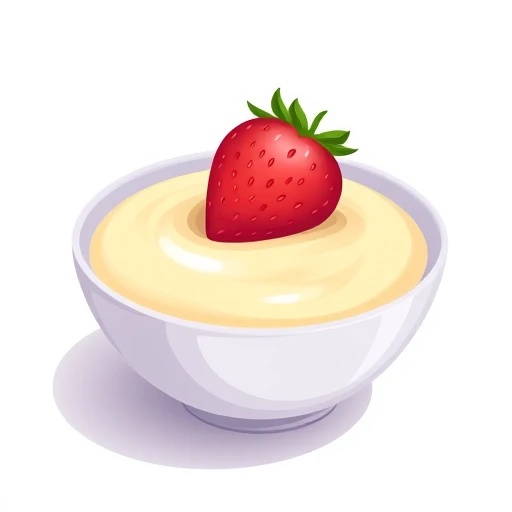
pudding in 30 Seconds
- A sweet, soft dessert often made from milk, sugar, and flavoring, typically eaten with a spoon in North American contexts.
- A general term used in British English to refer to the dessert course of a meal, regardless of the specific dish served.
- A category of savory dishes in British cuisine, often steamed or baked, such as Yorkshire pudding or black pudding.
- A word with deep cultural roots that serves as a linguistic marker for regional English dialects and social classes.
The word pudding is a fascinating linguistic chameleon that changes its meaning significantly depending on which side of the Atlantic Ocean you are standing. In American English, a pudding is almost exclusively a sweet, creamy, milk-based dessert with a consistency similar to custard or mousse. It is typically served cold and comes in flavors like chocolate, vanilla, or butterscotch. However, if you travel to the United Kingdom, the term expands into a much broader category. In British English, 'pudding' is often used as a generic synonym for the entire dessert course—anything sweet served after a main meal. Beyond that, the British also use it to describe specific savory dishes that are steamed or boiled in a crust or cloth, such as the famous Yorkshire pudding or the savory black pudding.
- The American Context
- In the United States, pudding is a specific type of comfort food. It is often associated with childhood snacks, lunchboxes, and simple home cooking. It is distinct from 'cake' or 'pie' because of its semi-liquid, spoonable texture. It is rarely savory in American usage.
After finishing his vegetables, the child was rewarded with a small bowl of chocolate pudding.
- The British Context
- In the UK, 'pudding' can refer to the 'sweet course' of a meal. A host might ask, 'Would anyone like some pudding?' even if they are serving fruit salad or cake. Furthermore, savory puddings like steak and kidney pudding or Yorkshire pudding (a baked batter) are staples of traditional British cuisine.
Historically, the word derives from the French 'boudin', which originally referred to a small sausage. This explains why many traditional British puddings are encased in a skin or cloth and boiled. Over centuries, the term evolved from these meat-based preparations to include sweet versions made with suet, flour, and dried fruits, eventually leading to the diverse range of dishes we see today. Whether you are eating a creamy vanilla snack in New York or a savory Yorkshire batter in Leeds, the word carries a sense of warmth, tradition, and satisfaction.
The traditional Sunday roast was served with a giant, fluffy Yorkshire pudding and plenty of gravy.
Christmas pudding is a rich, dark, steamed cake filled with dried fruits and spices, often flamed with brandy.
- Texture and Consistency
- The defining characteristic of most sweet puddings is their softness. Unlike a crisp biscuit or a chewy brownie, pudding is meant to be smooth, yielding, and easy to eat with a spoon. This makes it a popular 'comfort food' for people of all ages.
She stirred the rice pudding gently as it simmered on the stove, adding a pinch of nutmeg.
Black pudding, a type of blood sausage, is a key component of a full English breakfast.
Using the word pudding correctly requires an understanding of the grammatical context and the regional audience. As a noun, it can be both countable and uncountable. When referring to the substance in general, it is often uncountable ('I love pudding'). When referring to a specific serving or a specific type, it becomes countable ('We tried three different puddings').
- As a General Category
- In British English, you can use 'pudding' to refer to the course. Example: 'What's for pudding?' This is a very common informal and semi-formal way to ask about dessert.
The children were excited to find out that pudding was apple crumble with custard.
- Describing Texture
- You can use 'pudding' in compound nouns to describe specific dishes. These often highlight the main ingredient or the method of preparation, such as 'bread and butter pudding' or 'suet pudding'.
The chef prepared a savory steak and kidney pudding for the winter menu.
In American English, you would almost never use 'pudding' to refer to a cake or a fruit salad. If you say 'I want pudding', an American will expect a creamy, custard-like dish. Therefore, when writing for an international audience, it is often helpful to specify the type of pudding to avoid confusion. For example, 'creamy chocolate pudding' vs 'traditional Christmas pudding'.
He bought a pack of instant vanilla pudding to make a quick treat for the kids.
- Idiomatic Usage
- The word appears in several famous idioms. The most notable is 'The proof of the pudding is in the eating', which means you can only judge the quality of something by testing it or experiencing it.
The new software looks great on paper, but the proof of the pudding will be in the eating when we launch it.
We had a light main course so that we would have plenty of room for pudding.
You will encounter the word pudding in a variety of real-world settings, from casual family dinners to high-end restaurants and even in historical literature. Its usage is deeply embedded in the culinary culture of English-speaking nations, though the physical dish it represents will vary.
- In the Kitchen and Grocery Store
- In the US, you will see 'pudding cups' in the dairy aisle or 'instant pudding mix' in the baking aisle. In the UK, you might see 'suet pudding' in the canned goods section or 'black pudding' at the butcher's counter.
The grocery list included milk, eggs, and a box of chocolate pudding mix.
- In Restaurants and Pubs
- In a British pub, the menu might have a section titled 'Puddings' instead of 'Desserts'. You might see 'Sticky Toffee Pudding' or 'Bread and Butter Pudding' listed as classic options. In an American diner, 'Banana Pudding' is a common staple, often served with vanilla wafers.
The waiter asked if we wanted to see the pudding menu after we finished our steaks.
In pop culture and literature, 'pudding' often evokes a sense of nostalgia or Britishness. In the Harry Potter series, the 'Great Hall' feasts are famous for their magnificent puddings. In Pink Floyd's famous song 'Another Brick in the Wall', the line 'If you don't eat your meat, you can't have any pudding!' highlights the traditional role of pudding as a reward for finishing the main meal.
The grandmother's secret recipe for plum pudding had been passed down for four generations.
- Regional Dialects
- In the North of England, 'pudding' is used very frequently and covers a wide range of savory items. In the Southern US, 'pudding' often refers specifically to 'Banana Pudding', which is a cultural icon of the region.
The smell of steaming Christmas pudding filled the entire house on December 25th.
The most common mistake learners make with pudding is assuming it has a single, universal definition. Because the word is so regionally specific, using it incorrectly can lead to confusion or even a culinary surprise.
- Mistake 1: The 'Dessert' Confusion
- Learners often think 'pudding' always means a creamy custard. If you are in the UK and you order 'pudding', you might get a piece of cake, a tart, or a bowl of fruit. Conversely, an American might be confused if you refer to a chocolate cake as a 'pudding'.
Incorrect: (In the US) "I'll have the apple pie for my pudding." Correct: "I'll have the apple pie for dessert."
- Mistake 2: Savory vs. Sweet
- Another common error is assuming all puddings are sweet. 'Black pudding' is a savory sausage made with blood, and 'Yorkshire pudding' is a savory side dish. Ordering these expecting a sweet treat would be a significant mistake!
Incorrect: "I don't like meat, so I'll try the black pudding." Correct: "I don't like meat, so I'll avoid the black pudding."
Grammatically, learners sometimes struggle with the countability of the word. In general contexts, it is uncountable ('Do you like pudding?'). However, when referring to specific varieties or servings, it is countable ('They offer a range of puddings'). Using 'puddings' when you mean the general substance can sound slightly unnatural.
The menu featured several traditional British puddings, including spotted dick and treacle sponge.
- Spelling and Pronunciation
- Ensure you don't confuse the spelling with 'padding' (filling) or 'pudding' (the dish). The pronunciation uses a short 'oo' sound /ʊ/, similar to 'put' or 'foot', not a long 'oo' sound like 'food'.
She accidentally added too much milk, making the pudding too runny to set properly.
To enrich your vocabulary, it is helpful to look at words that are similar to pudding but carry slightly different nuances. Depending on the texture, the course, or the region, you might choose a different term.
- Dessert vs. Pudding
- 'Dessert' is the most common alternative. In the US, 'dessert' is the broad category, and 'pudding' is a specific item. In the UK, they are often used interchangeably, though 'pudding' can feel more traditional or domestic.
While the French call it 'dessert', many British families still refer to the final course as pudding.
- Custard, Mousse, and Blancmange
- If you are describing the texture of an American-style pudding, these words are useful. 'Custard' is egg-based; 'mousse' is light and airy; 'blancmange' is a milk pudding thickened with cornstarch or gelatin.
The chocolate mousse was much lighter than the dense bread pudding we had yesterday.
In the context of savory dishes, alternatives might include 'sausage' (for black pudding) or 'dumpling' (for some types of suet pudding). In the UK, 'afters' or 'sweet' are informal alternatives to 'pudding' or 'dessert', particularly in school or casual home settings.
The school cafeteria menu listed 'fruit crumble' as the daily pudding.
- Sweet Treat vs. Pudding
- 'Sweet treat' is a very informal, broad term for anything sugary. 'Pudding' implies a more substantial dish, often served as part of a meal rather than just a snack.
For the summer party, we decided to serve a light lemon posset instead of a heavy steamed pudding.
How Formal Is It?
Fun Fact
The transition from savory sausage to sweet dessert happened over several hundred years as people began adding sugar and fruit to the boiled mixtures.
Pronunciation Guide
- Pronouncing the 'u' like 'food' (long 'oo'). It should be short like 'foot'.
- Over-emphasizing the 'g' at the end. It should be a soft nasal 'ng'.
- Confusing it with 'padding' (short 'a' sound).
- Pronouncing it like 'pud-ding' with two distinct, heavy syllables.
- Misplacing the stress on the second syllable.
Difficulty Rating
Easy to recognize in most texts.
Requires knowledge of regional spelling and usage.
Pronunciation of the short 'u' can be tricky for some.
Clear sound, but context is needed to know the meaning.
What to Learn Next
Prerequisites
Learn Next
Advanced
Grammar to Know
Countable vs. Uncountable Nouns
I like pudding (uncountable) vs. I tried three puddings (countable).
Compound Nouns
Yorkshire pudding, rice pudding.
Zero Article with Courses
What's for pudding? (No 'the').
Adjectives before Nouns
Creamy, delicious chocolate pudding.
Prepositional Phrases
Pudding in a bowl, pudding with cream.
Examples by Level
I like chocolate pudding.
Me gusta el pudín de chocolate.
Simple subject + verb + object.
Is the pudding sweet?
¿Es dulce el pudín?
Question form with 'to be'.
She has a pudding.
Ella tiene un pudín.
Using 'has' for possession.
The pudding is cold.
El pudín está frío.
Adjective describing a noun.
We eat pudding after dinner.
Comemos pudín después de la cena.
Prepositional phrase 'after dinner'.
This is my favorite pudding.
Este es mi pudín favorito.
Demonstrative pronoun 'this'.
Do you want pudding?
¿Quieres pudín?
Direct question with 'do'.
The pudding is yellow.
El pudín es amarillo.
Color adjective.
I am making rice pudding today.
Estoy haciendo arroz con leche hoy.
Present continuous tense.
There are many types of pudding in the shop.
Hay muchos tipos de pudín en la tienda.
Plural 'there are'.
My grandmother makes the best pudding.
Mi abuela hace el mejor pudín.
Superlative 'the best'.
He doesn't like vanilla pudding.
A él no le gusta el pudín de vainilla.
Negative present simple.
Can I have some more pudding, please?
¿Puedo tener un poco más de pudín, por favor?
Polite request with 'can'.
We bought chocolate pudding for the party.
Compramos pudín de chocolate para la fiesta.
Past simple 'bought'.
Is there any pudding left?
¿Queda algo de pudín?
Question with 'any'.
The pudding is very creamy.
El pudín es muy cremoso.
Adverb 'very' modifying an adjective.
In England, pudding often means dessert.
En Inglaterra, 'pudding' a menudo significa postre.
Adverb of frequency 'often'.
I prefer sticky toffee pudding to ice cream.
Prefiero el pudín de dátil y caramelo al helado.
Comparison 'prefer X to Y'.
Yorkshire pudding is served with roast beef.
El pudín de Yorkshire se sirve con carne asada.
Passive voice 'is served'.
She has been cooking the Christmas pudding for hours.
Ella ha estado cocinando el pudín de Navidad durante horas.
Present perfect continuous.
If you finish your meal, you can have pudding.
Si terminas tu comida, puedes tener postre.
First conditional.
The pudding was so delicious that I had two servings.
El pudín estaba tan delicioso que tomé dos porciones.
Result clause 'so... that'.
I'm looking for a recipe for bread and butter pudding.
Estoy buscando una receta de pudín de pan y mantequilla.
Phrasal verb 'looking for'.
Would you like custard or cream with your pudding?
¿Te gustaría natillas o nata con tu pudín?
Polite offer with 'would'.
The proof of the pudding is in the eating.
La prueba del algodón es el uso (idiom).
Proverbial usage.
Black pudding is a traditional ingredient in a full English breakfast.
La morcilla es un ingrediente tradicional en un desayuno inglés completo.
Noun as a specific cultural term.
The chef specialized in creating modern twists on classic British puddings.
El chef se especializó en crear versiones modernas de los postres británicos clásicos.
Gerund after a preposition.
Despite being full, he managed to squeeze in a bit of pudding.
A pesar de estar lleno, se las arregló para hacer un hueco para el postre.
Contrast with 'despite'.
The texture of the pudding was perfectly smooth and velvety.
La textura del pudín era perfectamente suave y aterciopelada.
Adverbial phrase 'perfectly smooth'.
Many people find suet pudding a bit too heavy for a summer meal.
A mucha gente el pudín de sebo le resulta un poco pesado para una comida de verano.
Object complement structure.
Is 'pudding' a more appropriate term than 'dessert' in this context?
¿Es 'pudding' un término más apropiado que 'dessert' en este contexto?
Comparative adjective 'more appropriate'.
The pudding had been steaming in the pot all afternoon.
El pudín había estado cociéndose al vapor en la olla toda la tarde.
Past perfect continuous.
The term 'pudding' carries significant class connotations in British society.
El término 'pudding' conlleva importantes connotaciones de clase en la sociedad británica.
Abstract noun usage.
The evolution of pudding from a savory meat dish to a sweet dessert is fascinating.
La evolución del pudín de un plato de carne salado a un postre dulce es fascinante.
Noun phrase as subject.
He delivered a speech that was as substantial as a Christmas pudding.
Pronunció un discurso que fue tan sustancioso como un pudín de Navidad.
Simile for metaphorical effect.
The recipe calls for the pudding to be boiled in a traditional cloth bag.
La receta requiere que el pudín se hierva en una bolsa de tela tradicional.
Infinitive clause as object.
One cannot discuss British cuisine without mentioning the iconic Yorkshire pudding.
No se puede hablar de la cocina británica sin mencionar el icónico pudín de Yorkshire.
Formal 'one' as subject.
The consistency of the blancmange was more like a jelly than a pudding.
La consistencia del manjar blanco era más parecida a una gelatina que a un pudín.
Comparative 'more like... than'.
The cultural divide between 'pudding' and 'dessert' remains a topic of linguistic debate.
La brecha cultural entre 'pudding' y 'dessert' sigue siendo un tema de debate lingüístico.
Complex noun phrase.
The rich, dark flavors of the plum pudding were enhanced by the brandy butter.
Los ricos y oscuros sabores del pudín de ciruelas se vieron realzados por la mantequilla de brandy.
Passive voice with 'enhanced by'.
The protagonist's nostalgic yearning was epitomized by the scent of his mother's rice pudding.
El anhelo nostálgico del protagonista se personificaba en el aroma del arroz con leche de su madre.
Advanced literary vocabulary.
To call it a mere pudding would be to undersell the complexity of its artisanal preparation.
Llamarlo un mero pudín sería subestimar la complejidad de su preparación artesanal.
Subjunctive/Hypothetical structure.
The linguistic shift from 'pudding' as a meat product to a sweet treat reflects broader societal changes.
El cambio lingüístico del 'pudding' como producto cárnico a un dulce refleja cambios sociales más amplios.
Gerund as subject with complex modifiers.
In the nuanced hierarchy of British social markers, 'pudding' stands as a resilient 'U' term.
En la matizada jerarquía de los marcadores sociales británicos, 'pudding' se mantiene como un término 'U' (clase alta) resistente.
Technical sociolinguistic reference.
The pudding's density was such that it required a sharp blade rather than a spoon.
La densidad del pudín era tal que requería una hoja afilada en lugar de una cuchara.
Result clause 'such that'.
Her prose was thick and cloying, much like an over-sweetened butterscotch pudding.
Su prosa era densa y empalagosa, muy parecida a un pudín de caramelo demasiado endulzado.
Extended metaphor.
The traditional haggis is, in many respects, the ultimate savory pudding of the North.
El haggis tradicional es, en muchos aspectos, el pudín salado definitivo del Norte.
Parenthetical 'in many respects'.
The sheer variety of puddings across the Commonwealth is a testament to the word's versatility.
La gran variedad de pudines en toda la Commonwealth es un testimonio de la versatilidad de la palabra.
Noun phrase 'sheer variety'.
Common Collocations
Common Phrases
— A common way to ask what is being served for dessert.
I'm still hungry, what's for pudding?
— A slang term (often dated) for someone with a round, soft face.
He was a cheerful boy with a bit of a pudding face.
— British slang for being pregnant (very informal).
Did you hear that Sarah is in the pudding club?
— Describing something very dense or someone not very bright.
The fog was as thick as a pudding.
— A haircut that looks like a bowl was placed on the head.
He regretted his childhood pudding basin haircut.
— A traditional British savory steamed dish.
He ordered a hearty steak and kidney pudding.
— A British dessert made of bread and berries.
Summer pudding is best served with fresh cream.
— A heavy, traditional pudding made with animal fat.
Suet pudding is very filling on a cold day.
— A sweet wine served with the dessert course.
They opened a bottle of pudding wine to go with the tart.
— A simple dessert made primarily of milk and a thickener.
The hospital served a plain milk pudding.
Often Confused With
Padding is soft material used to fill something; pudding is a food.
Custard is specifically egg-based; pudding can be made with cornstarch or other thickeners.
Mousse is aerated and light; pudding is denser and creamier.
Idioms & Expressions
— You can only judge the quality of something by trying it.
The plan sounds good, but the proof of the pudding is in the eating.
neutral— To spoil something by trying too hard to improve it.
Don't over-egg the pudding with too many details.
informal— Stupid or muddled in thinking.
He made a pudding-headed mistake on the exam.
informal/dated— To be pregnant.
She's been glowing since she's been in the pudding club.
slang (UK)— To achieve something surprisingly good (rare/regional).
He really pulled a pudding with that last-minute goal.
slang— Lacking strength or firmness.
His resolve was as soft as pudding when he saw the cake.
informal— A lucky or opportune moment (archaic).
He arrived at pudding time, just as the news broke.
archaic— Describing someone who is clumsy or poorly dressed (rare).
He looked like a pudding in a bag in that oversized suit.
informal— Very full after eating (regional).
I can't eat another bite; I'm as full as a state pudding.
informalEasily Confused
They are often synonyms.
Dessert is the broad category; pudding is a specific type (US) or a synonym (UK).
We had cake for dessert.
It has 'pudding' in the name but isn't sweet.
It is a savory baked batter, not a dessert.
Serve the Yorkshire pudding with gravy.
It has 'pudding' in the name but is a sausage.
It is a savory blood sausage.
I had black pudding with my eggs.
Similar texture.
Custard is made with eggs; American pudding is often thickened with starch.
The custard was warm.
Both are soft desserts.
Jello is gelatin-based and clear; pudding is milk-based and opaque.
The kids wanted Jello instead of pudding.
Sentence Patterns
I like [flavor] pudding.
I like vanilla pudding.
Can I have some [adjective] pudding?
Can I have some more pudding?
[Dish] is a type of pudding.
Sticky toffee is a type of pudding.
The [noun] of the pudding is [phrase].
The proof of the pudding is in the eating.
The [adjective] nature of the pudding [verb].
The dense nature of the pudding made it very filling.
Metaphorical use of pudding.
His argument was as soft as a poorly set pudding.
What's for pudding?
What's for pudding tonight?
[Noun] pudding.
Rice pudding is great.
Word Family
Nouns
Verbs
Adjectives
Related
How to Use It
Common in daily speech, especially in the UK.
-
Using 'pudding' for 'cake' in the US.
→
Using 'dessert' or 'cake'.
Americans only use 'pudding' for creamy, custard-like dishes.
-
Pronouncing it 'poo-ding'.
→
Pronouncing it 'pud-ding' (short u).
The 'u' is short, not long.
-
Expecting a sweet dish when ordering 'black pudding'.
→
Expecting a savory sausage.
Black pudding is made with blood and is savory.
-
Saying 'the pudding' for the dessert course.
→
Saying 'pudding'.
In the UK, the course is usually just called 'pudding'.
-
Thinking all puddings are cold.
→
Knowing many are served hot.
Many British puddings are steamed and served warm.
Tips
Regional Awareness
Always check your audience. If you say 'pudding' to a Brit, they think 'dessert'. To an American, they think 'creamy cup'.
Uncountable Use
Use 'pudding' without an article when talking about it as a general food category.
Texture Matters
Pudding should be smooth. If it has lumps, it's usually considered poorly made.
The Proof
Use the idiom 'the proof of the pudding' when discussing a new idea that needs testing.
Synonym Choice
Use 'dessert' in formal international writing to avoid confusion.
Short U
Practice the /ʊ/ sound. It's the same sound as in 'book' and 'look'.
Holiday Context
If you're in the UK in December, 'pudding' almost always refers to Christmas pudding.
Pudding Club
Be careful with 'pudding club'—it's very informal and can be seen as rude in some contexts.
Morning Pudding
If you see 'pudding' on a breakfast menu, it's likely 'black pudding' or 'white pudding' (savory sausages).
Spoon Food
Pudding is almost always eaten with a spoon, not a fork (unless it's a cake-like British pudding).
Memorize It
Mnemonic
Think of 'PUD' as 'Put Under Dessert'. It's the sweet thing you put on the table after the main meal.
Visual Association
Imagine a wobbly, creamy chocolate mountain with a little flag on top that says 'Pudding'.
Word Web
Challenge
Try to use the word 'pudding' in three different ways today: once for a snack, once for a dessert, and once in an idiom.
Word Origin
The word 'pudding' comes from the Middle English 'poding', which likely derived from the Old French 'boudin', meaning 'sausage'. This French word itself comes from the Latin 'botellus', meaning 'small sausage' or 'intestine'.
Original meaning: Originally, it referred to a savory dish made by stuffing meat and other ingredients into an animal's stomach or intestine and boiling it.
Germanic/Romance hybrid influence.Cultural Context
None, though 'black pudding' (made with blood) can be a sensitive topic for vegetarians or those with certain dietary restrictions.
In Britain, 'pudding' can be a whole course. In America, it's a specific texture.
Practice in Real Life
Real-World Contexts
At a restaurant
- Can I see the pudding menu?
- What's the pudding of the day?
- Is the pudding served hot?
- I'll have the chocolate pudding.
In the kitchen
- Stir the pudding constantly.
- Let the pudding cool in the fridge.
- Add a pinch of salt to the pudding.
- The pudding hasn't set yet.
At a British dinner
- Who wants pudding?
- Pass the Yorkshire puddings, please.
- This Christmas pudding is delicious.
- I'm too full for pudding.
Grocery shopping
- Where is the instant pudding?
- Do you have any dairy-free pudding?
- I need a pack of pudding cups.
- Check the expiration date on the pudding.
Talking about childhood
- My favorite snack was pudding.
- We used to have rice pudding at school.
- I loved licking the pudding spoon.
- Pudding always reminds me of home.
Conversation Starters
"What is your favorite type of pudding?"
"Do you prefer chocolate or vanilla pudding?"
"Have you ever tried a savory pudding like Yorkshire pudding?"
"In your country, do you have a dessert similar to pudding?"
"Do you think 'pudding' is a better word than 'dessert'?"
Journal Prompts
Describe the best pudding you have ever eaten. What did it taste like?
Write about a time you tried a food that looked like pudding but tasted different.
If you had to invent a new flavor of pudding, what would it be?
Discuss the differences between 'pudding' and 'dessert' based on what you learned.
Write a short story about a character who is obsessed with Christmas pudding.
Frequently Asked Questions
10 questionsNo, in British English, there are many savory puddings like Yorkshire pudding and black pudding.
In the US, pudding is a specific creamy dish. In the UK, pudding is often a synonym for the entire dessert course.
It is pronounced PUD-ding, with a short 'u' sound like in 'foot'.
It is a rich, dark, steamed cake filled with dried fruits and spices, traditionally eaten in the UK at Christmas.
It depends on the ingredients, but most sweet puddings are high in sugar and milk.
Most sweet puddings are vegetarian, but some traditional British puddings use suet (animal fat) or blood (black pudding).
It is a powder that you mix with milk to quickly create a creamy pudding without cooking.
It originated in Yorkshire, England, as a way to use the drippings from roasting meat to cook a batter.
It means you have to experience or try something to know if it is good or true.
Yes, it is a very common type of pudding made by cooking rice in milk and sugar.
Test Yourself 182 questions
Describe your favorite pudding in two sentences.
Well written! Good try! Check the sample answer below.
Explain the difference between US and UK pudding.
Well written! Good try! Check the sample answer below.
Write a sentence using the idiom 'the proof of the pudding'.
Well written! Good try! Check the sample answer below.
What ingredients would you put in a Christmas pudding?
Well written! Good try! Check the sample answer below.
Describe the texture of a creamy pudding.
Well written! Good try! Check the sample answer below.
Write a short dialogue asking 'What's for pudding?'.
Well written! Good try! Check the sample answer below.
How do you make instant pudding? Write three steps.
Well written! Good try! Check the sample answer below.
Why is Yorkshire pudding unique?
Well written! Good try! Check the sample answer below.
Write a formal sentence about a banquet dessert.
Well written! Good try! Check the sample answer below.
Compare pudding to mousse.
Well written! Good try! Check the sample answer below.
Write a sentence using 'pudding' as an uncountable noun.
Well written! Good try! Check the sample answer below.
Write a sentence using 'puddings' as a countable noun.
Well written! Good try! Check the sample answer below.
Describe a savory pudding you have heard of.
Well written! Good try! Check the sample answer below.
What does 'over-egg the pudding' mean in your own words?
Well written! Good try! Check the sample answer below.
Write a marketing slogan for a new chocolate pudding.
Well written! Good try! Check the sample answer below.
Describe a 'pudding basin haircut'.
Well written! Good try! Check the sample answer below.
How does pudding relate to British social class?
Well written! Good try! Check the sample answer below.
Write a recipe title for a fruit-based pudding.
Well written! Good try! Check the sample answer below.
Use the word 'velvety' to describe a pudding.
Well written! Good try! Check the sample answer below.
Explain the origin of the word 'pudding'.
Well written! Good try! Check the sample answer below.
Say 'chocolate pudding' three times.
Read this aloud:
You said:
Speech recognition is not supported in your browser. Try Chrome or Edge.
Ask 'What is for pudding?' with a British accent.
Read this aloud:
You said:
Speech recognition is not supported in your browser. Try Chrome or Edge.
Describe the taste of vanilla pudding.
Read this aloud:
You said:
Speech recognition is not supported in your browser. Try Chrome or Edge.
Pronounce 'Yorkshire pudding' correctly.
Read this aloud:
You said:
Speech recognition is not supported in your browser. Try Chrome or Edge.
Explain the idiom 'the proof of the pudding' to a friend.
Read this aloud:
You said:
Speech recognition is not supported in your browser. Try Chrome or Edge.
Tell a short story about a pudding disaster.
Read this aloud:
You said:
Speech recognition is not supported in your browser. Try Chrome or Edge.
Discuss if you prefer sweet or savory pudding.
Read this aloud:
You said:
Speech recognition is not supported in your browser. Try Chrome or Edge.
Say 'Christmas pudding' and emphasize the stress.
Read this aloud:
You said:
Speech recognition is not supported in your browser. Try Chrome or Edge.
Talk about a traditional dessert in your country.
Read this aloud:
You said:
Speech recognition is not supported in your browser. Try Chrome or Edge.
Practice the short 'u' sound in 'pudding'.
Read this aloud:
You said:
Speech recognition is not supported in your browser. Try Chrome or Edge.
Roleplay ordering pudding in a restaurant.
Read this aloud:
You said:
Speech recognition is not supported in your browser. Try Chrome or Edge.
Explain why black pudding might be surprising to some.
Read this aloud:
You said:
Speech recognition is not supported in your browser. Try Chrome or Edge.
Describe the difference between pudding and mousse.
Read this aloud:
You said:
Speech recognition is not supported in your browser. Try Chrome or Edge.
Say 'The proof of the pudding is in the eating' clearly.
Read this aloud:
You said:
Speech recognition is not supported in your browser. Try Chrome or Edge.
Talk about why pudding is a comfort food.
Read this aloud:
You said:
Speech recognition is not supported in your browser. Try Chrome or Edge.
Describe a 'pudding basin' to someone who doesn't know.
Read this aloud:
You said:
Speech recognition is not supported in your browser. Try Chrome or Edge.
Discuss the etymology of the word.
Read this aloud:
You said:
Speech recognition is not supported in your browser. Try Chrome or Edge.
Give three synonyms for pudding.
Read this aloud:
You said:
Speech recognition is not supported in your browser. Try Chrome or Edge.
Ask 'Is there any pudding left?' politely.
Read this aloud:
You said:
Speech recognition is not supported in your browser. Try Chrome or Edge.
Describe the appearance of a Yorkshire pudding.
Read this aloud:
You said:
Speech recognition is not supported in your browser. Try Chrome or Edge.
Listen for the word 'pudding' in a recipe video.
Identify if the speaker says 'pudding' or 'padding'.
Listen to a British person ask 'What's for pudding?'.
Listen for the ingredients of a rice pudding.
Listen to the song 'Another Brick in the Wall' for the word.
Listen to a description of a Christmas pudding.
Listen for the stress in the word 'pudding'.
Identify the flavor mentioned: 'I love butterscotch pudding.'
Listen to a chef explain how to make Yorkshire pudding.
Listen for the idiom in a conversation.
Listen to the difference between 'pudding' and 'dessert' in a podcast.
Listen for the word 'creamy' in a pudding ad.
Listen to a child talking about their favorite snack.
Listen for the word 'savory' used with pudding.
Listen to the plural 'puddings' in a menu reading.
/ 182 correct
Perfect score!
Summary
Pudding is a versatile culinary term. While Americans see it as a creamy snack, the British use it for all desserts and some savory dishes. Example: 'I'm having chocolate pudding' (US) vs 'What's for pudding?' (UK).
- A sweet, soft dessert often made from milk, sugar, and flavoring, typically eaten with a spoon in North American contexts.
- A general term used in British English to refer to the dessert course of a meal, regardless of the specific dish served.
- A category of savory dishes in British cuisine, often steamed or baked, such as Yorkshire pudding or black pudding.
- A word with deep cultural roots that serves as a linguistic marker for regional English dialects and social classes.
Regional Awareness
Always check your audience. If you say 'pudding' to a Brit, they think 'dessert'. To an American, they think 'creamy cup'.
Uncountable Use
Use 'pudding' without an article when talking about it as a general food category.
Texture Matters
Pudding should be smooth. If it has lumps, it's usually considered poorly made.
The Proof
Use the idiom 'the proof of the pudding' when discussing a new idea that needs testing.