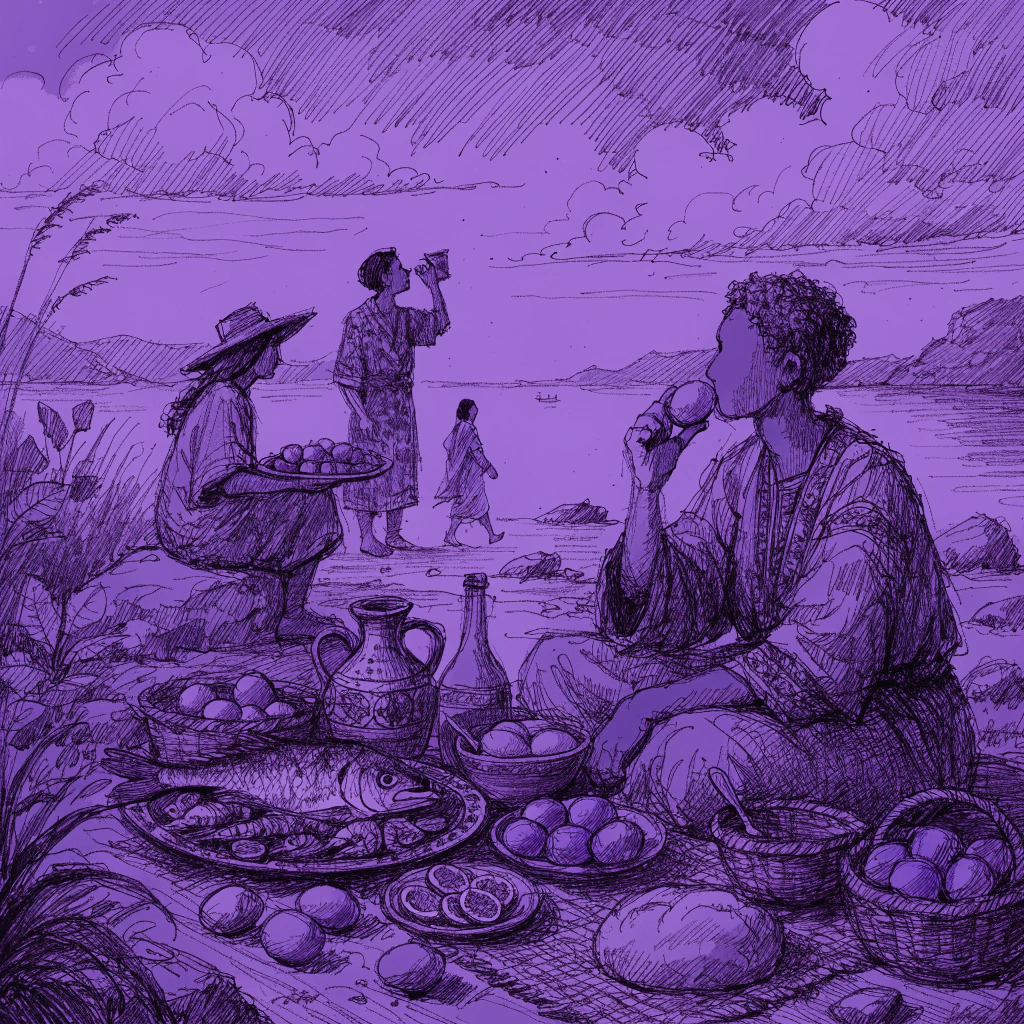
Sham El-Nessim: A Festa da Primavera no Egito
Sham El-Nessim é uma festa muito antiga no Egito. Esta celebração tem mais de 4.500 anos. Ela marca o início da primavera, a estação da renovação. É um dia de alegria para todas as pessoas no país.
As famílias egípcias celebram juntas. Elas vão a parques e jardins. As pessoas comem ovos coloridos e peixe salgado. É um feriado nacional para todos, de diferentes crenças. Todos gostam de celebrar a chegada da nova estação. É um tempo para a natureza e a vida nova. É uma tradição bonita.
Gramática em destaque
Padrão: O Verbo 'Ser' (Presente)
"Sham El-Nessim é uma festa muito antiga no Egito."
O verbo 'ser' é usado para descrever o que algo ou alguém 'é' de forma permanente. Ele descreve identidade, origem ou característica. No presente, 'é' é a forma para 'ele/ela/você'.
Padrão: Verbos no Presente Simples
"As famílias egípcias celebram juntas. Elas vão a parques e jardins. As pessoas comem ovos coloridos e peixe salgado."
Usamos o presente simples para falar sobre ações que acontecem regularmente ou que são verdades gerais. Os verbos 'celebram', 'vão' e 'comem' mostram o que as pessoas fazem sempre ou como hábito.
Teste sua compreensão
10 perguntas · A1 Iniciante · 1 pré-visualização grátis
Teste o que aprendeu neste artigo. Responda todas as perguntas para ganhar XP!
Onde Sham El-Nessim é celebrado?
Quer finalizar o quiz?
9 perguntas a mais estão esperando por você. Cadastre-se grátis para desbloquear o quiz completo e ganhar XP!
Cadastrar grátisJá tem conta? Entrar
Detalhamento das perguntas
Onde Sham El-Nessim é celebrado?
Sua resposta:
Resposta correta: No Egito
Sham El-Nessim é uma festa nova.
Sua resposta:
Resposta correta: Falso
O que significa 'primavera'?
Sua resposta:
Resposta correta: Uma estação do ano
As pessoas comem ovos _____ e peixe salgado.
Sua resposta:
Resposta correta: coloridos
Sham El-Nessim: A Spring Festival in Egypt
Sham El-Nessim is a very old festival in Egypt. It started more than 4,500 years ago in the time of the Ancient Egyptians. In the past, they called it 'Shemu' because they wanted to celebrate the harvest season. Today, it is a national holiday for all Egyptians. It happens every year on the Monday after Coptic Easter.
Families usually go to parks or sit near the Nile River because the weather is warmer than in winter. They enjoy the fresh air and 'smell the breeze.' This is a traditional way to welcome the spring. People eat special foods on this day. The most famous food is a salted fish called 'Fesikh.' They also eat green onions and boiled eggs.
Children love this holiday because they paint eggs with bright colors. It is more colorful and fun than a normal day. Sham El-Nessim is a happy time because it brings friends and families together to enjoy nature.
Gramática em destaque
Padrão: Past Simple
"Ancient Egyptians called it Shemu."
We use the past simple to talk about finished actions in the past. For regular verbs, we usually add '-ed' to the base verb.
Padrão: Comparatives
"The weather is warmer than in winter."
We use comparatives to compare two things. For short adjectives like 'warm', we add '-er' and use the word 'than'.
Teste sua compreensão
11 perguntas · A2 Elementar · 1 pré-visualização grátis
Teste o que aprendeu neste artigo. Responda todas as perguntas para ganhar XP!
How old is the Sham El-Nessim festival?
Quer finalizar o quiz?
10 perguntas a mais estão esperando por você. Cadastre-se grátis para desbloquear o quiz completo e ganhar XP!
Cadastrar grátisJá tem conta? Entrar
Detalhamento das perguntas
How old is the Sham El-Nessim festival?
Sua resposta:
Resposta correta: More than 4,500 years old
Sham El-Nessim is only for children.
Sua resposta:
Resposta correta: Falso
What does 'breeze' mean?
Sua resposta:
Resposta correta: A light and pleasant wind
The most famous food during the festival is a salted fish called _____.
Sua resposta:
Resposta correta: Fesikh
Where do families usually go to celebrate?
Sua resposta:
Resposta correta: To parks or near the Nile
Sham El-Nessim: Egypt's Ancient Celebration of Spring
Sham El-Nessim is a unique festival that has been celebrated by Egyptians for thousands of years. It marks the beginning of spring and is a national holiday that brings people of all backgrounds together. The name literally means "smelling the breeze," which describes how people spend their day outdoors enjoying the fresh air.
The history of this festival can be traced back to the Pharaonic era, specifically the Old Kingdom. It was originally called "Shemu," which represented the season of harvest and renewal. Today, it is celebrated on the Monday after Coptic Orthodox Easter. Although it has ancient roots, it is a secular holiday that is enjoyed by both Muslims and Christians alike.
Several traditional foods are prepared for this special day. The most famous dish is "Feseekh," which is salted fish that has been dried in the sun. This traditional meal is usually served with green onions and fresh lemons. Families also enjoy coloring boiled eggs, a custom that symbolizes new life and the arrival of spring. These colorful eggs are often placed in baskets and taken to local parks.
Early in the morning, many families go to public gardens or take boat trips on the Nile. These activities have been practiced for generations to enjoy the fresh air. Because the festival is about renewal, people feel a sense of joy and hope for the future. It is a time when the beauty of nature is appreciated by everyone across the country.
Gramática em destaque
Padrão: Present Perfect Passive
"Sham El-Nessim is a unique festival that has been celebrated by Egyptians for thousands of years."
This pattern is used to talk about an action that started in the past and continues to the present, where the focus is on the festival rather than the people. It is formed using 'has/have been' + past participle.
Padrão: Relative Clauses
"The most famous dish is 'Feseekh,' which is salted fish that has been dried in the sun."
Relative clauses provide extra information about a noun. 'Which' is used for things (Feseekh) and 'that' can be used for things or people (salted fish).
Teste sua compreensão
11 perguntas · B1 Intermediário · 1 pré-visualização grátis
Teste o que aprendeu neste artigo. Responda todas as perguntas para ganhar XP!
When did the history of Sham El-Nessim begin?
Quer finalizar o quiz?
10 perguntas a mais estão esperando por você. Cadastre-se grátis para desbloquear o quiz completo e ganhar XP!
Cadastrar grátisJá tem conta? Entrar
Detalhamento das perguntas
When did the history of Sham El-Nessim begin?
Sua resposta:
Resposta correta: During the Pharaonic era
Sham El-Nessim is a religious holiday celebrated only by Christians.
Sua resposta:
Resposta correta: Falso
What does the word 'symbolize' mean in the text?
Sua resposta:
Resposta correta: To represent something else
The name of the festival literally means smelling the _____.
Sua resposta:
Resposta correta: breeze
What is 'Feseekh'?
Sua resposta:
Resposta correta: Salted fish dried in the sun
Sham El-Nessim: Uma Celebração Milenar da Primavera no Egito
O Egito, berço de civilizações milenares, é palco de uma das mais antigas e fascinantes celebrações da humanidade: o Sham El-Nessim. Este festival, cujas raízes se estendem por mais de 4.500 anos, remonta à era faraônica, especificamente ao Antigo Reino. É um testemunho vivo da resiliência cultural egípcia, atravessando séculos e impérios, mantendo-se como um pilar de união e renovação.
A própria denominação do festival carrega consigo uma rica tapeçaria histórica. 'Sham El-Nessim' deriva do copta 'Shom en Nisim', que, por sua vez, tem sua origem no termo egípcio antigo 'Shemu'. 'Shemu' designava a estação da colheita e da renovação, um período de vitalidade e prosperidade após as cheias do Nilo. Este elo etimológico sublinha a profunda conexão do festival com os ciclos naturais e a abundância agrícola que moldaram a civilização egípcia.
Atualmente, o Sham El-Nessim é celebrado na primeira segunda-feira após a Páscoa Ortodoxa Copta, o que o estabelece como um feriado nacional secular. Embora suas origens estejam profundamente ligadas a rituais antigos, esta característica é crucial, pois permite que egípcios de todas as crenças – muçulmanos, cristãos e outros – participem ativamente da festividade. Longe de ser uma observância religiosa exclusiva, ele se manifesta como um momento de confraternização e alegria compartilhada, um verdadeiro prelúdio à estação mais florida do ano.
A essência da celebração reside no ato de 'cheirar a brisa' ou 'sentir o ar fresco', uma tradução literal do seu nome. As famílias egípcias tradicionalmente se reúnem em parques, jardins, às margens do Nilo ou em qualquer espaço ao ar livre para desfrutar da natureza e da companhia uns dos outros. Piqueniques são uma parte fundamental, com pratos específicos como peixe salgado (feseekh), ovos coloridos e cebolas verdes, simbolizando a fertilidade e a nova vida que a primavera traz. Ademais, a pintura de ovos, uma prática que antecede o cristianismo, reforça a simbologia de renascimento. Nesse dia, observam-se rituais e costumes ancestrais que reforçam o sentido de comunidade.
Em suma, o Sham El-Nessim é muito mais do que um simples feriado; é uma ponte entre o passado faraônico e o presente multifacetado do Egito. Ele encarna a capacidade de um povo de preservar suas tradições mais antigas, adaptando-as e transformando-as em um símbolo de unidade nacional e esperança. É um lembrete anual da importância da renovação e da celebração da vida em comunidade, independentemente das diferenças, sob o sol vibrante do Egito.
Gramática em destaque
Padrão: Orações Subordinadas Adjetivas (com pronome relativo "cujo/cuja")
"Este festival, cujas raízes se estendem por mais de 4.500 anos, remonta à era faraônica..."
As orações subordinadas adjetivas são introduzidas por pronomes relativos (como 'que', 'quem', 'onde', 'cujo') e funcionam como adjetivos, caracterizando um substantivo da oração principal. O pronome 'cujo/cuja' é usado para expressar posse e concorda em gênero e número com o substantivo que o segue, conectando a ideia de posse entre duas orações.
Padrão: Conjunções Concessivas (Embora)
"Embora suas origens estejam profundamente ligadas a rituais antigos, esta característica é crucial, pois permite que egípcios de todas as crenças participem ativamente da festividade."
A conjunção 'embora' é utilizada para introduzir uma ideia que expressa concessão ou oposição, mas que não impede a realização da ação principal. Geralmente, é seguida por um verbo no modo subjuntivo, indicando uma condição ou fato que, apesar de existir, não invalida o que é afirmado na oração principal.
Padrão: Voz Passiva Sintética com "se"
"Nesse dia, observam-se rituais e costumes ancestrais que reforçam o sentido de comunidade."
A voz passiva sintética, formada com o pronome 'se' e um verbo na terceira pessoa (singular ou plural), é usada para indicar que a ação é praticada sem especificar o agente, ou quando o agente é desconhecido ou irrelevante. É comum em textos formais e descritivos, conferindo impessoalidade à frase e focando na ação ou no objeto.
Teste sua compreensão
11 perguntas · B2 Intermediário superior · 1 pré-visualização grátis
Teste o que aprendeu neste artigo. Responda todas as perguntas para ganhar XP!
Qual é o principal propósito do Sham El-Nessim, conforme descrito no artigo?
Quer finalizar o quiz?
10 perguntas a mais estão esperando por você. Cadastre-se grátis para desbloquear o quiz completo e ganhar XP!
Cadastrar grátisJá tem conta? Entrar
Detalhamento das perguntas
Qual é o principal propósito do Sham El-Nessim, conforme descrito no artigo?
Sua resposta:
Resposta correta: Unir egípcios de todas as crenças na celebração da primavera.
O Sham El-Nessim é um feriado exclusivamente religioso para os cristãos coptas.
Sua resposta:
Resposta correta: Falso
O que significa "resiliência" no contexto do artigo?
Sua resposta:
Resposta correta: A habilidade de se adaptar e superar adversidades.
A denominação "Sham El-Nessim" deriva do termo egípcio antigo "Shemu", que significava a estação da colheita e da ______.
Sua resposta:
Resposta correta: renovação
Qual destes pratos é tradicionalmente consumido durante o Sham El-Nessim?
Sua resposta:
Resposta correta: Feseekh (peixe salgado).
The Perpetuation of Shemu: Analyzing the Cultural Resilience of Sham El-Nessim
The perpetuation of Sham El-Nessim serves as a compelling testament to the enduring cultural resilience of the Egyptian identity, transcending millennia of socio-political shifts. Rooted in the Pharaonic Old Kingdom over 4,500 years ago, this festival represents a secular tapestry that binds the nation’s diverse demographic. It was the ancient Egyptians who first observed 'Shemu', a season of renewal and harvest, marking the precise moment when day and night were of equal length. This astronomical precision underscores the sophisticated understanding of cosmic cycles possessed by the ancients, a vestige of which remains central to modern Egyptian life. Today, the festival is celebrated on the Monday following Coptic Orthodox Easter, yet its essence remains profoundly non-religious, facilitating a rare moment of communal cohesion across all faiths.
Nominalisation of historical events often obscures the lived experience of the past, but in the case of Sham El-Nessim, the etymological evolution from the Pharaonic 'Shemu' to the Coptic 'Shom en Nisim' provides a linguistic bridge to antiquity. The literal translation—'smelling the breeze'—captures the ephemeral beauty of spring’s arrival. Central to the festivities is the consumption of specific symbolic foods, most notably 'Fesikh', a fermented and salted grey mullet. Not only does the olfactory hallmark of Fesikh define the day, but it also evokes a collective nostalgia that resonates through every Egyptian household. The preparation of this fish is a delicate process of fermentation that requires mastery; a failure in technique can lead to toxicity, yet the tradition persists as a venerable rite of passage.
Furthermore, the inclusion of scallions and colored eggs highlights the symbolic rejuvenation inherent in the festival. Scallions were historically believed to ward off the 'evil eye,' while eggs represented the potentiality of new life. In contemporary Cairo, the sight of families flocking to verdant public parks or embarking on Nile cruises reflects a societal desire to reconnect with the natural world. This mass exodus to green spaces illustrates the psychological importance of the 'smelling of the breeze' as a therapeutic escape from urban density.
Ultimately, Sham El-Nessim is more than a mere holiday; it is a profound assertion of continuity. While other traditions may succumb to the pressures of globalization, the preservation of these customs ensures that the spirit of the Nile remains an integral component of the modern Egyptian psyche. The festival stands as a linguistic and cultural palimpsest, where ancient rituals are rewritten but never fully erased by the passing of time.
Gramática em destaque
Padrão: Cleft Sentences
"It was the ancient Egyptians who first observed 'Shemu', a season of renewal and harvest."
Cleft sentences are used to focus on a specific part of the sentence (the ancient Egyptians) by starting with 'It is/was'. This adds emphasis to the subject or agent of the action.
Padrão: Inversion with Negative/Restrictive Adverbials
"Not only does the olfactory hallmark of Fesikh define the day, but it also evokes a collective nostalgia."
When a sentence starts with 'Not only', the auxiliary verb (does) comes before the subject (the olfactory hallmark). This structure is common in formal writing to provide rhetorical emphasis.
Padrão: Nominalisation
"The perpetuation of Sham El-Nessim serves as a compelling testament..."
Nominalisation involves turning verbs (perpetuate) into nouns (perpetuation). This makes the writing more abstract, formal, and concise, which is a hallmark of C1-level academic English.
Teste sua compreensão
12 perguntas · C1 Avançado · 1 pré-visualização grátis
Teste o que aprendeu neste artigo. Responda todas as perguntas para ganhar XP!
What does the author suggest about the relationship between Sham El-Nessim and religion?
Quer finalizar o quiz?
11 perguntas a mais estão esperando por você. Cadastre-se grátis para desbloquear o quiz completo e ganhar XP!
Cadastrar grátisJá tem conta? Entrar
Detalhamento das perguntas
What does the author suggest about the relationship between Sham El-Nessim and religion?
Sua resposta:
Resposta correta: It is a secular event that promotes national unity across different faiths.
The name 'Sham El-Nessim' has no linguistic connection to the ancient Pharaonic language.
Sua resposta:
Resposta correta: Falso
Which word describes something that lasts for a very short duration?
Sua resposta:
Resposta correta: Ephemeral
The process of preparing Fesikh involves a delicate ______ that must be mastered to avoid toxicity.
Sua resposta:
Resposta correta: fermentation
What is the primary reason the author mentions 'astronomical precision'?
Sua resposta:
Resposta correta: To highlight the advanced knowledge of the ancient Egyptians.
The author views the preservation of Sham El-Nessim as a defense against globalization.
Sua resposta:
Resposta correta: Verdadeiro
The Perennial Resurgence: An Analytical Inquiry into the Cultural Palimpsest of Sham El-Nessim
To contemplate Sham El-Nessim is to engage with an intricate cultural palimpsest, one that has been meticulously layered over four and a half millennia of Egyptian history. Lest the historical significance of this festival be overlooked, one must consider its etymological trajectory, which originates in the Pharaonic 'Shemu.' This term, signifying the season of harvest and cosmic renewal, underscores the festival's foundational alignment with the vernal equinox. It is conjectured that the ancient Egyptians, as early as the Old Kingdom, conceptualized this period as the primordial moment of creation. Thus, the modern iteration of the holiday serves not merely as a respite from the quotidian, but as a profound link to a civilization that viewed the cyclical nature of time with ontological reverence.
Seldom has a festival managed to navigate the tumultuous waters of socio-political and religious shifts with such grace. While its roots are undeniably pagan, the celebration underwent a linguistic and temporal metamorphosis during the Coptic era, emerging as 'Shom en Nisim.' Despite the subsequent Islamic integration of Egypt, the festival maintained its secular integrity, eventually becoming a national holiday that transcends sectarian divides. This syncretism is a testament to the tenacity of Egyptian identity, where a shared heritage provides a cohesive social fabric. Had the ancient Egyptians not conceptualized the season of Shemu as a period of cosmic rebirth, the modern celebration might lack its profound symbolic resonance.
Central to the hermeneutical understanding of Sham El-Nessim is the semiotics of its culinary traditions. The consumption of 'fesikh'—a fermented, salted gray mullet—is perhaps the most visceral of these practices. While the olfactory profile of fesikh may be challenging to the uninitiated, its consumption is a ritualistic act connecting the contemporary Egyptian to the Nilotic bounty of antiquity. Salted fish was traditionally offered to the gods to ensure fertility and protection, a practice that persists today, albeit in a secularized form. Furthermore, the inclusion of scallions and colored eggs serves as a botanical and biological metaphor for the burgeoning life associated with spring. The egg, a universal symbol of potentiality, was often inscribed with prayers and hung in temples, a precursor to the modern tradition of decorative dyeing.
Sociologically, the act of 'smelling the breeze' (the literal translation of the modern name) represents a communal exodus to public gardens and the banks of the Nile. This collective movement functions as a re-appropriation of the natural landscape, where the urban populace seeks a temporary reunification with the pastoral. In this context, the festival acts as a leveling mechanism; the distinction between various social strata becomes blurred under the shared canopy of the spring sky. The palatable delights of the feast and the shared olfactory experience of the breeze create a sensory-driven solidarity.
In conclusion, Sham El-Nessim remains an enduring phenomenon that defies the ephemeral nature of modern trends. It is a celebration that requires an appreciation for the subtle interplay between the ancient and the contemporary. By honoring the arrival of spring through these age-old rituals, Egyptians do not merely observe a holiday; they participate in a continuous historical narrative. As the sun reaches its zenith during the equinox, the festival serves as a reminder that renewal is not only a biological necessity but a cultural imperative.
Gramática em destaque
Padrão: Subjunctive with 'Lest'
"Lest the historical significance of this festival be overlooked, one must consider its etymological trajectory."
The word 'lest' is used to express fear that something undesirable might happen. It is followed by the base form of the verb (the present subjunctive), regardless of the subject.
Padrão: Inversion with Negative Adverbials
"Seldom has a festival managed to navigate the tumultuous waters of socio-political and religious shifts with such grace."
When a negative or restrictive adverbial like 'seldom' starts a sentence, the auxiliary verb and the subject are inverted for rhetorical emphasis.
Padrão: Mixed Conditional (Hypothetical Past and Present)
"Had the ancient Egyptians not conceptualized the season of Shemu as a period of cosmic rebirth, the modern celebration might lack its profound symbolic resonance."
This structure uses a past perfect condition ('Had... not conceptualized') to discuss a hypothetical past action and its resulting state in the present ('might lack').
Teste sua compreensão
12 perguntas · C2 Domínio · 1 pré-visualização grátis
Teste o que aprendeu neste artigo. Responda todas as perguntas para ganhar XP!
What does the author suggest by calling Sham El-Nessim a 'cultural palimpsest'?
Quer finalizar o quiz?
11 perguntas a mais estão esperando por você. Cadastre-se grátis para desbloquear o quiz completo e ganhar XP!
Cadastrar grátisJá tem conta? Entrar
Detalhamento das perguntas
What does the author suggest by calling Sham El-Nessim a 'cultural palimpsest'?
Sua resposta:
Resposta correta: It is a celebration that has retained traces of its long history despite many changes.
The term 'Shemu' originally referred to the season of harvest in ancient Egypt.
Sua resposta:
Resposta correta: Verdadeiro
What is the meaning of 'tenacity' as used in the text?
Sua resposta:
Resposta correta: The quality of being persistent and enduring.
The author notes that the _____ profile of fesikh can be challenging for those who are not used to it.
Sua resposta:
Resposta correta: olfactory
How does the author characterize the role of the festival in modern Egyptian society?
Sua resposta:
Resposta correta: As a cohesive social fabric that transcends religious divides.
The author argues that Sham El-Nessim is an ephemeral trend in modern Egypt.
Sua resposta:
Resposta correta: Falso

