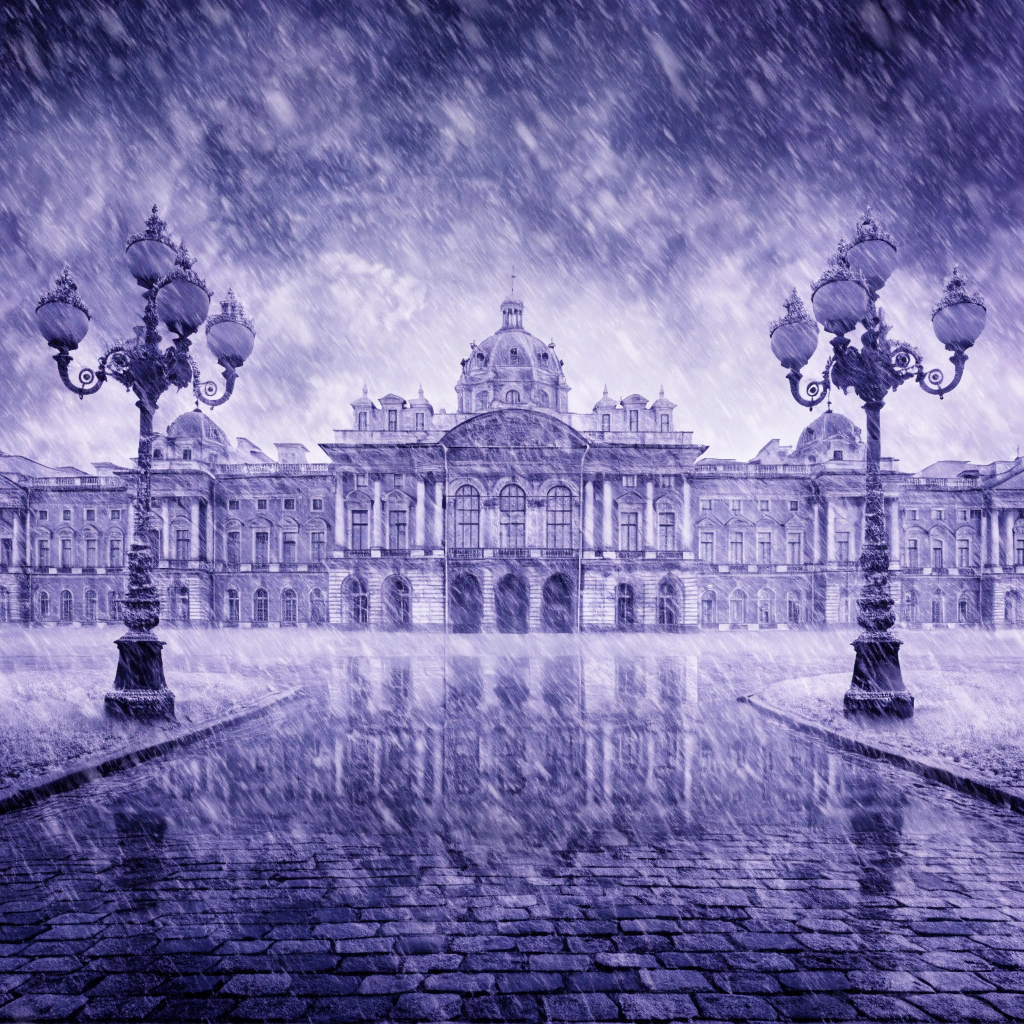
The Big Museum in Russia
The State Hermitage Museum is in Saint Petersburg, Russia. It is a very big and famous museum. There are five old buildings in the museum. One building is the Winter Palace. It is very beautiful and has many colors.
The museum has over three million items. You can see many old paintings and statues. Catherine the Great started the museum in 1764. Many people visit the museum every day. They walk through the large rooms and look at the art. It is a great place for history.
Gramática em destaque
Padrão: The Verb 'To Be' (Is/Are)
"The State Hermitage Museum is in Saint Petersburg, Russia."
We use 'is' for one thing and 'are' for many things. It describes the state or location of the subject.
Padrão: Present Simple (Has/Have)
"The museum has over three million items."
We use 'has' with singular subjects like 'the museum'. It shows possession or what something contains.
Teste sua compreensão
10 perguntas · A1 Iniciante · 1 pré-visualização grátis
Teste o que aprendeu neste artigo. Responda todas as perguntas para ganhar XP!
Where is the Hermitage Museum?
Quer finalizar o quiz?
9 perguntas a mais estão esperando por você. Cadastre-se grátis para desbloquear o quiz completo e ganhar XP!
Cadastrar grátisJá tem conta? Entrar
Detalhamento das perguntas
Where is the Hermitage Museum?
Sua resposta:
Resposta correta: Saint Petersburg
The museum has five old buildings.
Sua resposta:
Resposta correta: Verdadeiro
What does 'beautiful' mean?
Sua resposta:
Resposta correta: Very nice to look at
The museum has many old _____.
Sua resposta:
Resposta correta: paintings
The Amazing Hermitage Museum
The State Hermitage Museum is in Saint Petersburg, Russia. It is one of the oldest and largest museums in the world. Empress Catherine the Great started the museum in 1764. She bought a large collection of paintings from a merchant in Berlin.
The museum has five main buildings next to the Neva River. The most famous building is the Winter Palace. In the past, Russian emperors lived there. The palace is beautiful because it has gold decorations and many large windows.
Today, the museum has more than three million items. You can see famous paintings, ancient statues, and royal jewelry. It is much bigger than most other museums. Because there are so many things to see, you cannot see everything in one day. Visitors from many countries come to visit every year. Some people say you need years to look at every object! Visitors love the Hermitage because it shows the history and art of the world.
Gramática em destaque
Padrão: Past Simple
"Empress Catherine the Great started the museum in 1764."
We use the past simple to talk about actions that finished in the past. To form regular verbs, we usually add '-ed' to the end of the verb.
Padrão: Comparatives
"It is much bigger than most other museums."
We use comparatives to compare two things. For short adjectives like 'big', we add '-er' and use the word 'than'.
Teste sua compreensão
11 perguntas · A2 Elementar · 1 pré-visualização grátis
Teste o que aprendeu neste artigo. Responda todas as perguntas para ganhar XP!
Who started the Hermitage museum?
Quer finalizar o quiz?
10 perguntas a mais estão esperando por você. Cadastre-se grátis para desbloquear o quiz completo e ganhar XP!
Cadastrar grátisJá tem conta? Entrar
Detalhamento das perguntas
Who started the Hermitage museum?
Sua resposta:
Resposta correta: Catherine the Great
The museum is located in Moscow, Russia.
Sua resposta:
Resposta correta: Falso
What is a 'palace'?
Sua resposta:
Resposta correta: A large house for royalty
The museum has five main _____ next to the Neva River.
Sua resposta:
Resposta correta: buildings
Why is the Winter Palace famous?
Sua resposta:
Resposta correta: Russian emperors lived there
Exploring the Grandeur of the State Hermitage Museum
The State Hermitage Museum, which is located in Saint Petersburg, is one of the largest and oldest museums in the world. It was founded in 1764 by Empress Catherine the Great. She started the collection when she bought a huge group of paintings from a merchant in Berlin. Since then, the museum has grown significantly, and it now contains over three million items.
The museum complex is made up of several historic buildings along the Neva River. The most famous building is the Winter Palace, which used to be the official home of the Russian monarchs. The rooms are decorated with gold, marble, and beautiful crystals. These opulent rooms show the great wealth and power of the Russian Empire.
Visitors from all over the world have visited the Hermitage to see works by famous artists like Leonardo da Vinci, Rembrandt, and Picasso. Because the museum is so large, it has been said that you would need many years to see every single object for just one minute. Many new galleries have been opened in recent years to show even more art to the public.
Today, the Hermitage is not just a place for art; it is a symbol of Russian history. It has been preserved carefully so that future generations can enjoy its beauty. If you enjoy history and culture, this museum is a place that you must visit at least once in your life.
Gramática em destaque
Padrão: Relative Clauses
"The State Hermitage Museum, which is located in Saint Petersburg, is one of the largest and oldest museums in the world."
We use 'which' to give extra information about a thing or place. In this sentence, it adds information about the location of the museum.
Padrão: Passive Voice
"It was founded in 1764 by Empress Catherine the Great."
The passive voice is formed with 'be' + past participle. It is used when the action or the object is more important than the person doing the action.
Teste sua compreensão
11 perguntas · B1 Intermediário · 1 pré-visualização grátis
Teste o que aprendeu neste artigo. Responda todas as perguntas para ganhar XP!
Who founded the State Hermitage Museum?
Quer finalizar o quiz?
10 perguntas a mais estão esperando por você. Cadastre-se grátis para desbloquear o quiz completo e ganhar XP!
Cadastrar grátisJá tem conta? Entrar
Detalhamento das perguntas
Who founded the State Hermitage Museum?
Sua resposta:
Resposta correta: Catherine the Great
The State Hermitage Museum is located in Moscow.
Sua resposta:
Resposta correta: Falso
What does 'opulent' mean?
Sua resposta:
Resposta correta: Extremely rich and luxurious
The museum now contains over three _____ items.
Sua resposta:
Resposta correta: million
Which building was the official home of the Russian monarchs?
Sua resposta:
Resposta correta: The Winter Palace
The Grandeur of the Hermitage: A Testament to Imperial Legacy
The State Hermitage Museum in Saint Petersburg is far more than a mere repository for art; it stands as a sprawling monument to the cultural ambitions of the Russian Empire. Founded in 1764 by Empress Catherine the Great, the institution began its journey when she acquired a substantial collection of paintings from a merchant in Berlin. Over the subsequent centuries, the museum has expanded significantly, now boasting a staggering collection of over three million items that span across human history, from prehistoric artifacts to modern masterpieces.
The architectural heart of the complex is the Winter Palace, an opulent structure that once served as the official residence of the Russian monarchs. Situated majestically along the banks of the Neva River, the palace represents the pinnacle of Baroque and Neoclassical design. Visitors who wander through its grand halls are often overwhelmed by the sheer scale of the displays, which are housed within five interconnected historic buildings. Each room tells a story of imperial power and refined taste, reflecting the diverse interests of the tsars who meticulously curated these treasures.
While the Hermitage was initially established as a private gallery for the royal family, it eventually transitioned into a public institution, allowing the world to witness its unparalleled beauty. The collection is so vast that it is frequently remarked that if a visitor were to spend just one minute looking at each exhibit, it would take several years to see everything. This immense scale necessitates a strategic approach to exploration, as the museum features everything from Egyptian antiquities to the works of Renaissance masters like Leonardo da Vinci and Michelangelo.
In the modern era, the Hermitage continues to evolve, balancing the preservation of its historic legacy with the demands of contemporary tourism. Extensive restoration efforts have been undertaken to ensure that the intricate gold leaf and marble finishes remain as vibrant as they were during the 18th century. As a global cultural hub, the museum not only preserves the past but also fosters international dialogue through its traveling exhibitions and digital archives. Consequently, the Hermitage remains a vital symbol of national prestige and a cornerstone of global heritage.
Gramática em destaque
Padrão: Passive Voice
"Extensive restoration efforts have been undertaken to ensure that the intricate gold leaf and marble finishes remain as vibrant."
The passive voice is used here to focus on the action (restoration) rather than who performed it. It is formed using a form of 'to be' plus the past participle.
Padrão: Non-defining Relative Clauses
"The Winter Palace, which once served as the official residence of the Russian monarchs."
This pattern adds extra information about a noun (the Winter Palace). It is separated by commas and uses 'which' for things or 'who' for people.
Padrão: Second Conditional
"If a visitor were to spend just one minute looking at each exhibit, it would take several years to see everything."
This structure is used to talk about hypothetical or imaginary situations. It uses 'if' + past subjunctive and 'would' + base verb.
Teste sua compreensão
11 perguntas · B2 Intermediário superior · 1 pré-visualização grátis
Teste o que aprendeu neste artigo. Responda todas as perguntas para ganhar XP!
What event marked the beginning of the Hermitage collection in 1764?
Quer finalizar o quiz?
10 perguntas a mais estão esperando por você. Cadastre-se grátis para desbloquear o quiz completo e ganhar XP!
Cadastrar grátisJá tem conta? Entrar
Detalhamento das perguntas
What event marked the beginning of the Hermitage collection in 1764?
Sua resposta:
Resposta correta: Catherine the Great acquiring paintings from a Berlin merchant
The Hermitage was originally built as a public museum for all citizens.
Sua resposta:
Resposta correta: Falso
What is the best definition for 'opulent'?
Sua resposta:
Resposta correta: Extremely luxurious and expensive
The museum is situated along the banks of the _____ River.
Sua resposta:
Resposta correta: Neva
How many items are currently estimated to be in the museum's collection?
Sua resposta:
Resposta correta: Over three million
The State Hermitage: A Testament to Imperial Grandeur and Curatorial Resilience
Seldom does a singular institution encapsulate the geopolitical aspirations and aesthetic sensibilities of an entire empire as profoundly as the State Hermitage Museum. Nestled along the banks of the Neva River in Saint Petersburg, this sprawling complex serves as more than a mere repository for artistic masterpieces; it is a monumental synthesis of Russian history and European high culture. Founded in 1764 by Catherine the Great, whose proclivity for collecting art was matched only by her desire to modernize the Russian state, the museum began as a private gallery for the sovereign. It was Catherine’s initial acquisition of 225 paintings from a Berlin merchant that catalyzed the transformation of the Winter Palace into a global cultural titan.
What truly distinguishes the Hermitage from its European contemporaries is the visceral interplay between the art and the architecture. The Winter Palace, with its baroque opulence and emerald-green facade, does not merely house the collection; it frames it within a narrative of imperial power. Visitors traversing the Jordan Staircase are immediately struck by a sense of grandiose scale that was intended to intimidate and inspire foreign dignitaries. However, the museum’s journey has not always been one of uninterrupted prestige. Throughout the 20th century, the institution weathered the storms of revolution and the harrowing Siege of Leningrad, during which the basement served as a bomb shelter while the frames of evacuated masterpieces hung empty on the walls—a haunting vestige of a period where the survival of culture was as ephemeral as human life itself.
The acquisition of three million artifacts necessitates a logistical prowess that borders on the Herculean. From the enigmatic Scythian gold to the Renaissance brilliance of Da Vinci and Michelangelo, the curatorial challenges are immense. There is a palpable tension between the preservation of these delicate relics and the demands of modern tourism. Critics often debate whether the sheer volume of the collection dilutes the individual impact of each piece, yet it is this very density that provides an exhaustive chronicle of human creativity.
In the contemporary era, the Hermitage continues to reinvent itself, balancing its historical legacy with digital innovation. The expansion into the General Staff Building has allowed for a more nuanced presentation of Impressionist and modern works, providing a much-needed precursor to the 21st-century art scene. As one reflects on the museum’s evolution, it becomes clear that the Hermitage is not a static relic of the past but a living organism that continues to shape Russia’s cultural identity on the global stage. Only through understanding this complex history can one appreciate the museum as a beacon of artistic continuity in an ever-changing world.
Gramática em destaque
Padrão: Negative Inversion
"Seldom does a singular institution encapsulate the geopolitical aspirations and aesthetic sensibilities of an entire empire as profoundly as the State Hermitage Museum."
Inversion is used after negative or restrictive adverbials (like 'seldom') to add emphasis and formal tone. The auxiliary verb 'does' precedes the subject 'institution'.
Padrão: Cleft Sentences
"What truly distinguishes the Hermitage from its European contemporaries is the visceral interplay between the art and the architecture."
A pseudo-cleft sentence starting with 'What' is used to focus on a specific part of the information, highlighting the 'interplay' as the most significant factor.
Padrão: Nominalisation
"The acquisition of three million artifacts necessitates a logistical prowess that borders on the Herculean."
The verb 'acquire' is turned into the noun 'acquisition' to make the sentence more academic and concise, focusing on the concept rather than the action.
Teste sua compreensão
12 perguntas · C1 Avançado · 1 pré-visualização grátis
Teste o que aprendeu neste artigo. Responda todas as perguntas para ganhar XP!
What was the original purpose of the Hermitage when it was founded by Catherine the Great?
Quer finalizar o quiz?
11 perguntas a mais estão esperando por você. Cadastre-se grátis para desbloquear o quiz completo e ganhar XP!
Cadastrar grátisJá tem conta? Entrar
Detalhamento das perguntas
What was the original purpose of the Hermitage when it was founded by Catherine the Great?
Sua resposta:
Resposta correta: A private gallery for the sovereign
During the Siege of Leningrad, the art collection remained on the walls to boost morale.
Sua resposta:
Resposta correta: Falso
Which word describes something that lasts for a very short time?
Sua resposta:
Resposta correta: Ephemeral
The museum's emerald-green facade is a symbol of baroque _____.
Sua resposta:
Resposta correta: opulence
According to the article, what is a potential downside to the museum's massive collection?
Sua resposta:
Resposta correta: The volume might dilute the impact of individual pieces
The expansion into the General Staff Building focuses on Renaissance works.
Sua resposta:
Resposta correta: Falso
The Ontological Grandeur of the State Hermitage: A Bastion of Imperial and Artistic Synthesis
The State Hermitage Museum in Saint Petersburg is not merely an assemblage of artistic artifacts; it is a profound ontological manifestation of the Russian Empire’s historical trajectory and its aspirational cultural hegemony. Founded in 1764 by Catherine the Great, the institution’s inception was less an act of simple aesthetic patronage and more a calculated geopolitical maneuver intended to assert cultural parity with the Enlightenment-era courts of Western Europe. Should the museum be viewed solely through the lens of art history, one would overlook its fundamental function as a crucible of imperial identity. The acquisition of the Gotzkowsky collection was the catalyst that transformed a provincial outpost into a center of global intellectual gravity.
The architectural ensemble, a sprawling sequence of five interconnected edifices flanking the Neva River, serves as a physical manifestation of autocratic opulence. The Winter Palace, with its Rastrelliesque baroque exuberance, stands as the centerpiece of this complex. It is here that the interplay between architectural grandiosity and the intimate whispers of history becomes most palpable. The very walls seem to resonate with the echoes of a bygone era, yet the museum remains a living, breathing entity, constantly recalibrating its narrative to suit the exigencies of the contemporary age. It serves as a palimpsest, where layers of history—imperial, revolutionary, and post-Soviet—are superimposed upon one another, creating a rich tapestry of human endeavor.
Central to the Hermitage's allure is its sheer, overwhelming scale. Boasting a collection exceeding three million items, the museum encompasses everything from the intricate vestiges of Scythian gold to the sublime masterpieces of the Italian Renaissance. This vastness, however, presents a significant curatorial challenge. How does one maintain a coherent narrative across such a disparate array of objects? The answer lies in the museum's unwavering commitment to scholarly rigor and its refusal to simplify the complexities of the human experience. It is a site where the esoteric meets the universal, and where the specificities of Russian history are contextualized within the broader sweep of global civilization.
Furthermore, the transition of the Hermitage from an exclusive imperial sanctuary to a public institution reflects the seismic shifts in the Russian social paradigm. Under Catherine, the 'Hermitage' was a place of seclusion—a 'hermit's cell'—accessible only to a select few. Not only did the museum survive the cataclysmic events of the twentieth century, but it also emerged as a symbol of cultural resilience. The scars of revolution and the ravages of war are etched into the museum's fabric, serving as poignant reminders of the fragility of cultural heritage. Had the museum not survived the Siege of Leningrad, the world would have lost an irreplaceable epistemological bridge to our collective past.
The museum’s preeminence in the global cultural landscape is a testament to the vision of its founders and the dedication of the generations of scholars who have tended to its treasures. It asserts a form of cultural sovereignty that transcends national borders. As we navigate the uncertainties of the twenty-first century, the Hermitage remains a beacon of intellectual inquiry, inviting us to contemplate the enduring power of the human imagination. In conclusion, the State Hermitage Museum is far more than a gallery; it is a multifaceted prism through which we can observe the intricate intersections of power, art, and identity. Its legacy is not merely in the objects it houses, but in the intellectual framework it provides for understanding the human condition.
Gramática em destaque
Padrão: Inversion after negative adverbials
"Not only did the museum survive the cataclysmic events of the twentieth century, but it also emerged as a symbol of cultural resilience."
When a sentence starts with a negative adverbial like 'not only', the auxiliary verb comes before the subject. This is used in formal English to add rhetorical emphasis.
Padrão: Conditional Subjunctive
"Should the museum be viewed solely through the lens of art history, one would overlook its fundamental function as a crucible of imperial identity."
The use of 'Should' at the beginning of a conditional clause replaces 'If... should'. It is a formal way to express a hypothetical situation in the present or future.
Padrão: Mixed Conditional
"Had the museum not survived the Siege of Leningrad, the world would have lost an irreplaceable epistemological bridge to our collective past."
This third conditional structure (Had + subject + past participle) expresses a hypothetical past situation and its hypothetical past result, often used for scholarly reflection on historical events.
Teste sua compreensão
12 perguntas · C2 Domínio · 1 pré-visualização grátis
Teste o que aprendeu neste artigo. Responda todas as perguntas para ganhar XP!
What was Catherine the Great's primary motivation for starting the collection?
Quer finalizar o quiz?
11 perguntas a mais estão esperando por você. Cadastre-se grátis para desbloquear o quiz completo e ganhar XP!
Cadastrar grátisJá tem conta? Entrar
Detalhamento das perguntas
What was Catherine the Great's primary motivation for starting the collection?
Sua resposta:
Resposta correta: A geopolitical strategy to achieve cultural equality with Western Europe
The article suggests that the Hermitage's physical structure reflects only one single historical period.
Sua resposta:
Resposta correta: Falso
What does 'palimpsest' refer to in the context of the article?
Sua resposta:
Resposta correta: Something that has layers of history visible through its current form
The transition of the museum to a public institution reflects seismic shifts in the Russian social _____.
Sua resposta:
Resposta correta: paradigm
Which river does the main architectural complex of the Hermitage flank?
Sua resposta:
Resposta correta: The Neva
The museum contains more than three million items.
Sua resposta:
Resposta correta: Verdadeiro

