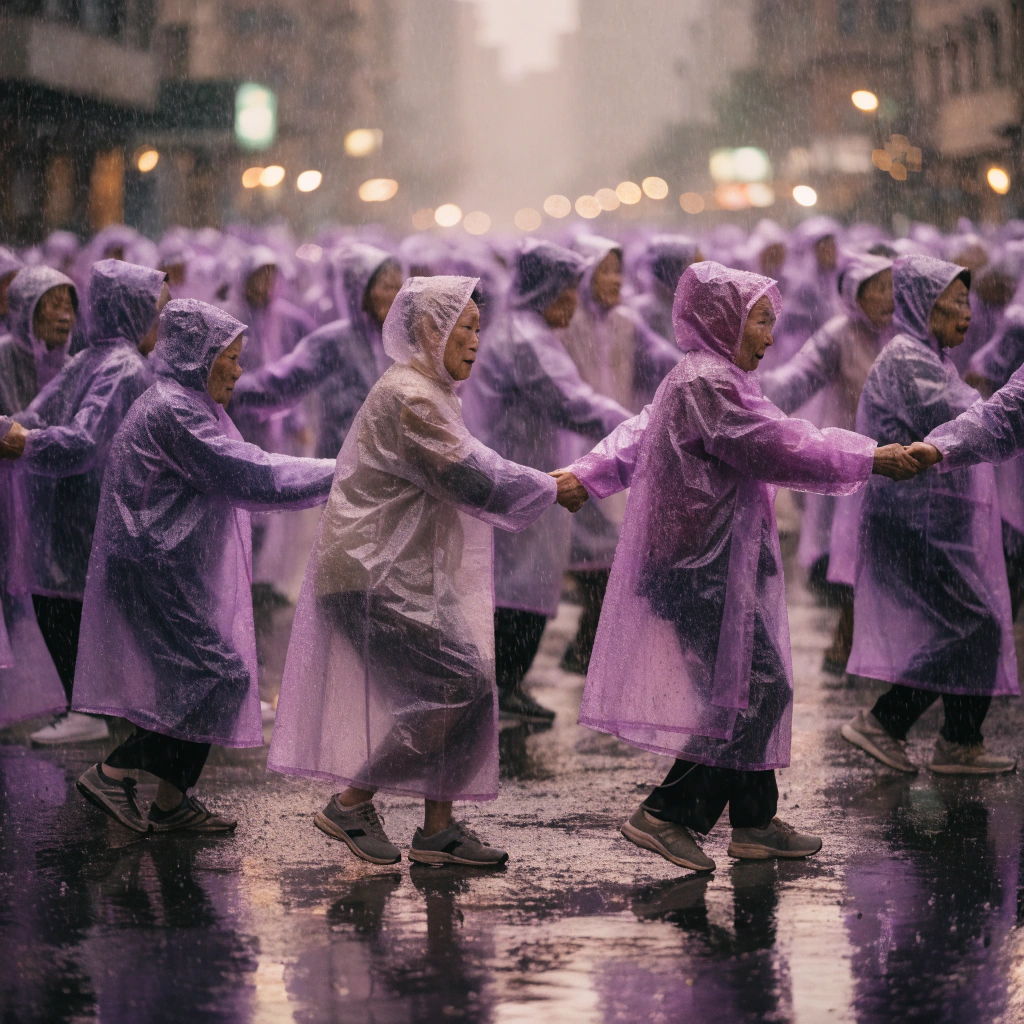
Dancing in the Park
In China, many people go to the park at night. They dance in big squares. This is Square Dancing. Most dancers are women. They are called Dama. They listen to loud music and move together. It is very fun. Square dancing is a good exercise. It is also a social activity. Friends meet and talk. They wear bright clothes. You can see them under bridges or in front of shops. The music is fast and happy. Everyone is welcome to join the group.
Grammar Spotlight
Pattern: Present Simple (to be)
"Most dancers are women."
We use 'are' with plural nouns like 'dancers' to describe a fact or state. It is the most common way to give information in English.
Pattern: Present Simple (Action Verbs)
"They dance in big squares."
We use the base form of the verb (dance) for 'they' to talk about habits or things that happen regularly.
Test Your Understanding
10 questions · A1 Beginner · 1 free preview
Test what you learned from this article. Answer all questions to earn XP!
Where do the people dance?
Want to finish the quiz?
9 more questions are waiting for you. Sign up free to unlock the full quiz and earn XP!
Sign Up FreeAlready have an account? Sign In
Question Breakdown
Where do the people dance?
Your answer:
Correct answer: In big squares
Only men do square dancing.
Your answer:
Correct answer: False
What does 'exercise' mean?
Your answer:
Correct answer: Moving to stay healthy
They listen to loud _____ and move together.
Your answer:
Correct answer: music
Dancing in the City: Square Dancing in China
Every evening in China, the city parks become very busy. When the sun goes down, many people go to public squares to dance. This is called 'Square Dancing.' Most of the dancers are middle-aged or older women. People call them 'Dama.'
The dancers wear colorful clothes and follow a leader. They play loud music on portable speakers. The routines are simple, so everyone can join. Square dancing is more popular than other sports because it is free and social. It is a great way to make new friends.
In the past, these women worked very hard for their families. Now, they are retired and have more time. They like dancing because it keeps them healthy and happy. Some people think the music is too loud, but the dancers love the rhythm. For them, the square is the best place to enjoy urban life.
Grammar Spotlight
Pattern: Comparatives
"Square dancing is more popular than other sports because it is free and social."
We use 'more + adjective + than' to compare two things. For long adjectives like 'popular,' we use 'more' instead of adding '-er'.
Pattern: Past Simple
"In the past, these women worked very hard for their families."
The past simple describes actions that finished in the past. For regular verbs like 'work,' we add '-ed' to the end.
Test Your Understanding
11 questions · A2 Elementary · 1 free preview
Test what you learned from this article. Answer all questions to earn XP!
Where do the people go to dance?
Want to finish the quiz?
10 more questions are waiting for you. Sign up free to unlock the full quiz and earn XP!
Sign Up FreeAlready have an account? Sign In
Question Breakdown
Where do the people go to dance?
Your answer:
Correct answer: To public squares and parks
Only young people participate in square dancing.
Your answer:
Correct answer: False
What does 'retired' mean?
Your answer:
Correct answer: Stopped working because of age
The dancers wear _____ clothes and follow a leader.
Your answer:
Correct answer: colorful
Why is square dancing popular?
Your answer:
Correct answer: Because it is free and social
Square Dancing: The Heart of the City
In many Chinese cities, when the sun goes down, the public squares come to life. Groups of people, who are mostly middle-aged and elderly women, gather to dance together. This popular activity is known as 'Guangchang Wu,' or Square Dancing. It has become a vital part of urban social life across the country.
The dancers, often called 'Dama,' perform synchronized routines to upbeat music. The music is usually played from portable speakers that are placed on the ground. Although it might look like a simple exercise class to an outsider, it is actually much more important. For many participants, square dancing is a way to stay healthy and connect with others.
In the past, many elderly people felt lonely in big cities. However, these dance groups have created a strong sense of community. New friendships are formed every night, and dancers often support each other in their daily lives. One dancer said, 'I have made many friends here, and we have shared many happy moments together.'
However, square dancing is not always peaceful. Sometimes, the loud music is criticized by neighbors who want quiet. Because of this, new rules have been introduced to control the volume and the time of the dances. Despite these challenges, the tradition continues to grow. It is a beautiful example of how public spaces can be used to bring people together.
Grammar Spotlight
Pattern: Present Perfect
"It has become a vital part of urban social life across the country."
The present perfect (has/have + past participle) is used to describe an action that started in the past and continues to be relevant now.
Pattern: Passive Voice
"New rules have been introduced to control the volume."
The passive voice is used when the focus is on the action or the object rather than who performed the action.
Test Your Understanding
11 questions · B1 Intermediate · 1 free preview
Test what you learned from this article. Answer all questions to earn XP!
Where does square dancing usually take place?
Want to finish the quiz?
10 more questions are waiting for you. Sign up free to unlock the full quiz and earn XP!
Sign Up FreeAlready have an account? Sign In
Question Breakdown
Where does square dancing usually take place?
Your answer:
Correct answer: In public squares and parks
Square dancing is only about physical exercise.
Your answer:
Correct answer: False
What does the word 'urban' mean?
Your answer:
Correct answer: Relating to a city
For many participants, square dancing is a way to stay _____ and connect with others.
Your answer:
Correct answer: healthy
Why is square dancing sometimes criticized?
Your answer:
Correct answer: Because of the loud music
Square Dancing: The Pulse of Urban Social Life
As the sun sets over China’s bustling metropolises, a fascinating sociological phenomenon unfolds in public squares and parks. Known as 'Guangchang Wu,' or square dancing, this activity involves synchronized routines performed by large groups, predominantly middle-aged and elderly women. While it may appear to be a mere recreational hobby, square dancing serves as a vital pillar of urban social life, addressing the challenges of isolation in a rapidly modernizing society.
The participants, often affectionately called ‘Dama,’ have transformed public spaces into vibrant communal hubs. For many of these women, who may have spent decades dedicated to their careers and families, retirement can lead to a sudden loss of social structure. Consequently, square dancing provides a renewed sense of belonging and identity. By congregating under highway overpasses or in shopping mall plazas, they reclaim their visibility in an urban landscape that often prioritizes the youth. The music ranges from traditional folk songs to contemporary pop hits, creating a bridge between generations. This blend of styles reflects the participants' ability to integrate the past with the present. Moreover, the routines are often choreographed by self-taught leaders who take great pride in their role, demonstrating that leadership and creativity are not restricted by age.
From a health perspective, the benefits are undeniable. Research suggests that the rhythmic coordination required for these dances contributes significantly to both physical fitness and cognitive health. Furthermore, the social interaction inherent in the practice acts as a buffer against mental health issues such as depression. Unlike solitary gym workouts, square dancing fosters a collective spirit, where members support one another through life's transitions. Nevertheless, the phenomenon is not without its controversies. The use of high-volume portable speakers has occasionally sparked tension between dancers and residents living in nearby high-rise apartments. These conflicts have prompted local authorities to implement regulations regarding noise levels and designated hours. Despite these disputes, the practice remains resilient, illustrating the ongoing negotiation over public space in densely populated cities.
Ultimately, square dancing is more than just a fitness trend; it is a manifestation of community resilience. As China continues to urbanize, the sight of hundreds of dancers moving in unison serves as a powerful reminder of the human need for connection. It is a testament to how traditional social values can adapt and thrive within a contemporary urban environment, ensuring that the pulse of the city remains inclusive of all generations.
Grammar Spotlight
Pattern: Present Perfect Tense
"The participants, often affectionately called ‘Dama,’ have transformed public spaces into vibrant communal hubs."
This tense is used here to describe an action that started in the past and has a continuing effect on the present state of public spaces. It is formed using 'have/has' plus the past participle.
Pattern: Non-defining Relative Clause
"For many of these women, who may have spent decades dedicated to their careers and families, retirement can lead to a sudden loss of social structure."
This clause provides extra information about 'these women' without being essential to the identity of the noun. It is separated from the rest of the sentence by commas.
Pattern: Passive Voice
"Moreover, the routines are often choreographed by self-taught leaders who take great pride in their role..."
The passive voice is used to shift focus from the person performing the action to the action itself (the choreography). It is formed with 'to be' + past participle.
Test Your Understanding
11 questions · B2 Upper Intermediate · 1 free preview
Test what you learned from this article. Answer all questions to earn XP!
Who are the primary participants of square dancing in China?
Want to finish the quiz?
10 more questions are waiting for you. Sign up free to unlock the full quiz and earn XP!
Sign Up FreeAlready have an account? Sign In
Question Breakdown
Who are the primary participants of square dancing in China?
Your answer:
Correct answer: Middle-aged and elderly women
The music used in square dancing is strictly limited to traditional Chinese folk songs.
Your answer:
Correct answer: False
Which word means 'disagreements that are often public and heated'?
Your answer:
Correct answer: Controversies
The sight of hundreds of dancers serves as a powerful _____ of the human need for connection.
Your answer:
Correct answer: reminder
What has caused tension between square dancers and local residents?
Your answer:
Correct answer: The volume of the portable speakers
Rhythms of Resistance and Reclamation: The Sociological Tapestry of Chinese Square Dancing
As twilight descends upon the concrete labyrinths of contemporary Chinese metropolises, a curious transformation occurs. In the interstices of high-rise developments and the sprawling expanses of shopping plazas, the rhythmic pulse of 'Guangchang Wu'—Square Dancing—begins to reverberate. Dominated primarily by the 'Dama'—a term affectionately, if sometimes derisively, applied to middle-aged and elderly women—this ubiquitous phenomenon transcends mere physical exertion. It represents a profound reclamation of the urban commons in an era characterized by hyper-individualism and rapid architectural flux.
Rarely has a leisure activity sparked such polarized discourse. To the practitioners, these synchronized routines offer a vital conduit for social cohesion, mitigating the isolation often felt by a generation that transitioned from the collective structures of the work-unit era to the atomized reality of modern city life. It is the yearning for communal belonging that drives thousands to congregate nightly, braving the elements and the occasional scorn of younger residents. Through synchronized movement, these women assert their visibility in a society that often relegates the elderly to the domestic sphere. The auditory landscape of these gatherings is equally complex, often blending contemporary pop beats with nostalgic melodies, allowing participants to reconcile their socialist upbringing with the consumerist present.
However, the proliferation of square dancing is not without its detractors. The cacophony of competing sound systems often leads to friction with neighbors, resulting in a contentious debate over the 'right to the city.' Critics argue that the appropriation of public space for loud, organized activities infringes upon the tranquility of others. Yet, such a critique often overlooks the socio-political underpinnings of the practice. What we witness is a juxtaposition of historical memory and modern necessity; the collective spirit of the past is being retrofitted to navigate the complexities of the present.
Not until one considers the historical trauma and rapid socio-economic shifts experienced by this demographic can the significance of square dancing be fully grasped. For many formerly disenfranchised individuals, the dance floor is a site of empowerment. The coordination of steps and the shared rhythm serve as a bulwark against the encroachment of loneliness and the perceived obsolescence of the aging body. Ultimately, square dancing is more than a public spectacle; it is a testament to the resilience of community in the face of relentless urbanisation and the evolving nature of social interaction in the 21st century.
Grammar Spotlight
Pattern: Negative Inversion
"Rarely has a leisure activity sparked such polarized discourse."
Inversion is used after negative or restrictive adverbials to add emphasis. The auxiliary verb 'has' moves before the subject 'a leisure activity'.
Pattern: It-Cleft Sentence
"It is the yearning for communal belonging that drives thousands to congregate nightly."
Cleft sentences focus on a specific part of the information. Here, 'the yearning for communal belonging' is highlighted as the primary cause using the 'It is... that' structure.
Pattern: Nominalisation
"The proliferation of square dancing is not without its detractors."
Nominalisation turns verbs or adjectives into nouns (proliferate -> proliferation). This creates a more formal, academic tone typical of C1 writing by focusing on concepts rather than actions.
Test Your Understanding
12 questions · C1 Advanced · 1 free preview
Test what you learned from this article. Answer all questions to earn XP!
What is the primary sociological function of square dancing according to the text?
Want to finish the quiz?
11 more questions are waiting for you. Sign up free to unlock the full quiz and earn XP!
Sign Up FreeAlready have an account? Sign In
Question Breakdown
What is the primary sociological function of square dancing according to the text?
Your answer:
Correct answer: To serve as a communal reclamation of urban space
The author suggests that square dancing is universally loved by all urban residents in China.
Your answer:
Correct answer: False
Which word describes a harsh mixture of competing sounds?
Your answer:
Correct answer: Cacophony
The coordination of steps serves as a _____ against the encroachment of loneliness.
Your answer:
Correct answer: bulwark
What does the term 'atomized reality' refer to in the second paragraph?
Your answer:
Correct answer: The shift toward individualistic, isolated living in cities
The music used in square dancing often reflects both socialist history and modern pop culture.
Your answer:
Correct answer: True
Choreographing the Concrete: The Sociological Tapestry of China’s Square Dancing
The urban landscape of contemporary China, characterized by its breakneck pace of development and the vertical proliferation of residential complexes, has inadvertently fostered a peculiar social vacuum. Into this void has stepped 'Guangchang Wu,' or Square Dancing—a phenomenon that transcends mere physical exertion to become a cornerstone of urban communal identity. As twilight descends upon the burgeoning metropolises, an auditory and visual spectacle unfolds within the interstitial spaces of the city. Were one to scrutinize the rhythmic synchronization of these predominantly middle-aged and elderly women, known as 'Dama,' one would discern a profound reclamation of the public sphere.
To the uninitiated observer, the sight of hundreds of individuals moving in lockstep to a high-decibel beat might seem a mere idiosyncrasy of the elderly. However, the practice is deeply rooted in a historical paradigm of collective activity. Having emerged from a historical period where collective identity was paramount, many retirees find the atomized nature of modern life disconcerting. In the Maoist era, the 'danwei' or work unit provided a framework for social life; with its dissolution, square dancing has emerged as a surrogate for that lost sense of belonging. The cacophony of upbeat music, often a nostalgic blend of revolutionary anthems and contemporary pop, serves as a sonic beacon, drawing individuals from their solitary apartments into a shared experience.
Rarely does a cultural phenomenon evoke such polarized sentiments, as the juxtaposition of high-decibel music with the serene expectations of modern urban living often leads to points of contention. The spatial politics of the Chinese megacity are such that every square inch of land is contested. For the dancers, the square is a site of empowerment; for the weary professional in a nearby high-rise, it is a source of auditory pollution. This friction highlights the ongoing negotiation between individual rights and collective traditions in a rapidly evolving society.
Nevertheless, for the participants, the dance provides a necessary solace. The square becomes a stage where the ephemeral nature of aging is momentarily suspended. It is through this collective movement that the 'Dama' reclaim their visibility in a society that often relegates the elderly to the periphery. The resurgence of such communal activities suggests that despite the onslaught of Western-style individualism, the craving for communal ties remains a potent force in the Chinese psyche.
Furthermore, the sociological implications of square dancing extend into the realm of public health. As the state grapples with an aging population, these self-organized groups function as a grassroots healthcare initiative. By fostering both physical health and psychological well-being, they mitigate the isolation that often leads to cognitive decline. It is an organic response to the alienation of the modern age, a way of transforming the cold, concrete 'non-places' of the city into vibrant hubs of human connection.
As China continues to urbanize, the square will likely remain a contested yet vital site for the negotiation of social norms. The 'Dama' are not merely dancing; they are asserting their right to the city, challenging the notion that public space is merely for transit or commerce. In the rhythmic pulse of the square, one finds the heartbeat of a community refusing to be silenced by the march of modernity. The persistence of 'Guangchang Wu' serves as a poignant reminder that even in the most technologically advanced societies, the fundamental human need for connection, movement, and shared space remains immutable.
Grammar Spotlight
Pattern: Subjunctive Mood in Conditional Inversion
"Were one to scrutinize the rhythmic synchronization of these predominantly middle-aged and elderly women, known as 'Dama,' one would discern a profound reclamation of the public sphere."
The use of 'Were one to...' is a formal way to express a hypothetical condition in the present or future. It replaces the standard 'If' structure to elevate the academic tone of the prose.
Pattern: Negative Inversion
"Rarely does a cultural phenomenon evoke such polarized sentiments, as the juxtaposition of high-decibel music with the serene expectations of modern urban living often leads to points of contention."
When an adverb with a negative or restrictive meaning (like 'Rarely') starts a sentence, the subject and auxiliary verb are inverted. This adds rhetorical emphasis and is a hallmark of C2-level writing.
Pattern: Cleft Sentences
"It is through this collective movement that the 'Dama' reclaim their visibility in a society that often relegates the elderly to the periphery."
A cleft sentence (starting with 'It is...') is used to emphasize a specific part of the sentence—in this case, the 'collective movement' as the means of reclamation.
Test Your Understanding
12 questions · C2 Mastery · 1 free preview
Test what you learned from this article. Answer all questions to earn XP!
What is the primary sociological function of square dancing according to the text?
Want to finish the quiz?
11 more questions are waiting for you. Sign up free to unlock the full quiz and earn XP!
Sign Up FreeAlready have an account? Sign In
Question Breakdown
What is the primary sociological function of square dancing according to the text?
Your answer:
Correct answer: To act as a surrogate for the communal identity lost after the Maoist era.
The article suggests that square dancing creates tension due to differing expectations of urban living.
Your answer:
Correct answer: True
Which word describes the comfort found by participants in the dance?
Your answer:
Correct answer: Solace
The dancers use collective movement to reclaim their _____ in a society that often ignores them.
Your answer:
Correct answer: visibility
Why does the author refer to the music as a 'sonic beacon'?
Your answer:
Correct answer: Because it attracts people from their isolation into a shared space.
The author believes square dancing is an organic response to modern alienation.
Your answer:
Correct answer: True
