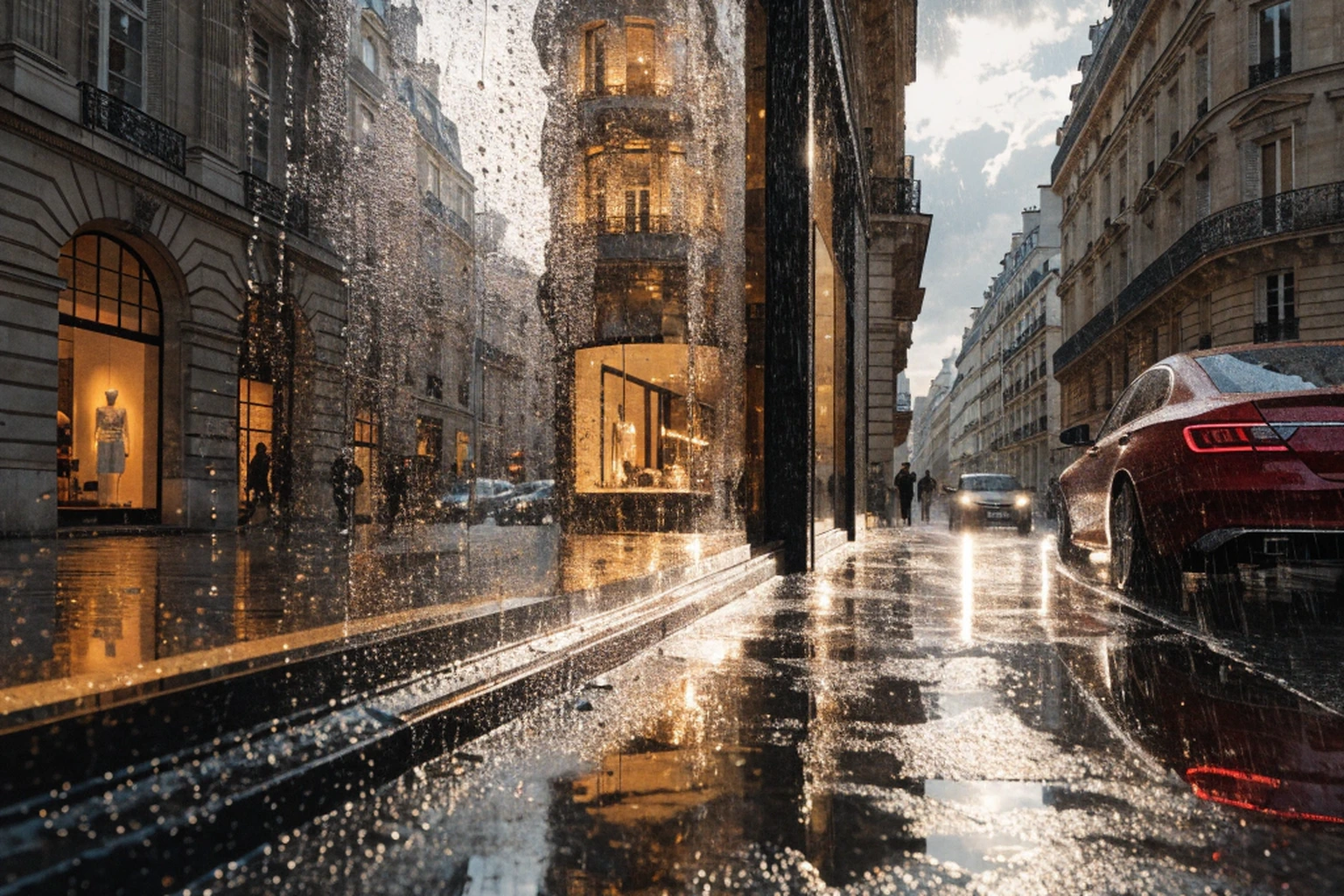
Big Shops in France
France is a country in Europe. It is famous for many beautiful things. Big shops in Paris sell nice clothes, bags, and perfume. The clothes are very pretty. The bags are special.
Many people go to France to see the fashion. Paris is the main city for fashion. You can see famous brand names in the windows. The shops are big and bright. People from all over the world visit them.
These things are from France. They are a part of French life. A dress or a bag from a big Paris shop is a famous souvenir. It is a nice memory from a trip.
Grammar Spotlight
Pattern: Present Simple: 'to be'
"France is a country in Europe."
We use 'is' to describe one thing. We use it to say what something is or where it is. For example, 'He is a student' or 'The book is on the table'.
Pattern: Plural Nouns
"Big shops in Paris sell nice clothes, bags, and perfume."
We add '-s' to the end of many words to talk about more than one thing. For example, one 'shop' becomes many 'shops'. One 'bag' becomes many 'bags'.
Test Your Understanding
10 questions · A1 Beginner · 1 free preview
Test what you learned from this article. Answer all questions to earn XP!
What does Paris sell in its big shops?
Want to finish the quiz?
9 more questions are waiting for you. Sign up free to unlock the full quiz and earn XP!
Sign Up FreeAlready have an account? Sign In
Question Breakdown
What does Paris sell in its big shops?
Your answer:
Correct answer: Clothes, bags, and perfume
Paris is the main city for fashion in France.
Your answer:
Correct answer: True
What does 'famous' mean?
Your answer:
Correct answer: Known by many people
The bags are _____.
Your answer:
Correct answer: special
French Fashion and Luxury
France is famous for its luxury goods. Many people know France for beautiful clothes, perfumes, and bags. Paris is the capital of fashion. Every year, millions of tourists visit Paris to shop.
French brands like Chanel, Dior, and Louis Vuitton are very popular. These companies make high-quality products. A bag from these brands is often more expensive than a normal bag. This is because they use the best materials. The workers spend a long time making each item.
In the past, kings and queens wore these expensive clothes. Today, people all over the world buy French luxury items. They buy them because they are beautiful and special. The luxury industry is very important for the French economy. It creates many jobs for people in France. French style is elegant and classic.
Grammar Spotlight
Pattern: Comparatives
"A bag from these brands is often more expensive than a normal bag."
We use comparatives to compare two things. For long adjectives like 'expensive', we add 'more' before the word and 'than' after it.
Pattern: Superlatives
"This is because they use the best materials."
We use superlatives to compare one thing to a whole group. 'Best' is the irregular superlative form of 'good'.
Test Your Understanding
11 questions · A2 Elementary · 1 free preview
Test what you learned from this article. Answer all questions to earn XP!
What is Paris known as?
Want to finish the quiz?
10 more questions are waiting for you. Sign up free to unlock the full quiz and earn XP!
Sign Up FreeAlready have an account? Sign In
Question Breakdown
What is Paris known as?
Your answer:
Correct answer: The capital of fashion
French luxury bags are usually cheap.
Your answer:
Correct answer: False
What does 'expensive' mean?
Your answer:
Correct answer: Costing a lot of money
French style is described as ______ and classic.
Your answer:
Correct answer: elegant
Why are these luxury items expensive?
Your answer:
Correct answer: They use the best materials
France: The World Leader in Luxury and Fashion
France is famous all over the world for its luxury goods industry. For centuries, French craftsmanship has been admired by people who appreciate high quality and elegance. Today, this sector is considered a vital part of the French economy and culture. It includes haute couture fashion, expensive jewelry, delicious perfumes, and fine wines.
The most successful luxury companies in the world are French. You may know famous names like Louis Vuitton, Chanel, and Hermès. These brands are owned by giant groups such as LVMH and Kering. LVMH, which stands for Moët Hennessy Louis Vuitton, is the largest luxury group globally. It has grown significantly in recent years. These companies employ thousands of skilled workers who have dedicated their lives to creating beautiful objects.
Leather bags, silk scarves, and diamond necklaces are sold in boutiques around the world. The label 'Made in France' is a symbol of prestige. For example, a single handbag might take an artisan forty hours to make by hand. This attention to detail is why customers are willing to pay high prices. The skills that are used to make these products have been passed down from generation to generation.
Paris, the capital of France, is often called the fashion capital of the world. Every year, fashion weeks are held there, attracting designers and models from every country. Visitors come to Paris to shop in famous stores along the Champs-Élysées. However, luxury is not just about expensive prices; it is about tradition and art. Many people believe that buying a French luxury item is an investment in style. Even if you cannot afford these items, looking at the window displays in Paris is a wonderful experience.
Grammar Spotlight
Pattern: Passive Voice
"These brands are owned by giant groups such as LVMH and Kering."
We use the passive voice (be + past participle) when we want to focus on the object (the brands) rather than the subject (the groups). It is very common in formal writing.
Pattern: Relative Clauses
"These companies employ thousands of skilled workers who have dedicated their lives to creating beautiful objects."
We use relative clauses starting with 'who' (for people) or 'which/that' (for things) to give more information about the noun before it.
Test Your Understanding
11 questions · B1 Intermediate · 1 free preview
Test what you learned from this article. Answer all questions to earn XP!
What is Paris often called according to the article?
Want to finish the quiz?
10 more questions are waiting for you. Sign up free to unlock the full quiz and earn XP!
Sign Up FreeAlready have an account? Sign In
Question Breakdown
What is Paris often called according to the article?
Your answer:
Correct answer: The fashion capital of the world
LVMH stands for London Vuitton Moët Hennessy.
Your answer:
Correct answer: False
What does 'vital' mean?
Your answer:
Correct answer: Absolutely necessary
The skills used to make products have been passed down from generation to _____.
Your answer:
Correct answer: generation
Why are customers willing to pay high prices?
Your answer:
Correct answer: Because of the attention to detail and craftsmanship
The Elegance Economy: France's Global Dominance in Luxury
France has long been synonymous with style, elegance, and high culture. However, the French luxury industry is not merely about superficial beauty; it represents a fundamental pillar of the national economy and a powerful projection of French soft power. Known as 'l'industrie du luxe', this sector encompasses haute couture, fine leather goods, perfumes, jewelry, and prestigious wines. France stands as the undisputed world leader in this field, setting global trends that others merely follow.
At the heart of this success lies the concept of 'savoir-faire', or traditional craftsmanship. Unlike mass-produced items, French luxury goods are often defined by the meticulous attention to detail involved in their creation. This dedication to quality is deeply rooted in French heritage. For centuries, skilled artisans have passed down unique techniques for tanning leather, cutting gems, or blending scents. Consequently, purchasing a handbag from Hermès or a suit from Dior is often seen not just as buying a product, but as investing in a piece of art.
Economically, the dominance of French luxury is staggering. Corporations such as LVMH (Moët Hennessy Louis Vuitton), Kering, and Hermès are among the most valuable companies in Europe. These conglomerates manage dozens of brands, generating billions of euros in revenue annually. Moreover, they are crucial for employment, supporting thousands of jobs ranging from vine growers in Bordeaux to seamstresses in Paris. The luxury sector is a major export engine, with a significant portion of its sales coming from international markets, particularly Asia and the United States.
Nevertheless, the industry faces modern challenges. Sustainability has become a critical issue, as consumers increasingly demand environmentally responsible practices. In response, many luxury houses are innovating to reduce their carbon footprint and ensure the ethical sourcing of raw materials. Furthermore, the rise of digital technology has forced these traditional brands to adapt to e-commerce without losing their sense of exclusivity. Despite these hurdles, France's ability to blend historic tradition with modern business strategy suggests that its reign over the luxury world is far from over.
Grammar Spotlight
Pattern: Discourse Markers (Linking Words)
"Consequently, purchasing a handbag from Hermès or a suit from Dior is often seen not just as buying a product, but as investing in a piece of art."
Words like 'Consequently', 'Moreover', and 'Nevertheless' are used to connect ideas logically. 'Consequently' shows that the second sentence is a result of the previous one.
Pattern: Passive Voice
"Unlike mass-produced items, French luxury goods are often defined by the meticulous attention to detail involved in their creation."
The passive voice ('are defined by') is used when the focus is on the action or the object, rather than the person performing the action. It is very common in formal and academic writing.
Pattern: Present Participle Clauses
"These conglomerates manage dozens of brands, generating billions of euros in revenue annually."
The -ing form ('generating') is used here to add extra information about the result of the main action ('manage dozens of brands') without starting a new sentence.
Test Your Understanding
11 questions · B2 Upper Intermediate · 1 free preview
Test what you learned from this article. Answer all questions to earn XP!
According to the article, what distinguishes French luxury goods from mass-produced items?
Want to finish the quiz?
10 more questions are waiting for you. Sign up free to unlock the full quiz and earn XP!
Sign Up FreeAlready have an account? Sign In
Question Breakdown
According to the article, what distinguishes French luxury goods from mass-produced items?
Your answer:
Correct answer: They are defined by meticulous attention to detail and craftsmanship.
The French luxury industry relies solely on domestic sales within France.
Your answer:
Correct answer: False
Which word means 'accepted without question or argument'?
Your answer:
Correct answer: Undisputed
Major companies like LVMH are crucial for __________, supporting thousands of jobs.
Your answer:
Correct answer: employment
What challenge is the luxury industry currently facing regarding the environment?
Your answer:
Correct answer: Consumer demand for sustainability and ethical sourcing.
The Gilded Engine: France's Dominance in Global Luxury
Scarcely can one discuss the modern French economy without acknowledging the colossus that is the luxury sector. While France is celebrated for its gastronomy and philosophy, it is the luxury goods industry—encompassing haute couture, leather goods, jewelry, and fine spirits—that arguably serves as its most potent ambassador. This sector, known locally as "l'industrie du luxe," is not merely a commercial enterprise; it represents a quintessential element of French cultural identity, projecting an image of sophistication and artisanal excellence to the world.
At the forefront of this dominance stand conglomerates such as LVMH, Kering, and Hermès. These corporate titans have mastered the delicate art of balancing heritage with modernity. Rarely has a business model so successfully monetized history while remaining relentlessly forward-looking. The resilience of these brands is remarkable; even during global economic downturns, the demand for high-end French goods often remains robust, driven by an emerging middle class in Asia and a faithful clientele in the West. It is this steadfast demand that has allowed French luxury to outperform many other sectors of the European economy.
However, the industry is rife with paradox. Central to the allure of French luxury is the concept of "savoir-faire"—the unique, often centuries-old know-how possessed by skilled artisans. Yet, the massive scale of operation required by today's global market threatens to dilute this very exclusivity. The commodification of luxury, where logos are plastered across mass-produced accessories, risks stripping brands of their mystique. It is the preservation of these artisanal skills in the face of industrial pressure that remains the sector's greatest challenge. Manufacturers must navigate the fine line between ubiquity, which generates revenue, and scarcity, which generates desire.
Furthermore, the environmental impact of fashion has come under intense scrutiny. The industry is now compelled to address the sustainability of its supply chains. No longer is it sufficient to produce beautiful objects; they must also be ethically sourced. What distinguishes the leaders of tomorrow will be their ability to integrate eco-consciousness without compromising on quality. Nominalisation of these issues—the transformation of raw dissent into corporate strategy—is evident in the rigorous sustainability charters now adopted by major houses.
Ultimately, French luxury is more than just the selling of expensive items; it is the export of a dream. Whether through a bottle of perfume or a hand-stitched bag, these brands offer a slice of the French "art de vivre." As the world evolves, so too must this gilded engine, ensuring that its shine is not merely superficial but reflects a deep commitment to excellence, innovation, and ethical responsibility.
Grammar Spotlight
Pattern: Negative Inversion
"Scarcely can one discuss the modern French economy without acknowledging the colossus that is the luxury sector."
This structure places a negative or restrictive adverb (scarcely, rarely, never) at the beginning of the sentence for emphasis. It requires the auxiliary verb to precede the subject (can one...), similar to question word order.
Pattern: Cleft Sentences
"It is this steadfast demand that has allowed French luxury to outperform many other sectors."
Cleft sentences are used to focus on a specific part of the sentence. The structure 'It is + [emphasized element] + that/who...' allows the writer to highlight the 'steadfast demand' as the specific cause.
Pattern: Nominalisation
"The proliferation of counterfeits risks stripping brands of their mystique."
Nominalisation involves turning verbs (proliferate) or adjectives into nouns (proliferation). This is common in academic and formal C1 writing as it allows for more abstract, objective, and concise expression of ideas.
Test Your Understanding
10 questions · C1 Advanced · 1 free preview
Test what you learned from this article. Answer all questions to earn XP!
According to the article, what is the 'paradox' facing the luxury industry?
Want to finish the quiz?
9 more questions are waiting for you. Sign up free to unlock the full quiz and earn XP!
Sign Up FreeAlready have an account? Sign In
Question Breakdown
According to the article, what is the 'paradox' facing the luxury industry?
Your answer:
Correct answer: The tension between maintaining exclusivity and the need for mass-market growth.
The article suggests that the luxury sector is purely an economic driver for France.
Your answer:
Correct answer: False
Which word means 'the capacity to recover quickly from difficulties'?
Your answer:
Correct answer: Resilience
The unique know-how possessed by skilled artisans is referred to as ____________.
Your answer:
Correct answer: savoir-faire
The Gilded Hegemony: French Luxury as Cultural Patrimony
The ascendancy of France as the unparalleled arbiter of global luxury is not merely a contemporary triumph of branding, but the culmination of a centuries-old strategic imperative. To view the French luxury sector—encompassing haute couture, viticulture, and leather goods—solely through the prism of economics is to overlook its profound sociological significance. It serves as a custodian of *savoir-faire*, a tangible manifestation of national heritage that Jean-Baptiste Colbert, minister to Louis XIV, presciently cultivated. Indeed, it was Colbert who famously remarked that 'fashions were to France what the mines of Peru were to Spain,' recognizing early on that the export of taste could yield dividends far exceeding those of precious metals.
In the contemporary landscape, this heritage has been consolidated into monolithic conglomerates like LVMH and Kering. These entities have masterfully commodified the intangible allure of French elegance, exporting a lifestyle that is at once aspirational and meticulously gatekept. Yet, a paradox emerges: how does one reconcile the requisite exclusivity of luxury with the financial demands of global ubiquity? The answer lies in the careful stratification of products, where entry-level cosmetics and accessories subsidize the rarefied air of made-to-measure creations. Were the illusion of scarcity to shatter, the brand equity would likely dissipate instantaneously.
Furthermore, the industry stands at a precipice regarding sustainability and ethical consumption. No longer can the provenance of raw materials be obscured behind a veil of glamour. Discriminating consumers now demand transparency, forcing historic houses to adapt or risk obsolescence. The resilience of French luxury, therefore, depends not on resting upon its laurels, but on its ability to weave sustainability into the very fabric of its narrative, ensuring that the pursuit of beauty does not come at the expense of ethical integrity. Thus, the French luxury sector remains a fascinating study in the tension between preserving archaic traditions and navigating the ruthless efficiency of modern capitalism.
Grammar Spotlight
Pattern: Inversion in Conditional Sentences
"Were the illusion of scarcity to shatter, the brand equity would likely dissipate instantaneously."
This construction omits 'if' and inverts the subject and auxiliary verb (Were... to...). It creates a more formal, hypothetical tone characteristic of C2 academic writing.
Pattern: Negative Inversion
"No longer can the provenance of raw materials be obscured behind a veil of glamour."
When a sentence begins with a negative adverbial phrase like 'No longer,' the subject and auxiliary verb are inverted ('can the provenance') for emphasis and rhetorical effect.
Pattern: Cleft Sentences
"Indeed, it was Colbert who famously remarked that 'fashions were to France what the mines of Peru were to Spain.'"
Using 'It was X who...' places strong emphasis on the subject (Colbert), singling him out as the specific agent responsible for the action.
Test Your Understanding
12 questions · C2 Mastery · 1 free preview
Test what you learned from this article. Answer all questions to earn XP!
According to the article, Jean-Baptiste Colbert viewed fashion as equivalent to which resource?
Want to finish the quiz?
11 more questions are waiting for you. Sign up free to unlock the full quiz and earn XP!
Sign Up FreeAlready have an account? Sign In
Question Breakdown
According to the article, Jean-Baptiste Colbert viewed fashion as equivalent to which resource?
Your answer:
Correct answer: Precious metals from Peru
The article suggests that modern luxury conglomerates have failed to capitalize on French heritage.
Your answer:
Correct answer: False
Which word is closest in meaning to 'hegemony'?
Your answer:
Correct answer: Dominance
The article states that discriminating consumers now demand _____ regarding raw materials.
Your answer:
Correct answer: transparency
What is the 'paradox' mentioned in the second paragraph?
Your answer:
Correct answer: Exclusivity vs. global availability
What does 'presciently' mean?
Your answer:
Correct answer: With foresight
