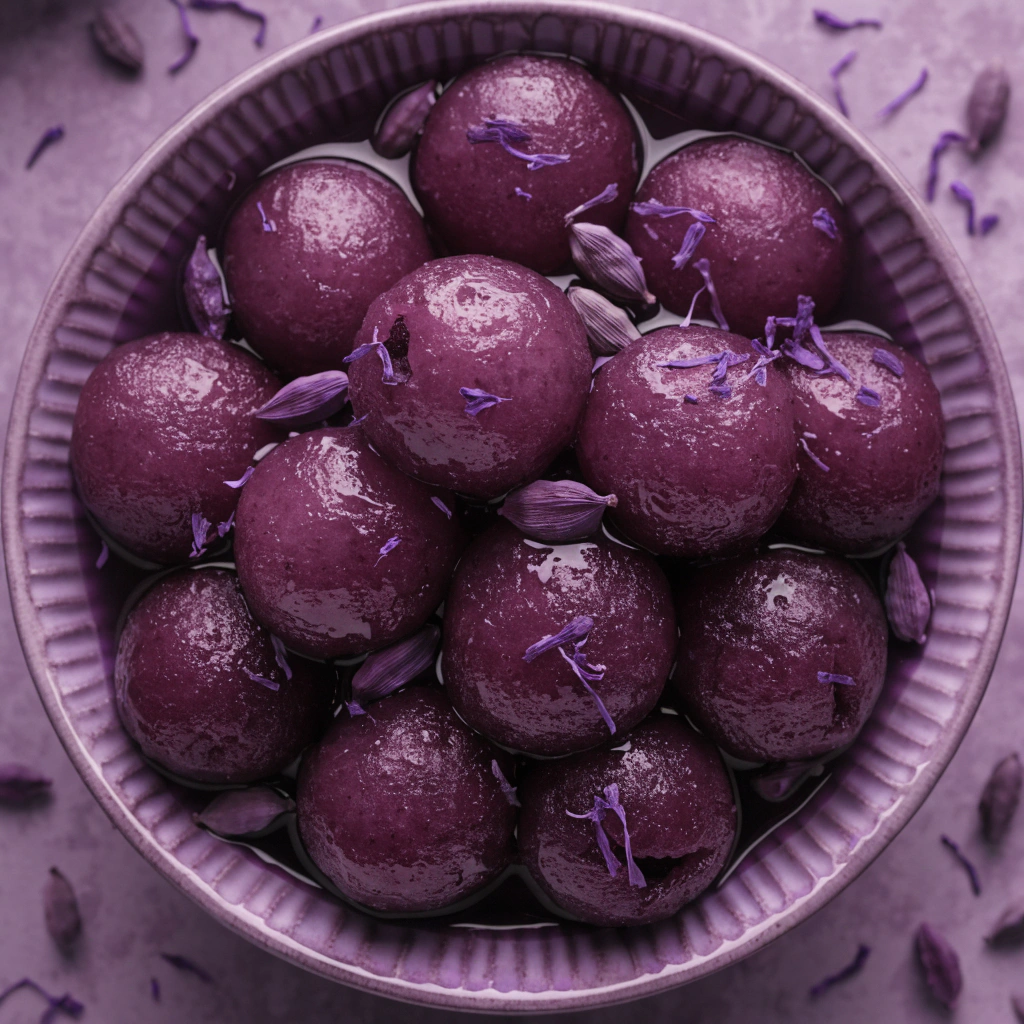
Gulab Jamun: A Sweet Indian Treat
Gulab Jamun is a very popular dessert in India. It is a small, round ball. People make it with milk and flour. First, they fry the balls in oil. Then, they put the balls in a sweet syrup. The syrup smells like roses.
Indian families eat Gulab Jamun at festivals and weddings. It is warm and very soft. Many people eat it with vanilla ice cream. It is very delicious. Children and adults love this sweet food. It is the king of Indian sweets.
Grammar Spotlight
Pattern: Present Simple (to be)
"Gulab Jamun is a very popular dessert in India."
We use 'is' with singular subjects like 'it' or names of food. It describes a fact or a state in the present.
Pattern: Present Simple (regular verbs)
"People make it with milk and flour."
We use the base form of the verb (make, eat, love) with plural subjects like 'people' or 'families'. This shows a general truth or habit.
Test Your Understanding
10 questions · A1 Beginner · 1 free preview
Test what you learned from this article. Answer all questions to earn XP!
What shape is Gulab Jamun?
Want to finish the quiz?
9 more questions are waiting for you. Sign up free to unlock the full quiz and earn XP!
Sign Up FreeAlready have an account? Sign In
Question Breakdown
What shape is Gulab Jamun?
Your answer:
Correct answer: Round
The syrup smells like roses.
Your answer:
Correct answer: True
What does 'delicious' mean?
Your answer:
Correct answer: Very good taste
Gulab Jamun is a sweet _____ in India.
Your answer:
Correct answer: dessert
India's Favorite Sweet: Gulab Jamun
In India, people love sweets. One of the most famous desserts is called Gulab Jamun. It is round, soft, and very sweet. Many people call it the 'king of Indian desserts' because it is so popular at festivals and weddings.
The name comes from two words. 'Gul' means flower and 'Ab' means water. This is because the dessert is served in a sweet syrup that smells like roses. 'Jamun' is a small fruit from India. The dessert looks like this fruit because it is round and dark brown.
In the past, people made Gulab Jamun using 'Khoya.' They cooked milk for a long time until it became solid. Today, it is easier to make than before. Some people use milk powder because it is faster. You fry the small balls in oil until they are brown. Then, you put them into the warm syrup. Gulab Jamun is better when you eat it warm. It is more delicious than many other sweets!
Grammar Spotlight
Pattern: Comparatives
"It is more delicious than many other sweets!"
We use 'more + adjective + than' for adjectives with two or more syllables to compare two things. For short adjectives, we add '-er' like 'easier'.
Pattern: Past Simple
"They cooked milk for a long time until it became solid."
The past simple describes finished actions. Regular verbs add '-ed' (cooked), while irregular verbs like 'become' change their form (became).
Test Your Understanding
11 questions · A2 Elementary · 1 free preview
Test what you learned from this article. Answer all questions to earn XP!
Why is the dessert called 'Gulab'?
Want to finish the quiz?
10 more questions are waiting for you. Sign up free to unlock the full quiz and earn XP!
Sign Up FreeAlready have an account? Sign In
Question Breakdown
Why is the dessert called 'Gulab'?
Your answer:
Correct answer: Because the syrup smells like roses
Gulab Jamun is better when you eat it cold.
Your answer:
Correct answer: False
What does 'delicious' mean?
Your answer:
Correct answer: Something that tastes very good
Some people use milk _____ because it is faster to make.
Your answer:
Correct answer: powder
What is 'Khoya'?
Your answer:
Correct answer: Milk cooked until it is solid
Gulab Jamun: The Sweet Heart of India
If you have ever visited India, you have probably noticed a delicious sweet called Gulab Jamun. It is often described as the 'king of Indian desserts' because it is loved by everyone across the country. No festival or wedding in India is truly complete without this soft, golden-brown treat.
The name comes from two Persian words: 'Gol,' which means flower, and 'Ab,' which means water. This refers to the rose-scented syrup that the dessert is soaked in. The word 'Jamun' refers to a small Indian fruit that the sweet resembles in its round shape. Although it has roots in medieval Arabic cooking, the recipe has been perfected in India over many centuries.
Gulab Jamun is made from a special ingredient called 'Khoya.' This is milk that has been simmered for hours until it becomes a soft solid. The Khoya is mixed with a little flour to make a dough, which is then shaped into small balls. These balls are deep-fried until they are golden and have a slightly crispy skin. Finally, they are placed into a warm sugar syrup for several hours.
The syrup, which is usually flavored with cardamom and rose water, makes the dessert incredibly juicy and sweet. Gulab Jamun has become a symbol of celebration and happiness. It is usually served warm, though some people prefer it cold with a scoop of vanilla ice cream. This combination of hot and cold is very popular in modern Indian restaurants. Whether it is a small family dinner or a massive national holiday like Diwali, this dessert is always the star of the table.
Grammar Spotlight
Pattern: Passive Voice
"These balls are deep-fried until they are golden."
We use the passive voice (be + past participle) when the action is more important than who is doing it. Here, the focus is on the cooking process of the dough balls.
Pattern: Present Perfect
"Gulab Jamun has become a symbol of celebration and happiness."
The present perfect (have/has + past participle) connects the past to the present. It shows that the dessert started being a symbol in the past and still is one today.
Test Your Understanding
11 questions · B1 Intermediate · 1 free preview
Test what you learned from this article. Answer all questions to earn XP!
What does the Persian word 'Ab' mean in the name of the dessert?
Want to finish the quiz?
10 more questions are waiting for you. Sign up free to unlock the full quiz and earn XP!
Sign Up FreeAlready have an account? Sign In
Question Breakdown
What does the Persian word 'Ab' mean in the name of the dessert?
Your answer:
Correct answer: Water
Khoya is a type of fruit used to make the dessert.
Your answer:
Correct answer: False
What does 'scented' mean?
Your answer:
Correct answer: Having a pleasant smell
The dough balls are _____ until they are golden and crispy.
Your answer:
Correct answer: deep-fried
According to the article, how do some people like to eat Gulab Jamun in modern restaurants?
Your answer:
Correct answer: With vanilla ice cream
Gulab Jamun: The Crown Jewel of Indian Confectionery
In the vast and diverse landscape of Indian gastronomy, few items command as much respect as the Gulab Jamun. The dessert is widely considered to be the undisputed king of Indian sweets, serving as a mandatory conclusion to festive meals and celebratory banquets across the subcontinent. To understand its prominence, one must look beyond its sugary exterior and examine its complex history and the sophisticated techniques required for its preparation.
If one were to analyze its etymology, the Persian influence would become immediately apparent. The name is derived from the Persian words 'Gol', meaning flower, and 'Ab', meaning water, which refers to the rose-scented syrup used to soak the dessert. The term 'Jamun' relates to an indigenous Indian fruit that the sweet resembles in both size and spherical shape. This linguistic blend highlights the historical fusion of Middle Eastern culinary traditions with local Indian ingredients, a process that has defined much of North Indian cuisine.
Having originated from the medieval Arabic dish Luqmat al-Qadi, the dessert was later adapted by Indian chefs to suit local palates. While the original Arabic version relied on a leavened batter, the Indian iteration underwent a significant transformation through the introduction of 'Khoya'. Khoya is a dairy product created by simmering milk for several hours until it reduces to a solid, fudge-like consistency. This indigenous ingredient provides a richness and density that distinguishes Gulab Jamun from its international relatives.
Furthermore, the preparation process is a delicate art that requires precision. The dough balls must be fried at a specific temperature to ensure they are cooked through without burning the exterior. Once fried, they are infused with a warm syrup typically flavored with cardamom, saffron, and rose water. This soaking process is critical; the syrup must penetrate to the very center of the ball to achieve the desired melt-in-the-mouth texture.
In contemporary society, Gulab Jamun remains a symbol of hospitality and joy. Despite the influx of modern, Western-style desserts, it maintains its aesthetic and cultural relevance. Whether served warm at a winter wedding or chilled during a summer festival, it represents the enduring legacy of India’s culinary evolution. Ultimately, the Gulab Jamun is not merely a sweet; it is a testament to the sophisticated blending of cultures that has occurred over centuries in the heart of South Asia.
Grammar Spotlight
Pattern: Passive with Infinitive
"The dessert is widely considered to be the undisputed king of Indian sweets."
This structure is used to report general beliefs or opinions. It uses 'subject + be + past participle + to-infinitive' to sound more formal and objective.
Pattern: Second Conditional
"If one were to analyze its etymology, the Persian influence would become immediately apparent."
The second conditional is used here to discuss a hypothetical situation. Using 'were' instead of 'was' with 'one' adds a formal, academic tone.
Pattern: Perfect Participle Clause
"Having originated from the medieval Arabic dish Luqmat al-Qadi, the dessert was later adapted by Indian chefs."
Perfect participle clauses (Having + past participle) are used to show that one action happened before another. It is a common feature of B2-level academic writing to vary sentence structure.
Test Your Understanding
11 questions · B2 Upper Intermediate · 1 free preview
Test what you learned from this article. Answer all questions to earn XP!
What does the name 'Gulab' specifically refer to in the context of this dessert?
Want to finish the quiz?
10 more questions are waiting for you. Sign up free to unlock the full quiz and earn XP!
Sign Up FreeAlready have an account? Sign In
Question Breakdown
What does the name 'Gulab' specifically refer to in the context of this dessert?
Your answer:
Correct answer: The rose-scented water used in the syrup
The Indian version of the dessert is identical to the original Arabic Luqmat al-Qadi.
Your answer:
Correct answer: False
What is the meaning of 'indigenous'?
Your answer:
Correct answer: Naturally occurring in a specific place
Khoya is created by _____ milk for several hours until it becomes solid.
Your answer:
Correct answer: simmering
Why is the soaking process described as 'critical'?
Your answer:
Correct answer: It ensures the syrup reaches the center for the correct texture.
The Alchemical Metamorphosis: Deciphering the Cultural Supremacy of Gulab Jamun
Within the multifaceted tapestry of Indian gastronomy, few delicacies command as much reverence as the Gulab Jamun. Often hailed as the undisputed sovereign of desserts, its presence at celebratory functions is not merely customary but virtually mandatory. The etymological roots of the name trace back to the Persian 'Gol' (flower) and 'Ab' (water), a nod to the rose-infused syrup that permeates the dough, while 'Jamun' denotes its resemblance to the Indian black plum. This nomenclature serves as a linguistic testament to the historical synthesis of cultures that has defined the Indian subcontinent for centuries.
Seldom does a culinary staple boast such a sophisticated lineage. While historians point to the medieval Arabic 'Luqmat al-Qadi' as its progenitor, it was the ingenious adaptation of this recipe within the Indian subcontinent that birthed the modern iteration. It was the substitution of flour with 'Khoya'—milk solids meticulously reduced over hours—that fundamentally altered the dessert's structural integrity, resulting in a texture that is simultaneously dense and ethereal. This shift from a simple yeast-based dough to a rich dairy foundation represents a significant milestone in regional culinary evolution, reflecting the agrarian importance of cattle in Indian society.
The preparation itself is an exercise in precision, demanding a level of mastery that borders on the scientific. One must navigate the delicate equilibrium between frying temperature and syrup saturation. Should the oil be too tepid, the spheres disintegrate into oily fragments; should it be too searing, the exterior caramelizes prematurely, leaving a raw, doughy core. The subsequent immersion in syrup is where the alchemical transformation occurs, as the porous khoya absorbs the floral notes of cardamom and rose. This process requires patience, as the jamuns must steep long enough to achieve a uniform sweetness without losing their form.
Beyond its sensory appeal, the Gulab Jamun serves as a cultural anchor. Whether it is the festive illumination of Diwali or the communal spirit of Eid, the dessert acts as a bridge across diverse socio-religious landscapes. The sheer ubiquity of this sweet treat underscores a shared heritage that transcends modern political borders, reminding us that shared culinary traditions often outlast administrative divisions. It is a symbol of hospitality, often being the first item offered to guests as a gesture of warmth and welcome.
To view the Gulab Jamun as a mere confection would be a reductive oversight. It represents a nuanced intersection of history, chemistry, and tradition. Rarely has a single dish managed to encapsulate the evolution of a region's palate while maintaining such a steadfast grip on its collective identity. Its enduring popularity is a testament to the timeless appeal of well-balanced flavors and the profound human connection to food that evokes nostalgia. As modern fusion trends attempt to reinvent the dessert, the classic version remains an untouchable benchmark of Indian culinary excellence.
Grammar Spotlight
Pattern: Negative Inversion
"Seldom does a culinary staple boast such a sophisticated lineage."
Used for emphasis by placing a negative or semi-negative adverb at the start of the sentence. This requires the auxiliary verb to come before the subject.
Pattern: Cleft Sentence
"It was the substitution of flour with 'Khoya'... that fundamentally altered the dessert's structural integrity."
This structure is used to focus on a specific piece of information. It splits a single clause into two parts, starting with 'It was/is' to highlight the subject.
Pattern: Inversion with 'Rarely'
"Rarely has a single dish managed to encapsulate the evolution of a region's palate."
Similar to negative inversion, this uses 'Rarely' to provide a formal, emphatic tone. The auxiliary 'has' is moved before the subject 'a single dish'.
Test Your Understanding
12 questions · C1 Advanced · 1 free preview
Test what you learned from this article. Answer all questions to earn XP!
According to the article, what does the name 'Jamun' refer to?
Want to finish the quiz?
11 more questions are waiting for you. Sign up free to unlock the full quiz and earn XP!
Sign Up FreeAlready have an account? Sign In
Question Breakdown
According to the article, what does the name 'Jamun' refer to?
Your answer:
Correct answer: A specific Indian fruit
The article states that Gulab Jamun has entirely Indian roots with no external historical influence.
Your answer:
Correct answer: False
Which word describes something that is extremely light and delicate?
Your answer:
Correct answer: Ethereal
The _____ roots of the name trace back to Persian words for flower and water.
Your answer:
Correct answer: etymological
What happens if the frying oil is too tepid during preparation?
Your answer:
Correct answer: The spheres disintegrate
The substitution of flour with 'Khoya' is described as a significant milestone in regional culinary evolution.
Your answer:
Correct answer: True
The Ontological Sovereignty of the Gulab Jamun: A Study in Syncretic Confectionery
Were one to traverse the vast expanse of the Indian subcontinent, it would become immediately axiomatic that no culinary journey is complete without the inclusion of the Gulab Jamun. This quintessential dessert, often termed the 'undisputed king' of Indian sweets, occupies a space that transcends mere sustenance, acting as a cultural signifier of hospitality and celebration. Seldom has a single confection managed to encapsulate the historical complexities of a nation as effectively as this deep-fried orb of dairy reduction. To analyze the Gulab Jamun is to peel back the layers of South Asian history, revealing a narrative of syncretic evolution that bridges the gap between Persian influence and indigenous ingenuity.
The etymological roots of the dish provide the first clue to its multifaceted identity. The nomenclature is derived from the Persian words 'Gol' (flower) and 'Ab' (water), which denote the rose-scented syrup that characterizes the dish, while 'Jamun' refers to the Syzygium cumini fruit, which the dessert resembles in both morphology and size. It is posited by culinary historians that the dessert is a descendant of the medieval Arabic 'Luqmat al-Qadi.' Had this early fritter not been introduced to the royal kitchens of the Delhi Sultanate, the contemporary iteration of the Gulab Jamun might never have materialized in its current form. In India, the recipe underwent a radical transformation; the traditional flour-based dough was supplanted by 'Khoya'—milk solids achieved through the painstaking process of simmering milk for hours until its moisture has evaporated, leaving behind a dense, fudge-like substance.
The preparation of Gulab Jamun requires a level of connoisseurship that borders on the scientific. The Khoya must be kneaded with a minute amount of flour to provide structural integrity, yet the ratio is delicate; an excess of flour results in a leaden texture, while too little causes the spheres to disintegrate upon contact with the hot oil. The frying process itself is an exercise in temperature control. The spheres are submerged in ghee or oil at a moderate heat, allowing for a slow Maillard reaction that imparts a deep mahogany hue without scorching the exterior. This process ensures that the heat permeates the core, transforming the dense dough into a porous, spongy medium ready for the final stage: immersion.
Once fried, the balls are introduced to a saccharine syrup infused with cardamom, saffron, and rose water. The viscosity of this syrup is of paramount importance; it must be thin enough to be absorbed into the very center of the Jamun, yet thick enough to provide a luscious mouthfeel. The resulting texture is a study in contrasts: a slightly resistant outer skin giving way to a melting, syrup-soaked interior. This ephemeral sensory experience is what elevates the Gulab Jamun above its peers. It is not merely a sweet; it is a testament to the sophisticated culinary alchemy of the medieval era.
From a sociological perspective, the Gulab Jamun serves as a cohesive element in the diverse tapestry of Indian society. Whether it is served at a lavish wedding in Delhi or a humble village festival in Kerala, its presence is a prerequisite for communal joy. The ubiquity of the dessert suggests a shared heritage that defies regional and linguistic barriers. One might argue that the Gulab Jamun represents a successful synthesis of foreign influence and local adaptation, a metaphor for India itself. In an era where culinary traditions are increasingly homogenized, the gravitas of the Gulab Jamun remains unshaken, standing as a bulwark against the encroachment of globalized, mass-produced confectionery.
Grammar Spotlight
Pattern: Subjunctive Mood for Hypothetical Situations
"Were one to traverse the vast expanse of the Indian subcontinent, it would become immediately axiomatic that no culinary journey is complete without the inclusion of the Gulab Jamun."
The 'were + subject + to-infinitive' structure is used here to create a formal, hypothetical condition. It emphasizes the analytical and scholarly tone of the text, common in C2 level prose.
Pattern: Negative Inversion for Emphasis
"Seldom has a single confection managed to encapsulate the historical complexities of a nation as effectively as this deep-fried orb of dairy reduction."
Inversion occurs when a negative or restrictive adverb (like 'seldom') starts the sentence, requiring the auxiliary verb to come before the subject. This is used to add rhetorical weight and sophistication.
Pattern: Third Conditional (Inverted Form)
"Had this early fritter not been introduced to the royal kitchens of the Delhi Sultanate, the contemporary iteration of the Gulab Jamun might never have materialized in its current form."
This structure uses an inverted 'had' instead of 'if' to express a hypothetical past situation and its hypothetical past result. It is a hallmark of formal academic English.
Test Your Understanding
12 questions · C2 Mastery · 1 free preview
Test what you learned from this article. Answer all questions to earn XP!
According to the text, what is the primary significance of the word 'Jamun' in the dessert's name?
Want to finish the quiz?
11 more questions are waiting for you. Sign up free to unlock the full quiz and earn XP!
Sign Up FreeAlready have an account? Sign In
Question Breakdown
According to the text, what is the primary significance of the word 'Jamun' in the dessert's name?
Your answer:
Correct answer: It refers to an Indian fruit that the dessert resembles.
The article suggests that Gulab Jamun is entirely indigenous to India and has no foreign roots.
Your answer:
Correct answer: False
What does the word 'syncretic' mean in the context of the article?
Your answer:
Correct answer: The blending of different cultural influences.
The transition from flour to _____ as the main ingredient was a major change in the Indian version of the dessert.
Your answer:
Correct answer: khoya
What technical challenge is mentioned regarding the frying process?
Your answer:
Correct answer: The heat must permeate the core without scorching the exterior.
The viscosity of the syrup is described as a detail of 'paramount importance' for the final texture.
Your answer:
Correct answer: True
