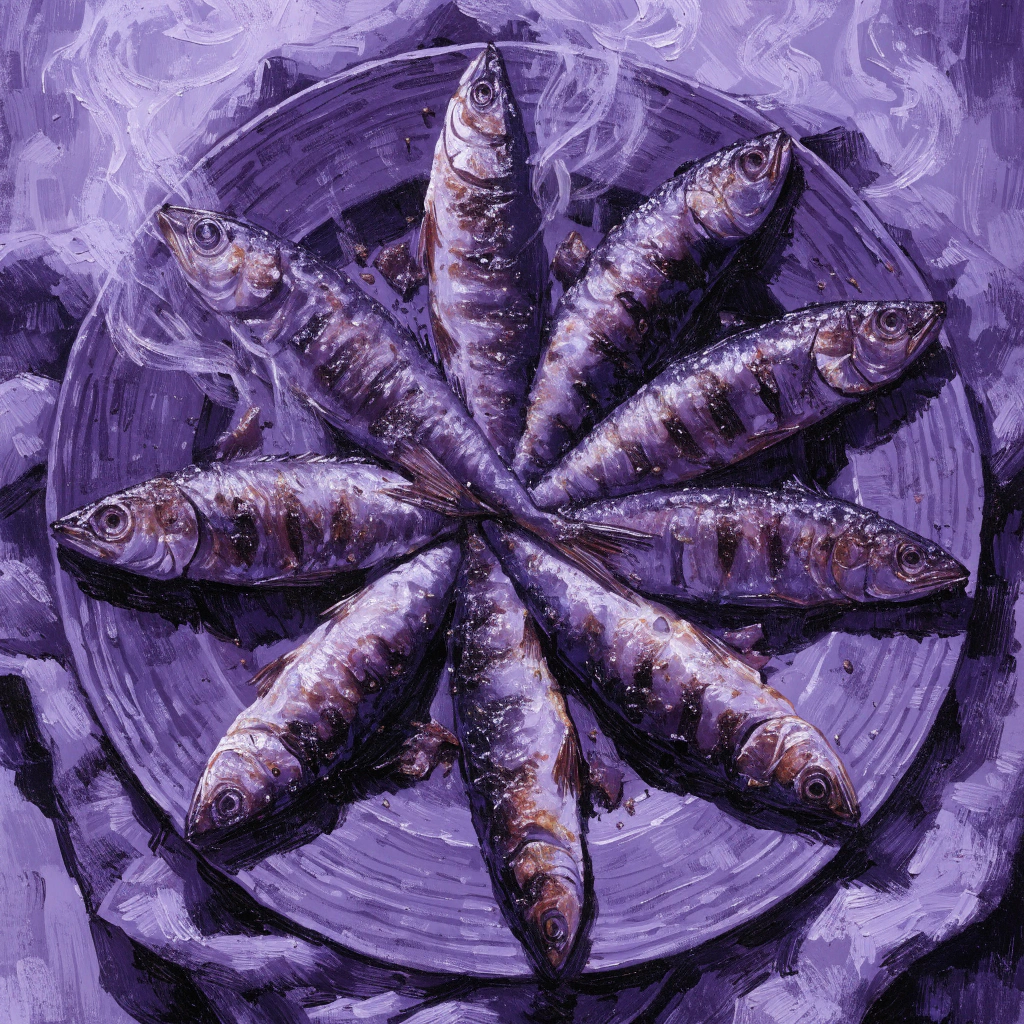
Summer and Sardines in Portugal
Summer is a special time in Portugal. The weather is hot and sunny. In June, there are big festivals in the streets. You can see many people outside.
People cook sardines on a fire. The smell of the fish is everywhere. The sardines are small and silver. They are very fresh. People eat the fish with bread and potatoes.
Families and friends eat together. They listen to music and dance. Grilled sardines are a national icon in Portugal. Everyone loves this traditional food. It is delicious!
Grammar Spotlight
Pattern: Present Simple with 'Be'
"The weather is hot and sunny."
We use 'is' with singular subjects like 'weather' to describe a state or condition. It is the most common verb in English for descriptions.
Pattern: Present Simple for Facts
"People cook sardines on a fire."
We use the base form of the verb 'cook' with plural subjects like 'people'. This pattern describes things that are generally true or happen regularly.
Test Your Understanding
10 questions · A1 Beginner · 1 free preview
Test what you learned from this article. Answer all questions to earn XP!
When are the big festivals in Portugal?
Want to finish the quiz?
9 more questions are waiting for you. Sign up free to unlock the full quiz and earn XP!
Sign Up FreeAlready have an account? Sign In
Question Breakdown
When are the big festivals in Portugal?
Your answer:
Correct answer: In June
People eat sardines with bread and potatoes.
Your answer:
Correct answer: True
What does the word 'fresh' mean?
Your answer:
Correct answer: New or recently caught food
People cook _____ on a fire.
Your answer:
Correct answer: sardines
Summer and Sardines in Portugal
Summer in Portugal is a very special time. When the weather gets hot, the streets of Lisbon and Porto smell like grilled sardines. This famous fish is a national symbol of Portugal. People love sardines because they are fresh and delicious.
In June, there are many big festivals called the 'Santos Populares'. The most famous festivals are Saint Anthony in Lisbon and Saint John in Porto. During these nights, thousands of people go outside to eat and dance. They cook the sardines on big grills in the street.
Traditional sardines are better than other fish because they are simple to cook. Most people eat their sardine on a thick piece of bread. Sometimes, they also eat them with boiled potatoes and green peppers. In the past, sardines were food for poor people, but now everyone loves them. It is a great way to celebrate the summer with friends and family.
Grammar Spotlight
Pattern: Comparatives (Better than)
"Traditional sardines are better than other fish because they are simple to cook."
We use 'better than' to compare two things when one is higher quality. 'Better' is the irregular comparative form of the adjective 'good'.
Pattern: Past Simple of 'To Be'
"In the past, sardines were food for poor people, but now everyone loves them."
We use 'were' as the past simple form of 'are' for plural subjects. It describes a state or situation that happened in the past but is different now.
Test Your Understanding
11 questions · A2 Elementary · 1 free preview
Test what you learned from this article. Answer all questions to earn XP!
Where do people cook the sardines during the festivals?
Want to finish the quiz?
10 more questions are waiting for you. Sign up free to unlock the full quiz and earn XP!
Sign Up FreeAlready have an account? Sign In
Question Breakdown
Where do people cook the sardines during the festivals?
Your answer:
Correct answer: On grills in the street
The festival of Saint John happens in Lisbon.
Your answer:
Correct answer: False
What does 'famous' mean?
Your answer:
Correct answer: Known by many people
Most people eat their sardine on a thick piece of _____.
Your answer:
Correct answer: bread
Why do people love sardines according to the text?
Your answer:
Correct answer: Because they are fresh and delicious
The Summer Scent of Portugal: Grilled Sardines
Summer in Portugal has arrived when the delicious smell of grilled sardines starts to fill the air. For many people who live in the narrow streets of Lisbon or Porto, this aroma is the true sign that the warm season has begun. The sardine is a national icon that has been celebrated in Portuguese art and literature for a very long time.
Although fish is eaten throughout the year in this maritime nation, the sardine becomes the most important food in June. This is the month of the 'Santos Populares' festivals. The most famous celebrations are for Saint Anthony in Lisbon and Saint John in Porto. During these events, the streets are decorated with colorful lights and flowers. Thousands of sardines are grilled over hot charcoal on every street corner.
The traditional way to eat them is very simple and has not changed much over time. They are usually served on a thick slice of bread, which absorbs the oil and flavor of the fish. This bread is often considered the best part of the meal! Sometimes, they are also served with boiled potatoes and grilled green peppers. In the past, this was a cheap meal for poor families who lived near the coast, but today, everyone enjoys it together regardless of their background.
These festivals bring communities together. People dance to traditional music and share meals with their neighbors. It is a tradition that has lasted for centuries. If you visit Portugal in June, you will definitely experience this unique atmosphere. The combination of good food, music, and friendship makes the summer festivals an unforgettable experience for both locals and tourists.
Grammar Spotlight
Pattern: Passive Voice
"Thousands of sardines are grilled over hot charcoal on every street corner."
The passive voice is used here because the action (grilling) is more important than who is doing it. It is formed using 'be' + past participle.
Pattern: Relative Clauses
"For many people who live in the narrow streets of Lisbon or Porto..."
Relative clauses provide more information about a noun. 'Who' is used here to give more details about the 'people' mentioned.
Test Your Understanding
11 questions · B1 Intermediate · 1 free preview
Test what you learned from this article. Answer all questions to earn XP!
What is the main sign that summer has started in Portugal?
Want to finish the quiz?
10 more questions are waiting for you. Sign up free to unlock the full quiz and earn XP!
Sign Up FreeAlready have an account? Sign In
Question Breakdown
What is the main sign that summer has started in Portugal?
Your answer:
Correct answer: The smell of grilled sardines in the streets
Sardines are only eaten by poor families in modern Portugal.
Your answer:
Correct answer: False
What does the word 'aroma' mean in the text?
Your answer:
Correct answer: A pleasant smell
Sardines are grilled over hot _____ during the June festivals.
Your answer:
Correct answer: charcoal
Which cities are mentioned for their famous June festivals?
Your answer:
Correct answer: Lisbon and Porto
The Cultural Significance of the Portuguese Sardine: More Than Just a Meal
In Portugal, the arrival of the summer season is heralded not by the rising temperatures on a thermometer, but by a distinct olfactory signal: the scent of 'sardinhas assadas' wafting through the narrow, cobblestone streets. While the sardine is a humble fish, it has evolved into a quintessential national icon, celebrated in literature, contemporary art, and grand festivals. Although fish is consumed year-round in this maritime nation, the sardine takes center stage specifically in June, coinciding with the 'Santos Populares' festivities. These celebrations, which honor Saint Anthony in Lisbon and Saint John in Porto, see thousands of people gathering in communal spaces to share a meal that transcends mere nutrition.
From a sociological perspective, the sardine represents a bridge between Portugal's rural past and its modern, urban identity. During the festivities, the atmosphere is electric; temporary grills are set up on every corner, and the smoke creates a hazy canopy over the merrymakers. It is traditionally served on a thick slice of sourdough bread, which absorbs the flavorful oils of the fish. This method of consumption is highly symbolic, reflecting a history where nothing was wasted. Furthermore, if one were to analyze the sardine’s presence in Portuguese pottery and graphic design, its enduring significance as a symbol of prosperity and national pride would become immediately apparent.
Nevertheless, the tradition is not without its challenges. Environmental concerns regarding overfishing have led to strict regulations on when and how many sardines can be caught. Consequently, the availability of fresh sardines has become a topic of intense public debate. Despite these ecological pressures, the ritual of the grilled sardine remains an integral part of the Portuguese summer. It serves as a powerful reminder of the importance of seasonal living and the strength of communal bonds in an increasingly digital world. Ultimately, the sardine is not just a culinary preference; it is a cultural manifestation that continues to define the Portuguese spirit, proving that even the smallest creatures can carry the weight of a nation's heritage.
Grammar Spotlight
Pattern: Passive Voice
"Although fish is consumed year-round in this maritime nation, the sardine takes center stage specifically in June."
The passive voice 'is consumed' is used here to focus on the action and the object (fish) rather than who is eating it. It is formed using the verb 'to be' plus the past participle.
Pattern: Second Conditional
"If one were to analyze the sardine’s presence in Portuguese pottery and graphic design, its enduring significance would become immediately apparent."
The second conditional uses 'if' + past subjunctive ('were to analyze') and 'would' to discuss a hypothetical situation and its probable result. It is used here for academic analysis.
Pattern: Non-defining Relative Clauses
"These celebrations, which honor Saint Anthony in Lisbon and Saint John in Porto, see thousands of people gathering in communal spaces."
The clause starting with 'which' provides extra information about the celebrations. It is separated by commas because the sentence would still make sense without it.
Test Your Understanding
11 questions · B2 Upper Intermediate · 1 free preview
Test what you learned from this article. Answer all questions to earn XP!
What primary signal marks the beginning of summer in Portugal according to the text?
Want to finish the quiz?
10 more questions are waiting for you. Sign up free to unlock the full quiz and earn XP!
Sign Up FreeAlready have an account? Sign In
Question Breakdown
What primary signal marks the beginning of summer in Portugal according to the text?
Your answer:
Correct answer: The smell of grilled sardines in the streets
Sardines are only eaten in Portugal during the month of June.
Your answer:
Correct answer: False
What does the word 'quintessential' mean in the context of the article?
Your answer:
Correct answer: The most typical or perfect example
The sardine's presence in pottery and design shows its _____ as a symbol of national pride.
Your answer:
Correct answer: significance
Why is the sardine traditionally served on a thick slice of bread?
Your answer:
Correct answer: To absorb the oils and reflect a history of not wasting food
The Silver-Scaled Icon: Deciphering the Cultural Weight of the Portuguese Sardine
Rarely does a single olfactory stimulus encapsulate the collective identity of a nation as poignantly as the scent of grilled sardines wafting through the labyrinthine alleys of Lisbon’s Alfama district. In Portugal, the arrival of summer is heralded not merely by the rising mercury, but by the ubiquitous presence of these silver-scaled delights. The sardine is far more than a seasonal delicacy; it is a cultural totem, a symbol of maritime heritage that transcends socio-economic boundaries and anchors the Portuguese soul to the Atlantic.
The democratization of what was once considered 'the poor man's fish' highlights a fascinating shift in Portugal’s gastronomic landscape. Historically, the sardine provided essential sustenance for coastal communities, yet today it enjoys a prestigious status, celebrated in haute cuisine and fine art alike. This elevation in status does not, however, strip the sardine of its humble roots. During the Santos Populares festivals in June, the visceral connection between the people and their sea is most palpable. It is through the lens of these festivities—honoring Saint Anthony in Lisbon and Saint John in Porto—that one truly grasps the sardine’s significance. Thousands of people congregate in the streets, transforming the urban landscape into a communal dining room where the hierarchy of the table is replaced by the democracy of the grill.
The preparation itself is a ritualistic endeavor, demanding precision and respect for the product's provenance. Traditionally, the fish are grilled over charcoal, seasoned only with coarse sea salt, and served atop a thick slice of rustic sourdough bread. The bread serves a dual purpose: it acts as a plate, absorbing the rich, omega-3-laden oils, and is ultimately consumed as the final, most flavorful morsel. Such a practice underscores the Portuguese ethos of resourcefulness and culinary honesty. Furthermore, the sardine’s influence extends deep into the realm of aesthetics. Each year, the 'Festas de Lisboa' hosts an international competition where artists redesign the sardine's silhouette, resulting in a kaleidoscope of creative interpretations that adorn the city. This artistic preoccupation mirrors the literary reverence found in the works of Portuguese masters, where the sea and its bounty are often metaphors for 'saudade'—that uniquely Portuguese longing.
However, the narrative of the sardine is not without its complexities. The ephemeral nature of the peak season, coupled with fluctuating stocks and stringent fishing quotas, has sparked critical debates regarding environmental sustainability. While the demand remains insatiable, the necessity for ecological stewardship is paramount to ensure that future generations can partake in this heritage. The tension between tradition and conservation is a testament to the sardine’s enduring importance. To understand the sardine is to understand Portugal—a nation inextricably bound to the Atlantic, navigating the currents between a storied past and an uncertain, yet hopeful, future.
Grammar Spotlight
Pattern: Negative Inversion
"Rarely does a single olfactory stimulus encapsulate the collective identity of a nation as poignantly as the scent of grilled sardines."
Inversion is used after negative or restrictive adverbs (like 'rarely') to create emphasis. The auxiliary verb 'does' moves before the subject 'stimulus'.
Pattern: Cleft Sentences
"It is through the lens of these festivities—honoring Saint Anthony in Lisbon and Saint John in Porto—that one truly grasps the sardine’s significance."
Cleft sentences use 'It is... that' to focus on a specific part of the sentence, in this case, the 'lens of these festivities' as the primary way to understand the topic.
Pattern: Nominalisation
"The democratization of what was once considered 'the poor man's fish' highlights a fascinating shift in Portugal’s gastronomic landscape."
Nominalisation turns verbs or adjectives into nouns (e.g., 'democratize' becomes 'democratization'). This is a hallmark of C1 writing, allowing for more abstract and concise arguments.
Test Your Understanding
12 questions · C1 Advanced · 1 free preview
Test what you learned from this article. Answer all questions to earn XP!
What does the author suggest about the sardine's role in modern Portugal?
Want to finish the quiz?
11 more questions are waiting for you. Sign up free to unlock the full quiz and earn XP!
Sign Up FreeAlready have an account? Sign In
Question Breakdown
What does the author suggest about the sardine's role in modern Portugal?
Your answer:
Correct answer: It has become an artistic and gastronomic icon across all social classes.
The bread used during the sardine ritual is typically discarded after absorbing the fish oils.
Your answer:
Correct answer: False
What does 'ephemeral' mean in the context of the article?
Your answer:
Correct answer: Short-lived
The _____ of the sardine from a 'poor man's fish' to a prestigious icon reflects a shift in social perception.
Your answer:
Correct answer: democratization
What is the primary purpose of the bread served with the sardines?
Your answer:
Correct answer: To act as a plate and absorb flavorful oils.
The article mentions that fishing quotas are a source of debate regarding the sardine's future.
Your answer:
Correct answer: True
The Ichthyological Icon: Deciphering the Socio-Cultural Resonance of the Portuguese Sardine
Were one to traverse the labyrinthine alleys of Lisbon’s Alfama district during the sweltering zenith of June, the sensory onslaught would be immediate and inescapable. It is not the architectural grandeur of the Manueline style that first captivates the visitor, but rather a pervasive, olfactory tapestry: the pungent, smoky aroma of 'sardinhas assadas'. To the uninitiated, the sardine might appear a mere dietary staple, yet within the Lusitanian zeitgeist, Sardina pilchardus serves as a semiotic vessel of national identity. This humble clupeid fish transcends its biological classification, metamorphosing into a sacrosanct emblem of 'portugalidade' during the festivities of the Santos Populares. The arrival of the sardine season is heralded not by the thermometer, but by the charcoal braziers that colonize every sidewalk, signaling a ritualistic return to communal sustenance.
Historically, the sardine’s prominence is predicated upon its ostensible ubiquity and affordability, providing essential nourishment to a maritime nation. However, its contemporary significance is far more nuanced. During the feast days of Saint Anthony and Saint John, the act of grilling sardines becomes an exercise in collective effervescence. It is widely contended that the sardine is the great equalizer; from the aristocrat to the artisan, all partake in the same tactile ritual. The fish is traditionally consumed atop a thick slice of sourdough bread, allowing the subcutaneous fats to saturate the crumb—a practice known as 'pinga no pão'. This method is not merely culinary, but philosophical, representing a refusal to let any vestige of the sea’s bounty go to waste.
Seldom has a mere foodstuff been so inextricably linked to the literary and artistic output of a nation. From the melancholic verses of Fado to the modern ceramic interpretations by Bordallo Pinheiro, the sardine is a recurring motif. Yet, this cultural adulation exists in a precarious equilibrium with ecological realities. Notwithstanding the sardine’s status as a national icon, the industry has faced draconian quotas and fluctuating populations, leading to a mercurial availability that only heightens its ephemeral allure. One might posit that the sardine’s scarcity in recent years has actually bolstered its symbolic capital, transforming it from a common commodity into a cherished seasonal luxury.
Furthermore, the preparation of the sardine demands a proclivity for minimalist perfection. To eviscerate the fish prior to grilling is often considered a culinary sacrilege in the Portuguese tradition; the internal integrity must be maintained to preserve the moisture and intensity of flavor. This insistence on authenticity reflects a broader societal desire to maintain a vestige of the archaic in an increasingly homogenized world. It is imperative that the fish be seasoned only with coarse sea salt, allowing the Maillard reaction on the skin to provide the requisite complexity. In this context, the sardine becomes a locus of resistance against the encroaching tides of globalized fast food.
In conclusion, the 'sardinhada' is far more than a gastronomic event; it is an epistemological bridge between Portugal’s maritime past and its modern, cosmopolitan present. The ritualized consumption of the sardine during the summer months reinforces social cohesion and provides a tangible link to the ancestral rhythms of the Atlantic. As long as the smoke continues to rise from the narrow streets of Lisbon and Porto, the sardine will remain the quintessential protagonist of the Portuguese summer, an ephemeral but enduring testament to the nation’s soul.
Grammar Spotlight
Pattern: Inverted Conditional (Were one to...)
"Were one to traverse the labyrinthine alleys of Lisbon’s Alfama district during the sweltering zenith of June, the sensory onslaught would be immediate."
This is a formal alternative to 'If someone were to traverse'. It uses inversion to create a more scholarly or hypothetical tone, common in C2 academic writing.
Pattern: Negative Inversion
"Seldom has a mere foodstuff been so inextricably linked to the literary and artistic output of a nation."
When a negative or restrictive adverb (like 'seldom') starts a sentence, the auxiliary verb comes before the subject. This emphasizes the rarity or importance of the statement.
Pattern: Subjunctive Mood with 'Imperative'
"It is imperative that the fish be seasoned only with coarse sea salt..."
After adjectives expressing urgency or requirement, the subjunctive form (the base form of the verb, 'be' instead of 'is/are') is used in formal English.
Test Your Understanding
12 questions · C2 Mastery · 1 free preview
Test what you learned from this article. Answer all questions to earn XP!
What is the author's primary argument regarding the sardine in Portugal?
Want to finish the quiz?
11 more questions are waiting for you. Sign up free to unlock the full quiz and earn XP!
Sign Up FreeAlready have an account? Sign In
Question Breakdown
What is the author's primary argument regarding the sardine in Portugal?
Your answer:
Correct answer: It serves as a complex cultural symbol that unites different social strata.
The author suggests that the recent scarcity of sardines has decreased their cultural value.
Your answer:
Correct answer: False
What does 'ephemeral' mean in the context of the article?
Your answer:
Correct answer: Short-lived and fleeting
The practice of letting fish fat soak into bread is known as '_____ no pão'.
Your answer:
Correct answer: pinga
Why is eviscerating the sardine before grilling considered 'sacrilege'?
Your answer:
Correct answer: It is thought to compromise the flavor and moisture of the fish.
The sardine is described as a 'great equalizer' because it is consumed by people of all social classes.
Your answer:
Correct answer: True
