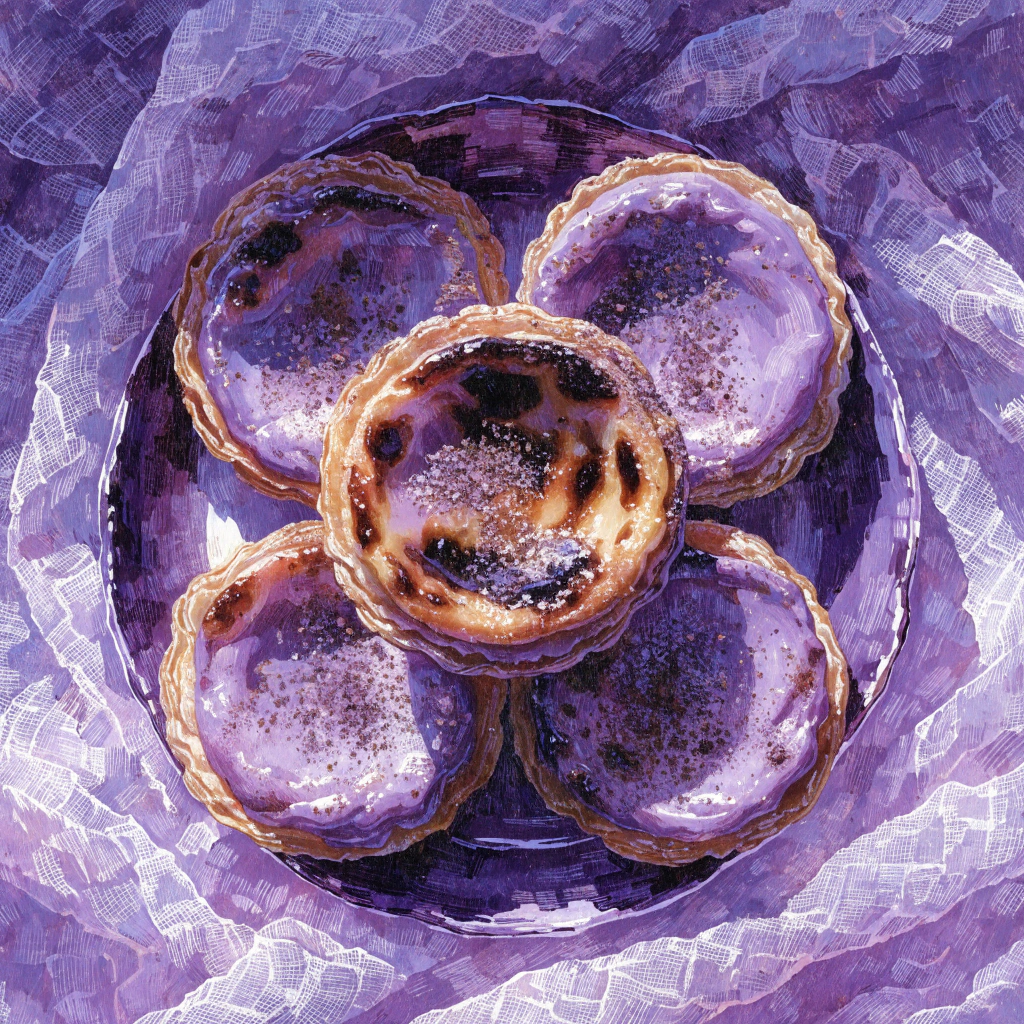
El Pastel de Nata: Un Dulce de Portugal
El Pastel de Nata es un postre muy famoso de Portugal. Es una tarta pequeña y dulce. Tiene crema y es muy rico. Muchas personas lo conocen.
Este postre tiene una historia interesante. Nació en un monasterio en Lisboa. Los monjes tenían muchas yemas de huevo. Con las yemas, ellos hacían este dulce. Así nació el Pastel de Nata.
Hoy, muchas personas en todo el mundo comen Pastel de Nata. Es muy popular en Portugal y también en otros países. Tú puedes comerlo caliente o frío. Es delicioso con café o té. ¡Es un símbolo de la cultura de Portugal!
Gramática destacada
Patrón: Verbo 'Ser' (Presente)
"El Pastel de Nata es un postre muy famoso."
Usamos el verbo 'ser' para hablar de la identidad o características de algo. 'Es' es la forma para 'él/ella/usted'.
Patrón: Verbo 'Tener' (Presente)
"Este postre tiene crema."
Usamos el verbo 'tener' para hablar de posesión o características. 'Tiene' es la forma para 'él/ella/usted'.
Pon a prueba tu comprensión
10 preguntas · A1 Principiante · 1 vista previa gratis
Pon a prueba lo que aprendiste en este artículo. ¡Responde todas las preguntas para ganar XP!
¿De dónde es el Pastel de Nata?
¿Quieres terminar el quiz?
9 preguntas más te esperan. ¡Regístrate gratis para desbloquear el quiz completo y ganar XP!
Regístrate gratis¿Ya tienes cuenta? Acceder
Desglose de preguntas
¿De dónde es el Pastel de Nata?
Tu respuesta:
Respuesta correcta: Portugal
El Pastel de Nata es salado.
Tu respuesta:
Respuesta correcta: Falso
¿Qué significa 'famoso'?
Tu respuesta:
Respuesta correcta: conocido
Los monjes usaban las _____ de huevo para hacer el dulce.
Tu respuesta:
Respuesta correcta: yemas
El Pastel de Nata: Un Dulce Símbolo de Portugal
El Pastel de Nata es un postre muy famoso de Portugal. Es una pequeña tarta de crema con una base crujiente. Mucha gente lo come en Lisboa y en todo el mundo. Su historia es muy interesante y antigua.
Este delicioso pastel nació en el siglo XVIII en un monasterio en Belém, Lisboa. Los monjes del Monasterio de los Jerónimos usaban muchas claras de huevo para almidonar su ropa. Por eso, les sobraban muchas yemas de huevo. Para no desperdiciarlas, los monjes crearon dulces con estas yemas. Así nació el Pastel de Nata.
Después de un tiempo, en 1834, el monasterio cerró. La receta original fue vendida a una fábrica de pasteles cerca del monasterio. Hoy, esta fábrica se llama "Pastéis de Belém" y es muy conocida. El Pastel de Nata es más que un postre; es una parte importante de la cultura portuguesa. Es delicioso y siempre es bueno comer uno caliente con un poco de canela.
Gramática destacada
Patrón: El Pretérito Imperfecto
"Los monjes del Monasterio de los Jerónimos usaban muchas claras de huevo."
Usamos el pretérito imperfecto para hablar de acciones habituales o repetidas en el pasado. También describe situaciones o estados en el pasado sin un inicio o fin específico.
Patrón: Comparativos: "más que"
"El Pastel de Nata es más que un postre; es una parte importante de la cultura portuguesa."
Usamos 'más que' para comparar dos cosas y decir que una tiene una cualidad en mayor grado que la otra. Se forma con 'más' + adjetivo/sustantivo + 'que'.
Pon a prueba tu comprensión
11 preguntas · A2 Básico · 1 vista previa gratis
Pon a prueba lo que aprendiste en este artículo. ¡Responde todas las preguntas para ganar XP!
¿Qué es el Pastel de Nata?
¿Quieres terminar el quiz?
10 preguntas más te esperan. ¡Regístrate gratis para desbloquear el quiz completo y ganar XP!
Regístrate gratis¿Ya tienes cuenta? Acceder
Desglose de preguntas
¿Qué es el Pastel de Nata?
Tu respuesta:
Respuesta correcta: Un postre famoso de Portugal
El Pastel de Nata se creó en el siglo XX.
Tu respuesta:
Respuesta correcta: Falso
¿Qué significa la palabra "monasterio"?
Tu respuesta:
Respuesta correcta: Un lugar donde viven monjes
Los monjes usaban muchas _____ de huevo para almidonar su ropa.
Tu respuesta:
Respuesta correcta: claras
¿Para qué usaban los monjes las yemas de huevo?
Tu respuesta:
Respuesta correcta: Para crear dulces y postres
El Pastel de Nata: Un Dulce Símbolo de Portugal
El Pastel de Nata es mucho más que un simple postre; es un verdadero embajador de la cultura portuguesa en el mundo. Esta icónica tarta de crema, que tiene una base crujiente y un relleno suave, ha conquistado paladares por todas partes. Su historia está profundamente arraigada en las tradiciones religiosas del siglo XVIII.
Originalmente, los pasteles de nata fueron creados por monjes en el Monasterio de los Jerónimos, en Belém, Lisboa. En aquella época, los monasterios utilizaban grandes cantidades de claras de huevo para almidonar los hábitos y ropas religiosas. Esto generaba un considerable excedente de yemas de huevo. Para no desperdiciarlas, los monjes y monjas comenzaron a usarlas para elaborar una variedad de dulces y pasteles. La receta del pastel de nata fue una de las más deliciosas.
Tras la Revolución Liberal del siglo XIX, muchos monasterios cerraron. Para sobrevivir, los monjes del Monasterio de los Jerónimos empezaron a vender sus pasteles en una pequeña tienda cercana. La popularidad de este dulce creció rápidamente. Hoy en día, la receta original se ha conservado en secreto y solo unos pocos la conocen. Es un secreto que ha pasado de generación en generación.
Cuando visitas Portugal, especialmente Lisboa, probar un pastel de nata es casi una obligación. Este postre, que se suele servir caliente y espolvoreado con canela y azúcar glas, ofrece un sabor único. Su textura perfecta lo ha convertido en uno de los postres más famosos del mundo. Es un pedazo de historia y tradición que se puede disfrutar en cada bocado.
Gramática destacada
Patrón: La Voz Pasiva con "ser"
"Originalmente, los pasteles de nata fueron creados por monjes en el Monasterio de los Jerónimos."
Usamos la voz pasiva con "ser" + participio pasado para indicar que la acción de un verbo la recibe el sujeto, no la realiza. El agente que realiza la acción (los monjes) a menudo se introduce con la preposición "por".
Patrón: Oraciones de Relativo con "que"
"Esta icónica tarta de crema, que tiene una base crujiente y un relleno suave, ha conquistado paladares por todas partes."
Las oraciones de relativo con "que" se usan para añadir información sobre un sustantivo mencionado anteriormente en la frase. "Que" puede referirse a personas o cosas y funciona como sujeto u objeto en la oración relativa.
Pon a prueba tu comprensión
11 preguntas · B1 Intermedio · 1 vista previa gratis
Pon a prueba lo que aprendiste en este artículo. ¡Responde todas las preguntas para ganar XP!
¿Quiénes crearon originalmente los pasteles de nata?
¿Quieres terminar el quiz?
10 preguntas más te esperan. ¡Regístrate gratis para desbloquear el quiz completo y ganar XP!
Regístrate gratis¿Ya tienes cuenta? Acceder
Desglose de preguntas
¿Quiénes crearon originalmente los pasteles de nata?
Tu respuesta:
Respuesta correcta: Monjes de un monasterio
Los monjes usaban las claras de huevo para almidonar sus ropas.
Tu respuesta:
Respuesta correcta: Verdadero
¿Qué significa la palabra "excedente"?
Tu respuesta:
Respuesta correcta: Cantidad que sobra
La receta original del pastel de nata se ha _____ en secreto.
Tu respuesta:
Respuesta correcta: conservado
¿Cómo se suele servir el pastel de nata?
Tu respuesta:
Respuesta correcta: Caliente, con canela y azúcar glas
El Pastel de Nata: Un Emblema Dulce de la Cultura Portuguesa
El Pastel de Nata, esa pequeña joya de la repostería portuguesa, es mucho más que un simple postre; es un auténtico embajador de la cultura y la historia lusas alrededor del mundo. Su origen se remonta al siglo XVIII, profundamente arraigado en las tradiciones religiosas y monásticas de Portugal.
La historia de este icónico dulce comienza en el Monasterio de los Jerónimos, situado en Belém, Lisboa. En aquella época, los conventos y monasterios utilizaban grandes cantidades de claras de huevo para almidonar los hábitos religiosos y otras prendas. Esta práctica generaba un considerable excedente de yemas de huevo, que los ingeniosos monjes y monjas no deseaban desperdiciar. Por consiguiente, comenzaron a desarrollar una variedad de dulces y postres para aprovechar estas yemas, siendo el Pastel de Nata la creación más célebre y perdurable.
Tras la Revolución Liberal de 1820 y la consecuente disolución de las órdenes religiosas en 1834, muchos monasterios cerraron sus puertas. Los monjes del Monasterio de los Jerónimos, ante la necesidad de subsistir, empezaron a vender sus pasteles en una refinería de azúcar cercana. Poco después, en 1837, la receta original fue vendida a la familia que aún hoy es propietaria de la famosa «Fábrica de Pastéis de Belém», garantizando la continuidad de su legado y su inconfundible sabor.
Lo que hace al Pastel de Nata tan singular es su combinación perfecta de una base de hojaldre crujiente y una crema pastelera rica y suave, con un toque caramelizado en la superficie. Aunque la receta exacta de Belém sigue siendo un secreto celosamente guardado, la popularidad del pastel ha trascendido fronteras, inspirando innumerables imitaciones y versiones en todo el mundo.
En la actualidad, es prácticamente imposible visitar Portugal sin degustar un Pastel de Nata. Es una experiencia sensorial que invita a la nostalgia y al disfrute. Se suelen servir templados, a menudo espolvoreados con canela molida o azúcar glas, realzando aún más su sabor. Su presencia en cafeterías y pastelerías de todo el país es omnipresente, y se ha convertido en un símbolo culinario que representa la dulzura y la tradición de Portugal, perdurando como un legado gastronómico que deleita paladares a nivel global.
Gramática destacada
Patrón: Pasado Perfecto de Subjuntivo
"Si no hubieran tenido ese excedente, quizás no hubieran surgido..."
El Pasado Perfecto de Subjuntivo se usa para hablar de acciones pasadas que no ocurrieron o que son hipotéticas en el pasado, a menudo en oraciones condicionales irreales. Se forma con el verbo 'haber' en imperfecto de subjuntivo ('hubiera/hubiese') más el participio pasado del verbo principal.
Patrón: Voz Pasiva con "ser" + participio
"la receta original fue vendida a la familia que aún hoy es propietaria..."
La voz pasiva se utiliza para enfatizar la acción o el objeto de la acción, en lugar de quién la realiza. Se forma con el verbo 'ser' conjugado en el tiempo verbal adecuado seguido del participio pasado del verbo principal, que concuerda en género y número con el sujeto.
Patrón: Marcadores Discursivos de Consecuencia
"Por consiguiente, empezaron a desarrollar una variedad de dulces..."
Los marcadores discursivos como 'por consiguiente' o 'en consecuencia' se usan para introducir una idea que es el resultado lógico o la consecuencia de lo que se ha dicho anteriormente. Ayudan a organizar las ideas y a mostrar las relaciones causales o de resultado en el texto.
Pon a prueba tu comprensión
11 preguntas · B2 Intermedio alto · 1 vista previa gratis
Pon a prueba lo que aprendiste en este artículo. ¡Responde todas las preguntas para ganar XP!
¿Dónde se originó el Pastel de Nata?
¿Quieres terminar el quiz?
10 preguntas más te esperan. ¡Regístrate gratis para desbloquear el quiz completo y ganar XP!
Regístrate gratis¿Ya tienes cuenta? Acceder
Desglose de preguntas
¿Dónde se originó el Pastel de Nata?
Tu respuesta:
Respuesta correcta: En el Monasterio de los Jerónimos en Belém.
Los monjes utilizaban las yemas de huevo para almidonar la ropa.
Tu respuesta:
Respuesta correcta: Falso
¿Qué significa la palabra "arraigado" en el contexto del artículo?
Tu respuesta:
Respuesta correcta: Profundamente establecido o con raíces fuertes.
La Revolución Liberal de 1820 provocó la _____ de muchas órdenes religiosas.
Tu respuesta:
Respuesta correcta: disolución
¿Qué se suele espolvorear sobre los Pasteles de Nata para realzar su sabor?
Tu respuesta:
Respuesta correcta: Canela molida o azúcar glas.
Beyond the Crust: The Sociocultural Resilience of the Pastel de Nata
Rarely does a culinary artifact achieve such profound global resonance as the Pastel de Nata, the iconic Portuguese custard tart. While today it is a ubiquitous feature of international bakeries from London to Shanghai, its origins are steeped in the ecclesiastical traditions of 18th-century Lisbon. To understand the Pastel de Nata is to understand the resilience of Portuguese culture through centuries of political and social upheaval.
The narrative begins within the cloisters of the Jerónimos Monastery in Belém. During this era, the starching of religious habits was a common practice, requiring vast quantities of egg whites. This process inevitably led to a significant surplus of egg yolks, which the monks, resourceful by necessity, repurposed into various confections. It was within this environment of monastic frugality that the original recipe was born—a delicate balance of flaky puff pastry and creamy custard, charred to perfection.
However, the peaceful existence of the monastery was not to last. It was the Liberal Revolution of 1820 that ultimately catalyzed the transition of this pastry from a cloistered secret to a commercial sensation. Following the closure of many religious institutions, the monks began selling the tarts to a nearby sugar refinery to secure their livelihood. By 1837, the 'Pastéis de Belém' bakery opened its doors, utilizing the secret recipe that remains unchanged to this day. This shift from religious vestiges to a market-driven commodity illustrates the broader secularization of Portuguese society during the 19th century.
The global proliferation of the tart serves as a testament to Portugal’s colonial and modern influence. From the 'dan tat' in Macau to the gourmet versions found in New York, the Pastel de Nata has undergone various iterations. Yet, for many, the authenticity of the experience remains tied to the artisanal craftsmanship found in the streets of Lisbon. The tension between mass production and traditional methods raises poignant questions about the homogenization of global food culture. Can a mass-produced version ever truly capture the soul of the original?
Furthermore, the Pastel de Nata acts as a form of soft power. It is not merely a dessert; it is a cultural hallmark that invites international dialogue. The meticulous preparation—the specific temperature of the oven, the exact lamination of the dough—reflects a commitment to heritage that persists despite the pressures of modernization. In conclusion, the Pastel de Nata is a symbol of historical continuity. It bridges the gap between the sacred and the profane, the local and the global, and the past and the present. Its enduring popularity ensures that even as the world changes, these small, golden vestiges of Portuguese history will remain a staple of the global palate.
Gramática destacada
Patrón: Inversion
"Rarely does a culinary artifact achieve such profound global resonance as the Pastel de Nata, the iconic Portuguese custard tart."
Inversion occurs when the auxiliary verb precedes the subject after restrictive adverbs like 'rarely'. It is used to add emphasis and a formal, literary tone.
Patrón: Cleft Sentences
"It was the Liberal Revolution of 1820 that ultimately catalyzed the transition of this pastry from a cloistered secret to a commercial sensation."
Cleft sentences use the structure 'It is/was... that...' to focus on a specific piece of information. They highlight the cause or the agent of an action.
Patrón: Nominalisation
"The global proliferation of the tart serves as a testament to Portugal’s colonial and modern influence."
Nominalisation turns verbs (proliferate) into nouns (proliferation). This technique allows writers to discuss complex concepts as objects, making the writing more concise and academic.
Pon a prueba tu comprensión
12 preguntas · C1 Avanzado · 1 vista previa gratis
Pon a prueba lo que aprendiste en este artículo. ¡Responde todas las preguntas para ganar XP!
What was the primary reason for the abundance of egg yolks in 18th-century monasteries?
¿Quieres terminar el quiz?
11 preguntas más te esperan. ¡Regístrate gratis para desbloquear el quiz completo y ganar XP!
Regístrate gratis¿Ya tienes cuenta? Acceder
Desglose de preguntas
What was the primary reason for the abundance of egg yolks in 18th-century monasteries?
Tu respuesta:
Respuesta correcta: Egg whites were used extensively for starching religious clothing.
The original recipe for Pastel de Nata was lost during the Liberal Revolution of 1820.
Tu respuesta:
Respuesta correcta: Falso
Which word describes the process of making different things uniform and similar?
Tu respuesta:
Respuesta correcta: Homogenization
The shift from religious _____ to a market-driven commodity illustrates secularization.
Tu respuesta:
Respuesta correcta: vestiges
Why did the monks initially begin selling the tarts to the public?
Tu respuesta:
Respuesta correcta: To maintain their livelihood after religious institutions were closed.
The Pastel de Nata is described in the text as a form of 'soft power' for Portugal.
Tu respuesta:
Respuesta correcta: Verdadero
The Gastronomic Palimpsest: Deciphering the Cultural Semiotics of the Pastel de Nata
To perceive the Pastel de Nata as a mere confection is to fundamentally misinterpret the semiotic weight it carries within the Lusophone zeitgeist. This iconic custard tart, with its charred, blistered surface and auditory-satisfying lamination, serves as a culinary palimpsest—a layer of modern consumerism atop a deep, ecclesiastical history. Its genesis is inextricably linked to the Jerónimos Monastery in Belém, where 18th-century monks operated within a peculiar socioeconomic framework. At the time, monasteries were the vanguard of vestiary maintenance; vast quantities of egg whites were utilized to starch religious habits, a process essential for maintaining the rigid aesthetic of the clergy. Consequently, this created a formidable surplus of egg yolks, an avian byproduct that the monks, through a stroke of culinary alchemy, transmuted into the rich, custard-filled pastries we recognize today.
However, the transition from monastic secret to global commodity was precipitated by the geopolitical upheaval of the 19th century. Following the Liberal Revolution of 1820, the subsequent dissolution of religious orders in 1834 forced the clergy into a state of precariousness. In a bid for survival, the monks began selling the 'Pastéis de Belém' to a nearby sugar refinery. This secularization of the recipe marked the beginning of its proliferation across the urban landscape of Lisbon and, eventually, the world. Should one venture into the labyrinthine alleys of Belém today, the olfactory allure of cinnamon and scorched cream remains a testament to this transition. It is not merely the taste that captures the epicurean imagination, but the juxtaposition of textures: the ephemeral crispness of the puff pastry against the unctuous, velvet-like density of the filling.
From an analytical perspective, the Pastel de Nata functions as a metonym for the Portuguese identity itself—resilient, traditional, yet adaptable to the forces of globalization. Having been forged in the crucible of religious asceticism, the tart now navigates the complexities of mass tourism. It is imperative that the pastry be consumed while still warm, ideally dusted with a judicious amount of cinnamon and icing sugar, to fully appreciate the Maillard reaction that gives the crust its characteristic bitterness. This bitterness provides a necessary counterpoint to the saccharine custard, achieving a structural harmony that mimics the balanced architecture of the monastery from which it emerged. Furthermore, its global diffusion, particularly through Macao to the wider Asian market, illustrates the enduring legacy of Portuguese maritime influence. Albeit a humble pastry, it carries the historical baggage of empires, revolutions, and the eventual triumph of artisanal craft over industrial homogeneity. To consume a Pastel de Nata is, therefore, to engage in a ritualistic consumption of history, where each bite reveals a layer of a sacrosanct past hitherto hidden by the veneer of modern tourism.
Gramática destacada
Patrón: Inverted Conditionals
"Should one venture into the labyrinthine alleys of Belém today, the olfactory allure of cinnamon and scorched cream remains a testament to this transition."
This formal construction replaces 'if' with the auxiliary verb 'should' placed before the subject. It is common in C2 academic prose to add a tone of hypothetical elegance.
Patrón: The Mandative Subjunctive
"It is imperative that the pastry be consumed while still warm..."
Used after adjectives or verbs expressing necessity or demand. The base form of the verb (be) is used regardless of the subject, indicating a required action.
Patrón: Perfect Participle Clause
"Having been forged in the crucible of religious asceticism, the tart now navigates the complexities of mass tourism."
This clause shows that one action was completed before another. It allows for a sophisticated way to link historical cause with present effect in a single sentence.
Pon a prueba tu comprensión
12 preguntas · C2 Dominio · 1 vista previa gratis
Pon a prueba lo que aprendiste en este artículo. ¡Responde todas las preguntas para ganar XP!
What was the primary reason the monks initially had an abundance of egg yolks?
¿Quieres terminar el quiz?
11 preguntas más te esperan. ¡Regístrate gratis para desbloquear el quiz completo y ganar XP!
Regístrate gratis¿Ya tienes cuenta? Acceder
Desglose de preguntas
What was the primary reason the monks initially had an abundance of egg yolks?
Tu respuesta:
Respuesta correcta: Egg whites were used as a starching agent for their garments.
The Liberal Revolution of 1820 directly led to the commercialization of the Pastel de Nata.
Tu respuesta:
Respuesta correcta: Verdadero
Which word describes the process of something becoming non-religious?
Tu respuesta:
Respuesta correcta: Secularization
The author describes the tart as a _____ for Portuguese identity, meaning it represents the whole culture.
Tu respuesta:
Respuesta correcta: metonym
According to the text, what provides the necessary sensory balance to the sweet custard?
Tu respuesta:
Respuesta correcta: The slight bitterness from the Maillard reaction on the crust.
The article argues that the Pastel de Nata has lost all its historical meaning due to modern tourism.
Tu respuesta:
Respuesta correcta: Falso

