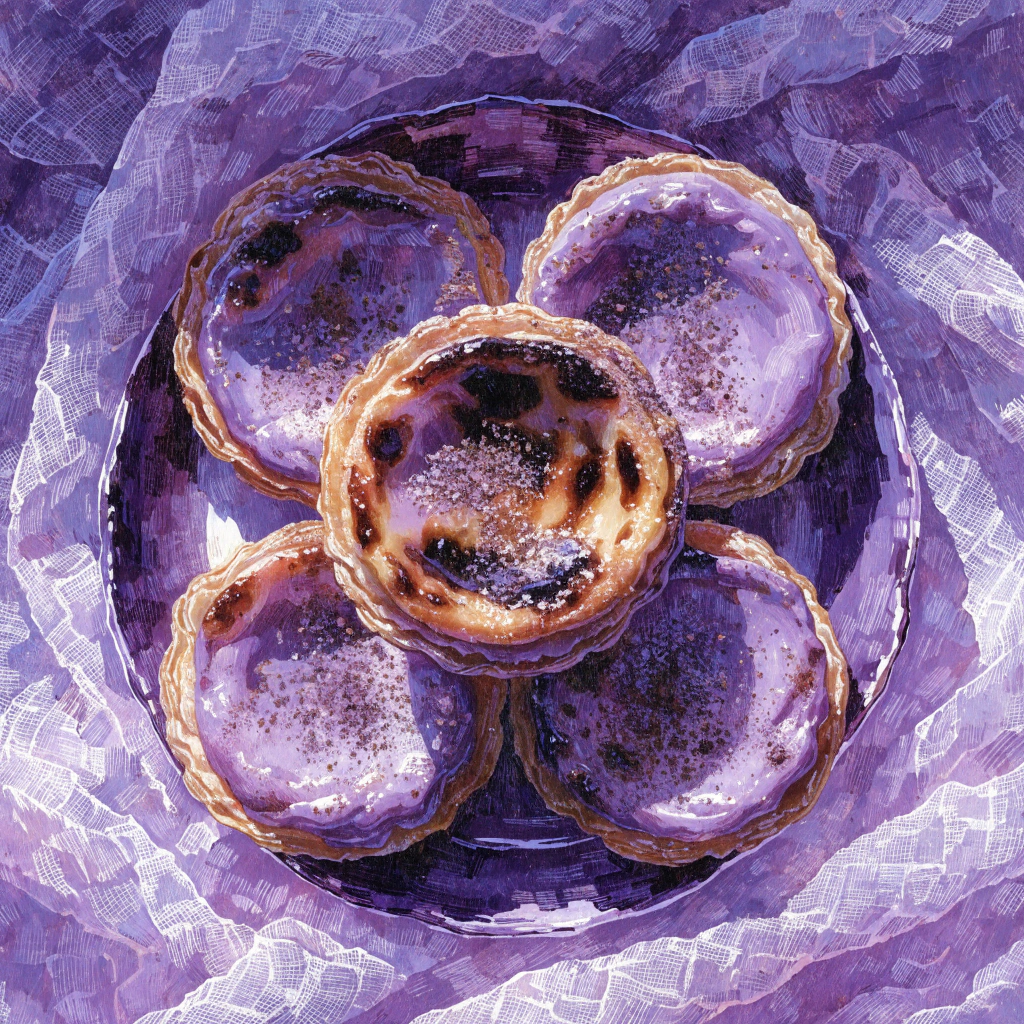
A Sweet Portuguese Treat
Portugal is a beautiful country. It has a very famous dessert. It is called Pastel de Nata. Many people love this small cake. It is a custard tart. It has egg yolks, milk, and sugar. The outside is thin and crispy. Long ago, monks in a monastery made the first cakes. Today, you can buy them in every cafe in Lisbon. People eat them with coffee. They are very delicious and sweet. Everyone enjoys this Portuguese tradition.
Point grammaire
Structure: Present Simple (to be)
"Portugal is a beautiful country."
We use 'is' with singular subjects like Portugal to describe a state or fact. It is the most common verb for beginners.
Structure: Present Simple (Regular Verbs)
"People eat them with coffee."
We use the base form of the verb 'eat' for plural subjects like 'people'. This shows a general habit or routine.
Teste ta compréhension
10 questions · A1 Débutant · 1 aperçu gratuit
Teste ce que tu as appris dans cet article. Réponds à toutes les questions pour gagner des XP !
Where is the Pastel de Nata from?
Tu veux terminer le quiz ?
9 questions supplémentaires t'attendent. Inscris-toi gratuitement pour débloquer le quiz complet et gagner des XP !
S'inscrire gratuitementTu as dj un compte ? Connexion
Bien joué !
Continue à pratiquer !
Déjà terminé — pas de XP supplémentaire
Inscris-toi pour gagner des XPDétail des questions
Where is the Pastel de Nata from?
Ta réponse:
Bonne réponse: Portugal
The Pastel de Nata is a custard tart.
Ta réponse:
Bonne réponse: Vrai
What does 'delicious' mean?
Ta réponse:
Bonne réponse: Tastes very good
People eat them with _____.
Ta réponse:
Bonne réponse: coffee
Le Pastel de Nata : Un Goût du Portugal
Le Pastel de Nata est un dessert très célèbre au Portugal. C'est une petite tarte à la crème, dorée et délicieuse. Son histoire est ancienne et intéressante. Au 18ème siècle, des moines vivaient dans un grand monastère à Belém, près de Lisbonne. Ils utilisaient beaucoup de blancs d'œufs pour repasser leurs vêtements religieux.
Mais que faire avec tous les jaunes d'œufs ? Les moines ont eu une bonne idée : ils ont créé des gâteaux ! Le Pastel de Nata est né de cette tradition. Après la fermeture des monastères, la recette a été vendue. Aujourd'hui, on peut trouver ces tartes partout au Portugal, et même dans d'autres pays. Elles sont parfaites avec un café. Beaucoup de gens pensent que c'est le meilleur dessert portugais, parce que c'est simple et très savoureux. C'est plus qu'un simple gâteau, c'est une partie de la culture portugaise.
Point grammaire
Structure: Le Passé Composé
"Le Pastel de Nata est né de cette tradition."
Le passé composé est utilisé pour parler d'actions terminées dans le passé. On le forme avec l'auxiliaire 'être' ou 'avoir' au présent et le participe passé du verbe. Ici, 'est né' vient du verbe 'naître' (to be born).
Structure: Les Comparatifs (plus... que)
"C'est plus qu'un simple gâteau..."
On utilise 'plus... que' pour comparer deux choses et dire qu'une est supérieure à l'autre. 'Plus' est suivi d'un adjectif ou d'un nom, et 'que' introduit l'élément de comparaison. Par exemple : 'Il est plus grand que moi'.
Teste ta compréhension
11 questions · A2 mentaire · 1 aperçu gratuit
Teste ce que tu as appris dans cet article. Réponds à toutes les questions pour gagner des XP !
Où est né le Pastel de Nata ?
Tu veux terminer le quiz ?
10 questions supplémentaires t'attendent. Inscris-toi gratuitement pour débloquer le quiz complet et gagner des XP !
S'inscrire gratuitementTu as dj un compte ? Connexion
Bien joué !
Continue à pratiquer !
Déjà terminé — pas de XP supplémentaire
Inscris-toi pour gagner des XPDétail des questions
Où est né le Pastel de Nata ?
Ta réponse:
Bonne réponse: Près de Lisbonne
Les moines utilisaient les jaunes d'œufs pour repasser leurs vêtements.
Ta réponse:
Bonne réponse: Faux
Que signifie 'monastère' ?
Ta réponse:
Bonne réponse: Un bâtiment où vivent des moines
Le Pastel de Nata est un dessert très ______ au Portugal.
Ta réponse:
Bonne réponse: célèbre
Avec quoi les Pastel de Nata sont-ils parfaits ?
Ta réponse:
Bonne réponse: Avec un café
Pastel de Nata: A Sweet Taste of Portuguese History
Portugal is famous for many things, but nothing is more iconic than the Pastel de Nata. This delicious custard tart, which is known for its creamy center and crispy crust, has been enjoyed by locals and tourists for centuries. If you visit Lisbon today, you will see these golden pastries in almost every bakery window.
The history of this sweet treat is deeply rooted in religious tradition. It was created by monks who lived at the Jerónimos Monastery in the district of Belém. During the 18th century, huge quantities of egg whites were used to starch religious robes. This process left a significant surplus of egg yolks. To avoid wasting these ingredients, the monks and nuns developed various recipes for sweet pastries.
After the Liberal Revolution in 1820, many religious orders were closed. To earn money, the monks began selling their custard tarts at a nearby sugar refinery. In 1837, the 'Fábrica de Pastéis de Belém' was opened, and the original recipe is still kept secret by the owners today. Only a few master chefs know the exact ingredients that are used to make the authentic version.
These tarts are usually served warm, straight from the oven. They are often topped with a sprinkle of cinnamon and powdered sugar, which adds a wonderful aroma. Today, the Pastel de Nata has become a global ambassador for Portuguese culture. It has been exported to cities all over the world, from London to New York and Macau.
For many travelers, eating a Pastel de Nata is an essential part of the Portuguese experience. It is a simple dessert that connects the past with the present. Whether you enjoy it with a strong cup of coffee or as a quick afternoon snack, it remains a timeless symbol of Portugal's culinary heritage.
Point grammaire
Structure: Passive Voice
"It was created by monks who lived at the Jerónimos Monastery in the district of Belém."
The passive voice is formed with the verb 'to be' and the past participle. We use it when the action or the object of the action is more important than the person doing it.
Structure: Present Perfect
"This delicious custard tart... has been enjoyed by locals and tourists for centuries."
The present perfect (have/has + past participle) connects the past to the present. Here, it shows that people started enjoying the tart in the past and continue to do so now.
Teste ta compréhension
11 questions · B1 Intermédiaire · 1 aperçu gratuit
Teste ce que tu as appris dans cet article. Réponds à toutes les questions pour gagner des XP !
Where was the Pastel de Nata originally created?
Tu veux terminer le quiz ?
10 questions supplémentaires t'attendent. Inscris-toi gratuitement pour débloquer le quiz complet et gagner des XP !
S'inscrire gratuitementTu as dj un compte ? Connexion
Bien joué !
Continue à pratiquer !
Déjà terminé — pas de XP supplémentaire
Inscris-toi pour gagner des XPDétail des questions
Where was the Pastel de Nata originally created?
Ta réponse:
Bonne réponse: At the Jerónimos Monastery in Belém
The original recipe for the Pastel de Nata is known by everyone today.
Ta réponse:
Bonne réponse: Faux
What is the meaning of 'authentic'?
Ta réponse:
Bonne réponse: Real and original
The original _____ is still kept secret by the owners of the bakery today.
Ta réponse:
Bonne réponse: recipe
Why did the monks have so many leftover egg yolks?
Ta réponse:
Bonne réponse: They used egg whites to starch their robes
The Pastel de Nata: A Golden Legacy of Portuguese Tradition
The Pastel de Nata stands as a quintessential symbol of Portuguese culinary heritage, transcending its status as a mere dessert to become a global ambassador for the nation's culture. While many tourists view it as a simple custard tart, its historical roots are deeply embedded in the religious traditions of the 18th century. Originally crafted by monks at the Jerónimos Monastery in Belém, Lisbon, the pastry's creation was born out of necessity rather than indulgence. During this era, monasteries utilized vast quantities of egg whites to starch religious habits and robes, ensuring they remained crisp and formal. Consequently, a significant surplus of egg yolks was generated. Rather than allowing these ingredients to go to waste, the monks and nuns developed various sweet recipes, with the Pastel de Nata emerging as their most celebrated achievement. This ingenuity allowed them to make use of every resource available within the monastic walls while providing a source of nourishment.
However, the trajectory of this pastry changed dramatically following the Liberal Revolution of 1820. As religious orders faced dissolution and funding was cut, the monks began selling the tarts to a local sugar refinery to generate vital income. Eventually, the secret recipe was sold to the refinery owners, who opened the 'Fábrica de Pastéis de Belém' in 1837. To this day, the original recipe remains a closely guarded secret, known only to a handful of master bakers who work in the 'Secret Room.' This exclusivity has only added to the allure of the pastry, making a visit to Belém a mandatory pilgrimage for food enthusiasts.
From a sociological perspective, the Pastel de Nata represents the resilience of Portuguese tradition in the face of political upheaval. It has evolved from a monastic byproduct into a sophisticated global phenomenon. The contrast between the crispy, flaky pastry and the creamy, scorched custard provides a sensory experience that mirrors the complexity of Portugal’s own history. Furthermore, the global expansion of this treat serves as a testament to the enduring appeal of authentic, locally-sourced culinary craftsmanship. In an age of mass-produced snacks, the Pastel de Nata remains a distinctive emblem of quality and cultural pride, proving that even the simplest recipes can carry the weight of a nation’s identity.
Point grammaire
Structure: Passive Voice (Past Simple)
"a significant surplus of egg yolks was generated."
Used to focus on the action or the object receiving the action rather than the subject. It is formed using 'was/were' + the past participle.
Structure: Participial Phrases
"Originally crafted by monks at the Jerónimos Monastery in Belém, Lisbon, the pastry's creation was born out of necessity."
These phrases function as adjectives to describe a noun. They allow for more concise and sophisticated sentence structures in formal writing.
Structure: Non-defining Relative Clauses
"the refinery owners, who opened the 'Fábrica de Pastéis de Belém' in 1837."
These provide extra, non-essential information about a noun and are always separated by commas. They are common in academic and descriptive texts.
Teste ta compréhension
11 questions · B2 Intermédiaire supérieur · 1 aperçu gratuit
Teste ce que tu as appris dans cet article. Réponds à toutes les questions pour gagner des XP !
Why did the monks originally have so many egg yolks left over?
Tu veux terminer le quiz ?
10 questions supplémentaires t'attendent. Inscris-toi gratuitement pour débloquer le quiz complet et gagner des XP !
S'inscrire gratuitementTu as dj un compte ? Connexion
Bien joué !
Continue à pratiquer !
Déjà terminé — pas de XP supplémentaire
Inscris-toi pour gagner des XPDétail des questions
Why did the monks originally have so many egg yolks left over?
Ta réponse:
Bonne réponse: They used the egg whites to starch their clothes.
The original recipe for the Pastel de Nata is now public knowledge and used by all bakeries in Lisbon.
Ta réponse:
Bonne réponse: Faux
What does 'resilience' mean in the context of the article?
Ta réponse:
Bonne réponse: The capacity to recover and survive through difficult political times.
The pastry was originally crafted by monks at the Jerónimos _____ in Lisbon.
Ta réponse:
Bonne réponse: Monastery
What event led to the monks selling their secret recipe?
Ta réponse:
Bonne réponse: The Liberal Revolution of 1820.
Beyond the Crust: The Sociocultural Resilience of the Pastel de Nata
Rarely does a culinary artifact achieve such profound global resonance as the Pastel de Nata, the iconic Portuguese custard tart. While today it is a ubiquitous feature of international bakeries from London to Shanghai, its origins are steeped in the ecclesiastical traditions of 18th-century Lisbon. To understand the Pastel de Nata is to understand the resilience of Portuguese culture through centuries of political and social upheaval.
The narrative begins within the cloisters of the Jerónimos Monastery in Belém. During this era, the starching of religious habits was a common practice, requiring vast quantities of egg whites. This process inevitably led to a significant surplus of egg yolks, which the monks, resourceful by necessity, repurposed into various confections. It was within this environment of monastic frugality that the original recipe was born—a delicate balance of flaky puff pastry and creamy custard, charred to perfection.
However, the peaceful existence of the monastery was not to last. It was the Liberal Revolution of 1820 that ultimately catalyzed the transition of this pastry from a cloistered secret to a commercial sensation. Following the closure of many religious institutions, the monks began selling the tarts to a nearby sugar refinery to secure their livelihood. By 1837, the 'Pastéis de Belém' bakery opened its doors, utilizing the secret recipe that remains unchanged to this day. This shift from religious vestiges to a market-driven commodity illustrates the broader secularization of Portuguese society during the 19th century.
The global proliferation of the tart serves as a testament to Portugal’s colonial and modern influence. From the 'dan tat' in Macau to the gourmet versions found in New York, the Pastel de Nata has undergone various iterations. Yet, for many, the authenticity of the experience remains tied to the artisanal craftsmanship found in the streets of Lisbon. The tension between mass production and traditional methods raises poignant questions about the homogenization of global food culture. Can a mass-produced version ever truly capture the soul of the original?
Furthermore, the Pastel de Nata acts as a form of soft power. It is not merely a dessert; it is a cultural hallmark that invites international dialogue. The meticulous preparation—the specific temperature of the oven, the exact lamination of the dough—reflects a commitment to heritage that persists despite the pressures of modernization. In conclusion, the Pastel de Nata is a symbol of historical continuity. It bridges the gap between the sacred and the profane, the local and the global, and the past and the present. Its enduring popularity ensures that even as the world changes, these small, golden vestiges of Portuguese history will remain a staple of the global palate.
Point grammaire
Structure: Inversion
"Rarely does a culinary artifact achieve such profound global resonance as the Pastel de Nata, the iconic Portuguese custard tart."
Inversion occurs when the auxiliary verb precedes the subject after restrictive adverbs like 'rarely'. It is used to add emphasis and a formal, literary tone.
Structure: Cleft Sentences
"It was the Liberal Revolution of 1820 that ultimately catalyzed the transition of this pastry from a cloistered secret to a commercial sensation."
Cleft sentences use the structure 'It is/was... that...' to focus on a specific piece of information. They highlight the cause or the agent of an action.
Structure: Nominalisation
"The global proliferation of the tart serves as a testament to Portugal’s colonial and modern influence."
Nominalisation turns verbs (proliferate) into nouns (proliferation). This technique allows writers to discuss complex concepts as objects, making the writing more concise and academic.
Teste ta compréhension
12 questions · C1 Avancé · 1 aperçu gratuit
Teste ce que tu as appris dans cet article. Réponds à toutes les questions pour gagner des XP !
What was the primary reason for the abundance of egg yolks in 18th-century monasteries?
Tu veux terminer le quiz ?
11 questions supplémentaires t'attendent. Inscris-toi gratuitement pour débloquer le quiz complet et gagner des XP !
S'inscrire gratuitementTu as dj un compte ? Connexion
Bien joué !
Continue à pratiquer !
Déjà terminé — pas de XP supplémentaire
Inscris-toi pour gagner des XPDétail des questions
What was the primary reason for the abundance of egg yolks in 18th-century monasteries?
Ta réponse:
Bonne réponse: Egg whites were used extensively for starching religious clothing.
The original recipe for Pastel de Nata was lost during the Liberal Revolution of 1820.
Ta réponse:
Bonne réponse: Faux
Which word describes the process of making different things uniform and similar?
Ta réponse:
Bonne réponse: Homogenization
The shift from religious _____ to a market-driven commodity illustrates secularization.
Ta réponse:
Bonne réponse: vestiges
Why did the monks initially begin selling the tarts to the public?
Ta réponse:
Bonne réponse: To maintain their livelihood after religious institutions were closed.
The Pastel de Nata is described in the text as a form of 'soft power' for Portugal.
Ta réponse:
Bonne réponse: Vrai
Le Pastel de Nata : Une Odyssée Culinaire, de l'Ascétisme Monastique à l'Hégémonie Mondiale
Force est de constater que peu de douceurs parviennent à transcender leur vocation première pour s'ériger en véritables emblèmes nationaux, voire en ambassadeurs culturels planétaires. Le pastel de nata, cette modeste tartelette à la crème, constitue sans conteste un parangon de cette ascension fulgurante. Loin de n'être qu'une simple friandise, il incarne une part intrinsèque de l'identité portugaise, dont la pérennité historique et la portée culturelle interpellent, invitant à une exégèse approfondie de ses origines et de son rayonnement contemporain.
L'histoire de ce délice crémeux est inextricablement liée aux traditions monastiques du Portugal du XVIIIe siècle. Il est plausible de supposer que son berceau fut le Mosteiro dos Jerónimos, à Belém, près de Lisbonne. À cette époque, les couvents et monastères, gardiens du savoir et de l'innovation culinaire, utilisaient d'importantes quantités de blancs d'œufs. Ceux-ci servaient principalement à l'amidonnage des habits religieux et des robes, une pratique courante pour conférer tenue et dignité aux étoffes. Cette utilisation intensive laissait inévitablement une pléthore de jaunes d'œufs inutilisés, dont la gestion représentait un défi logistique et économique. Plutôt que de les gaspiller, moines et nonnes firent preuve d'une ingéniosité remarquable, les intégrant à une multitude de pâtisseries, dont les recettes, souvent secrètes, sont devenues un héritage gastronomique inestimable. Le pastel de nata, avec sa garniture riche et onctueuse, émane directement de cette nécessité impérieuse de valoriser ces excédents.
La Révolution libérale portugaise et la subséquente suppression des ordres religieux en 1834 marquèrent un tournant décisif. Contraints de subsister par leurs propres moyens, les moines de Jerónimos commencèrent à vendre leurs tartelettes dans une raffinerie de sucre voisine, avant de céder la recette à un entrepreneur en 1837. C'est ainsi que la "Fábrica de Pastéis de Belém" vit le jour, un établissement qui, aujourd'hui encore, perpétue la tradition avec une ferveur quasi religieuse, utilisant une recette dont le secret est jalousement gardé et transmise de génération en génération. L'expérience y est presque rituelle : déguster un pastel de nata tiède, saupoudré de cannelle et de sucre glace, dans l'ambiance séculaire de la fabrique, constitue un pèlerinage pour nombre de gourmands et d'historiens culinaires.
Mais comment ce modeste délice a-t-il pu transcender les frontières portugaises pour s'imposer sur la scène gastronomique mondiale ? Sa simplicité apparente masque une complexité d'exécution et un équilibre des saveurs qui le rendent universellement appréciable. La croûte feuilletée, croustillante à souhait, contrastant avec la crème brûlée à la surface, offre une texture et un goût inimitables. Ce faisant, le pastel de nata ne se contente pas d'être un dessert ; il se mue en un véhicule culturel, un ambassadeur silencieux mais éloquent du Portugal. Où que l'on aille dans le monde, des marchés asiatiques aux cafés européens, sa présence évoque instantanément l'âme lusitanienne, ses traditions, son histoire et sa convivialité.
Il est indéniable que son succès planétaire a engendré une prolifération d'imitations, dont la qualité fluctue considérablement. Néanmoins, l'authentique pastel de nata, celui qui respecte scrupuleusement la recette originelle et les méthodes de fabrication ancestrales, conserve une aura inégalée. Il n'est pas rare d'entendre des puristes arguer que seul celui de Belém possède la véritable essence, une assertion qui, quoique subjective, témoigne de l'attachement viscéral des Portugais à leur patrimoine culinaire. Cette exigence de fidélité à l'original participe à la pérennité de son mythe.
En définitive, le pastel de nata est bien plus qu'une simple pâtisserie ; il est une entité consubstantielle à l'identité portugaise. Son parcours, de l'austérité monastique à l'exubérance des tables mondiales, est une allégorie de la capacité du Portugal à imprégner le monde de sa culture, tout en conservant une authenticité farouche. Il est un testament vivant de l'ingéniosité humaine face à la contrainte, et un rappel délicieux que les plus grandes histoires naissent parfois des besoins les plus prosaïques. Quoique son hégémonie culinaire ne soit plus à prouver, il demeure, pour qui sait l'apprécier, un fragment d'âme portugaise à chaque bouchée, une invitation à un voyage sensoriel et historique inoubliable.
Point grammaire
Structure: L'emploi de "dont" comme pronom relatif de possession
"Loin de n'être qu'une simple friandise, il incarne une part intrinsèque de l'identité portugaise, dont la pérennité historique et la portée culturelle interpellent, invitant à une exégèse approfondie de ses origines et de son rayonnement contemporain."
Le pronom relatif "dont" est utilisé ici pour exprimer la possession ou l'appartenance. Il remplace "de qui" ou "de quoi" et permet de relier un nom (ici, "la pérennité historique et la portée culturelle") à un antécédent (ici, "l'identité portugaise") sans répéter la préposition "de". Le verbe qui suit "dont" s'accorde avec le sujet introduit par "dont".
Structure: L'expression impersonnelle "Il est plausible de supposer que..."
"Il est plausible de supposer que son berceau fut le Mosteiro dos Jerónimos, à Belém, près de Lisbonne."
Cette construction impersonnelle est fréquemment employée pour introduire une hypothèse ou une idée avec une certaine prudence ou un degré de vraisemblance. Elle permet d'exprimer une possibilité de manière nuancée, conférant un ton plus académique ou mesuré au propos.
Structure: La conjonction "Quoique" suivie du subjonctif
"Quoique son hégémonie culinaire ne soit plus à prouver, il demeure, pour qui sait l'apprécier, un fragment d'âme portugaise à chaque bouchée, une invitation à un voyage sensoriel et historique inoubliable."
La conjonction "quoique" (ou "bien que") introduit une proposition subordonnée exprimant une concession, c'est-à-dire un fait qui pourrait s'opposer à la proposition principale sans l'empêcher. Elle est toujours suivie du subjonctif, soulignant le caractère hypothétique ou subjectif de la concession.
Teste ta compréhension
12 questions · C2 Maîtrise · 1 aperçu gratuit
Teste ce que tu as appris dans cet article. Réponds à toutes les questions pour gagner des XP !
Quelle était la principale utilisation des blancs d'œufs dans les monastères du XVIIIe siècle au Portugal ?
Tu veux terminer le quiz ?
11 questions supplémentaires t'attendent. Inscris-toi gratuitement pour débloquer le quiz complet et gagner des XP !
S'inscrire gratuitementTu as dj un compte ? Connexion
Bien joué !
Continue à pratiquer !
Déjà terminé — pas de XP supplémentaire
Inscris-toi pour gagner des XPDétail des questions
Quelle était la principale utilisation des blancs d'œufs dans les monastères du XVIIIe siècle au Portugal ?
Ta réponse:
Bonne réponse: Pour amidonner les habits religieux
La recette de la Fábrica de Pastéis de Belém est aujourd'hui accessible au public.
Ta réponse:
Bonne réponse: Faux
Que signifie le mot "parangon" dans le contexte de l'article ?
Ta réponse:
Bonne réponse: Un modèle parfait
Le pastel de nata émane directement de cette nécessité __________ de valoriser ces excédents de jaunes d'œufs.
Ta réponse:
Bonne réponse: impérieuse
Quel événement historique a marqué un tournant décisif pour les monastères et la vente des pastéis de nata ?
Ta réponse:
Bonne réponse: La Révolution libérale portugaise et la suppression des ordres religieux
L'article affirme que seuls les pastéis de Belém possèdent la véritable essence de la pâtisserie.
Ta réponse:
Bonne réponse: Faux

