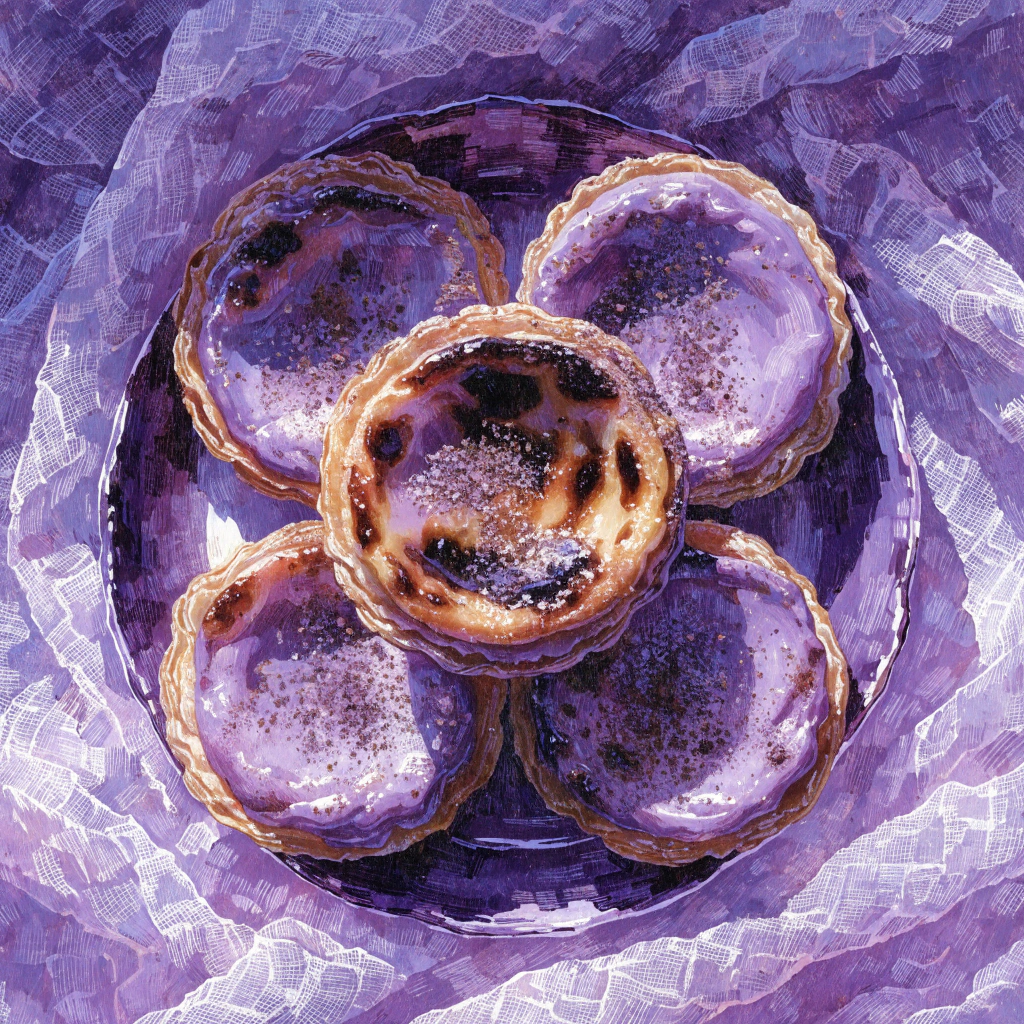
A Sweet Portuguese Treat
Portugal is a beautiful country. It has a very famous dessert. It is called Pastel de Nata. Many people love this small cake. It is a custard tart. It has egg yolks, milk, and sugar. The outside is thin and crispy. Long ago, monks in a monastery made the first cakes. Today, you can buy them in every cafe in Lisbon. People eat them with coffee. They are very delicious and sweet. Everyone enjoys this Portuguese tradition.
Gramática em destaque
Padrão: Present Simple (to be)
"Portugal is a beautiful country."
We use 'is' with singular subjects like Portugal to describe a state or fact. It is the most common verb for beginners.
Padrão: Present Simple (Regular Verbs)
"People eat them with coffee."
We use the base form of the verb 'eat' for plural subjects like 'people'. This shows a general habit or routine.
Teste sua compreensão
10 perguntas · A1 Iniciante · 1 pré-visualização grátis
Teste o que aprendeu neste artigo. Responda todas as perguntas para ganhar XP!
Where is the Pastel de Nata from?
Quer finalizar o quiz?
9 perguntas a mais estão esperando por você. Cadastre-se grátis para desbloquear o quiz completo e ganhar XP!
Cadastrar grátisJá tem conta? Entrar
Detalhamento das perguntas
Where is the Pastel de Nata from?
Sua resposta:
Resposta correta: Portugal
The Pastel de Nata is a custard tart.
Sua resposta:
Resposta correta: Verdadeiro
What does 'delicious' mean?
Sua resposta:
Resposta correta: Tastes very good
People eat them with _____.
Sua resposta:
Resposta correta: coffee
The Sweet Story of Pastel de Nata
The Pastel de Nata is a famous sweet from Portugal. It is a small custard tart with a golden top. Many people love it because it is delicious. The story began a long time ago in the 18th century. Monks at the Jerónimos Monastery in Lisbon created the recipe. They used many egg yolks to make the cream. At that time, they used egg whites to clean their clothes, so they had many yolks left.
In 1834, the monastery closed. The monks needed money, so they started to sell the tarts to a local shop. This shop became the famous Pastéis de Belém. Today, this shop is older than most other bakeries in the city. It is very popular with tourists and local people.
People usually eat the tart while it is warm. It is better with cinnamon and powdered sugar on top. The crust is more crunchy than a normal cake. Now, you can find this dessert in many countries, but the original version is still the best.
Gramática em destaque
Padrão: Past Simple
"Monks at the Jerónimos Monastery in Lisbon created the recipe."
We use the past simple to talk about finished actions in the past. For regular verbs, we add -ed to the base form.
Padrão: Comparatives
"The crust is more crunchy than a normal cake."
We use 'more + adjective + than' to compare two things when the adjective is long. It shows the difference between them.
Teste sua compreensão
11 perguntas · A2 Elementar · 1 pré-visualização grátis
Teste o que aprendeu neste artigo. Responda todas as perguntas para ganhar XP!
Where did the monks first make the Pastel de Nata?
Quer finalizar o quiz?
10 perguntas a mais estão esperando por você. Cadastre-se grátis para desbloquear o quiz completo e ganhar XP!
Cadastrar grátisJá tem conta? Entrar
Detalhamento das perguntas
Where did the monks first make the Pastel de Nata?
Sua resposta:
Resposta correta: At the Jerónimos Monastery
The monks used egg whites to make the custard cream.
Sua resposta:
Resposta correta: Falso
What does 'bakery' mean?
Sua resposta:
Resposta correta: A place where bread and cakes are made
The monks started to _____ the tarts because they needed money.
Sua resposta:
Resposta correta: sell
What do people usually put on top of the tart?
Sua resposta:
Resposta correta: Cinnamon and sugar
Pastel de Nata: A Sweet Taste of Portuguese History
Portugal is famous for many things, but nothing is more iconic than the Pastel de Nata. This delicious custard tart, which is known for its creamy center and crispy crust, has been enjoyed by locals and tourists for centuries. If you visit Lisbon today, you will see these golden pastries in almost every bakery window.
The history of this sweet treat is deeply rooted in religious tradition. It was created by monks who lived at the Jerónimos Monastery in the district of Belém. During the 18th century, huge quantities of egg whites were used to starch religious robes. This process left a significant surplus of egg yolks. To avoid wasting these ingredients, the monks and nuns developed various recipes for sweet pastries.
After the Liberal Revolution in 1820, many religious orders were closed. To earn money, the monks began selling their custard tarts at a nearby sugar refinery. In 1837, the 'Fábrica de Pastéis de Belém' was opened, and the original recipe is still kept secret by the owners today. Only a few master chefs know the exact ingredients that are used to make the authentic version.
These tarts are usually served warm, straight from the oven. They are often topped with a sprinkle of cinnamon and powdered sugar, which adds a wonderful aroma. Today, the Pastel de Nata has become a global ambassador for Portuguese culture. It has been exported to cities all over the world, from London to New York and Macau.
For many travelers, eating a Pastel de Nata is an essential part of the Portuguese experience. It is a simple dessert that connects the past with the present. Whether you enjoy it with a strong cup of coffee or as a quick afternoon snack, it remains a timeless symbol of Portugal's culinary heritage.
Gramática em destaque
Padrão: Passive Voice
"It was created by monks who lived at the Jerónimos Monastery in the district of Belém."
The passive voice is formed with the verb 'to be' and the past participle. We use it when the action or the object of the action is more important than the person doing it.
Padrão: Present Perfect
"This delicious custard tart... has been enjoyed by locals and tourists for centuries."
The present perfect (have/has + past participle) connects the past to the present. Here, it shows that people started enjoying the tart in the past and continue to do so now.
Teste sua compreensão
11 perguntas · B1 Intermediário · 1 pré-visualização grátis
Teste o que aprendeu neste artigo. Responda todas as perguntas para ganhar XP!
Where was the Pastel de Nata originally created?
Quer finalizar o quiz?
10 perguntas a mais estão esperando por você. Cadastre-se grátis para desbloquear o quiz completo e ganhar XP!
Cadastrar grátisJá tem conta? Entrar
Detalhamento das perguntas
Where was the Pastel de Nata originally created?
Sua resposta:
Resposta correta: At the Jerónimos Monastery in Belém
The original recipe for the Pastel de Nata is known by everyone today.
Sua resposta:
Resposta correta: Falso
What is the meaning of 'authentic'?
Sua resposta:
Resposta correta: Real and original
The original _____ is still kept secret by the owners of the bakery today.
Sua resposta:
Resposta correta: recipe
Why did the monks have so many leftover egg yolks?
Sua resposta:
Resposta correta: They used egg whites to starch their robes
The Pastel de Nata: A Golden Legacy of Portuguese Tradition
The Pastel de Nata stands as a quintessential symbol of Portuguese culinary heritage, transcending its status as a mere dessert to become a global ambassador for the nation's culture. While many tourists view it as a simple custard tart, its historical roots are deeply embedded in the religious traditions of the 18th century. Originally crafted by monks at the Jerónimos Monastery in Belém, Lisbon, the pastry's creation was born out of necessity rather than indulgence. During this era, monasteries utilized vast quantities of egg whites to starch religious habits and robes, ensuring they remained crisp and formal. Consequently, a significant surplus of egg yolks was generated. Rather than allowing these ingredients to go to waste, the monks and nuns developed various sweet recipes, with the Pastel de Nata emerging as their most celebrated achievement. This ingenuity allowed them to make use of every resource available within the monastic walls while providing a source of nourishment.
However, the trajectory of this pastry changed dramatically following the Liberal Revolution of 1820. As religious orders faced dissolution and funding was cut, the monks began selling the tarts to a local sugar refinery to generate vital income. Eventually, the secret recipe was sold to the refinery owners, who opened the 'Fábrica de Pastéis de Belém' in 1837. To this day, the original recipe remains a closely guarded secret, known only to a handful of master bakers who work in the 'Secret Room.' This exclusivity has only added to the allure of the pastry, making a visit to Belém a mandatory pilgrimage for food enthusiasts.
From a sociological perspective, the Pastel de Nata represents the resilience of Portuguese tradition in the face of political upheaval. It has evolved from a monastic byproduct into a sophisticated global phenomenon. The contrast between the crispy, flaky pastry and the creamy, scorched custard provides a sensory experience that mirrors the complexity of Portugal’s own history. Furthermore, the global expansion of this treat serves as a testament to the enduring appeal of authentic, locally-sourced culinary craftsmanship. In an age of mass-produced snacks, the Pastel de Nata remains a distinctive emblem of quality and cultural pride, proving that even the simplest recipes can carry the weight of a nation’s identity.
Gramática em destaque
Padrão: Passive Voice (Past Simple)
"a significant surplus of egg yolks was generated."
Used to focus on the action or the object receiving the action rather than the subject. It is formed using 'was/were' + the past participle.
Padrão: Participial Phrases
"Originally crafted by monks at the Jerónimos Monastery in Belém, Lisbon, the pastry's creation was born out of necessity."
These phrases function as adjectives to describe a noun. They allow for more concise and sophisticated sentence structures in formal writing.
Padrão: Non-defining Relative Clauses
"the refinery owners, who opened the 'Fábrica de Pastéis de Belém' in 1837."
These provide extra, non-essential information about a noun and are always separated by commas. They are common in academic and descriptive texts.
Teste sua compreensão
11 perguntas · B2 Intermediário superior · 1 pré-visualização grátis
Teste o que aprendeu neste artigo. Responda todas as perguntas para ganhar XP!
Why did the monks originally have so many egg yolks left over?
Quer finalizar o quiz?
10 perguntas a mais estão esperando por você. Cadastre-se grátis para desbloquear o quiz completo e ganhar XP!
Cadastrar grátisJá tem conta? Entrar
Detalhamento das perguntas
Why did the monks originally have so many egg yolks left over?
Sua resposta:
Resposta correta: They used the egg whites to starch their clothes.
The original recipe for the Pastel de Nata is now public knowledge and used by all bakeries in Lisbon.
Sua resposta:
Resposta correta: Falso
What does 'resilience' mean in the context of the article?
Sua resposta:
Resposta correta: The capacity to recover and survive through difficult political times.
The pastry was originally crafted by monks at the Jerónimos _____ in Lisbon.
Sua resposta:
Resposta correta: Monastery
What event led to the monks selling their secret recipe?
Sua resposta:
Resposta correta: The Liberal Revolution of 1820.
Beyond the Crust: The Sociocultural Resilience of the Pastel de Nata
Rarely does a culinary artifact achieve such profound global resonance as the Pastel de Nata, the iconic Portuguese custard tart. While today it is a ubiquitous feature of international bakeries from London to Shanghai, its origins are steeped in the ecclesiastical traditions of 18th-century Lisbon. To understand the Pastel de Nata is to understand the resilience of Portuguese culture through centuries of political and social upheaval.
The narrative begins within the cloisters of the Jerónimos Monastery in Belém. During this era, the starching of religious habits was a common practice, requiring vast quantities of egg whites. This process inevitably led to a significant surplus of egg yolks, which the monks, resourceful by necessity, repurposed into various confections. It was within this environment of monastic frugality that the original recipe was born—a delicate balance of flaky puff pastry and creamy custard, charred to perfection.
However, the peaceful existence of the monastery was not to last. It was the Liberal Revolution of 1820 that ultimately catalyzed the transition of this pastry from a cloistered secret to a commercial sensation. Following the closure of many religious institutions, the monks began selling the tarts to a nearby sugar refinery to secure their livelihood. By 1837, the 'Pastéis de Belém' bakery opened its doors, utilizing the secret recipe that remains unchanged to this day. This shift from religious vestiges to a market-driven commodity illustrates the broader secularization of Portuguese society during the 19th century.
The global proliferation of the tart serves as a testament to Portugal’s colonial and modern influence. From the 'dan tat' in Macau to the gourmet versions found in New York, the Pastel de Nata has undergone various iterations. Yet, for many, the authenticity of the experience remains tied to the artisanal craftsmanship found in the streets of Lisbon. The tension between mass production and traditional methods raises poignant questions about the homogenization of global food culture. Can a mass-produced version ever truly capture the soul of the original?
Furthermore, the Pastel de Nata acts as a form of soft power. It is not merely a dessert; it is a cultural hallmark that invites international dialogue. The meticulous preparation—the specific temperature of the oven, the exact lamination of the dough—reflects a commitment to heritage that persists despite the pressures of modernization. In conclusion, the Pastel de Nata is a symbol of historical continuity. It bridges the gap between the sacred and the profane, the local and the global, and the past and the present. Its enduring popularity ensures that even as the world changes, these small, golden vestiges of Portuguese history will remain a staple of the global palate.
Gramática em destaque
Padrão: Inversion
"Rarely does a culinary artifact achieve such profound global resonance as the Pastel de Nata, the iconic Portuguese custard tart."
Inversion occurs when the auxiliary verb precedes the subject after restrictive adverbs like 'rarely'. It is used to add emphasis and a formal, literary tone.
Padrão: Cleft Sentences
"It was the Liberal Revolution of 1820 that ultimately catalyzed the transition of this pastry from a cloistered secret to a commercial sensation."
Cleft sentences use the structure 'It is/was... that...' to focus on a specific piece of information. They highlight the cause or the agent of an action.
Padrão: Nominalisation
"The global proliferation of the tart serves as a testament to Portugal’s colonial and modern influence."
Nominalisation turns verbs (proliferate) into nouns (proliferation). This technique allows writers to discuss complex concepts as objects, making the writing more concise and academic.
Teste sua compreensão
12 perguntas · C1 Avançado · 1 pré-visualização grátis
Teste o que aprendeu neste artigo. Responda todas as perguntas para ganhar XP!
What was the primary reason for the abundance of egg yolks in 18th-century monasteries?
Quer finalizar o quiz?
11 perguntas a mais estão esperando por você. Cadastre-se grátis para desbloquear o quiz completo e ganhar XP!
Cadastrar grátisJá tem conta? Entrar
Detalhamento das perguntas
What was the primary reason for the abundance of egg yolks in 18th-century monasteries?
Sua resposta:
Resposta correta: Egg whites were used extensively for starching religious clothing.
The original recipe for Pastel de Nata was lost during the Liberal Revolution of 1820.
Sua resposta:
Resposta correta: Falso
Which word describes the process of making different things uniform and similar?
Sua resposta:
Resposta correta: Homogenization
The shift from religious _____ to a market-driven commodity illustrates secularization.
Sua resposta:
Resposta correta: vestiges
Why did the monks initially begin selling the tarts to the public?
Sua resposta:
Resposta correta: To maintain their livelihood after religious institutions were closed.
The Pastel de Nata is described in the text as a form of 'soft power' for Portugal.
Sua resposta:
Resposta correta: Verdadeiro
The Gastronomic Palimpsest: Deciphering the Cultural Semiotics of the Pastel de Nata
To perceive the Pastel de Nata as a mere confection is to fundamentally misinterpret the semiotic weight it carries within the Lusophone zeitgeist. This iconic custard tart, with its charred, blistered surface and auditory-satisfying lamination, serves as a culinary palimpsest—a layer of modern consumerism atop a deep, ecclesiastical history. Its genesis is inextricably linked to the Jerónimos Monastery in Belém, where 18th-century monks operated within a peculiar socioeconomic framework. At the time, monasteries were the vanguard of vestiary maintenance; vast quantities of egg whites were utilized to starch religious habits, a process essential for maintaining the rigid aesthetic of the clergy. Consequently, this created a formidable surplus of egg yolks, an avian byproduct that the monks, through a stroke of culinary alchemy, transmuted into the rich, custard-filled pastries we recognize today.
However, the transition from monastic secret to global commodity was precipitated by the geopolitical upheaval of the 19th century. Following the Liberal Revolution of 1820, the subsequent dissolution of religious orders in 1834 forced the clergy into a state of precariousness. In a bid for survival, the monks began selling the 'Pastéis de Belém' to a nearby sugar refinery. This secularization of the recipe marked the beginning of its proliferation across the urban landscape of Lisbon and, eventually, the world. Should one venture into the labyrinthine alleys of Belém today, the olfactory allure of cinnamon and scorched cream remains a testament to this transition. It is not merely the taste that captures the epicurean imagination, but the juxtaposition of textures: the ephemeral crispness of the puff pastry against the unctuous, velvet-like density of the filling.
From an analytical perspective, the Pastel de Nata functions as a metonym for the Portuguese identity itself—resilient, traditional, yet adaptable to the forces of globalization. Having been forged in the crucible of religious asceticism, the tart now navigates the complexities of mass tourism. It is imperative that the pastry be consumed while still warm, ideally dusted with a judicious amount of cinnamon and icing sugar, to fully appreciate the Maillard reaction that gives the crust its characteristic bitterness. This bitterness provides a necessary counterpoint to the saccharine custard, achieving a structural harmony that mimics the balanced architecture of the monastery from which it emerged. Furthermore, its global diffusion, particularly through Macao to the wider Asian market, illustrates the enduring legacy of Portuguese maritime influence. Albeit a humble pastry, it carries the historical baggage of empires, revolutions, and the eventual triumph of artisanal craft over industrial homogeneity. To consume a Pastel de Nata is, therefore, to engage in a ritualistic consumption of history, where each bite reveals a layer of a sacrosanct past hitherto hidden by the veneer of modern tourism.
Gramática em destaque
Padrão: Inverted Conditionals
"Should one venture into the labyrinthine alleys of Belém today, the olfactory allure of cinnamon and scorched cream remains a testament to this transition."
This formal construction replaces 'if' with the auxiliary verb 'should' placed before the subject. It is common in C2 academic prose to add a tone of hypothetical elegance.
Padrão: The Mandative Subjunctive
"It is imperative that the pastry be consumed while still warm..."
Used after adjectives or verbs expressing necessity or demand. The base form of the verb (be) is used regardless of the subject, indicating a required action.
Padrão: Perfect Participle Clause
"Having been forged in the crucible of religious asceticism, the tart now navigates the complexities of mass tourism."
This clause shows that one action was completed before another. It allows for a sophisticated way to link historical cause with present effect in a single sentence.
Teste sua compreensão
12 perguntas · C2 Domínio · 1 pré-visualização grátis
Teste o que aprendeu neste artigo. Responda todas as perguntas para ganhar XP!
What was the primary reason the monks initially had an abundance of egg yolks?
Quer finalizar o quiz?
11 perguntas a mais estão esperando por você. Cadastre-se grátis para desbloquear o quiz completo e ganhar XP!
Cadastrar grátisJá tem conta? Entrar
Detalhamento das perguntas
What was the primary reason the monks initially had an abundance of egg yolks?
Sua resposta:
Resposta correta: Egg whites were used as a starching agent for their garments.
The Liberal Revolution of 1820 directly led to the commercialization of the Pastel de Nata.
Sua resposta:
Resposta correta: Verdadeiro
Which word describes the process of something becoming non-religious?
Sua resposta:
Resposta correta: Secularization
The author describes the tart as a _____ for Portuguese identity, meaning it represents the whole culture.
Sua resposta:
Resposta correta: metonym
According to the text, what provides the necessary sensory balance to the sweet custard?
Sua resposta:
Resposta correta: The slight bitterness from the Maillard reaction on the crust.
The article argues that the Pastel de Nata has lost all its historical meaning due to modern tourism.
Sua resposta:
Resposta correta: Falso

