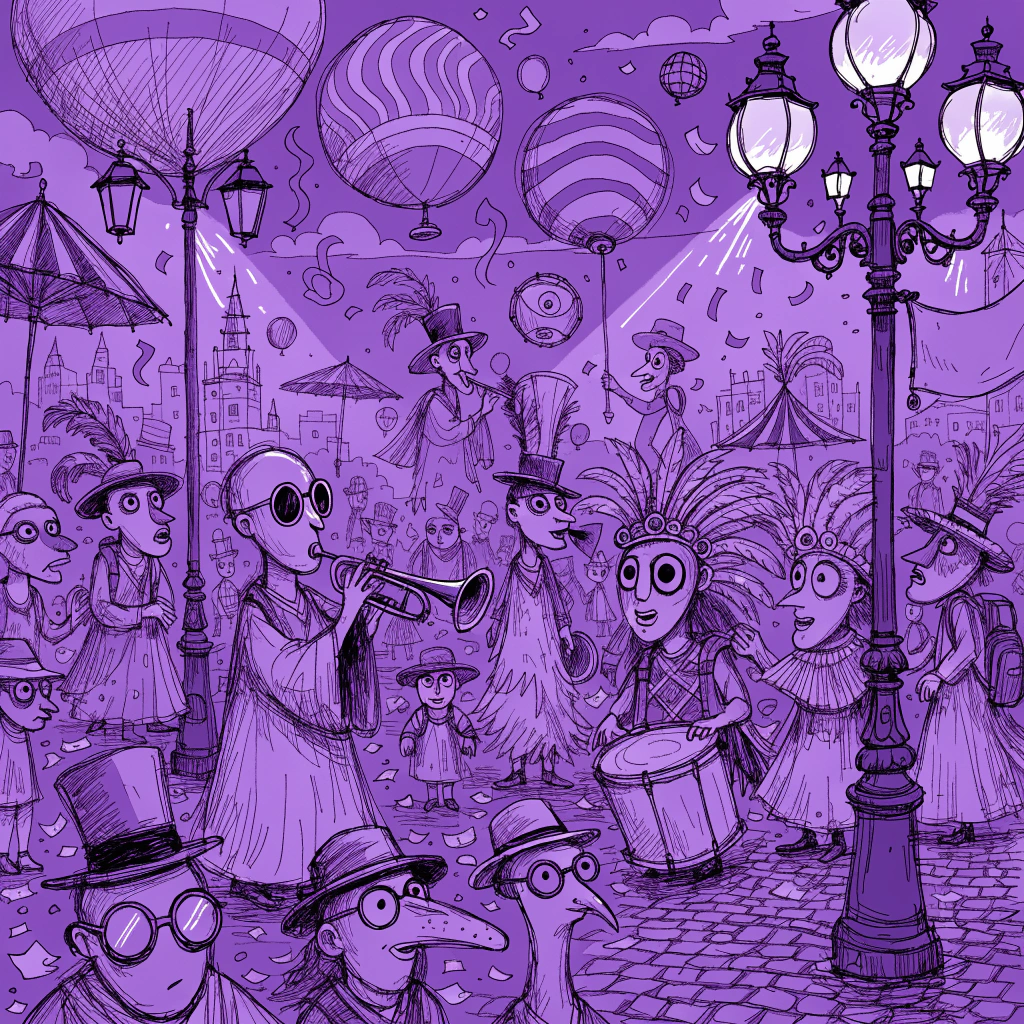
Carnaval in Portugal
Carnaval is a very big party in Portugal. It happens in February. People in cities and villages celebrate this tradition. It is a time for music and fun. Many tourists go to Portugal now.
Many people wear colorful costumes and masks. They dance in the streets. Children love the parades. There is music everywhere. Families eat special food together.
The weather is sometimes cold, but the people are happy. Portugal is very beautiful during Carnaval. Everyone smiles and laughs. It is a great time to visit.
Grammar Spotlight
Pattern: Present Simple (to be)
"Carnaval is a very big party in Portugal."
We use 'is' with singular subjects like 'Carnaval' to state facts. It describes a state or identity.
Pattern: Present Simple (Action Verbs)
"They dance in the streets."
We use the base form of the verb for 'they' and plural subjects. It shows a regular activity or habit.
Test Your Understanding
10 questions · A1 Beginner · 1 free preview
Test what you learned from this article. Answer all questions to earn XP!
Where is the party?
Want to finish the quiz?
9 more questions are waiting for you. Sign up free to unlock the full quiz and earn XP!
Sign Up FreeAlready have an account? Sign In
Question Breakdown
Where is the party?
Your answer:
Correct answer: Portugal
Carnaval happens in December.
Your answer:
Correct answer: False
What does 'village' mean?
Your answer:
Correct answer: A small town
Many people wear _____ costumes.
Your answer:
Correct answer: colorful
Carnaval in Portugal: A Colorful Tradition
Carnaval is a very popular festival in Portugal. It happens every year in February or March. This tradition is older than many people think. It started a long time ago as a religious celebration before Lent.
In many cities, people wear colorful costumes and masks. The parades are very loud and happy because there is a lot of music. Some people dance in the streets, and others watch the beautiful floats. In the north of Portugal, there are special characters called 'Caretos.' They wear colorful clothes made of wool and carry bells. They are louder than the other people in the parade!
Portuguese Carnaval is different from the festival in Brazil. It is smaller, but it is very interesting because it has political satire. People make jokes about famous people or politicians. This makes the festival funny for everyone.
Today, many tourists visit Portugal to see these traditions. It is a great time to visit because the atmosphere is amazing. Everyone feels happy during Carnaval.
Grammar Spotlight
Pattern: Comparatives
"They are louder than the other people in the parade!"
Use the adjective with '-er' and 'than' to compare two things. This pattern shows the difference between people or objects.
Pattern: Past Simple
"It started a long time ago as a religious celebration before Lent."
Use the past simple to talk about finished actions in the past. For regular verbs, we usually add '-ed' to the base form.
Test Your Understanding
11 questions · A2 Elementary · 1 free preview
Test what you learned from this article. Answer all questions to earn XP!
When does Carnaval in Portugal usually happen?
Want to finish the quiz?
10 more questions are waiting for you. Sign up free to unlock the full quiz and earn XP!
Sign Up FreeAlready have an account? Sign In
Question Breakdown
When does Carnaval in Portugal usually happen?
Your answer:
Correct answer: In February or March
Portuguese Carnaval is exactly the same as the festival in Brazil.
Your answer:
Correct answer: False
What is a 'costume'?
Your answer:
Correct answer: Special clothes for a festival
Portuguese Carnaval is _____ than the festival in Brazil.
Your answer:
Correct answer: smaller
What do the 'Caretos' characters carry?
Your answer:
Correct answer: Bells
The Magic of Carnival in Portugal
Carnival in Portugal is a fascinating tradition which has been celebrated for many centuries. While many people often think of the famous parties in Brazil, the Portuguese version has kept its own unique character. Historically, it was a time for people to enjoy rich food and loud music before the solemn season of Lent began.
In modern times, the streets of many cities are filled with colorful parades and energetic dancers. One of the most interesting parts of the Portuguese Carnival is political satire. Huge figures are often created by artists to make fun of politicians or famous celebrities. This tradition, which has become very popular in places like Torres Vedras, allows people to express their opinions in a humorous way. It is a time when people can laugh at the problems of the world together.
The celebrations are organized differently depending on the region. In the town of Ovar, the costumes are extremely detailed because they have been prepared by local groups for several months. However, in the north of Portugal, things are quite traditional. In Podence, men called 'Caretos' wear wooden masks and bright suits made of wool. These characters run through the streets, which creates a wild and exciting atmosphere. This ancient custom was recently added to the UNESCO list of intangible cultural heritage.
Today, the festival is loved by both locals and international tourists. It is often said that during Carnival, 'nobody is upset,' meaning everyone should be happy and forgive each other. Whether you prefer the giant floats in the south or the traditional masks in the mountains, you will find a warm welcome. Many visitors have described the experience as unforgettable because of the incredible energy and creativity on display.
Grammar Spotlight
Pattern: Passive Voice
"Huge figures are often created by artists to make fun of politicians."
The passive voice is used when the action is more important than the person doing it. It is formed using 'to be' and the past participle of the main verb.
Pattern: Relative Clauses
"Carnival in Portugal is a fascinating tradition which has been celebrated for many centuries."
Relative clauses give more information about a noun. 'Which' is used here to connect the noun 'tradition' with extra details about its history.
Test Your Understanding
11 questions · B1 Intermediate · 1 free preview
Test what you learned from this article. Answer all questions to earn XP!
What is the primary purpose of the huge figures used in some parades?
Want to finish the quiz?
10 more questions are waiting for you. Sign up free to unlock the full quiz and earn XP!
Sign Up FreeAlready have an account? Sign In
Question Breakdown
What is the primary purpose of the huge figures used in some parades?
Your answer:
Correct answer: For political satire
Carnival takes place during the solemn season of Lent.
Your answer:
Correct answer: False
What does the word 'heritage' refer to in the text?
Your answer:
Correct answer: Valued traditions and customs from the past
In the town of Ovar, the costumes are extremely _____ because they take months to prepare.
Your answer:
Correct answer: detailed
Which specific village is famous for the tradition of the 'Caretos'?
Your answer:
Correct answer: Podence
The Evolution of Entrudo: Decoding the Portuguese Carnival
The Portuguese Carnaval, historically referred to as 'Entrudo', represents a captivating intersection of ancient pagan rites and deep-seated Christian traditions. While the global perception of Carnival is frequently dominated by the rhythmic samba and flamboyant costumes of Brazil, the Portuguese iteration maintains a distinctively satirical and regional character. This festive period, which concludes on Shrove Tuesday, serves as a final opportunity for indulgence before the austere season of Lent commences. Historically, the roots of these celebrations can be traced back to Roman festivals and pagan winter solstices. With the arrival of Christianity, these rituals were adapted to fit the liturgical calendar. Consequently, the festival became a symbolic threshold where social norms could be temporarily inverted.
In many Portuguese towns, this inversion is manifested through elaborate floats that critique contemporary politicians and social issues. This penchant for satire is perhaps most evident in Torres Vedras, which is often dubbed 'the most Portuguese carnival of Portugal'. Here, rather than imported themes, the focus remains steadfastly on domestic affairs, mockingly portrayed by local participants. The craftsmanship involved in building these satirical floats is remarkable, often requiring months of preparation by dedicated artisans. These structures serve as visual essays, dissecting the year’s most controversial events with a biting wit that is both entertaining and thought-provoking. Furthermore, regional folklore plays a pivotal role in the authenticity of the Portuguese experience. In the northern regions, particularly in Podence, the 'Caretos' emerge. These are masked figures dressed in colorful, fringed wool suits who roam the streets, symbolizing fertility and the awakening of spring.
Their presence highlights a more primal aspect of the tradition, far removed from the urban parades of the coastal cities. The Caretos’ performance is a chaotic yet structured ritual that has been recognized by UNESCO as Intangible Cultural Heritage of Humanity. Moreover, the culinary aspect cannot be overlooked. Traditional sweets like 'filhós' are consumed in abundance, reinforcing the theme of indulgence. This gastronomic tradition provides a sensory link to the past, reminding participants of the cyclic nature of scarcity and plenty. Despite the increasing influence of globalization, Portugal’s Carnival has managed to preserve its unique identity. It remains a time when the boundaries between the sacred and the profane are blurred, allowing for a collective release of tension through humor. Ultimately, the Carnaval de Portugal is not merely a tourist spectacle but a profound expression of national heritage and social resilience. It invites both locals and visitors to reflect on the complexities of society while participating in a tradition that has endured for centuries.
Grammar Spotlight
Pattern: Passive Voice
"While the global perception of Carnival is frequently dominated by the rhythmic samba..."
The passive voice is used here to focus on the 'global perception' rather than the people who hold that perception. It is formed using the verb 'to be' and the past participle of the main verb.
Pattern: Non-defining Relative Clauses
"This festive period, which concludes on Shrove Tuesday, serves as a final opportunity..."
This pattern adds extra information about the subject (the festive period). It is separated by commas and uses 'which' for things, providing detail without changing the basic meaning of the sentence.
Pattern: Contrastive Discourse Markers
"Despite the increasing influence of globalization, Portugal’s Carnival has managed to preserve its unique identity."
'Despite' is a preposition used to show contrast between two ideas. It is followed by a noun or a gerund phrase, emphasizing that the result happened regardless of the obstacle.
Test Your Understanding
11 questions · B2 Upper Intermediate · 1 free preview
Test what you learned from this article. Answer all questions to earn XP!
What is a primary characteristic of the 'Entrudo' in Torres Vedras?
Want to finish the quiz?
10 more questions are waiting for you. Sign up free to unlock the full quiz and earn XP!
Sign Up FreeAlready have an account? Sign In
Question Breakdown
What is a primary characteristic of the 'Entrudo' in Torres Vedras?
Your answer:
Correct answer: A heavy emphasis on domestic political satire
The 'Caretos' of Podence are recognized by UNESCO as Intangible Cultural Heritage.
Your answer:
Correct answer: True
What does the word 'inverted' mean in the context of social norms during Carnival?
Your answer:
Correct answer: Reversed or turned upside down
Carnival serves as a final opportunity for _____ before the season of Lent begins.
Your answer:
Correct answer: indulgence
What do the 'Caretos' symbolize in northern Portuguese tradition?
Your answer:
Correct answer: Fertility and the awakening of spring
The Subversive Spirit: Unpacking the Cultural Tapestry of the Portuguese Carnaval
The annual arrival of Carnaval in Portugal represents far more than a mere precursor to the asceticism of Lent; it is a complex manifestation of cultural identity, blending ancestral pagan rituals with the religious framework of the Catholic Church. Historically known as 'Entrudo', this period of licensed transgression serves as a vital societal pressure valve. What defines the Portuguese iteration of this global phenomenon is its steadfast refusal to succumb entirely to the commercialised spectacle seen elsewhere, opting instead for a gritty, often acerbic, dedication to political satire and regional folklore.
Only in the remote villages of the Trás-os-Montes region does one truly encounter the atavistic heart of these festivities. Here, the 'Caretos'—masked figures clad in fringed wool suits—roam the streets in a cacophony of cowbells. Their presence is a startling reminder of ancient fertility rites, where the boundaries between the human and the spirit worlds were perceived to be porous. The preservation of these idiosyncratic customs highlights the resilience of local heritage in an increasingly homogenised world. It is through the endurance of such rituals that communities maintain a tangible link to their pre-Christian epoch.
Further south, in urban centres like Torres Vedras and Ovar, the tone shifts from the ritualistic to the overtly political. The 'Corsos' (parades) are famous for their giant satirical floats, which target both domestic politicians and international figures with ruthless wit. The institutionalisation of these celebrations has, remarkably, not dampened their subversive spirit. Converting public grievances into these ephemeral works of art allows for a collective catharsis, transforming societal frustration into shared laughter. Scarcely have the floats finished their circuit before the public begins debating the merits of the year’s social critiques. This emphasis on satire ensures that Carnaval remains a democratic space, where the hierarchy is momentarily upended and the common citizen finds a voice through caricature.
Furthermore, the linguistic roots of the word itself—believed to derive from 'carne vale', meaning 'farewell to meat'—underscore the looming solemnity of the Lenten season. The indulgence of 'Terça-feira Gorda' (Fat Tuesday) is a deliberate, albeit fleeting, rejection of the impending restraint. It is this inherent duality between the sacred and the profane that provides the festival with its profound depth. While the Brazilian Carnival may boast greater flamboyance, the Portuguese version offers a more nuanced interrogation of societal norms and power structures.
Ultimately, the Portuguese Carnaval is not merely an exercise in hedonism but a sophisticated negotiation between tradition and modernity. Whether through the raucous bells of the Caretos or the biting irony of the urban parades, the festival continues to evolve while anchoring itself in its historical origins. The resilience of the 'Entrudo' spirit proves that the need for communal reflection and satirical release remains as pertinent today as it was in centuries past.
Grammar Spotlight
Pattern: Inversion
"Only in the remote villages of the Trás-os-Montes region does one truly encounter the atavistic heart of these festivities."
Inversion reverses the subject and verb (does one encounter) after restrictive expressions like 'Only in...'. This structure is used in formal C1 writing to provide rhetorical emphasis.
Pattern: Cleft Sentences
"What defines the Portuguese iteration of this global phenomenon is its steadfast refusal to succumb entirely to the commercialised spectacle."
Cleft sentences use a 'What' clause to focus the reader's attention on a specific element. It highlights the defining characteristic of the subject by splitting the information into two parts.
Pattern: Nominalisation
"The institutionalisation of these celebrations has, remarkably, not dampened their subversive spirit."
Nominalisation turns verbs (institutionalise) into nouns (institutionalisation). This technique makes the writing more concise, abstract, and academic, which is a hallmark of C1 proficiency.
Test Your Understanding
12 questions · C1 Advanced · 1 free preview
Test what you learned from this article. Answer all questions to earn XP!
What is identified as the primary defining feature of Portuguese Carnaval compared to other global versions?
Want to finish the quiz?
11 more questions are waiting for you. Sign up free to unlock the full quiz and earn XP!
Sign Up FreeAlready have an account? Sign In
Question Breakdown
What is identified as the primary defining feature of Portuguese Carnaval compared to other global versions?
Your answer:
Correct answer: Its dedication to political satire and regional folklore
The 'Caretos' are traditionally found in urban centers like Lisbon and Porto.
Your answer:
Correct answer: False
Which word describes the release of emotional tension through the festival's activities?
Your answer:
Correct answer: Catharsis
Historically, the festival acts as a societal pressure _____, allowing for a period of licensed transgression.
Your answer:
Correct answer: valve
What does the linguistic root 'carne vale' signify in the context of the festival?
Your answer:
Correct answer: Farewell to meat before Lent
The article suggests that the institutionalisation of Carnaval has destroyed its subversive nature.
Your answer:
Correct answer: False
The Liminality of the Luso-Carnivalesque: A Socio-Anthropological Analysis of Portuguese Carnival
The annual advent of Carnival in Portugal represents far more than a mere ephemeral indulgence before the austere rigors of the Lenten season. It is, in essence, a sophisticated socio-political interregnum during which the established hierarchies of society are momentarily suspended, if not outright subverted. While the global zeitgeist often conflates the concept of Carnival with the iridescent spectacle of Rio de Janeiro, the Portuguese iteration—the Entrudo—possesses a distinctively visceral and satirical character, rooted in a complex syncretism of ancient paganistic fertility rites and ecclesiastical traditions. To truly comprehend the Portuguese Carnival, one must look beyond the surface level of flamboyant costumery and perceive it as a profound vessel for collective catharsis and institutional critique.
Historically, the festivities served as a liminal space where the peasantry could mock the landed gentry and the clergy without fear of immediate retribution. Seldom does one encounter a more visceral manifestation of ancient rites than in the village of Podence, where the 'Caretos'—masked figures draped in colorful wool and brandishing cowbells—emerge to enact a chaotic, almost bacchanalian ritual of purification. These figures represent the vestige of a pre-Christian past, embodying the untamed forces of nature. Their presence is a reminder that the Luso-identity is built upon layers of cultural sedimentation, where the pagan foundations remain surprisingly resilient despite centuries of Catholic hegemony. It is imperative that the cultural observer recognize these regional idiosyncrasies to avoid the trap of reductive homogenization.
In urban centers such as Torres Vedras, the celebration pivots toward the intellectual and the satirical. The 'Matrafonas'—men dressed in grotesque caricatures of female attire—serve to dismantle gender norms and societal expectations through the medium of parody. Here, the focus is not merely on visual absurdity but on the incisive critique of the political class. The elaborate floats, or 'carros alegóricos,' are frequently laden with biting allegories regarding contemporary governance or international relations. It is through this medium of the 'grotesque' that the populace exercises its democratic right to dissent, albeit under the protective aegis of the carnivalesque. Should the tradition of political satire fade, the very soul of the Portuguese Entrudo would arguably cease to exist.
Furthermore, the reciprocal influence between the Portuguese and Brazilian Carnivals creates a fascinating study in cultural diffusion. While the samba schools of Lisbon and Ovar reflect a clear aesthetic debt to their South American counterparts, the underlying ethos remains stubbornly indigenous. What remains truly remarkable is the capacity of the Portuguese populace to integrate these globalized elements without sacrificing the specificities of their own regional folklore. The modern celebration is thus a hybrid construct, blending the rhythmic vitality of Brazil with the somber, satirical undertones of the Iberian Peninsula. In this context, Carnival is not a static relic of the past but a dynamic, evolving discourse on national identity.
Ultimately, the Portuguese Carnival functions as a mechanism for societal equilibrium. By allowing for a controlled burst of transgression, the social fabric is paradoxically reinforced for the remainder of the year. It provides a sanctuary for those who wish to inhabit a different reality, if only for a fleeting moment. As the final parade concludes and the 'Burial of the Entrudo' takes place, the populace transitions back into the mundane reality of daily life, yet they do so with a renewed sense of communal solidarity. The Entrudo is not simply a party; it is a necessary ritual of renewal that bridges the gap between the sacred and the profane, the ancient and the modern, and the individual and the state.
Grammar Spotlight
Pattern: Negative Inversion for Emphasis
"Seldom does one encounter a more visceral manifestation of ancient rites than in the village of Podence."
This structure places a negative or restrictive adverb (seldom) at the beginning of the sentence, requiring an auxiliary verb before the subject. It is used in formal prose to add rhetorical weight and emphasis to a statement.
Pattern: Subjunctive Mood after Expressions of Necessity
"It is imperative that the cultural observer recognize these regional idiosyncrasies to avoid the trap of reductive homogenization."
The 'mandative subjunctive' uses the base form of the verb (recognize, not recognizes) after adjectives like imperative, essential, or paramount. It expresses a requirement or strong suggestion.
Pattern: Complex Conditional with Inversion (Type 2/3 variation)
"Should the tradition of political satire fade, the very soul of the Portuguese Entrudo would arguably cease to exist."
This is a formal alternative to 'If the tradition should fade.' By inverting 'should' and the subject, the writer achieves a more academic and analytical tone while expressing a hypothetical condition.
Test Your Understanding
12 questions · C2 Mastery · 1 free preview
Test what you learned from this article. Answer all questions to earn XP!
What is the primary function of Carnival according to the text's sociological perspective?
Want to finish the quiz?
11 more questions are waiting for you. Sign up free to unlock the full quiz and earn XP!
Sign Up FreeAlready have an account? Sign In
Question Breakdown
What is the primary function of Carnival according to the text's sociological perspective?
Your answer:
Correct answer: A mechanism for societal equilibrium through controlled transgression
The text suggests that the Portuguese Carnival is merely a imitation of the Brazilian Carnival.
Your answer:
Correct answer: False
Which word describes a trace of something that no longer exists in its full form?
Your answer:
Correct answer: Vestige
The merging of ancient pagan rites with Christian customs is referred to as cultural _____.
Your answer:
Correct answer: syncretism
What role do the 'Caretos' of Podence play in the festivities?
Your answer:
Correct answer: They embody ancient forces of nature in a ritual of purification
The 'Matrafonas' of Torres Vedras use gender-bending costumes to facilitate political and social critique.
Your answer:
Correct answer: True
