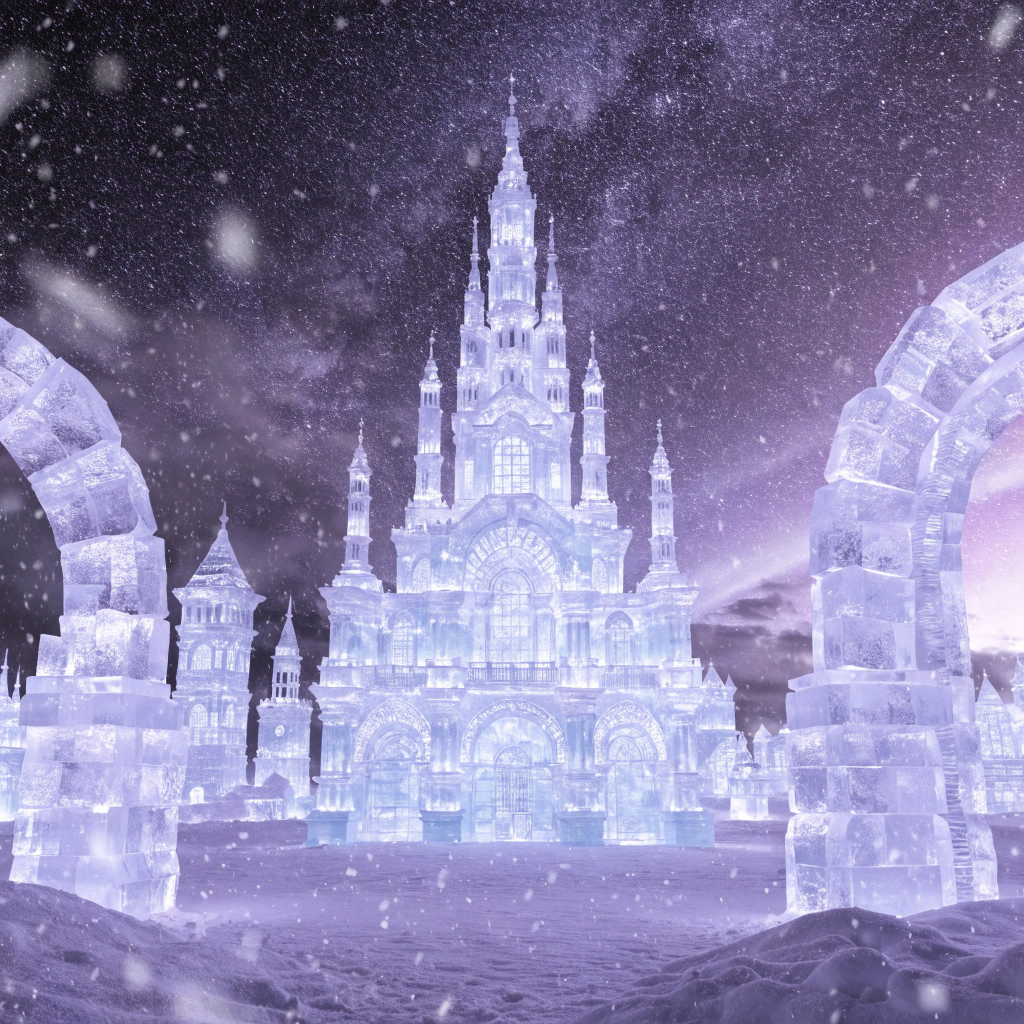
The Big Ice Festival in China
Harbin is a very cold city in China. Every year, there is a big ice festival. It starts on January 5th. Millions of people visit the festival. They see beautiful buildings and statues. Everything is made of ice and snow.
At night, the ice buildings have many colors. They look like a dream. Children like the ice slides. Visitors wear warm clothes because it is very cold. The festival is famous in the world. It is the largest ice festival. People take many photos of the lights.
Grammatik-Spotlight
Muster: Das Verb 'To Be' (is)
"Harbin is a very cold city in China."
Wir verwenden 'is' bei singulären Subjekten wie Harbin, um einen Fakt oder Zustand zu beschreiben. Es verbindet das Subjekt mit weiteren Informationen.
Muster: Present Simple für Fakten
"Millions of people visit the festival."
Wir verwenden die Grundform des Verbs 'visit' für Subjekte im Plural wie 'people'. Dieses Muster beschreibt Dinge, die regelmäßig jedes Jahr passieren.
Teste dein Verständnis
10 Fragen · A1 Anfänger · 1 kostenlose Vorschau
Teste, was du aus diesem Artikel gelernt hast. Beantworte alle Fragen und sammle XP!
Wann beginnt das Festival?
Möchtest du das Quiz beenden?
9 weitere Fragen warten auf dich. Registriere dich kostenlos, um das vollständige Quiz freizuschalten und XP zu sammeln!
Kostenlos registrierenHast du schon ein Konto? Anmelden
Gut gemacht!
Weiter üben!
Bereits abgeschlossen — keine zusätzlichen XP
Registriere dich, um XP zu verdienenFragenübersicht
Wann beginnt das Festival?
Deine Antwort:
Richtige Antwort: 5. Januar
Alles auf dem Festival ist aus Holz gemacht.
Deine Antwort:
Richtige Antwort: Falsch
Was ist ein 'festival'?
Deine Antwort:
Richtige Antwort: Eine besondere Feier
Das Festival ist in _____.
Deine Antwort:
Richtige Antwort: China
The Amazing Harbin Ice and Snow Festival
The Harbin Ice Festival is a very famous winter event in China. It starts on January 5th every year and it is the largest ice festival in the world. Harbin is one of the coldest cities in China, so it is the perfect place for ice and snow.
Long ago, in 1963, the festival began as a small lantern show. Today, it is much bigger and more exciting. Millions of people visit the city to see the amazing buildings made of ice. Artists use big blocks of ice from the Songhua River to build these sculptures. At night, the buildings look beautiful because they have many colorful lights inside them.
Visitors can do many things at the festival. They can slide down ice hills or look at the snow statues. Some sculptures are taller than houses! It is very cold, so people must wear warm clothes like coats, hats, and gloves. The festival finishes in late February when the ice starts to melt. It is a magical winter wonderland.
Grammatik-Spotlight
Muster: Superlative (Höchststufe) von Adjektiven
"It is the largest ice festival in the world."
Wir benutzen den Superlativ, um eine Sache mit vielen anderen in einer Gruppe zu vergleichen. Bei kurzen Adjektiven hängen wir '-est' an das Ende und setzen 'the' vor das Wort.
Muster: Komparativ (Vergleichsform) von Adjektiven
"Today, it is much bigger and more exciting."
Wir benutzen den Komparativ, um zwei Dinge zu vergleichen. Wir hängen '-er' an kurze Wörter wie 'big' an und benutzen 'more' vor längeren Wörtern wie 'exciting'.
Teste dein Verständnis
11 Fragen · A2 Grundkenntnisse · 1 kostenlose Vorschau
Teste, was du aus diesem Artikel gelernt hast. Beantworte alle Fragen und sammle XP!
Wann beginnt das Harbin Eisfestival jedes Jahr?
Möchtest du das Quiz beenden?
10 weitere Fragen warten auf dich. Registriere dich kostenlos, um das vollständige Quiz freizuschalten und XP zu sammeln!
Kostenlos registrierenHast du schon ein Konto? Anmelden
Gut gemacht!
Weiter üben!
Bereits abgeschlossen — keine zusätzlichen XP
Registriere dich, um XP zu verdienenFragenübersicht
Wann beginnt das Harbin Eisfestival jedes Jahr?
Deine Antwort:
Richtige Antwort: 5. Januar
Das Festival begann erstmals 1963.
Deine Antwort:
Richtige Antwort: Richtig
Was bedeutet 'sculptures'?
Deine Antwort:
Richtige Antwort: Kunstwerke, die durch Formen von Material gemacht sind
Nachts sehen die Gebäude _____ aus, weil sie bunte Lichter haben.
Deine Antwort:
Richtige Antwort: beautiful
Woher bekommen die Künstler das Eis, um die Skulpturen zu bauen?
Deine Antwort:
Richtige Antwort: Vom Songhua-Fluss
The Frozen Magic of Harbin
Have you ever dreamed of walking through a city made entirely of ice? Every winter, the Harbin International Ice and Snow Sculpture Festival transforms one of China’s coldest cities into a breathtaking winter wonderland. This event, which has been held since 1963, is now recognized as the largest of its kind globally.
The festival officially begins on January 5th and lasts until the ice starts to melt in late February. To build these masterpieces, huge blocks of ice are taken from the Songhua River and carved into incredible structures. These sculptures are created by talented artists from many different countries who participate in international competitions. Visitors can explore massive castles, famous global landmarks, and even functional slides, all of which are made from frozen water.
When the sun goes down, the "Ice and Snow World" becomes even more magical. Thousands of colorful LED lights are placed inside the sculptures, which makes the ice glow with vibrant colors. This tradition originally started as a simple lantern show, but it has evolved significantly over the decades. Because Harbin is located in Northeast China, the temperatures often drop to minus 30 degrees Celsius. However, the extreme cold is necessary to keep the delicate architecture from melting during the exhibition.
The festival has attracted millions of tourists who want to experience this unique crystalline world. People from all over the globe travel to Harbin to see the lights and enjoy winter activities like ice skating and sledding. Although the weather is freezing, the warm atmosphere and stunning views make it an unforgettable journey. If you appreciate winter sports and artistic creativity, Harbin is a destination that should definitely be on your travel list.
Grammatik-Spotlight
Muster: Present Perfect Tense
"The festival has attracted millions of tourists who want to experience this unique crystalline world."
Das Present Perfect wird mit 'has/have' und dem Partizip II (Past Participle) gebildet. Wir verwenden es hier, um eine Handlung zu beschreiben, die zu einem unbestimmten Zeitpunkt in der Vergangenheit stattfand und eine Verbindung zur Gegenwart hat.
Muster: Relativsätze
"This event, which has been held since 1963, is now recognized as the largest of its kind globally."
Relativsätze geben zusätzliche Informationen über ein Nomen. Die Verwendung von 'which' erlaubt es uns, Details über 'the event' hinzuzufügen, ohne einen neuen Satz zu beginnen, was den Schreibstil professioneller macht.
Teste dein Verständnis
11 Fragen · B1 Mittelstufe · 1 kostenlose Vorschau
Teste, was du aus diesem Artikel gelernt hast. Beantworte alle Fragen und sammle XP!
Wann beginnt das Harbin Eisfestival offiziell jedes Jahr?
Möchtest du das Quiz beenden?
10 weitere Fragen warten auf dich. Registriere dich kostenlos, um das vollständige Quiz freizuschalten und XP zu sammeln!
Kostenlos registrierenHast du schon ein Konto? Anmelden
Gut gemacht!
Weiter üben!
Bereits abgeschlossen — keine zusätzlichen XP
Registriere dich, um XP zu verdienenFragenübersicht
Wann beginnt das Harbin Eisfestival offiziell jedes Jahr?
Deine Antwort:
Richtige Antwort: Am 5. Januar
Das Eis für die Skulpturen wird aus dem Songhua-Fluss entnommen.
Deine Antwort:
Richtige Antwort: Richtig
Was bedeutet das Wort 'carve' im Kontext des Artikels?
Deine Antwort:
Richtige Antwort: In Eis schneiden, um eine Form zu erstellen
Harbin befindet sich im _____ Teil von China.
Deine Antwort:
Richtige Antwort: northeast
Warum ist das extrem kalte Wetter für das Festival notwendig?
Deine Antwort:
Richtige Antwort: Um zu verhindern, dass die Eisarchitektur schmilzt
A Crystalline Metropolis: The Magic of the Harbin Ice Festival
Since its humble beginnings as a traditional lantern show in 1963, the Harbin International Ice and Snow Sculpture Festival has evolved into a global phenomenon that redefines the limits of winter artistry. Located in the frigid landscape of Northeast China, Harbin transforms into a crystalline metropolis every winter, attracting millions of adventurous visitors who are willing to brave sub-zero temperatures for a glimpse of this ephemeral wonderland. The festival officially commences on January 5th, although many of the most impressive exhibits often open their gates earlier, provided that weather conditions remain sufficiently cold.
The sheer scale of the festival is truly breathtaking, typically divided into several distinct zones that cater to different artistic expressions. Sun Island is renowned for its massive snow sculptures, some of which stretch for hundreds of meters and reach heights that challenge the limits of the material. These works require months of meticulous planning and precise carving by skilled artisans who utilize specialized tools to shape the packed snow. In contrast, the 'Ice and Snow World' showcases architectural marvels constructed entirely from transparent blocks of ice. These structures, which frequently include intricate replicas of world-famous landmarks, traditional pagodas, and mythical castles, are illuminated from within by sophisticated, multi-colored LED systems. This creates a surreal, neon-lit landscape that only reveals its full splendor after the sun sets over the frozen horizon, turning the park into a glowing dreamscape.
The construction process itself is a remarkable feat of engineering and physical endurance, involving tens of thousands of workers. Laborers work around the clock to harvest massive ice blocks from the frozen Songhua River, using saws to cut pieces that can weigh several tons each. These blocks are then transported to the site, where they are stacked and carved with surgical precision using water as a 'glue' to freeze the components together. If the temperatures were to rise prematurely, the structural integrity of these frozen towers would be immediately compromised; however, Harbin’s notoriously harsh winters usually ensure the festival lasts until the ice begins to melt in late February.
Beyond the visual spectacle, the event serves as a platform for international cultural exchange and competitive spirit. Artists from across the globe travel to Harbin to participate in prestigious carving competitions, constantly pushing the boundaries of what can be achieved with such a fragile and demanding medium. Despite the temporary nature of the art—destined to return to the river as water—the impact on Harbin's local economy and its global status as a premier winter tourism hub is undeniable. Visitors often find themselves contemplating the contrast between the hostile, freezing environment and the profound beauty born from it, leaving with a newfound appreciation for human creativity in the face of nature's extremes.
Grammatik-Spotlight
Muster: Present Perfect Tense (Perfekt)
"The Harbin International Ice and Snow Sculpture Festival has evolved into a global phenomenon."
Dieses Muster wird verwendet, um eine Handlung zu beschreiben, die in der Vergangenheit begann und bis in die Gegenwart andauert oder für diese relevant ist. Es wird mit 'has' oder 'have' plus dem Partizip Perfekt (Past Participle) des Verbs gebildet.
Muster: Second Conditional (Hypothetisch)
"If the temperatures were to rise prematurely, the structural integrity of these frozen towers would be immediately compromised."
Diese Struktur wird verwendet, um über imaginäre oder höchst unwahrscheinliche Situationen in der Gegenwart oder Zukunft zu sprechen. Sie verwendet 'if + Konjunktiv Präteritum (were to)' und 'would + Grundform des Verbs', um das hypothetische Ergebnis zu zeigen.
Muster: Passive Voice (Passiv)
"These structures... are illuminated from within by sophisticated, multi-colored LED systems."
Das Passiv wird verwendet, wenn der Fokus auf dem Empfänger der Handlung liegt und nicht auf dem Ausführenden. Es wird mit dem Verb 'to be' gefolgt vom Partizip Perfekt gebildet.
Teste dein Verständnis
11 Fragen · B2 Obere Mittelstufe · 1 kostenlose Vorschau
Teste, was du aus diesem Artikel gelernt hast. Beantworte alle Fragen und sammle XP!
Was war das ursprüngliche Format des Harbin-Festivals, als es 1963 begann?
Möchtest du das Quiz beenden?
10 weitere Fragen warten auf dich. Registriere dich kostenlos, um das vollständige Quiz freizuschalten und XP zu sammeln!
Kostenlos registrierenHast du schon ein Konto? Anmelden
Gut gemacht!
Weiter üben!
Bereits abgeschlossen — keine zusätzlichen XP
Registriere dich, um XP zu verdienenFragenübersicht
Was war das ursprüngliche Format des Harbin-Festivals, als es 1963 begann?
Deine Antwort:
Richtige Antwort: Eine traditionelle Laternenschau
Die Schneeskulpturen auf der Sonneninsel werden hauptsächlich von automatisierten Maschinen geschnitzt.
Deine Antwort:
Richtige Antwort: Falsch
Was bedeutet das Wort 'ephemeral' im Kontext des Artikels?
Deine Antwort:
Richtige Antwort: Kurzlebig oder vorübergehend
Das Festival _____ offiziell jedes Jahr am 5. Januar.
Deine Antwort:
Richtige Antwort: commences
Warum sind die Eisstrukturen in der 'Eis- und Schneewelt' nachts besonders beeindruckend?
Deine Antwort:
Richtige Antwort: Sie werden von innen durch LED-Systeme beleuchtet
Ephemeral Grandeur: The Socio-Artistic Paradox of Harbin’s Frozen Metropolis
Seldom does one encounter a landscape so profoundly divorced from the mundane as Harbin during its annual International Ice and Snow Sculpture Festival. Nestled in China’s northeastern Heilongjiang province, this 'Ice City' endures sub-zero temperatures that would deter the most intrepid travelers. Yet, it is within this frigid crucible that an architectural marvel of unprecedented scale emerges. The festival represents more than a mere display of craftsmanship; it is a manifestation of human resilience against the elements, a seasonal metropolis carved from the very heart of the Songhua River. While contemporary iterations of the festival are synonymous with high-tech LED displays and sprawling crystalline castles, its genesis was markedly more modest. It was the humble ice lantern tradition, inaugurated in 1963, that catalyzed what has now become the world’s largest frozen spectacle. Historically, local fishermen fashioned these lanterns by freezing water in buckets, then hollowing out the centers to house candles—a practical solution for nighttime sustenance. Today, that survivalist ingenuity has evolved into a global phenomenon, attracting millions who navigate a labyrinth of towers that rival the grandeur of permanent urban centers. The logistical undertaking required to construct this ephemeral city is staggering. The extraction of gargantuan blocks of ice from the Songhua River demands a workforce of thousands, operating with surgical precision to ensure the structural integrity of the blocks. These frozen monoliths are then transported and meticulously carved using traditional tools and modern lasers. What distinguishes the Harbin festival from its international counterparts is the sheer audacity of its architectural ambition. Designers do not merely sculpt figures; they engineer functioning environments, complete with staircases, bridges, and intricate facades. However, a poignant paradox lies at the core of this endeavor: the more magnificent the structure, the more tragic its inevitable dissolution. Beyond the aesthetic allure, the festival serves as a critical economic engine for a region often characterized by its industrial 'rust belt' history. The transition from a heavy-industry reliance to a tourism-centric model has been facilitated by the festival’s global prestige. Nevertheless, this shift invites critical analysis regarding environmental sustainability. The immense energy consumption required for the nocturnal illumination of the 'Ice and Snow World' creates a tension between economic revitalization and ecological responsibility. Scholars argue that while the festival brings prosperity, it also necessitates a nuanced approach to resource management in an era of climatic volatility. The challenge lies in maintaining the cultural integrity of the event while mitigating its carbon footprint, ensuring that the 'Ice City' does not contribute to the very warming that threatens its existence. Ultimately, the Harbin Ice Festival is a testament to the beauty of transience. Only when the spring thaw commences do we truly appreciate the philosophical weight of these frozen monuments. They exist not to endure, but to remind us of the fleeting nature of human achievement. Visitors are left not only with photographs of glowing turrets but with a profound realization: that beauty, however gargantuan, is often most poignant when it is destined to vanish.
Grammatik-Spotlight
Muster: Negative Inversion
"Seldom does one encounter a landscape so profoundly divorced from the mundane as Harbin during its annual International Ice and Snow Sculpture Festival."
When a sentence starts with a negative or restrictive adverb like 'seldom', 'never', or 'hardly', the auxiliary verb comes before the subject. This structure is used in formal writing to add emphasis or dramatic flair.
Muster: Cleft Sentences
"It was the humble ice lantern tradition, inaugurated in 1963, that catalyzed what has now become the world’s largest frozen spectacle."
Cleft sentences (It + be + subject + relative clause) are used to focus on a specific piece of information. Here, it emphasizes that the specific 'ice lantern tradition' was the cause of the modern festival.
Muster: Nominalization
"The extraction of gargantuan blocks of ice from the Songhua River demands a workforce of thousands..."
Nominalization involves turning verbs (extract) into nouns (extraction). This is a hallmark of C1 academic and formal writing as it allows for more concise and objective descriptions of processes.
Teste dein Verständnis
12 Fragen · C1 Fortgeschritten · 1 kostenlose Vorschau
Teste, was du aus diesem Artikel gelernt hast. Beantworte alle Fragen und sammle XP!
According to the article, what was the original catalyst for the Harbin Ice Festival?
Möchtest du das Quiz beenden?
11 weitere Fragen warten auf dich. Registriere dich kostenlos, um das vollständige Quiz freizuschalten und XP zu sammeln!
Kostenlos registrierenHast du schon ein Konto? Anmelden
Gut gemacht!
Weiter üben!
Bereits abgeschlossen — keine zusätzlichen XP
Registriere dich, um XP zu verdienenFragenübersicht
According to the article, what was the original catalyst for the Harbin Ice Festival?
Deine Antwort:
Richtige Antwort: A traditional ice lantern show started by local fishermen in 1963
The construction of the ice city is a small-scale operation involving only a few hundred specialized artists.
Deine Antwort:
Richtige Antwort: Falsch
What does the word 'ephemeral' mean in the context of the article?
Deine Antwort:
Richtige Antwort: Lasting for a very short time
The festival is described as a manifestation of human _____ against the extreme sub-zero elements.
Deine Antwort:
Richtige Antwort: resilience
What is the primary socio-economic tension discussed regarding the festival's illumination?
Deine Antwort:
Richtige Antwort: Economic revitalization of a rust-belt region versus ecological responsibility
The ice for the sculptures is sourced directly from the Songhua River.
Deine Antwort:
Richtige Antwort: Richtig
Kristalline Ephemerität: Das Harbiner Eisfestival im Spannungsfeld zwischen monumentaler Ästhetik und ökologischem Wandel
Wenn die Quecksilbersäule in der mandschurischen Metropole Harbin auf lebensfeindliche Minusgrade sinkt, erwacht eine Welt zum Leben, die in ihrer fragilen Monumentalität ihresgleichen sucht. Das Harbiner Internationale Eis- und Schneefestival, dessen Genese auf eine bescheidene Laternenschau im Jahre 1963 zurückzuführen ist, hat sich längst zu einem globalen Phänomen ausgewachsen, das die Grenzen zwischen Architektur, Kunsthandwerk und technologischer Finesse verschwimmen lässt. Es handelt sich hierbei nicht bloß um eine touristische Attraktion, sondern um ein kulturelles Statement, das die Widrigkeiten des subarktischen Klimas in eine ästhetische Tugend transformiert.
Die logistische Meisterleistung, die diesem Spektakel zugrunde liegt, entzieht sich oft der oberflächlichen Wahrnehmung. Jährlich werden abertausende Kubikmeter Eis aus dem Songhua-Fluss extrahiert. Diese Extraktion erfolgt mit einer Akribie, die an wissenschaftliche Feldstudien erinnert, da nur das reinste, kristallinste Eis den statischen Anforderungen der gigantischen Skulpturen genügt. Die aus dem Fluss gewonnenen, tonnenschweren Eisblöcke bilden das Fundament für Repliken weltberühmter Kathedralen, Pagoden und futuristischer Ensembles, die mittels modernster LED-Technik in eine transzendente Illumination getaucht werden. Man könnte fast mutmaßen, dass die Architekten hier eine Form der „gefrorenen Musik“ erschaffen haben, wie sie Schelling einst für die Architektur im Allgemeinen definierte.
Die technische Ausführung der Skulpturen erfordert ein Höchstmaß an handwerklicher Virtuosität. Internationale Teams von Bildhauern reisen an, um sich in einem prestigeträchtigen Wettbewerb zu messen. Dabei kommen nicht nur klassische Meißel, sondern auch Lasertechnologien zum Einsatz, um filigrane Details aus dem spröden Material herauszuarbeiten. Die Präzision, mit der hierbei agiert wird, ist conditio sine qua non für die Standfestigkeit der teils über dreißig Meter hohen Konstruktionen. Würden die statischen Berechnungen auch nur geringfügig von der Realität abweichen, liefe das gesamte Ensemble Gefahr, unter seinem eigenen Gewicht zu kollabieren.
Gleichwohl darf die soziokulturelle Dimension dieses Ereignisses nicht unterschätzt werden. In einer Ära der rasanten Urbanisierung Chinas fungiert das Festival als ein Ankerpunkt regionaler Identität. Es evoziert eine Synergie zwischen traditioneller chinesischer Symbolik und westlichen Bauformen, was wiederum einen Diskurs über die Globalisierung der Ästhetik anstößt. Kritische Stimmen weisen indessen auf die ökologischen Implikationen hin. Obschon das Eis natürlichen Ursprungs ist, erfordert die Aufrechterhaltung der Infrastruktur sowie die energetische Versorgung der Lichtinstallationen einen signifikanten Ressourcenverbrauch. Inwiefern dieses Modell der „kristallinen Ephemerität“ in Zeiten des globalen Klimawandels zukunftsfähig bleibt, ist Gegenstand intensiver Debatten.
Die Faszination des Festivals speist sich maßgeblich aus seiner Vergänglichkeit. Im Gegensatz zu den steinernen Monumenten der Antike ist die Existenz dieser Eiskunstwerke von vornherein zeitlich limitiert. Sobald die ersten Frühlingsboten die Region erreichen, beginnt die unaufhaltsame Metamorphose zurück in den flüssigen Aggregatzustand. Diese inhärente Fragilität verleiht dem Besuch eine beinahe sakrale Aura; man wird Zeuge einer Manifestation, die morgen bereits Geschichte sein wird. Für den Lernenden bietet die Auseinandersetzung mit diesem Thema nicht nur eine Erweiterung des fachsprachlichen Vokabulars, sondern schult auch das Verständnis für komplexe hypothetische Satzgefüge und die Nuancen akademischer Distanzierung.
Abschließend lässt sich festhalten, dass das Harbiner Eisfestival weit mehr ist als eine bloße Ansammlung gefrorenen Wassers. Es ist ein Zeugnis menschlicher Resilienz und Gestaltungskraft unter extremen Bedingungen. Wer durch die illuminierten Schluchten aus Eis wandelt, dem offenbart sich eine Welt, in der die Materie ihre Schwere verliert und das Licht zur tragenden Säule der Wahrnehmung wird. Es bleibt abzuwarten, wie sich dieses frostige Gesamtkunstwerk unter dem Druck sich wandelnder ökologischer Rahmenbedingungen weiterentwickeln wird, doch seine heutige Strahlkraft bleibt unbestritten.
Grammatik-Spotlight
Muster: Konjunktiv II in hypothetischen Vergleichen
"Man könnte fast mutmaßen, dass die Architekten hier eine Form der „gefrorenen Musik“ erschaffen haben..."
Der Konjunktiv II wird hier verwendet, um eine vorsichtige Vermutung oder einen subjektiven Vergleich auszudrücken, der nicht als absolute Tatsache behauptet wird.
Muster: Erweitertes Partizipialattribut
"Die aus dem Fluss gewonnenen, tonnenschweren Eisblöcke bilden das Fundament..."
Hier wird ein Partizip (gewonnenen) durch weitere Angaben (aus dem Fluss) ergänzt und als Adjektiv vor das Substantiv gestellt, um Informationen kompakt zu bündeln.
Muster: Nominalstil zur Informationsverdichtung
"Diese Extraktion erfolgt mit einer Akribie, die an wissenschaftliche Feldstudien erinnert..."
Anstatt Verben zu verwenden, werden Substantive (Extraktion, Akribie) genutzt, um einen präzisen, wissenschaftlich-analytischen Ton zu erzeugen.
Teste dein Verständnis
12 Fragen · C2 Meisterschaft · 1 kostenlose Vorschau
Teste, was du aus diesem Artikel gelernt hast. Beantworte alle Fragen und sammle XP!
Wann fand die ursprüngliche Laternenschau statt, aus der das Festival hervorging?
Möchtest du das Quiz beenden?
11 weitere Fragen warten auf dich. Registriere dich kostenlos, um das vollständige Quiz freizuschalten und XP zu sammeln!
Kostenlos registrierenHast du schon ein Konto? Anmelden
Gut gemacht!
Weiter üben!
Bereits abgeschlossen — keine zusätzlichen XP
Registriere dich, um XP zu verdienenFragenübersicht
Wann fand die ursprüngliche Laternenschau statt, aus der das Festival hervorging?
Deine Antwort:
Richtige Antwort: 1963
Das Eis für die Skulpturen wird künstlich in Fabriken hergestellt, um Reinheit zu garantieren.
Deine Antwort:
Richtige Antwort: Falsch
Was bedeutet 'Ephemerität' im Kontext des Artikels?
Deine Antwort:
Richtige Antwort: Die Vergänglichkeit der Kunstwerke
Die Eisblöcke werden jährlich aus dem _____ extrahiert.
Deine Antwort:
Richtige Antwort: Songhua-Fluss
Welche Gefahr besteht laut Artikel bei fehlerhaften statischen Berechnungen?
Deine Antwort:
Richtige Antwort: Das Ensemble könnte kollabieren
Kritiker des Festivals thematisieren unter anderem den hohen Energieverbrauch der Lichtinstallationen.
Deine Antwort:
Richtige Antwort: Richtig

