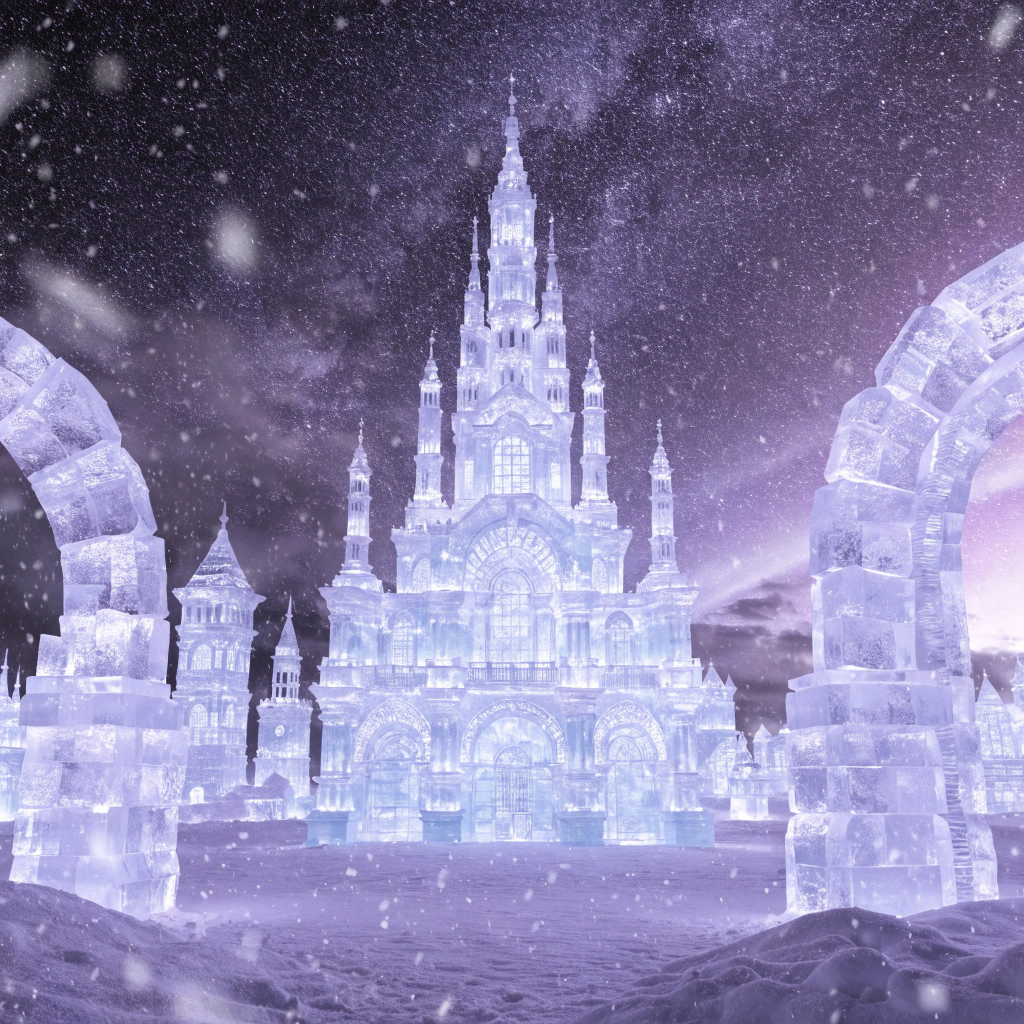
The Big Ice Festival in China
Harbin is a very cold city in China. Every year, there is a big ice festival. It starts on January 5th. Millions of people visit the festival. They see beautiful buildings and statues. Everything is made of ice and snow.
At night, the ice buildings have many colors. They look like a dream. Children like the ice slides. Visitors wear warm clothes because it is very cold. The festival is famous in the world. It is the largest ice festival. People take many photos of the lights.
Grammar Spotlight
Pattern: The Verb 'To Be' (is)
"Harbin is a very cold city in China."
We use 'is' with singular subjects like Harbin to describe a fact or a state. It connects the subject to more information.
Pattern: Present Simple for Facts
"Millions of people visit the festival."
We use the base form of the verb 'visit' for plural subjects like 'people'. This pattern describes things that happen regularly every year.
Test Your Understanding
10 questions · A1 Beginner · 1 free preview
Test what you learned from this article. Answer all questions to earn XP!
When does the festival start?
Want to finish the quiz?
9 more questions are waiting for you. Sign up free to unlock the full quiz and earn XP!
Sign Up FreeAlready have an account? Sign In
Question Breakdown
When does the festival start?
Your answer:
Correct answer: January 5th
Everything at the festival is made of wood.
Your answer:
Correct answer: False
What is a 'festival'?
Your answer:
Correct answer: A special celebration
The festival is in _____.
Your answer:
Correct answer: China
The Amazing Harbin Ice and Snow Festival
The Harbin Ice Festival is a very famous winter event in China. It starts on January 5th every year and it is the largest ice festival in the world. Harbin is one of the coldest cities in China, so it is the perfect place for ice and snow.
Long ago, in 1963, the festival began as a small lantern show. Today, it is much bigger and more exciting. Millions of people visit the city to see the amazing buildings made of ice. Artists use big blocks of ice from the Songhua River to build these sculptures. At night, the buildings look beautiful because they have many colorful lights inside them.
Visitors can do many things at the festival. They can slide down ice hills or look at the snow statues. Some sculptures are taller than houses! It is very cold, so people must wear warm clothes like coats, hats, and gloves. The festival finishes in late February when the ice starts to melt. It is a magical winter wonderland.
Grammar Spotlight
Pattern: Superlative Adjectives
"It is the largest ice festival in the world."
We use the superlative form to compare one thing with many others in a group. For short adjectives, we add '-est' to the end and 'the' before the word.
Pattern: Comparative Adjectives
"Today, it is much bigger and more exciting."
We use comparatives to compare two things. We add '-er' to short words like 'big' and use 'more' before longer words like 'exciting'.
Test Your Understanding
11 questions · A2 Elementary · 1 free preview
Test what you learned from this article. Answer all questions to earn XP!
When does the Harbin Ice Festival start every year?
Want to finish the quiz?
10 more questions are waiting for you. Sign up free to unlock the full quiz and earn XP!
Sign Up FreeAlready have an account? Sign In
Question Breakdown
When does the Harbin Ice Festival start every year?
Your answer:
Correct answer: January 5th
The festival first began in 1963.
Your answer:
Correct answer: True
What does 'sculptures' mean?
Your answer:
Correct answer: Works of art made by shaping material
At night, the buildings look _____ because they have colorful lights.
Your answer:
Correct answer: beautiful
Where do artists get the ice to build the sculptures?
Your answer:
Correct answer: From the Songhua River
The Frozen Magic of Harbin
Have you ever dreamed of walking through a city made entirely of ice? Every winter, the Harbin International Ice and Snow Sculpture Festival transforms one of China’s coldest cities into a breathtaking winter wonderland. This event, which has been held since 1963, is now recognized as the largest of its kind globally.
The festival officially begins on January 5th and lasts until the ice starts to melt in late February. To build these masterpieces, huge blocks of ice are taken from the Songhua River and carved into incredible structures. These sculptures are created by talented artists from many different countries who participate in international competitions. Visitors can explore massive castles, famous global landmarks, and even functional slides, all of which are made from frozen water.
When the sun goes down, the "Ice and Snow World" becomes even more magical. Thousands of colorful LED lights are placed inside the sculptures, which makes the ice glow with vibrant colors. This tradition originally started as a simple lantern show, but it has evolved significantly over the decades. Because Harbin is located in Northeast China, the temperatures often drop to minus 30 degrees Celsius. However, the extreme cold is necessary to keep the delicate architecture from melting during the exhibition.
The festival has attracted millions of tourists who want to experience this unique crystalline world. People from all over the globe travel to Harbin to see the lights and enjoy winter activities like ice skating and sledding. Although the weather is freezing, the warm atmosphere and stunning views make it an unforgettable journey. If you appreciate winter sports and artistic creativity, Harbin is a destination that should definitely be on your travel list.
Grammar Spotlight
Pattern: Present Perfect Tense
"The festival has attracted millions of tourists who want to experience this unique crystalline world."
The present perfect is formed with 'has/have' and the past participle. We use it here to describe an action that happened at an unspecified time in the past and has a connection to the present.
Pattern: Relative Clauses
"This event, which has been held since 1963, is now recognized as the largest of its kind globally."
Relative clauses provide extra information about a noun. Using 'which' allows us to add details about 'the event' without starting a new sentence, making the writing more professional.
Test Your Understanding
11 questions · B1 Intermediate · 1 free preview
Test what you learned from this article. Answer all questions to earn XP!
When does the Harbin Ice Festival officially begin each year?
Want to finish the quiz?
10 more questions are waiting for you. Sign up free to unlock the full quiz and earn XP!
Sign Up FreeAlready have an account? Sign In
Question Breakdown
When does the Harbin Ice Festival officially begin each year?
Your answer:
Correct answer: January 5th
The ice used for the sculptures is taken from the Songhua River.
Your answer:
Correct answer: True
What does the word 'carve' mean in the context of the article?
Your answer:
Correct answer: To cut into ice to create a shape
Harbin is located in the _____ part of China.
Your answer:
Correct answer: northeast
Why is the extreme cold weather necessary for the festival?
Your answer:
Correct answer: To prevent the ice architecture from melting
A Crystalline Metropolis: The Magic of the Harbin Ice Festival
Since its humble beginnings as a traditional lantern show in 1963, the Harbin International Ice and Snow Sculpture Festival has evolved into a global phenomenon that redefines the limits of winter artistry. Located in the frigid landscape of Northeast China, Harbin transforms into a crystalline metropolis every winter, attracting millions of adventurous visitors who are willing to brave sub-zero temperatures for a glimpse of this ephemeral wonderland. The festival officially commences on January 5th, although many of the most impressive exhibits often open their gates earlier, provided that weather conditions remain sufficiently cold.
The sheer scale of the festival is truly breathtaking, typically divided into several distinct zones that cater to different artistic expressions. Sun Island is renowned for its massive snow sculptures, some of which stretch for hundreds of meters and reach heights that challenge the limits of the material. These works require months of meticulous planning and precise carving by skilled artisans who utilize specialized tools to shape the packed snow. In contrast, the 'Ice and Snow World' showcases architectural marvels constructed entirely from transparent blocks of ice. These structures, which frequently include intricate replicas of world-famous landmarks, traditional pagodas, and mythical castles, are illuminated from within by sophisticated, multi-colored LED systems. This creates a surreal, neon-lit landscape that only reveals its full splendor after the sun sets over the frozen horizon, turning the park into a glowing dreamscape.
The construction process itself is a remarkable feat of engineering and physical endurance, involving tens of thousands of workers. Laborers work around the clock to harvest massive ice blocks from the frozen Songhua River, using saws to cut pieces that can weigh several tons each. These blocks are then transported to the site, where they are stacked and carved with surgical precision using water as a 'glue' to freeze the components together. If the temperatures were to rise prematurely, the structural integrity of these frozen towers would be immediately compromised; however, Harbin’s notoriously harsh winters usually ensure the festival lasts until the ice begins to melt in late February.
Beyond the visual spectacle, the event serves as a platform for international cultural exchange and competitive spirit. Artists from across the globe travel to Harbin to participate in prestigious carving competitions, constantly pushing the boundaries of what can be achieved with such a fragile and demanding medium. Despite the temporary nature of the art—destined to return to the river as water—the impact on Harbin's local economy and its global status as a premier winter tourism hub is undeniable. Visitors often find themselves contemplating the contrast between the hostile, freezing environment and the profound beauty born from it, leaving with a newfound appreciation for human creativity in the face of nature's extremes.
Grammar Spotlight
Pattern: Present Perfect Tense
"The Harbin International Ice and Snow Sculpture Festival has evolved into a global phenomenon."
This pattern is used to describe an action that started in the past and has continuing relevance to the present. It is formed using 'has' or 'have' plus the past participle of the verb.
Pattern: Second Conditional (Hypothetical)
"If the temperatures were to rise prematurely, the structural integrity of these frozen towers would be immediately compromised."
This structure is used to discuss imaginary or highly unlikely situations in the present or future. It uses 'if + past subjunctive (were to)' and 'would + base verb' to show the hypothetical result.
Pattern: Passive Voice
"These structures... are illuminated from within by sophisticated, multi-colored LED systems."
The passive voice is used when the focus is on the recipient of the action rather than the performer. It is formed using the verb 'to be' followed by the past participle.
Test Your Understanding
11 questions · B2 Upper Intermediate · 1 free preview
Test what you learned from this article. Answer all questions to earn XP!
What was the original format of the Harbin festival when it started in 1963?
Want to finish the quiz?
10 more questions are waiting for you. Sign up free to unlock the full quiz and earn XP!
Sign Up FreeAlready have an account? Sign In
Question Breakdown
What was the original format of the Harbin festival when it started in 1963?
Your answer:
Correct answer: A traditional lantern show
The snow sculptures on Sun Island are primarily carved by automated machines.
Your answer:
Correct answer: False
What does the word 'ephemeral' mean in the context of the article?
Your answer:
Correct answer: Short-lived or temporary
The festival officially _____ on January 5th each year.
Your answer:
Correct answer: commences
Why are the ice structures in the 'Ice and Snow World' particularly impressive at night?
Your answer:
Correct answer: They are illuminated from within by LED systems
Ephemeral Grandeur: The Socio-Artistic Paradox of Harbin’s Frozen Metropolis
Seldom does one encounter a landscape so profoundly divorced from the mundane as Harbin during its annual International Ice and Snow Sculpture Festival. Nestled in China’s northeastern Heilongjiang province, this 'Ice City' endures sub-zero temperatures that would deter the most intrepid travelers. Yet, it is within this frigid crucible that an architectural marvel of unprecedented scale emerges. The festival represents more than a mere display of craftsmanship; it is a manifestation of human resilience against the elements, a seasonal metropolis carved from the very heart of the Songhua River. While contemporary iterations of the festival are synonymous with high-tech LED displays and sprawling crystalline castles, its genesis was markedly more modest. It was the humble ice lantern tradition, inaugurated in 1963, that catalyzed what has now become the world’s largest frozen spectacle. Historically, local fishermen fashioned these lanterns by freezing water in buckets, then hollowing out the centers to house candles—a practical solution for nighttime sustenance. Today, that survivalist ingenuity has evolved into a global phenomenon, attracting millions who navigate a labyrinth of towers that rival the grandeur of permanent urban centers. The logistical undertaking required to construct this ephemeral city is staggering. The extraction of gargantuan blocks of ice from the Songhua River demands a workforce of thousands, operating with surgical precision to ensure the structural integrity of the blocks. These frozen monoliths are then transported and meticulously carved using traditional tools and modern lasers. What distinguishes the Harbin festival from its international counterparts is the sheer audacity of its architectural ambition. Designers do not merely sculpt figures; they engineer functioning environments, complete with staircases, bridges, and intricate facades. However, a poignant paradox lies at the core of this endeavor: the more magnificent the structure, the more tragic its inevitable dissolution. Beyond the aesthetic allure, the festival serves as a critical economic engine for a region often characterized by its industrial 'rust belt' history. The transition from a heavy-industry reliance to a tourism-centric model has been facilitated by the festival’s global prestige. Nevertheless, this shift invites critical analysis regarding environmental sustainability. The immense energy consumption required for the nocturnal illumination of the 'Ice and Snow World' creates a tension between economic revitalization and ecological responsibility. Scholars argue that while the festival brings prosperity, it also necessitates a nuanced approach to resource management in an era of climatic volatility. The challenge lies in maintaining the cultural integrity of the event while mitigating its carbon footprint, ensuring that the 'Ice City' does not contribute to the very warming that threatens its existence. Ultimately, the Harbin Ice Festival is a testament to the beauty of transience. Only when the spring thaw commences do we truly appreciate the philosophical weight of these frozen monuments. They exist not to endure, but to remind us of the fleeting nature of human achievement. Visitors are left not only with photographs of glowing turrets but with a profound realization: that beauty, however gargantuan, is often most poignant when it is destined to vanish.
Grammar Spotlight
Pattern: Negative Inversion
"Seldom does one encounter a landscape so profoundly divorced from the mundane as Harbin during its annual International Ice and Snow Sculpture Festival."
When a sentence starts with a negative or restrictive adverb like 'seldom', 'never', or 'hardly', the auxiliary verb comes before the subject. This structure is used in formal writing to add emphasis or dramatic flair.
Pattern: Cleft Sentences
"It was the humble ice lantern tradition, inaugurated in 1963, that catalyzed what has now become the world’s largest frozen spectacle."
Cleft sentences (It + be + subject + relative clause) are used to focus on a specific piece of information. Here, it emphasizes that the specific 'ice lantern tradition' was the cause of the modern festival.
Pattern: Nominalization
"The extraction of gargantuan blocks of ice from the Songhua River demands a workforce of thousands..."
Nominalization involves turning verbs (extract) into nouns (extraction). This is a hallmark of C1 academic and formal writing as it allows for more concise and objective descriptions of processes.
Test Your Understanding
12 questions · C1 Advanced · 1 free preview
Test what you learned from this article. Answer all questions to earn XP!
According to the article, what was the original catalyst for the Harbin Ice Festival?
Want to finish the quiz?
11 more questions are waiting for you. Sign up free to unlock the full quiz and earn XP!
Sign Up FreeAlready have an account? Sign In
Question Breakdown
According to the article, what was the original catalyst for the Harbin Ice Festival?
Your answer:
Correct answer: A traditional ice lantern show started by local fishermen in 1963
The construction of the ice city is a small-scale operation involving only a few hundred specialized artists.
Your answer:
Correct answer: False
What does the word 'ephemeral' mean in the context of the article?
Your answer:
Correct answer: Lasting for a very short time
The festival is described as a manifestation of human _____ against the extreme sub-zero elements.
Your answer:
Correct answer: resilience
What is the primary socio-economic tension discussed regarding the festival's illumination?
Your answer:
Correct answer: Economic revitalization of a rust-belt region versus ecological responsibility
The ice for the sculptures is sourced directly from the Songhua River.
Your answer:
Correct answer: True
Crystal Sovereignty: The Ephemeral Grandeur of Harbin’s Glacial Architecture
Nestled within the frozen embrace of Heilongjiang province, the Harbin International Ice and Snow Sculpture Festival represents an unparalleled convergence of artistic virtuosity and structural engineering. What originated in 1963 as a modest, traditional lantern show has since burgeoned into a global phenomenon, redefining the boundaries of architectural possibility through the medium of frozen water. To the casual observer, the festival might appear to be a mere whimsical display of winter festivities; however, a more analytical lens reveals a complex dialogue between human agency and environmental adversity. Seldom has the intersection of frigid meteorology and human ingenuity yielded such a profound aesthetic synthesis, where the harshness of the Siberian climate is not merely endured but is actively sublimated into art.
The technical prowess required to manifest this diaphanous metropolis is nothing short of extraordinary. Each winter, thousands of laborers descend upon the Songhua River to harvest colossal blocks of ice, which are subsequently transported to the festival site. This process necessitates a meticulous understanding of the ice’s structural integrity; the blocks must be clear, dense, and capable of withstanding the immense pressures of vertical construction. The resulting structures—replicas of cathedrals, pagodas, and futuristic skyscrapers—are illuminated from within using sophisticated LED systems. This internal luminescence creates a surreal, hyperreal environment that challenges the viewer’s perception of space and materiality. The transmutation of raw ice into intricate architectonic structures necessitates a meticulous synergy between laborer and designer, ensuring that the ephemeral nature of the material does not compromise the safety of the millions who traverse its corridors.
From a socio-economic perspective, the festival serves as a critical catalyst for Harbin’s urban identity. Historically an industrial hub, the city has successfully pivoted toward a service-oriented economy, leveraging its extreme climate as a unique selling proposition. This 'silver economy' thrives on the paradox of the festival’s impermanence. The knowledge that these crystalline monuments are destined to vanish with the spring thaw creates a sense of urgency and exclusivity that fuels tourism. Were it not for the relentless sub-zero temperatures provided by the Siberian winds, this diaphanous metropolis would inevitably dissolve, yet it is precisely this evanescence that constitutes its primary allure. The festival is, in essence, a celebration of the temporary, a monument to the human proclivity for creating beauty in the most inhospitable of circumstances.
Furthermore, the festival functions as a site of cultural diplomacy and international competition. Sculptors from across the globe participate in high-stakes contests, bringing diverse aesthetic traditions to the frozen plains of Northeast China. This internationalism fosters a cross-pollination of techniques and styles, enriching the festival’s visual vocabulary. The sheer scale of the endeavor—spanning over 600,000 square meters—positions Harbin as the preeminent global capital of ice art. As visitors wander through the towering frozen facades, they are invited to reflect on the fragility of our built environment and the potency of human imagination. Ultimately, the Harbin Ice and Snow Sculpture Festival is more than a tourist attraction; it is a profound exploration of the relationship between nature and culture, a frozen testament to the enduring power of the human spirit to transcend its environmental constraints through the pursuit of aesthetic excellence.
Grammar Spotlight
Pattern: Inversion with Negative Adverbs
"Seldom has the intersection of frigid meteorology and human ingenuity yielded such a profound aesthetic synthesis."
The word order is reversed after negative or restrictive adverbs like 'seldom' to emphasize the rarity or importance of the statement. The auxiliary verb 'has' precedes the subject 'the intersection'.
Pattern: Inverted Mixed Conditional (Subjunctive)
"Were it not for the relentless sub-zero temperatures provided by the Siberian winds, this diaphanous metropolis would inevitably dissolve."
This construction uses 'were' at the beginning of the clause to replace 'if it were not for'. It expresses a hypothetical condition in the present or future that is contrary to fact.
Pattern: Nominalization for Academic Tone
"The transmutation of raw ice into intricate architectonic structures necessitates a meticulous synergy between laborer and designer."
Nouns like 'transmutation' and 'synergy' are used instead of verbs ('transmute', 'synergize') to create a more formal, objective, and dense scholarly tone.
Test Your Understanding
12 questions · C2 Mastery · 1 free preview
Test what you learned from this article. Answer all questions to earn XP!
What does the author suggest is the primary allure of the Harbin Ice Festival?
Want to finish the quiz?
11 more questions are waiting for you. Sign up free to unlock the full quiz and earn XP!
Sign Up FreeAlready have an account? Sign In
Question Breakdown
What does the author suggest is the primary allure of the Harbin Ice Festival?
Your answer:
Correct answer: The fleeting and temporary nature of the art.
The festival originated as a large-scale international architectural competition in 1963.
Your answer:
Correct answer: False
What does 'diaphanous' mean in the context of the article?
Your answer:
Correct answer: Light, delicate, and translucent.
The laborers harvest colossal blocks of ice from the _____ River.
Your answer:
Correct answer: Songhua
How has Harbin’s economy changed because of the festival?
Your answer:
Correct answer: It has shifted from industrial to service-oriented.
The internal luminescence of the structures is achieved using traditional oil lamps.
Your answer:
Correct answer: False
