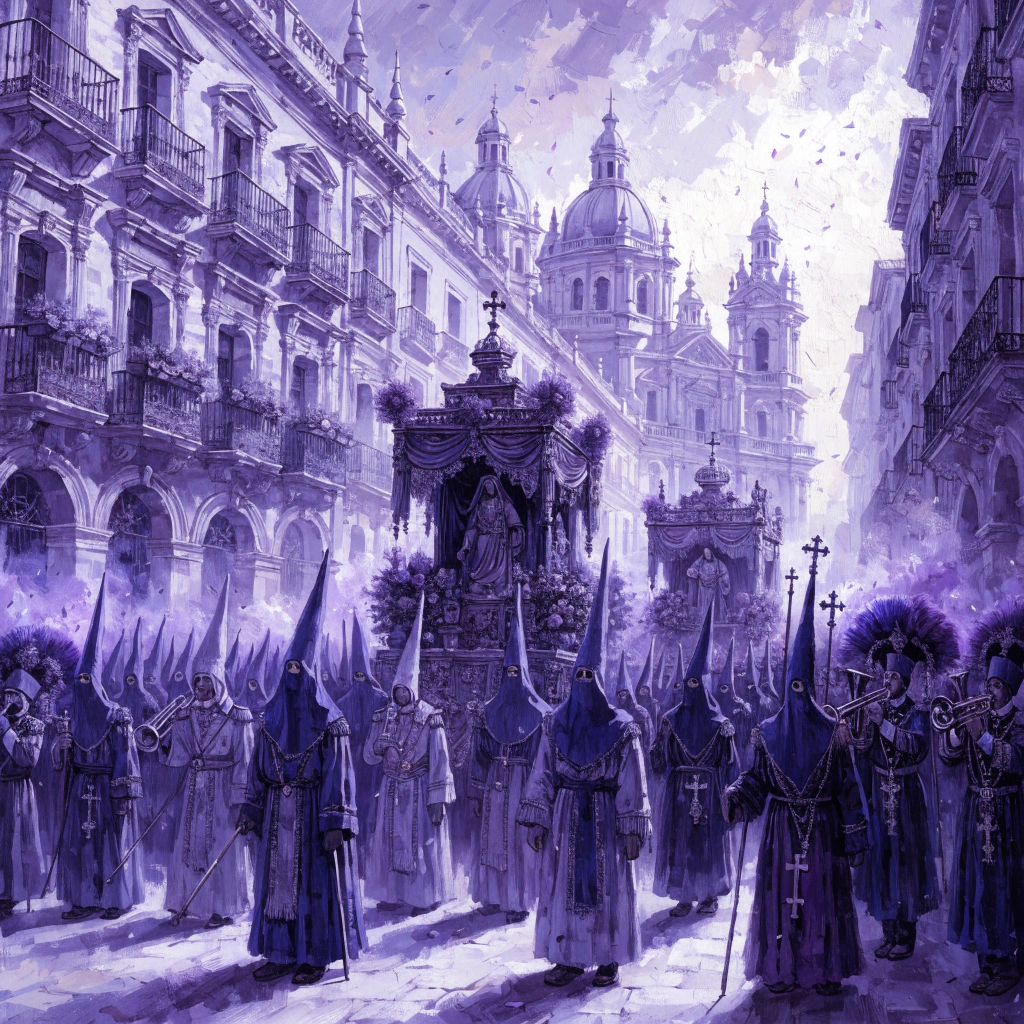
Holy Week in Spain
Holy Week is a big festival in Spain. It is in the spring. Many people visit the streets to watch processions. In the processions, people carry heavy wooden floats. These floats have statues of Jesus and Mary. They have many flowers and candles. There is music in the streets. Men wear long robes and special hats. It is a very old tradition. Families eat together. They watch the beautiful floats. It is a very emotional time for people in Spain.
Grammatik-Spotlight
Muster: Present Simple (to be)
"Holy Week is a big festival in Spain."
We use 'is' with singular subjects to describe facts or states. It connects the subject to a description.
Muster: Present Simple (regular verbs)
"Families eat together."
We use the base form of the verb for plural subjects like 'families'. This shows a regular action or habit.
Teste dein Verständnis
10 Fragen · A1 Anfänger · 1 kostenlose Vorschau
Teste, was du aus diesem Artikel gelernt hast. Beantworte alle Fragen und sammle XP!
Where is the festival?
Möchtest du das Quiz beenden?
9 weitere Fragen warten auf dich. Registriere dich kostenlos, um das vollständige Quiz freizuschalten und XP zu sammeln!
Kostenlos registrierenHast du schon ein Konto? Anmelden
Gut gemacht!
Weiter üben!
Bereits abgeschlossen — keine zusätzlichen XP
Registriere dich, um XP zu verdienenFragenübersicht
Where is the festival?
Deine Antwort:
Richtige Antwort: Spain
The festival is in the winter.
Deine Antwort:
Richtige Antwort: Falsch
What are 'floats'?
Deine Antwort:
Richtige Antwort: Large decorated platforms
There is _____ in the streets.
Deine Antwort:
Richtige Antwort: music
Die Semana Santa in Spanien: Ein besonderes Fest
Die Semana Santa, oder Heilige Woche, ist ein sehr wichtiges Fest in Spanien. Es findet jedes Jahr vor Ostern statt. Viele Menschen in Spanien feiern dieses Fest. Besonders bekannt ist die Semana Santa in Andalusien, im Süden von Spanien. Städte wie Sevilla und Málaga sind sehr berühmt dafür. Dort waren die Prozessionen besonders groß und beeindruckend.
In dieser Woche gibt es jeden Tag große Prozessionen. Religiöse Gruppen, die „Cofradías“ heißen, organisieren diese. Sie tragen große, schwere Holzfiguren durch die Straßen. Diese Figuren nennt man „Pasos“. Die „Pasos“ zeigen Szenen aus der Geschichte von Jesus Christus. Sie sind oft mit Gold und Silber schön geschmückt. Manchmal waren diese Figuren sehr alt und wertvoll.
Es ist eine ernste und feierliche Zeit, aber auch sehr emotional und beeindruckend. Viele Leute stehen an den Straßen und schauen zu. Sie sahen die „Pasos“ und hörten die Musik. Man spürte die Tradition. Für viele Spanier ist die Semana Santa ein großer Teil ihrer Kultur und Religion. Es ist ein Fest, das man sehen muss, um es wirklich zu verstehen. Es zieht jedes Jahr viele Besucher an.
Grammatik-Spotlight
Muster: Dativ nach Präpositionen
"Besonders bekannt ist die Semana Santa **in Andalusien**."
Manche Präpositionen stehen immer mit dem Dativ. Beispiele sind 'in', 'an', 'auf', 'mit'. Der Dativ zeigt oft einen Ort oder ein Mittel an. Hier beschreibt 'in Andalusien' den Ort.
Muster: Präteritum von 'sein' und 'geben'
"Dort **waren** die Prozessionen besonders groß und beeindruckend."
Das Präteritum ist eine Vergangenheitsform. Man benutzt es oft in Geschichten oder Berichten. 'War' ist das Präteritum von 'sein' und 'gab' ist das Präteritum von 'es gibt'.
Teste dein Verständnis
11 Fragen · A2 Grundkenntnisse · 1 kostenlose Vorschau
Teste, was du aus diesem Artikel gelernt hast. Beantworte alle Fragen und sammle XP!
Wann findet die Semana Santa statt?
Möchtest du das Quiz beenden?
10 weitere Fragen warten auf dich. Registriere dich kostenlos, um das vollständige Quiz freizuschalten und XP zu sammeln!
Kostenlos registrierenHast du schon ein Konto? Anmelden
Gut gemacht!
Weiter üben!
Bereits abgeschlossen — keine zusätzlichen XP
Registriere dich, um XP zu verdienenFragenübersicht
Wann findet die Semana Santa statt?
Deine Antwort:
Richtige Antwort: Vor Ostern
Die Semana Santa ist nur in Sevilla wichtig.
Deine Antwort:
Richtige Antwort: Falsch
Was bedeutet 'tragen'?
Deine Antwort:
Richtige Antwort: Etwas halten und bewegen
Die 'Pasos' sind große, schwere _____.
Deine Antwort:
Richtige Antwort: Holzfiguren
Wer organisiert die Prozessionen?
Deine Antwort:
Richtige Antwort: Religiöse Gruppen (Cofradías)
Die Semana Santa in Spanien: Eine faszinierende Tradition
Die Semana Santa, auch bekannt als die Heilige Woche, ist eines der wichtigsten religiösen und kulturellen Ereignisse in Spanien. Sie findet jedes Jahr vor Ostern statt und erinnert an die Leidenschaft Christi. Obwohl die Karwoche im ganzen Land gefeiert wird, sind die Prozessionen in Andalusien, besonders in Städten wie Sevilla, Málaga und Granada, weltberühmt. Viele Menschen haben diese beeindruckenden Feierlichkeiten schon einmal gesehen oder davon gehört.
Die Organisation der Semana Santa liegt in den Händen von sogenannten „Cofradías“ oder Bruderschaften. Diese Bruderschaften sind religiöse Vereinigungen, die oft eine lange Geschichte haben. Jede Bruderschaft hat ihre eigene Prozession, die durch die Straßen der Stadt zieht. Mitglieder der Bruderschaften, oft in traditionellen Gewändern, tragen schwere Altäre, die „Pasos“ genannt werden.
Diese „Pasos“ sind riesige, kunstvoll verzierte Holzfiguren oder Skulpturengruppen, die Szenen aus der Leidensgeschichte Jesu darstellen. Sie sind oft mit Silber, Gold und wertvollen Stoffen geschmückt und werden mit großer Andacht getragen. Es ist eine sehr emotionale Erfahrung für die Teilnehmer und Zuschauer gleichermaßen. Die Atmosphäre während der Prozessionen ist einzigartig: Stille wechselt sich ab mit Musik und dem Klang von Trommeln.
Für viele Spanier, besonders im Süden, ist die Semana Santa mehr als nur ein religiöses Fest; sie ist ein tief verwurzeltes Kulturerbe. Die Hingabe und das Gemeinschaftsgefühl, die in dieser Woche gezeigt werden, sind wirklich bemerkenswert. Wer einmal die Semana Santa erlebt hat, wird die Intensität und Schönheit dieser alten Tradition nicht vergessen. Sie hat sich über Jahrhunderte entwickelt und zieht jedes Jahr Tausende von Besuchern an.
Grammatik-Spotlight
Muster: Relativsätze (Relative Clauses)
"Die Semana Santa, die jedes Jahr vor Ostern stattfindet, erinnert an die Leidenschaft Christi."
Ein Relativsatz gibt zusätzliche Informationen zu einem Nomen. Er wird mit einem Relativpronomen (wie „der“, „die“, „das“) eingeleitet, das sich in Geschlecht und Zahl an das Bezugswort anpasst. Das Verb steht am Ende des Relativsatzes.
Muster: Passiv (Passive Voice)
"Die Semana Santa wird im ganzen Land gefeiert."
Das Passiv wird verwendet, wenn die Handlung wichtiger ist als der Handelnde. Es wird mit dem Hilfsverb „werden“ und dem Partizip II des Hauptverbs gebildet. Der Handelnde kann mit „von“ oder „durch“ genannt werden, ist aber oft unbekannt oder unwichtig.
Teste dein Verständnis
11 Fragen · B1 Mittelstufe · 1 kostenlose Vorschau
Teste, was du aus diesem Artikel gelernt hast. Beantworte alle Fragen und sammle XP!
Was ist die Semana Santa hauptsächlich?
Möchtest du das Quiz beenden?
10 weitere Fragen warten auf dich. Registriere dich kostenlos, um das vollständige Quiz freizuschalten und XP zu sammeln!
Kostenlos registrierenHast du schon ein Konto? Anmelden
Gut gemacht!
Weiter üben!
Bereits abgeschlossen — keine zusätzlichen XP
Registriere dich, um XP zu verdienenFragenübersicht
Was ist die Semana Santa hauptsächlich?
Deine Antwort:
Richtige Antwort: Ein wichtiges religiöses und kulturelles Ereignis
Nur in Sevilla werden Prozessionen der Semana Santa gefeiert.
Deine Antwort:
Richtige Antwort: Falsch
Was bedeutet das Wort "Bruderschaft"?
Deine Antwort:
Richtige Antwort: Eine religiöse Vereinigung
Die Semana Santa wird im ganzen _____ gefeiert.
Deine Antwort:
Richtige Antwort: Land
Was stellen die „Pasos“ dar?
Deine Antwort:
Richtige Antwort: Szenen aus der Leidensgeschichte Jesu
The Cultural Tapestry of Spain's Semana Santa
Semana Santa, or Holy Week, represents one of the most profound expressions of cultural identity in Spain. Although its origins are deeply rooted in religious devotion, the event has evolved into a multifaceted spectacle that attracts millions of visitors annually. Throughout the week, the streets of various Spanish cities, most notably in Andalusia, are transformed into stages for elaborate processions. This tradition is not merely a religious observance but a complex social phenomenon that bridges the gap between history and modernity.
The organization of these events falls to the 'cofradías' or religious brotherhoods. These groups, some of which date back several centuries, are responsible for maintaining the traditions and preparing the ornate floats known as 'pasos'. It is widely believed that the success of a procession depends on the meticulous coordination between the members. Had it not been for the dedication of these volunteers, the tradition might have faded into obscurity long ago. Each brotherhood possesses its own distinct history, colors, and symbols, which they display with immense pride during their scheduled walk to the local cathedral.
Central to the processions are the 'pasos', massive wooden structures adorned with gold, silver, and intricate carvings. These floats typically depict scenes from the Passion of Christ or the sorrows of the Virgin Mary. Carrying these structures is an arduous task performed by 'costaleros', who navigate narrow, winding streets with remarkable precision. The weight of the floats is substantial; nevertheless, being chosen as a bearer is considered a significant honor within the community. This physical sacrifice is seen as a form of penance and a demonstration of faith.
The atmosphere during Holy Week is a unique blend of solemnity and celebration. While Seville and Málaga are famous for their exuberant and emotional displays, cities in the north, such as Zamora, tend to observe the week with a more austere and silent approach. This regional diversity illustrates how Spanish society interprets its heritage in varied ways. Furthermore, the sensory experience—the scent of incense, the rhythmic beat of drums, and the haunting melodies of 'saetas' sung from balconies—creates an immersive environment that is hard to replicate. In conclusion, Semana Santa serves as a vital link between the past and the present, ensuring that Spain's collective memory remains vibrant. Even for those who do not subscribe to the religious aspects, the artistic and social dimensions of the week remain undeniably impressive, showcasing the endurance of tradition in the twenty-first century.
Grammatik-Spotlight
Muster: Third Conditional (Inverted Form)
"Had it not been for the dedication of these volunteers, the tradition might have faded into obscurity long ago."
This is a formal alternative to 'If it had not been for...'. By inverting the auxiliary verb 'had' and the subject, the sentence becomes more academic and emphasizes the hypothetical past condition.
Muster: Non-defining Relative Clauses
"These groups, some of which date back several centuries, are responsible for maintaining the traditions..."
These clauses add extra, non-essential information about a noun. They are separated by commas and often use 'which' or 'who' preceded by a quantifier like 'some of' or 'many of'.
Muster: Passive Voice with 'Consider'
"Nevertheless, being chosen as a bearer is considered a significant honor within the community."
This structure is used to express a general opinion or belief held by a group. It focuses on the status of the action rather than the specific people who hold that opinion.
Teste dein Verständnis
11 Fragen · B2 Obere Mittelstufe · 1 kostenlose Vorschau
Teste, was du aus diesem Artikel gelernt hast. Beantworte alle Fragen und sammle XP!
What is the primary focus of the article regarding Semana Santa?
Möchtest du das Quiz beenden?
10 weitere Fragen warten auf dich. Registriere dich kostenlos, um das vollständige Quiz freizuschalten und XP zu sammeln!
Kostenlos registrierenHast du schon ein Konto? Anmelden
Gut gemacht!
Weiter üben!
Bereits abgeschlossen — keine zusätzlichen XP
Registriere dich, um XP zu verdienenFragenübersicht
What is the primary focus of the article regarding Semana Santa?
Deine Antwort:
Richtige Antwort: The multifaceted cultural and social impact of the tradition
The article states that Semana Santa is only significant for religious people.
Deine Antwort:
Richtige Antwort: Falsch
Which word describes a task that is 'difficult and tiring'?
Deine Antwort:
Richtige Antwort: Arduous
The weight of the floats is _____; nevertheless, being chosen as a bearer is an honor.
Deine Antwort:
Richtige Antwort: substantial
How does the celebration in Zamora differ from those in Seville?
Deine Antwort:
Richtige Antwort: Zamora's celebrations are more austere and silent.
The Sociocultural Paradox of Spain’s Semana Santa: Between Solemnity and Spectacle
To the uninitiated observer, the spectacle of Spain’s Semana Santa might appear as a bewildering paradox. Seldom do we witness such a visceral manifestation of religious devotion intertwined so seamlessly with public performance. While the week is ostensibly a commemoration of the Passion of Christ, its implications reach far deeper into the bedrock of Spanish cultural identity, particularly in the sun-drenched streets of Andalusia. The sheer scale of the event, where entire cities are transformed into stages for the divine, speaks to a heritage that refuses to be relegated to the history books.
Central to this phenomenon is the 'cofradía', or religious brotherhood. The meticulous orchestration of these organizations ensures that every detail, from the scent of melting beeswax to the rhythmic sway of the 'pasos', is executed with precision. It is the profound sense of communal identity that underpins these processions, transforming them from mere historical reenactments into living, breathing expressions of piety. These brotherhoods are not merely seasonal entities; they are year-round social hubs that foster a sense of belonging in an increasingly fragmented modern world. Membership often spans generations, with the responsibility of carrying the floats being passed from father to son like a sacred inheritance.
The aesthetic of the processions is characterized by an almost ostentatious display of iconography. Massive wooden floats, adorned with silver and gold, carry lifelike statues that evoke a deep sense of pathos in the onlookers. These statues, often centuries old, are treated with a level of reverence that borders on the transcendental. The dichotomy between the silence of the 'nazarenos'—penitents whose conical hoods evoke a sense of anonymity and collective guilt—and the haunting, spontaneous outbursts of 'saetas' creates an atmosphere of heightened emotional intensity. Never before has the juxtaposition of grief and grandeur been so palpable, as the collective sorrow of the crowd meets the opulent beauty of the religious art. It is through the haunting melodies of the saeta that the collective sorrow finds a voice, piercing the heavy silence of the night.
However, the preservation of these centuries-old traditions is not without its challenges. The modern era has introduced a tension between the sacred nature of the event and its status as a global tourist attraction. Critics argue that the influx of international visitors risks diluting the spiritual essence of the week, turning a period of penance into a mere ephemeral spectacle. There is a growing concern that the commercialization of the event may eventually overshadow its theological roots. Yet, for the locals, the fervor remains undiminished. The experience is not just seen; it is felt in the bones, a visceral reminder of mortality and redemption that transcends the mundane.
Ultimately, Semana Santa serves as a mirror reflecting the complexities of the Spanish soul. It is a time when the past is not merely remembered but relived, where the boundaries between the divine and the terrestrial are blurred. The preservation of these centuries-old traditions depends on the unwavering dedication of the cofradías, who navigate the delicate balance between historical fidelity and modern adaptation. Whether one views it through the lens of faith or as a masterpiece of cultural performance, the impact of the week is undeniable. It remains a testament to the enduring power of ritual and the human need for shared experiences that touch upon the sublime.
Grammatik-Spotlight
Muster: Inversion
"Seldom do we witness such a visceral manifestation of religious devotion intertwined so seamlessly with public performance."
Inversion is used here by placing 'Seldom' at the beginning for emphasis, followed by the auxiliary verb 'do' before the subject 'we'. This structure is common in formal C1 writing to highlight rarity or intensity.
Muster: Cleft Sentence
"It is through the haunting melodies of the saeta that the collective sorrow finds a voice, piercing the heavy silence of the night."
This 'It is... that' cleft sentence focuses the reader's attention on the specific means (the saeta) by which the action occurs. It provides rhetorical weight to the sentence.
Muster: Nominalisation
"The preservation of these centuries-old traditions depends on the unwavering dedication of the cofradías."
Instead of using verbs (e.g., 'To preserve these traditions, the cofradías must dedicate themselves'), nouns like 'preservation' and 'dedication' are used. This creates a more formal, academic tone typical of advanced English.
Teste dein Verständnis
12 Fragen · C1 Fortgeschritten · 1 kostenlose Vorschau
Teste, was du aus diesem Artikel gelernt hast. Beantworte alle Fragen und sammle XP!
What does the author suggest about the role of 'cofradías' beyond the processions?
Möchtest du das Quiz beenden?
11 weitere Fragen warten auf dich. Registriere dich kostenlos, um das vollständige Quiz freizuschalten und XP zu sammeln!
Kostenlos registrierenHast du schon ein Konto? Anmelden
Gut gemacht!
Weiter üben!
Bereits abgeschlossen — keine zusätzlichen XP
Registriere dich, um XP zu verdienenFragenübersicht
What does the author suggest about the role of 'cofradías' beyond the processions?
Deine Antwort:
Richtige Antwort: They act as social hubs that provide a sense of community throughout the year.
The author argues that the influx of tourists has had no impact on the spiritual nature of the event.
Deine Antwort:
Richtige Antwort: Falsch
What does the word 'dichotomy' mean in the context of the article?
Deine Antwort:
Richtige Antwort: A sharp contrast or division between two things.
The meticulous _____ of these organizations ensures that every detail is executed with precision.
Deine Antwort:
Richtige Antwort: orchestration
According to the text, what characterizes the 'aesthetic' of the processions?
Deine Antwort:
Richtige Antwort: An ostentatious display of silver, gold, and lifelike statues.
The 'nazarenos' are described as penitents who wear conical hoods to evoke anonymity.
Deine Antwort:
Richtige Antwort: Richtig
The Liturgical Palimpsest: A Socio-Cultural Deconstruction of Spain’s Semana Santa
To behold the unfolding of Semana Santa in the Iberian Peninsula is to witness a profound, albeit paradoxical, convergence of the transcendental and the temporal. Far from being a mere vestige of medieval piety, the processions that weave through the labyrinthine streets of cities like Seville and Málaga represent an intricate semiotic system where religious dogma intersects with local identity. One might posit that the 'cofradías' function as the subterranean bedrock of Spanish social cohesion, manifesting a collective memory that defies the encroaching tides of secularization. This annual ritual serves not merely as a historical reenactment but as a vibrant, breathing entity that recalibrates the national psyche.
Central to this spectacle are the 'pasos'—monumental, ornate floats whose baroque extravagance borders on the overwhelming. These mobile altars, laden with gold leaf and polychrome wood, serve as the physical vessel for the Passion. However, to view them solely through an aesthetic lens would be to overlook their theological weight. The 'costaleros', those invisible bearers who toil beneath the weight, embody a form of physical penance that is both visceral and deeply private, despite the public nature of the event. Were one to scrutinize the rhythm of their gait, one would discern a choreographed suffering that mirrors the very narratives they carry, a physical manifestation of a spiritual burden.
Moreover, the auditory landscape of Holy Week is no less evocative. The 'saeta', a piercing, improvisational lament sung from a balcony, pierces the heavy silence of the night, acting as a bridge between the celestial and the earthly. This vocal tradition, rooted in the complex cultural syncretism of Andalusia, demands a level of emotional vulnerability that few other rituals can elicit. It is here that the distinction between the observer and the participant becomes blurred; the spectator is not merely watching a performance but is being subsumed into a communal catharsis. The air itself becomes thick with the scent of incense and orange blossom, creating a sensory overload that facilitates a psychological shift into the sacred.
Furthermore, the 'nazarenos', with their distinctive pointed hoods, evoke a visual rhetoric of anonymity and egalitarianism. While some might find the imagery jarring due to historical misinterpretations, within the Spanish context, the 'capirote' serves as a symbol of humility, ensuring that the individual’s identity is extinguished in favor of collective penitence. It is imperative that we consider whether this ritualistic erasure of the self serves as a necessary antidote to the hyper-individualism of the modern age. Through this uniformity, the brotherhoods present a united front of contrition that transcends social strata.
Despite the ostentatious displays of wealth in the silver-worked 'tronos' and the velvet robes, there remains an undercurrent of austerity. The flickering of beeswax candles and the somber brass bands create a liminal space where the past is not merely remembered but re-enacted. In conclusion, Semana Santa is far more than a folkloric curiosity. It is a living, breathing palimpsest upon which centuries of history, faith, and artistic endeavor have been inscribed. Whether viewed as an act of profound devotion or a masterpiece of public theater, its ability to galvanize the masses suggests that the human need for ritualized meaning remains as potent as ever. Should the secular world continue its relentless march, it is probable that such traditions will only grow in their symbolic significance, providing an anchor in an increasingly fragmented reality.
Grammatik-Spotlight
Muster: Inverted Conditional (Were...)
"Were one to scrutinize the rhythm of their gait, one would discern a choreographed suffering..."
This is a formal alternative to 'If someone were to scrutinize'. It uses inversion to create a more scholarly and hypothetical tone, typical of C2 academic writing.
Muster: Subjunctive for Hypothetical Future
"Should the secular world continue its relentless march, it is probable that such traditions will only grow..."
The use of 'Should' at the start of the sentence replaces 'If... should'. It expresses a hypothetical condition in the future with a high degree of formality.
Muster: Complex Nominalization
"To behold the unfolding of Semana Santa in the Iberian Peninsula is to witness a profound... convergence."
The use of an infinitive phrase ('To behold...') as the subject of the sentence allows for a conceptual, philosophical opening that focuses on the action as an abstract noun.
Teste dein Verständnis
12 Fragen · C2 Meisterschaft · 1 kostenlose Vorschau
Teste, was du aus diesem Artikel gelernt hast. Beantworte alle Fragen und sammle XP!
What is the primary symbolic function of the 'capirote' according to the text?
Möchtest du das Quiz beenden?
11 weitere Fragen warten auf dich. Registriere dich kostenlos, um das vollständige Quiz freizuschalten und XP zu sammeln!
Kostenlos registrierenHast du schon ein Konto? Anmelden
Gut gemacht!
Weiter üben!
Bereits abgeschlossen — keine zusätzlichen XP
Registriere dich, um XP zu verdienenFragenübersicht
What is the primary symbolic function of the 'capirote' according to the text?
Deine Antwort:
Richtige Antwort: To ensure individual humility and collective anonymity
The author suggests that the 'pasos' should be appreciated primarily for their artistic and aesthetic value.
Deine Antwort:
Richtige Antwort: Falsch
Which word describes the amalgamation of different cultural or religious influences?
Deine Antwort:
Richtige Antwort: Syncretism
The _____ is an improvisational vocal lament that acts as a bridge between the celestial and the earthly.
Deine Antwort:
Richtige Antwort: saeta
How does the author characterize the role of the 'costaleros'?
Deine Antwort:
Richtige Antwort: As laborers performing a visceral and private penance
The text posits that Semana Santa might become more significant as the world becomes more secular.
Deine Antwort:
Richtige Antwort: Richtig
Ein Fest in Spanien
Das ist Spanien. Spanien ist ein Land. Hier ist ein Fest. Es heißt Semana Santa. Es ist in Spanien. Viele Leute sind da. Sie sehen das Fest. Das Fest ist groß. Es ist schön. Die Leute gehen auf die Straße. Sie sind froh. Das ist gut.
Grammatik-Spotlight
Muster: Das Verb "sein" (to be)
"Das ist Spanien. Viele Leute sind da."
Das Verb "sein" ist sehr wichtig. Es bedeutet "to be". Wir benutzen "ist" für "das" oder "es". Wir benutzen "sind" für "viele Leute" oder "sie".
Teste dein Verständnis
9 Fragen · A0 Vor-Anfänger · 1 kostenlose Vorschau
Teste, was du aus diesem Artikel gelernt hast. Beantworte alle Fragen und sammle XP!
Wo ist das Fest Semana Santa?
Möchtest du das Quiz beenden?
8 weitere Fragen warten auf dich. Registriere dich kostenlos, um das vollständige Quiz freizuschalten und XP zu sammeln!
Kostenlos registrierenHast du schon ein Konto? Anmelden
Gut gemacht!
Weiter üben!
Bereits abgeschlossen — keine zusätzlichen XP
Registriere dich, um XP zu verdienenFragenübersicht
Wo ist das Fest Semana Santa?
Deine Antwort:
Richtige Antwort: In Spanien
Semana Santa ist ein kleines Fest.
Deine Antwort:
Richtige Antwort: Falsch
Was bedeutet 'Leute'?
Deine Antwort:
Richtige Antwort: Menschen

