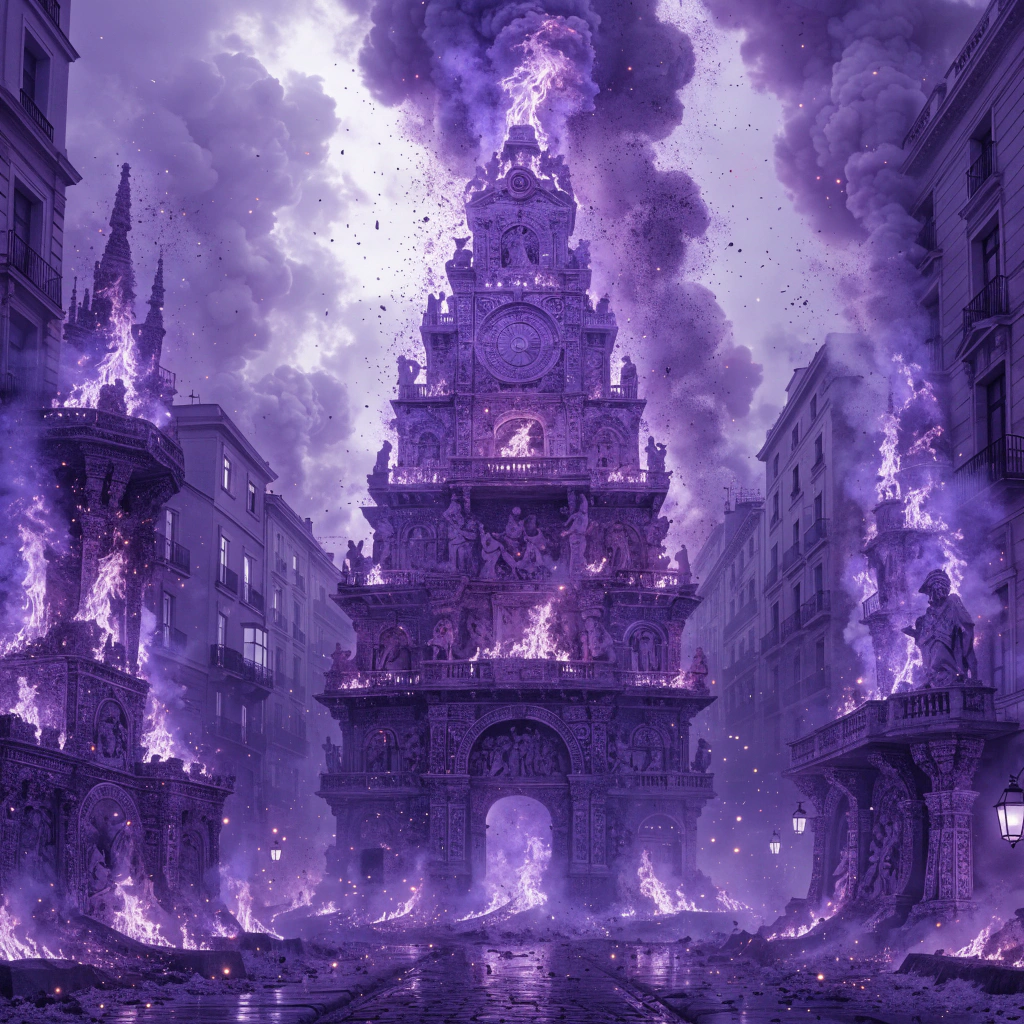
A Big Party in Spain: Las Fallas
Valencia is a city in Spain. Every March, there is a big festival. It is called Las Fallas. Many people visit the city for this party.
Artists make big statues. These statues are called ninots. They are very tall and colorful. Some statues are funny. They are made of wood and paper.
On the last night, people burn the statues. There is a lot of fire and music. It is very loud but beautiful. Families and friends eat food together. It is a special time in Spain.
Grammatik-Spotlight
Muster: Present Simple: To Be
"Valencia is a city in Spain."
We use 'is' with singular subjects like 'Valencia' or 'it'. This pattern describes facts and general truths.
Muster: Present Simple: Plural Verbs
"Artists make big statues."
With plural subjects like 'artists' or 'people', we use the base verb 'make'. We do not add an 's' to the verb.
Teste dein Verständnis
10 Fragen · A1 Anfänger · 1 kostenlose Vorschau
Teste, was du aus diesem Artikel gelernt hast. Beantworte alle Fragen und sammle XP!
Where is the festival of Las Fallas?
Möchtest du das Quiz beenden?
9 weitere Fragen warten auf dich. Registriere dich kostenlos, um das vollständige Quiz freizuschalten und XP zu sammeln!
Kostenlos registrierenHast du schon ein Konto? Anmelden
Gut gemacht!
Weiter üben!
Bereits abgeschlossen — keine zusätzlichen XP
Registriere dich, um XP zu verdienenFragenübersicht
Where is the festival of Las Fallas?
Deine Antwort:
Richtige Antwort: In Valencia
The statues are very small.
Deine Antwort:
Richtige Antwort: Falsch
What does 'loud' mean?
Deine Antwort:
Richtige Antwort: Making a lot of noise
On the last night, people _____ the statues.
Deine Antwort:
Richtige Antwort: burn
The Burning Statues of Valencia
Every year in March, the city of Valencia in Spain has a big festival called Las Fallas. It is a very old and famous celebration. People celebrate the start of spring and Saint Joseph. The streets are full of decorations and many people walk around to enjoy the sun.
In the past, carpenters burned old pieces of wood from their lamps to celebrate the end of winter. Today, artists make huge statues called 'ninots.' These statues are made of wood and paper. They are often taller than buildings and very colorful. Some statues are funny, and others are very beautiful.
The festival is very loud because there are many fireworks every day. On the last night, people burn all the statues in big fires. This is the most exciting part of the festival for everyone. Visitors from many different countries come to see the fire and listen to the traditional music. It is a special time because everyone is happy and the city is full of light.
Grammatik-Spotlight
Muster: Past Simple
"In the past, carpenters burned old pieces of wood from their lamps..."
We use the past simple to talk about finished actions in the past. For regular verbs, we usually add '-ed' to the end of the verb.
Muster: Comparatives
"They are often taller than buildings and very colorful."
We use comparatives to compare two things. For short adjectives like 'tall', we add '-er' and use the word 'than' after it.
Teste dein Verständnis
11 Fragen · A2 Grundkenntnisse · 1 kostenlose Vorschau
Teste, was du aus diesem Artikel gelernt hast. Beantworte alle Fragen und sammle XP!
In which city does Las Fallas take place?
Möchtest du das Quiz beenden?
10 weitere Fragen warten auf dich. Registriere dich kostenlos, um das vollständige Quiz freizuschalten und XP zu sammeln!
Kostenlos registrierenHast du schon ein Konto? Anmelden
Gut gemacht!
Weiter üben!
Bereits abgeschlossen — keine zusätzlichen XP
Registriere dich, um XP zu verdienenFragenübersicht
In which city does Las Fallas take place?
Deine Antwort:
Richtige Antwort: Valencia
The festival celebrates the start of winter.
Deine Antwort:
Richtige Antwort: Falsch
What is a 'ninot'?
Deine Antwort:
Richtige Antwort: A large statue
Statues are often _____ than buildings.
Deine Antwort:
Richtige Antwort: taller
What happens on the last night of the festival?
Deine Antwort:
Richtige Antwort: People burn the statues
The Burning Art of Valencia: Las Fallas
Every March, the city of Valencia in Spain transforms into a giant street party known as Las Fallas. This incredible festival, which honors Saint Joseph, has been celebrated for centuries. It is famous for its massive sculptures, colorful parades, and loud fireworks.
The origins of Las Fallas are found in the Middle Ages. In those days, carpenters used wooden supports, called 'parots,' to hold their candles during the dark winter months. When spring arrived, these supports were no longer needed. To celebrate the spring equinox, the carpenters burned the old wood in the streets. Over time, these simple bonfires evolved into the creation of 'ninots.' These are huge, intricate figures made of wood, wax, and papier-mâché.
Today, the festival is a major international event. The ninots are often very tall, with some reaching up to 30 meters in height. They usually represent famous people or funny scenes from daily life. For several days, the streets are filled with music and the smell of traditional food. Every afternoon, the 'mascletà' takes place, where thousands of firecrackers are set off to create a rhythmic sound that can be felt in the ground.
The most exciting moment happens on the final night, which is known as 'La Cremà.' Almost all the ninots are burned in enormous bonfires across the city. Only one small figure, which has been voted the best by the public, is saved from the flames. This tradition shows that even though the art is temporary, the spirit of the community continues every year.
Grammatik-Spotlight
Muster: Relative Clauses
"This incredible festival, which honors Saint Joseph, has been celebrated for centuries."
Non-defining relative clauses add extra information about a noun. They are separated by commas and use 'which' for things and 'who' for people.
Muster: Passive Voice
"Almost all the ninots are burned in enormous bonfires across the city."
The passive voice is used when the action is more important than the person performing it. It is formed using the verb 'to be' and the past participle.
Teste dein Verständnis
11 Fragen · B1 Mittelstufe · 1 kostenlose Vorschau
Teste, was du aus diesem Artikel gelernt hast. Beantworte alle Fragen und sammle XP!
What was the original purpose of the wooden 'parots' used by carpenters?
Möchtest du das Quiz beenden?
10 weitere Fragen warten auf dich. Registriere dich kostenlos, um das vollständige Quiz freizuschalten und XP zu sammeln!
Kostenlos registrierenHast du schon ein Konto? Anmelden
Gut gemacht!
Weiter üben!
Bereits abgeschlossen — keine zusätzlichen XP
Registriere dich, um XP zu verdienenFragenübersicht
What was the original purpose of the wooden 'parots' used by carpenters?
Deine Antwort:
Richtige Antwort: To hold candles during winter
The festival of Las Fallas takes place in Madrid.
Deine Antwort:
Richtige Antwort: Falsch
What does the word 'intricate' mean?
Deine Antwort:
Richtige Antwort: Having many complex details
The festival has been _____ for centuries.
Deine Antwort:
Richtige Antwort: celebrated
What happens during the 'mascletà'?
Deine Antwort:
Richtige Antwort: Firecrackers create a rhythmic sound
Las Fallas: A Spectacular Blend of Tradition and Artistic Fire
Every March, the city of Valencia undergoes a dramatic transformation as it prepares for Las Fallas, a festival that seamlessly blends historical tradition with contemporary artistic expression. While it is primarily held to commemorate Saint Joseph, the patron saint of carpenters, the event has evolved into a world-renowned spectacle that attracts millions of visitors annually. The origins of this unique celebration can be traced back to the Middle Ages, when local craftsmen would burn the wooden structures used to support their lamps during the winter months. This ritual, marking the arrival of spring, eventually transitioned into the creation of elaborate monuments known as 'ninots'.
These structures, which can reach heights of up to thirty meters, are characterized by their intricate designs and satirical themes. Unlike conventional art exhibitions, Las Fallas serves as a platform for social commentary, where artists utilize their craftsmanship to critique political figures and societal trends. Despite the immense effort and ingenuity required to construct these masterpieces, their existence is inherently ephemeral. On the final night of the festival, known as 'La Cremà', all but one of the monuments are set ablaze in a breathtaking display of fire and light. This 'pardoned' ninot is preserved in the local Fallas Museum, serving as a permanent record of that year's creativity.
The festival is not merely about the final spectacle; it is deeply rooted in the communal identity of Valencia. Throughout the year, neighborhood associations work tirelessly to fund and design their respective fallas. Furthermore, the event features daily firework displays called 'Mascletà', traditional music, and the 'Ofrenda de Flores', a massive floral offering to the Virgin Mary. Consequently, the city becomes a vibrant stage where the past and present coexist in a harmonious, albeit loud, celebration. For many spectators, the most poignant moment occurs when the flames consume the wood and papier-mâché. It is a symbolic gesture of renewal, reminding participants that life is constantly evolving. Although some might view the destruction of such detailed artwork as wasteful, the Valencian people perceive it as a necessary release, allowing for the birth of new ideas in the coming year. Ultimately, Las Fallas remains a testament to human creativity and the enduring power of cultural heritage.
Grammatik-Spotlight
Muster: Passive Voice with Modal Verbs
"The origins of this unique celebration can be traced back to the Middle Ages..."
Used to focus on the action or the object rather than the subject. It is formed using 'can/must/should' + 'be' + past participle.
Muster: Non-Defining Relative Clauses
"These structures, which can reach heights of up to thirty meters, are characterized by their intricate designs."
These clauses provide extra information about a noun. They are separated by commas and use 'which' for things and 'who' for people.
Muster: Discourse Markers for Consequence
"Consequently, the city becomes a vibrant stage where the past and present coexist..."
'Consequently' is a formal transition word used to show the result or effect of a previously mentioned situation.
Teste dein Verständnis
11 Fragen · B2 Obere Mittelstufe · 1 kostenlose Vorschau
Teste, was du aus diesem Artikel gelernt hast. Beantworte alle Fragen und sammle XP!
What was the original practical purpose of the fires burned by medieval craftsmen?
Möchtest du das Quiz beenden?
10 weitere Fragen warten auf dich. Registriere dich kostenlos, um das vollständige Quiz freizuschalten und XP zu sammeln!
Kostenlos registrierenHast du schon ein Konto? Anmelden
Gut gemacht!
Weiter üben!
Bereits abgeschlossen — keine zusätzlichen XP
Registriere dich, um XP zu verdienenFragenübersicht
What was the original practical purpose of the fires burned by medieval craftsmen?
Deine Antwort:
Richtige Antwort: To dispose of wooden lamp supports at the end of winter
Every single 'ninot' created for the festival is destroyed in the final fire.
Deine Antwort:
Richtige Antwort: Falsch
Which word describes something that is intentionally designed to be temporary?
Deine Antwort:
Richtige Antwort: Ephemeral
The festival serves as a platform for social _____, allowing artists to critique politics.
Deine Antwort:
Richtige Antwort: commentary
How do the Valencian people generally view the destruction of the artwork?
Deine Antwort:
Richtige Antwort: As a necessary release and symbolic renewal
Die Fallas von Valencia: Ein Fest der Vergänglichkeit und kreativen Explosion
Jedes Jahr im März verwandelt sich Valencia in ein atemberaubendes Spektakel aus Feuer, Kunst und Tradition, wenn die Stadt die „Fallas“ feiert. Dieses Fest, das zum immateriellen Kulturerbe der Menschheit gehört, ist weit mehr als nur ein Volksfest; es ist eine tief verwurzelte Hommage an den Frühling und eine einzigartige Ausdrucksform valencianischer Identität. Die Ursprünge reichen bis ins Mittelalter zurück, als Zimmermänner am Vorabend des Josefstags, dem 19. März, alte Holzstützen, sogenannte „parots“, verbrannten, die sie im Winter zur Beleuchtung ihrer Werkstätten genutzt hatten. Diese ursprünglich pragmatische Geste der Reinigung und des Neubeginns entwickelte sich im Laufe der Jahrhunderte zu einem immer aufwendigeren Brauchtum.
Aus diesen bescheidenen Anfängen entstand die Tradition der „Ninots“ – gigantische, oft satirische Figuren und Figurengruppen, die aus Holz, Pappmaché und Wachs gefertigt werden. Was einst kleine Puppen waren, hat sich zu monumentalen Meisterwerken entwickelt, die bis zu 30 Meter hoch sein können und ganze Plätze einnehmen. Die Erschaffung dieser aufwendigen Skulpturen ist ein ganzjähriger Prozess, an dem ganze Gemeinden, die sogenannten „Casals Fallers“, mit immenser Hingabe und handwerklichem Geschick arbeiten. Die Ninots karikieren oft politische Persönlichkeiten, gesellschaftliche Missstände oder kulturelle Eigenheiten, wodurch das Fest eine wichtige Plattform für kritische Reflexion und humorvolle Auseinandersetzung mit der Gegenwart bietet.
Die eigentlichen Feierlichkeiten beginnen mit der „Planta“, dem Aufbau der Fallas-Monumente in der gesamten Stadt, der bis zum 15. März abgeschlossen sein muss. Tagsüber und nachts sind die Straßen von unzähligen Feuerwerken, den ohrenbetäubenden „Mascletàs“, erfüllt, deren rhythmische Explosionen nicht nur das Gehör, sondern den ganzen Körper fordern. Ein weiterer Höhepunkt ist die „Ofrenda de Flores“, eine Prozession, bei der Tausende von Falleras und Falleros in traditionellen Trachten der Jungfrau Maria einen riesigen Blumenmantel darbringen, was ein beeindruckendes Bild der Gemeinschaft und Frömmigkeit abgibt. Doch all dies ist nur das Vorspiel zur „Cremà“.
In der Nacht des 19. März erreicht das Fest seinen dramatischen Höhepunkt: die „Cremà“. Dann werden alle Ninots, mit Ausnahme des „Ninot Indultat“ – einer durch öffentliche Abstimmung geretteten Figur, die ins Fallas-Museum einzieht –, in einem spektakulären Feuermeer verbrannt. Dieses scheinbar destruktive Ritual ist in Wahrheit ein tief symbolischer Akt der Reinigung, des Abschieds vom Alten und der Begrüßung des Neuen. Es ist die ultimative Darstellung der Vergänglichkeit und zugleich eine Feier der künstlerischen Kreativität, deren Wert nicht in ihrer Dauerhaftigkeit, sondern in ihrer Intensität und ihrem Moment begründet liegt. Man könnte argumentieren, dass diese Vergänglichkeit gerade das ist, was den Werken ihren besonderen Reiz verleiht, denn ihr Wert bemisst sich nicht an ihrer Dauerhaftigkeit. Die Asche, die danach bleibt, symbolisiert nicht das Ende, sondern den fruchtbaren Boden für den Neubeginn.
Die Fallas sind somit weit mehr als nur ein lokales Ereignis; sie sind ein faszinierendes Zusammenspiel aus Kunst, Satire, Glaube und Gemeinschaftssinn, das jedes Jahr Millionen von Besuchern anzieht. Sie demonstrieren auf eindrucksvolle Weise, wie tief verwurzelte Bräuche sich entwickeln können, ohne ihre Essenz zu verlieren. Was ursprünglich eine einfache Geste von Zimmermännern war, hat sich zu einem komplexen Kulturphänomen entwickelt, das die valencianische Identität prägt und weltweit für seine Einzigartigkeit bewundert wird. Es ist diese unvergleichliche Mischung aus Feuer, Lärm, Schönheit und Vergänglichkeit, die die Fallas zu einem unvergesslichen Erlebnis macht und ihre Bedeutung für die spanische und internationale Kultur unabdingbar erscheinen lässt.
Grammatik-Spotlight
Muster: Nominalisierung
"Die Erschaffung dieser aufwendigen Skulpturen ist ein ganzjähriger Prozess..."
Verben oder Adjektive werden hier zu Nomen umgewandelt. Dies führt zu einem formelleren und prägnanteren Stil, indem Handlungen oder Eigenschaften als Dinge dargestellt werden. Oft enden diese Nomen auf Suffixe wie „-ung“, „-heit“, „-keit“ oder sind substantivierte Infinitive.
Muster: Passiv mit Modalverb
"Der Aufbau der Fallas-Monumente... muss bis zum 15. März abgeschlossen sein."
Diese Konstruktion drückt aus, dass eine Handlung notwendig ist oder getan werden muss, ohne den Handelnden explizit zu nennen. Sie besteht aus einem Modalverb (hier „muss“), dem Partizip II des Hauptverbs („abgeschlossen“) und dem Hilfsverb „sein“.
Muster: Konjunktiv II für Irreales/Hypothetisches
"Man könnte argumentieren, dass diese Vergänglichkeit gerade das ist, was den Werken ihren besonderen Reiz verleiht..."
Der Konjunktiv II wird verwendet, um unwirkliche, hypothetische oder potenzielle Aussagen zu formulieren. Er zeigt an, dass etwas nicht der Realität entspricht oder nur eine Möglichkeit darstellt. In diesem Fall drückt „könnte“ eine Möglichkeit oder eine vorsichtige Annahme aus.
Teste dein Verständnis
12 Fragen · C1 Fortgeschritten · 1 kostenlose Vorschau
Teste, was du aus diesem Artikel gelernt hast. Beantworte alle Fragen und sammle XP!
Wann finden die Hauptfeierlichkeiten der Fallas statt?
Möchtest du das Quiz beenden?
11 weitere Fragen warten auf dich. Registriere dich kostenlos, um das vollständige Quiz freizuschalten und XP zu sammeln!
Kostenlos registrierenHast du schon ein Konto? Anmelden
Gut gemacht!
Weiter üben!
Bereits abgeschlossen — keine zusätzlichen XP
Registriere dich, um XP zu verdienenFragenübersicht
Wann finden die Hauptfeierlichkeiten der Fallas statt?
Deine Antwort:
Richtige Antwort: Im März
Die 'Ninots' sind kleine, einfache Holzfiguren.
Deine Antwort:
Richtige Antwort: Falsch
Was bedeutet 'Cremà' im Kontext der Fallas?
Deine Antwort:
Richtige Antwort: Das Verbrennen der Figuren
Die 'Ninots' karikieren oft __________ Persönlichkeiten oder gesellschaftliche Missstände.
Deine Antwort:
Richtige Antwort: politische
Welcher Schutzpatron wird mit Las Fallas geehrt?
Deine Antwort:
Richtige Antwort: Der Heilige Josef
Das Verbrennen der Ninots symbolisiert Zerstörung ohne tieferen Sinn.
Deine Antwort:
Richtige Antwort: Falsch
Ephemeral Grandeur: An Ontological Analysis of Valencia’s Fallas
The Valencian Fallas represents a paradigm of cultural paradox, where the meticulous craftsmanship of months is surrendered to the flames in a single, cathartic night. While ostensibly a celebration of Saint Joseph, the festival’s ontological roots extend into the pre-Christian spring equinox, signifying a seasonal rebirth through the medium of fire. Seldom has a tradition so successfully balanced the sacred with the profane, blending religious devotion with a biting, iconoclastic spirit that permeates the city’s atmosphere. The evolution of the 'parots'—simple wooden supports for winter lamps—into the towering, sophisticated 'ninots' of today reflects the vicissitudes of Spanish history and the enduring proclivity of the Valencian people for artistic subversion.
To the uninitiated, the Fallas might appear as a mere display of pyrotechnic excess; however, a closer scholarly examination reveals a complex socio-political tapestry. Each monument, or 'falla', serves as a transient vessel for satire, often targeting the political elite or societal follies with a sharp, evocative wit. It is imperative that the 'ninot indultat'—the single figure spared from the final conflagration—represent the pinnacle of both aesthetic beauty and cultural relevance. Were one to examine the intricate details of these papier-mâché giants, one would discern a profound commentary on the human condition, rendered in a style that fluctuates between the grotesque and the sublime.
The sensory landscape of the festival is equally significant, dominated by the 'Mascletà'. This is not merely noise, but a rhythmic orchestration of gunpowder that resonates within the very bones of the spectators. This cacophony serves a ritualistic purpose, clearing the path for the vernal transition. One might argue that the auditory intensity is a quintessential component of the Valencian identity, a shared experience that binds the community through a collective vibration. Despite the inherent dangers of such a massive undertaking, the city maintains a meticulous organization, ensuring that the transience of the art does not compromise the safety of the populace.
As the festival reaches its zenith during the 'Cremà', the destruction of the monuments is not mourned but celebrated. This act of purification by fire symbolizes the shedding of the old to make way for the new. It is a moment of profound collective catharsis. The smoke that billows over the Mediterranean city is a testament to the community’s resilience and its commitment to an art form that refuses to be commodified or preserved. In an era obsessed with permanence and digital archiving, the Fallas stands as a defiant reminder of the beauty found in the temporary. The legacy of the Fallas, now recognized by UNESCO, continues to thrive, proving that some of the most enduring cultural expressions are those that are built specifically to be destroyed.
Grammatik-Spotlight
Muster: Negative Inversion
"Seldom has a tradition so successfully balanced the sacred with the profane."
When using negative adverbs like 'seldom' or 'never' at the start of a sentence for emphasis, the auxiliary verb and subject are inverted. This creates a formal, rhetorical tone common in C2 academic writing.
Muster: Subjunctive Mood
"It is imperative that the 'ninot indultat' represent the pinnacle of both aesthetic beauty and cultural relevance."
The subjunctive 'represent' (rather than 'represents') is used after adjectives of necessity or urgency like 'imperative' or 'essential'. It indicates a desired or required state rather than a factual one.
Muster: Inverted Conditional (Were... to)
"Were one to examine the intricate details of these papier-mâché giants, one would discern a profound commentary."
This structure is a highly formal alternative to 'If one were to examine'. It is used to discuss hypothetical or unlikely situations in scholarly analysis.
Teste dein Verständnis
12 Fragen · C2 Meisterschaft · 1 kostenlose Vorschau
Teste, was du aus diesem Artikel gelernt hast. Beantworte alle Fragen und sammle XP!
According to the article, what is the 'ontological' origin of Las Fallas?
Möchtest du das Quiz beenden?
11 weitere Fragen warten auf dich. Registriere dich kostenlos, um das vollständige Quiz freizuschalten und XP zu sammeln!
Kostenlos registrierenHast du schon ein Konto? Anmelden
Gut gemacht!
Weiter üben!
Bereits abgeschlossen — keine zusätzlichen XP
Registriere dich, um XP zu verdienenFragenübersicht
According to the article, what is the 'ontological' origin of Las Fallas?
Deine Antwort:
Richtige Antwort: A pre-Christian celebration of the spring equinox.
The 'ninot indultat' is the only sculpture destroyed during the Cremà.
Deine Antwort:
Richtige Antwort: Falsch
Which word describes a harsh, discordant mixture of sounds?
Deine Antwort:
Richtige Antwort: Cacophony
The destruction of the monuments during the 'Cremà' is described as a moment of collective _____.
Deine Antwort:
Richtige Antwort: catharsis
How does the author characterize the 'Mascletà'?
Deine Antwort:
Richtige Antwort: A rhythmic orchestration of gunpowder that binds the community.
The author suggests that the festival's art form is a protest against digital archiving and permanence.
Deine Antwort:
Richtige Antwort: Richtig

