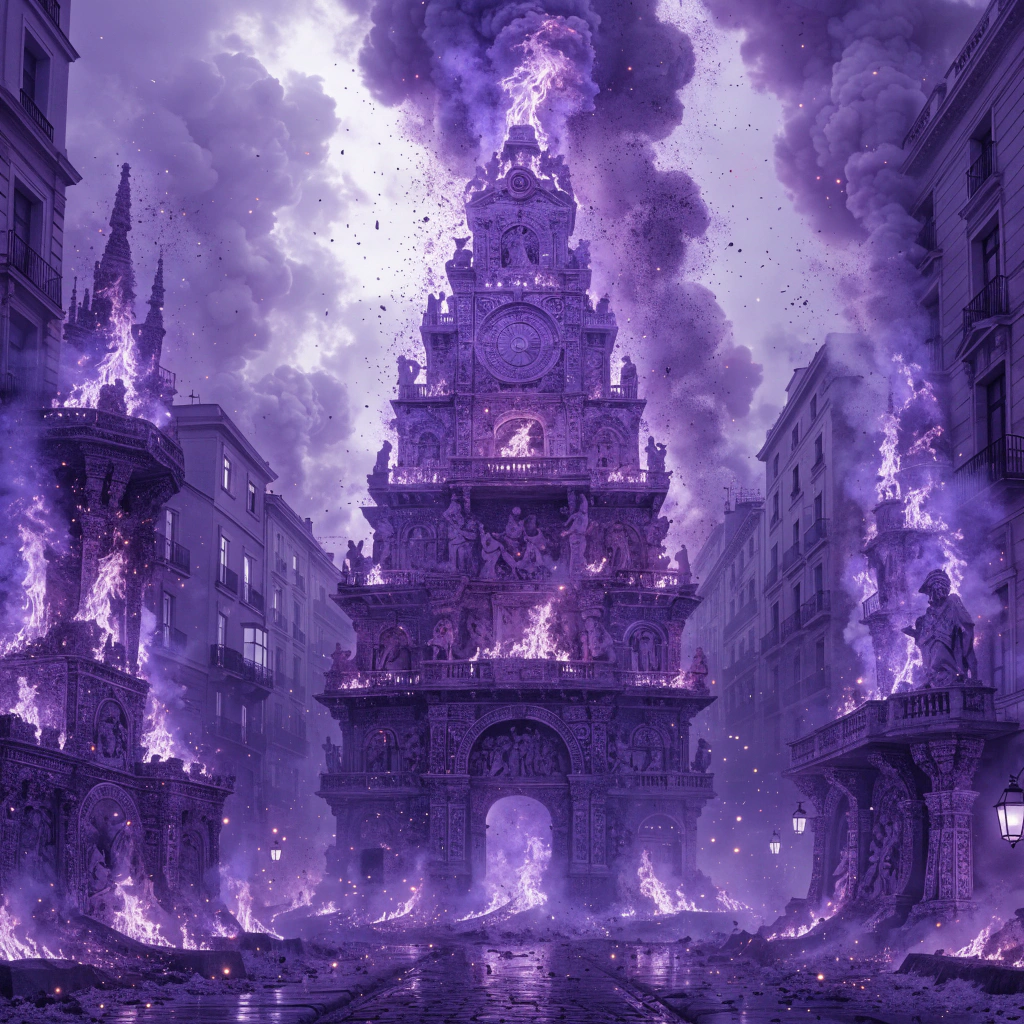
A Big Party in Spain: Las Fallas
Valencia is a city in Spain. Every March, there is a big festival. It is called Las Fallas. Many people visit the city for this party.
Artists make big statues. These statues are called ninots. They are very tall and colorful. Some statues are funny. They are made of wood and paper.
On the last night, people burn the statues. There is a lot of fire and music. It is very loud but beautiful. Families and friends eat food together. It is a special time in Spain.
Grammar Spotlight
Pattern: Present Simple: To Be
"Valencia is a city in Spain."
We use 'is' with singular subjects like 'Valencia' or 'it'. This pattern describes facts and general truths.
Pattern: Present Simple: Plural Verbs
"Artists make big statues."
With plural subjects like 'artists' or 'people', we use the base verb 'make'. We do not add an 's' to the verb.
Test Your Understanding
10 questions · A1 Beginner · 1 free preview
Test what you learned from this article. Answer all questions to earn XP!
Where is the festival of Las Fallas?
Want to finish the quiz?
9 more questions are waiting for you. Sign up free to unlock the full quiz and earn XP!
Sign Up FreeAlready have an account? Sign In
Question Breakdown
Where is the festival of Las Fallas?
Your answer:
Correct answer: In Valencia
The statues are very small.
Your answer:
Correct answer: False
What does 'loud' mean?
Your answer:
Correct answer: Making a lot of noise
On the last night, people _____ the statues.
Your answer:
Correct answer: burn
The Burning Statues of Valencia
Every year in March, the city of Valencia in Spain has a big festival called Las Fallas. It is a very old and famous celebration. People celebrate the start of spring and Saint Joseph. The streets are full of decorations and many people walk around to enjoy the sun.
In the past, carpenters burned old pieces of wood from their lamps to celebrate the end of winter. Today, artists make huge statues called 'ninots.' These statues are made of wood and paper. They are often taller than buildings and very colorful. Some statues are funny, and others are very beautiful.
The festival is very loud because there are many fireworks every day. On the last night, people burn all the statues in big fires. This is the most exciting part of the festival for everyone. Visitors from many different countries come to see the fire and listen to the traditional music. It is a special time because everyone is happy and the city is full of light.
Grammar Spotlight
Pattern: Past Simple
"In the past, carpenters burned old pieces of wood from their lamps..."
We use the past simple to talk about finished actions in the past. For regular verbs, we usually add '-ed' to the end of the verb.
Pattern: Comparatives
"They are often taller than buildings and very colorful."
We use comparatives to compare two things. For short adjectives like 'tall', we add '-er' and use the word 'than' after it.
Test Your Understanding
11 questions · A2 Elementary · 1 free preview
Test what you learned from this article. Answer all questions to earn XP!
In which city does Las Fallas take place?
Want to finish the quiz?
10 more questions are waiting for you. Sign up free to unlock the full quiz and earn XP!
Sign Up FreeAlready have an account? Sign In
Question Breakdown
In which city does Las Fallas take place?
Your answer:
Correct answer: Valencia
The festival celebrates the start of winter.
Your answer:
Correct answer: False
What is a 'ninot'?
Your answer:
Correct answer: A large statue
Statues are often _____ than buildings.
Your answer:
Correct answer: taller
What happens on the last night of the festival?
Your answer:
Correct answer: People burn the statues
The Burning Art of Valencia: Las Fallas
Every March, the city of Valencia in Spain transforms into a giant street party known as Las Fallas. This incredible festival, which honors Saint Joseph, has been celebrated for centuries. It is famous for its massive sculptures, colorful parades, and loud fireworks.
The origins of Las Fallas are found in the Middle Ages. In those days, carpenters used wooden supports, called 'parots,' to hold their candles during the dark winter months. When spring arrived, these supports were no longer needed. To celebrate the spring equinox, the carpenters burned the old wood in the streets. Over time, these simple bonfires evolved into the creation of 'ninots.' These are huge, intricate figures made of wood, wax, and papier-mâché.
Today, the festival is a major international event. The ninots are often very tall, with some reaching up to 30 meters in height. They usually represent famous people or funny scenes from daily life. For several days, the streets are filled with music and the smell of traditional food. Every afternoon, the 'mascletà' takes place, where thousands of firecrackers are set off to create a rhythmic sound that can be felt in the ground.
The most exciting moment happens on the final night, which is known as 'La Cremà.' Almost all the ninots are burned in enormous bonfires across the city. Only one small figure, which has been voted the best by the public, is saved from the flames. This tradition shows that even though the art is temporary, the spirit of the community continues every year.
Grammar Spotlight
Pattern: Relative Clauses
"This incredible festival, which honors Saint Joseph, has been celebrated for centuries."
Non-defining relative clauses add extra information about a noun. They are separated by commas and use 'which' for things and 'who' for people.
Pattern: Passive Voice
"Almost all the ninots are burned in enormous bonfires across the city."
The passive voice is used when the action is more important than the person performing it. It is formed using the verb 'to be' and the past participle.
Test Your Understanding
11 questions · B1 Intermediate · 1 free preview
Test what you learned from this article. Answer all questions to earn XP!
What was the original purpose of the wooden 'parots' used by carpenters?
Want to finish the quiz?
10 more questions are waiting for you. Sign up free to unlock the full quiz and earn XP!
Sign Up FreeAlready have an account? Sign In
Question Breakdown
What was the original purpose of the wooden 'parots' used by carpenters?
Your answer:
Correct answer: To hold candles during winter
The festival of Las Fallas takes place in Madrid.
Your answer:
Correct answer: False
What does the word 'intricate' mean?
Your answer:
Correct answer: Having many complex details
The festival has been _____ for centuries.
Your answer:
Correct answer: celebrated
What happens during the 'mascletà'?
Your answer:
Correct answer: Firecrackers create a rhythmic sound
Las Fallas: A Spectacular Blend of Tradition and Artistic Fire
Every March, the city of Valencia undergoes a dramatic transformation as it prepares for Las Fallas, a festival that seamlessly blends historical tradition with contemporary artistic expression. While it is primarily held to commemorate Saint Joseph, the patron saint of carpenters, the event has evolved into a world-renowned spectacle that attracts millions of visitors annually. The origins of this unique celebration can be traced back to the Middle Ages, when local craftsmen would burn the wooden structures used to support their lamps during the winter months. This ritual, marking the arrival of spring, eventually transitioned into the creation of elaborate monuments known as 'ninots'.
These structures, which can reach heights of up to thirty meters, are characterized by their intricate designs and satirical themes. Unlike conventional art exhibitions, Las Fallas serves as a platform for social commentary, where artists utilize their craftsmanship to critique political figures and societal trends. Despite the immense effort and ingenuity required to construct these masterpieces, their existence is inherently ephemeral. On the final night of the festival, known as 'La Cremà', all but one of the monuments are set ablaze in a breathtaking display of fire and light. This 'pardoned' ninot is preserved in the local Fallas Museum, serving as a permanent record of that year's creativity.
The festival is not merely about the final spectacle; it is deeply rooted in the communal identity of Valencia. Throughout the year, neighborhood associations work tirelessly to fund and design their respective fallas. Furthermore, the event features daily firework displays called 'Mascletà', traditional music, and the 'Ofrenda de Flores', a massive floral offering to the Virgin Mary. Consequently, the city becomes a vibrant stage where the past and present coexist in a harmonious, albeit loud, celebration. For many spectators, the most poignant moment occurs when the flames consume the wood and papier-mâché. It is a symbolic gesture of renewal, reminding participants that life is constantly evolving. Although some might view the destruction of such detailed artwork as wasteful, the Valencian people perceive it as a necessary release, allowing for the birth of new ideas in the coming year. Ultimately, Las Fallas remains a testament to human creativity and the enduring power of cultural heritage.
Grammar Spotlight
Pattern: Passive Voice with Modal Verbs
"The origins of this unique celebration can be traced back to the Middle Ages..."
Used to focus on the action or the object rather than the subject. It is formed using 'can/must/should' + 'be' + past participle.
Pattern: Non-Defining Relative Clauses
"These structures, which can reach heights of up to thirty meters, are characterized by their intricate designs."
These clauses provide extra information about a noun. They are separated by commas and use 'which' for things and 'who' for people.
Pattern: Discourse Markers for Consequence
"Consequently, the city becomes a vibrant stage where the past and present coexist..."
'Consequently' is a formal transition word used to show the result or effect of a previously mentioned situation.
Test Your Understanding
11 questions · B2 Upper Intermediate · 1 free preview
Test what you learned from this article. Answer all questions to earn XP!
What was the original practical purpose of the fires burned by medieval craftsmen?
Want to finish the quiz?
10 more questions are waiting for you. Sign up free to unlock the full quiz and earn XP!
Sign Up FreeAlready have an account? Sign In
Question Breakdown
What was the original practical purpose of the fires burned by medieval craftsmen?
Your answer:
Correct answer: To dispose of wooden lamp supports at the end of winter
Every single 'ninot' created for the festival is destroyed in the final fire.
Your answer:
Correct answer: False
Which word describes something that is intentionally designed to be temporary?
Your answer:
Correct answer: Ephemeral
The festival serves as a platform for social _____, allowing artists to critique politics.
Your answer:
Correct answer: commentary
How do the Valencian people generally view the destruction of the artwork?
Your answer:
Correct answer: As a necessary release and symbolic renewal
The Ephemeral Splendour of Las Fallas: A Study in Creative Destruction
Every March, the Mediterranean city of Valencia undergoes a profound metamorphosis, shedding its skin as a conventional urban hub to become a sprawling gallery of fire and satire. Rarely does a city undergo such a radical metamorphosis, yet for the Valencians, Las Fallas is not merely a festival; it is a fundamental pillar of their collective identity. The origins of this spectacle are rooted in the Middle Ages, when carpenters would incinerate the wooden supports used for their winter lamps to mark the arrival of the spring equinox. What began as a pragmatic disposal of seasonal debris has evolved into an ostentatious display of artistic prowess and socio-political commentary.
At the heart of the festivities are the 'fallas'—monumental structures that can tower up to thirty meters. These are composed of numerous 'ninots', or smaller figures, which are often satirical in nature. It is through these satirical effigies that the community voices its grievances, lampooning politicians, celebrities, and global events with a sharp, irreverent verve. The craftsmanship involved is staggering, requiring a year of meticulous labor, only for the entire creation to be reduced to ashes in a single night. This transient nature of the art is central to the festival's philosophy; it represents the cathartic purging of the old to make way for the new.
However, the festival is not without its controversies. Critics often point to the environmental impact of the 'Cremà'—the final night of burning—where the combustion of materials releases significant carbon emissions. Furthermore, the relentless cacophony of the 'Mascletà', a daily rhythmic explosion of gunpowder, is frequently cited as a source of urban stress. Despite these concerns, the preservation of this intangible cultural heritage remains a priority for the local government. They argue that the economic influx and the reinforcement of communal bonds outweigh the seasonal disruptions. It is the juxtaposition of destruction and creation that defines the unique allure of Las Fallas. To the outsider, the intentional incineration of millions of euros worth of art may seem illogical, yet to the local, it is a necessary cycle of rebirth. Scarcely had the smoke cleared from the final embers when the falleros began planning the following year’s monuments, proving that the spirit of the festival is as enduring as the art is ephemeral.
Grammar Spotlight
Pattern: Negative Inversion
"Rarely does a city undergo such a radical metamorphosis..."
When a sentence starts with a negative or restrictive adverb like 'rarely', the auxiliary verb comes before the subject. This is used in formal writing to add emphasis or dramatic effect.
Pattern: Cleft Sentences
"It is through these satirical effigies that the community voices its grievances."
A cleft sentence focuses on a specific part of the information by starting with 'It is/was'. It highlights the 'how' or 'why' of a statement, making the argument more persuasive.
Pattern: Nominalisation
"The preservation of this intangible cultural heritage remains a priority..."
Using a noun phrase ('The preservation of...') instead of a verb ('Preserving...') makes the writing more academic and objective. It focuses on the concept rather than the action.
Test Your Understanding
12 questions · C1 Advanced · 1 free preview
Test what you learned from this article. Answer all questions to earn XP!
What was the original pragmatic purpose of the bonfires in the Middle Ages?
Want to finish the quiz?
11 more questions are waiting for you. Sign up free to unlock the full quiz and earn XP!
Sign Up FreeAlready have an account? Sign In
Question Breakdown
What was the original pragmatic purpose of the bonfires in the Middle Ages?
Your answer:
Correct answer: To dispose of wooden supports for winter lamps
The article suggests that the environmental impact of the festival is universally ignored by Valencians.
Your answer:
Correct answer: False
Which word describes the act of mocking or satirizing public figures through art?
Your answer:
Correct answer: Lampooning
The article describes the sound of the Mascletà as a _____ of gunpowder explosions.
Your answer:
Correct answer: cacophony
According to the text, what is the 'Cremà'?
Your answer:
Correct answer: The final night when the structures are burned
The planning for the next year's festival begins almost immediately after the current one ends.
Your answer:
Correct answer: True
Ephemeral Grandeur: An Ontological Analysis of Valencia’s Fallas
The Valencian Fallas represents a paradigm of cultural paradox, where the meticulous craftsmanship of months is surrendered to the flames in a single, cathartic night. While ostensibly a celebration of Saint Joseph, the festival’s ontological roots extend into the pre-Christian spring equinox, signifying a seasonal rebirth through the medium of fire. Seldom has a tradition so successfully balanced the sacred with the profane, blending religious devotion with a biting, iconoclastic spirit that permeates the city’s atmosphere. The evolution of the 'parots'—simple wooden supports for winter lamps—into the towering, sophisticated 'ninots' of today reflects the vicissitudes of Spanish history and the enduring proclivity of the Valencian people for artistic subversion.
To the uninitiated, the Fallas might appear as a mere display of pyrotechnic excess; however, a closer scholarly examination reveals a complex socio-political tapestry. Each monument, or 'falla', serves as a transient vessel for satire, often targeting the political elite or societal follies with a sharp, evocative wit. It is imperative that the 'ninot indultat'—the single figure spared from the final conflagration—represent the pinnacle of both aesthetic beauty and cultural relevance. Were one to examine the intricate details of these papier-mâché giants, one would discern a profound commentary on the human condition, rendered in a style that fluctuates between the grotesque and the sublime.
The sensory landscape of the festival is equally significant, dominated by the 'Mascletà'. This is not merely noise, but a rhythmic orchestration of gunpowder that resonates within the very bones of the spectators. This cacophony serves a ritualistic purpose, clearing the path for the vernal transition. One might argue that the auditory intensity is a quintessential component of the Valencian identity, a shared experience that binds the community through a collective vibration. Despite the inherent dangers of such a massive undertaking, the city maintains a meticulous organization, ensuring that the transience of the art does not compromise the safety of the populace.
As the festival reaches its zenith during the 'Cremà', the destruction of the monuments is not mourned but celebrated. This act of purification by fire symbolizes the shedding of the old to make way for the new. It is a moment of profound collective catharsis. The smoke that billows over the Mediterranean city is a testament to the community’s resilience and its commitment to an art form that refuses to be commodified or preserved. In an era obsessed with permanence and digital archiving, the Fallas stands as a defiant reminder of the beauty found in the temporary. The legacy of the Fallas, now recognized by UNESCO, continues to thrive, proving that some of the most enduring cultural expressions are those that are built specifically to be destroyed.
Grammar Spotlight
Pattern: Negative Inversion
"Seldom has a tradition so successfully balanced the sacred with the profane."
When using negative adverbs like 'seldom' or 'never' at the start of a sentence for emphasis, the auxiliary verb and subject are inverted. This creates a formal, rhetorical tone common in C2 academic writing.
Pattern: Subjunctive Mood
"It is imperative that the 'ninot indultat' represent the pinnacle of both aesthetic beauty and cultural relevance."
The subjunctive 'represent' (rather than 'represents') is used after adjectives of necessity or urgency like 'imperative' or 'essential'. It indicates a desired or required state rather than a factual one.
Pattern: Inverted Conditional (Were... to)
"Were one to examine the intricate details of these papier-mâché giants, one would discern a profound commentary."
This structure is a highly formal alternative to 'If one were to examine'. It is used to discuss hypothetical or unlikely situations in scholarly analysis.
Test Your Understanding
12 questions · C2 Mastery · 1 free preview
Test what you learned from this article. Answer all questions to earn XP!
According to the article, what is the 'ontological' origin of Las Fallas?
Want to finish the quiz?
11 more questions are waiting for you. Sign up free to unlock the full quiz and earn XP!
Sign Up FreeAlready have an account? Sign In
Question Breakdown
According to the article, what is the 'ontological' origin of Las Fallas?
Your answer:
Correct answer: A pre-Christian celebration of the spring equinox.
The 'ninot indultat' is the only sculpture destroyed during the Cremà.
Your answer:
Correct answer: False
Which word describes a harsh, discordant mixture of sounds?
Your answer:
Correct answer: Cacophony
The destruction of the monuments during the 'Cremà' is described as a moment of collective _____.
Your answer:
Correct answer: catharsis
How does the author characterize the 'Mascletà'?
Your answer:
Correct answer: A rhythmic orchestration of gunpowder that binds the community.
The author suggests that the festival's art form is a protest against digital archiving and permanence.
Your answer:
Correct answer: True
