Holy Week in Spain
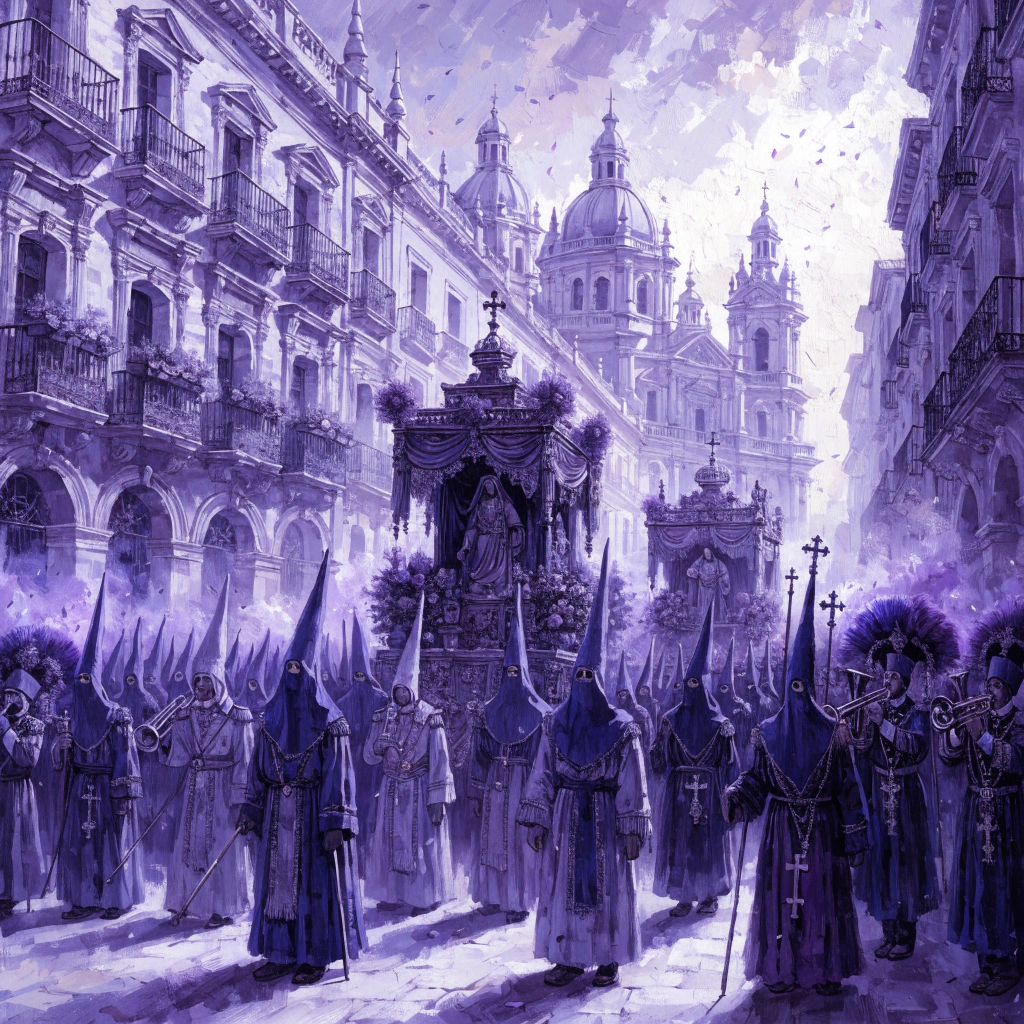
Holy Week is a big festival in Spain. It is in the spring. Many people visit the streets to watch processions. In the processions, people carry heavy wooden floats. These floats have statues of Jesus and Mary. They have many flowers and candles. There is music in the streets. Men wear long robes and special hats. It is a very old tradition. Families eat together. They watch the beautiful floats. It is a very emotional time for people in Spain.
Point grammaire
Structure: Present Simple (to be)
"Holy Week is a big festival in Spain."
We use 'is' with singular subjects to describe facts or states. It connects the subject to a description.
Structure: Present Simple (regular verbs)
"Families eat together."
We use the base form of the verb for plural subjects like 'families'. This shows a regular action or habit.
Teste ta compréhension
10 questions · A1 Débutant · 1 aperçu gratuit
Teste ce que tu as appris dans cet article. Réponds à toutes les questions pour gagner des XP !
Where is the festival?
Tu veux terminer le quiz ?
9 questions supplémentaires t'attendent. Inscris-toi gratuitement pour débloquer le quiz complet et gagner des XP !
S'inscrire gratuitementTu as dj un compte ? Connexion
Bien joué !
Continue à pratiquer !
Déjà terminé — pas de XP supplémentaire
Inscris-toi pour gagner des XPDétail des questions
Where is the festival?
Ta réponse:
Bonne réponse: Spain
The festival is in the winter.
Ta réponse:
Bonne réponse: Faux
What are 'floats'?
Ta réponse:
Bonne réponse: Large decorated platforms
There is _____ in the streets.
Ta réponse:
Bonne réponse: music
Holy Week in Spain
Semana Santa is a very special time in Spain. It happens every year in the spring. People call it Holy Week. It is more famous in the south of Spain than in the north.
During this week, there are many processions in the streets. Religious groups called brotherhoods carry large wooden floats. These floats are very heavy because they have beautiful statues on them. They are decorated with gold, silver, and many flowers.
The streets are louder and busier than usual. Thousands of people watch the processions every day. Men carry the heavy floats on their shoulders. They walk slowly and there is often traditional music. Many people wear long robes and tall, pointed hats.
Families eat special food during this time. They love 'torrijas', which is a sweet bread with honey. It is an emotional week for many Spanish people. It is also a popular time for tourists to visit because the weather is warm.
Point grammaire
Structure: Comparative Adjectives
"The streets are louder and busier than usual."
We use the suffix '-er' to compare two things. For adjectives ending in 'y' like 'busy', we change the 'y' to 'i' and then add 'er'.
Structure: Reason Connectors
"These floats are very heavy because they have beautiful statues on them."
We use the word 'because' to explain the reason for something. It connects a main idea with the cause behind it.
Teste ta compréhension
11 questions · A2 mentaire · 1 aperçu gratuit
Teste ce que tu as appris dans cet article. Réponds à toutes les questions pour gagner des XP !
Where is Holy Week most famous in Spain?
Tu veux terminer le quiz ?
10 questions supplémentaires t'attendent. Inscris-toi gratuitement pour débloquer le quiz complet et gagner des XP !
S'inscrire gratuitementTu as dj un compte ? Connexion
Bien joué !
Continue à pratiquer !
Déjà terminé — pas de XP supplémentaire
Inscris-toi pour gagner des XPDétail des questions
Where is Holy Week most famous in Spain?
Ta réponse:
Bonne réponse: The South
Spanish families eat sweet bread called torrijas during this week.
Ta réponse:
Bonne réponse: Vrai
What does the word 'floats' mean?
Ta réponse:
Bonne réponse: Large wooden platforms
When people carry the floats, they walk _____ and listen to music.
Ta réponse:
Bonne réponse: slowly
What do many people wear during the processions?
Ta réponse:
Bonne réponse: Long robes and tall hats
La Semaine Sainte en Espagne : Une Tradition Profonde
La Semaine Sainte, ou « Semana Santa » en espagnol, est l'un des événements culturels et religieux les plus importants d'Espagne. Elle est célébrée chaque année et marque la Passion du Christ, de son entrée à Jérusalem jusqu'à sa résurrection. Bien que cette célébration ait lieu dans tout le pays, certaines régions, comme l'Andalousie dans le sud, sont particulièrement réputées pour la ferveur et la splendeur de leurs processions.
Des villes comme Séville, Malaga et Grenade attirent des milliers de visiteurs. Pendant cette semaine, les rues sont remplies d'une atmosphère unique. Les « cofradías » (confréries religieuses) organisent des processions quotidiennes. Ces confréries sont composées de membres qui portent des capirotes, des cagoules pointues, et défilent lentement dans les rues.
Le cœur de ces processions est le « paso », un char monumental décoré avec une richesse incroyable. Ces pasos, souvent très anciens, sont ornés de sculptures religieuses, de fleurs, de bougies, d'argent et d'or. Ils sont portés à bras d'hommes, les « costaleros », qui avancent au rythme lent et solennel de la musique. Le poids de ces structures peut être énorme, et les costaleros sont souvent épuisés après plusieurs heures, mais ils continuent par dévotion.
L'émotion est palpable. Les spectateurs regardent avec respect et admiration, et il n'est pas rare de voir des gens pleurer. Des chants spontanés, appelés « saetas », sont parfois entonnés depuis les balcons, ajoutant à l'intensité du moment. La Semaine Sainte n'est pas seulement une fête religieuse ; c'est aussi une expression artistique et culturelle qui a été transmise de génération en génération. C'est une expérience inoubliable pour quiconque la vit.
Point grammaire
Structure: Le Passé Composé
"La Semaine Sainte n'est pas seulement une fête religieuse ; c'est aussi une expression artistique et culturelle qui a été transmise de génération en génération."
Le passé composé est utilisé pour parler d'actions passées qui sont terminées. Il est formé avec l'auxiliaire « avoir » ou « être » au présent, suivi du participe passé du verbe principal. Ici, « a été transmise » montre une action passée qui a des conséquences sur le présent.
Structure: La Voix Passive
"Ces pasos, souvent très anciens, sont ornés de sculptures religieuses, de fleurs, de bougies, d'argent et d'or."
La voix passive est utilisée quand le sujet de la phrase subit l'action, au lieu de la faire. Elle est formée avec le verbe « être » et le participe passé du verbe. Ici, les « pasos » ne décorent pas, ils sont décorés par quelqu'un ou quelque chose.
Teste ta compréhension
11 questions · B1 Intermédiaire · 1 aperçu gratuit
Teste ce que tu as appris dans cet article. Réponds à toutes les questions pour gagner des XP !
Où la Semaine Sainte est-elle particulièrement célèbre en Espagne ?
Tu veux terminer le quiz ?
10 questions supplémentaires t'attendent. Inscris-toi gratuitement pour débloquer le quiz complet et gagner des XP !
S'inscrire gratuitementTu as dj un compte ? Connexion
Bien joué !
Continue à pratiquer !
Déjà terminé — pas de XP supplémentaire
Inscris-toi pour gagner des XPDétail des questions
Où la Semaine Sainte est-elle particulièrement célèbre en Espagne ?
Ta réponse:
Bonne réponse: En Andalousie, dans le sud
Les « cofradías » sont des groupes de touristes qui visitent l'Espagne.
Ta réponse:
Bonne réponse: Faux
Que signifie le mot « ferveur » dans le contexte de l'article ?
Ta réponse:
Bonne réponse: Un grand enthousiasme religieux
Les « pasos » sont des chars _____ décorés.
Ta réponse:
Bonne réponse: monumentaux
Les « costaleros » portent les pasos à bras d'_____.
Ta réponse:
Bonne réponse: hommes
La Semaine Sainte en Espagne : Entre Ferveur et Tradition Séculaire
La Semaine Sainte, ou « Semana Santa » en espagnol, représente sans doute l'un des événements culturels et religieux les plus emblématiques et profondément enracinés en Espagne. Bien que célébrée à travers tout le pays, c'est indéniablement en Andalousie, et particulièrement dans les villes de Séville, Málaga et Grenade, que cette commémoration atteint son apogée, attirant des millions de fidèles et de curieux chaque année. Elle s'inscrit comme une période de recueillement intense, marquant la Passion du Christ, de son entrée à Jérusalem jusqu'à sa résurrection.
L'essence de la Semaine Sainte réside dans ses processions quotidiennes, orchestrées avec une précision méticuleuse par des « cofradías » ou « hermandades » (confréries religieuses). Ces associations, dont certaines remontent à plusieurs siècles, défilent à travers les rues, portant d'imposants « pasos ». Il s'agit de chars monumentaux, véritables œuvres d'art baroques, richement ornés de sculptures en bois polychrome représentant des scènes de la Passion, de la Vierge Marie ou de saints. Ces pasos, souvent parés d'argent, d'or et de velours brodé, sont portés à dos d'homme par les « costaleros », un labeur exténuant et empreint d'une dévotion admirable.
L'atmosphère durant ces processions est tout à fait unique et saisissante. Le silence solennel de la foule, ponctué par le roulement des tambours et le son des trompettes, contraste avec les chants spontanés de « saetas », des mélodies flamenco improvisées en l'honneur des images religieuses. Les participants, appelés « nazarenos », avancent vêtus de tuniques et de capirotes (cagoules coniques), symbolisant la pénitence et l'anonymat. Leur démarche lente et rythmée contribue à créer une ambiance de ferveur collective et de respect profond.
Au-delà de son aspect religieux, la Semaine Sainte est également un spectacle culturel d'une richesse inouïe. Elle constitue un héritage transmis de génération en génération, perpétuant des rituels et des savoir-faire artisanaux exceptionnels. Il est essentiel de comprendre que pour de nombreux Espagnols, et en particulier les Andalous, ces célébrations ne sont pas de simples reconstitutions historiques, mais l'expression vivante d'une foi et d'une identité collective profondément ancrées. C'est une expérience sensorielle et émotionnelle qui transcende le simple événement touristique, invitant chacun à une introspection et à une appréciation du patrimoine spirituel et artistique de l'Espagne.
Point grammaire
Structure: Le Subjonctif après une expression d'opinion ou de nécessité
"Il est essentiel de comprendre que pour de nombreux Espagnols, et en particulier les Andalous, ces célébrations ne sont pas de simples reconstitutions historiques."
Le subjonctif est souvent utilisé après des expressions impersonnelles comme "il est essentiel que", "il est important que" ou "il faut que", pour exprimer une nécessité, une obligation ou une opinion subjective. Il marque une action non encore réalisée ou incertaine.
Structure: Le Gérondif pour exprimer la simultanéité ou la manière
"Ces associations, dont certaines remontent à plusieurs siècles, défilent à travers les rues, portant d'imposants « pasos »."
Le gérondif (en + participe présent) est utilisé pour indiquer une action simultanée à l'action principale, ou pour décrire la manière dont l'action principale est réalisée. Il met en évidence le moyen ou la condition.
Structure: La proposition subordonnée relative avec « dont »
"Ces associations, dont certaines remontent à plusieurs siècles, défilent à travers les rues..."
Le pronom relatif "dont" remplace un complément introduit par "de" (de qui, de quoi). Il est utilisé pour éviter la répétition et connecter deux propositions en indiquant une possession, une origine ou un rapport de dépendance.
Teste ta compréhension
11 questions · B2 Intermédiaire supérieur · 1 aperçu gratuit
Teste ce que tu as appris dans cet article. Réponds à toutes les questions pour gagner des XP !
Où la Semaine Sainte est-elle particulièrement célèbre en Espagne ?
Tu veux terminer le quiz ?
10 questions supplémentaires t'attendent. Inscris-toi gratuitement pour débloquer le quiz complet et gagner des XP !
S'inscrire gratuitementTu as dj un compte ? Connexion
Bien joué !
Continue à pratiquer !
Déjà terminé — pas de XP supplémentaire
Inscris-toi pour gagner des XPDétail des questions
Où la Semaine Sainte est-elle particulièrement célèbre en Espagne ?
Ta réponse:
Bonne réponse: En Andalousie
Les 'pasos' sont de petits chars légers portés par une seule personne.
Ta réponse:
Bonne réponse: Faux
Que signifie le mot 'recueillement' dans le contexte de l'article ?
Ta réponse:
Bonne réponse: Un état de méditation profonde et de calme spirituel
Les 'nazarenos' avancent vêtus de tuniques et de _____ symbolisant la pénitence.
Ta réponse:
Bonne réponse: capirotes
Quel est le rôle des 'costaleros' ?
Ta réponse:
Bonne réponse: Ils portent les 'pasos' à dos d'homme
The Sociocultural Paradox of Spain’s Semana Santa: Between Solemnity and Spectacle
To the uninitiated observer, the spectacle of Spain’s Semana Santa might appear as a bewildering paradox. Seldom do we witness such a visceral manifestation of religious devotion intertwined so seamlessly with public performance. While the week is ostensibly a commemoration of the Passion of Christ, its implications reach far deeper into the bedrock of Spanish cultural identity, particularly in the sun-drenched streets of Andalusia. The sheer scale of the event, where entire cities are transformed into stages for the divine, speaks to a heritage that refuses to be relegated to the history books.
Central to this phenomenon is the 'cofradía', or religious brotherhood. The meticulous orchestration of these organizations ensures that every detail, from the scent of melting beeswax to the rhythmic sway of the 'pasos', is executed with precision. It is the profound sense of communal identity that underpins these processions, transforming them from mere historical reenactments into living, breathing expressions of piety. These brotherhoods are not merely seasonal entities; they are year-round social hubs that foster a sense of belonging in an increasingly fragmented modern world. Membership often spans generations, with the responsibility of carrying the floats being passed from father to son like a sacred inheritance.
The aesthetic of the processions is characterized by an almost ostentatious display of iconography. Massive wooden floats, adorned with silver and gold, carry lifelike statues that evoke a deep sense of pathos in the onlookers. These statues, often centuries old, are treated with a level of reverence that borders on the transcendental. The dichotomy between the silence of the 'nazarenos'—penitents whose conical hoods evoke a sense of anonymity and collective guilt—and the haunting, spontaneous outbursts of 'saetas' creates an atmosphere of heightened emotional intensity. Never before has the juxtaposition of grief and grandeur been so palpable, as the collective sorrow of the crowd meets the opulent beauty of the religious art. It is through the haunting melodies of the saeta that the collective sorrow finds a voice, piercing the heavy silence of the night.
However, the preservation of these centuries-old traditions is not without its challenges. The modern era has introduced a tension between the sacred nature of the event and its status as a global tourist attraction. Critics argue that the influx of international visitors risks diluting the spiritual essence of the week, turning a period of penance into a mere ephemeral spectacle. There is a growing concern that the commercialization of the event may eventually overshadow its theological roots. Yet, for the locals, the fervor remains undiminished. The experience is not just seen; it is felt in the bones, a visceral reminder of mortality and redemption that transcends the mundane.
Ultimately, Semana Santa serves as a mirror reflecting the complexities of the Spanish soul. It is a time when the past is not merely remembered but relived, where the boundaries between the divine and the terrestrial are blurred. The preservation of these centuries-old traditions depends on the unwavering dedication of the cofradías, who navigate the delicate balance between historical fidelity and modern adaptation. Whether one views it through the lens of faith or as a masterpiece of cultural performance, the impact of the week is undeniable. It remains a testament to the enduring power of ritual and the human need for shared experiences that touch upon the sublime.
Point grammaire
Structure: Inversion
"Seldom do we witness such a visceral manifestation of religious devotion intertwined so seamlessly with public performance."
Inversion is used here by placing 'Seldom' at the beginning for emphasis, followed by the auxiliary verb 'do' before the subject 'we'. This structure is common in formal C1 writing to highlight rarity or intensity.
Structure: Cleft Sentence
"It is through the haunting melodies of the saeta that the collective sorrow finds a voice, piercing the heavy silence of the night."
This 'It is... that' cleft sentence focuses the reader's attention on the specific means (the saeta) by which the action occurs. It provides rhetorical weight to the sentence.
Structure: Nominalisation
"The preservation of these centuries-old traditions depends on the unwavering dedication of the cofradías."
Instead of using verbs (e.g., 'To preserve these traditions, the cofradías must dedicate themselves'), nouns like 'preservation' and 'dedication' are used. This creates a more formal, academic tone typical of advanced English.
Teste ta compréhension
12 questions · C1 Avancé · 1 aperçu gratuit
Teste ce que tu as appris dans cet article. Réponds à toutes les questions pour gagner des XP !
What does the author suggest about the role of 'cofradías' beyond the processions?
Tu veux terminer le quiz ?
11 questions supplémentaires t'attendent. Inscris-toi gratuitement pour débloquer le quiz complet et gagner des XP !
S'inscrire gratuitementTu as dj un compte ? Connexion
Bien joué !
Continue à pratiquer !
Déjà terminé — pas de XP supplémentaire
Inscris-toi pour gagner des XPDétail des questions
What does the author suggest about the role of 'cofradías' beyond the processions?
Ta réponse:
Bonne réponse: They act as social hubs that provide a sense of community throughout the year.
The author argues that the influx of tourists has had no impact on the spiritual nature of the event.
Ta réponse:
Bonne réponse: Faux
What does the word 'dichotomy' mean in the context of the article?
Ta réponse:
Bonne réponse: A sharp contrast or division between two things.
The meticulous _____ of these organizations ensures that every detail is executed with precision.
Ta réponse:
Bonne réponse: orchestration
According to the text, what characterizes the 'aesthetic' of the processions?
Ta réponse:
Bonne réponse: An ostentatious display of silver, gold, and lifelike statues.
The 'nazarenos' are described as penitents who wear conical hoods to evoke anonymity.
Ta réponse:
Bonne réponse: Vrai
The Liturgical Palimpsest: A Socio-Cultural Deconstruction of Spain’s Semana Santa
To behold the unfolding of Semana Santa in the Iberian Peninsula is to witness a profound, albeit paradoxical, convergence of the transcendental and the temporal. Far from being a mere vestige of medieval piety, the processions that weave through the labyrinthine streets of cities like Seville and Málaga represent an intricate semiotic system where religious dogma intersects with local identity. One might posit that the 'cofradías' function as the subterranean bedrock of Spanish social cohesion, manifesting a collective memory that defies the encroaching tides of secularization. This annual ritual serves not merely as a historical reenactment but as a vibrant, breathing entity that recalibrates the national psyche.
Central to this spectacle are the 'pasos'—monumental, ornate floats whose baroque extravagance borders on the overwhelming. These mobile altars, laden with gold leaf and polychrome wood, serve as the physical vessel for the Passion. However, to view them solely through an aesthetic lens would be to overlook their theological weight. The 'costaleros', those invisible bearers who toil beneath the weight, embody a form of physical penance that is both visceral and deeply private, despite the public nature of the event. Were one to scrutinize the rhythm of their gait, one would discern a choreographed suffering that mirrors the very narratives they carry, a physical manifestation of a spiritual burden.
Moreover, the auditory landscape of Holy Week is no less evocative. The 'saeta', a piercing, improvisational lament sung from a balcony, pierces the heavy silence of the night, acting as a bridge between the celestial and the earthly. This vocal tradition, rooted in the complex cultural syncretism of Andalusia, demands a level of emotional vulnerability that few other rituals can elicit. It is here that the distinction between the observer and the participant becomes blurred; the spectator is not merely watching a performance but is being subsumed into a communal catharsis. The air itself becomes thick with the scent of incense and orange blossom, creating a sensory overload that facilitates a psychological shift into the sacred.
Furthermore, the 'nazarenos', with their distinctive pointed hoods, evoke a visual rhetoric of anonymity and egalitarianism. While some might find the imagery jarring due to historical misinterpretations, within the Spanish context, the 'capirote' serves as a symbol of humility, ensuring that the individual’s identity is extinguished in favor of collective penitence. It is imperative that we consider whether this ritualistic erasure of the self serves as a necessary antidote to the hyper-individualism of the modern age. Through this uniformity, the brotherhoods present a united front of contrition that transcends social strata.
Despite the ostentatious displays of wealth in the silver-worked 'tronos' and the velvet robes, there remains an undercurrent of austerity. The flickering of beeswax candles and the somber brass bands create a liminal space where the past is not merely remembered but re-enacted. In conclusion, Semana Santa is far more than a folkloric curiosity. It is a living, breathing palimpsest upon which centuries of history, faith, and artistic endeavor have been inscribed. Whether viewed as an act of profound devotion or a masterpiece of public theater, its ability to galvanize the masses suggests that the human need for ritualized meaning remains as potent as ever. Should the secular world continue its relentless march, it is probable that such traditions will only grow in their symbolic significance, providing an anchor in an increasingly fragmented reality.
Point grammaire
Structure: Inverted Conditional (Were...)
"Were one to scrutinize the rhythm of their gait, one would discern a choreographed suffering..."
This is a formal alternative to 'If someone were to scrutinize'. It uses inversion to create a more scholarly and hypothetical tone, typical of C2 academic writing.
Structure: Subjunctive for Hypothetical Future
"Should the secular world continue its relentless march, it is probable that such traditions will only grow..."
The use of 'Should' at the start of the sentence replaces 'If... should'. It expresses a hypothetical condition in the future with a high degree of formality.
Structure: Complex Nominalization
"To behold the unfolding of Semana Santa in the Iberian Peninsula is to witness a profound... convergence."
The use of an infinitive phrase ('To behold...') as the subject of the sentence allows for a conceptual, philosophical opening that focuses on the action as an abstract noun.
Teste ta compréhension
12 questions · C2 Maîtrise · 1 aperçu gratuit
Teste ce que tu as appris dans cet article. Réponds à toutes les questions pour gagner des XP !
What is the primary symbolic function of the 'capirote' according to the text?
Tu veux terminer le quiz ?
11 questions supplémentaires t'attendent. Inscris-toi gratuitement pour débloquer le quiz complet et gagner des XP !
S'inscrire gratuitementTu as dj un compte ? Connexion
Bien joué !
Continue à pratiquer !
Déjà terminé — pas de XP supplémentaire
Inscris-toi pour gagner des XPDétail des questions
What is the primary symbolic function of the 'capirote' according to the text?
Ta réponse:
Bonne réponse: To ensure individual humility and collective anonymity
The author suggests that the 'pasos' should be appreciated primarily for their artistic and aesthetic value.
Ta réponse:
Bonne réponse: Faux
Which word describes the amalgamation of different cultural or religious influences?
Ta réponse:
Bonne réponse: Syncretism
The _____ is an improvisational vocal lament that acts as a bridge between the celestial and the earthly.
Ta réponse:
Bonne réponse: saeta
How does the author characterize the role of the 'costaleros'?
Ta réponse:
Bonne réponse: As laborers performing a visceral and private penance
The text posits that Semana Santa might become more significant as the world becomes more secular.
Ta réponse:
Bonne réponse: Vrai

