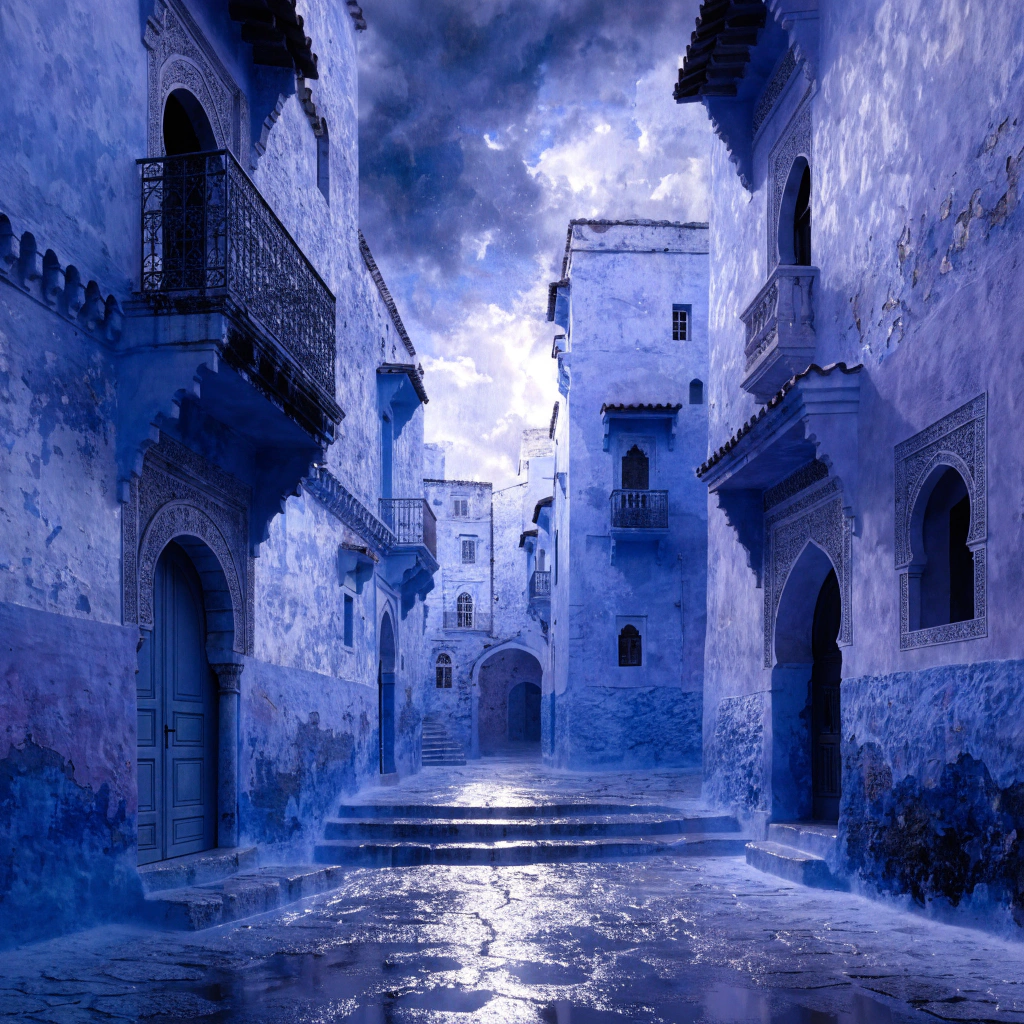
The Blue City of Morocco
Chefchaouen is a beautiful city in Morocco. It is in the Rif Mountains. People call it the Blue Pearl. The city is very famous because the buildings are blue.
The streets are small and quiet. You can see blue walls, blue doors, and blue stairs. It is very peaceful. Many people visit this place to take photos.
The weather is nice. You can walk in the old market. People are friendly and the food is good. It is a special place to visit.
Gramática destacada
Patrón: Present Simple 'to be'
"Chefchaouen is a beautiful city in Morocco."
We use the verb 'to be' (am, is, are) to describe things and give facts. In this sentence, 'is' connects the subject to its description.
Patrón: Can for possibility
"You can see blue walls, blue doors, and blue stairs."
We use 'can' followed by a verb to talk about things that are possible. It does not change based on the person (I can, you can, he can).
Pon a prueba tu comprensión
10 preguntas · A1 Principiante · 1 vista previa gratis
Pon a prueba lo que aprendiste en este artículo. ¡Responde todas las preguntas para ganar XP!
Where is the city of Chefchaouen?
¿Quieres terminar el quiz?
9 preguntas más te esperan. ¡Regístrate gratis para desbloquear el quiz completo y ganar XP!
Regístrate gratis¿Ya tienes cuenta? Acceder
Desglose de preguntas
Where is the city of Chefchaouen?
Tu respuesta:
Respuesta correcta: In Morocco
The buildings in the city are green.
Tu respuesta:
Respuesta correcta: Falso
What does 'peaceful' mean?
Tu respuesta:
Respuesta correcta: Quiet and calm
The streets are small and _____.
Tu respuesta:
Respuesta correcta: quiet
The Blue Pearl of Morocco
Chefchaouen is a very beautiful city in the Rif Mountains of Morocco. Many people call it the 'Blue Pearl' because almost all the buildings are blue. The walls, the doors, and even the stairs are different shades of blue. It is a very quiet and peaceful place to visit.
Why is the city blue? There are many stories. Some people say that Jewish refugees painted the buildings in the 1930s. They used blue because it is the color of the sky and heaven. Other people think the blue color keeps mosquitoes away. Today, the blue streets make the city famous and many tourists visit every year.
Walking in the medina is better than walking in a big city because there are no cars. The air is fresher and the people are friendlier. You can drink traditional mint tea and buy local crafts. The city is smaller than Tangier, but it is more beautiful. It is a dream for every photographer.
Gramática destacada
Patrón: Comparatives
"The city is smaller than Tangier, but it is more beautiful."
We use comparative adjectives to compare two things. Add '-er' to short words (small/smaller) and use 'more' for long words (beautiful/more beautiful).
Patrón: Past Simple
"Some people say that Jewish refugees painted the buildings in the 1930s."
The past simple describes finished actions in the past. To form regular verbs, we add '-ed' to the end of the verb.
Pon a prueba tu comprensión
11 preguntas · A2 Básico · 1 vista previa gratis
Pon a prueba lo que aprendiste en este artículo. ¡Responde todas las preguntas para ganar XP!
Where is Chefchaouen located?
¿Quieres terminar el quiz?
10 preguntas más te esperan. ¡Regístrate gratis para desbloquear el quiz completo y ganar XP!
Regístrate gratis¿Ya tienes cuenta? Acceder
Desglose de preguntas
Where is Chefchaouen located?
Tu respuesta:
Respuesta correcta: In the Rif Mountains
The buildings in Chefchaouen are famous because they are painted red.
Tu respuesta:
Respuesta correcta: Falso
What does 'traditional' mean in the article?
Tu respuesta:
Respuesta correcta: Following old customs
The city is a _____ for every photographer.
Tu respuesta:
Respuesta correcta: dream
Why did refugees use the color blue according to the text?
Tu respuesta:
Respuesta correcta: Because it is the color of the sky and heaven
Chefchaouen: La Perla Azul de Marruecos
Enclavada en las montañas del Rif, en el noroeste de Marruecos, se encuentra Chefchaouen, una ciudad que muchos han llamado "la Perla Azul". Es un destino que parece sacado de un sueño, con sus calles y casas pintadas de un azul intenso que cautiva a todos sus visitantes. Esta ciudad es famosa por su medina, donde cada rincón ofrece una vista espectacular.
La característica más notable de Chefchaouen es, sin duda, su color azul. Las paredes, los suelos y las escaleras de su antigua medina están cubiertos por este tono vibrante. Esta peculiaridad ha convertido a la ciudad en un lugar muy fotografiado y conocido en todo el mundo, atrayendo a turistas de todas partes que buscan su belleza singular.
El origen exacto de este color tan especial ha sido objeto de debate durante años. Algunos historiadores sugieren que el azul fue introducido por refugiados judíos en la década de 1930. Para ellos, el azul simbolizaba el cielo y el paraíso, y lo usaron para pintar sus hogares. Otros, sin embargo, creen que la pintura azul se usaba porque actúa como un repelente natural para los mosquitos, lo que era muy útil para la salud pública en ese momento. Sea cual sea la razón original, el resultado es una atmósfera innegablemente serena y única que define la identidad de la ciudad.
Pasear por Chefchaouen es una experiencia mágica e inolvidable. Cada rincón ofrece una nueva vista, una puerta decorada o una escalera que invita a explorar más. Los visitantes pueden disfrutar de la tranquilidad de sus calles estrechas, comprar artesanía local en sus mercados, como alfombras y productos de cuero, o simplemente sentarse en una terraza y observar la vida pasar. La ciudad ofrece una mezcla fascinante de cultura marroquí y una sensación de paz que es difícil de encontrar en otros lugares. Además, desde sus miradores se pueden apreciar impresionantes panorámicas de las montañas y los tejados azules.
Si alguna vez has pensado en visitar un lugar diferente y lleno de encanto, Chefchaouen es, sin duda, una excelente opción. Su belleza azul te espera para ofrecerte una experiencia inolvidable y muchas fotografías memorables.
Gramática destacada
Patrón: El Presente Perfecto (Pretérito Perfecto Compuesto)
"una ciudad que muchos han llamado 'la Perla Azul'."
Usamos el presente perfecto para hablar de acciones pasadas que tienen una conexión con el presente o que ocurrieron en un periodo de tiempo no terminado. Se forma con el verbo "haber" en presente y el participio pasado del verbo principal.
Patrón: La Voz Pasiva con "ser"
"el azul fue introducido por refugiados judíos en la década de 1930."
La voz pasiva se usa para enfocar la atención en la acción y en lo que recibe la acción, no en quién la realiza. Se forma con el verbo "ser" en el tiempo adecuado y el participio pasado del verbo principal, que concuerda en género y número con el sujeto.
Pon a prueba tu comprensión
11 preguntas · B1 Intermedio · 1 vista previa gratis
Pon a prueba lo que aprendiste en este artículo. ¡Responde todas las preguntas para ganar XP!
¿Cuál es la característica más famosa de Chefchaouen?
¿Quieres terminar el quiz?
10 preguntas más te esperan. ¡Regístrate gratis para desbloquear el quiz completo y ganar XP!
Regístrate gratis¿Ya tienes cuenta? Acceder
Desglose de preguntas
¿Cuál es la característica más famosa de Chefchaouen?
Tu respuesta:
Respuesta correcta: El color azul de sus casas
El artículo afirma que el color azul definitivamente repele a los mosquitos.
Tu respuesta:
Respuesta correcta: Falso
¿Qué significa la palabra "enclavada" en el contexto del artículo?
Tu respuesta:
Respuesta correcta: Situada en un lugar
Chefchaouen es conocida como la Perla _____.
Tu respuesta:
Respuesta correcta: Azul
Según algunos historiadores, ¿por qué pintaron los refugiados judíos sus casas de azul?
Tu respuesta:
Respuesta correcta: Para simbolizar el cielo y el paraíso
The Blue Pearl: Analyzing the Cultural Tapestry of Chefchaouen
Perched within the rugged Rif Mountains of northwest Morocco, Chefchaouen stands as a remarkable testament to cultural resilience and artistic expression. Known globally as the 'Blue Pearl,' the city is characterized by its mesmerizing blue-washed buildings, which cascade down the hillside in a vibrant display of azure and cobalt. While the aesthetic appeal of the medina is undeniable, the historical narrative behind its coloration is far more complex than it initially appears. To understand Chefchaouen, one must look beyond the surface and evaluate the various theories that define its identity.
One prevailing theory suggests that the blue hue was introduced by Jewish refugees who fled the Spanish Inquisition and later settled in the area during the 1930s. For these residents, the color blue served as a spiritual reminder of the sky and the heavens, symbolizing a constant connection to the divine. Conversely, some local historians argue that the paint serves a more pragmatic purpose, acting as a natural mosquito repellent. Regardless of its true origin, this distinctive feature has transformed Chefchaouen into a global landmark, drawing thousands of international visitors who seek to experience its tranquil atmosphere.
Furthermore, the city offers a fascinating synthesis of Berber and Andalusian cultures. This is particularly evident in its architecture, where red-tiled roofs and narrow, winding alleys reflect a heritage that spans centuries. The heart of the city, Uta el-Hammam square, serves as a bustling hub where the aroma of traditional Moroccan cuisine mingles with the sound of the call to prayer. Here, the preservation of ancient crafts, such as wool weaving and the production of artisan goat cheese, remains central to the local economy. Despite the influx of modern tourism, the local community has managed to maintain an air of serenity.
However, the impact of globalization presents ongoing challenges for the preservation of its traditional lifestyle. As the city evolves, stakeholders must balance the economic benefits of tourism with the necessity of protecting its cultural integrity. In conclusion, Chefchaouen is much more than a picturesque backdrop for photography. It is a living museum where history, spirituality, and daily life intersect. By exploring its streets, one gains a deeper understanding of how a community can preserve its identity through color and tradition in an ever-changing world.
Gramática destacada
Patrón: Passive Voice
"the blue hue was introduced by Jewish refugees who fled the Spanish Inquisition"
The passive voice is used here to focus on the action (the introduction of the color) and the object (the blue hue) rather than the subject. It is formed using the verb 'to be' + past participle.
Patrón: Non-defining Relative Clauses
"blue-washed buildings, which cascade down the hillside in a vibrant display"
This clause adds extra information about the buildings without being essential to the sentence's meaning. It is always separated by commas and uses 'which' for objects.
Patrón: Contrastive Discourse Markers
"Conversely, some local historians argue that the paint serves a more pragmatic purpose"
The marker 'conversely' is used to introduce an idea that is the opposite of or different from the one previously mentioned, helping to structure a balanced academic argument.
Pon a prueba tu comprensión
11 preguntas · B2 Intermedio alto · 1 vista previa gratis
Pon a prueba lo que aprendiste en este artículo. ¡Responde todas las preguntas para ganar XP!
What is the primary reason mentioned for the difficulty in determining why the city is blue?
¿Quieres terminar el quiz?
10 preguntas más te esperan. ¡Regístrate gratis para desbloquear el quiz completo y ganar XP!
Regístrate gratis¿Ya tienes cuenta? Acceder
Desglose de preguntas
What is the primary reason mentioned for the difficulty in determining why the city is blue?
Tu respuesta:
Respuesta correcta: There are multiple competing historical theories.
The article suggests that Chefchaouen's architecture is influenced solely by Berber traditions.
Tu respuesta:
Respuesta correcta: Falso
What does 'synthesis' mean in the context of the article?
Tu respuesta:
Respuesta correcta: A combination of different cultural elements.
The city has managed to maintain an air of _____ despite the increase in global visitors.
Tu respuesta:
Respuesta correcta: serenity
According to the text, what is a major challenge currently facing Chefchaouen?
Tu respuesta:
Respuesta correcta: Balancing tourism with cultural preservation.
La Perla Azul del Rif: Un Enigma Cromático en Chefchaouen
Enclavada majestuosamente entre las ubérrimas cumbres de las montañas del Rif, al noroeste de Marruecos, emerge Chefchaouen, una ciudad cuya mera existencia parece desafiar la paleta de colores de la realidad. Conocida globalmente como la "Perla Azul", su singularidad no reside únicamente en su ubicación geográfica privilegiada, sino, y sobre todo, en la hipnótica tonalidad añil que, cual manto etéreo, cubre cada rincón de su histórica medina. Es precisamente esa inmersión cromática la que la distingue, transformándola en un destino de ensueño para aquellos que buscan una experiencia visual y cultural sin parangón.
La fascinación que Chefchaouen ejerce sobre sus visitantes es casi palpable. Pasear por sus estrechas callejuelas empedradas, donde los arcos y las escalinatas se tiñen de infinitas variantes de azul, desde el celeste más pálido hasta el índigo más profundo, es sumergirse en un laberinto de serenidad. No en vano, esta ciudad ha sido musa de innumerables artistas y fotógrafos, quienes encuentran en cada esquina un cuadro viviente, un testimonio arquitectónico de una estética arraigada y misteriosa.
Sin embargo, la génesis de esta arraigada tradición de pintar la ciudad de azul es objeto de un debate perenne, añadiendo una capa más de intriga a su ya de por sí enigmático atractivo. Una de las conjeturas más extendidas sugiere que fueron los refugiados judíos, quienes se asentaron en la ciudad durante la década de 1930 huyendo de la persecución en Europa, los que introdujeron esta costumbre. Para ellos, el azul simbolizaba el cielo y el paraíso, un recordatorio constante de su fe y una conexión espiritual con lo divino. No es raro que, incluso hoy, se puedan observar estrellas de David sutilmente integradas en algunas fachadas.
Por otro lado, existe la teoría de que el azul sirve como un repelente natural para los mosquitos, una solución práctica y ancestral para combatir la proliferación de insectos en un entorno montañoso. Aunque menos poética, esta explicación no carece de lógica en un contexto donde la funcionalidad a menudo se entrelaza con la tradición. Una tercera hipótesis apunta a una mera cuestión estética, la cual se popularizó y perpetuó por su innegable belleza y el efecto refrescante que el color ejerce bajo el sol marroquí. Sea cual fuere la razón primigenia, lo cierto es que la persistencia de esta práctica ha cimentado la identidad de Chefchaouen.
De tal magnitud es su encanto que, a pesar de la afluencia turística creciente, la ciudad ha logrado preservar una atmósfera de calma y autenticidad. Los lugareños, con su hospitalidad característica, contribuyen a una experiencia inmersiva, donde el tiempo parece ralentizarse. Es aquí, en este enclave azul, donde el viajero puede desconectar del bullicio del mundo moderno y reconectar con la esencia de lo simple y lo sublime. Más que un mero destino turístico, Chefchaouen es un diálogo constante entre historia, cultura y un color que ha trascendido su función para convertirse en un verdadero patrimonio emocional. La controversia en torno al origen del azul, lejos de restar valor, solo subraya la riqueza de un lugar que invita a la reflexión y a la contemplación de su idiosincrasia única.
Gramática destacada
Patrón: Oraciones hendidas (Cleft Sentences)
"Es precisamente esa inmersión cromática la que la distingue, transformándola en un destino de ensueño."
Las oraciones hendidas se utilizan para enfatizar una parte de la oración. Se construyen con "ser" + el elemento enfatizado + "que/quien/lo que". En este caso, se enfatiza "esa inmersión cromática" como la característica distintiva de la ciudad.
Patrón: Nominalización
"La génesis de esta arraigada tradición de pintar la ciudad de azul es objeto de un debate perenne."
La nominalización consiste en transformar un verbo o un adjetivo en un sustantivo, a menudo con un artículo definido. Aquí, el verbo "generar" se convierte en el sustantivo "génesis", permitiendo una expresión más formal y compacta de la idea.
Patrón: Inversión con 'De tal magnitud... que'
"De tal magnitud es su encanto que, a pesar de la afluencia turística creciente, la ciudad ha logrado preservar una atmósfera de calma."
Esta estructura se usa para enfatizar la intensidad de una cualidad o acción, colocando el adjetivo o sustantivo de magnitud al inicio de la oración. "De tal magnitud es X que Y" significa que X es tan grande o importante que causa Y.
Pon a prueba tu comprensión
12 preguntas · C1 Avanzado · 1 vista previa gratis
Pon a prueba lo que aprendiste en este artículo. ¡Responde todas las preguntas para ganar XP!
¿Cuál es la característica más distintiva de Chefchaouen según el artículo?
¿Quieres terminar el quiz?
11 preguntas más te esperan. ¡Regístrate gratis para desbloquear el quiz completo y ganar XP!
Regístrate gratis¿Ya tienes cuenta? Acceder
Desglose de preguntas
¿Cuál es la característica más distintiva de Chefchaouen según el artículo?
Tu respuesta:
Respuesta correcta: Su tonalidad añil dominante
El artículo afirma que no hay debate sobre el origen del color azul de Chefchaouen.
Tu respuesta:
Respuesta correcta: Falso
¿Qué significa 'sin parangón' en el contexto del artículo?
Tu respuesta:
Respuesta correcta: Que no tiene igual o semejanza
Una de las _____ más extendidas sugiere que fueron los refugiados judíos quienes introdujeron el azul.
Tu respuesta:
Respuesta correcta: conjeturas
¿Qué simbolizaba el color azul para los refugiados judíos, según una de las teorías?
Tu respuesta:
Respuesta correcta: El cielo y el paraíso
El artículo menciona que Chefchaouen ha perdido su autenticidad debido al turismo.
Tu respuesta:
Respuesta correcta: Falso
The Cerulean Palimpsest: Decoding the Aesthetic and Sociocultural Stratigraphy of Chefchaouen
Rarely does one encounter a locale where the boundaries between the terrestrial and the ethereal are so irrevocably blurred as they are in Chefchaouen. Nestled within the rugged, vertiginous folds of the Rif Mountains in northwestern Morocco, this 'Blue Pearl' presents a visual palimpsest that defies simplistic categorization. To the uninitiated, the city is merely an aesthetic backdrop, yet to the scholar of urban semiotics, it represents a complex juxtaposition of historical trauma, religious symbolism, and modern commodification. It is the very ubiquity of this azure tint that serves as both a shield and a beckoning hand to the global traveler, inviting an inquiry into the nature of cultural identity in a globalized era.
The origins of this pervasive chromatic choice remain shrouded in a mist of conflicting oral histories and academic conjecture, providing a fertile ground for theoretical debate. One prevailing theory posits that the blue wash was introduced by Sephardic Jewish refugees fleeing the rise of European fascism in the 1930s. For these exiles, the color was purportedly a mnemonic device—a constant reminder of the sky and, by extension, the divine sovereignty of God. Were one to peel back the layers of cerulean paint, one might uncover a narrative far more nuanced than modern tourism suggests, revealing a community seeking spiritual anchorage in an unfamiliar landscape. This theory, while emotionally resonant, exists alongside a more pragmatic, albeit less romantic, hypothesis: that the pigment acts as a natural deterrent against mosquitoes, or serves as a traditional method for maintaining thermal equilibrium within the labyrinthine alleyways of the medina.
The labyrinthine structure of the medina itself is a testament to the city’s Andalusian heritage, established by Moorish exiles who sought refuge here after the Reconquista. The architectural stratigraphy reveals a synthesis of North African and Iberian influences, where the stark, cerulean walls meet intricate tilework and heavy cedarwood doors. However, this historical verisimilitude is increasingly fraught with the pressures of hyper-tourism. The ephemeral nature of the 'authentic' experience is often sacrificed at the altar of digital visibility. As visitors flock to capture the perfect juxtaposition of shadow and light against the blue masonry, the lived reality of the local inhabitants undergoes a subtle, yet profound, transformation. There is a palpable proclivity among modern travelers to view the city as a static stage set rather than a dynamic, breathing entity, a phenomenon that challenges the preservation of local agency.
Notwithstanding these contemporary pressures, the city maintains a degree of cultural sovereignty, preserved through the inexplicable resilience of its traditions and the enduring rhythm of its daily life. The 'Ras El Maa' waterfall, where locals still gather to wash clothes and socialize, serves as a poignant reminder of a time before the city became a global brand. This site provides a grounding contrast to the ethereal blue surroundings, anchoring the city in the physical realities of its environment. To navigate the steep, winding stairs of the medina is to engage with a history that is simultaneously present and receding, a lived experience that cannot be fully captured through a lens.
Ultimately, the allure of Chefchaouen lies in its refusal to be easily decoded. Whether the blue is a spiritual symbol, a practical tool, or a modern marketing masterstroke, it remains an integral part of the city’s soul. The stratigraphy of the city—its layers of paint, history, and myth—invites us to consider how we construct meaning in the places we inhabit and visit. It serves as a reminder that the beauty we perceive is often a reflection of the layers we choose to acknowledge, and that beneath the blue surface lies a depth of human experience that is both universal and uniquely Moroccan.
Gramática destacada
Patrón: Negative Inversion
"Rarely does one encounter a locale where the boundaries between the terrestrial and the ethereal are so irrevocably blurred as they are in Chefchaouen."
When a sentence starts with a negative or restrictive adverb (like 'Rarely'), the subject and auxiliary verb are inverted to create emphasis. This is a hallmark of formal, high-level English prose.
Patrón: The Subjunctive with 'Were' (Hypothetical Conditionals)
"Were one to peel back the layers of cerulean paint, one might uncover a narrative far more nuanced than modern tourism suggests."
This structure uses 'were' instead of 'if' to express a hypothetical or formal conditional situation. It adds a scholarly or literary tone to the analysis.
Patrón: Cleft Sentences for Emphasis
"It is the very ubiquity of this azure tint that serves as both a shield and a beckoning hand to the global traveler."
Cleft sentences (It + is/was + [emphasized part] + that/who...) are used to focus on a specific piece of information. Here, it emphasizes 'ubiquity' as the central cause.
Pon a prueba tu comprensión
12 preguntas · C2 Dominio · 1 vista previa gratis
Pon a prueba lo que aprendiste en este artículo. ¡Responde todas las preguntas para ganar XP!
Which theory regarding the blue paint is described as having an emotional resonance?
¿Quieres terminar el quiz?
11 preguntas más te esperan. ¡Regístrate gratis para desbloquear el quiz completo y ganar XP!
Regístrate gratis¿Ya tienes cuenta? Acceder
Desglose de preguntas
Which theory regarding the blue paint is described as having an emotional resonance?
Tu respuesta:
Respuesta correcta: The Sephardic Jewish refugee theory
The author suggests that Chefchaouen's blue aesthetic is purely a modern creation for social media.
Tu respuesta:
Respuesta correcta: Falso
What does 'ephemeral' mean in the context of the article?
Tu respuesta:
Respuesta correcta: Short-lived or fleeting
The city's historical _____ reveals a synthesis of North African and Iberian influences.
Tu respuesta:
Respuesta correcta: stratigraphy
What is the primary concern mentioned regarding 'hyper-tourism' in the city?
Tu respuesta:
Respuesta correcta: The loss of 'authentic' experience for digital visibility
The 'Ras El Maa' waterfall is cited as a place that still maintains local traditions.
Tu respuesta:
Respuesta correcta: Verdadero

