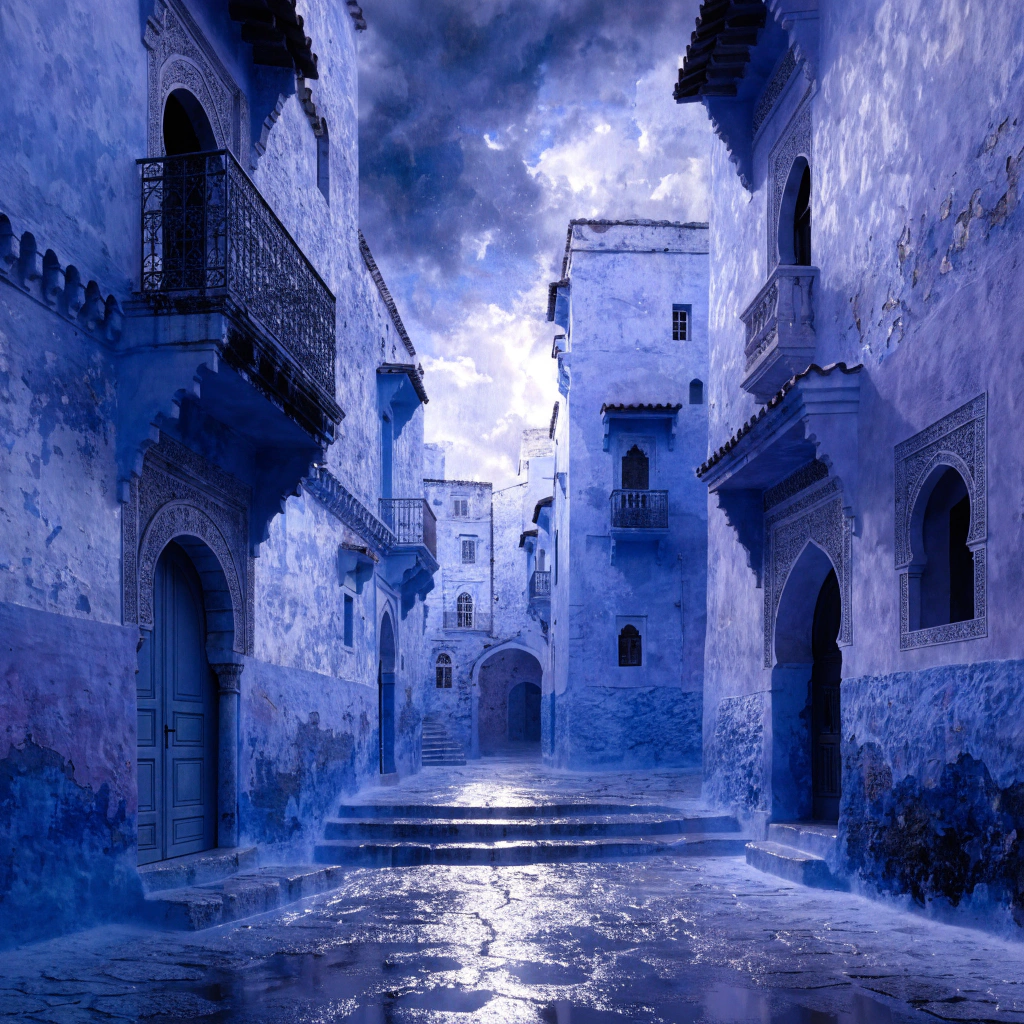
Chefchaouen: A Cidade Azul do Marrocos
Chefchaouen é uma cidade muito bonita no país Marrocos. Ela fica nas montanhas, no norte. As casas nesta cidade são todas azuis. Por isso, muitas pessoas chamam Chefchaouen de 'Pérola Azul'.
Por que a cidade é azul? Algumas pessoas dizem que a cor azul representa o céu. Outras pessoas pensam que o azul ajuda a manter os mosquitos longe. Não sabemos a razão exata, mas o resultado é lindo. A medina, que é a parte antiga da cidade, é um lugar especial. As ruas, as paredes e as escadas são azuis. É um lugar calmo e parece um sonho azul. Você pode andar e ver muitas coisas bonitas lá.
Gramática em destaque
Padrão: O Verbo 'Ser' (Presente)
"Chefchaouen é uma cidade muito bonita."
O verbo 'ser' é usado para descrever características permanentes, como a identidade ou a qualidade de algo. Ele também indica de onde algo ou alguém é. No presente, ele tem formas como 'eu sou', 'você é', 'ele/ela é', 'nós somos', 'vocês são', 'eles/elas são'.
Padrão: Adjetivos (Concordância)
"As casas nesta cidade são todas azuis."
Adjetivos descrevem substantivos (nomes). Em português, o adjetivo deve concordar em número (singular/plural) e gênero (masculino/feminino) com o substantivo que ele descreve. Por exemplo, 'cidade bonita' (singular feminino), 'casas azuis' (plural feminino).
Teste sua compreensão
10 perguntas · A1 Iniciante · 1 pré-visualização grátis
Teste o que aprendeu neste artigo. Responda todas as perguntas para ganhar XP!
Onde fica a cidade de Chefchaouen?
Quer finalizar o quiz?
9 perguntas a mais estão esperando por você. Cadastre-se grátis para desbloquear o quiz completo e ganhar XP!
Cadastrar grátisJá tem conta? Entrar
Detalhamento das perguntas
Onde fica a cidade de Chefchaouen?
Sua resposta:
Resposta correta: No Marrocos
As casas em Chefchaouen são todas vermelhas.
Sua resposta:
Resposta correta: Falso
O que significa a palavra 'céu'?
Sua resposta:
Resposta correta: Espaço acima da Terra
Chefchaouen é uma cidade muito ____.
Sua resposta:
Resposta correta: bonita
The Blue Pearl of Morocco
Chefchaouen is a very beautiful city in the Rif Mountains of Morocco. Many people call it the 'Blue Pearl' because almost all the buildings are blue. The walls, the doors, and even the stairs are different shades of blue. It is a very quiet and peaceful place to visit.
Why is the city blue? There are many stories. Some people say that Jewish refugees painted the buildings in the 1930s. They used blue because it is the color of the sky and heaven. Other people think the blue color keeps mosquitoes away. Today, the blue streets make the city famous and many tourists visit every year.
Walking in the medina is better than walking in a big city because there are no cars. The air is fresher and the people are friendlier. You can drink traditional mint tea and buy local crafts. The city is smaller than Tangier, but it is more beautiful. It is a dream for every photographer.
Gramática em destaque
Padrão: Comparatives
"The city is smaller than Tangier, but it is more beautiful."
We use comparative adjectives to compare two things. Add '-er' to short words (small/smaller) and use 'more' for long words (beautiful/more beautiful).
Padrão: Past Simple
"Some people say that Jewish refugees painted the buildings in the 1930s."
The past simple describes finished actions in the past. To form regular verbs, we add '-ed' to the end of the verb.
Teste sua compreensão
11 perguntas · A2 Elementar · 1 pré-visualização grátis
Teste o que aprendeu neste artigo. Responda todas as perguntas para ganhar XP!
Where is Chefchaouen located?
Quer finalizar o quiz?
10 perguntas a mais estão esperando por você. Cadastre-se grátis para desbloquear o quiz completo e ganhar XP!
Cadastrar grátisJá tem conta? Entrar
Detalhamento das perguntas
Where is Chefchaouen located?
Sua resposta:
Resposta correta: In the Rif Mountains
The buildings in Chefchaouen are famous because they are painted red.
Sua resposta:
Resposta correta: Falso
What does 'traditional' mean in the article?
Sua resposta:
Resposta correta: Following old customs
The city is a _____ for every photographer.
Sua resposta:
Resposta correta: dream
Why did refugees use the color blue according to the text?
Sua resposta:
Resposta correta: Because it is the color of the sky and heaven
Exploring Chefchaouen: The Blue Pearl of Morocco
Chefchaouen is a beautiful city that is located high in the Rif Mountains of northwest Morocco. It is often called the 'Blue Pearl' because of its famous blue buildings. In this peaceful town, the walls, floors, and even the stairs have been painted in different shades of blue for many years.
There are several theories about why the city is blue. Some people believe that the tradition was started by Jewish refugees who arrived in the 1930s. For them, the blue color represented the sky and heaven, which reminded them of God. However, other locals think the color was chosen because it acts as a natural mosquito repellent. Whatever the reason, the result is a place that feels like a dream.
The historic center, which is known as the medina, is a maze of narrow streets. Recently, Chefchaouen has become very popular with photographers and travelers from all over the world. Visitors can enjoy traditional Moroccan food in the main square, or they can hike in the mountains that surround the city.
Life in Chefchaouen is slower than in big cities like Casablanca. The people who live there are very friendly and proud of their unique home. Since the town was founded in 1471, it has changed many times, but it has kept its magical atmosphere. If you are looking for a quiet place to explore, this blue city is definitely worth a visit.
Gramática em destaque
Padrão: Passive Voice
"In this peaceful town, the walls, floors, and even the stairs have been painted in different shades of blue."
The passive voice is used when the action is more important than who did it. It is formed using the verb 'to be' and the past participle.
Padrão: Relative Clauses
"The historic center, which is known as the medina, is a maze of narrow streets."
Relative clauses give more information about a noun. 'Which' is used for things and 'who' is used for people.
Teste sua compreensão
11 perguntas · B1 Intermediário · 1 pré-visualização grátis
Teste o que aprendeu neste artigo. Responda todas as perguntas para ganhar XP!
Where is Chefchaouen located?
Quer finalizar o quiz?
10 perguntas a mais estão esperando por você. Cadastre-se grátis para desbloquear o quiz completo e ganhar XP!
Cadastrar grátisJá tem conta? Entrar
Detalhamento das perguntas
Where is Chefchaouen located?
Sua resposta:
Resposta correta: In the Rif Mountains
Some people believe the blue color helps keep mosquitoes away.
Sua resposta:
Resposta correta: Verdadeiro
What does the word 'maze' mean in the article?
Sua resposta:
Resposta correta: A complex system of narrow streets
The city is often called the Blue _____ because of its color.
Sua resposta:
Resposta correta: Pearl
When was the town of Chefchaouen founded?
Sua resposta:
Resposta correta: 1471
The Blue Pearl: Analyzing the Cultural Tapestry of Chefchaouen
Perched within the rugged Rif Mountains of northwest Morocco, Chefchaouen stands as a remarkable testament to cultural resilience and artistic expression. Known globally as the 'Blue Pearl,' the city is characterized by its mesmerizing blue-washed buildings, which cascade down the hillside in a vibrant display of azure and cobalt. While the aesthetic appeal of the medina is undeniable, the historical narrative behind its coloration is far more complex than it initially appears. To understand Chefchaouen, one must look beyond the surface and evaluate the various theories that define its identity.
One prevailing theory suggests that the blue hue was introduced by Jewish refugees who fled the Spanish Inquisition and later settled in the area during the 1930s. For these residents, the color blue served as a spiritual reminder of the sky and the heavens, symbolizing a constant connection to the divine. Conversely, some local historians argue that the paint serves a more pragmatic purpose, acting as a natural mosquito repellent. Regardless of its true origin, this distinctive feature has transformed Chefchaouen into a global landmark, drawing thousands of international visitors who seek to experience its tranquil atmosphere.
Furthermore, the city offers a fascinating synthesis of Berber and Andalusian cultures. This is particularly evident in its architecture, where red-tiled roofs and narrow, winding alleys reflect a heritage that spans centuries. The heart of the city, Uta el-Hammam square, serves as a bustling hub where the aroma of traditional Moroccan cuisine mingles with the sound of the call to prayer. Here, the preservation of ancient crafts, such as wool weaving and the production of artisan goat cheese, remains central to the local economy. Despite the influx of modern tourism, the local community has managed to maintain an air of serenity.
However, the impact of globalization presents ongoing challenges for the preservation of its traditional lifestyle. As the city evolves, stakeholders must balance the economic benefits of tourism with the necessity of protecting its cultural integrity. In conclusion, Chefchaouen is much more than a picturesque backdrop for photography. It is a living museum where history, spirituality, and daily life intersect. By exploring its streets, one gains a deeper understanding of how a community can preserve its identity through color and tradition in an ever-changing world.
Gramática em destaque
Padrão: Passive Voice
"the blue hue was introduced by Jewish refugees who fled the Spanish Inquisition"
The passive voice is used here to focus on the action (the introduction of the color) and the object (the blue hue) rather than the subject. It is formed using the verb 'to be' + past participle.
Padrão: Non-defining Relative Clauses
"blue-washed buildings, which cascade down the hillside in a vibrant display"
This clause adds extra information about the buildings without being essential to the sentence's meaning. It is always separated by commas and uses 'which' for objects.
Padrão: Contrastive Discourse Markers
"Conversely, some local historians argue that the paint serves a more pragmatic purpose"
The marker 'conversely' is used to introduce an idea that is the opposite of or different from the one previously mentioned, helping to structure a balanced academic argument.
Teste sua compreensão
11 perguntas · B2 Intermediário superior · 1 pré-visualização grátis
Teste o que aprendeu neste artigo. Responda todas as perguntas para ganhar XP!
What is the primary reason mentioned for the difficulty in determining why the city is blue?
Quer finalizar o quiz?
10 perguntas a mais estão esperando por você. Cadastre-se grátis para desbloquear o quiz completo e ganhar XP!
Cadastrar grátisJá tem conta? Entrar
Detalhamento das perguntas
What is the primary reason mentioned for the difficulty in determining why the city is blue?
Sua resposta:
Resposta correta: There are multiple competing historical theories.
The article suggests that Chefchaouen's architecture is influenced solely by Berber traditions.
Sua resposta:
Resposta correta: Falso
What does 'synthesis' mean in the context of the article?
Sua resposta:
Resposta correta: A combination of different cultural elements.
The city has managed to maintain an air of _____ despite the increase in global visitors.
Sua resposta:
Resposta correta: serenity
According to the text, what is a major challenge currently facing Chefchaouen?
Sua resposta:
Resposta correta: Balancing tourism with cultural preservation.
The Indigo Labyrinth: Socio-Aesthetic Dimensions of Chefchaouen’s Azure Identity
Nestled precariously within the rugged folds of the Rif Mountains, the city of Chefchaouen presents a visual spectacle that defies conventional urban aesthetics. Known colloquially as the 'Blue Pearl,' this Moroccan enclave is defined by a pervasive chromatic theme that blankets its medina in varying shades of cerulean, cobalt, and indigo. Seldom has a city’s palette so thoroughly dictated its global reputation, yet beneath the surface of this aesthetic uniformity lies a complex tapestry of historical narratives and utilitarian justifications. The preservation of this tradition is not merely a matter of habit but a deliberate act of cultural continuity.
It is the pervasive application of blue pigment that transforms the mundane stone architecture into an ethereal landscape. The origins of this practice remain a subject of scholarly debate, characterized by a fascinating dichotomy of theories. One prominent narrative suggests that the tradition was inaugurated by Sephardic Jewish refugees fleeing the Spanish Inquisition and later the rise of 19th-century European tensions. For these communities, the blue was evocative of the sky and the heavens, serving as a constant spiritual reminder of the divine. Conversely, a more pragmatic school of thought posits that the blue wash serves as a natural deterrent against mosquitoes or functions to keep the interior of buildings cool during the sweltering North African summers.
Regardless of its genesis, the result is a labyrinthine environment where the juxtaposition of vibrant walls and terracotta roofs creates a unique sensory experience. However, the burgeoning popularity of Chefchaouen on global digital platforms has introduced new challenges. The commodification of the city's serenity has led to a tension between authentic local life and the demands of international tourism. What was once a secluded mountain refuge is now a meticulously curated backdrop for global travelers. The challenge for the modern residents of Chefchaouen lies in maintaining the vestiges of their ancestral heritage while navigating the economic realities of their newfound fame.
Ultimately, the allure of Chefchaouen resides in its ability to remain enigmatic. Whether viewed through a historical, spiritual, or utilitarian lens, the city remains a quintessential example of how color can define the soul of a place. The blue of Chefchaouen is more than a decorative choice; it is a living archive of the city's resilience and its enduring capacity to enchant the world.
Gramática em destaque
Padrão: Inversion with Negative Adverbials
"Seldom has a city’s palette so thoroughly dictated its global reputation..."
When using negative adverbials like 'seldom' at the beginning of a sentence for emphasis, the auxiliary verb is placed before the subject.
Padrão: Cleft Sentences (It-cleft)
"It is the pervasive application of blue pigment that transforms the mundane stone architecture into an ethereal landscape."
This structure is used to focus on specific information (the blue pigment) by starting with 'It is/was' followed by the focused element and a relative clause.
Padrão: Nominalisation
"The preservation of this tradition is not merely a matter of habit but a deliberate act of cultural continuity."
Turning verbs (preserve) into nouns (preservation) creates a more formal, academic tone typical of C1 level writing.
Teste sua compreensão
12 perguntas · C1 Avançado · 1 pré-visualização grátis
Teste o que aprendeu neste artigo. Responda todas as perguntas para ganhar XP!
What does the author suggest about the origin of the blue color in Chefchaouen?
Quer finalizar o quiz?
11 perguntas a mais estão esperando por você. Cadastre-se grátis para desbloquear o quiz completo e ganhar XP!
Cadastrar grátisJá tem conta? Entrar
Detalhamento das perguntas
What does the author suggest about the origin of the blue color in Chefchaouen?
Sua resposta:
Resposta correta: It is a subject of ongoing academic disagreement.
Chefchaouen is located in the Atlas Mountains.
Sua resposta:
Resposta correta: Falso
Which word is a synonym for 'ethereal' as used in the text?
Sua resposta:
Resposta correta: Celestial
The city is known as the Blue _____.
Sua resposta:
Resposta correta: Pearl
What is the 'tension' mentioned in the third paragraph?
Sua resposta:
Resposta correta: The balance between tourism and authentic local life.
One theory suggests the blue color helps keep buildings cool.
Sua resposta:
Resposta correta: Verdadeiro
The Cerulean Palimpsest: Decoding the Aesthetic and Sociocultural Stratigraphy of Chefchaouen
Rarely does one encounter a locale where the boundaries between the terrestrial and the ethereal are so irrevocably blurred as they are in Chefchaouen. Nestled within the rugged, vertiginous folds of the Rif Mountains in northwestern Morocco, this 'Blue Pearl' presents a visual palimpsest that defies simplistic categorization. To the uninitiated, the city is merely an aesthetic backdrop, yet to the scholar of urban semiotics, it represents a complex juxtaposition of historical trauma, religious symbolism, and modern commodification. It is the very ubiquity of this azure tint that serves as both a shield and a beckoning hand to the global traveler, inviting an inquiry into the nature of cultural identity in a globalized era.
The origins of this pervasive chromatic choice remain shrouded in a mist of conflicting oral histories and academic conjecture, providing a fertile ground for theoretical debate. One prevailing theory posits that the blue wash was introduced by Sephardic Jewish refugees fleeing the rise of European fascism in the 1930s. For these exiles, the color was purportedly a mnemonic device—a constant reminder of the sky and, by extension, the divine sovereignty of God. Were one to peel back the layers of cerulean paint, one might uncover a narrative far more nuanced than modern tourism suggests, revealing a community seeking spiritual anchorage in an unfamiliar landscape. This theory, while emotionally resonant, exists alongside a more pragmatic, albeit less romantic, hypothesis: that the pigment acts as a natural deterrent against mosquitoes, or serves as a traditional method for maintaining thermal equilibrium within the labyrinthine alleyways of the medina.
The labyrinthine structure of the medina itself is a testament to the city’s Andalusian heritage, established by Moorish exiles who sought refuge here after the Reconquista. The architectural stratigraphy reveals a synthesis of North African and Iberian influences, where the stark, cerulean walls meet intricate tilework and heavy cedarwood doors. However, this historical verisimilitude is increasingly fraught with the pressures of hyper-tourism. The ephemeral nature of the 'authentic' experience is often sacrificed at the altar of digital visibility. As visitors flock to capture the perfect juxtaposition of shadow and light against the blue masonry, the lived reality of the local inhabitants undergoes a subtle, yet profound, transformation. There is a palpable proclivity among modern travelers to view the city as a static stage set rather than a dynamic, breathing entity, a phenomenon that challenges the preservation of local agency.
Notwithstanding these contemporary pressures, the city maintains a degree of cultural sovereignty, preserved through the inexplicable resilience of its traditions and the enduring rhythm of its daily life. The 'Ras El Maa' waterfall, where locals still gather to wash clothes and socialize, serves as a poignant reminder of a time before the city became a global brand. This site provides a grounding contrast to the ethereal blue surroundings, anchoring the city in the physical realities of its environment. To navigate the steep, winding stairs of the medina is to engage with a history that is simultaneously present and receding, a lived experience that cannot be fully captured through a lens.
Ultimately, the allure of Chefchaouen lies in its refusal to be easily decoded. Whether the blue is a spiritual symbol, a practical tool, or a modern marketing masterstroke, it remains an integral part of the city’s soul. The stratigraphy of the city—its layers of paint, history, and myth—invites us to consider how we construct meaning in the places we inhabit and visit. It serves as a reminder that the beauty we perceive is often a reflection of the layers we choose to acknowledge, and that beneath the blue surface lies a depth of human experience that is both universal and uniquely Moroccan.
Gramática em destaque
Padrão: Negative Inversion
"Rarely does one encounter a locale where the boundaries between the terrestrial and the ethereal are so irrevocably blurred as they are in Chefchaouen."
When a sentence starts with a negative or restrictive adverb (like 'Rarely'), the subject and auxiliary verb are inverted to create emphasis. This is a hallmark of formal, high-level English prose.
Padrão: The Subjunctive with 'Were' (Hypothetical Conditionals)
"Were one to peel back the layers of cerulean paint, one might uncover a narrative far more nuanced than modern tourism suggests."
This structure uses 'were' instead of 'if' to express a hypothetical or formal conditional situation. It adds a scholarly or literary tone to the analysis.
Padrão: Cleft Sentences for Emphasis
"It is the very ubiquity of this azure tint that serves as both a shield and a beckoning hand to the global traveler."
Cleft sentences (It + is/was + [emphasized part] + that/who...) are used to focus on a specific piece of information. Here, it emphasizes 'ubiquity' as the central cause.
Teste sua compreensão
12 perguntas · C2 Domínio · 1 pré-visualização grátis
Teste o que aprendeu neste artigo. Responda todas as perguntas para ganhar XP!
Which theory regarding the blue paint is described as having an emotional resonance?
Quer finalizar o quiz?
11 perguntas a mais estão esperando por você. Cadastre-se grátis para desbloquear o quiz completo e ganhar XP!
Cadastrar grátisJá tem conta? Entrar
Detalhamento das perguntas
Which theory regarding the blue paint is described as having an emotional resonance?
Sua resposta:
Resposta correta: The Sephardic Jewish refugee theory
The author suggests that Chefchaouen's blue aesthetic is purely a modern creation for social media.
Sua resposta:
Resposta correta: Falso
What does 'ephemeral' mean in the context of the article?
Sua resposta:
Resposta correta: Short-lived or fleeting
The city's historical _____ reveals a synthesis of North African and Iberian influences.
Sua resposta:
Resposta correta: stratigraphy
What is the primary concern mentioned regarding 'hyper-tourism' in the city?
Sua resposta:
Resposta correta: The loss of 'authentic' experience for digital visibility
The 'Ras El Maa' waterfall is cited as a place that still maintains local traditions.
Sua resposta:
Resposta correta: Verdadeiro

