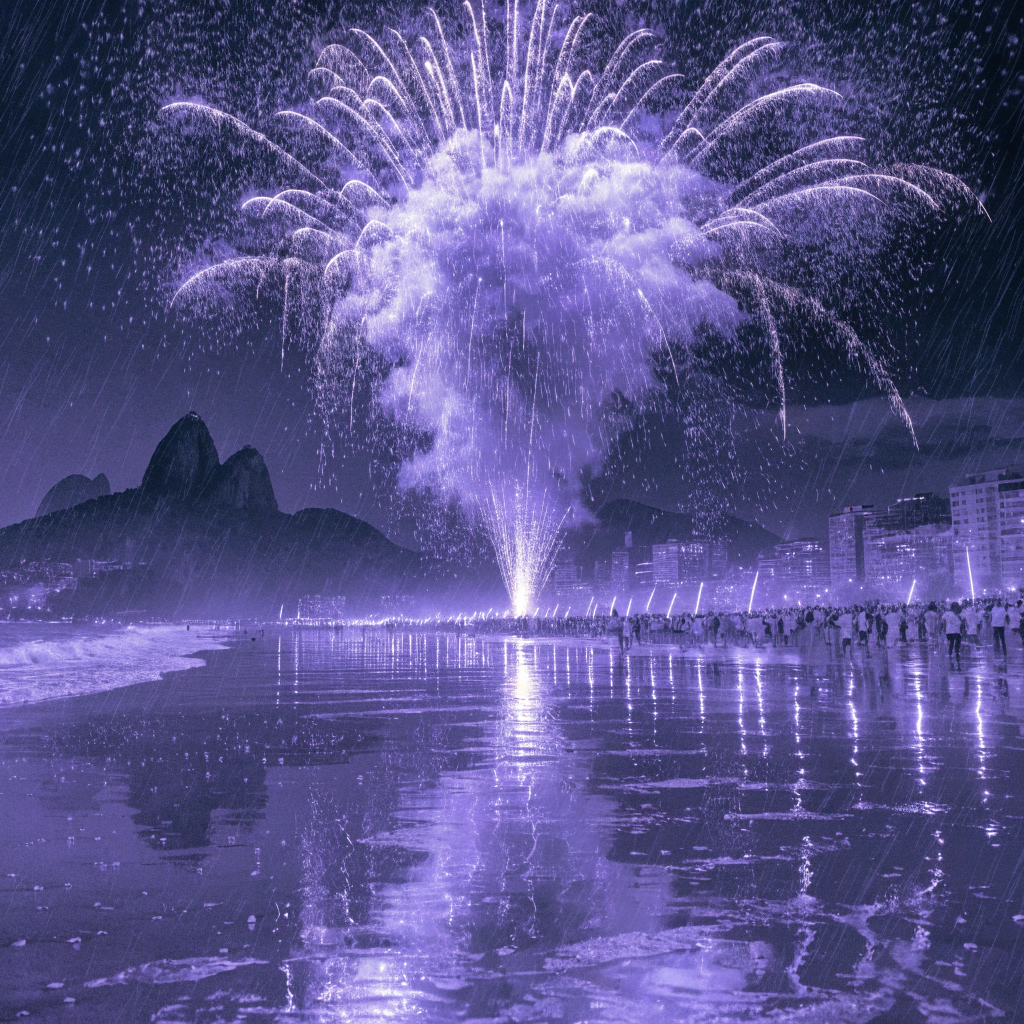
Le Réveillon au Brésil : Une Grande Fête en Blanc
Au Brésil, le Réveillon est une très grande fête. C'est la fête du Nouvel An. Beaucoup de personnes vont à la plage pour célébrer. C'est une tradition importante pour les Brésiliens.
La plage de Copacabana, à Rio de Janeiro, est très célèbre pour cette fête. Trois millions de personnes sont là ! Elles portent toutes des vêtements blancs. Le blanc est un symbole important. Il signifie la paix et la purification pour la nouvelle année. C'est aussi pour un bon départ.
Cette belle tradition vient de religions comme le Candomblé et l'Umbanda. Les gens dansent, chantent et regardent les feux d'artifice. C'est une soirée joyeuse et spirituelle pour tous.
Point grammaire
Structure: Le présent des verbes en -ER
"Elles portent toutes des vêtements blancs."
En français, le présent de l'indicatif décrit une action qui se passe maintenant ou une habitude. Pour les verbes réguliers en -ER, on enlève -ER et on ajoute les terminaisons : -e, -es, -e, -ons, -ez, -ent. Par exemple, 'porter' devient 'je porte', 'tu portes', 'il/elle porte', 'nous portons', 'vous portez', 'ils/elles portent'.
Structure: Les articles définis (le, la, les)
"La plage de Copacabana, à Rio de Janeiro, est très célèbre."
Les articles définis 'le' (masculin singulier), 'la' (féminin singulier) et 'les' (pluriel) sont utilisés devant un nom pour désigner quelque chose de spécifique ou déjà connu. Ils s'accordent en genre et en nombre avec le nom. 'La plage' est féminin singulier.
Teste ta compréhension
10 questions · A1 Débutant · 1 aperçu gratuit
Teste ce que tu as appris dans cet article. Réponds à toutes les questions pour gagner des XP !
Où se passe une grande partie de la fête du Réveillon au Brésil ?
Tu veux terminer le quiz ?
9 questions supplémentaires t'attendent. Inscris-toi gratuitement pour débloquer le quiz complet et gagner des XP !
S'inscrire gratuitementTu as dj un compte ? Connexion
Bien joué !
Continue à pratiquer !
Déjà terminé — pas de XP supplémentaire
Inscris-toi pour gagner des XPDétail des questions
Où se passe une grande partie de la fête du Réveillon au Brésil ?
Ta réponse:
Bonne réponse: À la plage de Copacabana
Les personnes portent des vêtements noirs pour le Réveillon.
Ta réponse:
Bonne réponse: Faux
Que signifie le mot 'paix' ?
Ta réponse:
Bonne réponse: Le silence et l'absence de guerre
Le Réveillon est une très grande ______ au Brésil.
Ta réponse:
Bonne réponse: fête
Le Réveillon au Brésil : Une Grande Fête Blanche
Le 31 décembre, le Brésil célèbre le Réveillon, le Nouvel An. C'est une fête très importante et joyeuse pour tout le pays. Dans toutes les villes, les gens organisent des célébrations. Mais la plus grande fête est à Rio de Janeiro, sur la célèbre plage de Copacabana. Chaque année, plus de trois millions de personnes se sont réunies là-bas pour regarder les feux d'artifice.
Un détail très spécial de cette fête est que beaucoup de gens portent des vêtements blancs. Cette tradition est ancienne et vient des religions Candomblé et Umbanda. Pour ces religions, le blanc symbolise la paix et la purification pour la nouvelle année. C'est une belle façon de commencer le mois de janvier. Les Brésiliens aiment beaucoup cette célébration unique. Ils dansent, chantent et regardent le ciel illuminé. Ils jettent aussi des fleurs dans la mer pour la déesse Yemanjá. C'est un moment de joie et d'espoir pour tout le monde.
Point grammaire
Structure: Le Passé Composé (avec l'auxiliaire 'être')
"plus de trois millions de personnes se sont réunies là-bas."
Le passé composé est utilisé pour parler d'une action passée et terminée. Avec certains verbes, comme les verbes de mouvement ou les verbes réfléchis, on utilise l'auxiliaire 'être' au présent, suivi du participe passé du verbe. Le participe passé s'accorde avec le sujet si l'auxiliaire est 'être'.
Structure: Les Verbes Réfléchis
"les gens se sont réunies là-bas"
Un verbe réfléchi indique que le sujet fait l'action sur lui-même. Le pronom réfléchi (me, te, se, nous, vous, se) se place avant le verbe. Au passé composé, les verbes réfléchis utilisent toujours l'auxiliaire 'être' et le participe passé s'accorde avec le sujet.
Teste ta compréhension
11 questions · A2 mentaire · 1 aperçu gratuit
Teste ce que tu as appris dans cet article. Réponds à toutes les questions pour gagner des XP !
Où se trouve la plus grande fête du Réveillon au Brésil ?
Tu veux terminer le quiz ?
10 questions supplémentaires t'attendent. Inscris-toi gratuitement pour débloquer le quiz complet et gagner des XP !
S'inscrire gratuitementTu as dj un compte ? Connexion
Bien joué !
Continue à pratiquer !
Déjà terminé — pas de XP supplémentaire
Inscris-toi pour gagner des XPDétail des questions
Où se trouve la plus grande fête du Réveillon au Brésil ?
Ta réponse:
Bonne réponse: À Rio de Janeiro, sur la plage de Copacabana
Les Brésiliens portent des vêtements noirs pour le Réveillon.
Ta réponse:
Bonne réponse: Faux
Que signifie le mot 'paix' ?
Ta réponse:
Bonne réponse: L'absence de guerre ou de problèmes
La fête de Copacabana attire plus de trois _____ de personnes.
Ta réponse:
Bonne réponse: millions
Quelle couleur de vêtements symbolise la paix et la purification ?
Ta réponse:
Bonne réponse: Le blanc
Réveillon: A Sea of White in Brazil
New Year's Eve in Brazil, which is locally known as 'Réveillon', is one of the most spectacular celebrations in the world. Every year, millions of tourists and locals travel to Rio de Janeiro to witness the famous fireworks display on Copacabana Beach. This event has been described by many travelers as the most vibrant party on the planet.
The most striking feature of Réveillon is that almost everyone wears white clothes. This tradition, which symbolizes peace and spiritual purification, has been followed for many decades. It is deeply influenced by African-Brazilian religions such as Candomblé and Umbanda. By wearing white, people hope to start the new year with a clean soul and positive energy.
As midnight approaches, many people go down to the water's edge. A popular custom involves jumping over seven waves in the ocean. For every wave that is jumped, a wish is made for the coming year. Additionally, beautiful flowers are often thrown into the sea as a gift to Iemanjá, who is the goddess of the ocean. These traditions are performed by people of all backgrounds, making it a very inclusive celebration.
The festivities are not just about spiritual customs; they are also about music, dance, and delicious food. Huge stages are built on the sand where famous international and local musicians perform until the sun rises. Traditional dishes, such as lentils and rice, are eaten because it is believed that they bring prosperity and wealth.
If you have never experienced Réveillon in Brazil, it is an event that should be on your bucket list. The sky is filled with incredible colors, and the energy of millions of people celebrating together creates a magical atmosphere that is truly unforgettable.
Point grammaire
Structure: Relative Clauses
"New Year's Eve in Brazil, which is locally known as 'Réveillon', is one of the most spectacular celebrations in the world."
Non-defining relative clauses are used to add extra information about a noun. They are separated by commas and often use 'which' for objects or 'who' for people.
Structure: Present Perfect Passive
"This event has been described by many travelers as the most vibrant party on the planet."
This is formed using 'has/have been' + past participle. It is used to focus on the action or the object rather than the person doing the action.
Teste ta compréhension
11 questions · B1 Intermédiaire · 1 aperçu gratuit
Teste ce que tu as appris dans cet article. Réponds à toutes les questions pour gagner des XP !
Where do millions of people go to see the fireworks in Rio de Janeiro?
Tu veux terminer le quiz ?
10 questions supplémentaires t'attendent. Inscris-toi gratuitement pour débloquer le quiz complet et gagner des XP !
S'inscrire gratuitementTu as dj un compte ? Connexion
Bien joué !
Continue à pratiquer !
Déjà terminé — pas de XP supplémentaire
Inscris-toi pour gagner des XPDétail des questions
Where do millions of people go to see the fireworks in Rio de Janeiro?
Ta réponse:
Bonne réponse: Copacabana Beach
Brazilians wear black clothes on New Year's Eve to show respect.
Ta réponse:
Bonne réponse: Faux
What does 'prosperity' mean?
Ta réponse:
Bonne réponse: The state of being wealthy and successful
A popular custom involves jumping over seven _____ in the ocean.
Ta réponse:
Bonne réponse: waves
Why do people eat lentils during the celebration?
Ta réponse:
Bonne réponse: Because it is believed they bring money
White Shores and Midnight Waves: The Spirit of Brazilian Réveillon
As the calendar turns its final page, few places on earth witness a celebration as monumental as Réveillon in Brazil. While many nations mark the New Year with private gatherings, the Brazilian approach is predominantly public, spiritual, and deeply rooted in cultural history. Nowhere is this more evident than on the iconic sands of Copacabana Beach in Rio de Janeiro, where millions of people gather in a sea of white to welcome the future. This manifestation of collective hope is not merely a party; it is a ritualistic experience that transcends social boundaries.
The most striking aspect of Réveillon is undoubtedly the dress code. Unlike the formal attire or colorful costumes found elsewhere, Brazilians almost exclusively wear white. This tradition, which has been observed for decades, finds its origins in Afro-Brazilian religions such as Candomblé and Umbanda. In these faiths, white symbolizes peace and spiritual purification. By wearing this color, participants seek to cleanse themselves of the previous year’s hardships while inviting harmony for the months ahead. It is a significant visual representation of the country's diverse religious landscape.
Furthermore, the celebration is characterized by specific superstitious acts intended to bring good fortune. As the clock strikes midnight and the fireworks commence, many Brazilians head toward the ocean to jump over seven waves. For each wave, a wish is made. This practice is dedicated to Iemanjá, the Goddess of the Sea, who is honored with offerings of flowers and small wooden boats launched into the Atlantic. Even for those who do not identify as religious, these customs remain a vibrant part of the national identity.
Despite the massive magnitude of the event, which attracts tourists from across the globe, the atmosphere remains remarkably inclusive. The sheer size of the crowd might seem overwhelming to some; however, the shared sense of purpose creates a unique bond among strangers. Consequently, Réveillon serves as a powerful reminder of Brazil’s ability to blend ancient traditions with modern festivities. As the first sun of the New Year rises over the horizon, the white-clad crowds slowly disperse, carrying with them the hope that their rituals have secured a prosperous year ahead.
Point grammaire
Structure: Non-defining Relative Clauses
"Copacabana Beach in Rio de Janeiro, where millions of people gather in a sea of white to welcome the future."
These clauses provide extra information about a specific noun. They are separated by commas and use relative pronouns like 'where' or 'which'.
Structure: Present Perfect Passive
"This tradition, which has been observed for decades, finds its origins in Afro-Brazilian religions."
This structure (has/have been + past participle) focuses on an action that started in the past and continues to be relevant today, emphasizing the tradition rather than the people.
Structure: Discourse Markers for Result
"Consequently, Réveillon serves as a powerful reminder of Brazil’s ability to blend ancient traditions with modern festivities."
The word 'Consequently' is used to introduce the logical result of the previously mentioned facts, helping to create a formal and cohesive transition.
Teste ta compréhension
11 questions · B2 Intermédiaire supérieur · 1 aperçu gratuit
Teste ce que tu as appris dans cet article. Réponds à toutes les questions pour gagner des XP !
Why do Brazilians primarily wear white during Réveillon?
Tu veux terminer le quiz ?
10 questions supplémentaires t'attendent. Inscris-toi gratuitement pour débloquer le quiz complet et gagner des XP !
S'inscrire gratuitementTu as dj un compte ? Connexion
Bien joué !
Continue à pratiquer !
Déjà terminé — pas de XP supplémentaire
Inscris-toi pour gagner des XPDétail des questions
Why do Brazilians primarily wear white during Réveillon?
Ta réponse:
Bonne réponse: To symbolize peace and spiritual purification
The tradition of jumping over seven waves is dedicated to Iemanjá, the Goddess of the Sea.
Ta réponse:
Bonne réponse: Vrai
What does the word 'commence' mean in the context of the article?
Ta réponse:
Bonne réponse: To begin or start
The Brazilian approach to New Year is _____ public and spiritual.
Ta réponse:
Bonne réponse: predominantly
Where is the epicenter of the Réveillon celebrations mentioned in the text?
Ta réponse:
Bonne réponse: Copacabana Beach
The Ethereal Tide: A Critical Analysis of Brazil’s Réveillon
Seldom does a spectacle capture the collective psyche of a nation as profoundly as Réveillon in Brazil. While New Year’s Eve is globally celebrated with pyrotechnics and revelry, the Brazilian iteration—specifically the massive gathering on Copacabana Beach—transcends mere festivity, evolving into a complex cultural manifestation. The sheer scale of the event, with upwards of three million participants dressed in white, creates a visual landscape that is as ethereal as it is overwhelming. What defines this transition is not merely the chronological shift from one year to the next, but a profound spiritual cleansing underpinned by deep-seated religious syncretism.
The tradition of wearing white is inextricably linked to the Afro-Brazilian religions of Candomblé and Umbanda. For many, the color is not a fashion statement but a vestige of spiritual devotion to Oxalá, symbolizing peace and purification. This convergence of the sacred and the profane is perhaps the most striking element of the night. As the clock strikes midnight, the solemnity of spiritual offerings to Iemanjá, the Goddess of the Sea, occurs amidst the deafening roar of fireworks. It is this dichotomy—the quiet prayer versus the explosive party—that characterizes the Brazilian soul.
However, a critical analysis of Réveillon reveals a more nuanced reality. The commercialization of the event has increasingly created a divide between the televised, high-security luxury of hotel balconies and the gritty, crowded reality of the sand below. This socio-economic stratification is often masked by the uniform of white, which provides a momentary illusion of equality. Yet, despite the encroachment of corporate sponsorship, the core rituals remain remarkably resilient. The act of jumping seven waves, each representing a different deity, remains a non-negotiable ritual for millions, regardless of social standing.
Ultimately, the ephemeral nature of the celebration mirrors the fluidity of Brazilian identity itself. The convergence of indigenous, African, and European influences creates a tapestry that is constantly being rewoven. As the first dawn of the New Year breaks over the Atlantic, the remnants of white flowers floating on the tide serve as a poignant reminder of the night’s spiritual weight. In the end, Réveillon is less about the passage of time and more about the collective aspiration for a renewed existence, proving that even in a modern, secular world, the need for communal ritual remains an essential human drive.
Point grammaire
Structure: Negative Inversion
"Seldom does a spectacle capture the collective psyche of a nation as profoundly as Réveillon in Brazil."
When using negative or restrictive adverbs like 'seldom' at the beginning of a sentence, the subject and auxiliary verb are inverted. This is used for emphasis and to create a formal, sophisticated tone.
Structure: Cleft Sentences
"What defines this transition is not merely the chronological shift from one year to the next, but a profound spiritual cleansing."
A pseudo-cleft sentence beginning with 'What' is used to focus on specific information. It highlights that the spiritual cleansing, rather than the date change, is the most important factor.
Structure: Nominalization
"The commercialization of the event has increasingly created a divide between the televised luxury and the crowded reality."
Nominalization involves turning verbs or adjectives into nouns (e.g., 'commercialize' to 'commercialization'). It allows for more abstract, objective, and dense information processing, typical of C1 academic writing.
Teste ta compréhension
12 questions · C1 Avancé · 1 aperçu gratuit
Teste ce que tu as appris dans cet article. Réponds à toutes les questions pour gagner des XP !
What is the primary spiritual origin of wearing white during Réveillon?
Tu veux terminer le quiz ?
11 questions supplémentaires t'attendent. Inscris-toi gratuitement pour débloquer le quiz complet et gagner des XP !
S'inscrire gratuitementTu as dj un compte ? Connexion
Bien joué !
Continue à pratiquer !
Déjà terminé — pas de XP supplémentaire
Inscris-toi pour gagner des XPDétail des questions
What is the primary spiritual origin of wearing white during Réveillon?
Ta réponse:
Bonne réponse: Afro-Brazilian religious syncretism
The author suggests that the white clothing worn by participants creates a lasting elimination of social classes.
Ta réponse:
Bonne réponse: Faux
What does the word 'dichotomy' refer to in the context of the article?
Ta réponse:
Bonne réponse: The contrast between spiritual prayer and loud celebration
The author notes that despite corporate influence, the core rituals remain remarkably _____.
Ta réponse:
Bonne réponse: resilient
According to the text, what does the jumping of seven waves represent?
Ta réponse:
Bonne réponse: Honoring different deities
The article argues that Réveillon is strictly a secular, modern party with no spiritual weight.
Ta réponse:
Bonne réponse: Faux
The Liminality of the Shore: Sociocultural Syncretism in the Brazilian Réveillon
To behold the shore of Copacabana on the eve of the Gregorian New Year is to witness a profound manifestation of collective effervescence. While ostensibly a secular celebration of temporal transition, the Brazilian Réveillon is inextricably intertwined with a rich tapestry of spiritual syncretism. Should one venture onto the sands, one is immediately struck by the pervasive sea of white—a visual shorthand for purification and peace. This chromatic uniformity is far from arbitrary; it is a vestigial remnant of Candomblé and Umbanda traditions, wherein the color white pays homage to Oxalá, the deity of creation. Were this merely a display of aesthetic preference, its sociological weight might be dismissed. However, the sheer scale of the gathering—upwards of three million souls—suggests a deeper, more visceral yearning for communal transcendence.
The act of dressing in white functions as a ritualistic leveling of social strata, albeit a temporary one, where the disparate threads of Brazilian society are woven into a singular, hopeful entity. One might argue that this monochromatic display serves as a protective aegis against the uncertainties of the impending year. Not only does the ocean serve as a backdrop for celebration, but it also acts as a profound spiritual conduit. Central to the littoral festivities is the veneration of Iemanjá, the Queen of the Sea. Offerings, ranging from white flowers to intricate miniature boats laden with perfumes and mirrors, are cast into the Atlantic’s embrace. This ritual underscores the liminal nature of the beach—a threshold between the terrestrial and the divine.
The practice of jumping seven waves, each accompanied by a petition for the future, further cements the event’s status as a spiritual endeavor. It is as if the rhythmic undulation of the tide were capable of washing away the accumulated detritus of the past twelve months. This metaphysical cleansing is augmented by the pyrotechnic spectacle that illuminates the Rio skyline. One should not view the fireworks merely as an exercise in sensory indulgence; rather, the cacophony of light and sound represents a symbolic purging of malevolent influences. It is a moment of collective catharsis, where the boundaries between the individual and the multitude blur into a state of shared euphoria.
Furthermore, the transition from the old year to the new is marked by a paradoxical interplay between the ephemeral and the eternal. The transient nature of the fireworks and the offerings stands in stark contrast to the enduring legacy of the Afro-Brazilian traditions that underpin them. Despite the commercialization that inevitably encroaches upon such massive events, the core of Réveillon remains a poignant synthesis of the profane and the sacred. It is a testament to the resilience of cultural identity in an increasingly globalized world, where ancient traditions are not merely preserved but are dynamically reinterpreted through the lens of modern celebration. Ultimately, Réveillon represents an ontological reset, a brief moment where the inexorable march of time is paused to allow for spiritual recalibration and a renewed sense of belonging to the human collective.
Point grammaire
Structure: Inversion for Emphasis
"Not only does the ocean serve as a backdrop for celebration, but it also acts as a profound spiritual conduit."
When a sentence starts with a negative or restrictive expression like 'not only', the auxiliary verb comes before the subject. This is used in formal English to add rhetorical weight or emphasis.
Structure: Second Conditional with Subjunctive 'Were'
"Were this merely a display of aesthetic preference, its sociological weight might be dismissed."
This is a highly formal version of 'If this were...'. By omitting 'if' and inverting the subject and 'were', the writer creates a scholarly and hypothetical tone.
Structure: Academic Hedging
"One might argue that this monochromatic display serves as a protective aegis against the uncertainties of the impending year."
Using 'one might argue' instead of a direct statement allows the writer to distance themselves from the claim, presenting it as a possibility or interpretation rather than an absolute fact.
Teste ta compréhension
12 questions · C2 Maîtrise · 1 aperçu gratuit
Teste ce que tu as appris dans cet article. Réponds à toutes les questions pour gagner des XP !
What is the primary spiritual origin of the tradition of wearing white during Réveillon?
Tu veux terminer le quiz ?
11 questions supplémentaires t'attendent. Inscris-toi gratuitement pour débloquer le quiz complet et gagner des XP !
S'inscrire gratuitementTu as dj un compte ? Connexion
Bien joué !
Continue à pratiquer !
Déjà terminé — pas de XP supplémentaire
Inscris-toi pour gagner des XPDétail des questions
What is the primary spiritual origin of the tradition of wearing white during Réveillon?
Ta réponse:
Bonne réponse: Afro-Brazilian religions such as Candomblé
The author suggests that the fireworks are purely for sensory indulgence and lack symbolic meaning.
Ta réponse:
Bonne réponse: Faux
Which word refers to the process of emotional release and relief?
Ta réponse:
Bonne réponse: Catharsis
The beach is described as a _____ space, representing a threshold between the terrestrial and the divine.
Ta réponse:
Bonne réponse: liminal
According to the text, how does the act of dressing in white affect social strata?
Ta réponse:
Bonne réponse: It functions as a temporary leveling of social divisions.
The author views Réveillon as a synthesis of both sacred and secular elements.
Ta réponse:
Bonne réponse: Vrai

