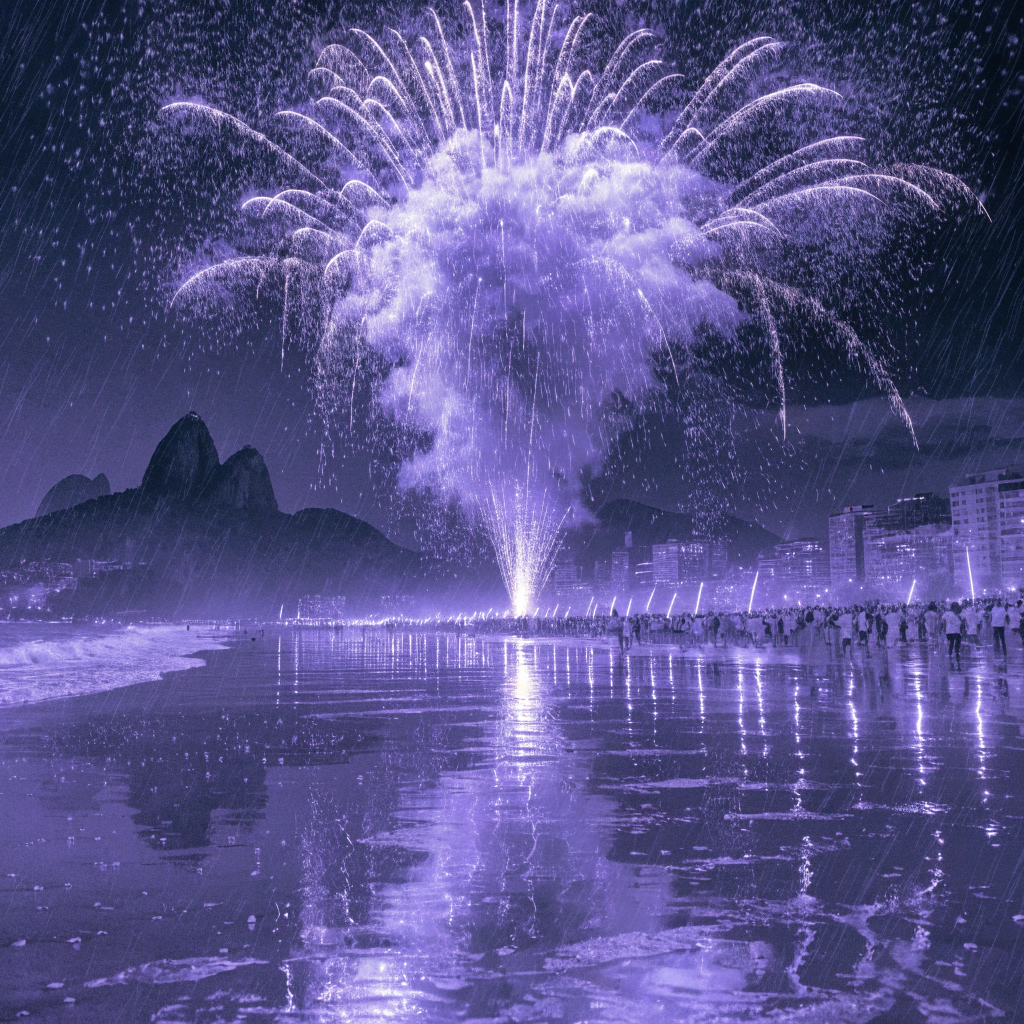
New Year's Eve in Brazil
New Year's Eve in Brazil is very big. People call it Réveillon. Many people go to Copacabana Beach in Rio de Janeiro. It is a famous place.
Everyone wears white clothes. White is the color of peace. They want a good new year. Some people go into the ocean. They jump over seven waves for luck.
There are beautiful fireworks in the sky at night. People dance and sing on the sand. They eat good food with their families. It is a very happy time for everyone.
文法スポットライト
パターン: Present Simple (to be)
"New Year's Eve in Brazil is very big."
We use 'is' for singular subjects to describe facts or states. In this sentence, it describes the size and importance of the holiday.
パターン: Present Simple (Plural Verbs)
"They jump over seven waves for luck."
With plural subjects like 'they' or 'people', we use the base form of the verb. We do not add an 's' at the end of the verb.
理解度をチェック
10 問 · A1 初級 · 無料プレビュー 1回
この記事で学んだことをテストしよう。全問正解してXPを獲得!
Where do many people go in Rio de Janeiro?
問題の内訳
Where do many people go in Rio de Janeiro?
あなたの回答:
正解: To Copacabana Beach
People wear black clothes for Réveillon.
あなたの回答:
正解: 間違い
What are fireworks?
あなたの回答:
正解: Bright colors in the sky
Some people jump over seven _____ in the ocean.
あなたの回答:
正解: waves
ブラジルのレベヨン:白い服のお祭り
ブラジルでは、12月31日の夜は「レベヨン」というとても大切なお祭りです。この日は、新しい年を祝います。ブラジル中の色々な町でお祝いをしますが、リオデジャネイロのコパカバーナビーチが一番有名です。
コパカバーナビーチには、毎年とてもたくさんの人が集まります。300万人以上も来ることもあります。みんな白い服を着ています。白い服は、平和と新しい年の心のきれいな浄化を意味します。これは、ブラジルのカンドンブレやウンバンダという宗教から来た習慣です。
夜になると、ビーチで大きな花火が上がります。みんなで花火を見て、新しい年を喜びます。レベヨンは、ブラジルの人々にとって、とても楽しい時間です。家族や友達と良い年を迎えたい気持ちでいっぱいです。
文法スポットライト
パターン: 〜て います
"みんな白い服を着ています。"
「〜て います」は、今している行動や、ある状態が続いていることを表すときに使います。この文では、みんなが白い服を着ているという状態が続いていることを示しています。
パターン: 〜たいです
"良い年を迎えたい気持ちでいっぱいです。"
「〜たいです」は、何かをしたいという自分の希望や願望を伝えるときに使います。この文では、良い年を迎えたいという強い気持ちがあることを表しています。
理解度をチェック
11 問 · A2 初級 · 無料プレビュー 1回
この記事で学んだことをテストしよう。全問正解してXPを獲得!
ブラジルでは、12月31日の夜を何と呼びますか?
問題の内訳
ブラジルでは、12月31日の夜を何と呼びますか?
あなたの回答:
正解: レベヨン
コパカバーナビーチはブラジルで一番有名なお祭り会場ではありません。
あなたの回答:
正解: 間違い
「平和」の意味は何ですか?
あなたの回答:
正解: 争いがなく、穏やかな状態
白い服は、平和と新しい年の心のきれいな___を意味します。
あなたの回答:
正解: 浄化
レベヨンで、人々は何色の服を着ますか?
あなたの回答:
正解: 白い服
Réveillon: A Sea of White in Brazil
New Year's Eve in Brazil, which is locally known as 'Réveillon', is one of the most spectacular celebrations in the world. Every year, millions of tourists and locals travel to Rio de Janeiro to witness the famous fireworks display on Copacabana Beach. This event has been described by many travelers as the most vibrant party on the planet.
The most striking feature of Réveillon is that almost everyone wears white clothes. This tradition, which symbolizes peace and spiritual purification, has been followed for many decades. It is deeply influenced by African-Brazilian religions such as Candomblé and Umbanda. By wearing white, people hope to start the new year with a clean soul and positive energy.
As midnight approaches, many people go down to the water's edge. A popular custom involves jumping over seven waves in the ocean. For every wave that is jumped, a wish is made for the coming year. Additionally, beautiful flowers are often thrown into the sea as a gift to Iemanjá, who is the goddess of the ocean. These traditions are performed by people of all backgrounds, making it a very inclusive celebration.
The festivities are not just about spiritual customs; they are also about music, dance, and delicious food. Huge stages are built on the sand where famous international and local musicians perform until the sun rises. Traditional dishes, such as lentils and rice, are eaten because it is believed that they bring prosperity and wealth.
If you have never experienced Réveillon in Brazil, it is an event that should be on your bucket list. The sky is filled with incredible colors, and the energy of millions of people celebrating together creates a magical atmosphere that is truly unforgettable.
文法スポットライト
パターン: Relative Clauses
"New Year's Eve in Brazil, which is locally known as 'Réveillon', is one of the most spectacular celebrations in the world."
Non-defining relative clauses are used to add extra information about a noun. They are separated by commas and often use 'which' for objects or 'who' for people.
パターン: Present Perfect Passive
"This event has been described by many travelers as the most vibrant party on the planet."
This is formed using 'has/have been' + past participle. It is used to focus on the action or the object rather than the person doing the action.
理解度をチェック
11 問 · B1 中級 · 無料プレビュー 1回
この記事で学んだことをテストしよう。全問正解してXPを獲得!
Where do millions of people go to see the fireworks in Rio de Janeiro?
問題の内訳
Where do millions of people go to see the fireworks in Rio de Janeiro?
あなたの回答:
正解: Copacabana Beach
Brazilians wear black clothes on New Year's Eve to show respect.
あなたの回答:
正解: 間違い
What does 'prosperity' mean?
あなたの回答:
正解: The state of being wealthy and successful
A popular custom involves jumping over seven _____ in the ocean.
あなたの回答:
正解: waves
Why do people eat lentils during the celebration?
あなたの回答:
正解: Because it is believed they bring money
ブラジルのレヴェイヨン:希望を紡ぐ大晦日の祭典
ブラジルにおける大晦日は、「レヴェイヨン」と呼ばれ、単なる年の終わりを祝う日以上の、精神的かつ祝祭的な一大イベントとして知られています。その規模は圧倒的で、特にリオデジャネイロのコパカバーナ海岸には、毎年300万人を超える人々が集結し、壮観な光景を繰り広げます。この祝祭は、単なる花火大会や音楽イベントにとどまらず、新しい年への希望と浄化を願う、ブラジル文化の奥深さを象徴するものです。
レヴェイヨンで最も印象的な光景の一つは、参加者の大半が全身白の服装を身につけていることです。この伝統は、アフリカ系ブラジル人の宗教であるカンドンブレーやウンバンダに由来しており、平和、純粋さ、そして新しい年における精神的な浄化を象徴するとされています。白は、悪霊を払い、幸運を呼び込む色として信じられており、多くの人々がこの習慣に倣います。海岸に広がる白い人々の波は、まさに圧巻の一言に尽きます。
さらに、レヴェイヨンには、白い服装に限らず、様々な興味深い習慣や儀式が存在します。例えば、多くのブラジル人が海に入り、波を七回飛び越えることで幸運を祈ります。これは、海の女神イエマンジャへの感謝と願いを込めた行為とされており、豊穣や繁栄を願う普遍的な人間の切望を反映しています。また、レンズ豆を食べることで富を、ブドウを食べることで幸運を願うといった食文化に基づいた伝統も根付いています。これらの行為は、来たる一年がより良いものとなるよう、古くからの信仰と結びついています。
コパカバーナのような大規模な祭典だけでなく、ブラジル各地の家庭やコミュニティでもレヴェイヨンは盛大に祝われます。家族や友人が集まり、食事を共にし、新年への期待を分かち合います。花火が夜空を彩り、音楽が鳴り響く中で、人々は過去を振り返り、未来への希望を胸に新たなスタートを切るのです。
レヴェイヨンは、多様な文化が融合したブラジルならではの、他に類を見ない祝祭です。それは、単なる娯楽ではなく、深い精神性と共同体の絆、そして未来へのポジティブな展望が一体となった、まさにブラジル人の魂を映し出す鏡と言えるでしょう。この大晦日の祭典は、世界中の人々を魅了し続けています。
文法スポットライト
パターン: ~として知られています
"ブラジルにおける大晦日は、「レヴェイヨン」と呼ばれ、単なる年の終わりを祝う日以上の、精神的かつ祝祭的な一大イベントとして知られています。"
「~として知られています」は、「~として有名です」や「~と認識されています」という意味を表します。ある対象がどのようなものとして世間に認識されているかを説明する際に用いる、フォーマルな表現です。「~として」は、その対象の役割や性質を示します。
パターン: ~に由来しており
"この伝統は、アフリカ系ブラジル人の宗教であるカンドンブレーやウンバンダに由来しており、平和、純粋さ、そして新しい年における精神的な浄化を象徴するとされています。"
「~に由来する」は、物事の起源や根源がどこにあるかを示す表現です。この形は、ある習慣や考え方が特定の文化や歴史、信仰から来ていることを説明する際に使われます。「~ており」は、「~ていて」のフォーマルな形です。
パターン: ~に限らず
"さらに、レヴェイヨンには、白い服装に限らず、様々な興味深い習慣や儀式が存在します。"
「~に限らず」は、「~だけでなく、他にも」という意味を表し、ある範囲や特定の事柄だけでなく、より広い範囲や他の事柄にも当てはまることを示す際に使われます。これにより、話題の範囲を広げ、多様性を表現することができます。
理解度をチェック
11 問 · B2 中上級 · 無料プレビュー 1回
この記事で学んだことをテストしよう。全問正解してXPを獲得!
ブラジルの「レヴェイヨン」は、主にどのようなイベントとして知られていますか。
問題の内訳
ブラジルの「レヴェイヨン」は、主にどのようなイベントとして知られていますか。
あなたの回答:
正解: 精神的かつ祝祭的な一大イベント
コパカバーナ海岸では、毎年100万人未満の人々がレヴェイヨンを祝うために集まります。
あなたの回答:
正解: 間違い
「象徴する」という言葉は、どのような意味ですか。
あなたの回答:
正解: あるものが別の意味を表すこと
レヴェイヨンの参加者の大半が全身白の服装を身につけていますが、これは平和や精神的な______を象徴するとされています。
あなたの回答:
正解: 浄化
海に入り波を七回飛び越える習慣は、何の女神への感謝と願いを込めた行為とされていますか。
あなたの回答:
正解: 海の女神イエマンジャ
The Ethereal Tide: A Critical Analysis of Brazil’s Réveillon
Seldom does a spectacle capture the collective psyche of a nation as profoundly as Réveillon in Brazil. While New Year’s Eve is globally celebrated with pyrotechnics and revelry, the Brazilian iteration—specifically the massive gathering on Copacabana Beach—transcends mere festivity, evolving into a complex cultural manifestation. The sheer scale of the event, with upwards of three million participants dressed in white, creates a visual landscape that is as ethereal as it is overwhelming. What defines this transition is not merely the chronological shift from one year to the next, but a profound spiritual cleansing underpinned by deep-seated religious syncretism.
The tradition of wearing white is inextricably linked to the Afro-Brazilian religions of Candomblé and Umbanda. For many, the color is not a fashion statement but a vestige of spiritual devotion to Oxalá, symbolizing peace and purification. This convergence of the sacred and the profane is perhaps the most striking element of the night. As the clock strikes midnight, the solemnity of spiritual offerings to Iemanjá, the Goddess of the Sea, occurs amidst the deafening roar of fireworks. It is this dichotomy—the quiet prayer versus the explosive party—that characterizes the Brazilian soul.
However, a critical analysis of Réveillon reveals a more nuanced reality. The commercialization of the event has increasingly created a divide between the televised, high-security luxury of hotel balconies and the gritty, crowded reality of the sand below. This socio-economic stratification is often masked by the uniform of white, which provides a momentary illusion of equality. Yet, despite the encroachment of corporate sponsorship, the core rituals remain remarkably resilient. The act of jumping seven waves, each representing a different deity, remains a non-negotiable ritual for millions, regardless of social standing.
Ultimately, the ephemeral nature of the celebration mirrors the fluidity of Brazilian identity itself. The convergence of indigenous, African, and European influences creates a tapestry that is constantly being rewoven. As the first dawn of the New Year breaks over the Atlantic, the remnants of white flowers floating on the tide serve as a poignant reminder of the night’s spiritual weight. In the end, Réveillon is less about the passage of time and more about the collective aspiration for a renewed existence, proving that even in a modern, secular world, the need for communal ritual remains an essential human drive.
文法スポットライト
パターン: Negative Inversion
"Seldom does a spectacle capture the collective psyche of a nation as profoundly as Réveillon in Brazil."
When using negative or restrictive adverbs like 'seldom' at the beginning of a sentence, the subject and auxiliary verb are inverted. This is used for emphasis and to create a formal, sophisticated tone.
パターン: Cleft Sentences
"What defines this transition is not merely the chronological shift from one year to the next, but a profound spiritual cleansing."
A pseudo-cleft sentence beginning with 'What' is used to focus on specific information. It highlights that the spiritual cleansing, rather than the date change, is the most important factor.
パターン: Nominalization
"The commercialization of the event has increasingly created a divide between the televised luxury and the crowded reality."
Nominalization involves turning verbs or adjectives into nouns (e.g., 'commercialize' to 'commercialization'). It allows for more abstract, objective, and dense information processing, typical of C1 academic writing.
理解度をチェック
12 問 · C1 上級 · 無料プレビュー 1回
この記事で学んだことをテストしよう。全問正解してXPを獲得!
What is the primary spiritual origin of wearing white during Réveillon?
問題の内訳
What is the primary spiritual origin of wearing white during Réveillon?
あなたの回答:
正解: Afro-Brazilian religious syncretism
The author suggests that the white clothing worn by participants creates a lasting elimination of social classes.
あなたの回答:
正解: 間違い
What does the word 'dichotomy' refer to in the context of the article?
あなたの回答:
正解: The contrast between spiritual prayer and loud celebration
The author notes that despite corporate influence, the core rituals remain remarkably _____.
あなたの回答:
正解: resilient
According to the text, what does the jumping of seven waves represent?
あなたの回答:
正解: Honoring different deities
The article argues that Réveillon is strictly a secular, modern party with no spiritual weight.
あなたの回答:
正解: 間違い
The Liminality of the Shore: Sociocultural Syncretism in the Brazilian Réveillon
To behold the shore of Copacabana on the eve of the Gregorian New Year is to witness a profound manifestation of collective effervescence. While ostensibly a secular celebration of temporal transition, the Brazilian Réveillon is inextricably intertwined with a rich tapestry of spiritual syncretism. Should one venture onto the sands, one is immediately struck by the pervasive sea of white—a visual shorthand for purification and peace. This chromatic uniformity is far from arbitrary; it is a vestigial remnant of Candomblé and Umbanda traditions, wherein the color white pays homage to Oxalá, the deity of creation. Were this merely a display of aesthetic preference, its sociological weight might be dismissed. However, the sheer scale of the gathering—upwards of three million souls—suggests a deeper, more visceral yearning for communal transcendence.
The act of dressing in white functions as a ritualistic leveling of social strata, albeit a temporary one, where the disparate threads of Brazilian society are woven into a singular, hopeful entity. One might argue that this monochromatic display serves as a protective aegis against the uncertainties of the impending year. Not only does the ocean serve as a backdrop for celebration, but it also acts as a profound spiritual conduit. Central to the littoral festivities is the veneration of Iemanjá, the Queen of the Sea. Offerings, ranging from white flowers to intricate miniature boats laden with perfumes and mirrors, are cast into the Atlantic’s embrace. This ritual underscores the liminal nature of the beach—a threshold between the terrestrial and the divine.
The practice of jumping seven waves, each accompanied by a petition for the future, further cements the event’s status as a spiritual endeavor. It is as if the rhythmic undulation of the tide were capable of washing away the accumulated detritus of the past twelve months. This metaphysical cleansing is augmented by the pyrotechnic spectacle that illuminates the Rio skyline. One should not view the fireworks merely as an exercise in sensory indulgence; rather, the cacophony of light and sound represents a symbolic purging of malevolent influences. It is a moment of collective catharsis, where the boundaries between the individual and the multitude blur into a state of shared euphoria.
Furthermore, the transition from the old year to the new is marked by a paradoxical interplay between the ephemeral and the eternal. The transient nature of the fireworks and the offerings stands in stark contrast to the enduring legacy of the Afro-Brazilian traditions that underpin them. Despite the commercialization that inevitably encroaches upon such massive events, the core of Réveillon remains a poignant synthesis of the profane and the sacred. It is a testament to the resilience of cultural identity in an increasingly globalized world, where ancient traditions are not merely preserved but are dynamically reinterpreted through the lens of modern celebration. Ultimately, Réveillon represents an ontological reset, a brief moment where the inexorable march of time is paused to allow for spiritual recalibration and a renewed sense of belonging to the human collective.
文法スポットライト
パターン: Inversion for Emphasis
"Not only does the ocean serve as a backdrop for celebration, but it also acts as a profound spiritual conduit."
When a sentence starts with a negative or restrictive expression like 'not only', the auxiliary verb comes before the subject. This is used in formal English to add rhetorical weight or emphasis.
パターン: Second Conditional with Subjunctive 'Were'
"Were this merely a display of aesthetic preference, its sociological weight might be dismissed."
This is a highly formal version of 'If this were...'. By omitting 'if' and inverting the subject and 'were', the writer creates a scholarly and hypothetical tone.
パターン: Academic Hedging
"One might argue that this monochromatic display serves as a protective aegis against the uncertainties of the impending year."
Using 'one might argue' instead of a direct statement allows the writer to distance themselves from the claim, presenting it as a possibility or interpretation rather than an absolute fact.
理解度をチェック
12 問 · C2 マスター · 無料プレビュー 1回
この記事で学んだことをテストしよう。全問正解してXPを獲得!
What is the primary spiritual origin of the tradition of wearing white during Réveillon?
問題の内訳
What is the primary spiritual origin of the tradition of wearing white during Réveillon?
あなたの回答:
正解: Afro-Brazilian religions such as Candomblé
The author suggests that the fireworks are purely for sensory indulgence and lack symbolic meaning.
あなたの回答:
正解: 間違い
Which word refers to the process of emotional release and relief?
あなたの回答:
正解: Catharsis
The beach is described as a _____ space, representing a threshold between the terrestrial and the divine.
あなたの回答:
正解: liminal
According to the text, how does the act of dressing in white affect social strata?
あなたの回答:
正解: It functions as a temporary leveling of social divisions.
The author views Réveillon as a synthesis of both sacred and secular elements.
あなたの回答:
正解: 正しい

