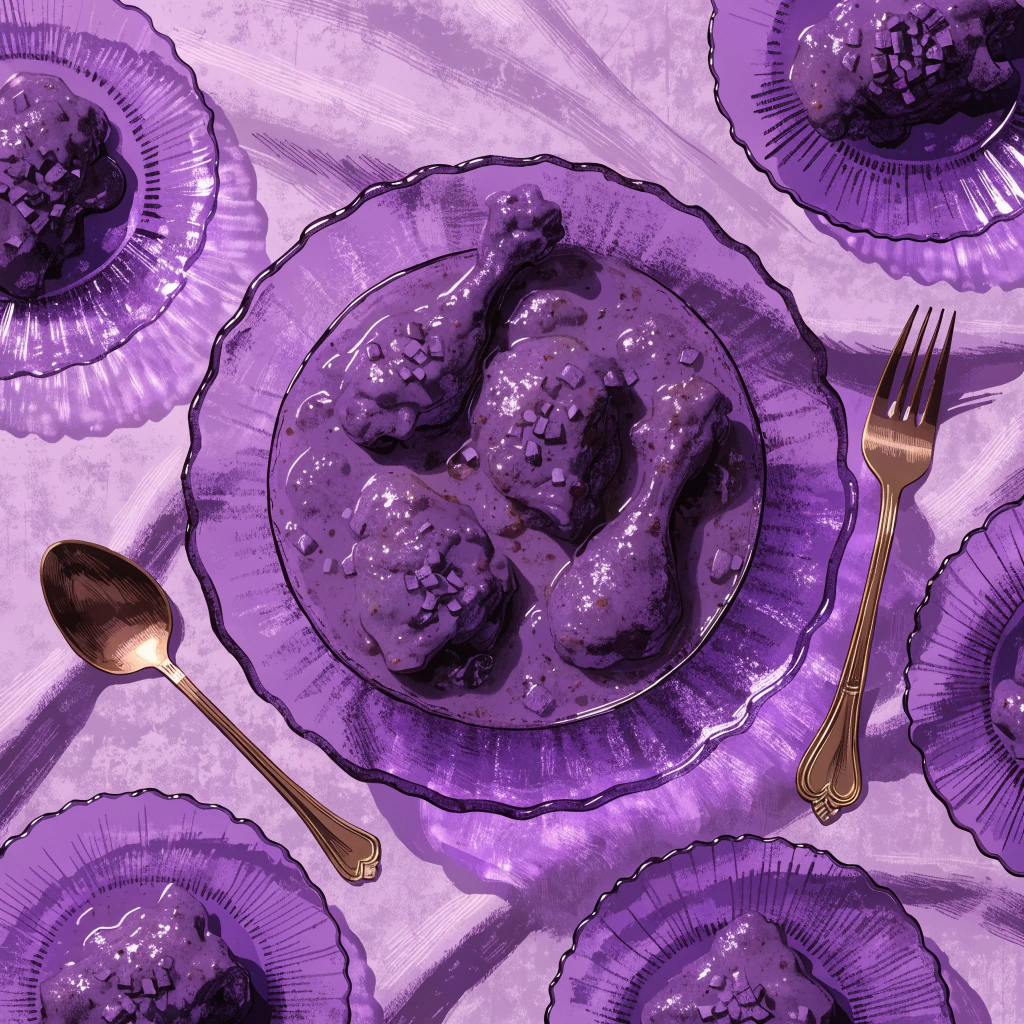
Butter Chicken: A Tasty Dish from India
Butter Chicken is a very famous food from India. It is a special dish from the city of Delhi. Chefs first make this dish in the 1950s. Today, many people love it.
Chefs use grilled chicken, red tomatoes, and fresh butter to make it. The sauce is orange and very creamy. It is sweet and not very spicy. It tastes great.
Many people eat Butter Chicken with warm bread or white rice. It is a delicious meal for families and friends. You can find this food in many restaurants all over the world.
Point grammaire
Structure: Present Simple (to be)
"It is a special dish from the city of Delhi."
We use 'is' with singular subjects like 'it' or 'the dish' to talk about facts or descriptions. It helps us say what something is.
Structure: Present Simple (Action Verbs)
"Chefs use grilled chicken, red tomatoes, and fresh butter to make it."
We use the base form of the verb (like 'use' or 'eat') for plural subjects like 'chefs' or 'people' to describe general truths or habits.
Teste ta compréhension
10 questions · A1 Débutant · 1 aperçu gratuit
Teste ce que tu as appris dans cet article. Réponds à toutes les questions pour gagner des XP !
Where is Butter Chicken from?
Tu veux terminer le quiz ?
9 questions supplémentaires t'attendent. Inscris-toi gratuitement pour débloquer le quiz complet et gagner des XP !
S'inscrire gratuitementTu as dj un compte ? Connexion
Bien joué !
Continue à pratiquer !
Déjà terminé — pas de XP supplémentaire
Inscris-toi pour gagner des XPDétail des questions
Where is Butter Chicken from?
Ta réponse:
Bonne réponse: India
Butter Chicken is very spicy.
Ta réponse:
Bonne réponse: Faux
What does 'famous' mean?
Ta réponse:
Bonne réponse: Known by many people
Many people eat Butter Chicken with warm _____.
Ta réponse:
Bonne réponse: bread
The Story of Butter Chicken
Butter Chicken is a very famous food from India. Many people around the world love it because it is creamy and delicious. In India, people call it 'Murgh Makhani'. It is one of the most popular dishes in Indian restaurants today.
The story of this dish started in the 1950s. A man named Kundan Lal Gujral worked at a restaurant in Delhi called Moti Mahal. He had a problem. Sometimes, the tandoori chicken was dry because it sat in the kitchen for a long time. He wanted to make the chicken better.
He decided to cook the chicken in a rich sauce. He used tomatoes, spices, and a lot of butter. This made the chicken soft and tasty. Soon, many people visited his restaurant to try this new dish.
Now, Butter Chicken is more famous than many other Indian foods. It is easy to find in many countries. If you like food that is not too spicy but very rich, you should try it!
Point grammaire
Structure: Past Simple (Regular and Irregular)
"He worked at a restaurant in Delhi called Moti Mahal."
We use the past simple to talk about completed actions in the past. For regular verbs like 'work', we add -ed. For irregular verbs like 'had', the form changes.
Structure: Comparatives
"Butter Chicken is more famous than many other Indian foods."
We use 'more + adjective + than' to compare two things. We use 'more' for longer adjectives like 'famous'.
Teste ta compréhension
11 questions · A2 mentaire · 1 aperçu gratuit
Teste ce que tu as appris dans cet article. Réponds à toutes les questions pour gagner des XP !
Where was Butter Chicken created?
Tu veux terminer le quiz ?
10 questions supplémentaires t'attendent. Inscris-toi gratuitement pour débloquer le quiz complet et gagner des XP !
S'inscrire gratuitementTu as dj un compte ? Connexion
Bien joué !
Continue à pratiquer !
Déjà terminé — pas de XP supplémentaire
Inscris-toi pour gagner des XPDétail des questions
Where was Butter Chicken created?
Ta réponse:
Bonne réponse: Delhi
Butter Chicken was created in the 1950s.
Ta réponse:
Bonne réponse: Vrai
What does 'delicious' mean?
Ta réponse:
Bonne réponse: Tasting very good
He used tomatoes, spices, and a lot of _____.
Ta réponse:
Bonne réponse: butter
Why did the chef create the sauce?
Ta réponse:
Bonne réponse: Because the chicken was dry
Le Poulet au Beurre : Une Histoire Gourmande Indienne
Le Poulet au Beurre, connu en Inde sous le nom de « Murgh Makhani », est un plat emblématique qui a conquis les palais du monde entier. Bien que beaucoup de plats indiens aient des origines très anciennes, le Poulet au Beurre, lui, possède une histoire relativement moderne et bien documentée. Ce plat délicieux est devenu un incontournable de la cuisine indienne internationale.
Son histoire a commencé dans les années 1950, dans les cuisines du célèbre restaurant Moti Mahal, situé à Delhi. Kundan Lal Gujral, le fondateur, et son équipe étaient souvent confrontés à un problème : comment réutiliser le poulet tandoori restant qui avait tendance à sécher ? Ils ont eu une idée brillante. Au lieu de jeter la viande, ils ont décidé de l'expérimenter en la cuisant doucement dans une sauce riche.
C'est ainsi qu'ils ont créé une sauce crémeuse et onctueuse à base de tomates fraîches, de beurre, de crème et d'épices parfumées. Le poulet tandoori était ensuite mijoté dans cette sauce, ce qui lui donnait une texture incroyablement tendre et un goût unique. Le résultat fut un plat succulent, à la fois doux et aromatique, très différent des currys plus épicés de l'époque.
Le succès fut immédiat. Le Poulet au Beurre est rapidement devenu la spécialité du Moti Mahal et sa popularité s'est étendue bien au-delà de Delhi. Aujourd'hui, il est servi dans les restaurants indiens du monde entier et est souvent considéré comme l'un des meilleurs représentants de la gastronomie indienne. Il est généralement accompagné de pain naan ou de riz, offrant une expérience culinaire réconfortante et mémorable.
Ce plat témoigne de l'ingéniosité culinaire et de la capacité à transformer des restes en une création extraordinaire. Le Poulet au Beurre n'est pas seulement un plat ; c'est un héritage, une innovation qui a marqué l'histoire de la cuisine indienne et continue de ravir des millions de personnes chaque jour.
Point grammaire
Structure: La Voix Passive
"Ce plat délicieux est devenu un incontournable."
La voix passive est utilisée pour mettre l'accent sur l'action subie par le sujet, plutôt que sur celui qui fait l'action. Elle se forme avec l'auxiliaire 'être' conjugué et le participe passé du verbe principal, qui s'accorde avec le sujet.
Structure: Les Propositions Subordonnées Relatives
"Le Poulet au Beurre, connu en Inde sous le nom de « Murgh Makhani », est un plat emblématique qui a conquis les palais du monde entier."
Les propositions subordonnées relatives donnent des informations supplémentaires sur un nom (l'antécédent). Elles sont introduites par un pronom relatif comme 'qui' (sujet) ou 'que' (objet direct).
Teste ta compréhension
11 questions · B1 Intermédiaire · 1 aperçu gratuit
Teste ce que tu as appris dans cet article. Réponds à toutes les questions pour gagner des XP !
Quand le Poulet au Beurre a-t-il été créé ?
Tu veux terminer le quiz ?
10 questions supplémentaires t'attendent. Inscris-toi gratuitement pour débloquer le quiz complet et gagner des XP !
S'inscrire gratuitementTu as dj un compte ? Connexion
Bien joué !
Continue à pratiquer !
Déjà terminé — pas de XP supplémentaire
Inscris-toi pour gagner des XPDétail des questions
Quand le Poulet au Beurre a-t-il été créé ?
Ta réponse:
Bonne réponse: Dans les années 1950
Le Poulet au Beurre est originaire de Mumbai.
Ta réponse:
Bonne réponse: Faux
Que signifie le mot "onctueuse" dans le contexte de l'article ?
Ta réponse:
Bonne réponse: Crémeuse et douce
Le Poulet au Beurre est souvent accompagné de pain naan ou de ____.
Ta réponse:
Bonne réponse: riz
Quel était le problème initial des chefs du Moti Mahal ?
Ta réponse:
Bonne réponse: Le poulet tandoori restant séchait
Le Murgh Makhani : L'Épopée Culinaire d'un Plat Indien Emblématique
Le Murgh Makhani, plus communément appelé « Poulet au Beurre » en Occident, est sans conteste l'un des ambassadeurs les plus célèbres de la gastronomie indienne à travers le monde. Sa saveur riche et onctueuse a conquis d'innombrables palais, le hissant au rang d'icône culinaire internationale. Contrairement à de nombreux plats traditionnels dont les origines se perdent dans la nuit des temps, l'histoire du Poulet au Beurre est étonnamment moderne et minutieusement documentée, offrant un aperçu fascinant de l'ingéniosité culinaire.
C'est dans les années 1950, au cœur de Delhi, que ce mets délectable a vu le jour. Kundan Lal Gujral, le fondateur du célèbre restaurant Moti Mahal, est crédité de cette invention révolutionnaire. Confronté à un défi courant dans la cuisine indienne de l'époque – comment éviter que les restes de poulet tandoori, grillé dans un four en terre cuite, ne se dessèchent et ne perdent de leur succulence – Gujral et son équipe ont fait preuve d'une remarquable créativité. L'idée fut de réutiliser ce poulet en le mijotant dans une sauce riche et parfumée, plutôt que de le jeter.
Ainsi est née la sauce makhani, une émulsion divine de tomates mûres, de beurre généreux, de crème fraîche, et d'un mélange subtil d'épices telles que le garam masala, le cumin, la coriandre et le fenugrec. Cette combinaison astucieuse a non seulement permis de préserver la tendreté du poulet, mais elle a également transformé un simple reste en un plat d'une complexité gustative extraordinaire. L'avènement de cette recette a marqué un tournant, offrant une nouvelle dimension à la cuisine du Pendjab et, par extension, à l'ensemble de la gastronomie indienne.
Le Poulet au Beurre est rapidement devenu un pilier du menu du Moti Mahal, attirant une clientèle variée, des dignitaires aux gourmets ordinaires. Sa popularité a transcendé les frontières de l'Inde, notamment grâce à la diaspora indienne et à l'attrait croissant pour les saveurs exotiques à l'échelle mondiale. Aujourd'hui, il est indissociable de l'expérience culinaire indienne dans presque tous les restaurants indiens occidentaux, et des pléthores de variantes existent, témoignant de son adaptabilité et de son succès universel.
Il convient de noter que, bien que son nom évoque une richesse opulente, un bon Murgh Makhani se distingue par un équilibre délicat entre le sucré, l'acide et l'umami, rehaussé par la douceur du beurre et de la crème. C'est un plat réconfortant par excellence, souvent servi avec du riz basmati ou du naan chaud. L'héritage de Kundan Lal Gujral perdure à travers ce chef-d'œuvre culinaire, qui continue d'enchanter les papilles et de symboliser la capacité de la cuisine indienne à innover tout en honorant ses traditions. Son histoire est un rappel éloquent que même les plus grandes inventions peuvent naître de la nécessité et d'une pincée de génie.
Point grammaire
Structure: L'expression du but/de la peur avec le subjonctif
"comment éviter que les restes de poulet tandoori, grillé dans un four en terre cuite, ne se dessèchent et ne perdent de leur succulence"
Cette construction est utilisée après des verbes ou des expressions qui expriment la peur, la prévention ou un but qui cherche à éviter un résultat indésirable. Le verbe qui suit (ici 'se dessèchent' et 'perdent') est toujours au subjonctif, souvent précédé de 'que'.
Structure: Le gérondif
"L'idée fut de réutiliser ce poulet en le mijotant dans une sauce riche et parfumée."
Le gérondif (formé avec 'en' + participe présent) est employé pour exprimer la simultanéité de deux actions, la manière dont une action est réalisée, ou parfois la cause. Dans cet exemple, il indique la manière dont le poulet a été réutilisé.
Structure: L'expression impersonnelle 'Il convient de'
"Il convient de noter que, bien que son nom évoque une richesse opulente, un bon Murgh Makhani se distingue par un équilibre délicat."
'Il convient de' est une expression impersonnelle formelle qui signifie 'il est approprié de' ou 'il est juste de'. Elle est toujours suivie d'un verbe à l'infinitif et est utilisée pour introduire une remarque, une suggestion ou une information pertinente.
Teste ta compréhension
11 questions · B2 Intermédiaire supérieur · 1 aperçu gratuit
Teste ce que tu as appris dans cet article. Réponds à toutes les questions pour gagner des XP !
Qui est crédité de l'invention du Poulet au Beurre ?
Tu veux terminer le quiz ?
10 questions supplémentaires t'attendent. Inscris-toi gratuitement pour débloquer le quiz complet et gagner des XP !
S'inscrire gratuitementTu as dj un compte ? Connexion
Bien joué !
Continue à pratiquer !
Déjà terminé — pas de XP supplémentaire
Inscris-toi pour gagner des XPDétail des questions
Qui est crédité de l'invention du Poulet au Beurre ?
Ta réponse:
Bonne réponse: Kundan Lal Gujral
Le Poulet au Beurre a été créé dans les années 1950.
Ta réponse:
Bonne réponse: Vrai
Que signifie le mot 'onctueuse' dans le contexte de l'article ?
Ta réponse:
Bonne réponse: Crémeuse et douce au palais
Le Murgh Makhani est un ambassadeur _______ de la gastronomie indienne.
Ta réponse:
Bonne réponse: célèbre
Quel problème les chefs du Moti Mahal cherchaient-ils à résoudre en créant la sauce makhani ?
Ta réponse:
Bonne réponse: Le dessèchement du poulet tandoori
Culinary Innovation or Accidental Legacy? The Metamorphosis of Murgh Makhani
Seldom has a single dish captured the global imagination so profoundly as Murgh Makhani, more commonly known as Butter Chicken. While the uninitiated might assume that such a staple of the Indian subcontinent has its roots in antiquity, its provenance is remarkably modern. It was the bustling post-partition environment of 1950s Delhi that served as the crucible for this culinary innovation. The transformation of leftover tandoori chicken—which was prone to desiccation—into a velvety, cream-infused masterpiece was not merely a stroke of luck, but a manifestation of pragmatic ingenuity.
Kundan Lal Gujral, the founder of the iconic Moti Mahal restaurant, is widely credited with this serendipitous metamorphosis. Faced with the economic imperative to minimize waste, Gujral and his team experimented by simmering grilled poultry in a sauce composed of tomatoes, butter, and a delicate balance of spices. What emerged was a dish that offered a nuanced juxtaposition of smoky charred notes and a luxurious, silken texture. Not only did this invention solve a logistical challenge, but it also fundamentally reshaped the gastronomic identity of the capital.
In the decades that followed, the proliferation of Butter Chicken across the globe has been nothing short of meteoric. From the high-end eateries of London to the takeaway kiosks of Sydney, the dish has become the quintessential ambassador of Indian cuisine. However, this ubiquity has not come without its share of critical scrutiny. Gastronomic purists often lament the dilution of the original recipe, arguing that the global version frequently descends into a saccharine caricature that lacks the complexity of Gujral’s initial vision. The standardization of the dish for international palates often necessitates the omission of the subtle tang and spice that characterize the authentic Delhi iteration.
Furthermore, the recent legal disputes in India over the 'true' origin of Butter Chicken highlight the cultural weight that such a dish carries. The contention between two rival restaurant families over the heritage of the recipe underscores the fact that culinary history is as much about identity as it is about sustenance. Notwithstanding these debates, the enduring appeal of the dish remains undeniable. It serves as a bridge between the traditional and the contemporary, demonstrating how culinary traditions are not static artifacts but evolving narratives.
Ultimately, the story of Butter Chicken is a testament to the power of human creativity in the face of constraint. The transition from a pragmatic solution to a global phenomenon illustrates the fluid nature of cultural exchange. Insofar as food remains a primary medium for cultural diplomacy, Butter Chicken stands as a succulent reminder of India’s profound influence on the global palate.
Point grammaire
Structure: Inversion with Negative Adverbials
"Seldom has a single dish captured the global imagination so profoundly as Murgh Makhani."
In formal English, when starting a sentence with a negative or restrictive adverb like 'seldom', the auxiliary verb is placed before the subject. This structure is used for rhetorical emphasis and dramatic effect.
Structure: Cleft Sentences for Emphasis
"It was the bustling post-partition environment of 1950s Delhi that served as the crucible for this culinary innovation."
Cleft sentences use the structure 'It is/was... that...' to focus on a specific piece of information. By placing 'the bustling post-partition environment' after 'It was', the author emphasizes the specific context of the invention.
Structure: Nominalisation
"The transformation of leftover tandoori chicken... into a velvety, cream-infused masterpiece was not merely a stroke of luck."
Nominalisation involves turning verbs (transform) into nouns (transformation). This is a hallmark of C1 academic and formal writing, as it allows for more complex ideas to be packed into the subject of a sentence.
Teste ta compréhension
12 questions · C1 Avancé · 1 aperçu gratuit
Teste ce que tu as appris dans cet article. Réponds à toutes les questions pour gagner des XP !
What was the primary practical reason for the creation of Butter Chicken?
Tu veux terminer le quiz ?
11 questions supplémentaires t'attendent. Inscris-toi gratuitement pour débloquer le quiz complet et gagner des XP !
S'inscrire gratuitementTu as dj un compte ? Connexion
Bien joué !
Continue à pratiquer !
Déjà terminé — pas de XP supplémentaire
Inscris-toi pour gagner des XPDétail des questions
What was the primary practical reason for the creation of Butter Chicken?
Ta réponse:
Bonne réponse: To prevent grilled chicken from becoming too dry to sell
The author suggests that Butter Chicken is an ancient dish with centuries of history.
Ta réponse:
Bonne réponse: Faux
What does 'ubiquity' mean in the context of the article?
Ta réponse:
Bonne réponse: The state of being found everywhere
The author describes the origin of the dish as a _____ metamorphosis from leftover poultry to a national treasure.
Ta réponse:
Bonne réponse: serendipitous
According to the text, why do culinary purists criticize international versions of the dish?
Ta réponse:
Bonne réponse: They are often overly sweet and lack the original complexity
Recent legal disputes in India suggest that the dish's origin is tied to cultural identity.
Ta réponse:
Bonne réponse: Vrai
The Gastronomic Palimpsest: Deconstructing the Hegemony of Butter Chicken
Were one to traverse the bustling thoroughfares of Old Delhi, the olfactory tapestry of spices would inevitably lead to the hallowed grounds of Moti Mahal, an establishment that stands as a testament to culinary ingenuity. While the global palate often perceives Indian cuisine through a monolithic lens, the genesis of ‘Murgh Makhani’—colloquially known as Butter Chicken—reveals a more nuanced narrative of post-partition adaptation and serendipitous innovation. Seldom has a dish transcended its humble origins to achieve such absolute ubiquity, yet its history is frequently obscured by the very fame it has garnered.
The progenitor of this dish, Kundan Lal Gujral, did not set out to revolutionize the gastronomic landscape of the subcontinent. Rather, the creation of Butter Chicken was an exercise in pragmatism. In the 1950s, the challenge of maintaining the succulence of tandoori chicken—meat grilled in clay ovens—presented a significant hurdle. Leftover pieces would invariably succumb to desiccation. To mitigate this, Gujral and his chefs devised a rich, tomato-based gravy, emulsified with copious amounts of butter and cream. This was not merely a culinary addition but a structural reification of the dish, transforming a dry protein into a luxurious, velvety experience. It was within the crucible of post-partition Delhi that this fusion of Punjabi tradition and modern necessity took root.
One might contend that the dish represents a culinary palimpsest, where layers of history are visible through the contemporary facade. The use of the tandoor—a vestigial element of Central Asian influence—was married to the vibrant, acidic profile of the tomato, a New World import that had become indispensable to Indian cooking. This synthesis reflects the broader cultural shifts of the era. As Delhi evolved into a cosmopolitan hub, the demand for sophisticated yet accessible flavors grew. Butter Chicken catered to this burgeoning epicurean class, offering a flavor profile that was neither excessively piquant nor overly austere.
However, the global proliferation of Butter Chicken has led to a degree of homogenization that many purists find lamentable. In the diaspora, the dish is frequently reduced to a sugary, neon-orange caricature of its former self, stripped of the smoky depth provided by the tandoor. This reification of the ‘curry’ brand often overlooks the intricate balance of fenugreek and garam masala that defines the authentic preparation. The tension between global accessibility and regional integrity remains a central theme in the discourse surrounding Indian food.
From a sociological perspective, the ascent of Butter Chicken mirrors the trajectory of India's middle class. Its transition from a localized Delhi specialty to a global icon signifies the commodification of ethnicity. When we consume this dish in London, New York, or Sydney, we are participating in a shared semiotic language of ‘Indianness.’ Yet, this shared language often lacks the grammatical precision of the original. The nuances of the ‘makhani’ sauce—the subtle hint of dried fenugreek leaves and the specific acidity of the tomatoes—are frequently lost in translation. Thus, the dish serves as both a bridge and a barrier, connecting the world to Indian flavors while simultaneously simplifying them for a global audience.
Furthermore, the legal disputes over the dish’s lineage highlight the importance of intellectual property in the culinary arts. Recent litigations between competing restaurant dynasties underscore that Butter Chicken is not merely a commodity but a cultural artifact. To understand Butter Chicken is to understand the resilience of the human spirit in the face of displacement; it is a story of how a community, uprooted by partition, reconstructed its identity through the medium of taste. Ultimately, while its ubiquity may mask its complexity, the dish remains a profound example of how culinary boundaries are perpetually redrawn through necessity and imagination.
Point grammaire
Structure: The Subjunctive Mood with Inversion
"Were one to traverse the bustling thoroughfares of Old Delhi, the olfactory tapestry of spices would inevitably lead..."
This is a formal conditional structure used to imagine a hypothetical situation. By starting with 'Were' instead of 'If', the writer achieves a more academic and sophisticated tone.
Structure: Negative Inversion for Emphasis
"Seldom has a dish transcended its humble origins to achieve such absolute ubiquity..."
Placing a negative or restrictive adverb like 'Seldom' at the beginning of the sentence requires the subject and auxiliary verb to switch places. This highlights the rarity or significance of the event.
Structure: Cleft Sentences
"It was within the crucible of post-partition Delhi that this fusion of Punjabi tradition and modern necessity took root."
A cleft sentence divides a single clause into two parts, starting with 'It is/was'. This structure is used to focus on a specific piece of information, in this case, the historical context of the dish's origin.
Teste ta compréhension
12 questions · C2 Maîtrise · 1 aperçu gratuit
Teste ce que tu as appris dans cet article. Réponds à toutes les questions pour gagner des XP !
According to the article, what was the primary motivation for creating the Butter Chicken sauce?
Tu veux terminer le quiz ?
11 questions supplémentaires t'attendent. Inscris-toi gratuitement pour débloquer le quiz complet et gagner des XP !
S'inscrire gratuitementTu as dj un compte ? Connexion
Bien joué !
Continue à pratiquer !
Déjà terminé — pas de XP supplémentaire
Inscris-toi pour gagner des XPDétail des questions
According to the article, what was the primary motivation for creating the Butter Chicken sauce?
Ta réponse:
Bonne réponse: To prevent grilled tandoori chicken from becoming too dry.
The article suggests that Butter Chicken is a dish with ancient, pre-modern origins.
Ta réponse:
Bonne réponse: Faux
What is the meaning of 'ubiquity' as used in the text?
Ta réponse:
Bonne réponse: The state of being everywhere.
The creation of Butter Chicken was a _____ innovation, born from the need to repurpose leftover tandoori chicken.
Ta réponse:
Bonne réponse: serendipitous
What does the author mean by describing the dish as a 'culinary palimpsest'?
Ta réponse:
Bonne réponse: It is a dish where different historical influences are layered together.
The author believes the global version of Butter Chicken is always superior to the original.
Ta réponse:
Bonne réponse: Faux

