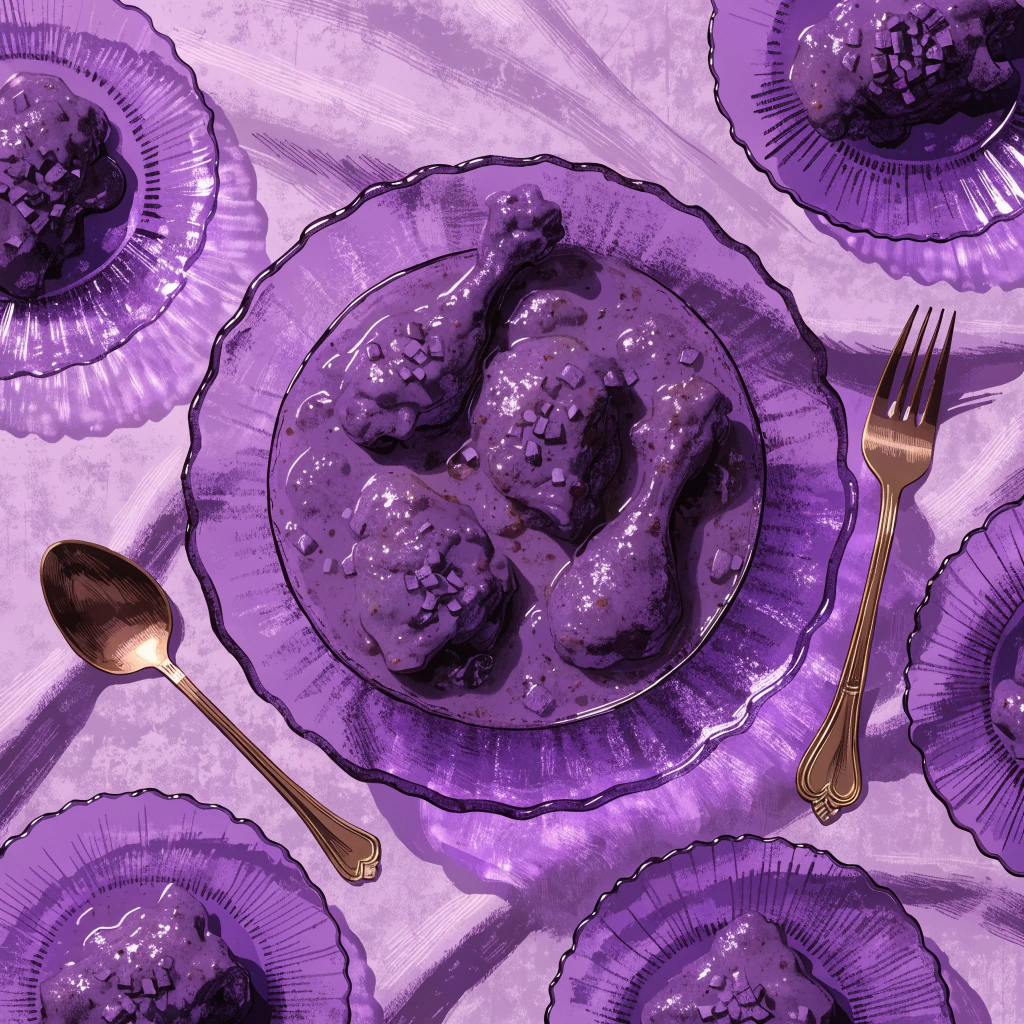
Butter Chicken: A Tasty Dish from India
Butter Chicken is a very famous food from India. It is a special dish from the city of Delhi. Chefs first make this dish in the 1950s. Today, many people love it.
Chefs use grilled chicken, red tomatoes, and fresh butter to make it. The sauce is orange and very creamy. It is sweet and not very spicy. It tastes great.
Many people eat Butter Chicken with warm bread or white rice. It is a delicious meal for families and friends. You can find this food in many restaurants all over the world.
语法聚焦
句型: Present Simple (to be)
"It is a special dish from the city of Delhi."
We use 'is' with singular subjects like 'it' or 'the dish' to talk about facts or descriptions. It helps us say what something is.
句型: Present Simple (Action Verbs)
"Chefs use grilled chicken, red tomatoes, and fresh butter to make it."
We use the base form of the verb (like 'use' or 'eat') for plural subjects like 'chefs' or 'people' to describe general truths or habits.
测试你的理解
10 个问题 · A1 初学 · 1 次免费预览
测试你从这篇文章中学到的知识。回答所有问题即可获得经验值!
题目详情
Where is Butter Chicken from?
你的回答:
正确答案: India
Butter Chicken is very spicy.
你的回答:
正确答案: 错误
What does 'famous' mean?
你的回答:
正确答案: Known by many people
Many people eat Butter Chicken with warm _____.
你的回答:
正确答案: bread
The Story of Butter Chicken
Butter Chicken is a very famous food from India. Many people around the world love it because it is creamy and delicious. In India, people call it 'Murgh Makhani'. It is one of the most popular dishes in Indian restaurants today.
The story of this dish started in the 1950s. A man named Kundan Lal Gujral worked at a restaurant in Delhi called Moti Mahal. He had a problem. Sometimes, the tandoori chicken was dry because it sat in the kitchen for a long time. He wanted to make the chicken better.
He decided to cook the chicken in a rich sauce. He used tomatoes, spices, and a lot of butter. This made the chicken soft and tasty. Soon, many people visited his restaurant to try this new dish.
Now, Butter Chicken is more famous than many other Indian foods. It is easy to find in many countries. If you like food that is not too spicy but very rich, you should try it!
语法聚焦
句型: Past Simple (Regular and Irregular)
"He worked at a restaurant in Delhi called Moti Mahal."
We use the past simple to talk about completed actions in the past. For regular verbs like 'work', we add -ed. For irregular verbs like 'had', the form changes.
句型: Comparatives
"Butter Chicken is more famous than many other Indian foods."
We use 'more + adjective + than' to compare two things. We use 'more' for longer adjectives like 'famous'.
测试你的理解
11 个问题 · A2 基础 · 1 次免费预览
测试你从这篇文章中学到的知识。回答所有问题即可获得经验值!
Where was Butter Chicken created?
题目详情
Where was Butter Chicken created?
你的回答:
正确答案: Delhi
Butter Chicken was created in the 1950s.
你的回答:
正确答案: 正确
What does 'delicious' mean?
你的回答:
正确答案: Tasting very good
He used tomatoes, spices, and a lot of _____.
你的回答:
正确答案: butter
Why did the chef create the sauce?
你的回答:
正确答案: Because the chicken was dry
The Surprising Story of India's Butter Chicken
Butter Chicken, which is also known as 'Murgh Makhani', is one of the most famous dishes from India. It has become a favorite meal for people all over the world because of its rich and creamy taste. However, many people do not know that this dish has a relatively modern history compared to other traditional Indian foods.
The story began in the 1950s at a famous restaurant called Moti Mahal in Delhi. It was created by a talented chef named Kundan Lal Gujral. At that time, the chefs faced a common problem with their tandoori chicken. After the chicken was grilled in the traditional clay oven, it often became dry if it was not eaten immediately. To solve this problem, the kitchen staff experimented with a new type of sauce.
The grilled chicken was simmered in a rich gravy made with fresh tomatoes, butter, and cream. This clever process kept the meat soft and juicy while adding a wonderful flavor. The result was a delicious dish that combined smoky grilled notes with a smooth, velvety texture. Since its invention, Butter Chicken has been exported to almost every country on Earth. It is usually served with warm naan bread or steamed rice.
Today, Butter Chicken is more than just a simple meal; it is a symbol of Indian culinary success. Although many different variations now exist in international restaurants, the original recipe from Delhi remains a classic. It is a dish that has truly changed how the world views Indian food. Whether you are in London, New York, or Sydney, you can likely find a version of this beloved dish.
语法聚焦
句型: Relative Clauses
"Butter Chicken, which is also known as 'Murgh Makhani', is one of the most famous dishes from India."
Relative clauses provide extra information about a noun. In this sentence, 'which' starts a non-defining clause that gives us another name for the dish.
句型: Passive Voice
"The grilled chicken was simmered in a rich gravy made with fresh tomatoes, butter, and cream."
The passive voice is used when the action or the object is more important than the person doing it. It is formed using the verb 'to be' and the past participle.
测试你的理解
11 个问题 · B1 中级 · 1 次免费预览
测试你从这篇文章中学到的知识。回答所有问题即可获得经验值!
Where was Butter Chicken first created?
题目详情
Where was Butter Chicken first created?
你的回答:
正确答案: Delhi
Butter Chicken was created in the 1950s.
你的回答:
正确答案: 正确
What is a 'gravy'?
你的回答:
正确答案: A thick sauce
The grilled chicken was _____ in a rich gravy to keep it soft.
你的回答:
正确答案: simmered
Why did the chefs create the sauce?
你的回答:
正确答案: To stop the tandoori chicken from becoming dry
The Culinary Evolution of Butter Chicken: From Delhi to the World
Butter Chicken, or 'Murgh Makhani' as it is known locally, stands as a testament to the innovative spirit of Indian gastronomy. While many international observers might assume that Indian cuisine consists solely of ancient recipes passed down through generations, Butter Chicken possesses a surprisingly modern and well-documented origin. Its inception dates back to the 1950s in the bustling kitchens of the Moti Mahal restaurant in Delhi. The transition of the founders from Peshawar to Delhi following the partition of India played a crucial role in this culinary development, as they sought to establish a new identity in a changing landscape.
The dish was pioneered by Kundan Lal Gujral, a visionary chef who sought to address a practical culinary dilemma. At the time, tandoori chicken was immensely popular; however, the meat often became excessively dry when left unsold. To prevent food waste and ensure customer satisfaction, Gujral experimented with a sauce that would rehydrate and complement the grilled poultry. By simmering the chicken in a rich, velvety concoction of tomatoes, fresh butter, and heavy cream, he created a masterpiece that balanced acidity with pure indulgence. This method not only preserved the meat but also transformed it into something entirely new.
Furthermore, the global appeal of Butter Chicken can be attributed to its mild yet complex flavor profile. Unlike the fiery heat often associated with regional Indian curries, this dish offers a subtle sweetness and a creamy texture that resonates with diverse palates. Consequently, it has become a staple in Indian restaurants worldwide, serving as an introductory dish for those who are unfamiliar with the subcontinent’s spices. The iconic orange hue and the aromatic blend of fenugreek and garam masala have made it recognizable across continents.
Despite its international fame, the dish remains a subject of pride and occasional debate within India regarding its authenticity. It represents a significant shift from traditional home-cooking to a more commercial, restaurant-driven culinary culture. In essence, Butter Chicken is not just a meal; it is a fascinating phenomenon of how necessity and creativity can merge to produce a global legacy. As diners across the globe enjoy its rich flavors today, they are participating in a history that began with a simple desire to improve the quality of a leftover meal.
语法聚焦
句型: Passive Voice
"The dish was pioneered by Kundan Lal Gujral, a visionary chef who sought to address a practical culinary dilemma."
The passive voice is used here to focus on the 'dish' rather than the chef initially. It is formed using the verb 'to be' (was) and the past participle (pioneered).
句型: Relative Clauses
"Gujral experimented with a sauce that would rehydrate and complement the grilled poultry."
The relative clause 'that would rehydrate...' provides essential information about the 'sauce'. It uses 'that' as a relative pronoun to link the two ideas smoothly.
句型: Present Perfect
"...it has become a staple in Indian restaurants worldwide..."
The present perfect (has + past participle) is used to describe an action that started in the past and continues to be true or relevant in the present.
测试你的理解
11 个问题 · B2 中高级 · 1 次免费预览
测试你从这篇文章中学到的知识。回答所有问题即可获得经验值!
What was the primary reason Kundan Lal Gujral created the butter chicken sauce?
题目详情
What was the primary reason Kundan Lal Gujral created the butter chicken sauce?
你的回答:
正确答案: To fix the problem of dry leftover tandoori chicken
Butter Chicken is considered an ancient recipe from thousands of years ago.
你的回答:
正确答案: 错误
What does 'inception' mean in the context of the article?
你的回答:
正确答案: The beginning or start of something
The dish offers a subtle _____ and a creamy texture that resonates with many palates.
你的回答:
正确答案: sweetness
In which city was the restaurant Moti Mahal located?
你的回答:
正确答案: Delhi
Culinary Innovation or Accidental Legacy? The Metamorphosis of Murgh Makhani
Seldom has a single dish captured the global imagination so profoundly as Murgh Makhani, more commonly known as Butter Chicken. While the uninitiated might assume that such a staple of the Indian subcontinent has its roots in antiquity, its provenance is remarkably modern. It was the bustling post-partition environment of 1950s Delhi that served as the crucible for this culinary innovation. The transformation of leftover tandoori chicken—which was prone to desiccation—into a velvety, cream-infused masterpiece was not merely a stroke of luck, but a manifestation of pragmatic ingenuity.
Kundan Lal Gujral, the founder of the iconic Moti Mahal restaurant, is widely credited with this serendipitous metamorphosis. Faced with the economic imperative to minimize waste, Gujral and his team experimented by simmering grilled poultry in a sauce composed of tomatoes, butter, and a delicate balance of spices. What emerged was a dish that offered a nuanced juxtaposition of smoky charred notes and a luxurious, silken texture. Not only did this invention solve a logistical challenge, but it also fundamentally reshaped the gastronomic identity of the capital.
In the decades that followed, the proliferation of Butter Chicken across the globe has been nothing short of meteoric. From the high-end eateries of London to the takeaway kiosks of Sydney, the dish has become the quintessential ambassador of Indian cuisine. However, this ubiquity has not come without its share of critical scrutiny. Gastronomic purists often lament the dilution of the original recipe, arguing that the global version frequently descends into a saccharine caricature that lacks the complexity of Gujral’s initial vision. The standardization of the dish for international palates often necessitates the omission of the subtle tang and spice that characterize the authentic Delhi iteration.
Furthermore, the recent legal disputes in India over the 'true' origin of Butter Chicken highlight the cultural weight that such a dish carries. The contention between two rival restaurant families over the heritage of the recipe underscores the fact that culinary history is as much about identity as it is about sustenance. Notwithstanding these debates, the enduring appeal of the dish remains undeniable. It serves as a bridge between the traditional and the contemporary, demonstrating how culinary traditions are not static artifacts but evolving narratives.
Ultimately, the story of Butter Chicken is a testament to the power of human creativity in the face of constraint. The transition from a pragmatic solution to a global phenomenon illustrates the fluid nature of cultural exchange. Insofar as food remains a primary medium for cultural diplomacy, Butter Chicken stands as a succulent reminder of India’s profound influence on the global palate.
语法聚焦
句型: Inversion with Negative Adverbials
"Seldom has a single dish captured the global imagination so profoundly as Murgh Makhani."
In formal English, when starting a sentence with a negative or restrictive adverb like 'seldom', the auxiliary verb is placed before the subject. This structure is used for rhetorical emphasis and dramatic effect.
句型: Cleft Sentences for Emphasis
"It was the bustling post-partition environment of 1950s Delhi that served as the crucible for this culinary innovation."
Cleft sentences use the structure 'It is/was... that...' to focus on a specific piece of information. By placing 'the bustling post-partition environment' after 'It was', the author emphasizes the specific context of the invention.
句型: Nominalisation
"The transformation of leftover tandoori chicken... into a velvety, cream-infused masterpiece was not merely a stroke of luck."
Nominalisation involves turning verbs (transform) into nouns (transformation). This is a hallmark of C1 academic and formal writing, as it allows for more complex ideas to be packed into the subject of a sentence.
测试你的理解
12 个问题 · C1 高级 · 1 次免费预览
测试你从这篇文章中学到的知识。回答所有问题即可获得经验值!
What was the primary practical reason for the creation of Butter Chicken?
题目详情
What was the primary practical reason for the creation of Butter Chicken?
你的回答:
正确答案: To prevent grilled chicken from becoming too dry to sell
The author suggests that Butter Chicken is an ancient dish with centuries of history.
你的回答:
正确答案: 错误
What does 'ubiquity' mean in the context of the article?
你的回答:
正确答案: The state of being found everywhere
The author describes the origin of the dish as a _____ metamorphosis from leftover poultry to a national treasure.
你的回答:
正确答案: serendipitous
According to the text, why do culinary purists criticize international versions of the dish?
你的回答:
正确答案: They are often overly sweet and lack the original complexity
Recent legal disputes in India suggest that the dish's origin is tied to cultural identity.
你的回答:
正确答案: 正确
The Gastronomic Palimpsest: Deconstructing the Hegemony of Butter Chicken
Were one to traverse the bustling thoroughfares of Old Delhi, the olfactory tapestry of spices would inevitably lead to the hallowed grounds of Moti Mahal, an establishment that stands as a testament to culinary ingenuity. While the global palate often perceives Indian cuisine through a monolithic lens, the genesis of ‘Murgh Makhani’—colloquially known as Butter Chicken—reveals a more nuanced narrative of post-partition adaptation and serendipitous innovation. Seldom has a dish transcended its humble origins to achieve such absolute ubiquity, yet its history is frequently obscured by the very fame it has garnered.
The progenitor of this dish, Kundan Lal Gujral, did not set out to revolutionize the gastronomic landscape of the subcontinent. Rather, the creation of Butter Chicken was an exercise in pragmatism. In the 1950s, the challenge of maintaining the succulence of tandoori chicken—meat grilled in clay ovens—presented a significant hurdle. Leftover pieces would invariably succumb to desiccation. To mitigate this, Gujral and his chefs devised a rich, tomato-based gravy, emulsified with copious amounts of butter and cream. This was not merely a culinary addition but a structural reification of the dish, transforming a dry protein into a luxurious, velvety experience. It was within the crucible of post-partition Delhi that this fusion of Punjabi tradition and modern necessity took root.
One might contend that the dish represents a culinary palimpsest, where layers of history are visible through the contemporary facade. The use of the tandoor—a vestigial element of Central Asian influence—was married to the vibrant, acidic profile of the tomato, a New World import that had become indispensable to Indian cooking. This synthesis reflects the broader cultural shifts of the era. As Delhi evolved into a cosmopolitan hub, the demand for sophisticated yet accessible flavors grew. Butter Chicken catered to this burgeoning epicurean class, offering a flavor profile that was neither excessively piquant nor overly austere.
However, the global proliferation of Butter Chicken has led to a degree of homogenization that many purists find lamentable. In the diaspora, the dish is frequently reduced to a sugary, neon-orange caricature of its former self, stripped of the smoky depth provided by the tandoor. This reification of the ‘curry’ brand often overlooks the intricate balance of fenugreek and garam masala that defines the authentic preparation. The tension between global accessibility and regional integrity remains a central theme in the discourse surrounding Indian food.
From a sociological perspective, the ascent of Butter Chicken mirrors the trajectory of India's middle class. Its transition from a localized Delhi specialty to a global icon signifies the commodification of ethnicity. When we consume this dish in London, New York, or Sydney, we are participating in a shared semiotic language of ‘Indianness.’ Yet, this shared language often lacks the grammatical precision of the original. The nuances of the ‘makhani’ sauce—the subtle hint of dried fenugreek leaves and the specific acidity of the tomatoes—are frequently lost in translation. Thus, the dish serves as both a bridge and a barrier, connecting the world to Indian flavors while simultaneously simplifying them for a global audience.
Furthermore, the legal disputes over the dish’s lineage highlight the importance of intellectual property in the culinary arts. Recent litigations between competing restaurant dynasties underscore that Butter Chicken is not merely a commodity but a cultural artifact. To understand Butter Chicken is to understand the resilience of the human spirit in the face of displacement; it is a story of how a community, uprooted by partition, reconstructed its identity through the medium of taste. Ultimately, while its ubiquity may mask its complexity, the dish remains a profound example of how culinary boundaries are perpetually redrawn through necessity and imagination.
语法聚焦
句型: The Subjunctive Mood with Inversion
"Were one to traverse the bustling thoroughfares of Old Delhi, the olfactory tapestry of spices would inevitably lead..."
This is a formal conditional structure used to imagine a hypothetical situation. By starting with 'Were' instead of 'If', the writer achieves a more academic and sophisticated tone.
句型: Negative Inversion for Emphasis
"Seldom has a dish transcended its humble origins to achieve such absolute ubiquity..."
Placing a negative or restrictive adverb like 'Seldom' at the beginning of the sentence requires the subject and auxiliary verb to switch places. This highlights the rarity or significance of the event.
句型: Cleft Sentences
"It was within the crucible of post-partition Delhi that this fusion of Punjabi tradition and modern necessity took root."
A cleft sentence divides a single clause into two parts, starting with 'It is/was'. This structure is used to focus on a specific piece of information, in this case, the historical context of the dish's origin.
测试你的理解
12 个问题 · C2 精通 · 1 次免费预览
测试你从这篇文章中学到的知识。回答所有问题即可获得经验值!
According to the article, what was the primary motivation for creating the Butter Chicken sauce?
题目详情
According to the article, what was the primary motivation for creating the Butter Chicken sauce?
你的回答:
正确答案: To prevent grilled tandoori chicken from becoming too dry.
The article suggests that Butter Chicken is a dish with ancient, pre-modern origins.
你的回答:
正确答案: 错误
What is the meaning of 'ubiquity' as used in the text?
你的回答:
正确答案: The state of being everywhere.
The creation of Butter Chicken was a _____ innovation, born from the need to repurpose leftover tandoori chicken.
你的回答:
正确答案: serendipitous
What does the author mean by describing the dish as a 'culinary palimpsest'?
你的回答:
正确答案: It is a dish where different historical influences are layered together.
The author believes the global version of Butter Chicken is always superior to the original.
你的回答:
正确答案: 错误

