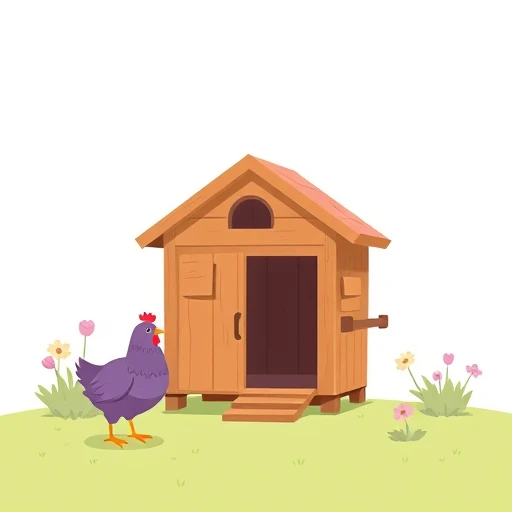
coop en 30 secondes
- A coop is a physical structure for housing poultry, usually made of wood and wire.
- As a verb, 'coop up' describes confining someone or something in a small, restricted space.
- The idiom 'fly the coop' means to escape or leave a place of confinement suddenly.
- It is commonly confused with 'co-op,' which refers to a cooperative business or organization.
The word coop functions primarily as both a noun and a verb, deeply rooted in the context of animal husbandry but widely extended into metaphorical descriptions of human confinement. As a noun, a coop is a small, enclosed structure designed to house poultry, specifically chickens. These structures are typically crafted from wood and wire mesh, providing protection from predators and the elements while restricting the birds' movement to a manageable area. In modern urban and suburban settings, the 'backyard coop' has seen a resurgence as sustainable living becomes more popular. However, the word's utility extends far beyond the farmyard. When used as a verb, particularly in the phrasal form 'to coop up,' it describes the act of confining someone or something in a restricted, often uncomfortably small space. This usage is frequent in daily conversation to express feelings of claustrophobia or the frustration of being stuck indoors due to bad weather or illness.
- Physical Structure
- A small cage or building for poultry, often featuring nesting boxes and perches.
- State of Confinement
- The act of being restricted to a small area, often used as 'cooped up'.
- Metaphorical Escape
- Used in idioms like 'fly the coop' to signify leaving a place of restriction or home.
After a week of heavy rain, the children felt restless being cooped up in the house.
Historically, the term derives from Middle English 'coupe,' which referred to a basket or cask. This evolution from a simple container to a specialized animal enclosure highlights the word's core essence: containment. In a professional context, you might hear 'coop' used in discussions about space management or, more colloquially, in creative writing to set a scene of isolation. It is important to distinguish this from 'co-op' (short for cooperative), which is pronounced differently and has an entirely different meaning related to collaborative organizations. The psychological weight of the word 'coop' is significant; it evokes a sense of being trapped, which is why it is so effective in literature to describe a character's internal struggle with their environment. Whether you are talking about a literal chicken coop or the feeling of being cooped up in a small apartment during a pandemic, the word conveys a lack of freedom and a desire for more space.
The farmer spent the morning cleaning out the coop to ensure the hens stayed healthy.
She felt like she was in a coop in that tiny office cubicle.
He decided it was time to fly the coop and start his own business.
Don't coop yourself up in your room all day; go get some fresh air.
Using 'coop' correctly requires an understanding of its grammatical flexibility. As a noun, it follows standard count noun rules. You can have one coop, two coops, or a large coop. It is frequently preceded by 'chicken' to specify its purpose, though 'poultry coop' or 'pigeon coop' are also used. When using it as a verb, it is almost always followed by the preposition 'up.' The phrase 'cooped up' functions as a past participle adjective in many cases, describing a state of being. For example, 'I am cooped up' or 'The dog was cooped up.' It is rarely used as a simple transitive verb like 'I cooped the bird,' although that is technically correct; usually, we say 'I put the bird in the coop.' In more formal writing, you might use 'confine' or 'enclose' instead of 'coop up,' as 'coop' carries a slightly more informal, descriptive tone that emphasizes the discomfort of the space.
- Noun Usage
- The structure itself: 'The coop needs a new roof.'
- Verb Usage (Phrasal)
- Expressing confinement: 'They were cooped up in the basement during the storm.'
- Idiomatic Usage
- 'Fly the coop' means to escape or leave a place suddenly.
The architect designed a modern chicken coop that matched the main house.
When constructing sentences, consider the emotional resonance you want to achieve. If you want to highlight the physical aspects of farming, focus on the noun. If you want to convey a sense of frustration or lack of freedom, the verb 'coop up' is your best tool. In academic or technical writing about agriculture, 'coop' is the standard term for these structures. In creative writing, 'coop' can be used to symbolize a character's stagnant life. For instance, 'His small apartment was a coop, and he was the bird that had forgotten how to fly.' This metaphorical use is very powerful. Additionally, pay attention to the tense. 'Cooping' is less common than 'cooped,' but you might say, 'Cooping animals in such small spaces is considered inhumane by some.' This uses the gerund form to discuss the practice of confinement.
We've been cooped up in this meeting for three hours!
The fox managed to break into the coop last night.
It's not healthy to coop yourself up; you need social interaction.
The kids are finally out of the coop and playing in the yard.
In the real world, 'coop' is a staple of rural vocabulary, but its metaphorical reach is global. If you visit a farm or a rural community, the word is used daily in its literal sense. Farmers discuss 'cleaning the coop,' 'building a bigger coop,' or 'locking the coop' at night. However, in urban environments, you are more likely to hear it in the context of personal well-being or social situations. During the winter months in colder climates, people frequently complain about being 'cooped up indoors.' This usage has become even more prevalent in the post-pandemic era, where 'cabin fever' and being 'cooped up' became shared global experiences. You will also find the word in literature, especially in Southern Gothic or rural-themed novels, where it serves as a symbol of domesticity or entrapment. In movies, the phrase 'fly the coop' is a classic line in prison break films or coming-of-age stories where a character finally leaves their restrictive hometown.
- Rural Settings
- Literal discussions about poultry housing and farm maintenance.
- Daily Conversation
- Complaints about staying inside too long or being in a small office.
- Pop Culture
- Idiomatic expressions in movies and books about escaping confinement.
The news report mentioned how the heavy snow had cooped up residents for days.
Interestingly, the word also appears in specialized hobbies. The 'backyard chicken' movement in cities like Portland, Austin, and London has brought the word 'coop' into the vocabulary of urban hipsters and sustainability advocates. You might hear someone at a dinner party talking about the 'artisan coop' they built for their heritage-breed hens. In a more metaphorical sense, office workers might refer to their cubicles as 'coops' to express their dissatisfaction with the lack of space and natural light. This usage is informal and often humorous. In the world of sports, a coach might tell players not to 'coop themselves up' on the defensive end, meaning they should spread out and use the whole field. While the word is simple, its ability to bridge the gap between literal farming and complex human emotions makes it a versatile part of the English language.
'I can't wait to fly the coop and go on vacation,' she sighed.
The documentary showed how a well-ventilated coop is essential for egg production.
Being cooped up in a hospital room is incredibly boring.
He spent the weekend painting the coop a bright shade of red.
The most frequent mistake learners make with 'coop' is confusing it with 'co-op.' This is not just a spelling error; it's a pronunciation and meaning error. 'Coop' /kuːp/ is a single syllable and refers to confinement or a chicken house. 'Co-op' /ˈkoʊ.ɒp/ is two syllables and is short for 'cooperative,' referring to a business or housing arrangement where members share ownership. Writing 'I live in a chicken co-op' would imply a very strange business venture with birds! Another common error is the omission of the preposition 'up' when using the verb form. While 'I was cooped in the house' is understandable, the standard idiomatic form is 'cooped up in the house.' Omitting 'up' makes the sentence sound slightly unnatural to native speakers. Additionally, learners sometimes confuse 'coop' with 'cage.' While they are similar, a 'coop' specifically implies a structure for poultry, whereas a 'cage' is a more general term for any barred enclosure.
- Spelling & Pronunciation
- Confusing 'coop' (rhymes with hoop) with 'co-op' (two syllables).
- Phrasal Verb Omission
- Using 'cooped' without 'up' when describing confinement.
- Specific vs. General
- Using 'coop' for non-poultry animals (like lions or dogs) instead of 'cage' or 'kennel'.
Incorrect: We are co-oped up because of the rain. (Should be 'cooped')
Another nuance involves the idiom 'fly the coop.' Some learners mistakenly say 'fly the cage' or 'fly the house.' While the meaning might be clear, the idiom is fixed as 'fly the coop.' Using the wrong noun breaks the idiomatic structure and sounds incorrect. Furthermore, there is a tendency to over-use 'coop' in formal writing. Because 'coop up' is quite descriptive and informal, it is better to use 'confine,' 'restrict,' or 'limit' in academic essays or professional reports. For example, instead of 'The prisoners were cooped up in small cells,' a more formal version would be 'The inmates were confined to small cells.' Understanding the register of the word helps in choosing the right context. Finally, ensure you don't confuse 'coop' with 'coupe' (a type of car or a shallow glass). Though 'coupe' is sometimes pronounced similarly in some dialects, it is spelled differently and refers to something entirely unrelated.
Incorrect: He bought a new chicken co-op. (Should be 'coop')
Incorrect: I feel cooped in this tiny car. (Should be 'cooped up')
Incorrect: The lion escaped from its coop. (Should be 'cage' or 'enclosure')
Incorrect: She decided to fly the nest. (While 'fly the nest' is also an idiom, 'fly the coop' is the specific one for escaping confinement)
When exploring synonyms for 'coop,' it is vital to distinguish between the noun (the structure) and the verb (the action of confining). For the noun, 'cage' is the most direct synonym, but it is more general. A 'hutch' is specifically for rabbits, while a 'pen' usually refers to a larger, fenced-in area for livestock like pigs or sheep. 'Enclosure' is a more formal, technical term used in zoos or scientific contexts. If you are looking for alternatives to the verb 'coop up,' 'confine' is a strong, versatile choice. 'Enclose' suggests surrounding something, while 'immure' is a very formal, literary term meaning to wall someone in. 'Pen' can also be used as a verb (e.g., 'to pen someone in'), which carries a similar agricultural connotation to 'coop up.' Understanding these subtle differences allows you to tailor your language to the specific situation.
- Coop vs. Cage
- A coop is specifically for poultry; a cage can be for any animal or object.
- Coop vs. Pen
- A coop is usually a building or small structure; a pen is often an open fenced area.
- Coop up vs. Confine
- 'Coop up' is informal and descriptive; 'confine' is neutral and formal.
The rabbit lives in a hutch, while the chickens are in the coop.
In metaphorical contexts, you might use 'trap' or 'imprison' if the confinement is forced or negative. If you feel restricted by rules or social expectations, you might say you feel 'boxed in' or 'stifled.' These alternatives provide different emotional shades. 'Boxed in' suggests a lack of options, while 'cooped up' specifically emphasizes the physical smallness of the space. In architecture, a 'coop' might be compared to a 'shed' or 'outbuilding,' though these are much larger and not necessarily for animals. When discussing the idiom 'fly the coop,' alternatives like 'break free,' 'escape,' or 'make a getaway' can be used, though they lack the specific imagery of the original phrase. By choosing the right synonym, you can communicate more precisely and avoid repetitive language in your writing and speech.
The sheep were kept in a pen near the barn.
He felt boxed in by the strict company policies.
The museum had a glass enclosure for the rare artifacts.
She was confined to her bed for two weeks while recovering.
How Formal Is It?
Le savais-tu ?
The word 'cooper' (someone who makes barrels) shares the same root as 'coop.' So, historically, a coop was just a specific kind of container made by a cooper!
Guide de prononciation
- Pronouncing it as two syllables like 'co-op' (ko-op).
- Confusing it with 'coupe' (koo-pay).
- Shortening the 'u' sound to sound like 'cup'.
- Adding an 's' sound at the end when it's singular.
- Mispronouncing the 'p' as a 'b' (coob).
Niveau de difficulté
Easy to recognize in context.
Requires correct spelling (two 'o's) and preposition usage.
Must distinguish from 'co-op'.
Can be confused with 'co-op' or 'coupe'.
Quoi apprendre ensuite
Prérequis
Apprends ensuite
Avancé
Grammaire à connaître
Phrasal Verbs
To 'coop up' is a phrasal verb where 'up' adds a sense of completion or intensity.
Passive Voice
We use 'to be cooped up' to describe a state caused by external factors (like weather).
Countable Nouns
A 'coop' takes an 's' in the plural: 'The farm has three coops.'
Idiomatic Expressions
'Fly the coop' is a fixed idiom; you cannot say 'fly the cage'.
Gerunds
'Cooping' can be used as a noun: 'Cooping animals is a common practice.'
Exemples par niveau
The chicken is in the coop.
Le poulet est dans le poulailler.
Simple subject-verb-prepositional phrase.
Is the coop big?
Est-ce que le poulailler est grand ?
Basic question structure.
The coop is red.
Le poulailler est rouge.
Adjective usage.
I see a coop.
Je vois un poulailler.
Simple transitive verb.
Open the coop.
Ouvre le poulailler.
Imperative mood.
The eggs are in the coop.
Les œufs sont dans le poulailler.
Plural noun.
A coop is for birds.
Un poulailler est pour les oiseaux.
Defining a noun.
Clean the coop.
Nettoie le poulailler.
Action verb.
The farmer built a new coop.
Le fermier a construit un nouveau poulailler.
Past tense verb.
I feel cooped up inside.
Je me sens enfermé à l'intérieur.
Introduction of 'cooped up'.
Don't coop the dog up.
N'enferme pas le chien.
Negative imperative.
The coop has a wire door.
Le poulailler a une porte en grillage.
Descriptive noun phrase.
We were cooped up all day.
Nous avons été enfermés toute la journée.
Passive voice with 'cooped up'.
There are ten hens in the coop.
Il y a dix poules dans le poulailler.
Quantifiers.
He is painting the coop.
Il est en train de peindre le poulailler.
Present continuous.
The coop is near the barn.
Le poulailler est près de la grange.
Preposition of place.
She's been cooped up in the office for hours.
Elle est enfermée au bureau depuis des heures.
Present perfect continuous.
The chickens returned to the coop at sunset.
Les poulets sont retournés au poulailler au coucher du soleil.
Time phrase.
He decided to fly the coop and travel.
Il a décidé de prendre la tangente et de voyager.
Idiomatic usage.
It's cruel to coop animals in small cages.
C'est cruel d'enfermer des animaux dans de petites cages.
Infinitive as subject complement.
The coop was damaged by the storm.
Le poulailler a été endommagé par la tempête.
Passive voice.
I'm tired of being cooped up in this apartment.
J'en ai assez d'être enfermé dans cet appartement.
Gerund after preposition.
They built a fancy coop for their heritage hens.
Ils ont construit un poulailler luxueux pour leurs poules de race.
Adjective-noun agreement.
Don't let the fox near the coop.
Ne laisse pas le renard s'approcher du poulailler.
Imperative with 'let'.
The kids are getting restless being cooped up indoors.
Les enfants s'impatientent d'être enfermés à l'intérieur.
Participle phrase describing a state.
The suspect managed to fly the coop before the police arrived.
Le suspect a réussi à s'éclipser avant l'arrivée de la police.
Idiom in a narrative context.
Urban coops are becoming a common sight in the city.
Les poulaillers urbains deviennent monnaie courante en ville.
Compound noun.
She felt cooped up by the restrictive rules of the school.
Elle se sentait étouffée par les règles restrictives de l'école.
Metaphorical use.
The coop requires regular maintenance to prevent disease.
Le poulailler nécessite un entretien régulier pour prévenir les maladies.
Formal vocabulary.
He was cooped up in a tiny cabin during the winter.
Il était enfermé dans une minuscule cabane pendant l'hiver.
Descriptive past passive.
They are cooping up the sheep for the night.
Ils enferment les moutons pour la nuit.
Present continuous verb.
The coop's design allows for maximum ventilation.
La conception du poulailler permet une ventilation maximale.
Possessive noun.
The sense of being cooped up can lead to significant psychological distress.
Le sentiment d'être enfermé peut entraîner une détresse psychologique importante.
Gerund phrase as subject.
The novel uses the chicken coop as a metaphor for domestic entrapment.
Le roman utilise le poulailler comme métaphore de l'enfermement domestique.
Literary analysis context.
He felt immured, cooped up within the gray walls of the institution.
Il se sentait emmuré, enfermé entre les murs gris de l'institution.
Appositive phrase for emphasis.
Factory farming often involves cooping thousands of birds in unsanitary conditions.
L'élevage industriel implique souvent d'enfermer des milliers d'oiseaux dans des conditions insalubres.
Gerund as object of verb.
After years of living with his parents, he finally flew the coop.
Après des années passées chez ses parents, il a fini par quitter le nid.
Idiomatic perfect tense.
The architectural integrity of the coop was compromised by the termites.
L'intégrité architecturale du poulailler a été compromise par les termites.
Formal passive voice.
Being cooped up in a high-pressure environment can stifle creativity.
Être enfermé dans un environnement à haute pression peut étouffer la créativité.
Complex subject phrase.
The coop was a sanctuary for the hens, protecting them from the elements.
Le poulailler était un sanctuaire pour les poules, les protégeant des éléments.
Metaphorical noun usage.
The protagonist's existential dread was mirrored by the cooped-up atmosphere of the village.
L'angoisse existentielle du protagoniste était reflétée par l'atmosphère confinée du village.
Complex passive construction.
The term 'coop' evokes a rustic simplicity that belies the complexity of avian husbandry.
Le terme 'coop' évoque une simplicité rustique qui cache la complexité de l'aviculture.
Sophisticated vocabulary.
To coop up a brilliant mind in menial labor is a tragedy of modern society.
Enfermer un esprit brillant dans un travail subalterne est une tragédie de la société moderne.
Infinitive phrase as subject.
The coop, once a symbol of sustenance, became a site of industrial exploitation.
Le poulailler, autrefois symbole de subsistance, est devenu un lieu d'exploitation industrielle.
Parenthetical phrase.
He spent his twilight years cooped up in a library, surrounded by ancient tomes.
Il a passé ses vieux jours enfermé dans une bibliothèque, entouré de vieux grimoires.
Participial adjective phrase.
The sudden urge to fly the coop was precipitated by a single, disparaging remark.
L'envie soudaine de s'enfuir a été précipitée par une seule remarque désobligeante.
Complex causal structure.
The coop's structural failure was a poignant allegory for the collapse of the family unit.
La défaillance structurelle du poulailler était une allégorie poignante de l'effondrement de la cellule familiale.
Abstract metaphorical usage.
One must not coop up one's emotions, lest they erupt in an uncontrollable fashion.
Il ne faut pas refouler ses émotions, de peur qu'elles n'éclatent de façon incontrôlable.
Archaic 'lest' construction.
Collocations courantes
Phrases Courantes
— Stuck inside a home for a long time.
We were cooped up in the house during the blizzard.
— Feeling trapped in a workplace.
I hate being cooped up in an office on a sunny day.
— A chicken house with too many birds.
The crowded coop led to a decrease in egg production.
— To secure the chicken house at night.
Don't forget to lock the coop before you go to bed.
— The act of constructing a poultry house.
He spent the weekend learning how to build a coop.
— Literal or metaphorical escape from confinement.
One clever hen managed to escape the coop.
— The area surrounding the structure.
The chickens are scratching for bugs outside the coop.
— Multiple people trapped in the same small space.
The whole family was cooped up together in the car.
Souvent confondu avec
A cooperative business. Pronounced 'ko-op'.
A type of car or glass. Pronounced 'koo-pay' or 'koop'.
A small container for drinking.
Expressions idiomatiques
— To leave a place suddenly, often to escape or move out of a family home.
As soon as he turned eighteen, he flew the coop.
informal— To be crowded together in a very small space.
The passengers were cooped up like chickens in the economy section.
informal— Someone who is very busy or restricted in their movements.
She's like a hen in a coop with all those chores.
informal— To cause trouble or disturb the peace in a small community.
His new ideas really rattled the coop at the office.
slang— A pun on 'coup d'etat,' used humorously when chickens take over.
The hens refused to lay eggs; it was a coop d'etat!
humorous— To get rid of everything or everyone in a group to start fresh.
The new manager decided to clean out the coop and hire a new team.
metaphorical— Unable to leave a boring or restrictive situation.
I'm stuck in the coop while everyone else is at the party.
informal— To destroy a restrictive system.
The activists wanted to break the coop of corporate greed.
literary— A variation of cabin fever; restlessness from being indoors.
The kids have coop fever after the long winter.
informal— Being the dominant person in a small group.
She's definitely the one ruling the coop in that department.
informalFacile à confondre
Similar spelling.
Coop is a cage; co-op is a business. Coop is one syllable; co-op is two.
I bought eggs at the co-op, then put them near the coop.
Similar meaning.
Coop is specifically for birds; cage is for anything.
The parrot is in a cage, but the chickens are in a coop.
Both are animal houses.
Hutch is for rabbits; coop is for poultry.
The rabbit is in the hutch.
Both are enclosures.
Pen is usually an open area; coop is a building.
The pigs are in the pen.
Both are small buildings.
Shed is for tools; coop is for birds.
The lawnmower is in the shed.
Structures de phrases
The [noun] is in the coop.
The hen is in the coop.
I am cooped up in [place].
I am cooped up in my room.
He decided to fly the coop.
He decided to fly the coop and move to Paris.
Being cooped up makes me [emotion].
Being cooped up makes me restless.
The [noun] was cooped up for [time].
The dog was cooped up for eight hours.
To coop up [abstract noun] is [adjective].
To coop up one's potential is tragic.
Don't coop [object] up.
Don't coop the cat up in the laundry room.
The coop needs [action].
The coop needs a thorough cleaning.
Famille de mots
Noms
Verbes
Adjectifs
Apparenté
Comment l'utiliser
Common in daily speech and rural contexts.
-
co-oped up
→
cooped up
Do not use a hyphen; that changes the word to 'cooperative'.
-
fly the cage
→
fly the coop
The idiom is fixed; you must use 'coop'.
-
cooped in the room
→
cooped up in the room
The phrasal verb requires 'up' for natural flow.
-
chicken co-op
→
chicken coop
A 'co-op' is a business, not a bird house.
-
pronouncing it 'ko-op'
→
pronouncing it 'kuːp'
The pronunciation must be one syllable.
Astuces
Use 'up'
Always use 'up' with the verb 'coop' when talking about people. 'I am cooped up' sounds much better than 'I am cooped.'
Rhyme Time
Remember: Coop, Hoop, Loop, Soup. They all rhyme!
Coop vs. Cage
Use 'coop' for farm birds and 'cage' for pets or wild animals.
Flying the Coop
Use this idiom when someone leaves home to start a new life.
No Hyphen
If you mean a chicken house, don't use a hyphen. 'Coop' is one word.
Urban Farming
If you live in a city, you might hear about 'backyard coops' as a hobby.
Passive State
We usually use 'cooped up' as an adjective to describe how we feel.
Small Spaces
Use 'coop' to describe any place that feels too small, like a tiny car or office.
Listen for Syllables
One syllable = chicken house. Two syllables = business.
Creative Writing
Use 'coop' to symbolize a character's lack of freedom.
Mémorise-le
Moyen mnémotechnique
Think of a 'coop' as a 'loop' of wire that keeps chickens in. Coop rhymes with hoop!
Association visuelle
Imagine a small wooden house with a red roof and chickens peeking through a wire window.
Word Web
Défi
Try to use 'coop' and 'cooped up' in three different sentences today while talking about your house or office.
Origine du mot
The word 'coop' comes from the Middle English 'coupe,' which was derived from the Latin 'cupa,' meaning a cask or vat. This Latin root also gave us words like 'cup' and 'cooper' (a person who makes barrels). Over time, the meaning shifted from a container for liquids to a container for animals.
Sens originel : A basket, cask, or container.
Indo-European (Latin -> Germanic -> English).Contexte culturel
Be careful when using 'cooped up' to describe people in difficult living situations, as it can sound dismissive of their hardship.
The 'backyard chicken' trend has made 'coop' a common word in suburban neighborhoods.
Pratique dans la vie réelle
Contextes réels
Farming
- clean the coop
- collect eggs
- secure the wire
- poultry housing
Weather
- cooped up by rain
- stuck inside
- cabin fever
- snowed in
Office Work
- cooped up in a cubicle
- need fresh air
- stifling environment
- fly the coop
Childhood
- fly the coop
- moving out
- leaving home
- growing up
Animal Welfare
- humane cooping
- space requirements
- cage-free
- enclosure size
Amorces de conversation
"Have you ever felt cooped up in your house for too long?"
"Do you think urban chicken coops are a good idea for cities?"
"When did you finally 'fly the coop' and move out of your parents' home?"
"What's the smallest space you've ever been cooped up in?"
"If you had a farm, would you build a big coop for your animals?"
Sujets d'écriture
Describe a time you felt cooped up. What did you do to feel better?
Write about the pros and cons of having a chicken coop in a city backyard.
What does the phrase 'fly the coop' mean to you personally?
Imagine you are a chicken in a coop. What do you see and hear?
Discuss how being cooped up affects a person's mental health.
Questions fréquentes
10 questionsWhile most commonly used for chickens, it can also refer to houses for other poultry like pigeons or turkeys.
It means to leave a place suddenly, often to escape confinement or to leave home for the first time.
It rhymes with 'hoop.' It has one syllable and a long 'u' sound.
Usually, yes. It implies that the space is uncomfortably small and you feel trapped.
Yes, but usually in the phrasal form 'cooped up.' For example, 'I've been cooped up all day.'
A 'coop' is a cage; a 'co-op' is a cooperative business. They are pronounced differently.
The noun is neutral, but the verb 'coop up' is quite informal.
In some contexts, 'the coop' can be slang for a prison or a small, cheap house.
It is a structure specifically built to house and sometimes breed pigeons.
It comes from the idea of a bird escaping its cage to find freedom.
Teste-toi 190 questions
Describe a chicken coop in three sentences.
Well written! Good try! Check the sample answer below.
Write about a time you felt cooped up.
Well written! Good try! Check the sample answer below.
Explain the idiom 'fly the coop' to a friend.
Well written! Good try! Check the sample answer below.
Compare a coop to a cage.
Well written! Good try! Check the sample answer below.
Why is it important to clean a coop?
Well written! Good try! Check the sample answer below.
Write a short story about a chicken that flies the coop.
Well written! Good try! Check the sample answer below.
Discuss the pros and cons of urban chicken coops.
Well written! Good try! Check the sample answer below.
How does being cooped up affect your mood?
Well written! Good try! Check the sample answer below.
Describe the materials used to build a coop.
Well written! Good try! Check the sample answer below.
Use 'coop' as both a noun and a verb in one paragraph.
Well written! Good try! Check the sample answer below.
Write a formal sentence using 'confine' instead of 'coop up'.
Well written! Good try! Check the sample answer below.
What are the dangers of a crowded coop?
Well written! Good try! Check the sample answer below.
Create a mnemonic to remember the spelling of 'coop'.
Well written! Good try! Check the sample answer below.
How do you feel when you are cooped up in an office?
Well written! Good try! Check the sample answer below.
Write a dialogue between two people who are cooped up in a car.
Well written! Good try! Check the sample answer below.
Explain the difference between 'coop' and 'co-op'.
Well written! Good try! Check the sample answer below.
Describe the history of the word 'coop'.
Well written! Good try! Check the sample answer below.
Write a poem about a bird in a coop.
Well written! Good try! Check the sample answer below.
What does 'rattling the coop' mean in a social context?
Well written! Good try! Check the sample answer below.
Summarize the main uses of the word 'coop'.
Well written! Good try! Check the sample answer below.
Talk about a time you felt cooped up. Where were you?
Read this aloud:
Tu as dit :
Speech recognition is not supported in your browser. Try Chrome or Edge.
Describe what a chicken coop looks like.
Read this aloud:
Tu as dit :
Speech recognition is not supported in your browser. Try Chrome or Edge.
Do you prefer being indoors or outdoors? Why?
Read this aloud:
Tu as dit :
Speech recognition is not supported in your browser. Try Chrome or Edge.
What would you do if you were cooped up in a house for a week?
Read this aloud:
Tu as dit :
Speech recognition is not supported in your browser. Try Chrome or Edge.
Explain the meaning of 'fly the coop'.
Read this aloud:
Tu as dit :
Speech recognition is not supported in your browser. Try Chrome or Edge.
Would you ever want to have a chicken coop in your backyard?
Read this aloud:
Tu as dit :
Speech recognition is not supported in your browser. Try Chrome or Edge.
How do you feel when you have to stay in one room for a long time?
Read this aloud:
Tu as dit :
Speech recognition is not supported in your browser. Try Chrome or Edge.
Describe the difference between a coop and a cage.
Read this aloud:
Tu as dit :
Speech recognition is not supported in your browser. Try Chrome or Edge.
What are some things you can do to not feel cooped up?
Read this aloud:
Tu as dit :
Speech recognition is not supported in your browser. Try Chrome or Edge.
Talk about the importance of space for animals.
Read this aloud:
Tu as dit :
Speech recognition is not supported in your browser. Try Chrome or Edge.
How would you build a coop if you had to?
Read this aloud:
Tu as dit :
Speech recognition is not supported in your browser. Try Chrome or Edge.
Discuss the idiom 'fly the coop' in the context of leaving home.
Read this aloud:
Tu as dit :
Speech recognition is not supported in your browser. Try Chrome or Edge.
What are the sounds you might hear in a coop?
Read this aloud:
Tu as dit :
Speech recognition is not supported in your browser. Try Chrome or Edge.
Is being cooped up a common problem in modern cities?
Read this aloud:
Tu as dit :
Speech recognition is not supported in your browser. Try Chrome or Edge.
Describe a farm you have visited.
Read this aloud:
Tu as dit :
Speech recognition is not supported in your browser. Try Chrome or Edge.
How does the weather affect being cooped up?
Read this aloud:
Tu as dit :
Speech recognition is not supported in your browser. Try Chrome or Edge.
What is the best way to clean a coop?
Read this aloud:
Tu as dit :
Speech recognition is not supported in your browser. Try Chrome or Edge.
Talk about the resurgence of backyard coops.
Read this aloud:
Tu as dit :
Speech recognition is not supported in your browser. Try Chrome or Edge.
Use 'cooped up' in a sentence about your work.
Read this aloud:
Tu as dit :
Speech recognition is not supported in your browser. Try Chrome or Edge.
What is the opposite of being cooped up?
Read this aloud:
Tu as dit :
Speech recognition is not supported in your browser. Try Chrome or Edge.
Listen to the sentence: 'The chickens are in the coop.' What is the noun?
Listen to the sentence: 'I'm cooped up in the office.' How does the speaker feel?
Listen to the sentence: 'He finally flew the coop.' What did he do?
Listen to the sentence: 'Clean the coop today.' What is the task?
Listen to the sentence: 'The coop is made of wood.' What is the material?
Listen to the sentence: 'Don't coop up your feelings.' What is the advice?
Listen to the sentence: 'We were cooped up for a week.' How long were they stuck?
Listen to the sentence: 'The fox is near the coop.' Where is the fox?
Listen to the sentence: 'I need to fly the coop for a while.' What does the speaker want?
Listen to the sentence: 'The coop has ten hens.' How many hens are there?
Listen to the sentence: 'Being cooped up is boring.' What is boring?
Listen to the sentence: 'The coop door is broken.' What is broken?
Listen to the sentence: 'They built a new coop.' What did they do?
Listen to the sentence: 'I'm cooped up with my family.' Who is the speaker with?
Listen to the sentence: 'The coop is red and white.' What color is the coop?
/ 190 correct
Perfect score!
Summary
The word 'coop' serves as both a literal term for a chicken house and a powerful metaphor for confinement. Example: 'After being cooped up in the tiny apartment all winter, she was desperate to fly the coop and travel.'
- A coop is a physical structure for housing poultry, usually made of wood and wire.
- As a verb, 'coop up' describes confining someone or something in a small, restricted space.
- The idiom 'fly the coop' means to escape or leave a place of confinement suddenly.
- It is commonly confused with 'co-op,' which refers to a cooperative business or organization.
Use 'up'
Always use 'up' with the verb 'coop' when talking about people. 'I am cooped up' sounds much better than 'I am cooped.'
Rhyme Time
Remember: Coop, Hoop, Loop, Soup. They all rhyme!
Coop vs. Cage
Use 'coop' for farm birds and 'cage' for pets or wild animals.
Flying the Coop
Use this idiom when someone leaves home to start a new life.