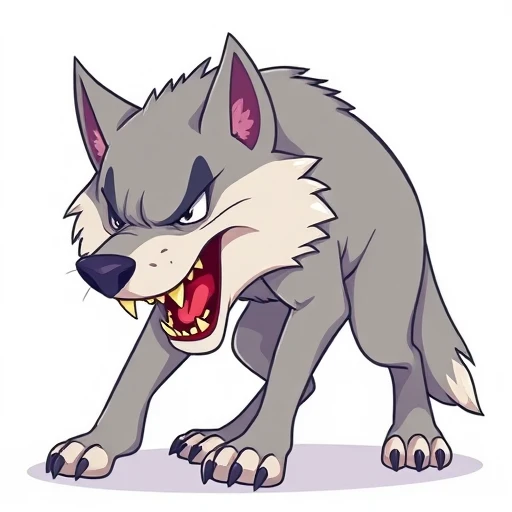
growls en 30 secondes
- A low, guttural sound primarily made by animals to signal warning or anger.
- Used for humans to describe speaking in a grumpy or unfriendly tone.
- Commonly describes the rumbling sound of a hungry stomach or a powerful engine.
- A versatile verb that adds sensory detail and emotional weight to descriptions.
The word growls serves as a vivid auditory descriptor, primarily functioning as a verb that captures a specific type of low-frequency, guttural sound. At its most literal level, it describes the vocalization made by animals—most notably canines, felines, and bears—to signal a warning, express agitation, or assert dominance. When a dog growls, it is not merely making noise; it is communicating a boundary. The sound vibrates deep in the throat, often accompanied by a baring of teeth, creating a resonant rumble that is instinctively understood by other creatures as a sign of potential aggression. This primal root is what gives the word its power when applied to other contexts.
- Animal Communication
- In the animal kingdom, a growl is a sophisticated tool for conflict de-escalation. By growling, an animal signals its readiness to fight without actually engaging in physical combat, often saving both parties from injury. It is a vocal manifestation of 'stay back.'
The old wolf growls softly to warn the pups away from the fresh kill.
Beyond the wilderness, 'growls' is frequently used metaphorically to describe human behavior and inanimate objects. When a person growls, they are usually speaking in a low, harsh, and unfriendly tone, often because they are annoyed, tired, or angry. It suggests a lack of patience and a desire to be left alone. For instance, a person who hasn't had their morning coffee might growl a response to a cheerful question. This usage bridges the gap between human language and animal instinct, suggesting that the person is tapping into a more primitive, less 'civilized' state of emotion.
- Mechanical Application
- Engines and machinery are often personified using this word. A powerful sports car 'growls' when the driver steps on the gas, suggesting latent power and a 'beast-like' quality to the machine.
The vintage motorcycle growls to life, vibrating the very pavement beneath it.
Furthermore, the word is used to describe internal bodily sensations, specifically the stomach. When you are hungry, the rumbling sound caused by gas and fluid moving through the intestines is colloquially described as the stomach 'growling'. This is an interesting linguistic choice, as it frames hunger as a small, restless animal inside the body demanding to be fed. In literature and creative writing, 'growls' can also describe natural phenomena like thunder or the sea, adding a sense of menace or impending danger to the environment. The versatility of 'growls'—from a literal dog to a metaphorical engine to a physiological stomach—makes it an essential verb for adding texture and mood to your descriptions.
- Emotional Nuance
- While often negative, a growl can sometimes be playful in specific contexts, such as during 'rough and tumble' play between dogs or even humans, though the context must be very clear to avoid misunderstanding.
'Don't touch my tools,' the mechanic growls without looking up from the engine.
As the storm approached, the distant thunder growls like a giant waking from a long slumber.
My stomach growls so loudly during the meeting that I am sure everyone can hear it.
Using the word growls correctly requires an understanding of its grammatical role as a third-person singular present tense verb. It typically follows a singular subject—be it an animal, a person, or an object—and describes an ongoing or habitual action. Because the word is so sensory, it is most effective when paired with descriptive adverbs or placed within a context that emphasizes the sound's quality. For example, 'The dog growls' is a simple statement of fact, but 'The dog growls menacingly' provides a much clearer picture of the atmosphere. Understanding the difference between its literal and figurative applications is key to mastering its use.
- Intransitive Use
- Most commonly, 'growls' is used intransitively, meaning it does not require a direct object. The action is complete in itself. Example: 'The bear growls.'
Whenever a stranger walks past the gate, the Doberman growls deep in its chest.
When using 'growls' to describe human speech, it often functions as a speech tag, similar to 'says' or 'whispers'. In this case, it can be used transitively to introduce a piece of dialogue. This tells the reader not just *what* was said, but *how* it was said—with a rough, angry, or impatient tone. It effectively eliminates the need for extra adverbs like 'angrily' because the verb itself carries that weight. For instance, 'Get out!' he growls, conveys much more emotion than 'Get out!' he says. It suggests a low-pitched, almost vibrating quality to the voice, often associated with suppressed rage or extreme fatigue.
- Describing Inanimate Objects
- When applying 'growls' to objects, it is usually to emphasize a low, continuous, and powerful sound. It is a form of personification that gives the object a 'personality' or a sense of hidden energy.
The heavy machinery in the factory growls throughout the night, never ceasing its rhythmic labor.
In more poetic or literary contexts, 'growls' can be used to describe the weather or the landscape. This creates a sense of foreboding. If the wind 'growls' through the trees, it sounds much more dangerous than if it 'blows' or 'whistles'. It implies a predatory or hostile nature to the environment. When writing, consider the 'texture' of the sound you are trying to describe. Is it smooth? Then 'growls' is the wrong word. Is it rough, low, and potentially threatening? Then 'growls' is perfect. It is a word that appeals directly to the reader's sense of hearing and their instinctual emotional responses.
- Prepositional Patterns
- 'Growls' is often followed by the preposition 'at' to indicate the target of the sound. Example: 'The dog growls at the mailman.'
The drill growls as it bites into the hard concrete wall.
'Leave me alone,' the tired father growls from behind his newspaper.
The ocean growls against the cliffs during the winter storms, throwing spray high into the air.
In everyday life, the word growls is most frequently encountered in contexts involving pets, physical health, and storytelling. If you own a dog or spend time around animals, you likely use or hear this word to describe their warnings. It is a standard part of the vocabulary for pet owners and trainers. In a medical or casual health context, people often say their 'stomach is growling' to indicate they are hungry. This is perhaps the most common 'friendly' or non-threatening use of the word, often used as a lighthearted excuse to go grab a snack or lunch.
- In Literature and Film
- In movies, especially horror or action films, 'growls' is a staple sound effect. Monsters, villains, and even the 'tough guy' protagonist are often scripted to growl their lines to convey intensity and danger. In books, authors use it to avoid the repetitive 'he said' and to add a layer of auditory imagery to a scene.
In the movie, the dragon growls before breathing fire, making the audience jump in their seats.
In the world of automotive enthusiasts and mechanical engineering, 'growls' is a positive term. It describes the deep, satisfying sound of a well-tuned engine. Car reviews often mention how an engine 'growls' under acceleration, which is a selling point for those who appreciate high-performance vehicles. This usage associates the sound with power, reliability, and precision. Similarly, in industrial settings, workers might use the word to describe the sound of a machine that is under heavy load or perhaps one that is starting to fail, though 'grind' or 'clatter' might be more common for malfunctions.
- News and Media
- Journalists might use 'growls' metaphorically to describe a politician's response to a tough question or the 'growling' discontent of a crowd. It suggests a low-level, simmering anger that hasn't yet erupted into a full-blown protest or shout.
The sports commentator noted that the coach growls at every missed play from the sidelines.
You will also find 'growls' in nature documentaries. Narrators use it to explain the behavior of predators. It helps the viewer understand the social hierarchy and the 'language' of the wild. Whether it's a lion defending its pride or a bear protecting its cubs, the 'growl' is a universal sign of a boundary being set. In music, particularly in genres like heavy metal or blues, vocalists may 'growl' their lyrics to achieve a specific emotional or aesthetic effect, often called 'death growls' in extreme metal. This shows how the word has been adopted into various subcultures to describe specific artistic expressions of raw emotion.
- Weather Reports
- While less common than 'rumbles', a weather reporter might say 'thunder growls in the distance' to add a bit of dramatic flair to a forecast about an incoming storm front.
The lead singer growls the chorus, giving the song a gritty, raw intensity.
'I'm not doing it,' he growls, crossing his arms and refusing to budge.
The stomach of the hungry hiker growls as he smells the campfire cooking.
One of the most frequent mistakes learners make with the word growls is confusing it with other similar-sounding or similar-meaning words. For example, 'growls' and 'grows' sound somewhat alike but have entirely different meanings. 'Grows' refers to increasing in size or developing, while 'growls' refers to a sound. Another common confusion is between 'growls' and 'howls'. While both are animal sounds, a 'howl' is a long, loud, high-pitched cry (like a wolf at the moon), whereas a 'growl' is low, guttural, and usually short or sustained at a low frequency. Using 'howl' when you mean 'growl' can change the entire mood of a sentence from threatening to mournful.
- Growl vs. Snarl
- A 'snarl' is often confused with a 'growl'. While they are related, a snarl specifically involves baring the teeth and is usually more aggressive and higher-pitched than a growl. A growl can happen with the mouth closed; a snarl almost always requires an open, aggressive facial expression.
Incorrect: The dog growls at the moon. (Should be 'howls').
Another mistake involves the subject-verb agreement. Because 'growls' ends in 's', some learners mistakenly use it with plural subjects (e.g., 'The dogs growls'). Remember that in English, the third-person singular present tense adds an 's', but the plural does not. So, 'The dog growls' (singular) but 'The dogs growl' (plural). Additionally, learners sometimes use 'growls' to describe sounds that are too high-pitched. If a sound is squeaky or sharp, 'growls' is inappropriate. It must have that deep, vibrating quality. Using it for a bird's chirp or a mouse's squeak would be semantically incorrect and confusing to a native speaker.
- Overuse in Dialogue
- In creative writing, beginners often over-use 'growls' as a speech tag to make their characters seem 'tough'. If every character growls every line, the effect is lost and the writing becomes melodramatic. Use it sparingly for maximum impact.
Incorrect: The kitten growls for its milk. (Better: 'meows' or 'purrs', unless it's a very angry kitten!).
Finally, be careful with the preposition 'to'. We usually growl *at* someone, not *to* someone. 'He growled at me' implies a direct warning or expression of anger. 'He growled to me' is non-standard and sounds awkward. Also, ensure the context supports the 'warning' or 'grumpy' nature of the word. You wouldn't say someone 'growls' a happy birthday wish unless they were doing it as a joke. Misaligning the emotional tone of the word with the situation is a subtle but common error that can make your English sound 'off' to native ears.
- Growl vs. Grumble
- A 'grumble' is more about complaining and is usually quieter and less threatening than a 'growl'. If someone is unhappy about the weather, they grumble. If they are ready to snap at you, they growl.
Correct: The guard growls a warning to the intruders.
Incorrect: The car growls its horn. (Better: 'honks' or 'blasts').
Correct: My stomach growls whenever I skip breakfast.
When you want to describe a low, rough sound but growls doesn't quite fit the nuance you're looking for, there are several excellent alternatives. Each carries a slightly different 'flavor' of meaning. 'Snarls' is the closest relative, but it adds a visual component of bared teeth and a more aggressive, sharp edge. 'Rumbles' is often used for larger, more distant sounds, like thunder or a large truck, and lacks the inherent 'warning' or 'anger' that a growl possesses. 'Grumble' is the human version of a growl that focuses on complaining or dissatisfaction rather than threat.
- Snarl vs. Growl
- A growl is the sound; a snarl is the sound plus the facial expression. Snarls feel more immediate and dangerous.
- Rumble vs. Growl
- Rumble is more neutral and often describes continuous, low-frequency vibrations (like a stomach or thunder) without the emotional weight of a growl.
- Grumble vs. Growl
- Grumbling is what you do when you're unhappy with a situation; growling is what you do when you're actually angry or warning someone off.
The tiger snarls when the keeper approaches too quickly.
Other alternatives include 'mutter', which is speaking quietly and unclearly, often in complaint, but without the guttural, vibrating quality of a growl. 'Snap' is used when someone speaks quickly and sharply in anger, which is the opposite of the low, sustained sound of a growl. 'Roar' is much louder and more explosive. If a growl is a warning, a roar is the attack. In mechanical contexts, you might use 'purr' for a smooth-running engine, which is the 'happy' version of an engine growl. Choosing the right word depends entirely on the intensity and the specific 'texture' of the sound you want to evoke in the reader's mind.
- Bark vs. Growl
- A bark is short, loud, and sudden. A growl is low, sustained, and often more menacing because it is quieter and more controlled.
The old man grumbles about the price of bread as he walks home.
In technical or scientific writing, you might avoid these descriptive verbs in favor of more precise terms like 'low-frequency vocalization' or 'abdominal sounds' (for a stomach growl), but in almost any other form of writing, 'growls' and its synonyms are far more effective at conveying the experience of the sound. When comparing these words, think about the 'pitch' and the 'intent'. A growl is low-pitched and intended to warn. A snap is high-pitched and intended to shut someone down. A rumble is low-pitched but often unintentional. By understanding these subtle distinctions, you can make your descriptions much more precise and evocative.
The thunder rumbles in the distance, promising rain by evening.
'Don't even think about it,' she snaps, her patience finally exhausted.
The lion's roar could be heard from miles away, echoing across the savanna.
How Formal Is It?
Le savais-tu ?
The word 'growl' is an example of onomatopoeia, where the sound of the word actually sounds like the action it describes. Say it slowly: 'grrrr-owww-l'.
Guide de prononciation
- Pronouncing it like 'grows' (omitting the 'l').
- Using a soft 's' instead of a voiced 'z' sound at the end.
- Confusing the 'ow' sound with 'oh'.
Niveau de difficulté
Easy to recognize in context.
Requires correct subject-verb agreement.
The 'lz' ending can be tricky for some.
Distinctive sound, but can be confused with 'grows'.
Quoi apprendre ensuite
Prérequis
Apprends ensuite
Avancé
Grammaire à connaître
Third-person singular 's'
He growls (singular) vs. They growl (plural).
Onomatopoeia as verbs
The word 'growl' sounds like the noise it represents.
Transitive vs. Intransitive
The dog growls (intransitive). He growls a warning (transitive).
Prepositional usage
Always growl 'at' something, not 'to' something.
Present simple for habits
The dog growls every time the bell rings.
Exemples par niveau
The dog growls at the cat.
Le chien grogne après le chat.
Third-person singular: 'The dog' + 'growls'.
My stomach growls because I am hungry.
Mon estomac grogne parce que j'ai faim.
Present simple for a physical state.
The bear growls in the woods.
L'ours grogne dans les bois.
Subject + verb + prepositional phrase.
Does the dog growl?
Est-ce que le chien grogne ?
Question form: 'Does' + subject + base verb 'growl'.
The tiger growls at the people.
Le tigre grogne après les gens.
Verb 'growls' + preposition 'at'.
He growls when he is angry.
Il grogne quand il est en colère.
Using 'growls' for a person's behavior.
The wolf growls at night.
Le loup grogne la nuit.
Time expression 'at night'.
Listen! The animal growls.
Écoute ! L'animal grogne.
Imperative 'Listen' followed by a statement.
The big dog growls whenever a car passes by.
Le gros chien grogne chaque fois qu'une voiture passe.
Using 'whenever' for habitual actions.
She growls a 'hello' because she is very tired.
Elle grogne un 'bonjour' parce qu'elle est très fatiguée.
Transitive use with a direct object ('hello').
The engine growls when you start the old truck.
Le moteur grogne quand on démarre le vieux camion.
Metaphorical use for a machine.
The lion growls to protect its food.
Le lion grogne pour protéger sa nourriture.
Infinitive of purpose: 'to protect'.
Why does your stomach growl so loudly?
Pourquoi ton estomac grogne-t-il si fort ?
Adverb 'loudly' modifying the verb.
The guard growls at anyone who comes near the gate.
Le garde grogne après quiconque s'approche de la porte.
Relative clause: 'who comes near'.
The monster in the story growls at the hero.
Le monstre dans l'histoire grogne après le héros.
Subject in a fictional context.
My dad growls if I wake him up early.
Mon père grogne si je le réveille tôt.
Zero conditional: 'if' + present simple.
The sports car growls as it speeds down the highway.
La voiture de sport rugit alors qu'elle dévale l'autoroute.
Descriptive use for power and speed.
He growls his orders to the workers, showing his bad mood.
Il grogne ses ordres aux ouvriers, montrant sa mauvaise humeur.
Transitive use indicating tone of voice.
The thunder growls in the distance, warning of a storm.
Le tonnerre gronde au loin, avertissant d'un orage.
Personification of weather.
Whenever she is hungry, her stomach growls quite noticeably.
Chaque fois qu'elle a faim, son estomac grogne de manière assez notable.
Adverbial phrase 'quite noticeably'.
The dog growls softly, sensing something in the shadows.
Le chien grogne doucement, sentant quelque chose dans l'ombre.
Present participle phrase 'sensing something'.
He growls at the computer when it crashes again.
Il grogne après l'ordinateur quand il plante à nouveau.
Expressing frustration with technology.
The bear growls a warning before moving closer to the camp.
L'ours grogne un avertissement avant de s'approcher du camp.
Direct object 'a warning'.
The old radiator growls and clanks every time the heat turns on.
Le vieux radiateur grogne et s'entrechoque chaque fois que le chauffage s'allume.
Compound verb: 'growls and clanks'.
The political leader growls at the journalists' persistent questions.
Le leader politique grogne face aux questions persistantes des journalistes.
Metaphorical use for public figures.
As the plane takes off, the powerful jet engine growls.
Au décollage de l'avion, le puissant moteur à réaction vrombit.
Describing mechanical intensity.
He growls out a response, clearly unwilling to engage in conversation.
Il grogne une réponse, manifestement peu disposé à engager la conversation.
Phrasal verb-like structure 'growls out'.
The sea growls against the rocks during the winter gale.
La mer gronde contre les rochers pendant le coup de vent d'hiver.
Literary personification of nature.
The coach growls at the team for their lack of discipline.
L'entraîneur grogne après l'équipe pour son manque de discipline.
Preposition 'for' indicating the reason.
My stomach growls so much that I can't concentrate on the lecture.
Mon estomac grogne tellement que je n'arrive pas à me concentrer sur le cours.
Result clause: 'so much that'.
The beast growls deep in its throat, a sound that chills the blood.
La bête grogne au fond de sa gorge, un son qui glace le sang.
Appositive phrase 'a sound that...'.
He growls at the injustice of the situation, though he says nothing.
Il grogne face à l'injustice de la situation, bien qu'il ne dise rien.
Metaphorical internal reaction.
The industrial machinery growls with a relentless, rhythmic intensity.
La machinerie industrielle gronde avec une intensité implacable et rythmique.
Complex adverbial phrase 'with a relentless...'.
He growls a sarcastic remark under his breath as the meeting continues.
Il grogne une remarque sarcastique entre ses dents alors que la réunion se poursuit.
Idiom 'under his breath'.
The distant artillery growls, a grim reminder of the nearby conflict.
L'artillerie lointaine gronde, un sinistre rappel du conflit tout proche.
Using 'growls' for the sound of war.
The protagonist growls his defiance, refusing to yield to the villain.
Le protagoniste grogne son défi, refusant de céder au méchant.
Transitive use with abstract noun 'defiance'.
The wind growls through the narrow canyons, creating an eerie whistle.
Le vent gronde dans les canyons étroits, créant un sifflement étrange.
Describing complex natural sounds.
She growls at the sheer incompetence of the local bureaucracy.
Elle grogne devant l'incompétence pure de la bureaucratie locale.
Abstract target of the growl.
The vintage amplifier growls when pushed to its maximum volume.
L'amplificateur vintage gronde lorsqu'il est poussé à son volume maximum.
Passive construction 'when pushed'.
The hungry panther growls, its eyes fixed on the unsuspecting prey.
La panthère affamée grogne, les yeux fixés sur la proie qui ne se doute de rien.
Absolute construction 'its eyes fixed...'.
The very earth seems to growl as the tectonic plates shift deep below.
La terre elle-même semble gronder alors que les plaques tectoniques se déplacent en profondeur.
Subjunctive-like 'seems to growl'.
He growls out his lines with a gravelly timbre that defines his performance.
Il grogne ses répliques avec un timbre graveleux qui définit sa performance.
Technical term 'gravelly timbre'.
The city growls with the pent-up energy of millions of restless souls.
La ville gronde de l'énergie refoulée de millions d'âmes agitées.
Highly metaphorical personification of a city.
The furnace growls in the basement, a mechanical beast keeping the house warm.
La fournaise gronde au sous-sol, une bête mécanique qui garde la maison au chaud.
Extended metaphor.
The critic growls at the lack of originality in modern cinema.
Le critique grogne face au manque d'originalité du cinéma moderne.
Metaphorical use for intellectual dissatisfaction.
The storm growls its fury, lashing the coast with unrelenting waves.
La tempête grogne sa fureur, fouettant la côte de vagues implacables.
Possessive 'its fury' as direct object.
The old man growls a curse at the fading light of the day.
Le vieil homme grogne une malédiction contre la lumière déclinante du jour.
Poetic use of 'growls'.
The bass guitar growls through the mix, providing a gritty foundation for the track.
La guitare basse gronde dans le mixage, offrant une base granuleuse au morceau.
Music industry jargon 'through the mix'.
Collocations courantes
Phrases Courantes
— A common way to say you are very hungry.
Is it lunchtime yet? My stomach is growling.
— To speak to someone in an angry or unfriendly way.
Don't growl at me just because you're tired.
— To make a sound because of extreme anger.
He began to growl with rage as he read the letter.
— To be very grumpy or speak very harshly.
He's been growling like a bear all morning.
— To give a response in a rough, angry voice.
He growled out an answer and walked away.
— To make a sound showing you don't like something.
The crowd began to growl in disapproval.
— A variation of 'howl at the moon', often used incorrectly.
The lonely wolf growls at the moon.
— To say hello in an unfriendly, low voice.
The shopkeeper growled a greeting to the customers.
Souvent confondu avec
Sounds similar but means to increase in size.
A high-pitched cry, whereas a growl is low-pitched.
A facial expression of anger, not a sound.
Expressions idiomatiques
— He is very hungry and his stomach is making noise.
We should eat soon; his stomach is growling.
Informal— To be extremely grumpy and irritable.
He's growling like a bear with a sore head today.
Informal— A hungry person will not listen to reason or advice.
You can't talk to him now; a growling stomach has no ears.
Proverbial— To be angry at everything and everyone.
He spends his days growling at the world from his porch.
Literary— To stop making noise after a final angry sound.
The engine growled into silence as the fuel ran out.
Literary— The sound of thunder or heavy wind personified.
The growling of the storm kept us awake all night.
Poetic— To complete a task while being constantly grumpy.
He growled his way through the Monday morning meeting.
Informal— A hidden or unexpected threat.
The rumors were like a growl in the dark for the company.
Metaphorical— A play on 'grin and bear it', meaning to endure something while complaining.
I guess I'll just have to growl and bear it.
Humorous— The noise and disruption caused by development.
The growl of progress could be heard as the new road was built.
MetaphoricalFacile à confondre
Both are aggressive animal sounds.
A snarl involves showing teeth and is sharper; a growl is deeper and can be done with the mouth closed.
The dog growls from the porch, but it snarls when you get close.
Both are low sounds of unhappiness.
Grumbling is for complaining; growling is for warning or real anger.
He grumbles about the rain, but he growls when he's truly mad.
Both are low, vibrating sounds.
Rumble is usually neutral or natural (thunder); growl is usually emotional or animalistic.
The thunder rumbles, but the bear growls.
Both are dog sounds.
A bark is a sudden 'woof'; a growl is a sustained 'grrr'.
The dog barks to get attention, but growls to warn you off.
Both are vocalizations.
Howl is long and high; growl is short and low.
Wolves howl at the moon and growl at their enemies.
Structures de phrases
The [Animal] growls.
The dog growls.
The [Animal] growls at the [Object].
The cat growls at the dog.
My stomach growls because [Reason].
My stomach growls because I missed lunch.
The [Machine] growls as it [Action].
The engine growls as it accelerates.
[Person] growls a [Noun] under their breath.
He growls a curse under his breath.
The [Abstract] growls with [Emotion].
The city growls with hidden tension.
He growls, '[Dialogue]'.
He growls, 'Stay away!'
The thunder growls, [Participle Phrase].
The thunder growls, shaking the windows.
Famille de mots
Noms
Verbes
Adjectifs
Apparenté
Comment l'utiliser
Common in daily speech and literature.
-
The dogs growls.
→
The dogs growl.
Plural subjects do not take the 's' in the present simple tense.
-
My stomach grows.
→
My stomach growls.
'Grows' means getting bigger; 'growls' is the sound of hunger.
-
The wolf growls at the moon.
→
The wolf howls at the moon.
Wolves 'howl' (high sound) at the moon, they 'growl' (low sound) at enemies.
-
He growls to me.
→
He growls at me.
The preposition 'at' is used to show the target of the growl.
-
The bird growls.
→
The bird chirps.
Birds generally do not growl; the sound is too low for most birds.
Astuces
Subject-Verb Agreement
Always check if your subject is singular. 'The bear growls' is correct. 'The bears growls' is wrong.
Use for Texture
Use 'growls' to add texture to your writing. It's better than just saying 'it made a noise'.
The 'OW' Sound
Make sure the 'ow' sounds like 'cow', not like 'low'. This is a common mistake for learners.
Hunger vs. Anger
Remember that 'stomach growls' is about hunger, while 'dog growls' is about anger. Don't mix them up!
Dialogue Tags
Use 'growls' as a dialogue tag to show a character's mood without using adverbs like 'angrily'.
Listen to Engines
Next time you hear a loud car, think 'that engine growls'. It helps reinforce the word.
The Hidden 'L'
Don't forget the 'l'! 'Grows' and 'growls' are very different words.
Personification
Use 'growls' for the wind or sea to give nature a personality in your stories.
Being Polite
If you say a person 'growls', you are saying they are being a bit rude or grumpy.
Animal Association
Associate 'growls' with a big, angry dog. It's the most common literal use.
Mémorise-le
Moyen mnémotechnique
Think of a dog named 'Growl' who 'lowers' his voice. The 'L' in growl stands for 'Low' sound.
Association visuelle
Imagine a dog with a grumpy face and a speech bubble that says 'GRRR'.
Word Web
Défi
Try to use 'growls' in three different ways today: for an animal, a person, and an object.
Origine du mot
The word 'growl' originated in the late 14th century, likely from Old French 'grouiller' or Middle Dutch 'grollen'. It is thought to be onomatopoeic in origin, mimicking the sound it describes.
Sens originel : To rumble, murmur, or make a low noise in the throat.
Germanic/Indo-EuropeanContexte culturel
Be careful when using 'growls' for people; it can be seen as insulting if they aren't actually being grumpy.
Commonly used in idioms like 'stomach growling' which is very informal and friendly.
Pratique dans la vie réelle
Contextes réels
At Home
- The dog growls.
- My stomach growls.
- The pipes growl.
- He growls in the morning.
In Nature
- The bear growls.
- Thunder growls.
- The wolf growls.
- The wind growls.
In the Garage
- The engine growls.
- The drill growls.
- The truck growls.
- The machine growls.
In a Story
- He growls a warning.
- The monster growls.
- She growls her answer.
- A low growl.
At the Office
- The boss growls.
- The printer growls.
- He growls at the email.
- The stomach growls.
Amorces de conversation
"Does your dog ever growl at people passing by your house?"
"How do you feel when your stomach growls in a quiet room?"
"What kind of car engines do you think have the best growl?"
"Have you ever heard thunder that sounds like it's growling?"
"Do you know anyone who growls before they've had their coffee?"
Sujets d'écriture
Describe a time when you heard a sound that made you feel like something was growling.
Write a short story about a character who growls instead of speaking.
How does the sound of a growling engine make you feel compared to a silent electric car?
Imagine your stomach could talk instead of growling. What would it say?
Describe the difference between a growl and a shout in your own words.
Questions fréquentes
10 questionsYes, people growl when they are angry, grumpy, or tired. It means they are speaking in a low, unfriendly voice. For example, 'He growls a response because he is sleepy.'
No, many animals growl, including bears, lions, and tigers. It is also used for stomachs, engines, and thunder. It describes the type of sound, not just the source.
'Growls' is the form used for singular subjects like 'he', 'she', 'it', or 'the dog'. 'Growl' is used for plural subjects like 'they' or 'the dogs'. For example: 'The dog growls' but 'The dogs growl'.
No, it is an informal but very common way to say you are hungry. In a formal medical report, you might see 'borborygmus' instead, but 'stomach growling' is fine for most situations.
Yes, it can be the plural form of the noun 'growl'. For example: 'We heard several low growls coming from the bushes.'
Usually, yes, but not always. A stomach growl means hunger, and an engine growl can mean power. In play, animals might growl without being truly angry.
The past tense is 'growled'. For example: 'The dog growled at me yesterday.'
Yes, the word is designed to sound like the actual noise of a growl.
'Grumble', 'mutter', or 'snap' are good synonyms depending on the exact mood.
Yes, in literature and creative writing, we often say thunder 'growls' to make it sound more like a living, threatening thing.
Teste-toi 200 questions
Write a sentence about a dog and a stranger using 'growls'.
Well written! Good try! Check the sample answer below.
Describe the sound of a powerful car using 'growls'.
Well written! Good try! Check the sample answer below.
Write a short dialogue where a character 'growls' their line.
Well written! Good try! Check the sample answer below.
Explain why someone's stomach might growl.
Well written! Good try! Check the sample answer below.
Use 'growls' to describe a storm.
Well written! Good try! Check the sample answer below.
Compare a growl to a snarl.
Well written! Good try! Check the sample answer below.
Write a sentence about a grumpy person using 'growls'.
Well written! Good try! Check the sample answer below.
Describe the sound of industrial machinery using 'growls'.
Well written! Good try! Check the sample answer below.
Use 'growls' in a metaphorical sense about a city.
Well written! Good try! Check the sample answer below.
Write a sentence about a bear protecting its food.
Well written! Good try! Check the sample answer below.
Describe a character's reaction to a bad situation using 'growls'.
Well written! Good try! Check the sample answer below.
Write a sentence using 'growls' as a noun (plural).
Well written! Good try! Check the sample answer below.
Use 'growls' to describe the wind.
Well written! Good try! Check the sample answer below.
Write a sentence about a coach and a team using 'growls'.
Well written! Good try! Check the sample answer below.
Describe a tiger in a zoo using 'growls'.
Well written! Good try! Check the sample answer below.
Use 'growls' to describe a radiator.
Well written! Good try! Check the sample answer below.
Write a sentence about a villain in a story.
Well written! Good try! Check the sample answer below.
Describe a person who hasn't had coffee yet.
Well written! Good try! Check the sample answer below.
Use 'growls' to describe the sea.
Well written! Good try! Check the sample answer below.
Write a sentence about a hungry hiker.
Well written! Good try! Check the sample answer below.
Pronounce the word 'growls' clearly. Focus on the 'ow' and 'lz' sounds.
Read this aloud:
Tu as dit :
Speech recognition is not supported in your browser. Try Chrome or Edge.
Say the sentence: 'The dog growls at the stranger.'
Read this aloud:
Tu as dit :
Speech recognition is not supported in your browser. Try Chrome or Edge.
Explain in your own words what it means when a stomach growls.
Read this aloud:
Tu as dit :
Speech recognition is not supported in your browser. Try Chrome or Edge.
Describe the sound of a growling engine using at least two adjectives.
Read this aloud:
Tu as dit :
Speech recognition is not supported in your browser. Try Chrome or Edge.
Role-play a grumpy person waking up. Use the word 'growls' in a sentence.
Read this aloud:
Tu as dit :
Speech recognition is not supported in your browser. Try Chrome or Edge.
Discuss why a dog might growl at someone it doesn't know.
Read this aloud:
Tu as dit :
Speech recognition is not supported in your browser. Try Chrome or Edge.
Compare the sound of a growl to the sound of a bark.
Read this aloud:
Tu as dit :
Speech recognition is not supported in your browser. Try Chrome or Edge.
Describe a storm using the word 'growls'.
Read this aloud:
Tu as dit :
Speech recognition is not supported in your browser. Try Chrome or Edge.
Explain the metaphorical use of 'growls' for a city.
Read this aloud:
Tu as dit :
Speech recognition is not supported in your browser. Try Chrome or Edge.
Give an example of someone 'growling' a response.
Read this aloud:
Tu as dit :
Speech recognition is not supported in your browser. Try Chrome or Edge.
How do you say 'growls' in your native language?
Read this aloud:
Tu as dit :
Speech recognition is not supported in your browser. Try Chrome or Edge.
Describe a bear in the woods using 'growls'.
Read this aloud:
Tu as dit :
Speech recognition is not supported in your browser. Try Chrome or Edge.
What is the difference between 'growls' and 'grows' in pronunciation?
Read this aloud:
Tu as dit :
Speech recognition is not supported in your browser. Try Chrome or Edge.
Tell a short story about a hungry student.
Read this aloud:
Tu as dit :
Speech recognition is not supported in your browser. Try Chrome or Edge.
Describe the sound of a lion using 'growls'.
Read this aloud:
Tu as dit :
Speech recognition is not supported in your browser. Try Chrome or Edge.
Explain why 'growls' is a good word for a villain.
Read this aloud:
Tu as dit :
Speech recognition is not supported in your browser. Try Chrome or Edge.
Use 'growls' to describe a broken machine.
Read this aloud:
Tu as dit :
Speech recognition is not supported in your browser. Try Chrome or Edge.
Describe the feeling of being very hungry using the word 'growls'.
Read this aloud:
Tu as dit :
Speech recognition is not supported in your browser. Try Chrome or Edge.
Explain the phrase 'growl like a bear'.
Read this aloud:
Tu as dit :
Speech recognition is not supported in your browser. Try Chrome or Edge.
How does a 'death growl' sound in music?
Read this aloud:
Tu as dit :
Speech recognition is not supported in your browser. Try Chrome or Edge.
Listen to the sentence: 'The dog growls at the gate.' What is the dog doing?
Listen to the sound of a low rumble. Is this a growl or a chirp?
Listen to the sentence: 'My stomach growls every morning.' When does it happen?
Listen to the sentence: 'The engine growls as it starts.' What is starting?
Listen to the sentence: 'He growls a warning to the kids.' Who is he talking to?
Listen to the sentence: 'Thunder growls in the distance.' Where is the thunder?
Listen to the sentence: 'The bear growls at the campers.' Who is the bear angry with?
Listen to the sentence: 'The machinery growls all night.' How long does it make noise?
Listen to the sentence: 'She growls at the slow traffic.' Why is she growling?
Listen to the sentence: 'The sea growls against the cliffs.' What is the sea hitting?
Listen to the sentence: 'The guard growls a curse.' What did the guard say?
Listen to the sentence: 'The radiator growls in the winter.' When does it growl?
Listen to the sentence: 'The tiger growls at the keeper.' Who is the keeper?
Listen to the sentence: 'He growls his response.' Did he speak nicely?
Listen to the sentence: 'The wind growls through the trees.' What is making the sound?
/ 200 correct
Perfect score!
Summary
The word 'growls' is a powerful sensory verb that bridges the gap between literal animal warnings and metaphorical human or mechanical sounds, always implying a low-pitched, vibrating quality and often a sense of threat or irritation. Example: 'The dog growls at the intruder.'
- A low, guttural sound primarily made by animals to signal warning or anger.
- Used for humans to describe speaking in a grumpy or unfriendly tone.
- Commonly describes the rumbling sound of a hungry stomach or a powerful engine.
- A versatile verb that adds sensory detail and emotional weight to descriptions.
Subject-Verb Agreement
Always check if your subject is singular. 'The bear growls' is correct. 'The bears growls' is wrong.
Use for Texture
Use 'growls' to add texture to your writing. It's better than just saying 'it made a noise'.
The 'OW' Sound
Make sure the 'ow' sounds like 'cow', not like 'low'. This is a common mistake for learners.
Hunger vs. Anger
Remember that 'stomach growls' is about hunger, while 'dog growls' is about anger. Don't mix them up!