









jeans in 30 Seconds
- Jeans are durable trousers made from denim fabric, originally designed for work but now a global casual fashion staple.
- The word is always plural in English; use 'a pair of jeans' to refer to one item and always use plural verbs.
- Common styles include skinny, straight, and bootcut, with colors ranging from classic indigo blue to black, grey, and white.
- Jeans are valued for their comfort, longevity, and versatility, fitting into almost any informal or semi-formal social setting.
The word jeans refers to a specific type of trousers or pants characterized by their construction from a rugged, twilled cotton textile known as denim. Historically, jeans were designed as utilitarian workwear for miners and laborers in the American West during the late 19th century, specifically popularized by Levi Strauss and Jacob Davis. The name itself is derived from the city of Genoa, Italy, where a similar heavy fabric was produced, while the term 'denim' comes from 'serge de Nîmes,' a fabric from Nîmes, France. In modern linguistics and fashion, jeans are a global staple of casual attire, transcending social classes, age groups, and cultures. They are defined not just by their material but by their construction details, such as copper rivets used to reinforce points of stress, a five-pocket layout, and double-stitched seams.
- Material Composition
- Jeans are almost exclusively made from denim. While modern variations include elastane for stretch, the core identity of jeans remains tied to the indigo-dyed cotton warp and white weft threads that create the classic diagonal ribbing pattern.
- Grammatical Status
- In English, 'jeans' is a plurale tantum, meaning it is a noun that appears only in the plural form. You cannot say 'a jean'; you must say 'a pair of jeans' or simply 'jeans'. This is a crucial distinction for learners to master early on.
He decided to wear his favorite dark blue jeans to the concert because they were comfortable and stylish.
People use the word 'jeans' in almost every daily context involving clothing. Whether discussing a dress code (e.g., 'casual Friday' often implies wearing jeans), shopping for new clothes, or describing someone's appearance, the term is ubiquitous. It carries a connotation of informality, though 'dressy' jeans (darker washes, tailored fits) have bridged the gap into business-casual environments. The versatility of jeans means they are used to describe everything from high-fashion runway pieces to rugged outdoor gear. In a cultural sense, jeans represent a democratization of fashion; they are the 'uniform' of the modern world, symbolizing youth, rebellion, and eventually, universal comfort.
The rugged jeans showed signs of wear after months of working in the garden.
- Cultural Significance
- In the 1950s, jeans became a symbol of teenage rebellion, popularized by icons like James Dean. Today, they are seen as a neutral, essential item found in nearly every wardrobe globally.
She paired her vintage jeans with a white silk blouse for a balanced look.
Furthermore, the terminology surrounding jeans is vast. You will hear words like 'inseam,' 'rise,' 'selvedge,' and 'distressed' used in conjunction with jeans. Each of these terms helps specify the fit and aesthetic of the garment. For example, 'high-rise jeans' sit above the belly button, while 'distressed jeans' feature intentional rips or frayed edges to give an aged appearance. Understanding these nuances is essential for navigating fashion conversations or online shopping. Despite the many variations, the fundamental concept remains the same: a durable, indigo-hued trouser that gets better with age.
These jeans are too tight around the waist; I need a larger size.
- Global Variations
- While 'jeans' is the universal term, in some British English contexts, people might refer to them as 'denim trousers,' though 'jeans' is still the most common name by far.
I never travel without a reliable pair of black jeans.
Using the word jeans correctly in a sentence requires an understanding of its plural nature and its role as a common noun. Because 'jeans' is always plural, it must be paired with plural verbs and pronouns. For instance, you would say 'Those jeans look great on you' rather than 'That jean looks great.' If you want to refer to a single item in a singular way, you must use the phrase 'a pair of.' This allows you to use singular verbs: 'This pair of jeans is expensive.' This distinction is one of the most common hurdles for English learners, but once mastered, it makes your speech sound much more natural and fluent.
- Subject-Verb Agreement
- Correct: 'My jeans are in the wash.' Incorrect: 'My jeans is in the wash.' The noun 'jeans' acts like 'scissors' or 'glasses'—it describes one object made of two parts, hence the plural form.
I need to buy new jeans because my old ones have a hole in the knee.
Beyond basic grammar, 'jeans' is often modified by adjectives to describe their fit, color, or condition. Common descriptors include 'skinny,' 'slim,' 'straight-leg,' 'bootcut,' 'relaxed,' and 'baggy.' You might also describe the color or 'wash' of the jeans, such as 'light-wash,' 'dark-wash,' 'acid-washed,' or 'black.' In more descriptive writing, you can use 'jeans' to set a scene or characterize a person. A character wearing 'faded, grease-stained jeans' suggests someone who does manual labor, while someone in 'crisp, tailored indigo jeans' suggests a more polished, urban aesthetic. The word is versatile enough to fit into technical descriptions of garments as well as casual everyday conversation.
She prefers wearing jeans and a t-shirt over formal dresses any day.
- Descriptive Phrases
- 'Distressed jeans' (with rips), 'High-waisted jeans' (sitting high on the torso), 'Raw denim jeans' (unwashed and stiff).
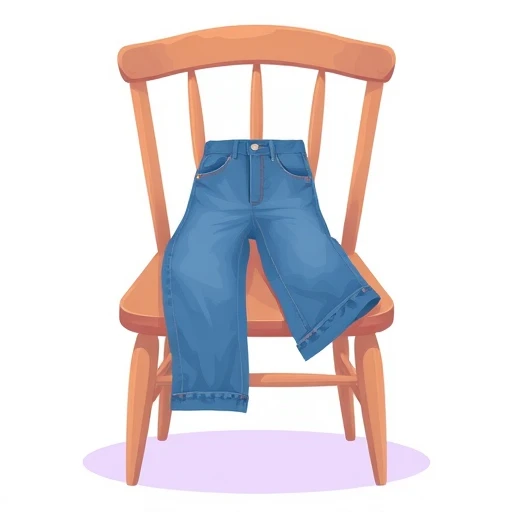
Can you pass me that pair of jeans hanging on the chair?
In professional settings, the use of 'jeans' in a sentence often revolves around policy. For example, 'The company policy allows employees to wear jeans on Fridays.' In this context, 'jeans' serves as a marker for the level of formality. In creative writing, the texture of jeans can be used for sensory detail: 'The rough denim of his jeans rubbed against his skin as he walked.' The word is also frequently used in the context of sustainability and ethics today, such as 'eco-friendly jeans' or 'ethically sourced jeans.' No matter the complexity of the sentence, the word 'jeans' remains a foundational piece of the English vocabulary for describing human attire.
Even at eighty, my grandfather still looks sharp in his classic blue jeans.
- Action Verbs
- Common verbs used with jeans: wear, put on, take off, wash, dry, mend, hem, zip up, button up.
I need to get these jeans hemmed because they are too long for me.
You will encounter the word jeans in a vast array of real-world environments, ranging from retail spaces to casual social gatherings. In a shopping mall or clothing store, 'jeans' is a primary category. You'll hear sales associates ask, 'Are you looking for a specific cut of jeans today?' or see signs directing you to the 'Men's Jeans' or 'Women's Jeans' section. In these commercial settings, the word is often accompanied by technical jargon about fit and sizing. You might hear someone in a fitting room complaining that 'these jeans are too tight in the thighs' or asking if 'these jeans will shrink in the wash.' This is the most direct and literal use of the word.
- Retail Context
- 'We have a sale on all denim jeans this weekend.' 'Do these jeans come in a shorter length?' 'I'm looking for high-waisted skinny jeans.'
The clerk told me that the jeans were on the second floor next to the t-shirts.
In social and workplace environments, 'jeans' is often used to define the level of formality for an event. You might hear a friend say, 'It's just a casual dinner, so you can just wear jeans.' Or, in an office setting, an HR manager might announce, 'We are having a charity fundraiser, so everyone can wear jeans if they donate five dollars.' In these cases, 'jeans' acts as a linguistic shorthand for 'informal' or 'relaxed.' It is the baseline for casual dress codes. You'll also hear the word in pop culture—songs often mention 'blue jeans' to evoke a sense of Americana, nostalgia, or simple, rugged beauty. From Lana Del Rey to Bruce Springsteen, jeans are a lyrical staple that represents the common person.
Is it okay if I wear jeans to the party, or is it more formal than that?
- Social Context
- 'Nice jeans! Where did you get them?' 'I spilled coffee on my jeans this morning.' 'I need to change out of these work jeans into something cleaner.'
The invitation said 'smart casual,' which usually means dark jeans are acceptable.
In the media and online, 'jeans' is a constant topic in fashion blogs, YouTube 'haul' videos, and social media style guides. Influencers might discuss 'the best jeans for your body type' or 'how to style baggy jeans.' In news reports about the textile industry, you might hear about the environmental impact of 'jeans production,' specifically regarding water usage and chemical dyes. Even in sports, you might hear about 'jeans' in a humorous or negative light, such as a commentator noting a fan running onto the field in 'jeans and sneakers.' The word is so deeply embedded in the English-speaking world that it is heard in nearly every facet of life, from the most mundane household chores to high-level industrial discussions.
I saw an advertisement for sustainable jeans made from recycled ocean plastic.
- Media & News
- 'The history of jeans is the history of American labor.' 'New trends suggest that skinny jeans are being replaced by wider silhouettes.'
The documentary explained how jeans became a global fashion phenomenon.
One of the most frequent errors English learners make with the word jeans involves its grammatical number. As a plurale tantum, 'jeans' must always be treated as plural. A common mistake is saying 'I am wearing a blue jean' or 'Where is my jean?' In English, the singular form 'jean' is almost never used to refer to the garment itself (though it can be used as an adjective, like 'a jean jacket,' or as a proper name). To refer to one item, you must use 'a pair of jeans.' This mistake often extends to pronoun usage; learners might say 'I like this jean, I will buy it,' when the correct form is 'I like these jeans, I will buy them.'
- The 'A' Mistake
- Incorrect: 'I bought a jean.' Correct: 'I bought a pair of jeans' or 'I bought some jeans.' Never use the indefinite article 'a' directly with 'jeans'.
Incorrect: My jean is too long. Correct: My jeans are too long.
Another common area of confusion is the distinction between 'jeans' and 'denim.' While they are closely related, they are not interchangeable in all contexts. 'Denim' is the name of the fabric, whereas 'jeans' is the name of the garment. You can have a denim skirt, a denim jacket, or denim bags, but you wouldn't call those 'jeans.' Conversely, while almost all jeans are made of denim, the word 'jeans' refers specifically to the trousers. Using 'denim' when you mean the pants can sound overly technical or slightly unnatural in casual conversation. For example, saying 'I'm wearing my denims today' is much less common than 'I'm wearing my jeans today.'
Incorrect: I love your denim! (when referring to pants). Correct: I love your jeans!
- Pronoun Agreement
- Incorrect: 'These jeans are nice, how much is it?' Correct: 'These jeans are nice, how much are they?' Always use 'they/them' for jeans.
Incorrect: I need to wash it. Correct: I need to wash them (referring to the jeans).
Finally, learners sometimes struggle with the 'pair of' construction. While 'jeans' is plural, 'a pair' is singular. This means the verb must agree with 'pair' if that is the subject. For example: 'This pair of jeans is new' (singular verb 'is' for 'pair') versus 'These jeans are new' (plural verb 'are' for 'jeans'). This is a subtle point that even advanced learners sometimes miss. Additionally, avoid using 'jeans' to describe any kind of pants; if the material isn't denim, they are likely 'trousers,' 'slacks,' or 'pants,' but not jeans. Calling khaki chinos 'jeans' would be a factual error in English.
Correct: That pair of jeans looks expensive. Incorrect: That pair of jeans look expensive.
- Spelling Errors
- Commonly misspelled as 'jeens' or 'janes'. Remember the 'ea' vowel combination.
I mistakenly called my sweatpants jeans because they were blue, but the material was different.
While jeans is the most specific term for denim trousers, there are several related words that can be used depending on the context, the material, or the level of formality. The most common broad alternative is 'pants' (US English) or 'trousers' (UK English). These are general terms that encompass all types of legwear. If you are in a formal setting, you might use 'slacks' or 'dress pants.' However, it is important to note that 'jeans' are a subset of these; all jeans are pants, but not all pants are jeans. Using the specific word 'jeans' is almost always preferred when the material is denim, as it conveys a specific style and level of informality.
- Jeans vs. Trousers
- 'Jeans' refers specifically to denim. 'Trousers' is a more formal or general term in British English. You would wear trousers to a wedding, but jeans to a park.
- Jeans vs. Chinos
- Chinos are made of lightweight cotton twill and are slightly more formal than jeans. They often come in khaki, navy, or olive, whereas jeans are typically indigo or black.
Instead of jeans, he wore corduroy trousers to the winter party for extra warmth.
Other alternatives include 'dungarees,' which is an older term often used in British English to refer to jeans or overalls. In some contexts, 'denims' is used as a collective noun for jeans. For very specific styles, you might hear 'jeggings' (stretchy denim leggings) or 'cut-offs' (jeans that have been cut into shorts). In the world of workwear, 'overalls' or 'bib-and-brace' trousers are often made of the same denim material as jeans but have a different construction. Understanding these alternatives helps you describe clothing more accurately and choose the right word for the right occasion. For example, you wouldn't call a pair of sweatpants 'jeans,' even if they are the same color, because the material and construction are the defining features.
The workers were dressed in heavy-duty dungarees that looked like thick jeans.
- Jeans vs. Cargo Pants
- Cargo pants have large side pockets and are usually made of rugged cotton, but not denim. They are as casual as jeans but have a more 'utility' or 'military' look.
She swapped her jeans for leggings before heading to her yoga class.
In summary, while 'jeans' is a very specific term, it exists within a larger family of words describing legwear. Choosing the right synonym depends on whether you want to emphasize the material (denim), the function (workwear/casual), or the regional dialect (pants/trousers). For most everyday situations, 'jeans' is the most accurate and commonly understood term. However, being aware of words like 'chinos,' 'corduroys,' and 'slacks' allows you to navigate the world of fashion and dress codes with much greater precision and confidence.
The store specializes in denim apparel, ranging from jeans to jackets.
- Technical Synonyms
- Five-pocket trousers, denim bottoms, indigo twills.
I prefer the feel of jeans over the thin fabric of dress trousers.
How Formal Is It?
Fun Fact
The fabric 'denim' also has a French origin, coming from 'serge de Nîmes' (fabric from the city of Nîmes). So, jeans are named after Genoa, and denim is named after Nîmes!
Pronunciation Guide
- Pronouncing it as 'janes' /dʒeɪnz/.
- Forgetting the 's' at the end.
- Pronouncing the 's' as a sharp 's' instead of a voiced 'z'.
- Confusing it with 'genes' (though they sound the same, the spelling is different).
- Shortening the 'ee' sound too much.
Difficulty Rating
Very easy to recognize in text.
Learners often forget the 's' or use 'a' incorrectly.
Requires plural verb agreement.
Distinctive sound, easy to hear.
What to Learn Next
Prerequisites
Learn Next
Advanced
Grammar to Know
Plurale Tantum
Jeans, scissors, and glasses are always plural.
Pair of construction
A pair of jeans IS on the bed. (Verb agrees with 'pair')
Plural pronouns
I like those jeans. I will buy THEM.
Adjective order
My new blue denim jeans. (Age, color, material)
Zero article with general plural
Jeans are comfortable. (Talking about jeans in general)
Examples by Level
I have blue jeans.
I possess trousers made of denim that are blue.
Uses the plural 'jeans' with a simple verb.
He is wearing black jeans.
He has black denim trousers on his body.
Present continuous tense with 'wearing'.
Are these your jeans?
Do these denim trousers belong to you?
Question form using 'these' and 'are'.
I like your jeans.
I find your denim trousers attractive.
Simple present with 'like'.
My jeans are dirty.
My denim trousers need washing.
Plural subject 'jeans' with plural verb 'are'.
She wants new jeans.
She desires a new pair of denim trousers.
Third person singular 'wants'.
Put on your jeans.
Dress yourself in your denim trousers.
Imperative mood using the phrasal verb 'put on'.
Where are my jeans?
In what place are my denim trousers?
Wh-question with plural verb.
I bought a new pair of jeans yesterday.
I purchased one item of denim trousers in the past.
Uses 'a pair of' to refer to a single item.
These jeans are too tight for me.
These denim trousers are not comfortable because they are small.
Adjective 'tight' modifying 'jeans'.
Do you have these jeans in a smaller size?
Is there a smaller version of these denim trousers available?
Question about size in a retail context.
I usually wear jeans and a t-shirt on weekends.
My habit is to wear denim trousers and a shirt on Saturdays and Sundays.
Adverb of frequency 'usually'.
She washed her jeans in cold water.
She cleaned her denim trousers using water that was not hot.
Past simple tense.
Can I wear jeans to the party?
Is it acceptable to wear denim trousers to the social event?
Modal verb 'can' for permission.
He has many pairs of jeans in his closet.
He owns several denim trousers.
Plural 'pairs of jeans'.
These jeans are very comfortable.
These denim trousers feel good to wear.
Adverb 'very' modifying 'comfortable'.
I prefer skinny jeans because they fit better.
I like tight-fitting denim trousers more.
Comparative 'better' and specific style 'skinny'.
His jeans are faded after many years of use.
His denim trousers have lost their color over time.
Adjective 'faded' describing condition.
You should wear dark jeans for a smarter look.
I advise you to wear dark denim trousers to look more professional.
Modal 'should' for advice.
I'm looking for a pair of jeans that aren't too expensive.
I want denim trousers that have a reasonable price.
Relative clause 'that aren't too expensive'.
Distressed jeans are very popular this season.
Denim trousers with intentional rips are fashionable now.
Specific style 'distressed'.
She decided to hem her jeans because they were too long.
She shortened the bottom of her denim trousers.
Infinitive of purpose 'to hem'.
I spilled some juice on my favorite jeans.
I accidentally dropped liquid on my preferred denim trousers.
Past simple with 'spilled'.
Most people in the office wear jeans on Fridays.
The majority of workers wear denim trousers on the last day of the work week.
Quantifier 'most'.
The durability of jeans makes them ideal for outdoor work.
Because denim trousers last a long time, they are good for working outside.
Abstract noun 'durability' as subject.
High-waisted jeans have made a significant comeback in recent years.
Denim trousers that sit high on the waist are popular again.
Present perfect 'have made'.
I need to find jeans with a bit of stretch for better mobility.
I want denim trousers that are flexible.
Noun 'stretch' used as a quality.
The company is known for its sustainable production of jeans.
The business is famous for making denim trousers in an eco-friendly way.
Passive construction 'is known for'.
Raw denim jeans require a specific breaking-in period.
Unwashed denim trousers need time to become comfortable.
Technical term 'breaking-in period'.
Despite being casual, dark jeans can be styled for semi-formal events.
Even though they are informal, dark denim trousers can look dressy.
Concession clause with 'despite'.
He was criticized for wearing ripped jeans to the interview.
People said negative things because he wore torn denim trousers to the job meeting.
Passive voice 'was criticized'.
The fashion industry is constantly reinventing the classic pair of jeans.
Fashion designers always change how denim trousers look.
Present continuous 'is reinventing'.
The cultural semiotics of blue jeans suggest a blend of rebellion and conformity.
The meaning of jeans in society shows both fighting the rules and following them.
Academic vocabulary like 'semiotics'.
Artisanal brands often use vintage shuttle looms to create high-quality selvedge jeans.
Small companies use old machines to make premium denim trousers.
Technical fashion terminology.
The ubiquity of jeans across the globe is a testament to the democratization of fashion.
The fact that everyone wears jeans shows how fashion became available to all.
Advanced noun 'ubiquity'.
Environmentalists advocate for the longevity of jeans to reduce textile waste.
People who care about nature want jeans to last longer to help the planet.
Verb 'advocate' with 'for'.
The indigo dye used in jeans has a rich history dating back centuries.
The blue color of denim trousers has been used for a very long time.
Participial phrase 'dating back centuries'.
One must consider the ethical implications of mass-producing cheap jeans.
We should think about the right and wrong of making many cheap denim trousers.
Formal pronoun 'one'.
The evolution of the jean silhouette reflects changing societal norms regarding gender.
How the shape of jeans changed shows how our ideas about men and women changed.
Complex subject-verb relationship.
Jeans serve as a versatile canvas for personal expression through customization.
Denim trousers allow people to show their personality by changing them.
Metaphorical use of 'canvas'.
The socio-economic narrative of jeans is inextricably linked to the history of American industrialization.
The story of jeans and money/society is tied to US factories.
Highly formal 'inextricably linked'.
To wear jeans in a high-stakes corporate environment is a calculated subversion of traditional power dynamics.
Wearing denim in a big business meeting is a choice to challenge the rules.
Infinitive phrase as subject.
The patina developed on raw denim jeans is a chronological record of the wearer's physical movements.
The way old jeans look shows exactly how the person moved over time.
Metaphorical and technical language.
Critics argue that the 'distressed' aesthetic in luxury jeans commodifies the appearance of poverty.
Some say expensive ripped jeans make being poor look like a product.
Complex philosophical argument.
The global hegemony of jeans as the default casual attire remains unchallenged by any other garment.
Jeans are the most dominant casual clothes in the world.
Advanced vocabulary like 'hegemony'.
Jeans possess a unique haptic quality that improves as the fibers break down over decades.
Jeans have a special feel that gets better as they get older.
Technical term 'haptic'.
The juxtaposition of a tailored tuxedo jacket with rugged jeans creates a compelling aesthetic tension.
Putting a formal jacket with rough jeans looks interesting because they are so different.
Noun 'juxtaposition'.
In the realm of textile conservation, preserving 19th-century jeans presents unique chemical challenges.
Saving very old jeans in museums is hard because of the science involved.
Prepositional phrase 'In the realm of'.
Synonyms
Antonyms
Common Collocations
Common Phrases
— Wearing a denim top and denim jeans together.
He's pulling off the denim on denim look.
— A day when employees can wear jeans to work.
I can't wait for casual Friday so I can wear my jeans.
— Often used when talking about expensive jeans.
He only wears jeans with designer labels.
— Jeans treated with chemicals for a mottled look.
Acid-washed jeans have a very 80s vibe.
Often Confused With
Sounds the same but refers to DNA/biology.
A woman's name or a type of fabric, but not the pants.
Sometimes misheard, but refers to precious stones.
Idioms & Expressions
— To be in someone's position (similar to 'in someone's shoes').
I wouldn't want to be in his jeans right now.
Informal— Extremely tight or a very close fit.
The schedule is as tight as a pair of skinny jeans.
Informal— An informal group or meeting.
We had a blue-jean committee to discuss the party.
Slang— Often used when jeans fit perfectly.
These new jeans fit like a glove.
Neutral— When jeans (or anything) are too tight.
After dinner, I was bursting at the seams of my jeans.
Idiomatic— To be the person in control (usually in a relationship).
In that house, she definitely wears the pants.
Neutral— To do something by instinct rather than a plan.
He's just flying by the seat of his pants.
Neutral— Stay calm (often used with casual clothing context).
Keep your shirt on, I'm just putting my jeans on!
Informal— To be restless or excited.
Sit still! Do you have ants in your pants?
Informal— Wanting to spend money quickly (pockets are usually on jeans).
He has money burning a hole in his jeans pocket.
InformalEasily Confused
Both relate to the same thing.
Denim is the fabric; jeans are the pants made from it.
This jacket is made of denim, but these are jeans.
Both are legwear.
Trousers is a general term; jeans are specifically denim.
I wear trousers to work and jeans at home.
Both are casual pants.
Chinos are cotton twill, usually in different colors; jeans are denim.
He wore khaki chinos, not blue jeans.
Both are tight legwear.
Leggings are thin and stretchy; jeans are thick and structured.
She wore leggings for the gym and jeans for dinner.
Often made of denim.
Overalls have a top part with straps; jeans only cover the legs.
The farmer wore denim overalls over his shirt.
Sentence Patterns
I have [color] jeans.
I have blue jeans.
I am wearing a pair of [adjective] jeans.
I am wearing a pair of new jeans.
These jeans are [adjective] than those.
These jeans are tighter than those.
I've had these jeans for [time].
I've had these jeans for five years.
The [noun] of these jeans is [adjective].
The quality of these jeans is exceptional.
Jeans represent a [concept] in [context].
Jeans represent a shift in cultural norms.
Can I wear jeans to [place]?
Can I wear jeans to the office?
Where did you get your jeans?
Where did you get your jeans?
Word Family
Nouns
Verbs
Adjectives
Related
How to Use It
Extremely high in daily conversation.
-
I am wearing a blue jean.
→
I am wearing blue jeans.
You cannot use 'a' with 'jeans' because it is always plural. Use 'some jeans' or 'a pair of jeans'.
-
Where is my jeans?
→
Where are my jeans?
Since 'jeans' is plural, it requires the plural verb 'are'.
-
I like this jeans.
→
I like these jeans.
Use the plural demonstrative 'these' instead of the singular 'this'.
-
He bought two jeans.
→
He bought two pairs of jeans.
To count jeans, you must count the 'pairs'.
-
I washed it.
→
I washed them.
When referring back to jeans, always use the plural pronoun 'them'.
Tips
Plural Verbs
Always use 'are', 'were', or 'have' with jeans. 'My jeans are blue' is the only correct way.
Darker is Dressier
If you want to look more professional in jeans, choose a dark indigo or black pair without any holes.
Check the Stretch
Look at the label for 'elastane' or 'spandex'. A little bit of stretch makes jeans much more comfortable.
Wash Inside Out
To prevent the blue color from fading, always turn your jeans inside out before putting them in the washing machine.
A Pair of...
Use the phrase 'a pair of' to make 'jeans' act like a singular noun. 'This pair of jeans is my favorite.'
Workwear Roots
Remember that jeans were made for miners. This explains why they are so strong and have metal rivets.
The Voiced Z
The 's' at the end of 'jeans' sounds like a bee buzzing: /z/. Practice saying 'jeanz'.
Universal Word
The word 'jeans' is understood in almost every country. It is a truly global English word.
Know Your Inseam
The 'inseam' is the length of the leg. Knowing this number will help you buy jeans that aren't too long.
Vintage is In
Old-looking jeans are often more expensive than new-looking ones. This is called the 'vintage' or 'distressed' trend.
Memorize It
Mnemonic
Think of 'J' for 'Jumping' in your 'Jeans'. You need strong pants to jump around!
Visual Association
Imagine a pair of bright blue pants with shiny copper circles (rivets) on the pockets.
Word Web
Challenge
Try to name five different colors of jeans you have seen people wear today.
Word Origin
The word 'jeans' comes from the French phrase 'bleu de Gênes', meaning 'blue of Genoa'. Genoa, Italy, was famous for producing a sturdy cotton corduroy used for work clothes.
Original meaning: A type of heavy cotton fabric used for making clothes for sailors and laborers.
Indo-European (via French and Italian).Cultural Context
Jeans are generally neutral, but wearing ripped jeans in very formal or religious settings can be seen as disrespectful.
In the US, 'blue jeans' is a classic term. In the UK, 'jeans' is standard, but 'trousers' is the general word for pants.
Practice in Real Life
Real-World Contexts
Shopping
- What size are these?
- Do you have a different wash?
- Where is the fitting room?
- Are these on sale?
Laundry
- Wash inside out
- Do not tumble dry
- These shrunk in the wash
- Use cold water
Work
- Is it a jeans day?
- Casual Friday policy
- Dark jeans are okay
- No ripped jeans allowed
Fashion
- High-waisted fit
- Distressed look
- Vintage style
- Straight-leg cut
Daily Life
- I'm just in jeans
- Where are my clean jeans?
- These jeans are comfy
- I need a belt for these
Conversation Starters
"What is your favorite brand of jeans to wear?"
"Do you prefer skinny jeans or a more relaxed fit?"
"How many pairs of jeans do you currently own?"
"Is it okay to wear jeans to a first date?"
"What do you usually wear with your favorite blue jeans?"
Journal Prompts
Describe the oldest pair of jeans you own. Why do you still keep them?
How has your style of jeans changed since you were a child?
Write about a time you wore jeans to an event where you should have dressed up.
If you had to design the perfect pair of jeans, what would they look like?
Why do you think jeans are so popular all over the world?
Frequently Asked Questions
10 questionsIt is always 'jeans'. You can say 'a pair of jeans' if you want to use a singular construction. For example, 'I bought a pair of jeans' is correct, but 'I bought a jean' is wrong.
In English, many items that have two parts (like two legs) are treated as plural. This includes scissors, glasses, and trousers. Even though it is one object, we think of the two parts.
Denim is the material (the cloth). Jeans are the actual pants made from that cloth. You can have denim bags or denim shirts, but only the pants are called jeans.
Usually, no. Most job interviews require more formal clothes like slacks or a suit. However, if the company is very casual (like a tech startup), dark, clean jeans might be okay. Always check the company culture first.
Many denim experts suggest washing jeans as little as possible to keep the color and shape. Some people only wash them once a month or when they are actually dirty. Always wash them inside out in cold water.
Skinny jeans are a style that is very tight and follows the shape of your legs from the waist to the ankle. They were very popular for many years.
Distressed jeans are made to look old and worn. They might have holes, frayed edges, or faded spots. This is a popular fashion choice.
These are jeans where the top part (the waistband) sits high up on your stomach, often above your belly button. They are a classic style that is currently very popular.
In American English, jeans are a type of pants. In British English, jeans are a type of trousers. So yes, they are in the same category, but 'jeans' is more specific.
It comes from the city of Genoa in Italy. The French called the fabric from Genoa 'bleu de Gênes', which eventually became the English word 'jeans'.
Test Yourself 200 questions
Describe your favorite pair of jeans. What color are they and why do you like them?
Well written! Good try! Check the sample answer below.
Write a short paragraph about the history of jeans.
Well written! Good try! Check the sample answer below.
Explain the difference between jeans and chinos.
Well written! Good try! Check the sample answer below.
Do you think jeans should be allowed in all workplaces? Why or why not?
Well written! Good try! Check the sample answer below.
Write a dialogue between a customer and a shop assistant about buying jeans.
Well written! Good try! Check the sample answer below.
Describe the process of washing and caring for high-quality denim.
Well written! Good try! Check the sample answer below.
How have jeans changed from the 19th century to today?
Well written! Good try! Check the sample answer below.
Write an advertisement for a new brand of sustainable jeans.
Well written! Good try! Check the sample answer below.
Compare skinny jeans and baggy jeans. Which do you prefer and why?
Well written! Good try! Check the sample answer below.
What does the phrase 'blue-collar worker' have to do with jeans?
Well written! Good try! Check the sample answer below.
Write a review of a pair of jeans you recently bought.
Well written! Good try! Check the sample answer below.
Discuss the environmental impact of the denim industry.
Well written! Good try! Check the sample answer below.
Describe a character in a story based only on the jeans they are wearing.
Well written! Good try! Check the sample answer below.
Explain the grammatical rules for the word 'jeans'.
Well written! Good try! Check the sample answer below.
What is 'selvedge denim' and why is it special?
Well written! Good try! Check the sample answer below.
Write a short story where a pair of jeans is a central object.
Well written! Good try! Check the sample answer below.
How do jeans represent American culture?
Well written! Good try! Check the sample answer below.
What are the pros and cons of 'fast fashion' jeans?
Well written! Good try! Check the sample answer below.
Describe the different 'washes' of jeans.
Well written! Good try! Check the sample answer below.
Why do you think jeans have remained popular for over 100 years?
Well written! Good try! Check the sample answer below.
Talk about what you are wearing today. Do you have jeans on?
Read this aloud:
You said:
Speech recognition is not supported in your browser. Try Chrome or Edge.
Describe the process of buying a new pair of jeans.
Read this aloud:
You said:
Speech recognition is not supported in your browser. Try Chrome or Edge.
Explain why jeans are so popular in your country.
Read this aloud:
You said:
Speech recognition is not supported in your browser. Try Chrome or Edge.
Discuss the pros and cons of wearing jeans to work.
Read this aloud:
You said:
Speech recognition is not supported in your browser. Try Chrome or Edge.
Give advice to someone on how to find the perfect fit of jeans.
Read this aloud:
You said:
Speech recognition is not supported in your browser. Try Chrome or Edge.
Talk about a famous person who is known for wearing jeans.
Read this aloud:
You said:
Speech recognition is not supported in your browser. Try Chrome or Edge.
Describe the difference between 'fast fashion' jeans and 'heritage' denim.
Read this aloud:
You said:
Speech recognition is not supported in your browser. Try Chrome or Edge.
Tell a story about a time you ruined your favorite pair of jeans.
Read this aloud:
You said:
Speech recognition is not supported in your browser. Try Chrome or Edge.
Explain the history of jeans to a friend.
Read this aloud:
You said:
Speech recognition is not supported in your browser. Try Chrome or Edge.
Discuss the future of denim. Will we still wear jeans in 50 years?
Read this aloud:
You said:
Speech recognition is not supported in your browser. Try Chrome or Edge.
Describe your ideal pair of jeans in detail.
Read this aloud:
You said:
Speech recognition is not supported in your browser. Try Chrome or Edge.
Roleplay: You are returning a pair of jeans to a store because they don't fit.
Read this aloud:
You said:
Speech recognition is not supported in your browser. Try Chrome or Edge.
Talk about the different styles of jeans you have seen people wear.
Read this aloud:
You said:
Speech recognition is not supported in your browser. Try Chrome or Edge.
Discuss the cultural significance of jeans in the 20th century.
Read this aloud:
You said:
Speech recognition is not supported in your browser. Try Chrome or Edge.
Explain the grammatical concept of 'plurale tantum' using 'jeans' as an example.
Read this aloud:
You said:
Speech recognition is not supported in your browser. Try Chrome or Edge.
Talk about the environmental challenges of making jeans.
Read this aloud:
You said:
Speech recognition is not supported in your browser. Try Chrome or Edge.
Describe the texture and feel of a new pair of raw denim jeans.
Read this aloud:
You said:
Speech recognition is not supported in your browser. Try Chrome or Edge.
Compare wearing jeans to wearing other types of pants.
Read this aloud:
You said:
Speech recognition is not supported in your browser. Try Chrome or Edge.
Discuss the concept of 'designer jeans'. Is the high price worth it?
Read this aloud:
You said:
Speech recognition is not supported in your browser. Try Chrome or Edge.
Explain the phrase 'ants in your pants' and give an example.
Read this aloud:
You said:
Speech recognition is not supported in your browser. Try Chrome or Edge.
Listen to the sentence: 'I bought these jeans at the mall.' What did the person buy?
Listen to the sentence: 'My jeans are in the laundry.' Where are the jeans?
Listen to the sentence: 'These skinny jeans are too tight.' What is the problem?
Listen to the sentence: 'I prefer dark-wash denim for a more formal look.' What does the person prefer?
Listen to the sentence: 'The rivets on these jeans are made of copper.' What are the rivets made of?
Listen to the sentence: 'I need to hem my jeans because they are dragging on the floor.' Why does the person need to hem them?
Listen to the sentence: 'Raw denim requires a long break-in period.' What does raw denim require?
Listen to the sentence: 'She's wearing high-waisted mom jeans.' What style is she wearing?
Listen to the sentence: 'The sustainability of the denim industry is a major concern.' What is the concern about?
Listen to the sentence: 'I've had these jeans for over a decade.' How long has the person had them?
Listen to the sentence: 'The inseam on these jeans is 32 inches.' What is 32 inches?
Listen to the sentence: 'I love the whiskering on these vintage jeans.' What does the person love?
Listen to the sentence: 'Don't wear ripped jeans to the interview.' What is the advice?
Listen to the sentence: 'Jeans are a staple of American fashion.' What are jeans a staple of?
Listen to the sentence: 'The dye from these new jeans might rub off on the sofa.' What is the warning?
/ 200 correct
Perfect score!
Summary
Jeans are the ultimate versatile garment, made from rugged denim. Remember: they are grammatically plural! Always say 'My jeans are...' and never 'My jean is...' to sound like a natural English speaker. Example: 'These jeans are perfect for the hike.'
- Jeans are durable trousers made from denim fabric, originally designed for work but now a global casual fashion staple.
- The word is always plural in English; use 'a pair of jeans' to refer to one item and always use plural verbs.
- Common styles include skinny, straight, and bootcut, with colors ranging from classic indigo blue to black, grey, and white.
- Jeans are valued for their comfort, longevity, and versatility, fitting into almost any informal or semi-formal social setting.
Plural Verbs
Always use 'are', 'were', or 'have' with jeans. 'My jeans are blue' is the only correct way.
Darker is Dressier
If you want to look more professional in jeans, choose a dark indigo or black pair without any holes.
Check the Stretch
Look at the label for 'elastane' or 'spandex'. A little bit of stretch makes jeans much more comfortable.
Wash Inside Out
To prevent the blue color from fading, always turn your jeans inside out before putting them in the washing machine.
Example
I like to wear blue jeans every day.
Related Content

Learn it in Context
This Word in Other Languages
Related Grammar Rules
More daily_life words
go shopping
A2To visit shops and buy things.
city centre
A2The central part of a city, usually a commercial or cultural area.
cent
A2A monetary unit equal to one hundredth of a dollar or euro.
cloth
A2Woven or felted fabric made from natural or synthetic fibres.
stroll
A2To walk in a leisurely way.
diary
A2A book in which one keeps a daily record of events.
belt
A2A strip of material worn around the waist.
to wake up
A2To stop sleeping; to become conscious.
prepare
A2To make something ready for use or consideration.
umbrella
A2A device for protection against rain or sun, consisting of a folding canopy.

