
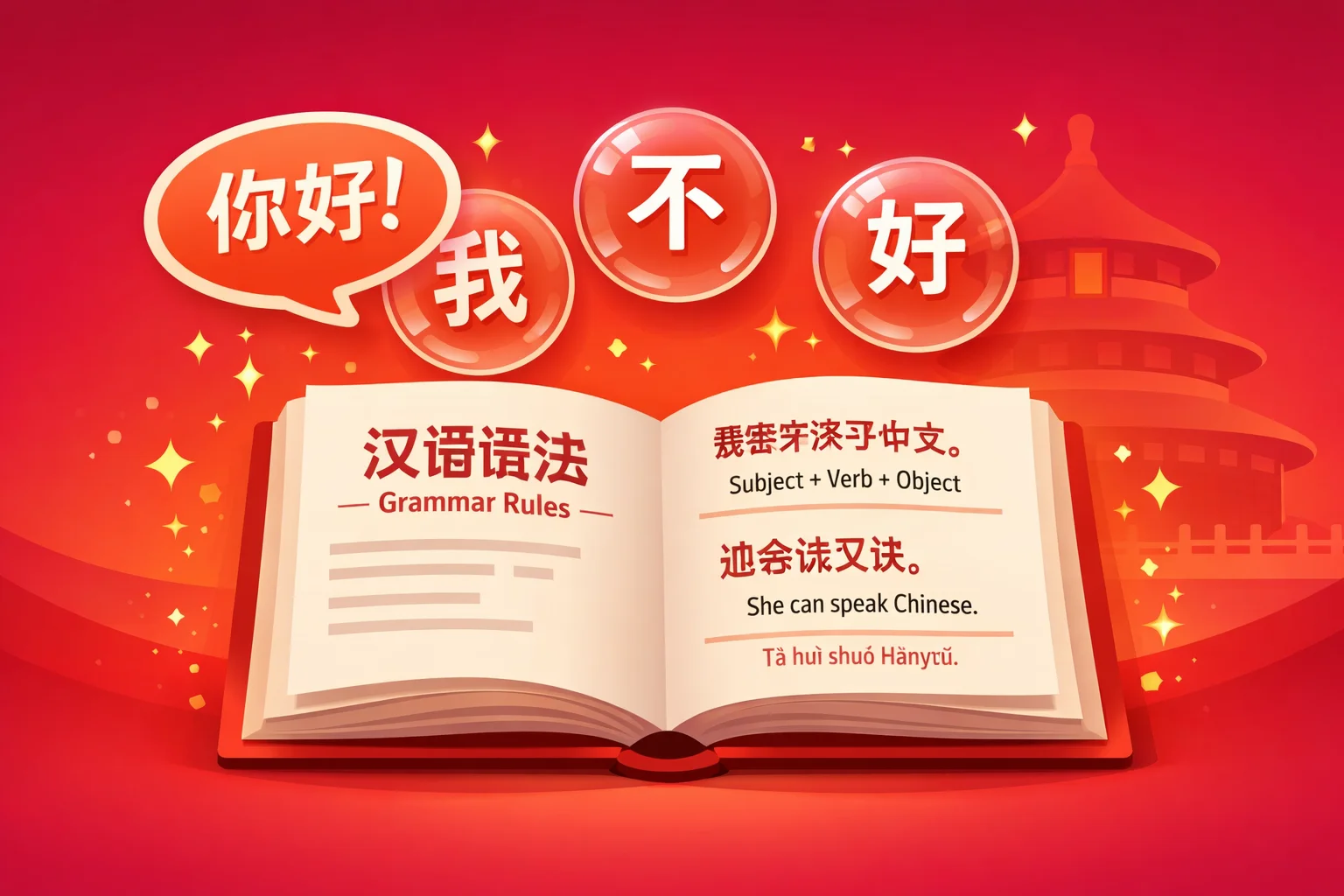
Chinese Grammar Hub

Understand Chinese Grammar Faster

Browse the grammar system by level and category, then open clear explanations with practical examples.

399 Total Rules
73 Chapters
6 CEFR level
Understand Chinese Grammar Faster

New to Chinese Grammar?

Start with the basics and build your foundation step by step.

Start Here
Active filters: CEFR level: C2
C2 Advanced Patterns Verified

Four-Character Magic: Chengyu Patterns

Mastering the structural architecture of Chengyu allows you to use advanced Chinese with native-level rhythm and precision.

  • Most Chengyu follow rigid 4-character structural p...
  • Patterns create rhythm and symmetry, making them e...
10 examples 8 exercises 8 FAQ
Read rule

C2 Particles Verified

Literary Noun Chains (之...之...)

Stack 之 instead of 的 to connect nouns when you want to sound like a sophisticated scholar.

  • Replaces repetitive 的 particles in formal writing...
  • Elevates tone to an academic or literary register.
11 examples 8 exercises 8 FAQ
Read rule
C2 Sentence Structure Verified

Existential Sentences: Using 有, 无, 存

To say something exists, start with the location, then use `有`, `无`, or `存` to describe what's there (or not there).

  • Always put the location first to say what exists s...
  • Use `有 (yǒu)` for general existence; its negative...
10 examples 1 exercises 1 FAQ
Read rule
C2 Conjunctions & Connectors Verified

Sophisticated Purpose Clauses: `以`, `用以`, `为...而`

Use these classical purpose clauses to elevate your Chinese from basic communication to professional and academic mastery.

  • Classical markers for 'in order to' or 'so as to'...
  • `以` connects an action to a goal in professional...
10 examples 8 exercises 8 FAQ
Read rule

C2 Conjunctions & Connectors Verified

Advanced Causality: So... That (以致, 致使, 从而)

Mastering these connectors allows you to precisely convey the tone and intention behind any cause-and-effect relationship.

  • Use `以致` for undesirable or negative consequence...
  • Apply `致使` for objective, formal cause-and-effec...
10 examples 8 exercises 8 FAQ
Read rule
C2 Conjunctions & Connectors Verified

Formal Conditionals (若, 苟, 设): The Literary 'If'

To sound highly educated in Chinese, drop conversational words and embrace concise, single-character literary conditionals like 若.

  • Replaces basic 如果 for high-level formal writing.
  • 若 (if) pairs with 则/便 for elegant flow.
12 examples 8 exercises 8 FAQ
Read rule

C2 Verb Aspects Verified

Saying Goodbye with Respect (逝世, 驾崩, 仙逝)

Match the verb's register to the person's status to show respect and cultural mastery.

  • 逝世 is for famous or highly respected figures in...
  • 驾崩 is exclusively for the death of emperors or e...
10 examples 8 exercises 8 FAQ
Read rule

C2 Advanced Patterns Verified

Classical Euphemism & Taboo Avoidance (委婉语)

Mastering Chinese taboos allows you to handle sensitive realities with professional elegance and cultural sensitivity.

  • Avoid harsh terms for death, illness, and failure.
  • Use classical synonyms to show high-level cultural...
10 examples 8 exercises 8 FAQ
Read rule

C2 Advanced Patterns Verified

Mastering Parallel Prose (Pianwen)

Mastering Parallel Prose transforms your Chinese from functional communication into authoritative, rhythmic, and aesthetically powerful 'literary' expression.

  • Symmetrical structure using paired phrases with ma...
  • Commonly features 4-character and 6-character alte...
10 examples 1 exercises 1 FAQ
Read rule

Why Learn Chinese Grammar?

Grammar is the foundation of language fluency. Without understanding grammar patterns, you can memorize vocabulary but struggle to form correct sentences. Here's why structured grammar study matters:

Build Accurate Sentences

Move beyond memorized phrases. Understand the rules so you can create original, correct sentences in any situation.

Pass Language Exams

Grammar is tested in every major language exam — IELTS, DELE, DELF, JLPT, HSK, TOPIK, and more. Our CEFR-aligned curriculum maps directly to exam requirements.

Understand Native Speakers

Knowing grammar helps you parse complex sentences, understand nuance, and follow conversations even when speakers use advanced constructions.

Progress Faster

Students who study grammar systematically reach fluency faster than those who rely on immersion alone. Structure accelerates learning.

How Our Chinese Grammar Course Works

1

Choose Your Level

Start with your CEFR level — from A0 Zero Point to C2 Mastery. Not sure? Begin at A0 and progress at your own pace.

2

Study Structured Chapters

Each chapter covers a grammar topic with clear explanations, pattern tables, and real-world example sentences.

3

Practice with Exercises

Test your understanding with interactive exercises — fill-in-the-blank, multiple choice, sentence building, and translation practice.

4

Track & Progress

Your progress is saved automatically. Complete chapters, unlock new levels, and watch your grammar mastery grow.

Frequently Asked Questions About Chinese Grammar

SubLearn covers 399 Chinese grammar rules organized across 6 CEFR proficiency levels (from A1 to C2), spanning 73 structured chapters. Each rule includes clear explanations, real-world examples, and interactive practice exercises.

Our Chinese grammar curriculum covers CEFR levels from A1 to C2. Each level is designed to match your current proficiency — beginners start with basic sentence patterns at A1, while advanced learners tackle nuanced structures at C1-C2.


Yes! All Chinese grammar rules, explanations, and examples are completely free to access. You can browse the full curriculum, read detailed explanations, and practice with exercises at no cost.

Grammar is organized into 73 thematic chapters following the CEFR framework. Each chapter groups related rules together — for example, verb tenses, sentence structure, or particles — so you can learn related concepts in a logical sequence.

Yes! Create a free account to track which grammar rules you've studied, see your progress across all CEFR levels, and pick up exactly where you left off. Your learning progress syncs across devices.









































