La Tomatina: Uma Festa na Espanha
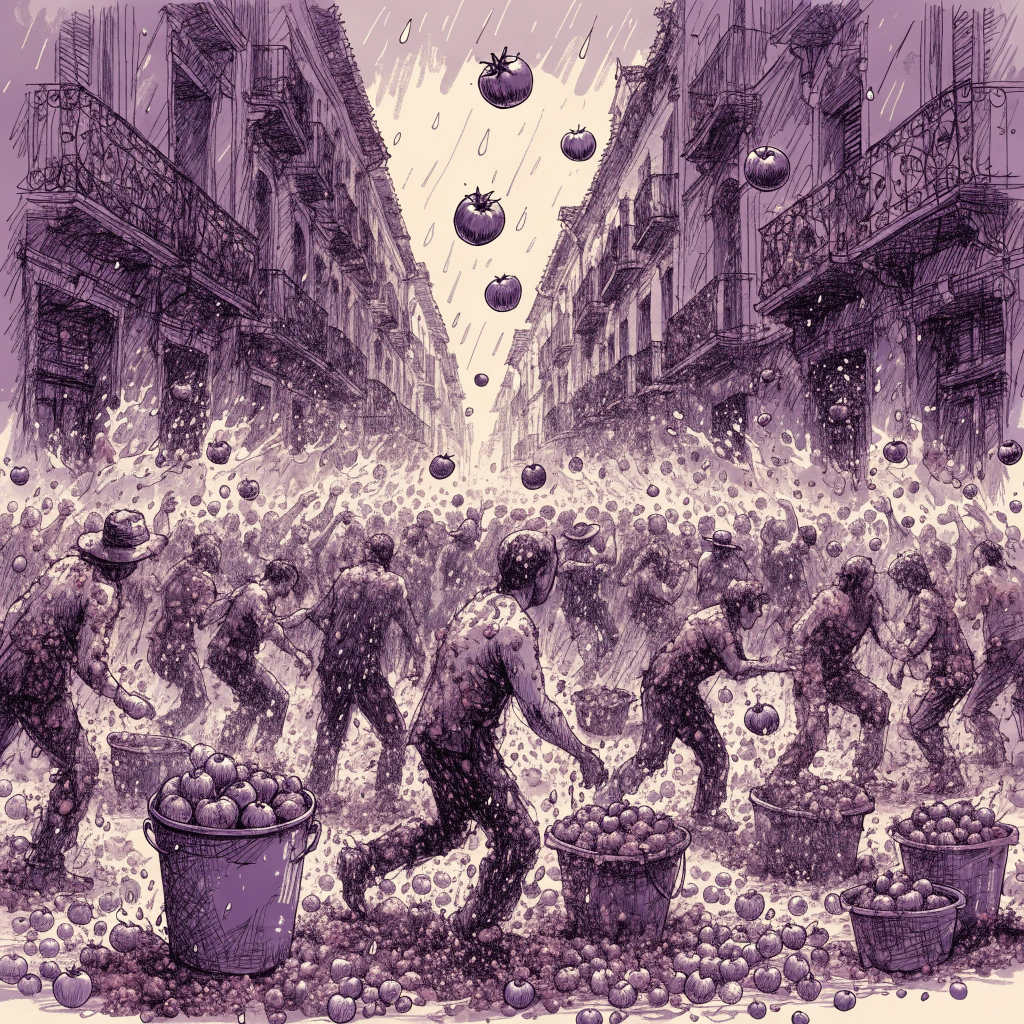
“La Tomatina” é uma festa na Espanha. Ela acontece em Buñol, uma cidade perto de Valência. Muitas pessoas vão para esta festa. Elas jogam tomates umas nas outras.
A festa começou em 1945. Não tem uma origem religiosa. No início, pessoas brigaram na rua. Elas pegaram tomates de uma barraca. Depois, jovens gostaram da ideia e jogaram tomates de novo. O governo proibiu a festa, mas as pessoas queriam mais.
Hoje, “La Tomatina” é muito famosa. É uma festa divertida com muitos tomates!
Gramática em destaque
Padrão: Verbo "ser" no presente
"“La Tomatina” é uma festa na Espanha."
O verbo "ser" mostra quem ou o que algo é. No presente, ele muda: eu sou, você é, ele/ela é, nós somos, vocês são, eles/elas são.
Padrão: Verbos no Presente do Indicativo
"Elas jogam tomates umas nas outras."
Usamos o Presente do Indicativo para falar de ações que acontecem agora ou que são um hábito. Para verbos regulares terminados em -ar (como "jogar"), tiramos o -ar e colocamos -o, -a, -amos, -am.
Teste sua compreensão
10 perguntas · A1 Iniciante · 1 pré-visualização grátis
Teste o que aprendeu neste artigo. Responda todas as perguntas para ganhar XP!
Onde acontece a festa "La Tomatina"?
Quer finalizar o quiz?
9 perguntas a mais estão esperando por você. Cadastre-se grátis para desbloquear o quiz completo e ganhar XP!
Cadastrar grátisJá tem conta? Entrar
Detalhamento das perguntas
Onde acontece a festa "La Tomatina"?
Sua resposta:
Resposta correta: Em Buñol
A festa "La Tomatina" tem uma origem religiosa.
Sua resposta:
Resposta correta: Falso
O que significa a palavra "pessoas"?
Sua resposta:
Resposta correta: Homens, mulheres e crianças
A festa "La Tomatina" é muito _____.
Sua resposta:
Resposta correta: famosa
The Biggest Food Fight in the World
La Tomatina is a very famous festival in a small town called Buñol, near Valencia in Spain. It happens every year on the last Wednesday of August. Thousands of people come from all over the world to join the biggest food fight on Earth.
The festival started in 1945 by accident. During a parade, some young people started a fight. There was a vegetable stall nearby, so they threw tomatoes at each other. The next year, they met again and brought their own tomatoes. It was more fun than a normal parade!
Today, there are rules to keep everyone safe. You must squash the tomatoes in your hands before you throw them. This makes them softer and less dangerous. You should also wear old clothes because the streets become very messy and red.
La Tomatina is unique because it is not a religious event. It is just for fun and friendship. After one hour, the fight ends and fire trucks clean the streets with water. It is a strange but wonderful tradition.
Gramática em destaque
Padrão: Past Simple
"The festival started in 1945 by accident."
We use the past simple to talk about finished actions in the past. Regular verbs add '-ed' to the end of the base verb.
Padrão: Comparatives
"It was more fun than a normal parade!"
We use 'more' with adjectives that have two or more syllables to compare two things. We usually use 'than' after the adjective.
Teste sua compreensão
11 perguntas · A2 Elementar · 1 pré-visualização grátis
Teste o que aprendeu neste artigo. Responda todas as perguntas para ganhar XP!
Where does La Tomatina take place?
Quer finalizar o quiz?
10 perguntas a mais estão esperando por você. Cadastre-se grátis para desbloquear o quiz completo e ganhar XP!
Cadastrar grátisJá tem conta? Entrar
Detalhamento das perguntas
Where does La Tomatina take place?
Sua resposta:
Resposta correta: In Buñol, near Valencia
The festival started for religious reasons.
Sua resposta:
Resposta correta: Falso
What does 'messy' mean?
Sua resposta:
Resposta correta: Dirty or untidy
People must _____ the tomatoes before they throw them.
Sua resposta:
Resposta correta: squash
How long does the tomato fight last?
Sua resposta:
Resposta correta: One hour
The World's Biggest Food Fight: La Tomatina
Every year, on the last Wednesday of August, the small town of Buñol in Spain transforms into a sea of red. This famous festival, which is known as 'La Tomatina,' attracts thousands of tourists from all over the world. While many Spanish festivals have religious roots, La Tomatina is unique because it began by accident.
The tradition started in 1945 during a local parade. A group of young people, who wanted to be part of the event, caused a small scuffle near a vegetable stall. They began to throw tomatoes at each other until the police arrived to stop them. Although the event was banned for several years during the 1950s, the local citizens fought to keep it alive. Eventually, the festival was officially recognized, and it has become a major part of Spanish culture.
Today, the event is highly organized to ensure everyone stays safe. Before the fight begins, a large ham is placed on top of a greasy pole. The tomato battle only starts after someone has climbed the pole and grabbed the ham. Then, several trucks carry tons of overripe tomatoes into the town square. Participants are advised to squash the tomatoes before throwing them to avoid injuries.
Since its humble beginnings, La Tomatina has grown significantly. More than 20,000 people now participate in this messy celebration. After one hour of chaos, the streets are washed with water from fire trucks, leaving the town surprisingly clean. It is an unforgettable experience that shows how a simple argument can turn into a world-famous celebration of joy.
Gramática em destaque
Padrão: The Passive Voice
"Although the event was banned for several years during the 1950s..."
The passive voice is used when the action is more important than the person doing it. It is formed using 'to be' + the past participle (was + banned).
Padrão: Relative Clauses
"This famous festival, which is known as 'La Tomatina,' attracts thousands of tourists..."
Relative clauses provide extra information about a noun. 'Which' is used here to give more details about the festival without starting a new sentence.
Teste sua compreensão
11 perguntas · B1 Intermediário · 1 pré-visualização grátis
Teste o que aprendeu neste artigo. Responda todas as perguntas para ganhar XP!
Where does the La Tomatina festival take place?
Quer finalizar o quiz?
10 perguntas a mais estão esperando por você. Cadastre-se grátis para desbloquear o quiz completo e ganhar XP!
Cadastrar grátisJá tem conta? Entrar
Detalhamento das perguntas
Where does the La Tomatina festival take place?
Sua resposta:
Resposta correta: Buñol
La Tomatina started as a religious celebration.
Sua resposta:
Resposta correta: Falso
What does 'scuffle' mean?
Sua resposta:
Resposta correta: A small, unplanned fight
The festival was _____ for several years during the 1950s before it became official.
Sua resposta:
Resposta correta: banned
What must happen before the tomato fight begins?
Sua resposta:
Resposta correta: Someone must grab a ham from a pole
La Tomatina: A Excentricidade Vermelha de Buñol
No coração da Espanha, na pequena cidade de Buñol, perto de Valência, ocorre anualmente um dos festivais mais inusitados e, para muitos, excêntricos do mundo: a La Tomatina. Diferentemente da maioria das celebrações espanholas, que frequentemente possuem raízes religiosas ou históricas profundas, a La Tomatina destaca-se por sua origem peculiar e, de certa forma, acidental, tornando-se um fenômeno cultural que atrai milhares de participantes de todos os cantos do globo.
A história desse espetáculo começou em 1945, durante um desfile de Gigantes y Cabezudos. Uma escaramuça espontânea irrompeu entre os jovens, e a proximidade de uma barraca de vegetais se revelou o cenário perfeito para o que viria a ser uma batalha de tomates improvisada. No ano seguinte, os mesmos jovens, já cientes do potencial de diversão, retornaram ao local com seus próprios tomates, transformando o incidente em uma "luta" planejada e, assim, selando o destino do que se tornaria uma tradição. A persistência dos moradores foi crucial, pois, apesar de ter sido proibida por um período nos anos 1950, a paixão pela festa prevaleceu, levando ao seu restabelecimento oficial.
Atualmente, a La Tomatina é um evento massivo e regulamentado. Para garantir a segurança e a organização, o acesso é limitado e requer a compra de ingressos. Antes do início da "batalha", os tomates devem ser esmagados para evitar ferimentos, e um canhão de água sinaliza o começo e o fim da contenda, que dura exatamente uma hora. Após a frenética guerra de tomates, a cidade de Buñol é limpa rapidamente, e seus habitantes e visitantes se entregam a outras festividades.
Embora a La Tomatina seja frequentemente alvo de debates sobre o desperdício de alimentos, seus defensores argumentam que os tomates utilizados são impróprios para consumo e que o festival gera uma receita significativa para a economia local, além de promover a cultura e o turismo da região. O que começou como uma brincadeira despretensiosa evoluiu para um evento globalmente reconhecido, simbolizando a alegria e a capacidade de reinvenção das tradições populares. É, sem dúvida, uma experiência única que desafia as convenções dos festivais tradicionais, consolidando seu legado como uma celebração de pura e simples diversão.
Gramática em destaque
Padrão: Orações Concessivas com 'Embora' + Subjuntivo
"Embora a La Tomatina seja frequentemente alvo de debates sobre o desperdício de alimentos, seus defensores argumentam que os tomates utilizados são impróprios para consumo."
A conjunção 'embora' introduz uma oração que expressa uma ideia de contraste ou oposição, mas não impede a realização da ação da oração principal. É sempre seguida pelo modo subjuntivo para indicar essa concessão ou hipótese.
Padrão: Voz Passiva com 'Ser' + Particípio Passado
"Apesar de ter sido proibida por um período nos anos 1950, a paixão pela festa prevaleceu."
A voz passiva é usada para dar destaque à ação ou ao objeto que sofre a ação, em vez de quem a pratica. É formada com o verbo 'ser' no tempo verbal adequado e o particípio passado do verbo principal, concordando em gênero e número com o sujeito paciente.
Padrão: Pronome Relativo 'O que' para Ideias ou Fatos
"O que começou como uma brincadeira despretensiosa evoluiu para um evento globalmente reconhecido."
O pronome relativo 'o que' é frequentemente utilizado para se referir a uma ideia, um fato, uma frase inteira ou um conceito abstrato que foi mencionado anteriormente, funcionando como um elemento coesivo que retoma um contexto mais amplo, não apenas um substantivo específico.
Teste sua compreensão
11 perguntas · B2 Intermediário superior · 1 pré-visualização grátis
Teste o que aprendeu neste artigo. Responda todas as perguntas para ganhar XP!
Qual é a principal diferença da La Tomatina em relação à maioria dos festivais espanhóis?
Quer finalizar o quiz?
10 perguntas a mais estão esperando por você. Cadastre-se grátis para desbloquear o quiz completo e ganhar XP!
Cadastrar grátisJá tem conta? Entrar
Detalhamento das perguntas
Qual é a principal diferença da La Tomatina em relação à maioria dos festivais espanhóis?
Sua resposta:
Resposta correta: Ela não possui raízes religiosas ou históricas profundas.
A La Tomatina foi um evento planejado desde sua primeira edição em 1945.
Sua resposta:
Resposta correta: Falso
Qual é o significado da palavra 'escaramuça' no contexto do artigo?
Sua resposta:
Resposta correta: Uma pequena briga ou confronto.
Para garantir a segurança dos participantes, os tomates devem ser _____ antes da batalha.
Sua resposta:
Resposta correta: esmagados
Por que os defensores da La Tomatina argumentam que não há desperdício de alimentos?
Sua resposta:
Resposta correta: Os tomates são impróprios para consumo e o festival gera receita para a economia local.
Red Deluge: The Sophisticated Paradox of Buñol’s Tomato War
Seldom does a provincial town find itself the epicenter of global intrigue, yet every August, the Valencian municipality of Buñol transforms into a crimson stage for La Tomatina. While many Spanish festivities are deeply rooted in liturgical traditions or hagiographic commemorations, La Tomatina stands as an anomalous entity. It is a festival born not of religious fervor, but of a spontaneous scuffle during a 1945 parade. What began as a localized outburst of frustration at a vegetable stall has evolved into a meticulously choreographed spectacle, raising poignant questions about the commodification of local culture in the age of global tourism.
It was in 1945 that the seeds of this peculiar tradition were sown. During a 'Gigantes y Cabezudos' parade, a group of restless youths instigated a brawl that quickly escalated into a fruit-based battle. Although the local authorities initially viewed this as an act of public disorder, the townspeople harbored a peculiar fondness for the event’s inherent spontaneity. The subsequent prohibition of the festival during the mid-20th century only served to galvanize the community. The townspeople’s defiant persistence, exemplified by a symbolic 'tomato funeral' in 1957, eventually forced the institutionalization of the event. This transition from a grassroots protest to a state-sanctioned holiday highlights a fascinating sociological shift.
Central to the modern iteration of the festival is the 'Palo Jabón', a greased pole challenge that precedes the main event. Only when a participant manages to retrieve a ham from the top of the pole does the cacophony of the tomato fight commence. Thousands of participants from across the globe descend upon Buñol, engaging in an ephemeral hour of chaos. However, beneath the surface-level revelry lies a complex logistical framework. Tons of overripe tomatoes are trucked in, and the town’s narrow streets are lined with plastic to protect the ancient masonry from the acidic deluge.
Critically, the modern festival faces scrutiny regarding its environmental footprint and the perceived dilution of its authentic spirit. Critics argue that the introduction of ticketing and the heavy presence of international sponsors have turned a vestige of local rebellion into a commercial product. Yet, proponents maintain that the festival’s economic benefits are indispensable for the region’s prosperity. Ultimately, La Tomatina remains a testament to the power of collective memory and the human desire for cathartic release through play. Whether viewed as a wasteful extravagance or a vibrant cultural cornerstone, its status as a global phenomenon is undeniable.
Gramática em destaque
Padrão: Negative Inversion
"Seldom does a provincial town find itself the epicenter of global intrigue..."
Inversion occurs after negative or restrictive adverbs like 'seldom' or 'rarely' at the start of a sentence. It places the auxiliary verb before the subject to add rhetorical emphasis and formality.
Padrão: Cleft Sentence
"It was in 1945 that the seeds of this peculiar tradition were sown."
A cleft sentence (It + is/was + focus + relative clause) is used to emphasize a specific piece of information, in this case, the specific year the tradition began.
Padrão: Nominalization
"The subsequent prohibition of the festival during the mid-20th century only served to galvanize the community."
Nominalization involves turning verbs or adjectives into nouns (e.g., 'prohibition', 'institutionalization'). It is a hallmark of C1 writing as it creates a more objective, academic, and concise tone.
Teste sua compreensão
12 perguntas · C1 Avançado · 1 pré-visualização grátis
Teste o que aprendeu neste artigo. Responda todas as perguntas para ganhar XP!
What primary distinction does the author make between La Tomatina and other Spanish festivals?
Quer finalizar o quiz?
11 perguntas a mais estão esperando por você. Cadastre-se grátis para desbloquear o quiz completo e ganhar XP!
Cadastrar grátisJá tem conta? Entrar
Detalhamento das perguntas
What primary distinction does the author make between La Tomatina and other Spanish festivals?
Sua resposta:
Resposta correta: It lacks the liturgical or religious origins common in Spanish culture.
The 'tomato funeral' of 1957 was a protest against the prohibition of the festival.
Sua resposta:
Resposta correta: Verdadeiro
Which word describes something that is 'deviating from the norm'?
Sua resposta:
Resposta correta: Anomalous
The festival's transition from a grassroots protest to a state-sanctioned holiday is described as its _____.
Sua resposta:
Resposta correta: institutionalization
What must occur before the tomato throwing can officially begin?
Sua resposta:
Resposta correta: A participant must climb a greased pole and retrieve a ham.
The author argues that the economic benefits of the festival are widely considered irrelevant.
Sua resposta:
Resposta correta: Falso
The Crimson Catharsis: A Socio-Anthropological Deconstruction of La Tomatina
To the uninitiated observer, the small municipality of Buñol might appear an unlikely stage for one of the most visceral displays of communal exuberance in the Western world. Yet, every August, this Valencian town undergoes a radical metamorphosis, shedding its tranquil exterior to host La Tomatina—a festival whose inception was as serendipitous as its legacy is enduring. Scarcely had the 1945 parade of 'Gigantes y Cabezudos' commenced when an organic, albeit aggressive, skirmish erupted, forever altering the town's cultural trajectory. What began as a spontaneous outburst of youthful pique involving the contents of a local vegetable stall has, over the subsequent decades, been distilled into a highly regulated, yet purportedly chaotic, ritual of red pulp and collective release.
Lest the festival be reduced to a mere footnote in tourism brochures, one must acknowledge its roots in civil defiance. During the mid-20th century, Spain’s socio-political climate was characterized by a rigid hegemony that sought to stifle idiosyncratic local expressions. Consequently, the townspeople’s persistence in staging the event despite repeated prohibitions by the Francoist regime imbues the tomato fight with a subversive undertone. It was not merely a fight; it was a vestige of public autonomy in an era of centralized control. This historical context provides a necessary lens through which to view the contemporary iteration of the event, which, despite its burgeoning commercialization, remains a potent symbol of communal identity and resilience.
Central to the allure of La Tomatina is the concept of the carnivalesque. As theorized by Mikhail Bakhtin, the carnivalesque represents a temporary suspension of social hierarchies, a brief window where the profane and the sacred, the orderly and the chaotic, coalesce. In the narrow streets of Buñol, the cacophony of the crowd and the ephemeral nature of the battle create a liminal space where social distinctions are momentarily obliterated by a layer of tomato juice. It is this very juxtaposition of destruction and jubilation that defines the event’s core. The act of throwing overripe fruit is both a wasteful absurdity and a profound catharsis, allowing participants to engage in a primitive, tactile experience that stands in stark contrast to the sterile, digitalized reality of modern existence. In this state, the individual is subsumed by the collective, and the tomato becomes a medium through which the boundaries of the self are blurred.
However, the transition of La Tomatina from a local tradition to a global phenomenon has not been without its critics. Some academic circles argue that the institutionalization of the fight—complete with ticketing systems and designated 'battle zones'—has eroded the very spontaneity that once defined it. The 'regulated chaos' of the modern festival is, in many ways, an oxymoron, reflecting a broader trend where folk traditions are sanitized for international consumption to ensure safety and economic viability. Yet, even within this structured framework, the sheer physicality of the event persists. The visceral impact of being submerged in a sea of red, the smell of acidity, and the shared laughter of strangers suggest that the underlying spirit of the festival remains resilient against the encroaching forces of commodification.
Ultimately, La Tomatina serves as a reminder of the human need for periodic release from the constraints of societal norms. Whether viewed as a historical act of defiance, a Bakhtinian carnival, or a modern tourist spectacle, its enduring popularity underscores a universal desire for the experiential and the tactile. As the last of the tomatoes are hosed from the cobblestones, leaving only a faint scent of vinegar and the memory of a crimson haze, the town of Buñol returns to its quietude, awaiting the next cycle of its idiosyncratic tradition. The festival is, in essence, a celebration of the present moment—a fleeting, messy, and magnificent affirmation of life.
Gramática em destaque
Padrão: Inversion after negative/restrictive adverbials
"Scarcely had the 1945 parade of 'Gigantes y Cabezudos' commenced when an organic, albeit aggressive, skirmish erupted."
This structure is used for emphasis and formal tone. When starting a sentence with 'Scarcely', 'Hardly', or 'No sooner', the auxiliary verb comes before the subject.
Padrão: Subjunctive Mood with 'Lest'
"Lest the festival be reduced to a mere footnote in tourism brochures, one must acknowledge its roots in civil defiance."
The conjunction 'lest' is followed by the base form of the verb (subjunctive) to indicate a negative purpose or to prevent an undesirable outcome.
Padrão: It-Cleft Sentences for Emphasis
"It is this very juxtaposition of destruction and jubilation that defines the event’s core."
Cleft sentences focus on a specific part of the information. By using 'It is... that...', the writer highlights the specific cause or reason for a phenomenon.
Teste sua compreensão
12 perguntas · C2 Domínio · 1 pré-visualização grátis
Teste o que aprendeu neste artigo. Responda todas as perguntas para ganhar XP!
What is the author's primary perspective on the origins of La Tomatina?
Quer finalizar o quiz?
11 perguntas a mais estão esperando por você. Cadastre-se grátis para desbloquear o quiz completo e ganhar XP!
Cadastrar grátisJá tem conta? Entrar
Detalhamento das perguntas
What is the author's primary perspective on the origins of La Tomatina?
Sua resposta:
Resposta correta: It was a serendipitous and organic event arising from a local parade.
The author suggests that the modern, regulated version of the festival has completely lost its visceral impact.
Sua resposta:
Resposta correta: Falso
Which word describes something that lasts for a very short duration?
Sua resposta:
Resposta correta: Ephemeral
The townspeople’s persistence in staging the event despite repeated prohibitions imbues the tomato fight with a _____ undertone.
Sua resposta:
Resposta correta: subversive
According to the text, what does Mikhail Bakhtin's concept of the 'carnivalesque' involve?
Sua resposta:
Resposta correta: A temporary suspension and reversal of social hierarchies.
La Tomatina was banned for a period during the Francoist regime.
Sua resposta:
Resposta correta: Verdadeiro

