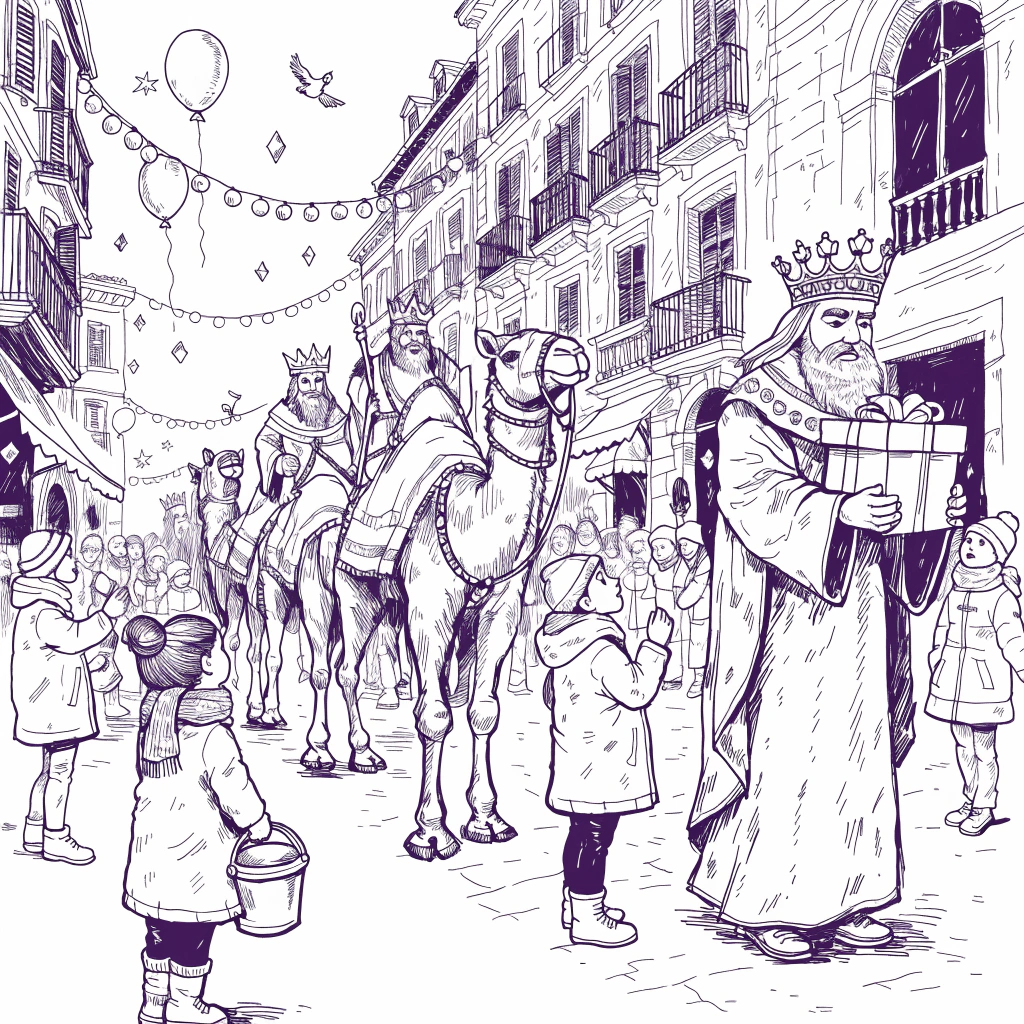
Three Kings Day in Spain
January 6th is a special day in Spain. It is Three Kings Day. People celebrate the Three Wise Men. Their names are Melchior, Caspar, and Balthazar.
On January 5th, there is a big parade. It is the Three Kings Parade. The Kings ride horses or camels. They throw sweets to the children. Many people watch the parade in the street.
Children get gifts from the Kings. Families eat a special cake. It is called Roscon de Reyes. It is a happy day for everyone in Spain.
Gramática em destaque
Padrão: O Verbo 'To Be' (Presente Simples)
"January 6th is a special day in Spain."
Usamos 'is' com sujeitos no singular para descrever fatos ou estados. Nesta frase, ele conecta a data à sua descrição.
Padrão: Presente Simples para Ações Regulares
"They throw sweets to the children."
Usamos a forma base do verbo para sujeitos no plural como 'they'. Este padrão descreve uma tradição ou uma ação regular.
Teste sua compreensão
10 perguntas · A1 Iniciante · 1 pré-visualização grátis
Teste o que aprendeu neste artigo. Responda todas as perguntas para ganhar XP!
Quando é o Dia de Reis?
Quer finalizar o quiz?
9 perguntas a mais estão esperando por você. Cadastre-se grátis para desbloquear o quiz completo e ganhar XP!
Cadastrar grátisJá tem conta? Entrar
Detalhamento das perguntas
Quando é o Dia de Reis?
Sua resposta:
Resposta correta: 6 de janeiro
As crianças recebem presentes dos Três Reis.
Sua resposta:
Resposta correta: Verdadeiro
O que significa 'sweets'?
Sua resposta:
Resposta correta: Balas e alimentos com açúcar
Os Reis montam em cavalos ou _____.
Sua resposta:
Resposta correta: camels
Three Kings Day: Spain's Favorite Holiday
In Spain, the Christmas season is very long. It does not end in December. The most exciting day is January 6th. This is 'Los Reyes Magos' or Three Kings Day. It celebrates the three wise men who visited baby Jesus long ago.
The celebration starts on January 5th. Every city has a big parade. The Kings travel through the streets on horses or big floats. They throw many sweets to the children. This parade is louder and more colorful than a normal parade. Thousands of people watch the Kings arrive.
Before they go to sleep, children put their shoes near the window. They also leave food for the Kings and water for their camels. On the morning of January 6th, the children find many gifts. Families eat a special cake called 'Roscón'. It is a sweet bread with fruit on top. This holiday is special because families spend time together and share a big meal.
Gramática em destaque
Padrão: Comparativos
"This parade is louder and more colorful than a normal parade."
Usamos comparativos para comparar duas coisas. Adicionamos '-er' a adjetivos curtos e usamos 'more' antes de adjetivos longos.
Padrão: Presente Simples para Hábitos
"Every city has a big parade."
Usamos o presente simples para descrever tradições e eventos regulares. Para um sujeito singular como 'every city', usamos 'has' em vez de 'have'.
Teste sua compreensão
11 perguntas · A2 Elementar · 1 pré-visualização grátis
Teste o que aprendeu neste artigo. Responda todas as perguntas para ganhar XP!
Quando é celebrado o Dia de Reis na Espanha?
Quer finalizar o quiz?
10 perguntas a mais estão esperando por você. Cadastre-se grátis para desbloquear o quiz completo e ganhar XP!
Cadastrar grátisJá tem conta? Entrar
Detalhamento das perguntas
Quando é celebrado o Dia de Reis na Espanha?
Sua resposta:
Resposta correta: 6 de janeiro
Os Reis jogam doces para as crianças durante o desfile.
Sua resposta:
Resposta correta: Verdadeiro
O que é um 'Roscón'?
Sua resposta:
Resposta correta: Um bolo especial
As crianças colocam seus _____ perto da janela antes de irem dormir.
Sua resposta:
Resposta correta: shoes
Por que as crianças deixam água do lado de fora em 5 de janeiro?
Sua resposta:
Resposta correta: Para os camelos
The Magic of the Three Kings in Spain
In many parts of the world, the holiday season ends shortly after New Year's Day. However, in Spain, the most exciting celebrations continue until January 6th. This special day is known as 'Los Reyes Magos' or Three Kings Day. It is a time when the arrival of the Three Wise Men—Melchior, Caspar, and Balthazar—is celebrated with great joy and ancient traditions.
The festivities officially begin on the evening of January 5th with a massive procession called the 'Cabalgata'. This event, which is watched by millions of excited families, features colorful floats and music. The Kings and their helpers throw thousands of sweets to the children who have been waiting patiently in the streets for hours. This festive atmosphere has been enjoyed by generations of Spanish people, and it remains the highlight of the winter season.
Before going to sleep, children participate in a unique tradition. They leave their shoes near the window or under the Christmas tree so the Kings know where to put the presents. They also leave some biscuits for the Kings and a bowl of water for the tired camels. Traditionally, children who have been good throughout the year receive wonderful gifts. However, those who have been naughty might find a piece of black 'coal'. Luckily, this coal is actually made of sugar!
On the morning of January 6th, families gather to open their presents and eat a special breakfast. The main treat is the 'Roscón de Reyes', a ring-shaped cake which is decorated with colorful candied fruits. Inside the cake, two items are hidden: a small toy figure and a dry bean. According to tradition, the person who finds the toy is crowned 'king' or 'queen' for the day. In contrast, the unlucky person who finds the bean must pay for the cake next year!
Gramática em destaque
Padrão: Orações Relativas
"The Kings and their helpers throw thousands of sweets to the children who have been waiting patiently in the streets for hours."
Orações relativas começam com palavras como 'who', 'which' ou 'that' para dar mais informações sobre um substantivo. Neste exemplo, 'who' nos diz exatamente para quais crianças os Reis estão dando doces.
Padrão: Voz Passiva
"It is a time when the arrival of the Three Wise Men is celebrated with great joy and ancient traditions."
A voz passiva é formada com 'to be' + particípio passado. É usada quando a ação é mais importante do que a pessoa que a realiza, o que é comum em descrições formais de festivais.
Teste sua compreensão
11 perguntas · B1 Intermediário · 1 pré-visualização grátis
Teste o que aprendeu neste artigo. Responda todas as perguntas para ganhar XP!
Quando acontece o desfile da 'Cabalgata'?
Quer finalizar o quiz?
10 perguntas a mais estão esperando por você. Cadastre-se grátis para desbloquear o quiz completo e ganhar XP!
Cadastrar grátisJá tem conta? Entrar
Detalhamento das perguntas
Quando acontece o desfile da 'Cabalgata'?
Sua resposta:
Resposta correta: Na noite de 5 de janeiro
As crianças espanholas deixam seus sapatos para fora para que os Reis saibam onde colocar os presentes.
Sua resposta:
Resposta correta: Verdadeiro
O que significa a palavra 'tradition' (tradição)?
Sua resposta:
Resposta correta: Um costume ou crença de longa data
A pessoa azarada que encontrar o _____ deve pagar pelo bolo no próximo ano.
Sua resposta:
Resposta correta: bean
O que é 'Roscón de Reyes'?
Sua resposta:
Resposta correta: Um bolo em formato de anel
The Persistence of Tradition: Understanding Spain's Three Kings Day
While much of the Western world concludes its festive season shortly after New Year’s Day, Spain maintains a vibrant tradition that extends well into January. The celebration of Los Reyes Magos, or the Three Wise Men, represents a cornerstone of Spanish cultural identity, often taking precedence over the globalized figure of Santa Claus. Historically rooted in the biblical narrative of Melchior, Caspar, and Balthazar, the holiday serves as a profound reminder of the country’s historical and religious heritage.
The festivities commence in earnest on the evening of January 5th with the 'Cabalgata de Reyes'. This grand procession, which is characterized by elaborate floats and performers, winds through the streets of every major city. It is during this event that the Three Kings are seen distributing sweets to the throngs of spectators. For many Spanish children, the level of anticipation during this evening is unrivalled. They are encouraged to leave their shoes out, often accompanied by snacks for the weary camels, in hopes that their behavior throughout the year warrants a generous bounty of gifts.
Moreover, the symbolic nature of the gifts—Gold, Frankincense, and Myrrh—is frequently analyzed in an educational context. In modern times, these elements have been adapted to reflect contemporary values, though the core message of generosity remains intact. The kings themselves are often depicted as wise scholars from the East, each representing different parts of the known world at the time. This diversity, historically significant, continues to resonate in today’s multicultural Spain.
Furthermore, the socio-cultural impact of this holiday cannot be overlooked. In an era where commercialism often dilutes traditional practices, Spain has successfully preserved the unique essence of the Epiphany. Although Santa Claus has gained some traction in recent decades, the Three Kings remain the primary distributors of joy and gifts. Arguably, if these local customs had not been so deeply ingrained in the family unit, they might have been superseded by more homogenous international trends.
The celebration concludes on January 6th with a family gathering centered around the 'Roscón de Reyes', a circular cake decorated with candied fruits. Hidden within the dough are a small figurine and a dried bean; the individual who discovers the former is crowned 'king', while the latter must pay for the cake next year. This blend of playful competition and communal dining illustrates the enduring appeal of the holiday. Ultimately, Los Reyes Magos is not merely about the reception of material goods, but about the subsequent reinforcement of familial bonds and the preservation of a collective narrative that has spanned centuries.
Gramática em destaque
Padrão: Voz Passiva (Presente Simples)
"This grand procession, which is characterized by elaborate floats and performers, winds through the streets..."
Usada para focar na ação ou no objeto que está sendo descrito, em vez da pessoa que realiza a ação. É formada usando 'is/are' + particípio passado.
Padrão: Terceiro Condicional
"...if these local customs had not been so deeply ingrained in the family unit, they might have been superseded..."
Usado para descrever uma situação hipotética no passado que não aconteceu. É formado usando 'if + past perfect' e 'would/might have + past participle'.
Padrão: Referência: O Primeiro e O Último
"...the individual who discovers the former is crowned 'king', while the latter must pay for the cake next year."
Usado para evitar repetição ao se referir a duas coisas mencionadas anteriormente. 'O primeiro' refere-se ao primeiro item, e 'o último' refere-se ao segundo.
Teste sua compreensão
11 perguntas · B2 Intermediário superior · 1 pré-visualização grátis
Teste o que aprendeu neste artigo. Responda todas as perguntas para ganhar XP!
Qual evento principal acontece na noite de 5 de janeiro na Espanha?
Quer finalizar o quiz?
10 perguntas a mais estão esperando por você. Cadastre-se grátis para desbloquear o quiz completo e ganhar XP!
Cadastrar grátisJá tem conta? Entrar
Detalhamento das perguntas
Qual evento principal acontece na noite de 5 de janeiro na Espanha?
Sua resposta:
Resposta correta: Uma grande procissão chamada 'Cabalgata de Reyes'
Na Espanha, o Papai Noel substituiu completamente os Três Reis Magos como os principais doadores de presentes.
Sua resposta:
Resposta correta: Falso
Qual palavra significa 'melhor do que qualquer outra pessoa ou coisa do mesmo tipo'?
Sua resposta:
Resposta correta: Unrivalled
Para muitas crianças espanholas, o nível de _____ durante esta noite é inigualável.
Sua resposta:
Resposta correta: anticipation
Na tradição do Roscón de Reyes, o que a pessoa que encontra o feijão deve fazer?
Sua resposta:
Resposta correta: Pagar o bolo no próximo ano
Epiphany and the Iberian Identity: The Enduring Legacy of Los Reyes Magos
Rarely in the modern era does a traditional festival withstand the homogenizing force of globalization with such poise as the Spanish celebration of Los Reyes Magos. While much of the Western world concludes its festivities shortly after December 25th, Spain prepares for its most significant cultural crescendo on January 6th. This day marks the Epiphany, commemorating the arrival of Melchior, Caspar, and Balthazar in Bethlehem. However, the significance of the event transcends religious boundaries, embedding itself into the very fabric of Spanish social life. The persistence of this tradition is not merely a matter of habit but a testament to the cultural resilience of a nation that treasures its specific heritage over imported alternatives.
Central to this celebration is the 'Cabalgata de Reyes', a magnificent pageant that unfolds on the evening of January 5th. Not only does this procession captivate the younger generation, but it also serves as a sophisticated display of civic prowess. Each municipality, regardless of its size, coordinates elaborate floats that shower the gathered crowds with sweets. It is the sheer scale and logistical complexity of these events that reinforces the holiday's precedence over more commercialized alternatives like Santa Claus. Despite the inroads made by Northern European and American traditions, the Three Kings remain the primary bringers of gifts, maintaining a symbolic grip on the national psyche that is both enduring and deeply emotional.
The economic impact of the season is profound, yet the discussion surrounding it often requires a certain degree of nuance. While the commercialization of Christmas is ubiquitous across the globe, the Spanish approach provides a fascinating case study in cultural resilience. The consumption of the 'Roscón de Reyes'—a ring-shaped cake containing a hidden figurine and a bean—is a ritualistic necessity that underscores the communal aspect of the day. This tradition, far from being a mere vestige of the past, continues to thrive in the 21st century, driven by a collective nostalgia that effectively bridges the generational gap. Families gather with a sense of anticipation, knowing that finding the bean results in paying for the cake, while the figurine grants the title of 'king'.
What distinguishes the Spanish festive calendar is its unique chronological structure. By extending the holiday season into the first week of January, Spain preserves a slower, more contemplative pace of celebration. This temporal discrepancy often puzzles foreign observers, yet for Spaniards, it is the culmination of a weeks-long buildup. The anticipation is palpable, particularly among children who write letters to the Kings, detailing their behavior throughout the year. The eventual arrival of the Kings, often preceded by a symbolic 'royal postman' or 'emissary', represents a confluence of mythology and reality that few other traditions can replicate. Children carefully leave their shoes by the window, accompanied by snacks for the Kings and water for their weary camels.
Ultimately, the enduring popularity of Los Reyes Magos is a testament to the power of shared narrative and communal identity. In an age where digital distractions are constant, the physical presence of the Three Kings—arriving by boat, helicopter, or camel—demands a rare moment of collective attention. It is through these meticulously curated rituals that Spain continues to safeguard its cultural identity, ensuring that the magic of the Epiphany remains as potent today as it was for previous generations. As long as the tradition of the 'carbon' for the naughty and the Roscón for the family remains, the Kings will continue to reign supreme over the Iberian festive landscape.
Gramática em destaque
Padrão: Inversão para Ênfase
"Rarely in the modern era does a traditional festival withstand the homogenizing force of globalization with such poise as the Spanish celebration of Los Reyes Magos."
A inversão ocorre quando o sujeito e o verbo auxiliar são trocados, geralmente após advérbios negativos ou restritivos. Essa construção é usada para dar ênfase e um tom mais formal e literário à declaração inicial.
Padrão: Frases Clivadas
"It is the sheer scale and logistical complexity of these events that reinforces the holiday's precedence over more commercialized alternatives like Santa Claus."
Frases clivadas usam a estrutura 'É/Foi... que...' para focar em uma parte específica da frase (o foco). Neste caso, enfatiza as razões específicas (escala e complexidade) para a dominância do feriado.
Padrão: Frases Pseudo-Clivadas
"What distinguishes the Spanish festive calendar is its unique chronological structure."
Frases pseudo-clivadas usam uma oração 'wh-' (geralmente começando com 'O que') como sujeito para introduzir e enfatizar novas informações. Essa estrutura foca a atenção do leitor na 'estrutura cronológica única' como a característica definidora.
Teste sua compreensão
12 perguntas · C1 Avançado · 1 pré-visualização grátis
Teste o que aprendeu neste artigo. Responda todas as perguntas para ganhar XP!
De acordo com o artigo, o que mais contribui para a precedência do feriado sobre o Papai Noel?
Quer finalizar o quiz?
11 perguntas a mais estão esperando por você. Cadastre-se grátis para desbloquear o quiz completo e ganhar XP!
Cadastrar grátisJá tem conta? Entrar
Detalhamento das perguntas
De acordo com o artigo, o que mais contribui para a precedência do feriado sobre o Papai Noel?
Sua resposta:
Resposta correta: A enorme escala e complexidade logística dos desfiles
O autor descreve o 'Roscón de Reyes' como um vestígio do passado em desaparecimento.
Sua resposta:
Resposta correta: Falso
No contexto do texto, o que significa 'onipresente' (ubiquitous)?
Sua resposta:
Resposta correta: Encontrado em todos os lugares
A chegada dos Reis Magos em 6 de janeiro marca a _____.
Sua resposta:
Resposta correta: epiphany
Qual é a função principal da 'Cabalgata de Reyes' mencionada no texto?
Sua resposta:
Resposta correta: Para cativar as crianças e exibir a destreza cívica
As crianças na Espanha deixam seus sapatos para fora para os Reis Magos encontrarem.
Sua resposta:
Resposta correta: Verdadeiro
The Persistence of Epiphany: A Sociocultural Analysis of ‘Los Reyes Magos’ in Spain
While the Gregorian calendar marks the turn of the year with universal fanfare, Spain’s festive period remains uniquely elongated, reaching its zenith not on the first of January, but on the sixth. This day, the Epiphany, or 'Día de Reyes', is far more than a mere religious observance; it is a profound sociocultural anchor that has successfully resisted the homogenizing forces of globalized consumerism. The arrival of the Three Wise Men—Melchior, Caspar, and Balthazar—is a cornerstone of Spanish identity, representing a temporal bridge between ancient liturgy and modern festivity.
To suggest that the Anglo-American figure of 'Papá Noel' has been entirely rebuffed would be an oversimplification of contemporary Spanish trends. A delicate, albeit sometimes fraught, coexistence has emerged. However, the Three Kings remain the primary dispensers of both tangible gifts and cultural continuity. Should the Kings ever be relegated to a secondary status, it would signal a significant erosion of the Spanish domestic tapestry. Not only does the Epiphany mark the spiritual culmination of the Nativity, but it also functions as a vital mechanism for intergenerational bonding, where the collective suspension of disbelief sustains a shared magical realism.
The evening of January 5th witnesses the 'Cabalgata de Reyes', a processional spectacle that transforms urban centers into arenas of sensory opulence. These parades are not merely logistical exercises in candy distribution; they are civic rituals where the mythic is reified. As the Kings traverse the streets, they are met by dense throngs of families, all participating in a performative act of welcome. For the children, the physical presence of the Kings—perched atop elaborate floats—validates the weeks of anticipatory behavior and the meticulous drafting of 'the letter'. Historically, the 'Cabalgata' has evolved from humble neighborhood processions into high-production theatrical events. This adaptability ensures that the ritual remains relevant to successive generations, preventing it from becoming a stagnant relic of the past.
In the domestic sphere, the ritual nuances are equally significant. The tradition of placing shoes in a conspicuous location, accompanied by refreshments for the Kings and water for their weary camels, persists as an essential ritualistic gesture. This act of hospitality, though seemingly trivial, reinforces the pedagogical values of gratitude and preparation. The subsequent discovery of gifts on the morning of the 6th is the denouement of a season-long narrative arc, one that prioritizes patience over the instant gratification often championed by modern retail.
The culinary dimensions of the day are centered around the 'Roscón de Reyes'. This circular brioche, festooned with candied fruit to resemble a jeweled crown, contains a duality of surprises: a small king figurine and a dried fava bean. The individual who discovers the king is rightfully crowned, while the unfortunate recipient of the bean is traditionally tasked with the financial settlement for the cake. This playful tradition mirrors the vagaries of fortune, introducing a secular element of chance into the religious holiday. It serves as a social glue, compelling families to gather and share in a final moment of communal indulgence before the return to the mundane routines of January.
Ultimately, the enduring popularity of 'Los Reyes Magos' serves as a testament to the resilience of tradition in the face of rapid secularization. While the theological underpinnings may have shifted for many, the cultural imperatives remain robust. The holiday provides a structured conclusion to the winter cycle, ensuring that the transition into the new year is tempered by wonder and heritage. It is this unique synthesis of the sacred and the celebratory that allows the Three Kings to maintain their sovereign grip on the Spanish imagination, standing as a bulwark against the encroachment of a more standardized, globalized holiday experience.
Gramática em destaque
Padrão: Primeira Condicional Invertida
"Should the Kings ever be relegated to a secondary status, it would signal a significant erosion of the Spanish domestic tapestry."
A palavra 'Should' é usada no início da oração para substituir 'If' em contextos formais ou acadêmicos. Ela descreve uma possibilidade hipotética e exige a forma base do verbo.
Padrão: Inversão Negativa
"Not only does the Epiphany mark the spiritual culmination of the Nativity, but it also functions as a vital mechanism for intergenerational bonding."
Quando 'Not only' inicia uma frase para dar ênfase, o sujeito e o verbo auxiliar (does) são invertidos. Essa estrutura deve ser seguida por uma oração com 'but also'.
Padrão: Frase no Infinitivo como Sujeito com Modal Condicional
"To suggest that the Anglo-American figure of 'Papá Noel' has been entirely rebuffed would be an oversimplification of contemporary Spanish trends."
A frase no infinitivo 'To suggest...' atua como o sujeito gramatical da oração. O uso de 'would be' funciona como uma proteção acadêmica, suavizando a afirmação e fazendo-a soar mais analítica.
Teste sua compreensão
12 perguntas · C2 Domínio · 1 pré-visualização grátis
Teste o que aprendeu neste artigo. Responda todas as perguntas para ganhar XP!
Qual é o argumento principal sobre a relação entre o Papai Noel e os Três Reis Magos na Espanha?
Quer finalizar o quiz?
11 perguntas a mais estão esperando por você. Cadastre-se grátis para desbloquear o quiz completo e ganhar XP!
Cadastrar grátisJá tem conta? Entrar
Detalhamento das perguntas
Qual é o argumento principal sobre a relação entre o Papai Noel e os Três Reis Magos na Espanha?
Sua resposta:
Resposta correta: As duas figuras coexistem, embora os Reis Magos continuem sendo o foco cultural principal.
A 'Cabalgata de Reyes' é descrita como um exercício logístico focado exclusivamente na distribuição eficiente de doces.
Sua resposta:
Resposta correta: Falso
Qual palavra descreve melhor as 'mudanças inesperadas e inexplicáveis' mencionadas em relação ao Roscón de Reyes?
Sua resposta:
Resposta correta: Imprevisibilidades
O período festivo espanhol é descrito como atingindo seu _____ em 6 de janeiro.
Sua resposta:
Resposta correta: zenith
De acordo com o texto, quais valores pedagógicos a tradição de deixar sapatos e lanches reforça?
Sua resposta:
Resposta correta: Gratidão e preparação
Na tradição do Roscón de Reyes, encontrar a fava é um resultado positivo que resulta em ser coroado.
Sua resposta:
Resposta correta: Falso

