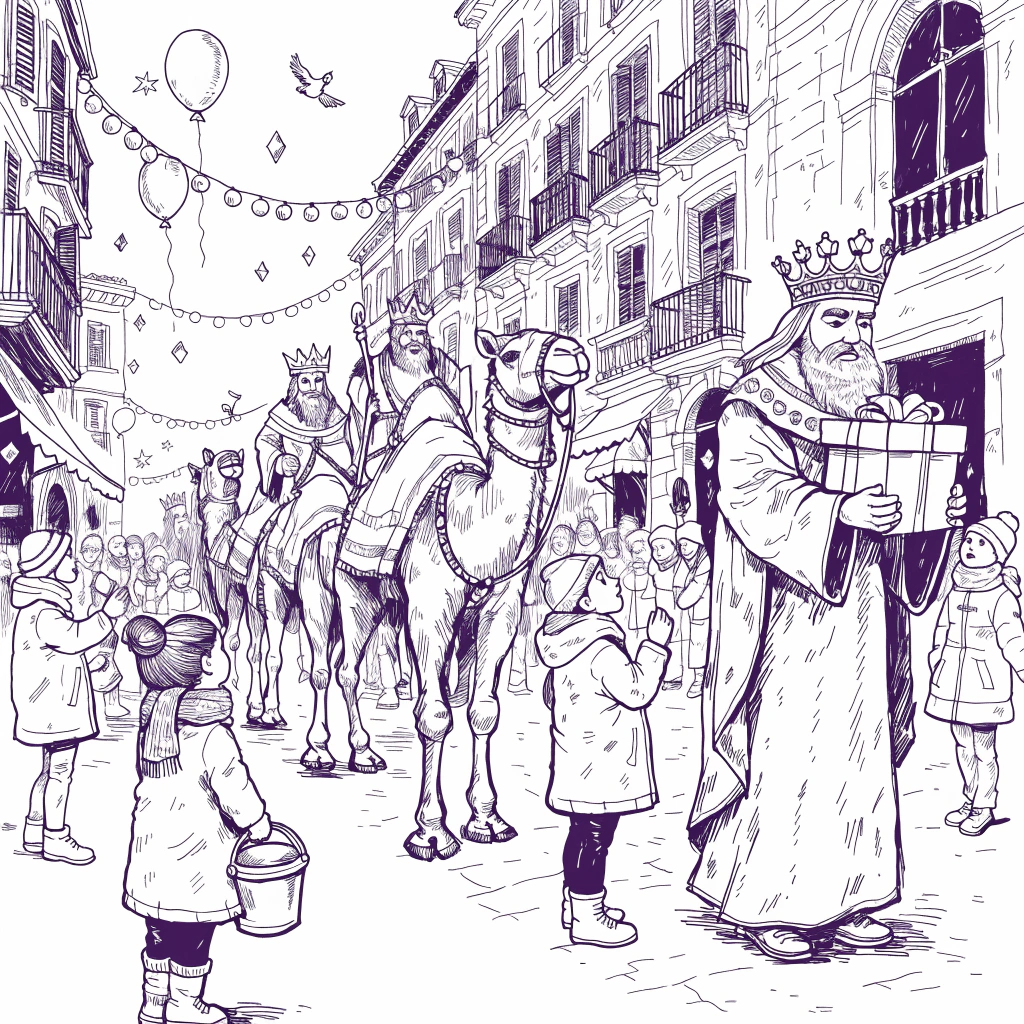
Three Kings Day in Spain
January 6th is a special day in Spain. It is Three Kings Day. People celebrate the Three Wise Men. Their names are Melchior, Caspar, and Balthazar.
On January 5th, there is a big parade. It is the Three Kings Parade. The Kings ride horses or camels. They throw sweets to the children. Many people watch the parade in the street.
Children get gifts from the Kings. Families eat a special cake. It is called Roscon de Reyes. It is a happy day for everyone in Spain.
语法聚焦
句型: 动词“To Be”(一般现在时)
"January 6th is a special day in Spain."
我们用 'is' 搭配单数主语来描述事实或状态。在这个句子中,它将日期与其描述联系起来。
句型: 用于日常活动的一般现在时
"They throw sweets to the children."
对于像 'they' 这样的复数主语,我们使用动词的原形。这种模式描述一个传统或常规活动。
测试你的理解
10 个问题 · A1 初学 · 1 次免费预览
Three Kings Day: Spain's Favorite Holiday
In Spain, the Christmas season is very long. It does not end in December. The most exciting day is January 6th. This is 'Los Reyes Magos' or Three Kings Day. It celebrates the three wise men who visited baby Jesus long ago.
The celebration starts on January 5th. Every city has a big parade. The Kings travel through the streets on horses or big floats. They throw many sweets to the children. This parade is louder and more colorful than a normal parade. Thousands of people watch the Kings arrive.
Before they go to sleep, children put their shoes near the window. They also leave food for the Kings and water for their camels. On the morning of January 6th, the children find many gifts. Families eat a special cake called 'Roscón'. It is a sweet bread with fruit on top. This holiday is special because families spend time together and share a big meal.
语法聚焦
句型: 比较级
"This parade is louder and more colorful than a normal parade."
我们用比较级来比较两样东西。在短的形容词后面加'-er',在长的形容词前面用'more'。
句型: 表示习惯的一般现在时
"Every city has a big parade."
我们用一般现在时来描述传统和常规活动。对于像 'every city' 这样的单数主语,我们用 'has' 而不是 'have'。
测试你的理解
11 个问题 · A2 基础 · 1 次免费预览
测试你从这篇文章中学到的知识。回答所有问题即可获得经验值!
题目详情
西班牙什么时候庆祝三王节?
你的回答:
正确答案: 1月6日
国王们在游行时会向孩子们扔糖果。
你的回答:
正确答案: 正确
'Roscón' 是什么?
你的回答:
正确答案: 一种特殊的蛋糕
孩子们睡觉前会把他们的 _____ 放在窗边。
你的回答:
正确答案: shoes
为什么孩子们在1月5日会把水放在外面?
你的回答:
正确答案: 给骆驼的
The Magic of the Three Kings in Spain
In many parts of the world, the holiday season ends shortly after New Year's Day. However, in Spain, the most exciting celebrations continue until January 6th. This special day is known as 'Los Reyes Magos' or Three Kings Day. It is a time when the arrival of the Three Wise Men—Melchior, Caspar, and Balthazar—is celebrated with great joy and ancient traditions.
The festivities officially begin on the evening of January 5th with a massive procession called the 'Cabalgata'. This event, which is watched by millions of excited families, features colorful floats and music. The Kings and their helpers throw thousands of sweets to the children who have been waiting patiently in the streets for hours. This festive atmosphere has been enjoyed by generations of Spanish people, and it remains the highlight of the winter season.
Before going to sleep, children participate in a unique tradition. They leave their shoes near the window or under the Christmas tree so the Kings know where to put the presents. They also leave some biscuits for the Kings and a bowl of water for the tired camels. Traditionally, children who have been good throughout the year receive wonderful gifts. However, those who have been naughty might find a piece of black 'coal'. Luckily, this coal is actually made of sugar!
On the morning of January 6th, families gather to open their presents and eat a special breakfast. The main treat is the 'Roscón de Reyes', a ring-shaped cake which is decorated with colorful candied fruits. Inside the cake, two items are hidden: a small toy figure and a dry bean. According to tradition, the person who finds the toy is crowned 'king' or 'queen' for the day. In contrast, the unlucky person who finds the bean must pay for the cake next year!
语法聚焦
句型: 关系从句
"The Kings and their helpers throw thousands of sweets to the children who have been waiting patiently in the streets for hours."
关系从句以‘who’、‘which’或‘that’等词开头,用以提供关于名词的更多信息。在这个例子中,‘who’明确告诉我们国王们正在给哪些孩子们发糖果。
句型: 被动语态
"It is a time when the arrival of the Three Wise Men is celebrated with great joy and ancient traditions."
被动语态由‘to be’+ 过去分词构成。当动作本身比执行动作的人更重要时使用,这在正式描述节日时很常见。
测试你的理解
11 个问题 · B1 中级 · 1 次免费预览
测试你从这篇文章中学到的知识。回答所有问题即可获得经验值!
题目详情
“三王节花车游行”(Cabalgata)在什么时候举行?
你的回答:
正确答案: 1月5日晚上
西班牙的孩子们会把鞋子放在外面,这样三位国王就知道把礼物放在哪里了。
你的回答:
正确答案: 正确
‘tradition’这个词是什么意思?
你的回答:
正确答案: 一个历史悠久的习俗或信仰
找到_____的倒霉蛋明年必须为蛋糕买单。
你的回答:
正确答案: bean
什么是‘Roscón de Reyes’(国王蛋糕)?
你的回答:
正确答案: 一个环形蛋糕
The Persistence of Tradition: Understanding Spain's Three Kings Day
While much of the Western world concludes its festive season shortly after New Year’s Day, Spain maintains a vibrant tradition that extends well into January. The celebration of Los Reyes Magos, or the Three Wise Men, represents a cornerstone of Spanish cultural identity, often taking precedence over the globalized figure of Santa Claus. Historically rooted in the biblical narrative of Melchior, Caspar, and Balthazar, the holiday serves as a profound reminder of the country’s historical and religious heritage.
The festivities commence in earnest on the evening of January 5th with the 'Cabalgata de Reyes'. This grand procession, which is characterized by elaborate floats and performers, winds through the streets of every major city. It is during this event that the Three Kings are seen distributing sweets to the throngs of spectators. For many Spanish children, the level of anticipation during this evening is unrivalled. They are encouraged to leave their shoes out, often accompanied by snacks for the weary camels, in hopes that their behavior throughout the year warrants a generous bounty of gifts.
Moreover, the symbolic nature of the gifts—Gold, Frankincense, and Myrrh—is frequently analyzed in an educational context. In modern times, these elements have been adapted to reflect contemporary values, though the core message of generosity remains intact. The kings themselves are often depicted as wise scholars from the East, each representing different parts of the known world at the time. This diversity, historically significant, continues to resonate in today’s multicultural Spain.
Furthermore, the socio-cultural impact of this holiday cannot be overlooked. In an era where commercialism often dilutes traditional practices, Spain has successfully preserved the unique essence of the Epiphany. Although Santa Claus has gained some traction in recent decades, the Three Kings remain the primary distributors of joy and gifts. Arguably, if these local customs had not been so deeply ingrained in the family unit, they might have been superseded by more homogenous international trends.
The celebration concludes on January 6th with a family gathering centered around the 'Roscón de Reyes', a circular cake decorated with candied fruits. Hidden within the dough are a small figurine and a dried bean; the individual who discovers the former is crowned 'king', while the latter must pay for the cake next year. This blend of playful competition and communal dining illustrates the enduring appeal of the holiday. Ultimately, Los Reyes Magos is not merely about the reception of material goods, but about the subsequent reinforcement of familial bonds and the preservation of a collective narrative that has spanned centuries.
语法聚焦
句型: 被动语态(一般现在时)
"This grand procession, which is characterized by elaborate floats and performers, winds through the streets..."
用于强调动作或被描述的对象,而不是执行动作的人。由'is/are' + 过去分词构成。
句型: 第三条件句
"...if these local customs had not been so deeply ingrained in the family unit, they might have been superseded..."
用于描述过去未发生的假设情况。由'if + 过去完成时'和'would/might have + 过去分词'构成。
句型: 指代:前者与后者
"...the individual who discovers the former is crowned 'king', while the latter must pay for the cake next year."
用于避免重复提及之前提到的两件事物。'The former'指第一项,'the latter'指第二项。
测试你的理解
11 个问题 · B2 中高级 · 1 次免费预览
测试你从这篇文章中学到的知识。回答所有问题即可获得经验值!
题目详情
在西班牙,1月5日晚上会举行什么主要活动?
你的回答:
正确答案: 一场名为‘三王节花车游行’的盛大游行
在西班牙,圣诞老人已完全取代三位国王成为主要的送礼者。
你的回答:
正确答案: 错误
哪个词的意思是‘比同类型的所有人或物都好’?
你的回答:
正确答案: Unrivalled
对许多西班牙孩子来说,这天晚上_____的感觉是无与伦比的。
你的回答:
正确答案: anticipation
在国王蛋糕(Roscón de Reyes)的传统中,找到蚕豆的人必须做什么?
你的回答:
正确答案: 支付明年的蛋糕钱
Epiphany and the Iberian Identity: The Enduring Legacy of Los Reyes Magos
Rarely in the modern era does a traditional festival withstand the homogenizing force of globalization with such poise as the Spanish celebration of Los Reyes Magos. While much of the Western world concludes its festivities shortly after December 25th, Spain prepares for its most significant cultural crescendo on January 6th. This day marks the Epiphany, commemorating the arrival of Melchior, Caspar, and Balthazar in Bethlehem. However, the significance of the event transcends religious boundaries, embedding itself into the very fabric of Spanish social life. The persistence of this tradition is not merely a matter of habit but a testament to the cultural resilience of a nation that treasures its specific heritage over imported alternatives.
Central to this celebration is the 'Cabalgata de Reyes', a magnificent pageant that unfolds on the evening of January 5th. Not only does this procession captivate the younger generation, but it also serves as a sophisticated display of civic prowess. Each municipality, regardless of its size, coordinates elaborate floats that shower the gathered crowds with sweets. It is the sheer scale and logistical complexity of these events that reinforces the holiday's precedence over more commercialized alternatives like Santa Claus. Despite the inroads made by Northern European and American traditions, the Three Kings remain the primary bringers of gifts, maintaining a symbolic grip on the national psyche that is both enduring and deeply emotional.
The economic impact of the season is profound, yet the discussion surrounding it often requires a certain degree of nuance. While the commercialization of Christmas is ubiquitous across the globe, the Spanish approach provides a fascinating case study in cultural resilience. The consumption of the 'Roscón de Reyes'—a ring-shaped cake containing a hidden figurine and a bean—is a ritualistic necessity that underscores the communal aspect of the day. This tradition, far from being a mere vestige of the past, continues to thrive in the 21st century, driven by a collective nostalgia that effectively bridges the generational gap. Families gather with a sense of anticipation, knowing that finding the bean results in paying for the cake, while the figurine grants the title of 'king'.
What distinguishes the Spanish festive calendar is its unique chronological structure. By extending the holiday season into the first week of January, Spain preserves a slower, more contemplative pace of celebration. This temporal discrepancy often puzzles foreign observers, yet for Spaniards, it is the culmination of a weeks-long buildup. The anticipation is palpable, particularly among children who write letters to the Kings, detailing their behavior throughout the year. The eventual arrival of the Kings, often preceded by a symbolic 'royal postman' or 'emissary', represents a confluence of mythology and reality that few other traditions can replicate. Children carefully leave their shoes by the window, accompanied by snacks for the Kings and water for their weary camels.
Ultimately, the enduring popularity of Los Reyes Magos is a testament to the power of shared narrative and communal identity. In an age where digital distractions are constant, the physical presence of the Three Kings—arriving by boat, helicopter, or camel—demands a rare moment of collective attention. It is through these meticulously curated rituals that Spain continues to safeguard its cultural identity, ensuring that the magic of the Epiphany remains as potent today as it was for previous generations. As long as the tradition of the 'carbon' for the naughty and the Roscón for the family remains, the Kings will continue to reign supreme over the Iberian festive landscape.
语法聚焦
句型: 用于强调的倒装句
"Rarely in the modern era does a traditional festival withstand the homogenizing force of globalization with such poise as the Spanish celebration of Los Reyes Magos."
当主语和助动词位置互换时,就构成了倒装,这通常发生在否定或限制性副词之后。这种结构用于加强语气,使开场白听起来更正式、更具文学色彩。
句型: 分裂句
"It is the sheer scale and logistical complexity of these events that reinforces the holiday's precedence over more commercialized alternatives like Santa Claus."
分裂句使用“It is/was... that...”结构来聚焦于句子的特定部分(焦点)。在这个例子中,它强调了该节日之所以比圣诞老人更受重视的具体原因(即规模和后勤复杂性)。
句型: 伪分裂句
"What distinguishes the Spanish festive calendar is its unique chronological structure."
伪分裂句使用一个“wh-”从句(通常以“What”开头)作为主语,来引出并强调新的信息。这种结构将读者的注意力引向“独特的年表结构”这一决定性特征上。
测试你的理解
12 个问题 · C1 高级 · 1 次免费预览
测试你从这篇文章中学到的知识。回答所有问题即可获得经验值!
题目详情
根据文章,什么最能说明这个节日比圣诞老人更受重视?
你的回答:
正确答案: 盛大游行的巨大规模和后勤复杂性
作者将“国王环形蛋糕”描述为一种正在消失的昔日遗迹。
你的回答:
正确答案: 错误
在文中,“ubiquitous”是什么意思?
你的回答:
正确答案: 随处可见的
1月6日三王的到来标志着____。
你的回答:
正确答案: epiphany
文中提到的“三王节游行”的主要作用是什么?
你的回答:
正确答案: 吸引孩子们并展示市民的组织能力
西班牙的孩子们会把鞋子放在外面,好让三王找到。
你的回答:
正确答案: 正确
The Persistence of Epiphany: A Sociocultural Analysis of ‘Los Reyes Magos’ in Spain
While the Gregorian calendar marks the turn of the year with universal fanfare, Spain’s festive period remains uniquely elongated, reaching its zenith not on the first of January, but on the sixth. This day, the Epiphany, or 'Día de Reyes', is far more than a mere religious observance; it is a profound sociocultural anchor that has successfully resisted the homogenizing forces of globalized consumerism. The arrival of the Three Wise Men—Melchior, Caspar, and Balthazar—is a cornerstone of Spanish identity, representing a temporal bridge between ancient liturgy and modern festivity.
To suggest that the Anglo-American figure of 'Papá Noel' has been entirely rebuffed would be an oversimplification of contemporary Spanish trends. A delicate, albeit sometimes fraught, coexistence has emerged. However, the Three Kings remain the primary dispensers of both tangible gifts and cultural continuity. Should the Kings ever be relegated to a secondary status, it would signal a significant erosion of the Spanish domestic tapestry. Not only does the Epiphany mark the spiritual culmination of the Nativity, but it also functions as a vital mechanism for intergenerational bonding, where the collective suspension of disbelief sustains a shared magical realism.
The evening of January 5th witnesses the 'Cabalgata de Reyes', a processional spectacle that transforms urban centers into arenas of sensory opulence. These parades are not merely logistical exercises in candy distribution; they are civic rituals where the mythic is reified. As the Kings traverse the streets, they are met by dense throngs of families, all participating in a performative act of welcome. For the children, the physical presence of the Kings—perched atop elaborate floats—validates the weeks of anticipatory behavior and the meticulous drafting of 'the letter'. Historically, the 'Cabalgata' has evolved from humble neighborhood processions into high-production theatrical events. This adaptability ensures that the ritual remains relevant to successive generations, preventing it from becoming a stagnant relic of the past.
In the domestic sphere, the ritual nuances are equally significant. The tradition of placing shoes in a conspicuous location, accompanied by refreshments for the Kings and water for their weary camels, persists as an essential ritualistic gesture. This act of hospitality, though seemingly trivial, reinforces the pedagogical values of gratitude and preparation. The subsequent discovery of gifts on the morning of the 6th is the denouement of a season-long narrative arc, one that prioritizes patience over the instant gratification often championed by modern retail.
The culinary dimensions of the day are centered around the 'Roscón de Reyes'. This circular brioche, festooned with candied fruit to resemble a jeweled crown, contains a duality of surprises: a small king figurine and a dried fava bean. The individual who discovers the king is rightfully crowned, while the unfortunate recipient of the bean is traditionally tasked with the financial settlement for the cake. This playful tradition mirrors the vagaries of fortune, introducing a secular element of chance into the religious holiday. It serves as a social glue, compelling families to gather and share in a final moment of communal indulgence before the return to the mundane routines of January.
Ultimately, the enduring popularity of 'Los Reyes Magos' serves as a testament to the resilience of tradition in the face of rapid secularization. While the theological underpinnings may have shifted for many, the cultural imperatives remain robust. The holiday provides a structured conclusion to the winter cycle, ensuring that the transition into the new year is tempered by wonder and heritage. It is this unique synthesis of the sacred and the celebratory that allows the Three Kings to maintain their sovereign grip on the Spanish imagination, standing as a bulwark against the encroachment of a more standardized, globalized holiday experience.
语法聚焦
句型: 倒装第一条件句
"Should the Kings ever be relegated to a secondary status, it would signal a significant erosion of the Spanish domestic tapestry."
在正式或学术语境中,'Should' 置于从句开头以替代 'If'。它描述了一种假设的可能性,并且要求使用动词原形。
句型: 否定倒装句
"Not only does the Epiphany mark the spiritual culmination of the Nativity, but it also functions as a vital mechanism for intergenerational bonding."
当 'Not only' 开头用于强调时,主语和助动词(does)会倒装。这种结构必须后跟 'but also' 从句。
句型: 不定式短语作主语并带条件情态动词
"To suggest that the Anglo-American figure of 'Papá Noel' has been entirely rebuffed would be an oversimplification of contemporary Spanish trends."
不定式短语 'To suggest...' 在句中充当语法主语。使用 'would be' 旨在学术上进行委婉表达,使论点听起来更具分析性,而非武断。
测试你的理解
12 个问题 · C2 精通 · 1 次免费预览
测试你从这篇文章中学到的知识。回答所有问题即可获得经验值!
关于西班牙圣诞老人(Papá Noel)和三王之间关系的主要论点是什么?
题目详情
关于西班牙圣诞老人(Papá Noel)和三王之间关系的主要论点是什么?
你的回答:
正确答案: 这两个形象并存,但三王仍然是主要的文化焦点。
“三王大游行”被描述为一个纯粹侧重于高效分发糖果的物流活动。
你的回答:
正确答案: 错误
哪个词最能描述与“三王蛋糕(Roscón de Reyes)”相关的“出人意料且难以解释的变化”?
你的回答:
正确答案: Vagaries
西班牙的节日季被描述为在1月6日达到其_____。
你的回答:
正确答案: zenith
根据文章,摆放鞋子和点心的传统强化了哪些教育价值?
你的回答:
正确答案: 感恩和准备
在“三王蛋糕(Roscón de Reyes)”的传统中,找到豆子是一个积极的结果,意味着被加冕。
你的回答:
正确答案: 错误

