









pandora em 30 segundos
- Pandora is the first woman in Greek mythology, created as a punishment for humanity, whose curiosity led her to release all the world's evils from a jar.
- The phrase 'Pandora's box' is a widely used idiom meaning a source of extensive but unforeseen troubles or a situation that becomes uncontrollably complex.
- While the myth originally featured a storage jar (pithos), a 16th-century mistranslation turned it into a 'box,' which is the term used in modern English.
- The word is commonly found in literature, politics, and science, often serving as a warning against the unintended consequences of human curiosity or interference.
The term Pandora originates from ancient Greek mythology, representing the first human woman created by the gods. According to the myth, Zeus ordered Hephaestus to mold her from earth as part of a punishment for humanity after Prometheus stole fire. Each god contributed a unique gift—beauty, persuasion, and music—hence her name, which translates to 'all-gifted' (pan meaning 'all' and doron meaning 'gift'). However, the most significant aspect of her story involves a vessel, often referred to as 'Pandora's box,' which she was instructed never to open. Driven by curiosity, she eventually opened it, inadvertently releasing all the evils, diseases, and hardships into the world. The only thing that remained inside when she finally closed the lid was hope. In modern English, the name is rarely used for individuals but is ubiquitous in the idiomatic expression 'to open a Pandora's box,' which serves as a powerful metaphor for performing an action that seems small or innocent but results in a cascade of complex, uncontrollable, and often negative consequences. People use this term in political, social, and personal contexts to warn against meddling in situations where the full extent of the repercussions is unknown. It evokes a sense of irreversible change and the fragility of order when faced with human curiosity or interference.
- Mythological Origin
- Created by Hephaestus on Zeus's orders to bring balance (and punishment) to mankind.
- The Vessel
- Originally a 'pithos' (large jar), it was mistranslated into 'pyxis' (box) in the 16th century by Erasmus of Rotterdam.
- Symbolic Hope
- The presence of Elpis (Hope) at the bottom suggests that even in the face of total calamity, humanity retains a saving grace.
The investigation into the company's finances opened a Pandora's box of legal troubles that no one expected.
Beyond the myth, the word has been adopted by various brands and scientific entities. For instance, Pandora is a well-known music streaming service that uses the 'Music Genome Project' to provide 'gifts' of music to its users, playing on the 'all-gifted' etymology. In astronomy, Pandora is one of the inner moons of Saturn, discovered in 1980. The word carries a weight of ancient wisdom, reminding us that curiosity is a double-edged sword. It is used by writers to describe characters who are catalysts for change, often unintended. When a journalist says a new law might open a Pandora's box, they are signaling a warning that the law's side effects might be far worse than the problem it intends to solve. This usage requires a high level of cultural literacy, as it assumes the listener is familiar with the Greek tragedy and the concept of unintended consequences. It is a staple of C1 and C2 level English, appearing frequently in editorials, academic essays, and high-level literature to add depth and historical resonance to an argument.
In the movie, the scientist realized that his invention was a Pandora's box that could destroy the world.
She felt like Pandora, unable to resist the urge to look inside the forbidden room.
The diplomat warned that military intervention would be a Pandora's box for the region.
Once the secret was out, the Pandora's box of family drama could not be closed.
Using the word Pandora correctly requires an understanding of its possessive form and its metaphorical weight. Most commonly, it appears as 'Pandora's box.' This phrase functions as a noun phrase that can be the subject or object of a sentence. For example, 'Pandora's box was opened' (passive) or 'He opened Pandora's box' (active). It is crucial to remember that the 'box' is the central element of the metaphor. You don't just 'use Pandora'; you refer to her story or her box. When you use the term, you are often describing a situation that is complex and likely to get worse. It is a formal and literary term, so it fits well in academic writing, journalism, and sophisticated conversation. It is rarely used in very casual slang, although the concept is understood by most English speakers due to its prevalence in pop culture. To use it effectively, ensure that the context involves a 'point of no return'—once the action is taken, the consequences are inevitable and widespread.
- As a Metaphor for Complexity
- 'The new tax law is a Pandora's box of loopholes and contradictions.'
- As a Warning
- 'Before you ask about his past, remember that you might be opening a Pandora's box.'
- In Literature
- 'She stood before the door like Pandora, her hand trembling on the latch.'
The CEO's resignation opened a Pandora's box of corporate scandals.
In more advanced usage, you can refer to 'Pandora' as an archetype. An archetype is a typical example of a certain person or thing. Pandora is the archetype of the 'curious woman' or the 'unwitting bringer of chaos.' In a sentence like, 'The protagonist is a modern-day Pandora,' you are implying that her actions, though perhaps well-intentioned or simply curious, will lead to a massive upheaval. This level of usage is common in literary criticism and character analysis. Additionally, you might see the term used in scientific naming conventions. When a scientist names a new species or a phenomenon 'Pandora,' they are often referencing the 'all-gifted' aspect or the idea of something being released from a hidden state. For example, the 'Pandoravirus' was named because its discovery opened up many new questions about the nature of viruses, effectively opening a 'Pandora's box' of scientific inquiry. When writing, always consider if the situation truly warrants such a strong mythological reference. If the consequences are minor, 'Pandora's box' might be too hyperbolic.
Asking about the budget during the meeting was like opening Pandora's box.
The discovery of the ancient tomb was a Pandora's box for the archaeologists.
You will encounter Pandora in a variety of high-level discourse environments. In political journalism, it is a favorite term for pundits describing the potential fallout of a controversial policy or a legal ruling. For example, a news anchor might say, 'The Supreme Court's decision has opened a Pandora's box of litigation across the country.' This tells the audience that the ruling has created a situation where many people will now start suing each other, leading to chaos in the legal system. In the world of technology and business, the word often appears in the names of companies and projects. The most famous is Pandora Media, the music streaming service. Here, the name is meant to evoke the 'all-gifted' nature of the service—providing an endless stream of music tailored to the user. However, the irony of the name is not lost on those who know the myth, as the music industry has often felt that digital streaming opened a 'Pandora's box' of copyright and revenue issues.
- News and Media
- Used to describe the unintended consequences of political actions or social movements.
- Science and Technology
- Used in naming (e.g., Pandora's moon, Pandoravirus) to signify discovery and new questions.
- Pop Culture
- The planet in the movie 'Avatar' is named Pandora, emphasizing its beauty and the danger of human interference.
The 'Pandora Papers' leak revealed the hidden wealth of world leaders, opening a Pandora's box of corruption investigations.
Another significant place you will hear this word is in the 'Pandora Papers.' This was a massive leak of nearly 12 million documents in 2021 that exposed the secret offshore accounts of world leaders, billionaires, and celebrities. The journalists chose the name 'Pandora' specifically because the leak 'opened the box' on global financial secrecy, releasing a flood of scandals and legal challenges. This real-world application of the myth demonstrates how deeply embedded the concept is in our collective consciousness. In literature and film, Pandora is often used as a name for characters who are beautiful but dangerous, or who possess a secret that could change everything. In the movie 'Avatar,' the moon Pandora is a lush, beautiful world that humans try to exploit, which leads to a catastrophic war. The choice of the name highlights the theme of human greed and the 'evils' released when we disturb the natural order. Whether in a serious news report or a sci-fi blockbuster, the word 'Pandora' serves as a shorthand for the complex relationship between curiosity, discovery, and consequence.
One of the most frequent mistakes learners make with Pandora is failing to capitalize it. Because it is a proper noun derived from Greek mythology, it must always start with a capital 'P.' Another common error is using the word without the 's' in the possessive form when referring to the box. It is 'Pandora's box,' not 'Pandora box.' Some learners also confuse the meaning of the idiom, thinking it refers to a 'box of treasures' or a 'good surprise' because of the 'all-gifted' etymology. While Pandora herself was gifted, the 'box' (or jar) contained only evils. Therefore, opening a Pandora's box is never a positive thing in the idiomatic sense, although it might lead to 'hope' eventually. It is also important to distinguish between 'Pandora' and 'panacea.' A panacea is a cure-all or a solution to all problems, which is essentially the opposite of what Pandora's box represents.
- Capitalization
- Incorrect: 'He opened a pandora's box.' Correct: 'He opened a Pandora's box.'
- Possessive Form
- Incorrect: 'The Pandora box of issues.' Correct: 'The Pandora's box of issues.'
- Confusion with Panacea
- A panacea fixes everything; Pandora's box breaks everything.
Don't say: 'This new software is a Pandora's box that will solve all our problems.' (Incorrect usage)
Additionally, some people mistakenly believe that Pandora was evil herself. In the original myths, she was often portrayed as an innocent or naive figure who was simply a tool of the gods' vengeance. The 'evil' came from the contents of the jar, not from her character. Misinterpreting her as a villain can lead to incorrect usage in literary analysis. Furthermore, there is the historical 'jar vs. box' issue. While scholars know it was originally a jar (pithos), in modern English, saying 'Pandora's jar' will likely confuse people. Stick to 'Pandora's box' for the idiom, but you can mention the 'jar' in an academic or historical context to show off your deep knowledge. Finally, avoid overusing the idiom. It is a very strong metaphor. If you use it for every minor problem, it loses its impact. Save it for situations that truly involve a complex and irreversible set of problems.
If you find yourself using Pandora too often, or if the mythological reference doesn't quite fit the tone of your writing, there are several alternatives. 'Can of worms' is the most common informal equivalent. To 'open a can of worms' means to start a process that will be far more complicated and unpleasant than you anticipated. While 'Pandora's box' has a grand, tragic, and ancient feel, 'can of worms' is more everyday and slightly messy. Another alternative is 'slippery slope,' which refers to a situation where one small step will lead to a chain of events that cannot be stopped, usually ending in disaster. While similar, a slippery slope focuses on the process of decline, whereas Pandora's box focuses on the sudden release of many different problems at once.
- Can of worms
- Informal. Used for messy, complicated situations. 'Let's not open that can of worms today.'
- Slippery slope
- Focuses on the inevitable decline. 'Allowing this minor change is a slippery slope to total deregulation.'
- The tip of the iceberg
- Focuses on the fact that the visible problems are only a small part of a much larger issue.
Instead of saying 'Pandora's box,' you could say: 'The new policy is a minefield of potential issues.'
In a more formal or technical context, you might use terms like 'unintended consequences' or 'cascading failures.' These lack the poetic flair of the Greek myth but are more precise for scientific or business reports. 'Unintended consequences' is a neutral way to describe the 'evils' that come out of the box. 'Cascading failures' is used in engineering and systems theory to describe how one small failure can trigger a series of others. Another interesting comparison is with 'the Trojan Horse.' While both come from Greek myth, a Trojan Horse is something that looks like a gift but is actually a hidden trap. Pandora herself was a 'gift' that brought trouble, but the idiom 'Pandora's box' focuses on the act of releasing the trouble, whereas 'Trojan Horse' focuses on the deception involved. Choosing the right word depends on whether you want to emphasize the surprise (Pandora), the deception (Trojan Horse), the messiness (can of worms), or the inevitability (slippery slope).
How Formal Is It?
Curiosidade
The 'box' in Pandora's box was actually a large storage jar called a 'pithos.' The change to 'box' happened in the 16th century when the scholar Erasmus of Rotterdam translated the story into Latin and used the word 'pyxis' (box) instead of 'pithos' (jar).
Guia de pronúncia
- Stressing the first syllable (PAN-dor-a).
- Pronouncing the 'o' as a short 'o' like in 'hot' instead of the long 'or' sound.
- Pronouncing the final 'a' as a long 'ay' sound.
- Confusing the pronunciation with 'pan-door-ah'.
- Mumbling the 'n' sound in the first syllable.
Nível de dificuldade
Requires knowledge of Greek mythology and the ability to understand metaphorical language.
Using the idiom correctly in a sentence requires a high level of nuance and context.
The pronunciation is straightforward, but the cultural reference must be used appropriately.
Common in news and documentaries, often used without explanation.
O que aprender depois
Pré-requisitos
Aprenda a seguir
Avançado
Gramática essencial
Possessive Proper Nouns
Pandora's box (The 's indicates possession by the mythological figure).
Definite vs. Indefinite Articles with Idioms
He opened *a* Pandora's box (general) vs. He opened *the* Pandora's box of scandals (specific).
Capitalization of Mythological Figures
Pandora must always be capitalized as it is a proper name.
Using Nouns as Adjectives (Attributive Nouns)
The Pandora myth (Pandora acts as an adjective describing the myth).
Metaphorical Noun Phrases
The situation was a Pandora's box (The whole phrase acts as a single noun).
Exemplos por nível
Pandora was a woman in an old story.
Pandora était une femme dans une vieille histoire.
Proper noun used as a subject.
She had a big box.
Elle avait une grande boîte.
Simple past tense 'had'.
The gods told Pandora, 'Do not open it.'
Les dieux ont dit à Pandora : 'Ne l'ouvre pas.'
Imperative mood 'Do not open'.
Pandora was very curious.
Pandora était très curieuse.
Adjective 'curious' describing the subject.
She opened the box and bad things came out.
Elle a ouvert la boîte et des choses mauvaises sont sorties.
Compound sentence with 'and'.
Pandora was sad.
Pandora était triste.
Simple subject-verb-adjective structure.
Hope was still in the box.
L'espoir était encore dans la boîte.
Noun 'Hope' as a subject.
We call this 'Pandora's box'.
Nous appelons cela 'la boîte de Pandore'.
Possessive form with 's.
Pandora was the first woman in Greek myths.
Pandora était la première femme dans les mythes grecs.
Ordinal number 'first' before the noun.
The gods gave her many gifts.
Les dieux lui ont donné de nombreux cadeaux.
Indirect object 'her' before direct object 'gifts'.
She could not stop herself from opening the box.
Elle n'a pas pu s'empêcher d'ouvrir la boîte.
Reflexive pronoun 'herself'.
Opening the box was a big mistake.
Ouvrir la boîte était une grosse erreur.
Gerund 'Opening' as the subject.
Many problems flew out into the world.
De nombreux problèmes se sont envolés dans le monde.
Prepositional phrase 'into the world'.
She tried to close the lid quickly.
Elle a essayé de fermer le couvercle rapidement.
Infinitive 'to close' after the verb 'tried'.
Only hope remained inside.
Seul l'espoir est resté à l'intérieur.
Adverb 'Only' modifying the noun 'hope'.
Don't open a Pandora's box of trouble.
N'ouvre pas une boîte de Pandore de problèmes.
Negative imperative.
The name Pandora means 'all-gifted' in Greek.
Le nom Pandora signifie 'tous les dons' en grec.
Present simple for a general fact.
Her curiosity is the most famous part of the story.
Sa curiosité est la partie la plus célèbre de l'histoire.
Superlative 'the most famous'.
The jar contained all the evils of the world.
La jarre contenait tous les maux du monde.
Past tense of 'contain'.
If she hadn't opened it, the world would be different.
Si elle ne l'avait pas ouverte, le monde serait différent.
Third conditional for an imaginary past.
People often use Pandora's box as a metaphor.
Les gens utilisent souvent la boîte de Pandore comme métaphore.
Adverb of frequency 'often'.
Asking that question might open a Pandora's box.
Poser cette question pourrait ouvrir une boîte de Pandore.
Modal verb 'might' for possibility.
She felt like Pandora when she found the secret diary.
Elle s'est sentie comme Pandora quand elle a trouvé le journal intime secret.
Simile using 'like'.
The story of Pandora teaches us about consequences.
L'histoire de Pandora nous enseigne les conséquences.
Transitive verb 'teaches' with two objects.
Zeus created Pandora to punish mankind for stealing fire.
Zeus a créé Pandora pour punir l'humanité d'avoir volé le feu.
Infinitive of purpose 'to punish'.
The myth explains why there is suffering in the world.
Le mythe explique pourquoi il y a de la souffrance dans le monde.
Noun clause 'why there is suffering'.
Erasmus of Rotterdam is responsible for the 'box' translation.
Érasme de Rotterdam est responsable de la traduction 'boîte'.
Adjective 'responsible' followed by the preposition 'for'.
The investigation opened a Pandora's box of corruption.
L'enquête a ouvert une boîte de Pandore de corruption.
Metaphorical use of the noun phrase.
Once you open Pandora's box, you can't easily close it.
Une fois que vous ouvrez la boîte de Pandore, vous ne pouvez pas la refermer facilement.
Conjunction 'Once' introducing a time clause.
Her decision was a Pandora's box that ruined her career.
Sa décision était une boîte de Pandore qui a ruiné sa carrière.
Relative clause 'that ruined her career'.
The phrase is a common idiom in political journalism.
L'expression est un idiome courant dans le journalisme politique.
Compound noun 'political journalism'.
Hope is the only thing that makes life bearable after the box is opened.
L'espoir est la seule chose qui rend la vie supportable après l'ouverture de la boîte.
Passive voice 'is opened'.
The etymology of Pandora suggests she was a vessel of divine gifts.
L'étymologie de Pandora suggère qu'elle était un réceptacle de dons divins.
Subject-verb agreement with 'etymology'.
Hesiod's account of Pandora is deeply rooted in ancient misogyny.
Le récit d'Hésiode sur Pandora est profondément enraciné dans la misogynie antique.
Passive construction 'is deeply rooted'.
The legal ruling could potentially open a Pandora's box of lawsuits.
La décision de justice pourrait potentiellement ouvrir une boîte de Pandore de procès.
Adverb 'potentially' modifying the modal 'could'.
She was wary of opening a Pandora's box by mentioning the inheritance.
Elle craignait d'ouvrir une boîte de Pandore en mentionnant l'héritage.
Gerund 'opening' after the preposition 'of'.
The discovery of the virus was a Pandora's box for the scientific community.
La découverte du virus a été une boîte de Pandore pour la communauté scientifique.
Prepositional phrase 'for the scientific community'.
The 'Pandora Papers' highlighted the scale of global tax evasion.
Les 'Pandora Papers' ont mis en évidence l'ampleur de l'évasion fiscale mondiale.
Proper noun phrase as a subject.
The myth serves as a cautionary tale about the limits of human knowledge.
Le mythe sert de conte moral sur les limites de la connaissance humaine.
Verb 'serves as' followed by a noun phrase.
Pandora's curiosity is often contrasted with Prometheus's foresight.
La curiosité de Pandora est souvent opposée à la prévoyance de Prométhée.
Passive voice with 'is often contrasted'.
The Pandoric myth encapsulates the inherent risks of intellectual hubris.
Le mythe de Pandore résume les risques inhérents à l'orgueil intellectuel.
Precise vocabulary 'encapsulates' and 'hubris'.
To invoke Pandora is to acknowledge the irreversible nature of certain social shifts.
Invoquer Pandora, c'est reconnaître le caractère irréversible de certains changements sociaux.
Infinitive phrases used as subject and complement.
The linguistic shift from jar to box altered the visual semiotics of the myth.
Le glissement linguistique de la jarre à la boîte a modifié la sémiotique visuelle du mythe.
Technical term 'semiotics'.
The protagonist's actions were the catalyst that opened a Pandora's box of existential dread.
Les actions du protagoniste ont été le catalyseur qui a ouvert une boîte de Pandore d'angoisse existentielle.
Complex sentence with a relative clause.
The report was a Pandora's box, unleashing a torrent of public indignation.
Le rapport était une boîte de Pandore, déchaînant un torrent d'indignation publique.
Participial phrase 'unleashing a torrent'.
Scholars debate whether Elpis was a final gift or the ultimate evil within the vessel.
Les érudits débattent pour savoir si Elpis était un dernier cadeau ou le mal ultime à l'intérieur du récipient.
Noun clause 'whether Elpis was...'.
The environmental impact of the project proved to be a Pandora's box of ecological disasters.
L'impact environnemental du projet s'est avéré être une boîte de Pandore de catastrophes écologiques.
Infinitive 'to be' after the verb 'proved'.
Her role in the scandal made her a modern-day Pandora in the eyes of the media.
Son rôle dans le scandale a fait d'elle une Pandora des temps modernes aux yeux des médias.
Prepositional phrase 'in the eyes of the media'.
Colocações comuns
Frases Comuns
— To do something that causes a lot of new and unexpected problems. It is the most common way to use the word.
The court's ruling has opened Pandora's box for future legal battles.
— A literal reference to the myth, describing a collection of very bad things. It is used for emphasis.
The war released a Pandora's box of evils upon the civilian population.
— Describing someone who is dangerously curious or who inadvertently causes trouble. It is a character comparison.
He stood there like Pandora, wondering if he should look inside the file.
— A gift that seems good but actually brings trouble. This is a more subtle reference to the 'all-gifted' name.
The promotion felt like a Pandora's gift, bringing more stress than money.
— A psychological term or general concept where curiosity leads people to do things that might harm them. It is used in behavioral science.
The Pandora effect explains why people click on clickbait links.
— Referring to the idea that even in bad situations, something good remains. It is a more positive use of the myth.
In the midst of the crisis, we found Pandora's hope.
— A way to describe a situation that is extremely complicated. It is common in professional settings.
Merging the two companies turned out to be a Pandora's box of issues.
— The lasting impact of a mistake or a discovery that changed everything. It is used in historical or scientific contexts.
The legacy of the nuclear age is a kind of Pandora's box.
— A specific type of curiosity that is irresistible but dangerous. It is used to describe a personality trait.
Her Pandora's curiosity always got her into trouble.
— A more descriptive version of the main idiom, emphasizing the start of the process. It is used for dramatic effect.
By asking that question, you are opening the lid of Pandora's box.
Frequentemente confundido com
A panacea is a universal cure, while Pandora's box is a source of universal trouble. They are opposites.
Both are Greek myths, but a Trojan Horse is a hidden trap, while Pandora's box is about curiosity and unintended consequences.
Similar meaning, but 'can of worms' is informal and 'Pandora's box' is formal/literary.
Expressões idiomáticas
— To start a process that will lead to many unforeseen and uncontrollable problems. It is a very common idiom.
The new law opened a Pandora's box of complaints.
Neutral/Formal— A variation used to describe someone who has many surprising (and often problematic) ways of doing things. It is less common.
The politician had a Pandora's box of tricks to win the election.
Informal— A simile used to compare a current action to the mythological event. It highlights the risk involved.
Starting a business with a friend can be like opening Pandora's box.
Neutral— Used when someone reveals a series of hidden facts that cause trouble. It is common in drama and fiction.
The diary was a Pandora's box of secrets that destroyed the family.
Neutral— Describes a situation that brings up many different and difficult feelings. It is used in psychological contexts.
Going back to his hometown opened a Pandora's box of emotions.
Neutral— A specific legal idiom referring to a ruling that will lead to many more lawsuits. It is common in law.
The patent dispute opened a Pandora's box of litigation.
Formal— A slightly ironic use where the 'surprises' are usually negative. It is used for dramatic effect.
The old house was a Pandora's box of surprises, most of them expensive to fix.
Informal— A modern idiom referring to the various social and ethical problems caused by digital technology. It is common in tech criticism.
Social media has become the Pandora's box of the 21st century.
Neutral— A rare hybrid of 'Pandora's box' and 'can of worms.' It is technically incorrect but sometimes heard.
He really opened a Pandora's box of worms with that comment.
Informal— A straightforward variation of the main idiom. It is used to emphasize the negative nature of the consequences.
The divorce was a Pandora's box of troubles for everyone involved.
NeutralFácil de confundir
Both start with 'Pan-' and relate to global or universal concepts.
A panacea is a positive solution that fixes everything. Pandora's box is a negative source of many problems. You want a panacea; you avoid a Pandora's box.
The new vaccine was seen as a panacea, not a Pandora's box.
Both start with 'Pan-' and involve chaos.
Pandemonium is a state of wild noise and confusion (a noun for the situation itself). Pandora is a person/myth that *causes* the chaos. You can have pandemonium *after* opening Pandora's box.
Pandemonium broke out after the Pandora's box of secrets was opened.
Both start with 'Pan-' and are related to performance or stories.
A pantomime is a type of silent acting or a specific kind of play. It has nothing to do with the myth of Pandora or unintended consequences.
The children enjoyed the pantomime, which was unrelated to the myth of Pandora.
Both start with 'Pan-' and refer to a wide view or scope.
A panorama is a wide-angle view of a physical space. Pandora's box refers to a wide scope of problems. One is visual; the other is metaphorical.
From the top of the hill, we saw a panorama, not a Pandora's box.
It's the same name used for a popular brand.
The brand uses the name to suggest a box of beautiful gifts (the 'all-gifted' meaning). The idiom uses the name to suggest a box of troubles. Context is key.
She bought a bracelet at Pandora, not a Pandora's box of trouble.
Padrões de frases
Pandora was [adjective].
Pandora was curious.
She opened the [noun].
She opened the box.
It is like opening a Pandora's box.
Asking him about his ex-wife is like opening a Pandora's box.
The [noun] opened a Pandora's box of [noun].
The new law opened a Pandora's box of complaints.
To [verb] is to open a Pandora's box of [adjective] [noun].
To deregulate the market is to open a Pandora's box of economic instability.
The [noun] proved to be a Pandora's box, unleashing [noun].
The scientific discovery proved to be a Pandora's box, unleashing a host of ethical dilemmas.
Once Pandora's box is opened, [clause].
Once Pandora's box is opened, there is no going back to the way things were.
Invoking the myth of Pandora, the [noun] argued that [clause].
Invoking the myth of Pandora, the senator argued that the bill would cause more harm than good.
Família de palavras
Substantivos
Adjetivos
Relacionado
Como usar
Common in journalism, literature, and high-level academic writing. Rare in basic daily conversation.
-
Using 'Pandora box' without the 's'.
→
Pandora's box.
The idiom requires the possessive form because the box is associated with the character Pandora.
-
Thinking Pandora's box contains good things.
→
Pandora's box contains evils/troubles.
Learners often get confused by the name 'all-gifted' and think the box is a good thing. In the idiom, it is always negative.
-
Not capitalizing the 'P' in Pandora.
→
Pandora's box.
Pandora is a proper noun from Greek mythology and must be capitalized.
-
Using 'Pandora's box' for a simple, easy-to-solve problem.
→
A minor issue / A small problem.
Pandora's box implies a cascade of uncontrollable problems. Using it for small things is hyperbolic and incorrect.
-
Confusing 'Pandora's box' with 'Trojan Horse'.
→
Use 'Pandora's box' for curiosity/consequences and 'Trojan Horse' for hidden traps.
While both are Greek, they describe different types of trouble. A Trojan Horse is a trick; Pandora's box is a mistake driven by curiosity.
Dicas
Capitalize the P
Always capitalize 'Pandora' because it is a proper noun from mythology. Writing it with a lowercase 'p' is a common spelling error.
Use the Possessive
Always include the 's' after Pandora. It is 'Pandora's box,' indicating the box that belonged to her.
Save it for Big Issues
Don't use 'Pandora's box' for small problems like losing your keys. Use it for big, complicated situations like political scandals or major life changes.
Can of Worms
If you are in a casual setting, use 'can of worms' instead. It means the same thing but sounds less formal and more natural in daily speech.
The Definite Article
Usually, we say 'open *a* Pandora's box' when talking about a general possibility, and 'open *the* Pandora's box of...' when specifying the problems.
Jar vs. Box
Knowing it was originally a jar is a great 'fun fact' for academic essays, but always use 'box' in the idiom so people understand you.
Avoid Overuse
Because it's a very strong and famous metaphor, using it too often can make your writing feel cliché. Use it once for maximum impact.
Curious Pandora
Associate Pandora with 'curiosity.' It helps you remember why the box was opened and what the idiom implies about human nature.
Pandora vs. Panacea
Remember that Panacea is the 'cure' and Pandora is the 'cause' of trouble. They both start with 'Pan' but have opposite effects.
Hope is Key
Don't forget that 'hope' was at the bottom. You can use this to add a positive twist to your writing: 'While the decision opened a Pandora's box, there is still hope for a solution.'
Memorize
Mnemônico
Think of 'PAN' (all) and 'DORA' (like the explorer). Pandora was an explorer of a box that contained ALL the world's problems.
Associação visual
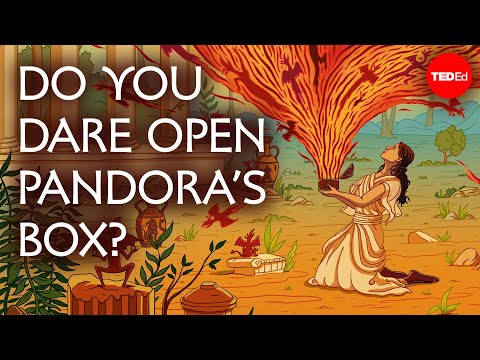
Imagine a beautiful ancient Greek woman looking nervously at a glowing wooden box. As she lifts the lid, dark, smoky spirits fly out into the sky.
Word Web
Desafio
Try to use 'Pandora's box' in a sentence about a current news event or a personal experience where a small action led to a big mess.
Origem da palavra
Derived from the Greek name Πανδώρα (Pandōra). It is a combination of 'pan' (all) and 'dōron' (gift). In Greek mythology, she was the 'all-gifted' because every god gave her a unique attribute.
Significado original: The one who possesses all gifts or the one who is a gift from all the gods.
Indo-European (Greek branch).Contexto cultural
Be aware that the myth has historically been used to promote negative stereotypes about women's curiosity.
In English-speaking countries, the phrase 'Pandora's box' is a standard part of the vocabulary for journalists and politicians.
Pratique na vida real
Contextos reais
Political Debate
- Open a Pandora's box of litigation
- A Pandora's box of social unrest
- Unleashing a Pandora's box of problems
- The Pandora's box of policy change
Scientific Discovery
- A Pandora's box of ethical concerns
- Opening a Pandora's box of new questions
- The Pandora's box of genetic engineering
- A scientific Pandora's box
Legal Proceedings
- A Pandora's box of evidence
- Opening a Pandora's box of claims
- The Pandora's box of the investigation
- Closing the Pandora's box of the trial
Personal Relationships
- A Pandora's box of emotions
- Opening a Pandora's box of secrets
- Like Pandora's box of drama
- Don't open that Pandora's box
Business and Finance
- A Pandora's box of liabilities
- The Pandora's box of the merger
- Opening a Pandora's box of audits
- A Pandora's box of market volatility
Iniciadores de conversa
"Do you think some scientific discoveries are like opening a Pandora's box?"
"Have you ever opened a Pandora's box of problems by asking a simple question?"
"Why do you think the story of Pandora is still so famous today?"
"In your culture, is there a story similar to the myth of Pandora?"
"Do you think 'hope' being in the box makes the story positive or negative?"
Temas para diário
Write about a time you were as curious as Pandora and what the consequences were.
If you were Pandora, would you have opened the box? Why or why not?
Discuss a modern invention that you believe has opened a Pandora's box for humanity.
Reflect on the idea of 'hope' being the only thing left in the box. What does that mean to you?
How does the myth of Pandora influence the way we think about women and curiosity?
Perguntas frequentes
10 perguntasNo, in the original Greek myth, it was a 'pithos,' which is a large clay storage jar. The word was mistranslated into 'box' (pyxis) in the 16th century by Erasmus of Rotterdam, and the name 'Pandora's box' stuck in the English language.
This is a subject of much debate among scholars. Some believe hope was a gift to help humans survive the evils. Others believe hope was actually the worst evil of all—'false hope'—that keeps humans suffering instead of giving up. In the story, it is the only thing that doesn't escape.
No, Pandora is a fictional character from ancient Greek mythology. She was created by the gods as the first human woman, similar to the figure of Eve in the Bible.
It is grammatically incorrect to say 'Pandora box.' You should always use the possessive form 'Pandora's box' because the box belongs to her in the story.
In the idiomatic sense, no. It always refers to starting a process that leads to trouble. However, some people use it ironically or to suggest that while the process is painful, the final result (like 'hope') might be necessary.
She opened it because of her curiosity. The gods gave her the gift of curiosity, but they also gave her the jar and told her not to open it, knowing she eventually would.
The Pandora Papers is a massive leak of financial documents in 2021 that exposed the secret offshore bank accounts of many world leaders and celebrities. It was named after the myth because it 'opened the box' on global corruption.
It is pronounced pan-DOR-a, with the stress on the middle syllable. The 'pan' sounds like a frying pan, and 'dora' sounds like the name Dora.
Yes, it is one of the most famous metaphors in English. It represents any action that seems small but causes a huge amount of unexpected trouble.
The myth says the jar contained all the miseries of the world, including sickness, old age, toil, jealousy, and various types of pain and suffering that did not exist before.
Teste-se 191 perguntas
Explain the meaning of the idiom 'to open a Pandora's box' in your own words.
Well written! Good try! Check the sample answer below.
Describe a situation in modern politics where someone might 'open a Pandora's box'.
Well written! Good try! Check the sample answer below.
Compare and contrast the figures of Pandora and Eve.
Well written! Good try! Check the sample answer below.
Write a short story (50 words) using the word 'Pandora's box'.
Well written! Good try! Check the sample answer below.
Discuss the significance of 'Hope' remaining in the box.
Well written! Good try! Check the sample answer below.
Why is it important to capitalize 'Pandora'?
Well written! Good try! Check the sample answer below.
How does the 'all-gifted' etymology of Pandora relate to her story?
Well written! Good try! Check the sample answer below.
Give an example of a scientific discovery that could be a Pandora's box.
Well written! Good try! Check the sample answer below.
Rewrite this sentence using 'Pandora's box': 'His decision caused many new problems.'
Well written! Good try! Check the sample answer below.
What is the difference between 'Pandora's box' and a 'can of worms'?
Well written! Good try! Check the sample answer below.
Explain the role of curiosity in the myth of Pandora.
Well written! Good try! Check the sample answer below.
Describe the 'Pandora Papers' and why they were named that way.
Well written! Good try! Check the sample answer below.
How did the mistranslation of 'jar' to 'box' happen?
Well written! Good try! Check the sample answer below.
Is the myth of Pandora misogynistic? Explain your view.
Well written! Good try! Check the sample answer below.
Use 'Pandora' in a sentence about a moon.
Well written! Good try! Check the sample answer below.
What does 'kalon kakon' imply about the gods' intentions?
Well written! Good try! Check the sample answer below.
Write a sentence using 'Pandora's box' in a legal context.
Well written! Good try! Check the sample answer below.
Why do brands like Pandora Jewelry use this name?
Well written! Good try! Check the sample answer below.
What is the 'Pandora effect' in psychology?
Well written! Good try! Check the sample answer below.
Summarize the myth of Pandora in three sentences.
Well written! Good try! Check the sample answer below.
Describe the story of Pandora's box to a friend.
Read this aloud:
Você disse:
Speech recognition is not supported in your browser. Try Chrome or Edge.
Give a short speech about the dangers of curiosity using the word 'Pandora'.
Read this aloud:
Você disse:
Speech recognition is not supported in your browser. Try Chrome or Edge.
Discuss whether you think hope being in the box was a good thing.
Read this aloud:
Você disse:
Speech recognition is not supported in your browser. Try Chrome or Edge.
Explain the idiom 'Pandora's box' to someone who has never heard it.
Read this aloud:
Você disse:
Speech recognition is not supported in your browser. Try Chrome or Edge.
Debate the idea that modern technology is a Pandora's box.
Read this aloud:
Você disse:
Speech recognition is not supported in your browser. Try Chrome or Edge.
Pronounce the word 'Pandora' and identify the stressed syllable.
Read this aloud:
Você disse:
Speech recognition is not supported in your browser. Try Chrome or Edge.
Tell a story about a time you opened a 'can of worms' or a 'Pandora's box'.
Read this aloud:
Você disse:
Speech recognition is not supported in your browser. Try Chrome or Edge.
How would you use 'Pandora's box' in a professional meeting?
Read this aloud:
Você disse:
Speech recognition is not supported in your browser. Try Chrome or Edge.
Compare the myth of Pandora to a story from your own culture.
Read this aloud:
Você disse:
Speech recognition is not supported in your browser. Try Chrome or Edge.
What are the pros and cons of using mythological references in speech?
Read this aloud:
Você disse:
Speech recognition is not supported in your browser. Try Chrome or Edge.
Why do you think Pandora is still a popular name for companies?
Read this aloud:
Você disse:
Speech recognition is not supported in your browser. Try Chrome or Edge.
Describe the image of Pandora opening the box.
Read this aloud:
Você disse:
Speech recognition is not supported in your browser. Try Chrome or Edge.
What does the phrase 'the point of no return' have to do with Pandora?
Read this aloud:
Você disse:
Speech recognition is not supported in your browser. Try Chrome or Edge.
How does the 'Pandora Papers' leak affect our view of the world?
Read this aloud:
Você disse:
Speech recognition is not supported in your browser. Try Chrome or Edge.
Is curiosity always a bad thing in the context of Pandora?
Read this aloud:
Você disse:
Speech recognition is not supported in your browser. Try Chrome or Edge.
Explain the term 'kalon kakon' in English.
Read this aloud:
Você disse:
Speech recognition is not supported in your browser. Try Chrome or Edge.
What would happen if hope had also escaped the box?
Read this aloud:
Você disse:
Speech recognition is not supported in your browser. Try Chrome or Edge.
Why is it important to know the etymology of 'Pandora'?
Read this aloud:
Você disse:
Speech recognition is not supported in your browser. Try Chrome or Edge.
How does the media use the 'Pandora' metaphor today?
Read this aloud:
Você disse:
Speech recognition is not supported in your browser. Try Chrome or Edge.
Summarize the common mistakes people make when using this word.
Read this aloud:
Você disse:
Speech recognition is not supported in your browser. Try Chrome or Edge.
Listen to a description of the myth and identify the three main characters mentioned.
Identify the tone of the speaker when they say 'You're opening a Pandora's box.'
What is the speaker referring to when they mention 'Pandora's moon'?
Listen for the word 'pithos'. What does it mean in the context of the myth?
How many times does the speaker use the idiom in the news report?
What is the 'gift' the speaker mentions in relation to the name Pandora?
Listen to the pronunciation of 'Pandora'. Which syllable is stressed?
What does the speaker say was the 'only saving grace' in the box?
In the academic lecture, what does the speaker call Pandora's role?
What specific 'evils' does the speaker list from the box?
Identify the difference in pronunciation between the UK and US speakers.
What is the speaker's opinion on the 'Pandora Papers'?
Listen for the word 'Elpis'. What does it refer to?
Why does the speaker say the jewelry brand chose the name?
What is the 'Pandora effect' according to the podcast?
/ 191 correct
Perfect score!
Summary
Pandora is more than just a name; it is a powerful cultural symbol for the 'point of no return.' When you use the phrase 'Pandora's box,' you are warning that a seemingly simple action could unleash a flood of problems. Example: 'The new policy opened a Pandora's box of legal issues.'
- Pandora is the first woman in Greek mythology, created as a punishment for humanity, whose curiosity led her to release all the world's evils from a jar.
- The phrase 'Pandora's box' is a widely used idiom meaning a source of extensive but unforeseen troubles or a situation that becomes uncontrollably complex.
- While the myth originally featured a storage jar (pithos), a 16th-century mistranslation turned it into a 'box,' which is the term used in modern English.
- The word is commonly found in literature, politics, and science, often serving as a warning against the unintended consequences of human curiosity or interference.
Capitalize the P
Always capitalize 'Pandora' because it is a proper noun from mythology. Writing it with a lowercase 'p' is a common spelling error.
Use the Possessive
Always include the 's' after Pandora. It is 'Pandora's box,' indicating the box that belonged to her.
Save it for Big Issues
Don't use 'Pandora's box' for small problems like losing your keys. Use it for big, complicated situations like political scandals or major life changes.
Can of Worms
If you are in a casual setting, use 'can of worms' instead. It means the same thing but sounds less formal and more natural in daily speech.
Exemplo
The scientists feared that splitting the atom would open a Pandora's box they couldn't close.
Conteúdo relacionado

Frases relacionadas
Mais palavras de Culture
creon
C2Creonte é o governante de Tebas na mitologia grega, uma figura central nas lendas trágicas de Édipo.
ethnic
B2Um membro de um grupo étnico é uma pessoa que pertence a um grupo com uma cultura específica.
wukong’s
B1A forma possessiva de Wukong, referindo-se a coisas que pertencem ao Rei Macaco.
germanic
B2Relativo à família de línguas que inclui o inglês e o alemão. As tribus germânicas moldaram a Europa.
hercules
C1Hércules é um herói da mitologia romana celebrado por sua força sobre-humana.
moroccan
A2Relativo a Marrocos, ao seu povo ou à sua cultura. Um marroquino é um cidadão de Marrocos.
daedalus
B2Dédalo foi um lendário arquiteto e inventor grego que projetou o Labirinto para o Rei Minos de Creta.
oedipus’
C1Oedipus' é a forma possessiva do nome Édipo, referindo-se a algo que lhe pertence ou está associado a ele.
turkish
A1Relativo à Turquia, ao seu povo ou à sua língua.
imp
B2Um imp é um pequeno demônio ou duende travesso no folclore.

