









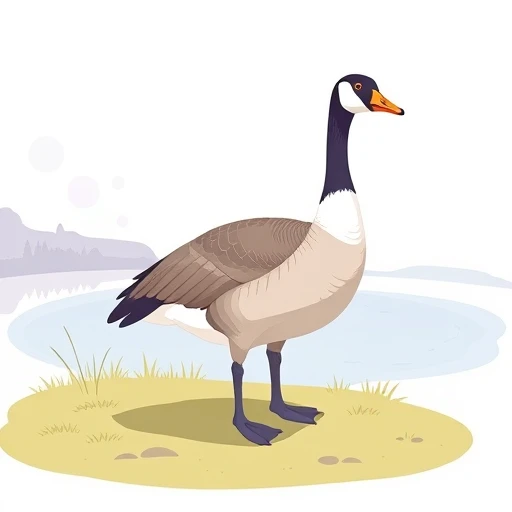
goose 30秒了解
- A large waterfowl known for its long neck, loud honking, and migratory flight in V-formations.
- The plural form is 'geese', an irregular change that is essential for English learners to master.
- Commonly used as a mild, affectionate metaphor for a silly or foolish person ('silly goose').
- Appears in many English idioms like 'wild goose chase' and 'cook someone's goose'.
The word goose is a multifaceted noun that primarily identifies a large waterfowl belonging to the family Anatidae. Biologically, it sits between the smaller duck and the larger swan. Geese are characterized by their long necks, webbed feet, and a tendency to live in both aquatic and terrestrial environments. In common parlance, the term is not just a biological label but a cultural icon. When people use the word 'goose,' they might be referring to the living bird, the meat served as a delicacy, or a person behaving in a lighthearted, foolish manner. The versatility of the word allows it to transition from a scientific context to a cozy kitchen setting or a playful playground interaction.
- Biological Context
- In a scientific or naturalistic setting, a goose is a bird of any of several waterfowl species. They are known for their migratory patterns and the iconic V-formation they fly in during seasonal changes.
Look at that giant goose leading the flock across the lake.
Beyond the physical bird, the word 'goose' is frequently employed as a mild, often affectionate insult. If someone makes a silly mistake or acts in a way that is nonsensical but harmless, they are often called a 'silly goose.' This usage is particularly common when speaking to children or close friends, as it lacks the bite of more aggressive terms like 'idiot' or 'fool.' It suggests a level of clumsiness or lack of foresight that is endearing rather than offensive. This metaphorical use stems from the bird's somewhat awkward gait on land, which contrasts sharply with its grace in flight or on water.
- Culinary Context
- In gastronomy, goose refers to the meat of the bird, which is known for being rich, dark, and high in fat content. It is a traditional centerpiece for Christmas dinner in many European cultures.
We decided to roast a goose for the holiday feast instead of the usual turkey.
Furthermore, the word appears in numerous idioms that color the English language. Phrases like 'a wild goose chase' or 'killing the goose that lays the golden eggs' demonstrate how the bird's perceived behaviors and legendary attributes have been woven into the fabric of English thought. These idioms often deal with themes of futility, greed, or unexpected consequences. The goose is also a staple of folklore, most notably through the character of Mother Goose, who is the fictional narrator of many classic nursery rhymes. This association cements the word in the early linguistic development of most English-speaking children.
The detective realized he was on a wild goose chase after following the wrong lead for three days.
- Symbolic Meaning
- In various cultures, the goose symbolizes loyalty, bravery, and vigilance. Their commitment to their mates and their protective nature over their young are highly regarded traits.
The goose hissed at the dog to protect its goslings near the pond.
In summary, 'goose' is a word that spans the gap between the natural world and human social behavior. Whether you are observing a flock in the park, enjoying a festive meal, or teasing a friend for a silly blunder, the word carries a rich history and a variety of nuances that make it an essential part of the B1-level vocabulary. Its irregular plural 'geese' and its presence in foundational idioms make it a key term for learners to master in order to sound more natural and culturally aware in English.
Using the word goose correctly involves understanding its grammatical properties and its various contextual applications. As a countable noun, it requires an article or a determiner in the singular form. However, the most important grammatical rule to remember is its irregular pluralization. Unlike most English nouns that add '-s' or '-es', 'goose' becomes 'geese'. This change from 'oo' to 'ee' is a remnant of Old English and is shared with words like 'foot' (feet) and 'tooth' (teeth). Mastering this distinction is crucial for clear communication, especially when describing groups of birds or multiple instances of the meat.
- Singular vs. Plural
- Use 'goose' for one bird and 'geese' for two or more. Example: 'One goose is honking, but three geese are flying away.'
The lone goose wandered away from the rest of the geese in the meadow.
When using 'goose' as a collective noun for its meat, it often functions as an uncountable noun, similar to 'chicken' or 'beef'. You might say, 'We are having goose for dinner,' rather than 'a goose,' unless you are referring to the whole bird being cooked. This distinction is subtle but helps in sounding more like a native speaker. Additionally, when describing the behavior of a person, the phrase 'silly goose' is almost always used as a singular noun phrase. You wouldn't typically say 'You are all silly geese' as often as you would use the singular form for a specific individual, though the plural is grammatically correct.
- Idiomatic Usage
- Idioms like 'cook someone's goose' mean to ruin someone's plans. These are fixed expressions where 'goose' cannot be replaced by another bird.
By arriving late to the interview, he really cooked his own goose.
In descriptive writing, 'goose' can be modified by various adjectives to provide more detail. Common modifiers include 'Canadian' (referring to the specific species), 'wild', 'domestic', 'roasted', or 'honking'. These adjectives help specify whether the context is biological, culinary, or environmental. For example, 'The Canadian goose is a common sight in North American suburbs' provides a specific geographic and biological context. In contrast, 'The golden goose' is a metaphorical reference to a source of great wealth that should not be destroyed through greed.
The company's software division was the goose that laid the golden eggs.
- Compound Words
- Words like 'goosebumps' describe the small bumps on the skin when cold or scared, resembling the skin of a plucked goose.
The cold wind gave me goosebumps all over my arms.
Finally, when using 'goose' in a sentence, consider the tone. Calling a colleague a 'goose' might be too informal for a professional setting, whereas calling a child a 'silly goose' is perfectly appropriate. The word carries a certain weight of tradition and playfulness that makes it a versatile tool for any English speaker, provided the grammatical rules of pluralization and the nuances of idiomatic expressions are respected.
The word goose is heard in a variety of real-world environments, ranging from the tranquility of nature to the bustling atmosphere of a holiday kitchen. One of the most common places to encounter the word is in public parks or near bodies of water. In many cities across Europe and North America, geese are a permanent fixture of the urban landscape. You will hear people warning their children not to feed the geese or commenting on the loud honking that fills the air during the morning and evening. In these contexts, 'goose' is a literal term used to describe the birds that often fearlessly approach humans for food.
- Outdoor Recreation
- In parks, you'll hear: 'Watch out for the goose droppings!' or 'The geese are migrating early this year.'
The park ranger told us that the goose population has doubled since last spring.
Another frequent setting for the word is the domestic sphere, particularly during the winter holidays. In the United Kingdom, Germany, and other parts of Northern Europe, goose is a traditional alternative to turkey for Christmas or Michaelmas. You will hear it in butcher shops, supermarkets, and around the dinner table. Conversations might revolve around how to properly roast the bird to ensure the skin is crispy while the meat remains succulent. In this culinary context, the word 'goose' evokes a sense of tradition, luxury, and festive celebration, often associated with historical literature like Charles Dickens' 'A Christmas Carol'.
- Everyday Idioms
- You will hear 'goose' in idioms during casual conversation, such as when someone describes a futile task as a 'wild goose chase'.
I spent all morning looking for my keys, only to find them in my pocket—what a wild goose chase!
In educational settings, especially for young children, 'goose' is a staple word. It appears in nursery rhymes, fables, and children's games. The game 'Duck, Duck, Goose' is a rite of passage for many English-speaking children, where the word 'goose' is the signal for action and excitement. Similarly, the stories of Aesop, such as 'The Goose that Laid the Golden Eggs,' are used to teach moral lessons about greed. Because of these early exposures, the word carries a deep-seated familiarity and a touch of whimsy for native speakers, which is why it is so often used in a playful, metaphorical sense later in life.
The teacher read a story about a goose that could talk to the moon.
- Metaphorical Teasing
- In social gatherings, you might hear: 'Don't be such a goose!' when someone does something silly or forgets something obvious.
Stop being a silly goose and come inside before you catch a cold.
Finally, the word is heard in scientific or environmental documentaries. Narrators often discuss the migration of geese, their social structures, and their impact on the ecosystems they inhabit. In these programs, the word is used with precision, often accompanied by the specific species name, such as the Brent goose or the Barnacle goose. Whether it is the 'honk' in the park, the 'roast' in the oven, or the 'chase' in an idiom, the word 'goose' is a constant presence in the English-speaking world's auditory landscape.
When learning the word goose, several common pitfalls can lead to grammatical errors or social awkwardness. The most frequent mistake is undoubtedly the pluralization. Because the vast majority of English nouns follow the 'add -s' rule, many learners instinctively say 'gooses' when they mean 'geese'. This is a classic 'overregularization' error. While 'gooses' is actually a valid word (it is the third-person singular present tense of the verb 'to goose'), it is almost never the correct form when you are talking about more than one bird. Remembering the 'oo' to 'ee' shift is essential for B1 learners moving toward fluency.
- Pluralization Error
- Incorrect: 'I saw five gooses in the park.' Correct: 'I saw five geese in the park.'
The geese (not gooses) were flying in a perfect V-shape.
Another common mistake involves confusing 'goose' with other similar waterfowl, specifically ducks and swans. While they all belong to the same family, they are distinct. Calling a swan a 'goose' might be seen as a lack of observation, as swans are significantly larger and have much longer, more curved necks. Similarly, ducks are usually smaller and have flatter bills. In a culinary context, this mistake is even more significant; goose meat is much fattier and richer than duck meat, and the two are prepared differently. Using the wrong term in a restaurant or butcher shop could lead to a very different dining experience than intended.
- Idiom Misuse
- Learners sometimes mix up idioms, saying 'a wild duck chase' instead of 'a wild goose chase'. These phrases are fixed and cannot be changed.
Don't send me on a wild goose chase looking for a file that doesn't exist.
The metaphorical use of 'goose' also requires careful handling. While 'silly goose' is a mild and friendly term, using 'goose' on its own to describe someone can sometimes be misinterpreted if the tone isn't clearly playful. Furthermore, the verb form 'to goose' (to poke someone unexpectedly) is highly informal and can be offensive or considered harassment in many contexts. Learners should avoid using the verb form unless they are entirely sure of the social dynamics and the appropriateness of the situation. It is much safer to stick to the noun form in most professional and semi-formal interactions.
She felt like a goose for forgetting her own birthday party.
- Pronunciation Pitfall
- The 'oo' in goose is a long /uː/ sound. Some learners might shorten it, making it sound like 'gus', which is a name, not a bird.
The goose (pronounced /ɡuːs/) let out a loud honk.
Lastly, there is the confusion between 'goose' and 'gander'. A gander is specifically a male goose. While 'goose' can be used for the species as a whole, in more technical or farming contexts, the distinction matters. There is even a famous proverb: 'What's sauce for the goose is sauce for the gander,' meaning that what is good for one person should be good for another. Misusing these gender-specific terms in a farming context might mark you as a novice, though in general conversation, 'goose' is usually sufficient for both sexes.
Exploring words similar to goose helps to refine your vocabulary and provides alternatives for different contexts. The most immediate relatives are other waterfowl. 'Duck' and 'swan' are the most common comparisons. While a goose is larger than a duck, it is less aquatic, often spending more time grazing on land. A swan is the most elegant of the three, known for its pure white feathers (usually) and very long neck. In a scientific context, you might use the term 'waterfowl' to describe the entire group, or 'poultry' if you are referring to birds raised for food, including geese, chickens, and turkeys.
- Goose vs. Duck
- Geese are larger, have longer necks, and are more likely to be found in fields. Ducks are smaller and more common in ponds.
While the duck paddled in the water, the goose ate grass on the bank.
When looking for synonyms for the metaphorical 'goose' (a silly person), several options exist depending on the desired level of intensity. 'Sillying' or 'jester' are quite old-fashioned. More modern alternatives include 'nitwit', 'dunderhead', or 'clown'. However, 'silly goose' remains the most gentle and socially acceptable way to tease someone. If you want to describe someone who is easily fooled, you might call them a 'simpleton' or a 'gull' (from which we get the word 'gullible'). Interestingly, 'gull' is also a type of bird, showing a recurring theme in English where bird names are used to describe human traits.
- Goose vs. Swan
- Swans are larger and often seen as more 'noble' or 'graceful' than geese, which are seen as more 'homely' or 'aggressive'.
The swan glided silently, a stark contrast to the noisy goose.
In culinary terms, 'game' or 'fowl' are broader categories that include goose. If a recipe calls for goose but you cannot find it, 'duck' is the most common substitute, though it is smaller and has a slightly different flavor profile. 'Turkey' is another alternative, especially for large holiday meals, though it is much leaner. In some high-end culinary circles, you might hear the term 'foie gras', which is a controversial product made from the liver of a specially fattened goose or duck. Understanding these related culinary terms is helpful for navigating menus and food-related discussions.
The chef recommended the roasted goose for its unique, rich flavor.
- Collective Nouns
- Instead of 'a group of geese', use 'a gaggle of geese' to sound more like a native speaker.
A gaggle of geese blocked the road, refusing to move for the cars.
By understanding these similar words and alternatives, you can tailor your language to be more precise, whether you are describing a scene in nature, discussing a recipe, or playfully teasing a friend. The goose, with its specific biological traits and rich metaphorical associations, provides a wonderful entry point into the complexities of English vocabulary and the way we categorize the world around us.
How Formal Is It?
趣味小知识
The irregular plural 'geese' exists because of a linguistic process called 'i-mutation' or 'umlaut'. In very old forms of the language, the plural had an 'i' sound at the end which caused the 'o' in the middle to change to an 'e'. Eventually, the 'i' disappeared, but the 'e' stayed!
发音指南
- Pronouncing the 'oo' like the 'u' in 'bus' (making it sound like 'gus').
- Adding a 'z' sound at the end instead of a soft 's'.
- Confusing the pronunciation with 'choose' (which has a 'ch' sound).
- Shortening the vowel sound too much.
- Over-emphasizing the 'g' so it sounds like 'k'.
难度评级
The word is easy to recognize, but idioms can be tricky.
The irregular plural 'geese' is a common point of error.
Pronunciation is straightforward but requires a long vowel.
Easily distinguished from other words in context.
接下来学什么
前置知识
接下来学习
高级
需要掌握的语法
Irregular Plurals (Mutation)
Goose becomes geese, just as foot becomes feet.
Collective Nouns
A 'gaggle' is the specific term for a group of geese on the ground.
Uncountable Nouns for Meat
When referring to the food, we often say 'I like goose' without an article.
Compound Noun Formation
Goose + bumps = goosebumps (a new noun with a specific meaning).
Possessive of Irregular Plurals
The geese's feathers (add 's to the plural form).
按水平分级的例句
The goose is white.
Le jars est blanc.
Use 'is' for one goose.
I see two geese.
Je vois deux oies.
The plural of goose is geese.
The goose says honk.
L'oie fait honk.
Third person singular 'says'.
A goose has a long neck.
Une oie a un long cou.
Use 'a' before goose.
Do you like the goose?
Aimes-tu l'oie ?
Question form with 'do'.
The goose is in the water.
L'oie est dans l'eau.
Preposition 'in'.
That is a big goose.
C'est une grosse oie.
Adjective 'big' before the noun.
Look at the goose!
Regarde l'oie !
Imperative form.
Geese fly south in the winter.
Les oies s'envolent vers le sud en hiver.
Plural subject 'geese' with plural verb 'fly'.
The goose is eating grass.
L'oie mange de l'herbe.
Present continuous tense.
Don't be a silly goose!
Ne sois pas une bête oie !
Common idiomatic expression.
The farmer has many geese.
Le fermier a beaucoup d'oies.
Use 'many' with countable plural nouns.
The goose hissed at the dog.
L'oie a sifflé après le chien.
Past tense 'hissed'.
We saw a gaggle of geese.
Nous avons vu un troupeau d'oies.
Collective noun 'gaggle'.
The goose has orange feet.
L'oie a des pattes orange.
Descriptive sentence.
Is that a goose or a duck?
Est-ce une oie ou un canard ?
Alternative question.
I went on a wild goose chase looking for that shop.
Je me suis lancé dans une quête inutile en cherchant ce magasin.
Idiom meaning a futile search.
Roasted goose is a traditional Christmas meal.
L'oie rôtie est un repas de Noël traditionnel.
Goose used as an uncountable culinary noun.
The geese are migrating to a warmer climate.
Les oies migrent vers un climat plus chaud.
Present continuous for ongoing action.
She got goosebumps when she heard the ghost story.
Elle a eu la chair de poule en entendant l'histoire de fantômes.
Compound word 'goosebumps'.
The goose protected its goslings from the cat.
L'oie a protégé ses oisons du chat.
Vocabulary: goslings (baby geese).
Stop being such a goose and just ask her out!
Arrête d'être aussi bête et demande-lui simplement de sortir !
Metaphorical use for a silly person.
The honking of the geese woke me up early.
Le cri des oies m'a réveillé tôt.
Gerund 'honking' used as a noun.
He felt like a goose after making that mistake.
Il s'est senti bête après avoir fait cette erreur.
Simile using 'like'.
Selling the company now would be like killing the goose that lays the golden eggs.
Vendre l'entreprise maintenant reviendrait à tuer la poule aux œufs d'or.
Complex idiom about destroying a source of profit.
The politician's comments really cooked his goose with the voters.
Les commentaires du politicien ont vraiment ruiné ses chances auprès des électeurs.
Idiom 'cook someone's goose' meaning to ruin chances.
The Canadian goose is known for its distinctive black head and neck.
La bernache du Canada est connue pour sa tête et son cou noirs distinctifs.
Specific species identification.
A gander is typically larger and more aggressive than a female goose.
Un jars est généralement plus grand et plus agressif qu'une oie femelle.
Vocabulary: gander (male goose).
The geese maintain a strict hierarchy within the gaggle.
Les oies maintiennent une hiérarchie stricte au sein du troupeau.
Scientific/behavioral context.
Her skin was covered in gooseflesh due to the sudden draft.
Sa peau était couverte de chair de poule à cause du courant d'air soudain.
Synonym for goosebumps: 'gooseflesh'.
The conservationists are tracking the migration of the Brent goose.
Les écologistes suivent la migration de la bernache cravant.
Technical environmental context.
Don't try to goose the production numbers just to look good.
N'essaie pas de gonfler artificiellement les chiffres de production juste pour bien paraître.
Verb use: to 'goose' (increase/boost) - informal.
The author used the goose as a symbol of domestic vigilance in the novel.
L'auteur a utilisé l'oie comme symbole de vigilance domestique dans le roman.
Literary analysis context.
What's sauce for the goose is sauce for the gander, so you should follow the same rules.
Ce qui est bon pour l'un est bon pour l'autre, tu devrais donc suivre les mêmes règles.
Proverbial usage.
The historical use of goose quills revolutionized the art of calligraphy.
L'utilisation historique des plumes d'oie a révolutionné l'art de la calligraphie.
Historical context.
The geese's migratory instincts are finely tuned to celestial patterns.
Les instincts migrateurs des oies sont finement adaptés aux motifs célestes.
Possessive plural 'geese's'.
He was accused of being a 'goose' by the more cynical members of the board.
Il a été accusé d'être un 'imbécile' par les membres les plus cyniques du conseil.
Metaphorical use in a formal/semi-formal setting.
The down feathers of a goose provide exceptional insulation for winter clothing.
Le duvet d'une oie offre une isolation exceptionnelle pour les vêtements d'hiver.
Technical/material context.
The fable of the golden goose serves as a timeless warning against short-sighted greed.
La fable de l'oie aux œufs d'or sert d'avertissement intemporel contre la cupidité à courte vue.
Moral/philosophical context.
The goose's territorial nature makes it an effective, albeit noisy, guardian.
La nature territoriale de l'oie en fait un gardien efficace, bien que bruyant.
Possessive singular 'goose's'.
The etymological roots of 'goose' can be traced back to the Proto-Indo-European *ghans-.
Les racines étymologiques de 'goose' remontent au proto-indo-européen *ghans-.
Linguistic/etymological context.
The tailor used a heavy goose to press the seams of the bespoke suit.
Le tailleur a utilisé un lourd fer à repasser pour presser les coutures du costume sur mesure.
Archaic/specialized noun usage.
The sheer audacity of the plan was enough to goose the stagnant market.
L'audace pure du plan a suffi à stimuler le marché stagnant.
Metaphorical verb usage in finance.
Her performance was a bit of a 'goose-step' through the delicate nuances of the script.
Sa performance était un peu une 'marche forcée' à travers les nuances délicates du scénario.
Reference to 'goose-step' (stiff military march).
The intricate social dynamics of a gaggle of geese are a marvel of evolutionary biology.
La dynamique sociale complexe d'un troupeau d'oies est une merveille de la biologie évolutive.
High-level scientific register.
He was sent on a wild goose chase by the cryptic clues left in the will.
Il a été lancé dans une quête vaine par les indices cryptiques laissés dans le testament.
Idiomatic use in a complex narrative.
The goose's plumage was iridescent under the midday sun.
Le plumage de l'oie était iridescent sous le soleil de midi.
Advanced descriptive vocabulary ('iridescent').
To 'goose' the engine is a colloquialism often heard among vintage car enthusiasts.
'Donner un coup d'accélérateur' au moteur est un provincialisme souvent entendu chez les passionnés de voitures anciennes.
Specialized jargon/slang.
常见搭配
常用短语
— A search that is completely unsuccessful or a waste of time. It implies looking for something that doesn't exist.
I spent hours looking for the file, but it was a wild goose chase.
— To ruin someone's plans or chances of success. It is often used in a competitive or vengeful context.
His testimony will really cook the defendant's goose.
— A friendly way to tell someone they are being foolish or funny. It is very common when talking to children.
Come here, you silly goose, and put your shoes on.
— A person or thing that is a continuous source of wealth or profit. It comes from a famous fable.
This patent is the goose that lays the golden eggs for us.
— What is acceptable for one person should be acceptable for another. It emphasizes fairness.
If she can take a long lunch, so can I; what's sauce for the goose is sauce for the gander.
— Small bumps on the skin caused by cold, fear, or excitement. They look like the skin of a plucked goose.
The beautiful music gave me goosebumps.
— Very relaxed or flexible. It is an informal simile.
After the massage, I felt loose as a goose.
— To destroy something that is profitable out of greed or stupidity. It is a warning against short-term thinking.
By raising prices too high, they might kill the golden goose.
— A special way of marching with the legs kept straight. It is associated with military parades.
The soldiers performed a goose-step during the ceremony.
— To have a loud, harsh, or annoying voice. It is a descriptive comparison.
When he laughs, he sounds like a honking goose.
容易混淆的词
Ducks are smaller, have shorter necks, and are more aquatic than geese.
Swans are much larger, usually all white, and have very long, curved necks.
A gander is specifically a male goose, while 'goose' can be general.
习语与表达
— A pursuit of something unattainable or non-existent. It suggests a long and frustrating waste of effort.
The police were sent on a wild goose chase by the prank caller.
informal/neutral— To ensure someone's failure or to spoil their plans completely. It implies a definitive end to their chances.
The new evidence is going to cook his goose in court.
informal— To destroy a reliable source of income or benefit through greed or lack of foresight.
Cutting the research budget is like killing the goose that lays the golden eggs.
neutral— The principle that one person should be treated the same way as another in a similar situation.
You can't complain about him being late if you are late too; what's sauce for the goose is sauce for the gander.
neutral/proverbial— A gentle term for a person acting in a foolish or amusingly clumsy way.
Don't be a silly goose, there's no such thing as monsters.
informal/child-friendly— A state where one is in serious trouble and there is no way to escape the consequences.
Once the boss saw the error, I knew my goose was cooked.
informal— To overestimate the value or importance of one's own possessions or family members.
He thinks his son is a genius, but all his geese are swans.
literary/old-fashioned— Used in the negative ('couldn't say boo to a goose') to describe someone who is very shy or timid.
She's so quiet she wouldn't say boo to a goose.
informal— A score of zero in a game or competition; also a bump on the head from an injury.
The team ended the game with a big fat goose egg.
informal/sports— Extremely relaxed, often physically. It can also refer to being clumsy or imprecise.
He was loose as a goose after a few drinks.
informal/slang容易混淆
Irregular plural
One is goose, two are geese. Never use 'gooses' for the birds.
I saw one goose and three geese.
Similar spelling/rhyme
Choose is a verb meaning to select; goose is a noun for a bird.
I will choose the roasted goose for dinner.
Rhyme
Loose is an adjective meaning not tight; goose is a bird.
The goose got loose from the pen.
Rhyme and animal
A moose is a giant mammal; a goose is a bird. Also, the plural of moose is moose, but the plural of goose is geese.
The moose and the geese live in the same forest.
Gender specific
Gander is male; goose is female or general. Also 'take a gander' means to look at something.
Take a gander at that big gander!
句型
The [noun] is [adjective].
The goose is white.
There are [number] [plural noun].
There are four geese.
Don't be a [adjective] [noun].
Don't be a silly goose.
It was a [idiom].
It was a wild goose chase.
The [noun] that [verb] the [object].
The goose that laid the golden eggs.
What is [noun] for the [noun] is [noun] for the [noun].
What's sauce for the goose is sauce for the gander.
The [noun]'s [noun] is [adjective].
The goose's plumage is beautiful.
To [verb] the [object] is to [verb].
To goose the economy is to invite inflation.
词族
名词
动词
形容词
相关
如何使用
Common in nature, cooking, and idiomatic speech.
-
I saw three gooses.
→
I saw three geese.
The plural of goose is irregular. You must change the 'oo' to 'ee'.
-
We had a wild duck chase.
→
We had a wild goose chase.
Idioms are fixed. You cannot swap the bird in 'wild goose chase'.
-
The goose is a small bird.
→
The goose is a large bird.
Geese are significantly larger than ducks; don't confuse their sizes.
-
He is a stupid goose.
→
He is a silly goose.
The idiom is almost always 'silly goose'. 'Stupid goose' sounds unnatural and harsher.
-
I got chickenbumps.
→
I got goosebumps.
Even though other birds have skin bumps, the English term is specifically 'goosebumps'.
小贴士
Master the Plural
Always remember: one goose, two geese. Practice this alongside other irregular plurals like foot/feet and tooth/teeth to build a strong mental pattern.
Learn the Family
To sound more advanced, learn 'gander' (male) and 'gosling' (baby). Using these specific terms shows you have a deeper grasp of the language.
Use 'Wild Goose Chase'
This is a very common idiom. Use it when you've wasted time looking for something. It makes your English sound much more natural and idiomatic.
Be a 'Silly Goose'
Use this phrase to lighten the mood. It's a safe, friendly way to tease someone without the risk of offending them, unlike words like 'stupid' or 'dumb'.
Long Vowel Sound
The 'oo' in goose is long. Imagine you are saying 'moo' like a cow, but with a 'g' at the start and an 's' at the end. Don't rush the vowel!
Collective Nouns
In creative writing, use 'a gaggle of geese'. It's a specific and evocative collective noun that adds flavor to your descriptions of nature.
Holiday Context
If you're in the UK or Europe during December, you'll hear 'goose' a lot in relation to food. Knowing this cultural link helps you follow holiday conversations.
Listen for the Honk
Geese are often described by the sound they make. If you hear the word 'honking', there's a good chance a goose is the subject of the sentence.
Ancient Roots
Knowing that 'goose' is related to 'Gans' (German) and 'anser' (Latin) can help you remember it if you speak or study those languages.
Verb Caution
Be careful with 'goose' as a verb. While it can mean to boost something, its physical meaning can be rude. Stick to the noun until you're very comfortable.
记住它
记忆技巧
Think of the 'OO' in goose as two big eyes of a bird, and the 'EE' in geese as two birds flying together.
视觉联想
Imagine a large white bird with a long neck wearing a chef's hat (for the culinary link) or a dunce cap (for the 'silly' link).
Word Web
挑战
Try to use the word 'goose' and its plural 'geese' in three different sentences today: one about nature, one about food, and one as a joke.
词源
The word 'goose' comes from the Old English 'gōs', which is derived from the Proto-Germanic '*gans-'. This root is very old and is shared by many Indo-European languages. For example, it is related to the German 'Gans', the Dutch 'gans', and even the Latin 'anser' and Greek 'khēn'.
原始含义: The original meaning has always referred to the bird itself, specifically the domestic or wild waterfowl.
Germanic branch of the Indo-European family.文化背景
The verb 'to goose' can be considered inappropriate or offensive as it refers to touching someone's buttocks. Use with caution.
In the UK and US, 'silly goose' is a very common, gentle way to tease children or friends without being mean.
在生活中练习
真实语境
At the park
- Don't feed the geese.
- Watch out for the goose.
- The geese are honking.
- Look at the goslings.
In the kitchen
- Roast the goose.
- Goose fat is great for potatoes.
- Is the goose ready?
- Traditional Christmas goose.
Casual conversation
- You silly goose!
- It was a wild goose chase.
- I got goosebumps.
- Don't be a goose.
On a farm
- The gander is aggressive.
- A gaggle of geese.
- Herding the geese.
- Goose eggs for sale.
In a storybook
- Mother Goose rhymes.
- The golden goose.
- The goose flew away.
- A talking goose.
对话开场白
"Have you ever seen a flock of geese flying in a V-formation?"
"Do you prefer eating turkey or goose for a holiday meal?"
"Why do you think we call people 'silly geese' in English?"
"Have you ever been chased by a goose in a park?"
"What is the most famous story you know that features a goose?"
日记主题
Describe a time you went on a 'wild goose chase'. What happened?
Write a short story about a goose that decides not to migrate south for the winter.
How do you feel about the use of animals like geese in traditional holiday meals?
Imagine you are a goose for a day. What would you do and where would you go?
Reflect on a time you felt like a 'silly goose'. What did you learn from the experience?
常见问题
10 个问题No, the plural of goose is 'geese'. This is an irregular plural that changed over hundreds of years. Using 'gooses' is a common mistake for learners, but it is only used as a verb form (e.g., 'he gooses the engine'). Always use 'geese' when talking about more than one bird.
It is a gentle, affectionate way to call someone foolish or funny. It is not a mean insult. You might say it to a friend who forgot their keys or a child who is making a funny face. It's one of the most common bird-related metaphors in English.
It is an idiom that describes a search or pursuit that is completely useless and leads nowhere. For example, if you look for a book in a library that doesn't even have that book, you are on a wild goose chase. It implies a waste of time and energy.
Yes, goose is a popular meat in many cultures, especially during the winter holidays. It is a dark meat, similar to duck but much richer and fattier. It is often roasted whole and served with fruit-based sauces like apple or cranberry.
A male goose is called a 'gander'. While you can just say 'goose' for any of them, using 'gander' is more specific. There is also a famous saying, 'What's sauce for the goose is sauce for the gander,' which means everyone should be treated equally.
A baby goose is called a 'gosling'. They are usually yellow and fluffy when they are very young. You will often see a row of goslings swimming behind their mother in the springtime. It's a very common word in nature books.
Geese fly in a V-formation to save energy. The bird in front works the hardest, and the birds behind it get a lift from the air moving over the leader's wings. They take turns being the leader so no one gets too tired. It's a great example of teamwork.
They can be! Geese are very territorial, especially when they are nesting or have goslings. If you get too close, they might hiss at you or even try to bite. It's best to give them plenty of space in the park.
Goosebumps are the tiny bumps you get on your skin when you are cold, scared, or excited. They are called goosebumps because they make your skin look like the skin of a goose after its feathers have been plucked. In some places, they are also called 'gooseflesh'.
Mother Goose is a fictional character who is said to be the author of many famous nursery rhymes and fairy tales. She is often pictured as an old woman with a tall hat, sometimes riding on the back of a large goose. She is a very important figure in English children's literature.
自我测试 200 个问题
Write a sentence using the word 'geese' correctly.
Well written! Good try! Check the sample answer below.
Describe a goose using three adjectives.
Well written! Good try! Check the sample answer below.
Write a short story about a 'wild goose chase'.
Well written! Good try! Check the sample answer below.
Explain why geese fly in a V-formation.
Well written! Good try! Check the sample answer below.
Compare a goose and a duck in three sentences.
Well written! Good try! Check the sample answer below.
Write a dialogue where someone is called a 'silly goose'.
Well written! Good try! Check the sample answer below.
Describe the taste and texture of roasted goose.
Well written! Good try! Check the sample answer below.
Write a poem about a goose in a park.
Well written! Good try! Check the sample answer below.
Explain the meaning of 'killing the golden goose'.
Well written! Good try! Check the sample answer below.
Write a formal description of a Canadian goose.
Well written! Good try! Check the sample answer below.
What would you do if a goose hissed at you?
Well written! Good try! Check the sample answer below.
Describe the feeling of getting goosebumps.
Well written! Good try! Check the sample answer below.
Write a nursery rhyme about a goose.
Well written! Good try! Check the sample answer below.
Discuss the ethics of producing foie gras.
Well written! Good try! Check the sample answer below.
How do geese affect the environment in cities?
Well written! Good try! Check the sample answer below.
Write a sentence using 'gander' and 'goose' together.
Well written! Good try! Check the sample answer below.
Describe a 'gaggle' of geese in a field.
Well written! Good try! Check the sample answer below.
What is the importance of Mother Goose in culture?
Well written! Good try! Check the sample answer below.
Write a sentence using the verb 'to goose'.
Well written! Good try! Check the sample answer below.
Summarize the fable of the golden goose.
Well written! Good try! Check the sample answer below.
Describe a goose to a partner.
Read this aloud:
你说的:
Speech recognition is not supported in your browser. Try Chrome or Edge.
Tell a story about a time you were a 'silly goose'.
Read this aloud:
你说的:
Speech recognition is not supported in your browser. Try Chrome or Edge.
Discuss the pros and cons of eating goose for Christmas.
Read this aloud:
你说的:
Speech recognition is not supported in your browser. Try Chrome or Edge.
Explain the idiom 'wild goose chase' to someone who doesn't know it.
Read this aloud:
你说的:
Speech recognition is not supported in your browser. Try Chrome or Edge.
How would you react if a goose chased you in a park?
Read this aloud:
你说的:
Speech recognition is not supported in your browser. Try Chrome or Edge.
Talk about the migration of birds like geese.
Read this aloud:
你说的:
Speech recognition is not supported in your browser. Try Chrome or Edge.
Pronounce 'goose' and 'geese' clearly.
Read this aloud:
你说的:
Speech recognition is not supported in your browser. Try Chrome or Edge.
Explain the fable of the golden goose.
Read this aloud:
你说的:
Speech recognition is not supported in your browser. Try Chrome or Edge.
Discuss the difference between a goose and a swan.
Read this aloud:
你说的:
Speech recognition is not supported in your browser. Try Chrome or Edge.
Use the phrase 'what's sauce for the goose' in a sentence.
Read this aloud:
你说的:
Speech recognition is not supported in your browser. Try Chrome or Edge.
Describe the sound a goose makes.
Read this aloud:
你说的:
Speech recognition is not supported in your browser. Try Chrome or Edge.
Talk about 'goosebumps' and what causes them for you.
Read this aloud:
你说的:
Speech recognition is not supported in your browser. Try Chrome or Edge.
Explain what a 'gaggle' is.
Read this aloud:
你说的:
Speech recognition is not supported in your browser. Try Chrome or Edge.
Discuss the use of goose feathers in products.
Read this aloud:
你说的:
Speech recognition is not supported in your browser. Try Chrome or Edge.
Tell a partner about 'Mother Goose'.
Read this aloud:
你说的:
Speech recognition is not supported in your browser. Try Chrome or Edge.
Describe a V-formation in the sky.
Read this aloud:
你说的:
Speech recognition is not supported in your browser. Try Chrome or Edge.
Use 'cook someone's goose' in a short story.
Read this aloud:
你说的:
Speech recognition is not supported in your browser. Try Chrome or Edge.
Talk about the territorial nature of geese.
Read this aloud:
你说的:
Speech recognition is not supported in your browser. Try Chrome or Edge.
Discuss the etymology of the word 'goose'.
Read this aloud:
你说的:
Speech recognition is not supported in your browser. Try Chrome or Edge.
Explain the verb 'to goose' in a mechanical context.
Read this aloud:
你说的:
Speech recognition is not supported in your browser. Try Chrome or Edge.
Listen and identify: Is the speaker talking about one bird or many? (Audio: 'The geese are flying.')
Listen for the idiom: What did the speaker do? (Audio: 'I went on a wild goose chase.')
Listen for the sound: What bird makes this sound? (Audio: 'Honk! Honk!')
Listen for the person: Who is being silly? (Audio: 'You're such a silly goose, Tim!')
Listen for the plural: How many birds? (Audio: 'There's a goose by the pond.')
Listen for the food: What's for dinner? (Audio: 'We're having roasted goose tonight.')
Listen for the baby: What is it called? (Audio: 'Look at that cute little gosling.')
Listen for the group: What word is used? (Audio: 'A gaggle of geese is blocking the way.')
Listen for the reaction: Why did he get them? (Audio: 'The cold air gave me goosebumps.')
Listen for the plan: What happened? (Audio: 'That really cooked his goose.')
Listen for the gender: Is it male or female? (Audio: 'The gander is very big.')
Listen for the formation: What letter? (Audio: 'They are flying in a V.')
Listen for the character: Who is it? (Audio: 'It's a Mother Goose story.')
Listen for the proverb: What is the gander's sauce? (Audio: 'Sauce for the goose is sauce for the gander.')
Listen for the verb: What did he do to the engine? (Audio: 'He goosed the engine.')
/ 200 correct
Perfect score!
Summary
The word 'goose' refers to a large water bird, its meat, or a silly person. Remember the irregular plural 'geese' and its frequent use in idioms. Example: 'The geese flew over the park while I was on a wild goose chase for my lost keys.'
- A large waterfowl known for its long neck, loud honking, and migratory flight in V-formations.
- The plural form is 'geese', an irregular change that is essential for English learners to master.
- Commonly used as a mild, affectionate metaphor for a silly or foolish person ('silly goose').
- Appears in many English idioms like 'wild goose chase' and 'cook someone's goose'.
Master the Plural
Always remember: one goose, two geese. Practice this alongside other irregular plurals like foot/feet and tooth/teeth to build a strong mental pattern.
Learn the Family
To sound more advanced, learn 'gander' (male) and 'gosling' (baby). Using these specific terms shows you have a deeper grasp of the language.
Use 'Wild Goose Chase'
This is a very common idiom. Use it when you've wasted time looking for something. It makes your English sound much more natural and idiomatic.
Be a 'Silly Goose'
Use this phrase to lighten the mood. It's a safe, friendly way to tease someone without the risk of offending them, unlike words like 'stupid' or 'dumb'.
例句
The Canada goose is easily identified by its black head and neck with a white 'chinstrap'.
相关内容
更多Animals词汇
albatross
B2信天翁(一种大型海鸟);比喻沉重的负担。
animal
A1动物是一种能够自主运动、以有机物为食的生命体。
animals
A1动物是多细胞真核生物,属于动物界,通常能够自由运动。
ant
A1蚂蚁是一种生活在高度组织化群体中的小型社会性昆虫。
antelope
C1羚羊是一种类似鹿的敏捷哺乳动物,具有永久性的角。它们主要生活在非洲和亚洲的草原上。
antiarchal
C1关于胴甲鱼目(Antiarchi)的,这是一类生活在泥盆纪的已灭绝的有颌盾皮鱼。
antler
C2鹿角是鹿科动物头上每年脱落并重新生长的分叉骨质结构。与牛角不同,鹿角是活组织生长的结果。
ants
A1蚂蚁是生活在高度组织化的社会群体中的小型昆虫。
ape
B2笨拙地或机械地模仿某人或某事。
arboreal
B2树栖动物主要在树上活动和生活。

