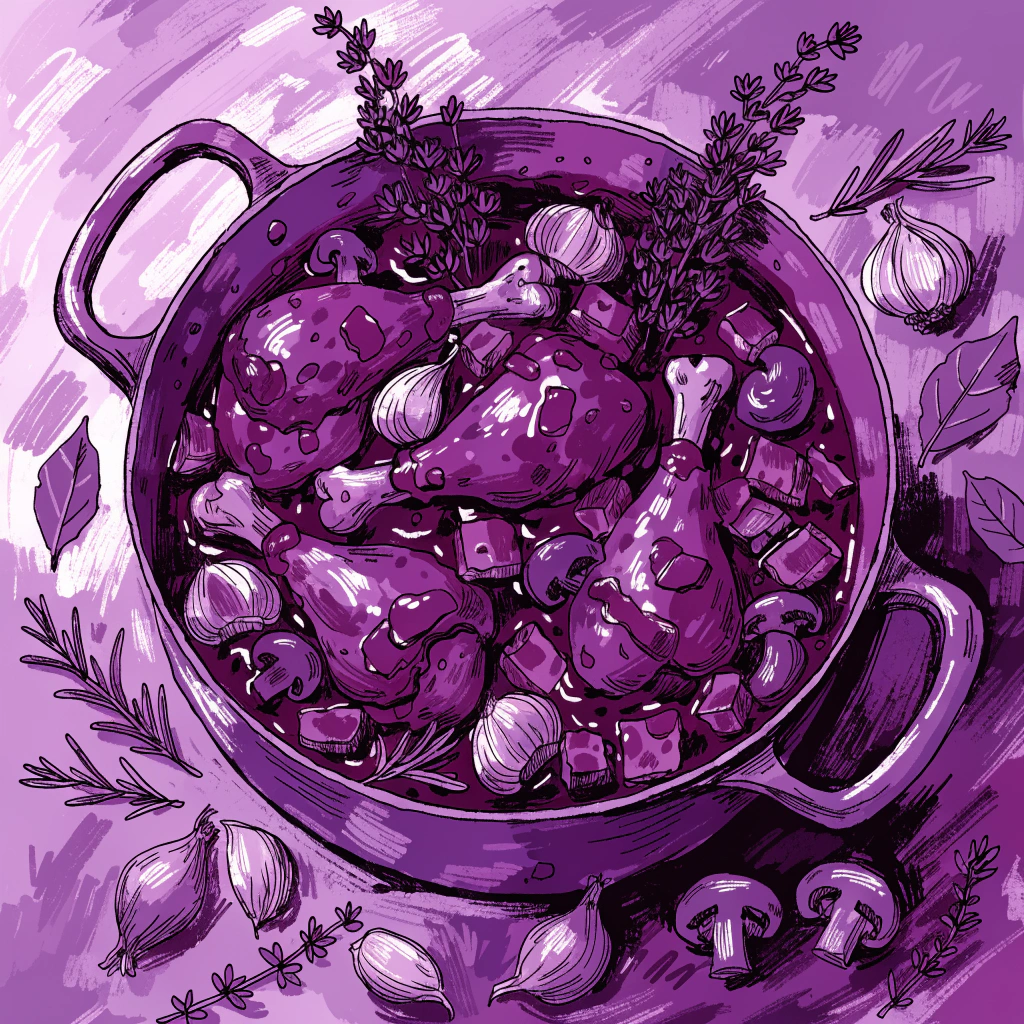
Coq au Vin: Ein Klassiker aus Frankreich
Coq au Vin ist ein bekanntes Gericht aus Frankreich. Es ist sehr alt. Früher war das Essen für arme Familien. Heute essen es viele Menschen auf der ganzen Welt. Das Gericht schmeckt sehr gut.
Was ist in dem Topf? Man braucht Fleisch von einem Hahn. Man kocht das Fleisch lange in Rotwein. Der Wein macht das Fleisch weich. Dazu kommen Speck, Pilze und Zwiebeln.
Die Franzosen essen Coq au Vin oft am Sonntag. Es ist ein gemütliches Essen. Man trinkt dazu ein Glas Wein und isst Brot. Guten Appetit!
Grammatik-Spotlight
Muster: Präsens (Gegenwart)
"Coq au Vin ist ein bekanntes Gericht aus Frankreich."
Wir nutzen das Präsens für Fakten. Man nimmt den Verbstamm und hängt die Endung für die Person an (z.B. er/sie/es ist).
Muster: Satzbau (Verb an Position 2)
"Die Franzosen essen Coq au Vin oft am Sonntag."
In einem normalen Hauptsatz steht das konjugierte Verb immer an der zweiten Stelle. Das Subjekt steht meistens davor.
Teste dein Verständnis
10 Fragen · A1 Anfänger · 1 kostenlose Vorschau
Teste, was du aus diesem Artikel gelernt hast. Beantworte alle Fragen und sammle XP!
Woher kommt das Gericht Coq au Vin?
Möchtest du das Quiz beenden?
9 weitere Fragen warten auf dich. Registriere dich kostenlos, um das vollständige Quiz freizuschalten und XP zu sammeln!
Kostenlos registrierenHast du schon ein Konto? Anmelden
Gut gemacht!
Weiter üben!
Bereits abgeschlossen — keine zusätzlichen XP
Registriere dich, um XP zu verdienenFragenübersicht
Woher kommt das Gericht Coq au Vin?
Deine Antwort:
Richtige Antwort: Aus Frankreich
Coq au Vin ist ein sehr neues Gericht.
Deine Antwort:
Richtige Antwort: Falsch
Was ist 'Rotwein'?
Deine Antwort:
Richtige Antwort: Ein Getränk
Man kocht das Fleisch lange in _____.
Deine Antwort:
Richtige Antwort: Rotwein
Coq au Vin: Ein französisches Gericht
Coq au Vin ist ein sehr bekanntes und beliebtes Gericht aus Frankreich. Es ist ein traditionelles Hühnchengericht, das man oft in ländlichen Regionen findet. Der Name bedeutet wörtlich „Hahn in Wein“. Früher haben die Menschen oft alte Hähne dafür benutzt, weil ihr Fleisch zäher war. Durch das lange Kochen in Rotwein wurde das Fleisch dann weicher und sehr schmackhaft.
Für Coq au Vin braucht man Hähnchenfleisch, Rotwein, Speck, Zwiebeln und Pilze. Man brät zuerst das Hähnchen und den Speck an. Danach kommen die Zwiebeln und Pilze dazu. Alles wird dann mit viel Rotwein übergossen. Das Gericht kocht dann sehr lange und langsam auf dem Herd oder im Ofen. So können die Aromen gut zusammenkommen.
Heute ist Coq au Vin ein Festessen, das man oft an besonderen Tagen isst. Es ist nicht mehr nur ein einfaches Bauerngericht, sondern ein Symbol für die gute französische Küche. Viele Leute mögen es, weil es so herzhaft und aromatisch ist. Es schmeckt am besten mit Kartoffeln oder Brot.
Grammatik-Spotlight
Muster: Das Präteritum (Vergangenheit)
"Früher haben die Menschen oft alte Hähne dafür benutzt."
Das Präteritum ist eine Form der Vergangenheit, die man oft in Erzählungen oder Berichten verwendet. Es beschreibt abgeschlossene Handlungen. Bei regelmäßigen Verben bildet man es oft mit „-te-“ (z.B. „spielte“), bei unregelmäßigen Verben muss man die Form lernen (z.B. „haben“ wird zu „hatten“ oder „benutzen“ zu „benutzten“).
Muster: Präpositionen mit Dativ
"Es ist ein beliebtes Gericht aus Frankreich."
Manche Präpositionen stehen immer mit dem Dativ. Beispiele sind „aus“, „mit“, „nach“, „von“, „zu“. Nach diesen Präpositionen muss das Nomen oder Pronomen im Dativ stehen (z.B. „aus Frankreich“, „mit Rotwein“).
Teste dein Verständnis
11 Fragen · A2 Grundkenntnisse · 1 kostenlose Vorschau
Teste, was du aus diesem Artikel gelernt hast. Beantworte alle Fragen und sammle XP!
Was bedeutet der Name „Coq au Vin“ wörtlich?
Möchtest du das Quiz beenden?
10 weitere Fragen warten auf dich. Registriere dich kostenlos, um das vollständige Quiz freizuschalten und XP zu sammeln!
Kostenlos registrierenHast du schon ein Konto? Anmelden
Gut gemacht!
Weiter üben!
Bereits abgeschlossen — keine zusätzlichen XP
Registriere dich, um XP zu verdienenFragenübersicht
Was bedeutet der Name „Coq au Vin“ wörtlich?
Deine Antwort:
Richtige Antwort: Hahn in Wein
Coq au Vin kocht man sehr schnell.
Deine Antwort:
Richtige Antwort: Falsch
Was bedeutet 'zäh'?
Deine Antwort:
Richtige Antwort: Nicht weich
Für Coq au Vin braucht man Hähnchenfleisch, Rotwein, Speck, Zwiebeln und _____.
Deine Antwort:
Richtige Antwort: Pilze
Welche Zutat ist NICHT typisch für Coq au Vin?
Deine Antwort:
Richtige Antwort: Reis
The Rich History of Coq au Vin: A French Masterpiece
Coq au Vin is a famous French dish that has been enjoyed for many centuries by people all over the world. It is widely known as a classic example of rustic cooking, which means it uses simple ingredients that come from the countryside. Originally, this meal was created by peasant families who lived in rural areas and needed to find a way to cook old roosters. These birds were often too tough to roast over a fire, so they were braised slowly in a bath of red wine.
The name of the dish literally translates to 'rooster in wine.' The process of slow cooking is very important for the flavor. The meat is soaked in wine for a long time, which helps to break down the tough connective tissues. Usually, ingredients like mushrooms, small onions, and pieces of bacon are added to the pot to create a rich and sophisticated flavor. Although traditional recipes used a rooster, most modern cooks have chosen to use regular chicken because it is easier to find in local markets.
In modern times, Coq au Vin has become a masterpiece of French cuisine that is served in expensive restaurants. It is often served with boiled potatoes or fresh crusty bread, which is used to soak up the delicious purple sauce. Many famous chefs have shared their own unique versions of the recipe, yet the basic soul of the dish remains the same.
This meal is a great example of how a practical solution for a difficult ingredient can become a legendary part of food history. If you have never tried it, you should look for it on a menu the next time you visit a French bistro. It is a warm, comforting meal that has truly stood the test of time.
Grammatik-Spotlight
Muster: Passive Voice
"The meat is soaked in wine for a long time."
The passive voice is used here to focus on the meat rather than the person cooking it. It is formed using 'to be' + past participle.
Muster: Relative Clauses
"...peasant families who lived in rural areas..."
The relative pronoun 'who' starts a clause that gives more information about the subject (peasant families). This helps combine two ideas into one complex sentence.
Teste dein Verständnis
11 Fragen · B1 Mittelstufe · 1 kostenlose Vorschau
Teste, was du aus diesem Artikel gelernt hast. Beantworte alle Fragen und sammle XP!
Why did peasant families originally cook roosters in wine?
Möchtest du das Quiz beenden?
10 weitere Fragen warten auf dich. Registriere dich kostenlos, um das vollständige Quiz freizuschalten und XP zu sammeln!
Kostenlos registrierenHast du schon ein Konto? Anmelden
Gut gemacht!
Weiter üben!
Bereits abgeschlossen — keine zusätzlichen XP
Registriere dich, um XP zu verdienenFragenübersicht
Why did peasant families originally cook roosters in wine?
Deine Antwort:
Richtige Antwort: To make the tough meat soft and edible
Today, Coq au Vin is only served in small, poor villages.
Deine Antwort:
Richtige Antwort: Falsch
What does 'rustic' mean in the context of the article?
Deine Antwort:
Richtige Antwort: Relating to simple life in the countryside
The name of the dish literally _____ to 'rooster in wine'.
Deine Antwort:
Richtige Antwort: translates
What is often used to soak up the sauce in modern restaurants?
Deine Antwort:
Richtige Antwort: Fresh crusty bread
The Gastronomic Evolution of Coq au Vin: From Peasant Fare to National Treasure
Coq au Vin represents the quintessential intersection of French rustic traditions and sophisticated culinary artistry. While it is now celebrated in high-end establishments worldwide, its origins were far more humble, rooted deeply in the necessity of peasant life. Historically, French farmers sought a practical solution for utilizing older roosters that were no longer productive. These birds possessed tough, lean meat that would have been virtually inedible if prepared through standard roasting methods. Consequently, a slow-cooking technique was developed to transform this challenging ingredient into a tender masterpiece through the patient process of braising. This method must have originated from a need to avoid waste while providing a hearty meal for the family.
The fundamental chemistry of Coq au Vin relies on the interaction between the meat and acidic red wine. By submerging the rooster in a wine-based marinade and cooking it slowly over a low flame, the connective tissues are gradually broken down. This transformation is not merely about texture; the wine, typically a robust Burgundy, infuses the meat with a deep, complex flavor profile. Traditional recipes also incorporate lardons, mushrooms, and pearl onions, which further enrich the sauce. Furthermore, the addition of a 'bouquet garni'—a bundle of herbs—ensures that the aroma is as enticing as the taste. This combination of ingredients reflects the local resources available to rural families, demonstrating how environmental constraints can inspire culinary innovation.
In the modern era, Coq au Vin has undergone a significant evolution. Although contemporary chefs often substitute the traditional rooster with younger chickens to reduce cooking time, the core principles of the dish remain unchanged. It serves as a testament to the French heritage of 'terroir'—the idea that food should reflect the specific land and climate from which it comes. Moreover, the dish highlights the importance of patience in gastronomy. In a world increasingly dominated by fast food, the slow, deliberate preparation required for Coq au Vin acts as a cultural anchor.
Ultimately, the enduring popularity of Coq au Vin lies in its ability to bridge the gap between the past and the present. It is a dish that demands respect for the ingredient and a sophisticated understanding of chemical transformations. Whether served in a modest village kitchen or a Michelin-starred restaurant in Paris, it remains a powerful symbol of how simple beginnings can lead to a sophisticated culinary legacy. Analyzing its history allows us to appreciate not just the flavor, but the ingenuity of generations who mastered the art of slow cooking.
Grammatik-Spotlight
Muster: Passive Voice
"the connective tissues are gradually broken down."
The passive voice is used here to focus on the action being performed on the tissues rather than who is performing the action. It is formed using the verb 'to be' plus the past participle.
Muster: Third Conditional (Hypothetical Past)
"These birds... would have been virtually inedible if prepared through standard roasting methods."
This structure describes a hypothetical situation in the past and its imaginary result. It uses 'would have + past participle' in the main clause and 'if + past perfect' in the conditional clause.
Muster: Modal Verbs for Deduction
"This method must have originated from a need to avoid waste."
The modal 'must have' followed by a past participle is used to express a strong belief or a logical deduction about a past event based on evidence.
Teste dein Verständnis
11 Fragen · B2 Obere Mittelstufe · 1 kostenlose Vorschau
Teste, was du aus diesem Artikel gelernt hast. Beantworte alle Fragen und sammle XP!
What was the primary historical reason for using red wine in this dish?
Möchtest du das Quiz beenden?
10 weitere Fragen warten auf dich. Registriere dich kostenlos, um das vollständige Quiz freizuschalten und XP zu sammeln!
Kostenlos registrierenHast du schon ein Konto? Anmelden
Gut gemacht!
Weiter üben!
Bereits abgeschlossen — keine zusätzlichen XP
Registriere dich, um XP zu verdienenFragenübersicht
What was the primary historical reason for using red wine in this dish?
Deine Antwort:
Richtige Antwort: To tenderize the tough meat of old roosters
Coq au Vin was originally created as a luxury meal for the French aristocracy.
Deine Antwort:
Richtige Antwort: Falsch
Which word describes a dish that is culturally inherited and valued?
Deine Antwort:
Richtige Antwort: Heritage
The process of _____ involves cooking the meat slowly in a liquid over a low flame.
Deine Antwort:
Richtige Antwort: braising
What does the term 'terroir' refer to in the context of the article?
Deine Antwort:
Richtige Antwort: The idea that food reflects its land and climate
Gastronomic Alchemy: The Socio-Cultural Evolution of Coq au Vin
Seldom has a dish so perfectly encapsulated the rustic ingenuity of French culinary heritage as Coq au Vin. While contemporary diners might perceive it as a mainstay of sophisticated bistros, its origins are firmly rooted in the pragmatic constraints of peasant life. It was the necessity of tenderizing the sinewy flesh of an aged rooster that birthed the technique of slow-braising in red wine. This gastronomic alchemy, whereby a tough, seemingly inedible bird is transformed into a succulent masterpiece, epitomizes the French ability to elevate the mundane to the sublime.
The historical significance of Coq au Vin lies in its role as a solution to waste. In agrarian societies, an old rooster was a liability—too tough for roasting and no longer useful for breeding. However, through the amalgamation of local wine, lardons, and aromatic vegetables, rural cooks discovered that the slow degradation of connective tissue yields a depth of flavor that is truly unparalleled. What started as a survival strategy eventually underwent a process of refinement, finding its way into the repertoire of legendary chefs like Auguste Escoffier.
Central to the dish's allure is the chemical interplay between the acidity of the wine and the proteins of the meat. The wine acts not merely as a flavoring agent but as a catalyst for tenderization. As the liquid simmers, the harsh tannins mellow, creating a complex, velvety sauce that binds the ingredients together. This transformation is a testament to the fact that time, rather than luxury, is often the most critical ingredient in traditional cooking.
In the modern era, Coq au Vin has faced a resurgence in popularity, albeit with certain adaptations. While the quintessential recipe demands a rooster, the ubiquitous availability of younger chickens has altered the dish's texture. Nevertheless, the soul of the recipe remains unchanged. It serves as a reminder of a time when the rhythm of the kitchen was dictated by the seasons and the available livestock.
Furthermore, the dish invites a critical analysis of how national identity is constructed through food. Coq au Vin is more than a meal; it is a cultural narrative. It represents the triumph of patience over poverty and the democratization of flavor. To consume it is to engage with centuries of tradition, recognizing that the most palatable experiences often emerge from the most challenging circumstances. Ultimately, the enduring legacy of Coq au Vin proves that culinary excellence is not the exclusive domain of the wealthy, but rather the result of a profound understanding of one's environment.
Grammatik-Spotlight
Muster: Inversion with negative adverbials
"Seldom has a dish so perfectly encapsulated the rustic ingenuity of French culinary heritage as Coq au Vin."
When a sentence starts with a negative adverbial like 'seldom' or 'never', the auxiliary verb and the subject swap places to add emphasis and formal tone.
Muster: Cleft Sentences
"It was the necessity of tenderizing the sinewy flesh of an aged rooster that birthed the technique of slow-braising in red wine."
Cleft sentences use the structure 'It is/was... that' to focus on a specific piece of information, in this case, the reason for the technique's creation.
Muster: Nominalisation
"The slow degradation of connective tissue yields a depth of flavor that is truly unparalleled."
This involves turning verbs (degrade) into nouns (degradation) to make the text more concise, abstract, and formal, which is typical of academic or advanced English.
Teste dein Verständnis
12 Fragen · C1 Fortgeschritten · 1 kostenlose Vorschau
Teste, was du aus diesem Artikel gelernt hast. Beantworte alle Fragen und sammle XP!
What was the primary historical reason for the creation of Coq au Vin?
Möchtest du das Quiz beenden?
11 weitere Fragen warten auf dich. Registriere dich kostenlos, um das vollständige Quiz freizuschalten und XP zu sammeln!
Kostenlos registrierenHast du schon ein Konto? Anmelden
Gut gemacht!
Weiter üben!
Bereits abgeschlossen — keine zusätzlichen XP
Registriere dich, um XP zu verdienenFragenübersicht
What was the primary historical reason for the creation of Coq au Vin?
Deine Antwort:
Richtige Antwort: To make tough, old roosters edible through slow cooking
The text suggests that modern Coq au Vin is identical in texture to the original peasant version.
Deine Antwort:
Richtige Antwort: Falsch
What does 'epitomize' mean in the context of the article?
Deine Antwort:
Richtige Antwort: To serve as a perfect example of something
The wine acts not merely as a flavoring agent but as a _____ for tenderization.
Deine Antwort:
Richtige Antwort: catalyst
According to the article, what is often the most critical ingredient in traditional cooking?
Deine Antwort:
Richtige Antwort: Time
The acidity of the wine is responsible for the chemical breakdown of the meat's proteins.
Deine Antwort:
Richtige Antwort: Richtig
Gastronomic Metamorphosis: The Dialectics of Coq au Vin in French Culinary Heritage
The culinary landscape of France is often perceived as a monolithic entity of refinement; however, it is arguably best epitomized by the rustic resilience of Coq au Vin. This quintessential dish serves as a profound testament to the ingenuity of the French peasantry, who sought to transmute the most recalcitrant of ingredients into a gastronomic masterpiece. Historically, the dish was predicated upon the necessity of utilizing the 'coq'—an aged rooster whose tenacious muscle fibers and abundant connective tissue rendered it unsuitable for conventional roasting. Were it not for the slow, methodical application of heat within an acidic medium, such a specimen would have remained an exercise in masticatory frustration.
At the heart of Coq au Vin lies the chemical metamorphosis facilitated by braising. This technique, characterized by searing the meat before simmering it in a lid-covered vessel with liquid, is not merely a method of cooking but an act of culinary alchemy. The collagen, which provides the rooster its structural rigidity, undergoes a denaturation process, eventually dissolving into gelatin. This transition imbues the sauce with a luxurious, velvety viscosity that synthetic thickeners could never replicate. Furthermore, the choice of wine is paramount. While modern iterations may employ various vintages, the traditional Burgundian approach insists upon a robust red, rich in tannins and acidity. These organoleptic properties are essential for cutting through the richness of the lardons and the earthy depth of the mushrooms, creating a nuanced symbiosis of flavors.
The aromatic profile of the dish is further augmented by the 'bouquet garni', a bundle of herbs that imparts a subtle, herbaceous complexity. This addition is not merely decorative; the volatile oils within the thyme and bay leaves interact with the wine's tannins, mitigating their astringency while enhancing the overall aromatic depth. This chemical interplay is a hallmark of culinary mastery, where the chef must anticipate the evolution of flavors over several hours of simmering. The gradual reduction of the braising liquid concentrates these elements, resulting in a sauce that is both intellectually stimulating and viscerally satisfying.
The regionality of the dish further complicates its narrative. While Burgundy claims the definitive version, variations such as Coq au Riesling from Alsace demonstrate the adaptability of the terroir concept. In Alsace, the use of a dry white wine shifts the profile from the heavy, blood-red depths of the central plains to a brighter, more floral expression. This divergence highlights how local agriculture dictates culinary evolution. One might argue that the hegemony of Coq au Vin in the global epicurean consciousness is a result of its successful migration from the farmhouse to the Parisian bistro. It represents a bridge between the 'cuisine du terroir'—a cooking style deeply rooted in the specific geography and soil of a region—and the sophisticated expectations of haute cuisine.
Sociologically, the dish encapsulates a transition in French identity. The inclusion of the pearl onions and button mushrooms reflects a refined balance that elevates the dish beyond its utilitarian origins. Rarely has a dish so effectively captured the duality of the French identity: a fierce adherence to tradition coupled with an unyielding pursuit of aesthetic and sensory perfection. In contemporary gastronomic discourse, Coq au Vin is often subjected to academic hedging. Some purists maintain that the absence of authentic rooster blood as a thickening agent—a practice largely abandoned for sanitary reasons—renders modern versions mere approximations. Nevertheless, the dish remains a cornerstone of French heritage. It challenges the chef to master the variables of time and temperature, demanding a patience that is increasingly rare in the fast-paced modern world. Ultimately, Coq au Vin is not merely a recipe; it is a cultural artifact that narrates the story of survival, innovation, and the eventual triumph of flavor over adversity.
Grammatik-Spotlight
Muster: Inversion with Negative/Restrictive Adverbs
"Rarely has a dish so effectively captured the duality of the French identity."
When a sentence begins with a negative or restrictive adverb like 'rarely', 'seldom', or 'never', the subject and auxiliary verb are inverted to add emphasis and formal weight. This is a common feature of high-level academic and literary English.
Muster: Inverted Second/Third Conditional (Subjunctive)
"Were it not for the slow, methodical application of heat within an acidic medium, such a specimen would have remained an exercise in masticatory frustration."
The phrase 'Were it not for' is a formal alternative to 'If it were not for'. It uses the subjunctive 'were' and inversion to create a more sophisticated hypothetical statement about a necessary condition.
Muster: Academic Hedging with Modals
"One might argue that the hegemony of Coq au Vin in the global epicurean consciousness is a result of its successful migration from the farmhouse to the Parisian bistro."
The use of 'one might argue' instead of 'I think' or 'it is' allows the writer to present a claim tentatively. This academic hedging is essential for C2 writing to acknowledge that other interpretations may exist.
Teste dein Verständnis
12 Fragen · C2 Meisterschaft · 1 kostenlose Vorschau
Teste, was du aus diesem Artikel gelernt hast. Beantworte alle Fragen und sammle XP!
What was the primary historical reason for braising the 'coq'?
Möchtest du das Quiz beenden?
11 weitere Fragen warten auf dich. Registriere dich kostenlos, um das vollständige Quiz freizuschalten und XP zu sammeln!
Kostenlos registrierenHast du schon ein Konto? Anmelden
Gut gemacht!
Weiter üben!
Bereits abgeschlossen — keine zusätzlichen XP
Registriere dich, um XP zu verdienenFragenübersicht
What was the primary historical reason for braising the 'coq'?
Deine Antwort:
Richtige Antwort: To break down tough connective tissues
The article suggests that using synthetic thickeners is the traditional way to achieve the sauce's viscosity.
Deine Antwort:
Richtige Antwort: Falsch
What does 'organoleptic' mean?
Deine Antwort:
Richtige Antwort: Relating to sensory properties of food
The collagen eventually dissolves into _____, providing the sauce with its characteristic viscosity.
Deine Antwort:
Richtige Antwort: gelatin
How does the 'Coq au Riesling' variant differ from the Burgundian version?
Deine Antwort:
Richtige Antwort: It employs white wine instead of red
The use of rooster blood as a thickener is still widely practiced in modern restaurants for sanitary reasons.
Deine Antwort:
Richtige Antwort: Falsch
Coq au Vin: Ein Essen aus Frankreich
Coq au Vin. Das ist ein Essen. Es kommt aus Frankreich. Es ist mit Huhn und Wein. Der Wein ist rot. Das Essen ist gut. Ich mag Coq au Vin. Frankreich ist schön. Huhn ist ein Tier. Wein ist ein Getränk.
Grammatik-Spotlight
Muster: Verb 'sein' (ist)
"Coq au Vin ist ein Essen."
Das Verb 'sein' bedeutet 'to be'. 'Ist' ist die Form für 'es' oder 'das'. Es verbindet Dinge oder beschreibt sie.
Teste dein Verständnis
9 Fragen · A0 Vor-Anfänger · 1 kostenlose Vorschau
Teste, was du aus diesem Artikel gelernt hast. Beantworte alle Fragen und sammle XP!
Woher kommt Coq au Vin?
Möchtest du das Quiz beenden?
8 weitere Fragen warten auf dich. Registriere dich kostenlos, um das vollständige Quiz freizuschalten und XP zu sammeln!
Kostenlos registrierenHast du schon ein Konto? Anmelden
Gut gemacht!
Weiter üben!
Bereits abgeschlossen — keine zusätzlichen XP
Registriere dich, um XP zu verdienenFragenübersicht
Woher kommt Coq au Vin?
Deine Antwort:
Richtige Antwort: Frankreich
Coq au Vin ist ein Getränk.
Deine Antwort:
Richtige Antwort: Falsch
Was bedeutet 'Huhn'?
Deine Antwort:
Richtige Antwort: Ein Tier

