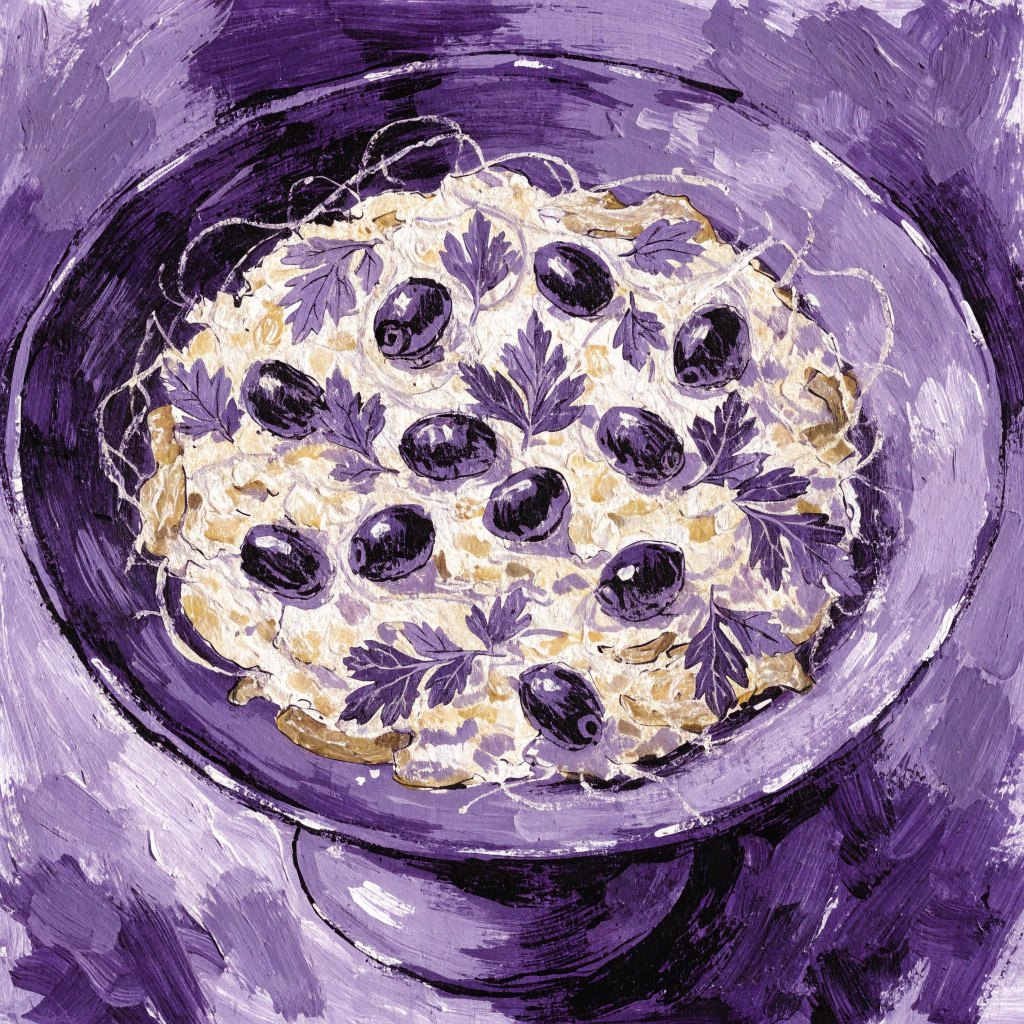
A Famous Fish Dish from Portugal
Portugal loves fish. The most famous fish is cod. People call it "the faithful friend." There are many different ways to cook it.
Bacalhau à Brás is a very popular dish. It comes from Lisbon. It has salt cod, onions, and thin fried potatoes. You mix them with eggs. It is delicious and soft.
People often put black olives and parsley on top. Families eat this meal together at home. It is a simple and traditional food. You can find this dish in every restaurant in Portugal. It is perfect for lunch or dinner.
Grammatik-Spotlight
Muster: Present Simple (to be)
"It is a simple and traditional food."
We use 'is' with singular subjects like 'it' to describe facts or qualities. It is formed by using the subject followed by the verb 'to be'.
Muster: Present Simple (Action Verbs)
"Families eat this meal together at home."
We use the base form of the verb for plural subjects like 'families'. This pattern describes regular habits or general truths.
Teste dein Verständnis
10 Fragen · A1 Anfänger · 1 kostenlose Vorschau
Teste, was du aus diesem Artikel gelernt hast. Beantworte alle Fragen und sammle XP!
Where does Bacalhau à Brás come from?
Möchtest du das Quiz beenden?
9 weitere Fragen warten auf dich. Registriere dich kostenlos, um das vollständige Quiz freizuschalten und XP zu sammeln!
Kostenlos registrierenHast du schon ein Konto? Anmelden
Gut gemacht!
Weiter üben!
Bereits abgeschlossen — keine zusätzlichen XP
Registriere dich, um XP zu verdienenFragenübersicht
Where does Bacalhau à Brás come from?
Deine Antwort:
Richtige Antwort: Lisbon
There is only one way to cook cod in Portugal.
Deine Antwort:
Richtige Antwort: Falsch
What does 'dish' mean?
Deine Antwort:
Richtige Antwort: Food cooked in a specific way
Families eat this meal _____ at home.
Deine Antwort:
Richtige Antwort: together
A Famous Fish from Portugal
Bacalhau is a special type of dried and salted cod. People in Portugal love it very much. They call it "the faithful friend" because it is always in their kitchens. There are many ways to cook this fish. Some people say there are more than 365 recipes, so you can eat a different dish every day of the year!
One of the most popular dishes is called Bacalhau à Brás. It started in the 19th century in a part of Lisbon called Bairro Alto. A man named Brás created the recipe. He wanted to make something fast and tasty.
To make this dish, you need shredded cod, onions, and very small fried potatoes. You mix these ingredients with eggs and add black olives on top. It is better than other fish dishes because it is salty and crispy at the same time. Today, many people in Portugal eat Bacalhau à Brás for lunch or dinner because it is easy to cook.
Grammatik-Spotlight
Muster: Past Simple
"A man named Brás created the recipe."
We use the past simple to talk about finished actions in the past. To form it for regular verbs, we usually add '-ed' to the base verb.
Muster: Comparatives
"It is better than other fish dishes because it is salty and crispy."
We use comparatives to compare two things. For short adjectives, we add '-er' + 'than', but 'good' changes to the irregular form 'better'.
Teste dein Verständnis
11 Fragen · A2 Grundkenntnisse · 1 kostenlose Vorschau
Teste, was du aus diesem Artikel gelernt hast. Beantworte alle Fragen und sammle XP!
Where did the recipe for Bacalhau à Brás begin?
Möchtest du das Quiz beenden?
10 weitere Fragen warten auf dich. Registriere dich kostenlos, um das vollständige Quiz freizuschalten und XP zu sammeln!
Kostenlos registrierenHast du schon ein Konto? Anmelden
Gut gemacht!
Weiter üben!
Bereits abgeschlossen — keine zusätzlichen XP
Registriere dich, um XP zu verdienenFragenübersicht
Where did the recipe for Bacalhau à Brás begin?
Deine Antwort:
Richtige Antwort: In a part of Lisbon
There are exactly ten ways to cook cod in Portugal.
Deine Antwort:
Richtige Antwort: Falsch
What is the meaning of 'century'?
Deine Antwort:
Richtige Antwort: One hundred years
You put black _____ on top of the dish.
Deine Antwort:
Richtige Antwort: olives
Why do people call the fish 'the faithful friend'?
Deine Antwort:
Richtige Antwort: Because it is always in their kitchens
Bacalhau à Brás: Portugals "treuer Freund" auf dem Teller
In Portugal hat ein Fisch einen ganz besonderen Platz in den Herzen der Menschen: der Kabeljau. Er wird oft als 'o fiel amigo', also 'der treue Freund', bezeichnet. Es ist bekannt, dass es über 365 verschiedene Arten gibt, diesen Fisch zuzubereiten – für jeden Tag des Jahres eine. Unter all diesen Rezepten ist Bacalhau à Brás vielleicht das beliebteste Alltagsgericht und ein echter Klassiker der portugiesischen Küche.
Bacalhau à Brás ist ein Gericht, das viele Portugiesen lieben, weil es so einfach und doch so lecker ist. Es bietet eine perfekte Mischung aus salzigen, herzhaften und knusprigen Texturen. Die Hauptzutaten sind gesalzener Kabeljau, der vorher gewässert wurde, dünne Kartoffelstifte, Eier und Zwiebeln. Alles wird zusammen in einer Pfanne gebraten, bis die Kartoffeln goldbraun und knusprig sind und die Eier stocken. Am Ende wird das Gericht oft mit frischer Petersilie und schwarzen Oliven garniert.
Man sagt, dass Bacalhau à Brás im 19. Jahrhundert in Lissabon entstanden ist, genauer gesagt im Viertel Bairro Alto. Ein Wirt namens Brás soll dieses Rezept erfunden haben. Es hat sich schnell verbreitet und ist heute aus keiner portugiesischen Küche wegzudenken, egal ob zu Hause oder im Restaurant. Viele Familien haben ihr eigenes Geheimnis, wie sie es am liebsten zubereiten.
Dieses Gericht zeigt sehr gut, wie die Portugiesen aus einfachen Zutaten etwas Besonderes machen können. Wenn Sie Portugal besuchen, sollten Sie Bacalhau à Brás unbedingt probieren. Es ist nicht nur ein Essen, sondern ein Stück portugiesische Kultur, das man einfach schmecken muss. Guten Appetit!
Grammatik-Spotlight
Muster: Passiv (Präsens)
"Er wird oft als 'o fiel amigo' ... bezeichnet."
Das Passiv benutzen wir, wenn die Handlung wichtiger ist als die Person, die sie ausführt, oder wenn die Person unbekannt ist. Es wird mit einer Form von 'werden' und dem Partizip II des Hauptverbs gebildet. Im Beispiel: 'Er' (der Kabeljau) wird bezeichnet, nicht er selbst bezeichnet.
Muster: Relativsätze
"Bacalhau à Brás ist ein Gericht, das viele Portugiesen lieben."
Relativsätze geben zusätzliche Informationen über ein Nomen. Sie beginnen mit einem Relativpronomen ('der', 'die', 'das' oder 'welcher', 'welche', 'welches'), das sich auf das Nomen bezieht. Das Verb steht am Ende des Relativsatzes.
Teste dein Verständnis
11 Fragen · B1 Mittelstufe · 1 kostenlose Vorschau
Teste, was du aus diesem Artikel gelernt hast. Beantworte alle Fragen und sammle XP!
Wie viele Zubereitungsarten für Kabeljau gibt es laut Legende in Portugal?
Möchtest du das Quiz beenden?
10 weitere Fragen warten auf dich. Registriere dich kostenlos, um das vollständige Quiz freizuschalten und XP zu sammeln!
Kostenlos registrierenHast du schon ein Konto? Anmelden
Gut gemacht!
Weiter üben!
Bereits abgeschlossen — keine zusätzlichen XP
Registriere dich, um XP zu verdienenFragenübersicht
Wie viele Zubereitungsarten für Kabeljau gibt es laut Legende in Portugal?
Deine Antwort:
Richtige Antwort: Über 365
Bacalhau à Brás ist ein sehr schwieriges und kompliziertes Gericht.
Deine Antwort:
Richtige Antwort: Falsch
Was bedeutet 'knusprig'?
Deine Antwort:
Richtige Antwort: Fest und macht Geräusche beim Beißen
Der Kabeljau wird in Portugal oft als 'der treue _____' bezeichnet.
Deine Antwort:
Richtige Antwort: Freund
Das Gericht Bacalhau à Brás ist im 19. Jahrhundert in Lissabon _____.
Deine Antwort:
Richtige Antwort: entstanden
Bacalhau à Brás: The Soul of Portuguese Culinary Heritage
Portugal’s culinary landscape is dominated by a single, iconic ingredient: salted cod, known locally as 'bacalhau.' Often referred to as 'o fiel amigo' or the faithful friend, it has become an undisputed symbol of the nation's gastronomic heritage. While legend suggests there are more than 365 ways to prepare this fish—one for every day of the year—few dishes capture the essence of Portuguese comfort food as effectively as Bacalhau à Brás. This preparation represents a perfect marriage of history, necessity, and flavor.
Originating in the 19th century within the narrow, cobblestone streets of Lisbon’s Bairro Alto district, the dish was reportedly created by a tavern owner named Brás. What makes this preparation stand out in the vast Portuguese repertoire is its sophisticated simplicity. It consists of finely shredded cod, thinly sliced onions, and matchstick-sized fried potatoes—known as 'batata palha'—all bound together by creamy scrambled eggs. The result is a harmonious blend of contrasting textures: the tenderness of the fish, the slight crunch of the potatoes, and the velvety richness of the eggs. Traditionally, it is garnished with black olives and fresh parsley to provide a sharp, herbal contrast to the savory base.
The widespread popularity of Bacalhau à Brás can be attributed to its remarkable versatility and speed of preparation. Although the primary ingredients are humble, the execution must be handled meticulously to ensure the eggs do not overcook; if the heat is too high, the dish loses its signature moisture. This requirement for precise balance reflects a broader Portuguese culinary philosophy: the art of transforming simple, preserved ingredients into a feast that satisfies both the palate and the soul. It is a dish that demands attention despite its unassuming appearance.
For many, this dish is a staple of the weekly diet, yet it remains special enough to be served at festive gatherings. It serves as a testament to the historical necessity of preserving fish with salt, a practice that allowed the Portuguese to explore distant oceans while maintaining a reliable food source. Today, even though fresh fish is readily available, the preference for salted cod persists, proving that tradition often outweighs convenience. In conclusion, Bacalhau à Brás is more than just a meal; it is a reflection of Lisbon’s history and the enduring creativity of its people.
Grammatik-Spotlight
Muster: Cleft Sentences
"What makes this preparation stand out in the vast Portuguese repertoire is its sophisticated simplicity."
Cleft sentences are used to focus on specific information. They often start with 'What' followed by a clause and the verb 'to be' to emphasize the subject.
Muster: Passive Voice with Modal Verbs
"the execution must be handled meticulously to ensure the eggs do not overcook"
This structure (modal + be + past participle) is used to express necessity or obligation without focusing on the person doing the action.
Muster: Present Perfect
"it has become an undisputed symbol of the nation's gastronomic heritage."
The present perfect is used here to describe a state that started in the past and continues to be true in the present.
Teste dein Verständnis
11 Fragen · B2 Obere Mittelstufe · 1 kostenlose Vorschau
Teste, was du aus diesem Artikel gelernt hast. Beantworte alle Fragen und sammle XP!
Where was Bacalhau à Brás originally created?
Möchtest du das Quiz beenden?
10 weitere Fragen warten auf dich. Registriere dich kostenlos, um das vollständige Quiz freizuschalten und XP zu sammeln!
Kostenlos registrierenHast du schon ein Konto? Anmelden
Gut gemacht!
Weiter üben!
Bereits abgeschlossen — keine zusätzlichen XP
Registriere dich, um XP zu verdienenFragenübersicht
Where was Bacalhau à Brás originally created?
Deine Antwort:
Richtige Antwort: In the Bairro Alto district of Lisbon
The article states that there are exactly 365 ways to cook cod in Portugal.
Deine Antwort:
Richtige Antwort: Falsch
What is the meaning of 'meticulously'?
Deine Antwort:
Richtige Antwort: With great attention to detail
For many Portuguese people, this dish is a _____ of the weekly diet.
Deine Antwort:
Richtige Antwort: staple
What is the main risk when cooking the eggs in this dish?
Deine Antwort:
Richtige Antwort: They might overcook and lose moisture
The Culinary Alchemy of Bacalhau à Brás: A Cultural and Gastronomic Analysis
Seldom does a single ingredient command such unwavering devotion as the salted cod does in Portugal. Known colloquially as 'o fiel amigo', this dried and salted fish transcends mere sustenance, embedding itself into the very fabric of Lusitanian identity. While the origins of cod consumption in the Iberian Peninsula date back centuries, it is the sheer versatility of the ingredient that warrants scholarly attention. Legend has it that there exist no fewer than 365 ways to prepare it—a culinary repertoire that allows for a different iteration every single day of the year. Chief among these preparations is the illustrious Bacalhau à Brás. It was in the nineteenth century, within the labyrinthine and bohemian alleys of Lisbon’s Bairro Alto, that this dish was allegedly conceived. Attributed to a tavern owner named Senhor Brás, the recipe represents a triumph of culinary alchemy. By shredding the cod and marrying it with finely julienned potatoes, sautéed onions, and scrambled eggs, Brás created a dish where the texture is the protagonist. The addition of black olives and fresh parsley provides a necessary aesthetic and flavor contrast, elevating humble components into a sophisticated ensemble. The preparation of Bacalhau à Brás requires a meticulousness that belies its rustic appearance. The desalinization process alone demands foresight, as the fish must be soaked for several days to achieve the requisite salinity. Furthermore, the success of the dish hinges on the 'cremosidade'—a silkiness achieved by ensuring the eggs are not overcooked. Should the heat be too intense, the dish risks becoming a dry scramble rather than the velvety masterpiece it is intended to be. This delicate balance reflects a broader Portuguese culinary philosophy: the elevation of the mundane through technical precision. From a sociological perspective, the ubiquity of Bacalhau à Brás across all social strata is particularly noteworthy. What began as a resourceful solution in a Lisbon tavern has permeated the menus of high-end gastronomic establishments and family kitchens alike. Its popularity serves as a testament to the democratisation of Portuguese cuisine. Moreover, the dish exemplifies the concept of 'saudade'—a nostalgic longing for simplicity and tradition in an increasingly globalised world. In conclusion, Bacalhau à Brás is not merely a meal; it is a cultural artifact. The enduring legacy of Senhor Brás’s invention lies in its ability to reconcile the salt of the Atlantic with the warmth of the Portuguese hearth. As long as there are those who appreciate the subtle interplay of crispy straw potatoes and tender cod, the 'faithful friend' will remain firmly perched upon its gastronomic throne.
Grammatik-Spotlight
Muster: Negative Inversion
"Seldom does a single ingredient command such unwavering devotion as the salted cod does in Portugal."
When a negative or restrictive adverbial (like 'seldom') starts a sentence, the auxiliary verb and subject are inverted. This is used in formal writing to add emphasis.
Muster: Cleft Sentences
"It was in the nineteenth century, within the labyrinthine and bohemian alleys of Lisbon’s Bairro Alto, that this dish was allegedly conceived."
Cleft sentences use 'It + be + [emphasized part] + relative clause' to focus on specific information. Here, it emphasizes the specific time and location of the dish's origin.
Muster: Nominalisation
"The preparation of Bacalhau à Brás requires a meticulousness that belies its rustic appearance."
Nominalisation turns verbs or adjectives into nouns (e.g., 'preparation' instead of 'preparing'). This creates a more formal, academic tone typical of C1 level writing.
Teste dein Verständnis
12 Fragen · C1 Fortgeschritten · 1 kostenlose Vorschau
Teste, was du aus diesem Artikel gelernt hast. Beantworte alle Fragen und sammle XP!
What is the primary objective of the article?
Möchtest du das Quiz beenden?
11 weitere Fragen warten auf dich. Registriere dich kostenlos, um das vollständige Quiz freizuschalten und XP zu sammeln!
Kostenlos registrierenHast du schon ein Konto? Anmelden
Gut gemacht!
Weiter üben!
Bereits abgeschlossen — keine zusätzlichen XP
Registriere dich, um XP zu verdienenFragenübersicht
What is the primary objective of the article?
Deine Antwort:
Richtige Antwort: To analyze the cultural and historical significance of a specific dish
According to the text, there are exactly 365 ways to cook cod in Portugal.
Deine Antwort:
Richtige Antwort: Falsch
What does the word 'interplay' mean in the context of the final paragraph?
Deine Antwort:
Richtige Antwort: The interaction between different elements
If the heat is too high, the dish might turn into a dry ____ instead of being silky.
Deine Antwort:
Richtige Antwort: scramble
Why does the author mention 'saudade'?
Deine Antwort:
Richtige Antwort: To link the dish to a sense of nostalgic longing
The desalinization process is a quick task that can be done right before cooking.
Deine Antwort:
Richtige Antwort: Falsch
The Alchemical Symbiosis of Salt and Soul: An Analytical Inquiry into Bacalhau à Brás
Should one deconstruct the gastronomic landscape of the Iberian Peninsula, the ubiquity of salt cod, or bacalhau, emerges not merely as a culinary preference but as an indissoluble cultural phenomenon. Often referred to with affectionate reverence as 'o fiel amigo'—the faithful friend—this preserved fish has sustained the Portuguese spirit through centuries of maritime exploration and economic fluctuation. While legend posits that there exist more than three hundred and sixty-five ways to prepare this gadoid, few iterations capture the national psyche as poignantly as Bacalhau à Brás. This dish, a sophisticated assemblage of shredded cod, finely julienned potatoes, and silken eggs, represents a masterclass in textural equilibrium and socio-historical evolution.
The provenance of Bacalhau à Brás is traditionally traced to the 19th century, specifically within the labyrinthine corridors of Lisbon’s Bairro Alto district. It is purportedly the creation of a tavern keeper whose nomenclature—Brás—now serves as a linguistic signifier for the dish itself. However, to view this preparation solely through the lens of historical anecdote would be to overlook its theoretical complexity. The dish functions as a culinary palimpsest, where the ancient technique of salt-curing meets the 19th-century innovation of the 'batata palha' (straw potato). Not only does the dish demand a precise temporal execution, but it also necessitates a profound understanding of textural interplay, where the crunch of the potato must be preserved against the encroaching moisture of the eggs.
From a technical perspective, the preparation is an exercise in emulsion and heat management. The cod must be meticulously desalted—a process requiring days of patient hydration—before being sautéed with aromatics. The introduction of the eggs is the most precarious phase; were the heat to be too aggressive, the mixture would curdle into a dry scramble, thereby forfeiting its characteristic creaminess. It is this very alchemy of disparate elements that elevates a peasant staple to the heights of the national culinary canon. The final aesthetic flourishes—the pungent salinity of black olives and the verdant freshness of parsley—are not merely decorative but serve as essential counterpoints to the richness of the yolk.
Furthermore, the enduring popularity of Bacalhau à Brás invites a scholarly examination of how ephemeral trends are eschewed in favor of tradition. In an era of globalized gastronomy, where culinary boundaries are increasingly porous, the dish remains an idiosyncratic bastion of Portuguese identity. Its survival is predicated on its accessibility; it is a democratic dish, found in both the most austere rural taverns and the most avant-garde urban bistros. The quintessence of the dish lies in its ability to reconcile the preservation needs of the past with the sensory desires of the present. Ultimately, Bacalhau à Brás is more than a meal; it is a semiotic expression of a nation that has always looked to the sea for its sustenance and its stories, proving that even the most humble ingredients, when treated with intellectual and manual rigor, can achieve a state of sublime permanence.
Grammatik-Spotlight
Muster: Inverted Conditional (Should...)
"Should one deconstruct the gastronomic landscape of the Iberian Peninsula, the ubiquity of salt cod emerges not merely as a culinary preference but as an indissoluble cultural phenomenon."
This structure is used to express a hypothetical condition in a formal way. It replaces 'If one should deconstruct...' and is common in academic or literary English.
Muster: Negative Inversion
"Not only does the dish demand a precise temporal execution, but it also necessitates a profound understanding of textural interplay."
When a sentence begins with a negative or restrictive expression like 'Not only', the subject and auxiliary verb are inverted. This adds rhetorical emphasis to the dual nature of the statement.
Muster: Cleft Sentence (It is... that...)
"It is this very alchemy of disparate elements that elevates a peasant staple to the heights of the national culinary canon."
A cleft sentence is used to focus on a specific part of the sentence (the focus). Here, 'this very alchemy' is emphasized as the primary cause of the dish's elevated status.
Teste dein Verständnis
12 Fragen · C2 Meisterschaft · 1 kostenlose Vorschau
Teste, was du aus diesem Artikel gelernt hast. Beantworte alle Fragen und sammle XP!
What does the author suggest by calling the dish a 'culinary palimpsest'?
Möchtest du das Quiz beenden?
11 weitere Fragen warten auf dich. Registriere dich kostenlos, um das vollständige Quiz freizuschalten und XP zu sammeln!
Kostenlos registrierenHast du schon ein Konto? Anmelden
Gut gemacht!
Weiter üben!
Bereits abgeschlossen — keine zusätzlichen XP
Registriere dich, um XP zu verdienenFragenübersicht
What does the author suggest by calling the dish a 'culinary palimpsest'?
Deine Antwort:
Richtige Antwort: It represents layers of historical and technical evolution.
The author argues that Bacalhau à Brás is only found in high-end urban bistros.
Deine Antwort:
Richtige Antwort: Falsch
What does 'provenance' mean in the context of the article?
Deine Antwort:
Richtige Antwort: The origin or history of the dish.
The dish is described as a masterclass in _____ equilibrium.
Deine Antwort:
Richtige Antwort: textural
According to the text, what is the most 'precarious' part of the preparation?
Deine Antwort:
Richtige Antwort: The introduction of eggs to the mixture.
The term 'o fiel amigo' refers to the tavern keeper who invented the dish.
Deine Antwort:
Richtige Antwort: Falsch

