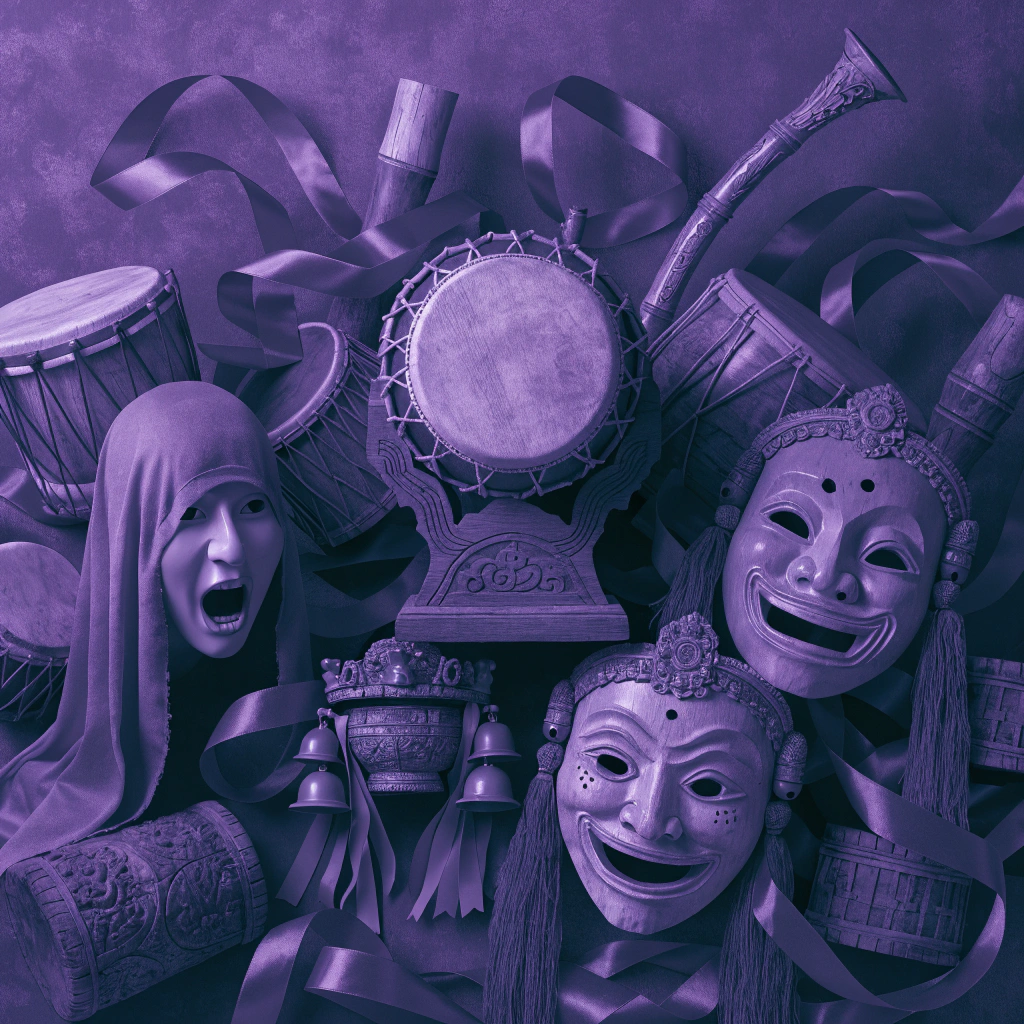
Pansori: Traditional Music of Korea
Pansori is a special music from South Korea. It is a very old tradition. One person sings a long story. This person is a singer. They use a fan and move their body.
There is also a drummer. The drummer hits a big drum. The drummer makes a rhythm for the singer. People watch and listen to the music together.
The singer tells stories about history and people. The music is loud and beautiful. Pansori is very important in Korea. Many people love this traditional art form today.
Grammatik-Spotlight
Muster: Present Simple (Be)
"Pansori is a special music from South Korea."
We use 'is' for singular subjects like 'Pansori' or 'It'. It describes a fact or a state.
Muster: Present Simple (Third Person Singular)
"The drummer hits a big drum."
We add '-s' to the verb (hit becomes hits) when the subject is one person like 'the drummer'. It describes a regular action.
Teste dein Verständnis
10 Fragen · A1 Anfänger · 1 kostenlose Vorschau
Teste, was du aus diesem Artikel gelernt hast. Beantworte alle Fragen und sammle XP!
Where is Pansori from?
Möchtest du das Quiz beenden?
9 weitere Fragen warten auf dich. Registriere dich kostenlos, um das vollständige Quiz freizuschalten und XP zu sammeln!
Kostenlos registrierenHast du schon ein Konto? Anmelden
Gut gemacht!
Weiter üben!
Bereits abgeschlossen — keine zusätzlichen XP
Registriere dich, um XP zu verdienenFragenübersicht
Where is Pansori from?
Deine Antwort:
Richtige Antwort: South Korea
One person sings a long story in Pansori.
Deine Antwort:
Richtige Antwort: Richtig
What is a 'drummer'?
Deine Antwort:
Richtige Antwort: A person who plays a drum
The drummer hits a big _____.
Deine Antwort:
Richtige Antwort: drum
Pansori: Eine besondere Musik aus Korea
Pansori ist eine sehr alte und besondere Musikform aus Südkorea. Es ist wie eine Oper, aber nur für eine Person. Ein Sänger oder eine Sängerin erzählt eine lange Geschichte und singt dabei. Manchmal benutzt die Person auch Gesten und Mimik, um die Geschichte lebendiger zu machen.
Diese Kunst entstand vor langer Zeit, im 17. Jahrhundert, während der Joseon-Dynastie. Am Anfang war Pansori oft mit Schamanenliedern verbunden. Später wurde es eine beliebte Unterhaltung für viele Menschen, nicht nur für die einfachen Leute, sondern auch für reiche Familien. Ein Trommler begleitet den Sänger oft mit rhythmischen Klängen.
Pansori ist heute sehr wichtig für die koreanische Kultur. Es ist ein lebendiges Erbe und wird immer noch von vielen Menschen geliebt. Die Geschichten sind oft traurig oder lustig und handeln von Liebe, Mut oder Gerechtigkeit.
Grammatik-Spotlight
Muster: Präteritum (Vergangenheitsform)
"Diese Kunst entstand vor langer Zeit."
Das Präteritum ist eine Vergangenheitsform, die man oft in Erzählungen oder bei Berichten über vergangene Ereignisse benutzt. Bei regelmäßigen Verben hängt man '-te' an den Stamm, bei unregelmäßigen Verben ändert sich der Stamm, wie hier bei 'entstehen' zu 'entstand'.
Muster: Passiv mit 'wurde' (Präteritum)
"Später wurde es eine beliebte Unterhaltung für viele Menschen."
Diese Form zeigt, dass etwas mit jemandem oder etwas gemacht wurde, nicht dass es aktiv etwas getan hat. Man bildet es mit 'werden' im Präteritum ('wurde') und dem Partizip II des Hauptverbs (hier ist 'Unterhaltung' das Ergebnis, es ist ein Zustands-Passiv-ähnlicher Satzbau).
Teste dein Verständnis
11 Fragen · A2 Grundkenntnisse · 1 kostenlose Vorschau
Teste, was du aus diesem Artikel gelernt hast. Beantworte alle Fragen und sammle XP!
Was ist Pansori?
Möchtest du das Quiz beenden?
10 weitere Fragen warten auf dich. Registriere dich kostenlos, um das vollständige Quiz freizuschalten und XP zu sammeln!
Kostenlos registrierenHast du schon ein Konto? Anmelden
Gut gemacht!
Weiter üben!
Bereits abgeschlossen — keine zusätzlichen XP
Registriere dich, um XP zu verdienenFragenübersicht
Was ist Pansori?
Deine Antwort:
Richtige Antwort: Eine besondere Musikform aus Korea
Pansori ist eine sehr neue Kunstform.
Deine Antwort:
Richtige Antwort: Falsch
Was bedeutet 'Dynastie'?
Deine Antwort:
Richtige Antwort: Eine Reihe von Herrschern aus derselben Familie
Ein _________ begleitet den Sänger oft mit rhythmischen Klängen.
Deine Antwort:
Richtige Antwort: Trommler
Wie viele Personen singen normalerweise Pansori?
Deine Antwort:
Richtige Antwort: Nur eine Person
Pansori: Eine faszinierende koreanische Erzählkunst
Pansori ist eine traditionelle koreanische Musikform, die oft als „Ein-Personen-Oper“ beschrieben wird. Sie ist ein wichtiger Teil der koreanischen Kultur und wurde sogar von der UNESCO als Meisterwerk des mündlichen und immateriellen Erbes der Menschheit anerkannt.
Der Name „Pansori“ setzt sich aus zwei koreanischen Wörtern zusammen: „Pan“, was einen Ort bezeichnet, wo viele Menschen zusammenkommen, und „Sori“, was Klang oder Gesang bedeutet. Diese einzigartige Kunstform entstand im 17. Jahrhundert während der Joseon-Dynastie. Ursprünglich hat sie sich aus Schamanengesängen entwickelt und wurde zu einer populären Unterhaltung für das einfache Volk. Später wurde sie auch beim Adel sehr beliebt.
Ein Pansori-Künstler, der sogenannte „Sorikkun“, erzählt eine lange Geschichte nur mit seiner Stimme. Dabei singt er, spricht und benutzt oft rhythmische Bewegungen. Ein Schlagzeuger, der „Gosu“, begleitet den Sorikkun auf einer Trommel. Die Geschichten sind meistens Dramen über Liebe, Freundschaft oder soziale Probleme. Sie können viele Stunden dauern und erfordern vom Sorikkun unglaubliches stimmliches Können und viel Ausdruckskraft.
Heute wird Pansori immer noch von vielen Menschen in Südkorea und weltweit geschätzt. Es ist ein lebendiges Beispiel dafür, wie alte Traditionen fortbestehen und Menschen noch heute begeistern können. Wer sich für die koreanische Kultur interessiert, sollte sich unbedingt einmal ein Pansori-Stück ansehen oder anhören.
Grammatik-Spotlight
Muster: Das Vorgangspassiv
"Pansori wurde sogar von der UNESCO als Meisterwerk des mündlichen und immateriellen Erbes der Menschheit anerkannt."
Das Vorgangspassiv wird verwendet, um zu beschreiben, was mit etwas geschieht oder getan wird, wobei der Handelnde nicht immer wichtig ist. Es wird mit einer Form von 'werden' und dem Partizip II des Hauptverbs gebildet.
Muster: Relativsätze mit "der, die, das"
"Pansori ist eine traditionelle koreanische Musikform, die oft als „Ein-Personen-Oper“ beschrieben wird."
Relativsätze geben zusätzliche Informationen über ein Nomen. Sie beginnen mit einem Relativpronomen (der, die, das), das sich auf das Bezugswort bezieht und den Kasus des Relativsatzes bestimmt. Das konjugierte Verb steht am Ende des Relativsatzes.
Teste dein Verständnis
11 Fragen · B1 Mittelstufe · 1 kostenlose Vorschau
Teste, was du aus diesem Artikel gelernt hast. Beantworte alle Fragen und sammle XP!
Was bedeutet „Sori“ im Namen „Pansori“?
Möchtest du das Quiz beenden?
10 weitere Fragen warten auf dich. Registriere dich kostenlos, um das vollständige Quiz freizuschalten und XP zu sammeln!
Kostenlos registrierenHast du schon ein Konto? Anmelden
Gut gemacht!
Weiter üben!
Bereits abgeschlossen — keine zusätzlichen XP
Registriere dich, um XP zu verdienenFragenübersicht
Was bedeutet „Sori“ im Namen „Pansori“?
Deine Antwort:
Richtige Antwort: Gesang
Pansori hat sich ursprünglich aus Schamanengesängen entwickelt.
Deine Antwort:
Richtige Antwort: Richtig
Was bedeutet das Wort „erfordern“ im Text?
Deine Antwort:
Richtige Antwort: Etwas notwendig machen
Ein Pansori-Künstler erzählt eine lange Geschichte nur mit seiner __________.
Deine Antwort:
Richtige Antwort: Stimme
Welcher Instrumentalist begleitet den Sorikkun?
Deine Antwort:
Richtige Antwort: Ein Schlagzeuger
Pansori: The Soulful Resonance of Korean Narrative Song
Pansori, often characterized as a 'one-person opera,' represents a pinnacle of Korean traditional performing arts. Originating in the 17th century during the Joseon Dynasty, this expressive genre combines dramatic storytelling with intricate vocal techniques. Although it initially emerged from shamanic rituals among the common people, it eventually transcended its humble beginnings to captivate audiences across all social strata, including the aristocracy.
A typical performance relies on a delicate balance between the vocalist, known as the sorikkun, and the drummer, or gosu. While the vocalist narrates epic tales through a mixture of song, speech, and gesture, the drummer provides the essential rhythmic accompaniment. Furthermore, the audience is far from passive; they play an active role through 'chuimsae'—spontaneous verbal encouragements that bridge the gap between the performer and the spectator. This interaction creates a unique atmosphere where the energy of the crowd directly influences the intensity of the performance.
One cannot discuss Pansori without mentioning the concept of 'han'—a profound sense of sorrow or unresolved resentment that is considered central to the Korean psyche. Performers must undergo years of rigorous training to develop the specialized 'husky' voice necessary to convey these complex emotions effectively. Because of this dedication to craft, Pansori was designated as a UNESCO Intangible Cultural Heritage of Humanity in 2003, ensuring its preservation for future generations.
Despite the dominance of modern pop culture, Pansori continues to evolve and maintain its relevance. Contemporary artists are increasingly integrating traditional elements with Western instruments and modern theatrical styles, demonstrating the genre's enduring versatility. By analyzing its historical trajectory, it becomes evident that Pansori is not merely a relic of the past, but a living testament to Korean cultural identity and artistic resilience. It remains a powerful medium for storytelling, reflecting the shared joys and pains of the human experience through its unique melodic structure.
Grammatik-Spotlight
Muster: Participle Phrases for Background Information
"Originating in the 17th century during the Joseon Dynasty, this expressive genre combines dramatic storytelling with intricate vocal techniques."
The present or past participle phrase at the beginning of a sentence provides essential context or background for the main subject. It functions as an adjective clause to make writing more concise and formal.
Muster: Passive Voice for Formal Designation
"Pansori was designated as a UNESCO Intangible Cultural Heritage of Humanity in 2003."
The passive voice is used here to focus on the art form (the object) rather than the organization that designated it. It is formed using 'be' + past participle.
Muster: Gerunds as Subjects for Analysis
"By analyzing its historical trajectory, it becomes evident that Pansori is not merely a relic of the past."
The gerund 'analyzing' follows a preposition to describe the method or means by which a conclusion is reached. This is a common structure in academic and analytical writing.
Teste dein Verständnis
11 Fragen · B2 Obere Mittelstufe · 1 kostenlose Vorschau
Teste, was du aus diesem Artikel gelernt hast. Beantworte alle Fragen und sammle XP!
What is the role of the 'gosu' in a Pansori performance?
Möchtest du das Quiz beenden?
10 weitere Fragen warten auf dich. Registriere dich kostenlos, um das vollständige Quiz freizuschalten und XP zu sammeln!
Kostenlos registrierenHast du schon ein Konto? Anmelden
Gut gemacht!
Weiter üben!
Bereits abgeschlossen — keine zusätzlichen XP
Registriere dich, um XP zu verdienenFragenübersicht
What is the role of the 'gosu' in a Pansori performance?
Deine Antwort:
Richtige Antwort: To provide rhythmic drumming accompaniment
Pansori was originally created for the aristocracy and only later became popular among common people.
Deine Antwort:
Richtige Antwort: Falsch
Which word describes the ability to adapt to many different functions or styles?
Deine Antwort:
Richtige Antwort: Versatility
The audience provides verbal encouragements known as _____, which bridge the gap with the performer.
Deine Antwort:
Richtige Antwort: chuimsae
What does the concept of 'han' represent in the context of Pansori?
Deine Antwort:
Richtige Antwort: A deep sense of sorrow or unresolved resentment
The Echoes of Han: Deconstructing the Narrative Power of Pansori
Few art forms encapsulate the historical consciousness of a nation as poignantly as Pansori, the traditional Korean genre of musical storytelling. Often characterized as a 'one-person opera,' Pansori is a visceral synthesis of vocal prowess, dramatic narrative, and rhythmic accompaniment. Its origins, which trace back to the 17th-century Joseon Dynasty, are steeped in shamanic ritual and folk tradition. Yet, the evolution of Pansori into a sophisticated medium of social commentary reflects a complex trajectory through the Korean social hierarchy.
At the heart of a Pansori performance lies the 'sorikkun' (singer) and the 'gosu' (drummer). Seldom does an art form demand such a grueling synthesis of physical endurance and emotional depth from its practitioners. The sorikkun must master an array of vocal textures, ranging from delicate whispers to thunderous, guttural roars. It is within the raw resonance of the singer’s voice that the essence of 'han'—a profound collective sentiment of unresolved grief and resilience—finds its most evocative expression. This emotional catharsis is not merely a solo endeavor; the gosu provides a rhythmic framework, while the audience participates through 'chuimsae,' spontaneous verbal encouragements that bridge the gap between performer and spectator.
The gosu’s role, while seemingly secondary, is indispensable; through the 'buk' (barrel drum), the drummer regulates the tempo and provides the 'jangdan' (rhythmic cycles) that anchor the singer’s improvisational flights. Furthermore, the training of a sorikkun is a legendary feat of endurance. To achieve the necessary vocal grit, aspirants historically practiced near waterfalls, attempting to drown out the roar of the water until their vocal cords were permanently altered. This physical transformation is a prerequisite for capturing the 'rough' beauty that defines the genre’s aesthetic.
The historical trajectory of Pansori is equally compelling. Initially, it served as a populist medium, providing the common folk with a vehicle for satirizing the aristocratic elite. However, by the 19th century, the genre’s aesthetic sophistication had attracted the patronage of the upper classes. This transition necessitated a refinement of the lyrical content, blending vernacular humor with classical literary allusions. The preservation of Pansori in the modern era, however, faces significant challenges. In a globalized cultural landscape dominated by digital immediacy, the arduous training required to become a master sorikkun is increasingly rare.
Nevertheless, the enduring relevance of Pansori lies in its capacity for improvisation and its narrative adaptability. It is the inherent flexibility of the form that allows it to resonate across generational divides. While the traditional 'five stories' remain the core repertoire, contemporary artists are increasingly experimenting with modern themes, ensuring that this 'sound of the people' does not become a static museum piece. The institutionalization of Pansori as a National Intangible Cultural Property has further solidified its status, yet its true survival depends on its ability to evoke a visceral response in a modern audience.
Grammatik-Spotlight
Muster: Negative Inversion
"Seldom does an art form demand such a grueling synthesis of physical endurance and emotional depth from its practitioners."
When negative or restrictive adverbs like 'seldom' or 'never' are placed at the beginning of a sentence for emphasis, the subject and auxiliary verb are inverted. This creates a more formal and dramatic tone.
Muster: It-Cleft Sentence
"It is within the raw resonance of the singer’s voice that the essence of 'han' finds its most evocative expression."
Cleft sentences use 'It is/was... that' to focus on a specific part of the sentence (in this case, the location/source of the expression). It highlights the importance of the focused element over the rest of the clause.
Muster: Nominalisation
"The institutionalization of Pansori as a National Intangible Cultural Property has further solidified its status..."
Nominalisation involves turning verbs or adjectives into nouns (e.g., 'institutionalize' to 'institutionalization'). This is common in academic and advanced writing to pack more information into a sentence and sound more objective.
Teste dein Verständnis
12 Fragen · C1 Fortgeschritten · 1 kostenlose Vorschau
Teste, was du aus diesem Artikel gelernt hast. Beantworte alle Fragen und sammle XP!
What distinguishes the role of the gosu in a Pansori performance?
Möchtest du das Quiz beenden?
11 weitere Fragen warten auf dich. Registriere dich kostenlos, um das vollständige Quiz freizuschalten und XP zu sammeln!
Kostenlos registrierenHast du schon ein Konto? Anmelden
Gut gemacht!
Weiter üben!
Bereits abgeschlossen — keine zusätzlichen XP
Registriere dich, um XP zu verdienenFragenübersicht
What distinguishes the role of the gosu in a Pansori performance?
Deine Antwort:
Richtige Antwort: They regulate the tempo and anchor the singer's improvisations.
Pansori was originally created for the aristocratic elite before becoming popular among commoners.
Deine Antwort:
Richtige Antwort: Falsch
Which word describes a sound produced in the throat that is harsh or deep?
Deine Antwort:
Richtige Antwort: Guttural
The concept of _____ refers to a collective Korean sentiment of unresolved grief and hope.
Deine Antwort:
Richtige Antwort: han
According to the text, why did Pansori lyrics change in the 19th century?
Deine Antwort:
Richtige Antwort: To suit the tastes of aristocratic patrons.
Training to be a sorikkun historically involved practicing near waterfalls to alter the voice.
Deine Antwort:
Richtige Antwort: Richtig
The Ontological Resonance of Pansori: A Synthesis of Sorrow and Satire
Pansori, often heralded as the quintessence of Korean traditional music, represents a profound intersection of narrative drama, visceral vocalization, and rhythmic complexity. Originating in the 17th century during the Joseon Dynasty, this 'one-person opera' ostensibly evolved from shamanic chants into a sophisticated medium for folk storytelling. Were one to scrutinize the socio-political landscape of its inception, one would find an art form that served as a rare egalitarian space. It allowed for a confluence of voices, where the grievances of the commonality were articulated through a lens of both poignant sorrow and biting satire. This existential sorrow, termed 'han,' is the emotional core of the performance, demanding that the vocalist, or sorikkun, undergo an arduous process of vocal cultivation to achieve the elusive 'deuk-eum'—the attainment of a voice that can pierce the soul.
The structural integrity of Pansori relies upon a delicate symbiosis between the sorikkun and the gosu, a drummer who provides the rhythmic foundation using a buk. This relationship is not merely functional; it is a shared journey through the 'pan,' the space where the performance unfolds. The gosu does not simply keep time but punctuates the narrative with 'chuimsae'—vocal encouragements that catalyze the performer’s energy. Lest the audience perceive this as a static exhibition, it is vital to acknowledge that Pansori is inherently improvisational. The sorikkun must navigate the idiosyncrasies of each audience, adjusting the narrative pace and emotional intensity in real-time. This fluidity ensures that no two performances are identical, reflecting the ephemeral nature of the human experience.
Furthermore, the narrative content of the surviving five 'madang'—the core cycles of Pansori—reveals a subversive undercurrent. While ostensibly celebrating Confucian virtues such as filial piety and loyalty, these stories frequently utilize humor and parody to critique the excesses of the aristocracy. It is through this synthesis of high-brow morality and low-brow artifice that Pansori bridged the gap between the ruling class and the peasantry. As the performance progresses, the sorikkun’s voice must emanate from the abdomen, producing a gravelly, multifaceted timbre that contrasts sharply with the crystalline aesthetics of Western operatic traditions. This vocal grit is not a deficiency but a deliberate aesthetic choice, signifying the hardships of the life it portrays.
In the contemporary era, the preservation of Pansori faces the perennial challenge of maintaining authenticity while embracing evolution. Designated as a UNESCO Intangible Cultural Heritage of Humanity, it remains a pillar of Korean identity. However, should the art form become fossilized in its own tradition, it risks losing the very vitality that allowed it to flourish in the marketplaces of the past. Modern practitioners are therefore tasked with a difficult balancing act: honoring the rigorous techniques of their predecessors while ensuring the narrative remains relevant to a burgeoning global audience. Ultimately, Pansori stands as a testament to the power of the human voice to transcend social stratifications, offering a resonant exploration of the human condition that is as relevant today as it was four centuries ago.
Grammatik-Spotlight
Muster: Inverted Conditional (Subjunctive)
"Were one to scrutinize the socio-political landscape of its inception, one would find an art form that served as a rare egalitarian space."
This formal structure replaces 'If one were to...' by inverting the verb and subject. It is used in academic or literary contexts to express hypothetical situations with a high degree of formality.
Muster: Negative Purpose with 'Lest'
"Lest the audience perceive this as a static exhibition, it is vital to acknowledge that Pansori is inherently improvisational."
The word 'lest' is used to express a desire to prevent a particular undesirable outcome. It is followed by a base form verb or a subjunctive clause, characteristic of C2 level prose.
Muster: Hypothetical Conditional with 'Should'
"However, should the art form become fossilized in its own tradition, it risks losing the very vitality that allowed it to flourish in the marketplaces of the past."
Using 'should' at the beginning of a conditional clause is a formal alternative to 'if', indicating a possibility that is considered unlikely but must be addressed.
Teste dein Verständnis
12 Fragen · C2 Meisterschaft · 1 kostenlose Vorschau
Teste, was du aus diesem Artikel gelernt hast. Beantworte alle Fragen und sammle XP!
What does the term 'han' primarily represent in the context of Pansori?
Möchtest du das Quiz beenden?
11 weitere Fragen warten auf dich. Registriere dich kostenlos, um das vollständige Quiz freizuschalten und XP zu sammeln!
Kostenlos registrierenHast du schon ein Konto? Anmelden
Gut gemacht!
Weiter üben!
Bereits abgeschlossen — keine zusätzlichen XP
Registriere dich, um XP zu verdienenFragenübersicht
What does the term 'han' primarily represent in the context of Pansori?
Deine Antwort:
Richtige Antwort: A profound, existential sorrow that forms the emotional core
Pansori was originally created as an entertainment form for the aristocracy during the 17th century.
Deine Antwort:
Richtige Antwort: Falsch
Which word describes a relationship where both parties benefit from each other?
Deine Antwort:
Richtige Antwort: Symbiosis
The drummer in a Pansori performance is known as the _____.
Deine Antwort:
Richtige Antwort: gosu
According to the article, why is the vocal 'grit' in Pansori considered a deliberate choice?
Deine Antwort:
Richtige Antwort: To signify the hardships and reality of the life it portrays
The 'chuimsae' are vocal encouragements provided by the drummer to support the singer.
Deine Antwort:
Richtige Antwort: Richtig

