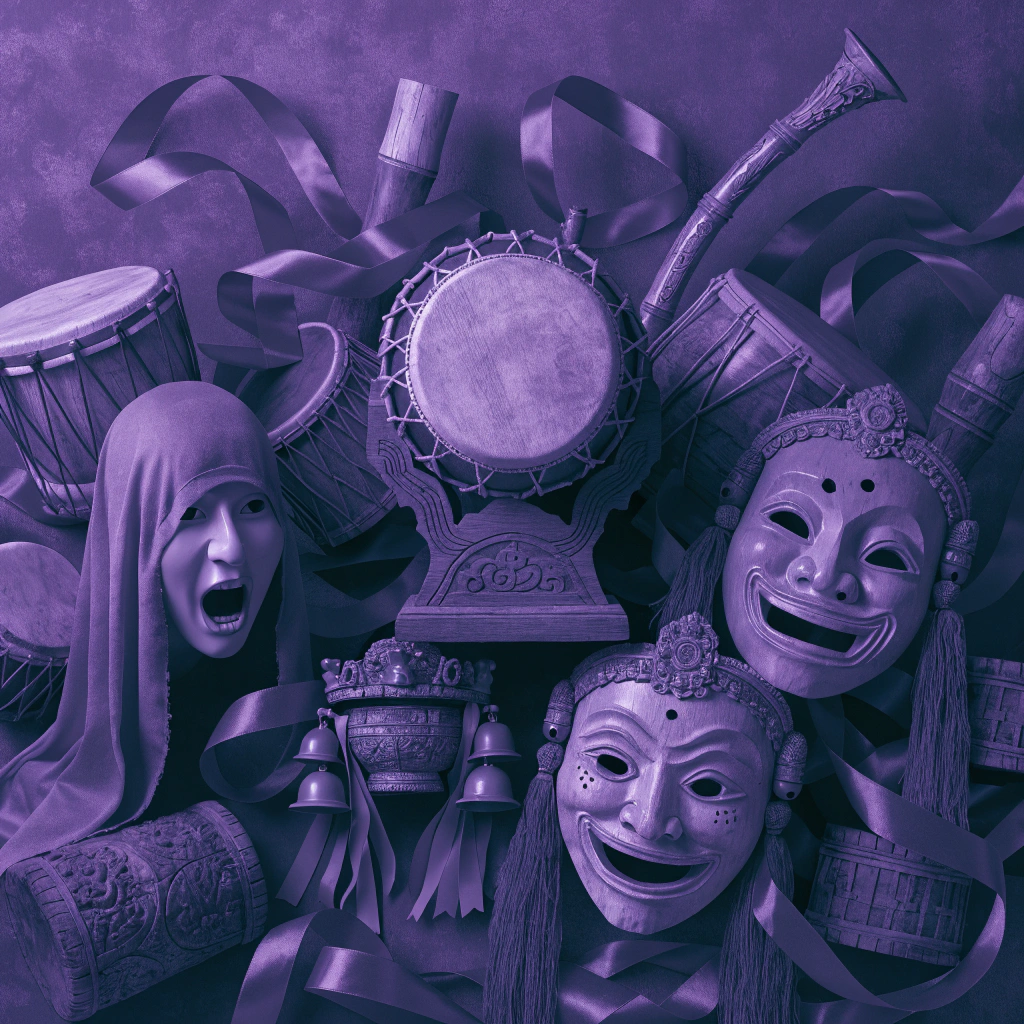
Pansori: Traditional Music of Korea
Pansori is a special music from South Korea. It is a very old tradition. One person sings a long story. This person is a singer. They use a fan and move their body.
There is also a drummer. The drummer hits a big drum. The drummer makes a rhythm for the singer. People watch and listen to the music together.
The singer tells stories about history and people. The music is loud and beautiful. Pansori is very important in Korea. Many people love this traditional art form today.
Point grammaire
Structure: Present Simple (Be)
"Pansori is a special music from South Korea."
We use 'is' for singular subjects like 'Pansori' or 'It'. It describes a fact or a state.
Structure: Present Simple (Third Person Singular)
"The drummer hits a big drum."
We add '-s' to the verb (hit becomes hits) when the subject is one person like 'the drummer'. It describes a regular action.
Teste ta compréhension
10 questions · A1 Débutant · 1 aperçu gratuit
Teste ce que tu as appris dans cet article. Réponds à toutes les questions pour gagner des XP !
Where is Pansori from?
Tu veux terminer le quiz ?
9 questions supplémentaires t'attendent. Inscris-toi gratuitement pour débloquer le quiz complet et gagner des XP !
S'inscrire gratuitementTu as dj un compte ? Connexion
Bien joué !
Continue à pratiquer !
Déjà terminé — pas de XP supplémentaire
Inscris-toi pour gagner des XPDétail des questions
Where is Pansori from?
Ta réponse:
Bonne réponse: South Korea
One person sings a long story in Pansori.
Ta réponse:
Bonne réponse: Vrai
What is a 'drummer'?
Ta réponse:
Bonne réponse: A person who plays a drum
The drummer hits a big _____.
Ta réponse:
Bonne réponse: drum
Pansori: The One-Person Opera of Korea
Pansori is a special kind of traditional music from South Korea. Many people call it a 'one-person opera.' In a performance, there is only one singer and one drummer. The singer tells a long story with songs and talking.
The singer uses a fan and moves their body to show different characters. The drummer sits next to the singer and plays a drum called a 'buk.' The drummer also makes sounds to help the singer. The music is very difficult because the singer needs a strong voice to show many emotions. Some stories are sadder than others, but many are funny.
Pansori started in the 17th century. At first, it was for normal people, but later, rich people liked it too. Today, Pansori is more famous than it was in the past. It is an important part of Korean culture. UNESCO even says it is a treasure for the whole world. Many people visit Korea to hear this beautiful music.
Point grammaire
Structure: Past Simple
"Pansori started in the 17th century."
We use the Past Simple to talk about finished actions in the past. To form it for regular verbs, we add '-ed' to the base verb.
Structure: Comparatives with 'more'
"Today, Pansori is more famous than it was in the past."
We use 'more + adjective + than' to compare two things. We use this pattern for long adjectives with two or more syllables.
Teste ta compréhension
11 questions · A2 mentaire · 1 aperçu gratuit
Teste ce que tu as appris dans cet article. Réponds à toutes les questions pour gagner des XP !
How many singers are usually in a Pansori performance?
Tu veux terminer le quiz ?
10 questions supplémentaires t'attendent. Inscris-toi gratuitement pour débloquer le quiz complet et gagner des XP !
S'inscrire gratuitementTu as dj un compte ? Connexion
Bien joué !
Continue à pratiquer !
Déjà terminé — pas de XP supplémentaire
Inscris-toi pour gagner des XPDétail des questions
How many singers are usually in a Pansori performance?
Ta réponse:
Bonne réponse: One
The drummer plays a drum called a 'buk'.
Ta réponse:
Bonne réponse: Vrai
What does 'famous' mean?
Ta réponse:
Bonne réponse: Known by many people
The singer uses a _____ to show different characters.
Ta réponse:
Bonne réponse: fan
When did Pansori start?
Ta réponse:
Bonne réponse: In the 17th century
Pansori: The Soul of Korean Storytelling
Pansori, which is often called 'one-person opera,' is a unique style of traditional music from South Korea. It is a powerful form of storytelling that combines singing, speaking, and dramatic gestures. This art form has been part of Korean culture for over three hundred years, and it remains a source of great national pride for many people today.
The performance usually involves only two people: a singer, known as a sorikkun, and a drummer, called a gosu. The singer holds a fan and tells a long story that can last for several hours. The singer must use a variety of vocal techniques to represent different characters. While the singer performs, the drummer provides the rhythm and shouts words of encouragement to keep the energy high. These stories are often emotional, focusing on themes like love, loyalty, and family.
Pansori was originally created by common people during the 17th century. At first, it was performed in open spaces where many people could gather. Later, it became popular among the aristocracy because of its sophisticated lyrics and deep emotions. Many famous stories have been passed down through generations, and they are still loved by modern audiences.
In recent years, Pansori has been recognized by UNESCO as a masterpiece of oral heritage. Because it requires immense vocal skill and years of training, it is considered one of the most difficult arts to master. Although the world has changed, Pansori has survived because it connects people to the history and soul of Korea.
Point grammaire
Structure: Relative Clauses with 'which'
"Pansori, which is often called 'one-person opera,' is a unique style of traditional music from South Korea."
We use 'which' in a non-defining relative clause to give extra information about a noun. It is separated from the rest of the sentence by commas.
Structure: Passive Voice (Past Simple)
"Pansori was originally created by common people during the 17th century."
The passive voice is used when the action is more important than the person doing it. It is formed with 'was/were' and the past participle.
Teste ta compréhension
11 questions · B1 Intermédiaire · 1 aperçu gratuit
Teste ce que tu as appris dans cet article. Réponds à toutes les questions pour gagner des XP !
How many performers are typically involved in a Pansori performance?
Tu veux terminer le quiz ?
10 questions supplémentaires t'attendent. Inscris-toi gratuitement pour débloquer le quiz complet et gagner des XP !
S'inscrire gratuitementTu as dj un compte ? Connexion
Bien joué !
Continue à pratiquer !
Déjà terminé — pas de XP supplémentaire
Inscris-toi pour gagner des XPDétail des questions
How many performers are typically involved in a Pansori performance?
Ta réponse:
Bonne réponse: Two people: a singer and a drummer
Pansori stories can last for several hours.
Ta réponse:
Bonne réponse: Vrai
Which word describes a work of outstanding artistry?
Ta réponse:
Bonne réponse: Masterpiece
The singer holds a _____ while telling the story.
Ta réponse:
Bonne réponse: fan
Who originally created Pansori in the 17th century?
Ta réponse:
Bonne réponse: Common people
Pansori: The Soulful Resonance of Korean Narrative Song
Pansori, often characterized as a 'one-person opera,' represents a pinnacle of Korean traditional performing arts. Originating in the 17th century during the Joseon Dynasty, this expressive genre combines dramatic storytelling with intricate vocal techniques. Although it initially emerged from shamanic rituals among the common people, it eventually transcended its humble beginnings to captivate audiences across all social strata, including the aristocracy.
A typical performance relies on a delicate balance between the vocalist, known as the sorikkun, and the drummer, or gosu. While the vocalist narrates epic tales through a mixture of song, speech, and gesture, the drummer provides the essential rhythmic accompaniment. Furthermore, the audience is far from passive; they play an active role through 'chuimsae'—spontaneous verbal encouragements that bridge the gap between the performer and the spectator. This interaction creates a unique atmosphere where the energy of the crowd directly influences the intensity of the performance.
One cannot discuss Pansori without mentioning the concept of 'han'—a profound sense of sorrow or unresolved resentment that is considered central to the Korean psyche. Performers must undergo years of rigorous training to develop the specialized 'husky' voice necessary to convey these complex emotions effectively. Because of this dedication to craft, Pansori was designated as a UNESCO Intangible Cultural Heritage of Humanity in 2003, ensuring its preservation for future generations.
Despite the dominance of modern pop culture, Pansori continues to evolve and maintain its relevance. Contemporary artists are increasingly integrating traditional elements with Western instruments and modern theatrical styles, demonstrating the genre's enduring versatility. By analyzing its historical trajectory, it becomes evident that Pansori is not merely a relic of the past, but a living testament to Korean cultural identity and artistic resilience. It remains a powerful medium for storytelling, reflecting the shared joys and pains of the human experience through its unique melodic structure.
Point grammaire
Structure: Participle Phrases for Background Information
"Originating in the 17th century during the Joseon Dynasty, this expressive genre combines dramatic storytelling with intricate vocal techniques."
The present or past participle phrase at the beginning of a sentence provides essential context or background for the main subject. It functions as an adjective clause to make writing more concise and formal.
Structure: Passive Voice for Formal Designation
"Pansori was designated as a UNESCO Intangible Cultural Heritage of Humanity in 2003."
The passive voice is used here to focus on the art form (the object) rather than the organization that designated it. It is formed using 'be' + past participle.
Structure: Gerunds as Subjects for Analysis
"By analyzing its historical trajectory, it becomes evident that Pansori is not merely a relic of the past."
The gerund 'analyzing' follows a preposition to describe the method or means by which a conclusion is reached. This is a common structure in academic and analytical writing.
Teste ta compréhension
11 questions · B2 Intermédiaire supérieur · 1 aperçu gratuit
Teste ce que tu as appris dans cet article. Réponds à toutes les questions pour gagner des XP !
What is the role of the 'gosu' in a Pansori performance?
Tu veux terminer le quiz ?
10 questions supplémentaires t'attendent. Inscris-toi gratuitement pour débloquer le quiz complet et gagner des XP !
S'inscrire gratuitementTu as dj un compte ? Connexion
Bien joué !
Continue à pratiquer !
Déjà terminé — pas de XP supplémentaire
Inscris-toi pour gagner des XPDétail des questions
What is the role of the 'gosu' in a Pansori performance?
Ta réponse:
Bonne réponse: To provide rhythmic drumming accompaniment
Pansori was originally created for the aristocracy and only later became popular among common people.
Ta réponse:
Bonne réponse: Faux
Which word describes the ability to adapt to many different functions or styles?
Ta réponse:
Bonne réponse: Versatility
The audience provides verbal encouragements known as _____, which bridge the gap with the performer.
Ta réponse:
Bonne réponse: chuimsae
What does the concept of 'han' represent in the context of Pansori?
Ta réponse:
Bonne réponse: A deep sense of sorrow or unresolved resentment
The Echoes of Han: Deconstructing the Narrative Power of Pansori
Few art forms encapsulate the historical consciousness of a nation as poignantly as Pansori, the traditional Korean genre of musical storytelling. Often characterized as a 'one-person opera,' Pansori is a visceral synthesis of vocal prowess, dramatic narrative, and rhythmic accompaniment. Its origins, which trace back to the 17th-century Joseon Dynasty, are steeped in shamanic ritual and folk tradition. Yet, the evolution of Pansori into a sophisticated medium of social commentary reflects a complex trajectory through the Korean social hierarchy.
At the heart of a Pansori performance lies the 'sorikkun' (singer) and the 'gosu' (drummer). Seldom does an art form demand such a grueling synthesis of physical endurance and emotional depth from its practitioners. The sorikkun must master an array of vocal textures, ranging from delicate whispers to thunderous, guttural roars. It is within the raw resonance of the singer’s voice that the essence of 'han'—a profound collective sentiment of unresolved grief and resilience—finds its most evocative expression. This emotional catharsis is not merely a solo endeavor; the gosu provides a rhythmic framework, while the audience participates through 'chuimsae,' spontaneous verbal encouragements that bridge the gap between performer and spectator.
The gosu’s role, while seemingly secondary, is indispensable; through the 'buk' (barrel drum), the drummer regulates the tempo and provides the 'jangdan' (rhythmic cycles) that anchor the singer’s improvisational flights. Furthermore, the training of a sorikkun is a legendary feat of endurance. To achieve the necessary vocal grit, aspirants historically practiced near waterfalls, attempting to drown out the roar of the water until their vocal cords were permanently altered. This physical transformation is a prerequisite for capturing the 'rough' beauty that defines the genre’s aesthetic.
The historical trajectory of Pansori is equally compelling. Initially, it served as a populist medium, providing the common folk with a vehicle for satirizing the aristocratic elite. However, by the 19th century, the genre’s aesthetic sophistication had attracted the patronage of the upper classes. This transition necessitated a refinement of the lyrical content, blending vernacular humor with classical literary allusions. The preservation of Pansori in the modern era, however, faces significant challenges. In a globalized cultural landscape dominated by digital immediacy, the arduous training required to become a master sorikkun is increasingly rare.
Nevertheless, the enduring relevance of Pansori lies in its capacity for improvisation and its narrative adaptability. It is the inherent flexibility of the form that allows it to resonate across generational divides. While the traditional 'five stories' remain the core repertoire, contemporary artists are increasingly experimenting with modern themes, ensuring that this 'sound of the people' does not become a static museum piece. The institutionalization of Pansori as a National Intangible Cultural Property has further solidified its status, yet its true survival depends on its ability to evoke a visceral response in a modern audience.
Point grammaire
Structure: Negative Inversion
"Seldom does an art form demand such a grueling synthesis of physical endurance and emotional depth from its practitioners."
When negative or restrictive adverbs like 'seldom' or 'never' are placed at the beginning of a sentence for emphasis, the subject and auxiliary verb are inverted. This creates a more formal and dramatic tone.
Structure: It-Cleft Sentence
"It is within the raw resonance of the singer’s voice that the essence of 'han' finds its most evocative expression."
Cleft sentences use 'It is/was... that' to focus on a specific part of the sentence (in this case, the location/source of the expression). It highlights the importance of the focused element over the rest of the clause.
Structure: Nominalisation
"The institutionalization of Pansori as a National Intangible Cultural Property has further solidified its status..."
Nominalisation involves turning verbs or adjectives into nouns (e.g., 'institutionalize' to 'institutionalization'). This is common in academic and advanced writing to pack more information into a sentence and sound more objective.
Teste ta compréhension
12 questions · C1 Avancé · 1 aperçu gratuit
Teste ce que tu as appris dans cet article. Réponds à toutes les questions pour gagner des XP !
What distinguishes the role of the gosu in a Pansori performance?
Tu veux terminer le quiz ?
11 questions supplémentaires t'attendent. Inscris-toi gratuitement pour débloquer le quiz complet et gagner des XP !
S'inscrire gratuitementTu as dj un compte ? Connexion
Bien joué !
Continue à pratiquer !
Déjà terminé — pas de XP supplémentaire
Inscris-toi pour gagner des XPDétail des questions
What distinguishes the role of the gosu in a Pansori performance?
Ta réponse:
Bonne réponse: They regulate the tempo and anchor the singer's improvisations.
Pansori was originally created for the aristocratic elite before becoming popular among commoners.
Ta réponse:
Bonne réponse: Faux
Which word describes a sound produced in the throat that is harsh or deep?
Ta réponse:
Bonne réponse: Guttural
The concept of _____ refers to a collective Korean sentiment of unresolved grief and hope.
Ta réponse:
Bonne réponse: han
According to the text, why did Pansori lyrics change in the 19th century?
Ta réponse:
Bonne réponse: To suit the tastes of aristocratic patrons.
Training to be a sorikkun historically involved practicing near waterfalls to alter the voice.
Ta réponse:
Bonne réponse: Vrai
The Ontological Resonance of Pansori: A Synthesis of Sorrow and Satire
Pansori, often heralded as the quintessence of Korean traditional music, represents a profound intersection of narrative drama, visceral vocalization, and rhythmic complexity. Originating in the 17th century during the Joseon Dynasty, this 'one-person opera' ostensibly evolved from shamanic chants into a sophisticated medium for folk storytelling. Were one to scrutinize the socio-political landscape of its inception, one would find an art form that served as a rare egalitarian space. It allowed for a confluence of voices, where the grievances of the commonality were articulated through a lens of both poignant sorrow and biting satire. This existential sorrow, termed 'han,' is the emotional core of the performance, demanding that the vocalist, or sorikkun, undergo an arduous process of vocal cultivation to achieve the elusive 'deuk-eum'—the attainment of a voice that can pierce the soul.
The structural integrity of Pansori relies upon a delicate symbiosis between the sorikkun and the gosu, a drummer who provides the rhythmic foundation using a buk. This relationship is not merely functional; it is a shared journey through the 'pan,' the space where the performance unfolds. The gosu does not simply keep time but punctuates the narrative with 'chuimsae'—vocal encouragements that catalyze the performer’s energy. Lest the audience perceive this as a static exhibition, it is vital to acknowledge that Pansori is inherently improvisational. The sorikkun must navigate the idiosyncrasies of each audience, adjusting the narrative pace and emotional intensity in real-time. This fluidity ensures that no two performances are identical, reflecting the ephemeral nature of the human experience.
Furthermore, the narrative content of the surviving five 'madang'—the core cycles of Pansori—reveals a subversive undercurrent. While ostensibly celebrating Confucian virtues such as filial piety and loyalty, these stories frequently utilize humor and parody to critique the excesses of the aristocracy. It is through this synthesis of high-brow morality and low-brow artifice that Pansori bridged the gap between the ruling class and the peasantry. As the performance progresses, the sorikkun’s voice must emanate from the abdomen, producing a gravelly, multifaceted timbre that contrasts sharply with the crystalline aesthetics of Western operatic traditions. This vocal grit is not a deficiency but a deliberate aesthetic choice, signifying the hardships of the life it portrays.
In the contemporary era, the preservation of Pansori faces the perennial challenge of maintaining authenticity while embracing evolution. Designated as a UNESCO Intangible Cultural Heritage of Humanity, it remains a pillar of Korean identity. However, should the art form become fossilized in its own tradition, it risks losing the very vitality that allowed it to flourish in the marketplaces of the past. Modern practitioners are therefore tasked with a difficult balancing act: honoring the rigorous techniques of their predecessors while ensuring the narrative remains relevant to a burgeoning global audience. Ultimately, Pansori stands as a testament to the power of the human voice to transcend social stratifications, offering a resonant exploration of the human condition that is as relevant today as it was four centuries ago.
Point grammaire
Structure: Inverted Conditional (Subjunctive)
"Were one to scrutinize the socio-political landscape of its inception, one would find an art form that served as a rare egalitarian space."
This formal structure replaces 'If one were to...' by inverting the verb and subject. It is used in academic or literary contexts to express hypothetical situations with a high degree of formality.
Structure: Negative Purpose with 'Lest'
"Lest the audience perceive this as a static exhibition, it is vital to acknowledge that Pansori is inherently improvisational."
The word 'lest' is used to express a desire to prevent a particular undesirable outcome. It is followed by a base form verb or a subjunctive clause, characteristic of C2 level prose.
Structure: Hypothetical Conditional with 'Should'
"However, should the art form become fossilized in its own tradition, it risks losing the very vitality that allowed it to flourish in the marketplaces of the past."
Using 'should' at the beginning of a conditional clause is a formal alternative to 'if', indicating a possibility that is considered unlikely but must be addressed.
Teste ta compréhension
12 questions · C2 Maîtrise · 1 aperçu gratuit
Teste ce que tu as appris dans cet article. Réponds à toutes les questions pour gagner des XP !
What does the term 'han' primarily represent in the context of Pansori?
Tu veux terminer le quiz ?
11 questions supplémentaires t'attendent. Inscris-toi gratuitement pour débloquer le quiz complet et gagner des XP !
S'inscrire gratuitementTu as dj un compte ? Connexion
Bien joué !
Continue à pratiquer !
Déjà terminé — pas de XP supplémentaire
Inscris-toi pour gagner des XPDétail des questions
What does the term 'han' primarily represent in the context of Pansori?
Ta réponse:
Bonne réponse: A profound, existential sorrow that forms the emotional core
Pansori was originally created as an entertainment form for the aristocracy during the 17th century.
Ta réponse:
Bonne réponse: Faux
Which word describes a relationship where both parties benefit from each other?
Ta réponse:
Bonne réponse: Symbiosis
The drummer in a Pansori performance is known as the _____.
Ta réponse:
Bonne réponse: gosu
According to the article, why is the vocal 'grit' in Pansori considered a deliberate choice?
Ta réponse:
Bonne réponse: To signify the hardships and reality of the life it portrays
The 'chuimsae' are vocal encouragements provided by the drummer to support the singer.
Ta réponse:
Bonne réponse: Vrai

