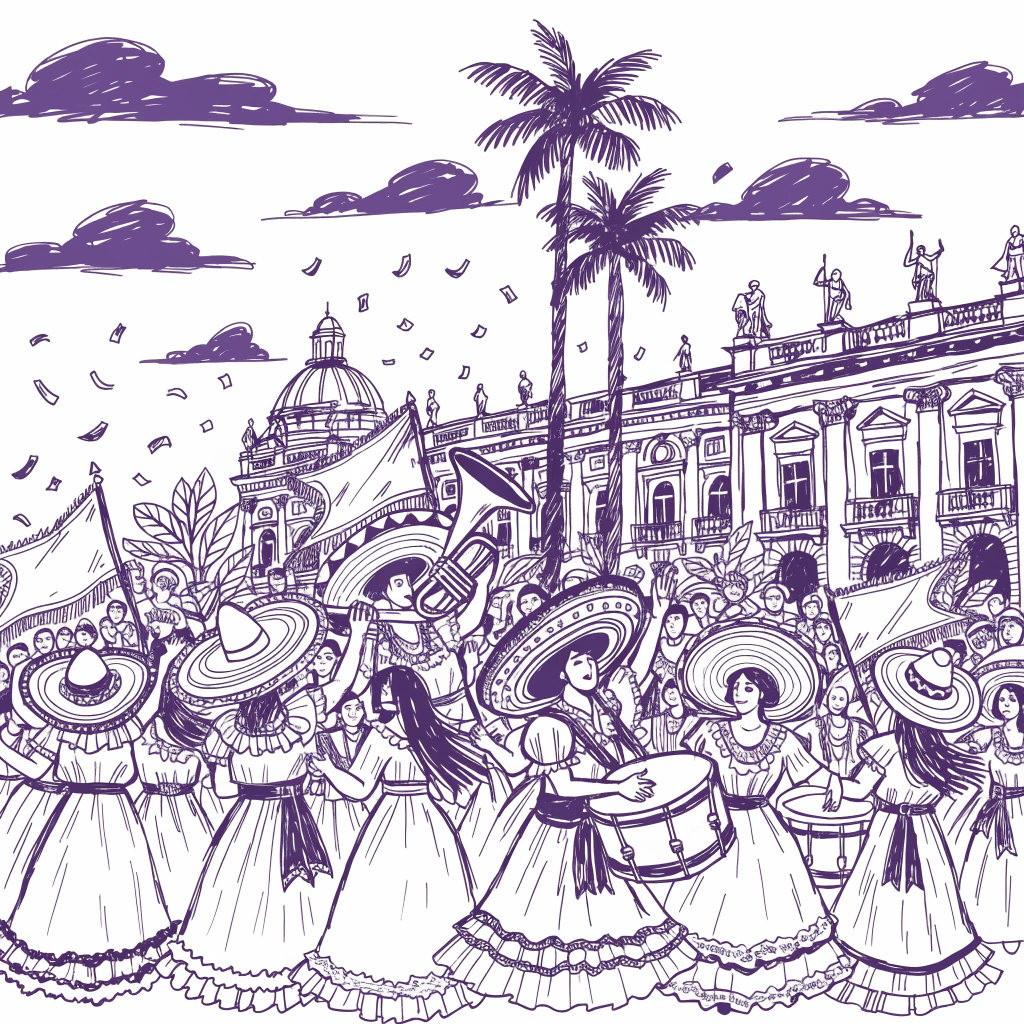
¡México Celebra su Libertad!
¡Viva México! México celebra su Día de la Independencia. Es una fiesta muy importante. La gente celebra el 16 de septiembre. Pero la gran fiesta empieza la noche del 15 de septiembre.
En el año 1810, un sacerdote, Miguel Hidalgo, vive en un pueblo. El pueblo se llama Dolores. Hidalgo toca una campana. Él dice un grito por la libertad de España. Muchas personas escuchan. La gente quiere un país libre.
Ahora, los mexicanos celebran con música y comida rica. Comen tacos y bailan. Las familias están juntas. Todos dicen: "¡Viva México!". Es un día de alegría y orgullo nacional.
Gramática destacada
Patrón: El Verbo "Ser" (to be)
"Es una fiesta muy importante."
Usamos "ser" para decir qué es algo o quién es alguien. También lo usamos para describir cosas permanentes. "Es" es la forma para "él/ella/usted".
Patrón: Verbos Regulares en Presente
"La gente celebra el 16 de septiembre."
Los verbos en presente indican acciones que ocurren ahora o son habituales. Para verbos que terminan en '-ar', quitamos '-ar' y añadimos '-a' o '-an' para "él/ella/usted" o "ellos/ellas/ustedes".
Pon a prueba tu comprensión
10 preguntas · A1 Principiante · 1 vista previa gratis
Pon a prueba lo que aprendiste en este artículo. ¡Responde todas las preguntas para ganar XP!
¿Cuándo es el Día de la Independencia de México?
¿Quieres terminar el quiz?
9 preguntas más te esperan. ¡Regístrate gratis para desbloquear el quiz completo y ganar XP!
Regístrate gratis¿Ya tienes cuenta? Acceder
Desglose de preguntas
¿Cuándo es el Día de la Independencia de México?
Tu respuesta:
Respuesta correcta: El 16 de septiembre
Miguel Hidalgo era un rey de España.
Tu respuesta:
Respuesta correcta: Falso
¿Qué significa "libertad"?
Tu respuesta:
Respuesta correcta: No tener límites de otros
Miguel Hidalgo toca una _____.
Tu respuesta:
Respuesta correcta: campana
Independence Day in Mexico
Mexico celebrates its Independence Day every year in September. It is a very important holiday for the country. The celebration starts on the night of September 15th and continues on September 16th.
The story began a long time ago in 1810. A priest named Miguel Hidalgo lived in a small town. He wanted Mexico to be free from Spain. One night, he rang a church bell and gave a famous speech to the people. He told them to fight for their freedom. This speech is famous and people call it the 'Grito de Dolores'.
Today, the celebrations are louder and bigger than before. Families meet to eat delicious food and listen to loud music. Many people wear green, white, and red clothes because these are the colors of the flag. In the main square of Mexico City, the president rings the same bell. Everyone shouts 'Viva México!' because they are proud of their history.
Gramática destacada
Patrón: Past Simple
"He wanted Mexico to be free from Spain."
The past simple is used for finished actions in the past. For regular verbs, we usually add '-ed' to the base form.
Patrón: Comparatives
"Today, the celebrations are louder and bigger than before."
We use comparatives to compare two things. For short adjectives, we add '-er' and use the word 'than'.
Pon a prueba tu comprensión
11 preguntas · A2 Básico · 1 vista previa gratis
Pon a prueba lo que aprendiste en este artículo. ¡Responde todas las preguntas para ganar XP!
When does the celebration begin?
¿Quieres terminar el quiz?
10 preguntas más te esperan. ¡Regístrate gratis para desbloquear el quiz completo y ganar XP!
Regístrate gratis¿Ya tienes cuenta? Acceder
Desglose de preguntas
When does the celebration begin?
Tu respuesta:
Respuesta correcta: The night of September 15th
Miguel Hidalgo was a king from Spain.
Tu respuesta:
Respuesta correcta: Falso
What does 'famous' mean?
Tu respuesta:
Respuesta correcta: Known by many people
In the main _____ of Mexico City, the president rings the bell.
Tu respuesta:
Respuesta correcta: square
Why do people wear green, white, and red?
Tu respuesta:
Respuesta correcta: They are the colors of the flag
Mexico's Night of Freedom: The Grito de Dolores
Mexico’s Independence Day is a vibrant celebration that captures the heart of the nation. Although the official holiday is September 16th, the festivities have always started on the night of the 15th. This event commemorates the beginning of Mexico's struggle for freedom from Spanish rule, which lasted for three hundred years.
The story began in 1810 in the small town of Dolores. A priest named Miguel Hidalgo y Costilla, who is now considered the father of the nation, took a brave step. He rang his church bell to gather the people and gave a powerful speech known as the 'Grito de Dolores.' This cry was a call for independence and justice. Today, this historic moment is remembered by millions of people across the globe.
Every year at 11:00 PM on September 15th, the President of Mexico stands on the balcony of the National Palace in Mexico City. The original bell, which was moved from Dolores, is rung once again. The President shouts '¡Viva México!' and the crowd responds with equal energy. This ceremony has been performed for many decades and remains a symbol of national pride.
In the streets, the atmosphere is electric. Cities are decorated with green, white, and red lights. Families gather to eat traditional food like 'Chiles en Nogada,' a dish that represents the colors of the Mexican flag. People also enjoy folk music and dancing. It is a time when the history of the country is celebrated with joy and respect. If you ever visit Mexico during this time, you will see how much the people value their hard-won liberty.
Gramática destacada
Patrón: Passive Voice
"Today, this historic moment is remembered by millions of people across the globe."
The passive voice is used here because the action (remembering) is more important than who is doing it. It is formed using the verb 'to be' plus the past participle.
Patrón: Relative Clauses
"A priest named Miguel Hidalgo y Costilla, who is now considered the father of the nation, took a brave step."
The relative clause 'who is now considered the father of the nation' provides extra information about the subject. It is introduced by the relative pronoun 'who' because it refers to a person.
Pon a prueba tu comprensión
11 preguntas · B1 Intermedio · 1 vista previa gratis
Pon a prueba lo que aprendiste en este artículo. ¡Responde todas las preguntas para ganar XP!
When do the independence celebrations actually begin in Mexico?
¿Quieres terminar el quiz?
10 preguntas más te esperan. ¡Regístrate gratis para desbloquear el quiz completo y ganar XP!
Regístrate gratis¿Ya tienes cuenta? Acceder
Desglose de preguntas
When do the independence celebrations actually begin in Mexico?
Tu respuesta:
Respuesta correcta: On the night of September 15th
The original bell from the town of Dolores is still used in the ceremony today.
Tu respuesta:
Respuesta correcta: Verdadero
What does 'struggle' mean in the context of the article?
Tu respuesta:
Respuesta correcta: A long and difficult effort for freedom
The President of Mexico _____ '¡Viva México!' from the balcony.
Tu respuesta:
Respuesta correcta: shouts
Who is known as the father of the Mexican nation?
Tu respuesta:
Respuesta correcta: Miguel Hidalgo y Costilla
The Spirit of Sovereignty: Celebrating Mexican Independence
Every year, as September approaches, the streets of Mexico are transformed into a vibrant display of green, white, and red. Although the official holiday falls on the 16th, the heart of the celebration beats strongest on the night of the 15th. This tradition serves to commemorate the pivotal moment in 1810 when Miguel Hidalgo y Costilla, a local priest, issued the 'Grito de Dolores'. Had he not taken this bold step, the course of Mexican history might have been entirely different.
The 'Grito' was not merely a speech; it was a defiant call for an uprising against three centuries of colonial rule. At that time, the social hierarchy imposed by the Spanish crown had created significant tension among the various classes of society. Consequently, what began as a localized movement in the small town of Dolores quickly evolved into a nationwide struggle for sovereignty. Throughout the eleven-year conflict that followed, various leaders such as José María Morelos emerged, each contributing to the eventual liberation of the country. This period was marked by immense resilience and sacrifice, qualities that are still celebrated by Mexicans today.
In contemporary Mexico, the reenactment of the 'Grito' by the President at the National Palace is a deeply symbolic event. As the bell rings, thousands of citizens gather in the Zócalo, the main square, to echo the patriotic shouts of their ancestors. The atmosphere is electric, filled with a sense of unity that transcends political differences. Furthermore, the festivities are characterized by traditional music, fireworks, and culinary delights such as 'Chiles en Nogada'. This dish, which features the colors of the national flag, represents the fusion of cultures that defines the modern Mexican identity. It is often said that to taste this dish is to consume the history of the nation itself.
Nevertheless, beyond the fireworks and parties, Independence Day provides an opportunity for citizens to reflect on the nation's legacy. It is a time when the complexities of the past are acknowledged, and the achievements of the present are proclaimed with pride. The event serves as a reminder that freedom is a continuous process rather than a static goal. By honoring their history, Mexicans reinforce their collective identity and look toward a future shaped by the same spirit of independence that ignited the revolution over two centuries ago. This enduring commitment to liberty remains the cornerstone of the Mexican spirit.
Gramática destacada
Patrón: Third Conditional
"Had he not taken this bold step, the course of Mexican history might have been entirely different."
This structure is used to imagine a different past. It uses 'had + past participle' in the condition and 'might/would have + past participle' in the result.
Patrón: Passive Voice
"the streets of Mexico are transformed into a vibrant display of green, white, and red."
The passive voice is used here to focus on the streets (the object) rather than who is decorating them. It is formed with the verb 'to be' and the past participle.
Patrón: Non-defining Relative Clause
"This dish, which features the colors of the national flag, represents the fusion of cultures..."
This clause provides extra information about 'this dish'. It is separated by commas and uses 'which' to add descriptive detail without changing the core meaning of the sentence.
Pon a prueba tu comprensión
11 preguntas · B2 Intermedio alto · 1 vista previa gratis
Pon a prueba lo que aprendiste en este artículo. ¡Responde todas las preguntas para ganar XP!
What was the primary purpose of the 'Grito de Dolores'?
¿Quieres terminar el quiz?
10 preguntas más te esperan. ¡Regístrate gratis para desbloquear el quiz completo y ganar XP!
Regístrate gratis¿Ya tienes cuenta? Acceder
Desglose de preguntas
What was the primary purpose of the 'Grito de Dolores'?
Tu respuesta:
Respuesta correcta: To call for a rebellion against Spanish rule
The struggle for Mexican independence was resolved in a matter of months.
Tu respuesta:
Respuesta correcta: Falso
What does the word 'sovereignty' mean in the context of the article?
Tu respuesta:
Respuesta correcta: The power of a country to govern itself
Every year, the streets are _____ into a vibrant display of national colors.
Tu respuesta:
Respuesta correcta: transformed
What does the dish 'Chiles en Nogada' symbolize?
Tu respuesta:
Respuesta correcta: The fusion of cultures and national identity
The Clarion Call of Liberty: A Nuanced Analysis of Mexico’s Independence
Seldom does a national holiday encapsulate the collective psyche of a people as profoundly as Mexico’s Independence Day. To the uninitiated, the festivities of September 15th and 16th might appear to be a mere explosion of color and pyrotechnics. However, beneath the surface lies a multifaceted commemoration of emancipation that challenges the very vestiges of colonial identity. It was in the early hours of September 16, 1810, that Miguel Hidalgo y Costilla, a parish priest in the small town of Dolores, uttered the 'Grito de Dolores.' This clarion call acted as the ultimate catalyst for the burgeoning insurgent movement against Spanish hegemony, marking the definitive commencement of a decade-long struggle for autonomy.
The transition from colonial subjugation to sovereign statehood was by no means a linear progression. Rather, it was a convoluted struggle characterized by shifting alliances and ideological fractures. Central to this narrative is the figure of Hidalgo, whose radical proclamation of liberty sought to dismantle three centuries of European dominance. What remains particularly striking to modern historians is the populist nature of the uprising; it wasn't merely an orchestrated political coup by the elite, but a visceral reclamation of land and dignity by the marginalized indigenous and mestizo masses. This grassroots involvement underscored a burgeoning national consciousness that transcended class boundaries.
In contemporary Mexico, the 'Grito' is reenacted annually with solemnity and fervor from the balcony of the National Palace in Mexico City. This ritualistic performance serves as a potent reminder of the inherent fragility of independence. Not only does the President echo Hidalgo’s historical cry, but the collective response of the populace also reaffirms a shared cultural idiosyncrasy that defines the nation. This celebration is inextricably linked to the concept of 'Mexicanidad,' a complex identity forged in the fires of revolution and tempered by the ongoing pursuit of social justice. The atmosphere is one of profound historical resonance, where the past and present converge in a singular moment of national unity.
Critically analyzing the event reveals a nuanced duality that is often overlooked in simplified historical accounts. While the official narrative emphasizes a unified front against oppression, the historical reality of the independence movement was marked by intense internal dissent and conflicting visions for the nation's future. The eventual achievement of independence in 1821, following the entry of the Army of the Three Guarantees into Mexico City, did not immediately rectify the systemic inequalities rooted in the colonial era. Consequently, the modern celebration functions as both a nostalgic look at a heroic past and a forward-looking aspiration for a more equitable future.
The perpetuation of these traditions ensures that the spirit of the insurgency remains a living component of the national discourse, rather than a stagnant historical artifact. It is through this lens that we see the true significance of the holiday: it is a rejection of historical amnesia. By celebrating the 'Grito,' Mexicans are not just honoring a date, but are participating in a continuous dialogue about what it means to be a free and sovereign people.
Ultimately, Mexico’s Independence Day transcends the boundaries of simple patriotism. It is a sophisticated tapestry of historical memory, social critique, and cultural pride. Through the lens of this holiday, one can observe the enduring resilience of a nation that continues to navigate its complex post-colonial legacy while fiercely guarding its hard-won sovereignty. The echoes of the bell rung in Dolores continue to vibrate through the halls of history, reminding the world that the quest for liberty is an ongoing endeavor.
Gramática destacada
Patrón: Negative Inversion
"Seldom does a national holiday encapsulate the collective psyche of a people as profoundly as Mexico’s Independence Day."
When using negative or restrictive adverbs like 'seldom' or 'rarely' at the beginning of a sentence for emphasis, the auxiliary verb is placed before the subject.
Patrón: It-Cleft Sentence
"It was in the early hours of September 16, 1810, that Miguel Hidalgo y Costilla, a parish priest, uttered the 'Grito de Dolores.'"
Cleft sentences are used to focus on a specific piece of information. The structure 'It is/was [emphasized part] that/who...' highlights the specific time or person.
Patrón: Nominalisation
"The transition from colonial subjugation to sovereign statehood was by no means a linear progression."
This involves turning verbs or adjectives into nouns (e.g., 'subjugation' instead of 'subjugating'). This creates a more formal, academic tone typical of C1 level writing.
Pon a prueba tu comprensión
12 preguntas · C1 Avanzado · 1 vista previa gratis
Pon a prueba lo que aprendiste en este artículo. ¡Responde todas las preguntas para ganar XP!
What does the author suggest about the 'Grito de Dolores' in the context of the insurgent movement?
¿Quieres terminar el quiz?
11 preguntas más te esperan. ¡Regístrate gratis para desbloquear el quiz completo y ganar XP!
Regístrate gratis¿Ya tienes cuenta? Acceder
Desglose de preguntas
What does the author suggest about the 'Grito de Dolores' in the context of the insurgent movement?
Tu respuesta:
Respuesta correcta: It served as the primary trigger for the revolution.
The author argues that Mexico's path to independence was straightforward and lacked internal conflict.
Tu respuesta:
Respuesta correcta: Falso
Which word best describes a deep, instinctive feeling as mentioned in the text?
Tu respuesta:
Respuesta correcta: Visceral
The transition from colonial _____ to sovereign statehood was characterized by ideological fractures.
Tu respuesta:
Respuesta correcta: subjugation
According to the article, how does the modern 'Grito' ceremony function for the Mexican people?
Tu respuesta:
Respuesta correcta: As a reaffirmation of a unique shared identity and social justice pursuit.
The independence movement was officially concluded in 1821.
Tu respuesta:
Respuesta correcta: Verdadero
The Historiography of Hegemony: Deconstructing the Mexican Insurrection of 1810
The genesis of Mexican sovereignty is frequently relegated to the annals of romanticized mythology, yet a rigorous academic inquiry reveals a far more convoluted tapestry of geopolitical shifts and Enlightenment-era fervor. To understand the 'Grito de Dolores' is to engage not merely with a singular moment of auditory rebellion, but with the culmination of centuries of systemic friction within the Viceroyalty of New Spain. Were one to scrutinize the socio-political landscape of the early 19th century, the inevitability of the rupture between the metropole and its colonial periphery becomes manifest. The Bourbon Reforms, intended to centralize Iberian control, paradoxically served as the very catalyst for insurrectionary sentiment among the criollo elite, who found themselves increasingly marginalized by a peninsular hegemony. The Napoleonic invasion of Spain in 1808 further exacerbated this instability, creating a power vacuum that necessitated a re-evaluation of local governance and colonial loyalty.
On the night of September 15th, 1810, Miguel Hidalgo y Costilla, a priest whose intellectual leanings were deeply steeped in the egalitarian philosophies of the age, initiated a movement that would irrevocably alter the trajectory of the Americas. His call to arms, delivered from the parish of Dolores, was not merely a localized grievance against high taxes or bad harvests; it was a sophisticated rhetorical locus where the frustrations of the disenfranchised coalesced into a unified, albeit heterogeneous, front. The 'Grito' was, in essence, a performative act of defiance that sought to dismantle the epistemological foundations of colonial rule. It was a clarion call that transcended class boundaries, mobilizing the mestizo and indigenous populations under the banner of the Virgin of Guadalupe, a symbol of syncretic national identity.
Furthermore, the subsequent decade of conflict was characterized by a syncretic blending of indigenous aspirations and republican ideals. It might be argued that the struggle for independence was less a clean break from the past and more an arduous negotiation of identity. The transition from the First Mexican Empire to a federal republic underscores the volatility inherent in such a profound structural metamorphosis. Rarely has a single rhetorical act, such as Hidalgo’s, reverberated with such sustained intensity through the corridors of history. The conflict was not a monolithic march toward liberty but a fragmented series of regional uprisings, often marred by protracted subterfuge and shifting alliances that defined the era's complex political landscape.
In contemporary Mexico, the commemoration of this event transcends mere historical recollection. It has evolved into a ritualistic reaffirmation of statehood, a liturgical event where the 'Grito' is reenacted from the balconies of government palaces across the nation. This annual performance serves to bridge the temporal chasm between the revolutionary past and the precarious present. While some critics suggest that such celebrations risk obscuring the nuanced complexities of the actual conflict, the symbolic resonance of the bell remains an indomitable vestige of the national psyche. The modern state utilizes this collective memory to bolster a sense of continuity, ensuring that the revolutionary spirit remains a cornerstone of the national narrative.
Ultimately, the independence of Mexico should be viewed through a scholarly lens as a multifaceted phenomenon. It was a movement predicated on the rejection of external dominance and the pursuit of self-determination. The historical narrative, while often simplified for public consumption, remains a fertile ground for analytical discourse. By examining the interplay between enlightened thought and grassroots mobilization, one gains a deeper appreciation for the profound legacy of 1810. The 'Grito' continues to echo, not as a static memory, but as a dynamic testament to the enduring human quest for autonomy in the face of institutionalized oppression. This legacy reminds us that sovereignty is not merely granted but is perpetually reclaimed through the collective will of a people striving for justice.
Gramática destacada
Patrón: Second Conditional with Subjunctive 'Were'
"Were one to scrutinize the socio-political landscape of the early 19th century, the inevitability of the rupture between the metropole and its colonial periphery becomes manifest."
This formal construction uses 'were' instead of 'if... was' to express a hypothetical condition. It is common in academic writing to present a scholarly perspective or analytical scenario.
Patrón: Negative Inversion
"Rarely has a single rhetorical act, such as Hidalgo’s, reverberated with such sustained intensity through the corridors of history."
Starting a sentence with a negative or restrictive adverb (Rarely) requires the auxiliary verb to come before the subject. This adds rhetorical emphasis and is typical of high-level literary or academic English.
Patrón: Academic Hedging with Modal Verbs
"It might be argued that the struggle for independence was less a clean break from the past and more an arduous negotiation of identity."
The use of 'might be argued' is a form of hedging, allowing the writer to present a claim as a possibility rather than an absolute fact. This is essential for maintaining a balanced and critical scholarly tone.
Pon a prueba tu comprensión
12 preguntas · C2 Dominio · 1 vista previa gratis
Pon a prueba lo que aprendiste en este artículo. ¡Responde todas las preguntas para ganar XP!
According to the text, what was a paradoxical result of the Bourbon Reforms?
¿Quieres terminar el quiz?
11 preguntas más te esperan. ¡Regístrate gratis para desbloquear el quiz completo y ganar XP!
Regístrate gratis¿Ya tienes cuenta? Acceder
Desglose de preguntas
According to the text, what was a paradoxical result of the Bourbon Reforms?
Tu respuesta:
Respuesta correcta: They inadvertently fueled revolutionary feelings among those they sought to control.
The author suggests that the 'Grito de Dolores' was primarily a reaction to agricultural failure.
Tu respuesta:
Respuesta correcta: Falso
What does 'syncretic' mean in the context of the article?
Tu respuesta:
Respuesta correcta: The blending of diverse cultural or political elements.
The author describes the symbolic bell as an indomitable _____ of the national psyche.
Tu respuesta:
Respuesta correcta: vestige
What role does the 'Grito' play in contemporary Mexico according to the text?
Tu respuesta:
Respuesta correcta: It serves as a liturgical reaffirmation of the country's statehood.
The text describes the Mexican struggle for independence as a monolithic and unified movement.
Tu respuesta:
Respuesta correcta: Falso

