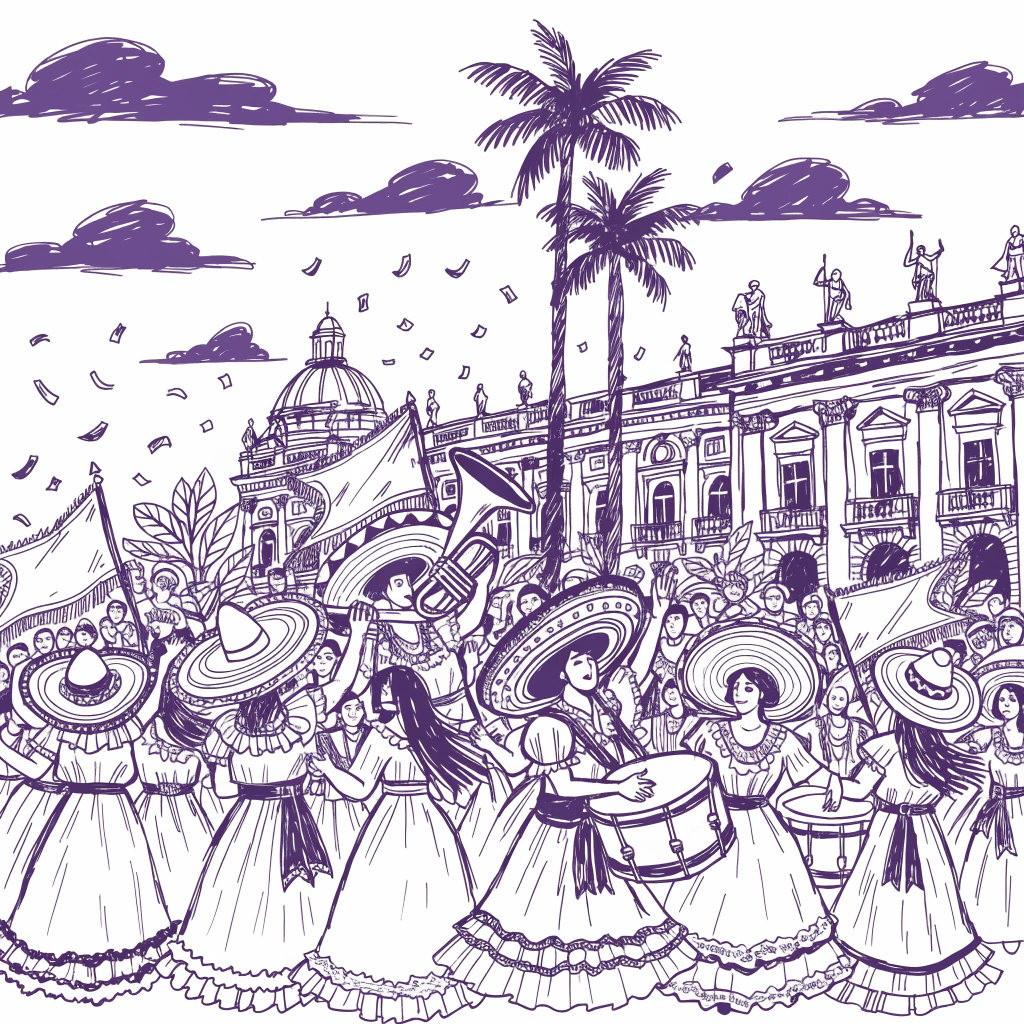
Independence Day in Mexico
Mexico celebrates Independence Day on September 16th. People start the party on September 15th at night. It is a very big holiday for everyone.
In the evening, many people go to the city center. They wear green, white, and red clothes. These are the colors of the Mexican flag. Families walk together and listen to music.
A leader shouts "¡Viva México!" and rings a big bell. People eat traditional food like tacos and watch bright fireworks in the sky. It is a very happy time for every family in Mexico.
Point grammaire
Structure: Present Simple (Third Person Singular)
"Mexico celebrates Independence Day on September 16th."
We use the present simple for facts and schedules. When the subject is a single thing like 'Mexico', we add -s to the verb.
Structure: Plural Nouns
"These are the colors of the Mexican flag."
To talk about more than one thing, we usually add -s to the noun. For example, one color becomes many colors.
Teste ta compréhension
10 questions · A1 Débutant · 1 aperçu gratuit
Teste ce que tu as appris dans cet article. Réponds à toutes les questions pour gagner des XP !
When is the official Independence Day in Mexico?
Tu veux terminer le quiz ?
9 questions supplémentaires t'attendent. Inscris-toi gratuitement pour débloquer le quiz complet et gagner des XP !
S'inscrire gratuitementTu as dj un compte ? Connexion
Bien joué !
Continue à pratiquer !
Déjà terminé — pas de XP supplémentaire
Inscris-toi pour gagner des XPDétail des questions
When is the official Independence Day in Mexico?
Ta réponse:
Bonne réponse: September 16th
People wear blue and yellow clothes for the holiday.
Ta réponse:
Bonne réponse: Faux
What is a 'flag'?
Ta réponse:
Bonne réponse: A piece of cloth with country colors
A leader shouts and rings a big _____.
Ta réponse:
Bonne réponse: bell
Independence Day in Mexico
Mexico celebrates its Independence Day every year in September. It is a very important holiday for the country. The celebration starts on the night of September 15th and continues on September 16th.
The story began a long time ago in 1810. A priest named Miguel Hidalgo lived in a small town. He wanted Mexico to be free from Spain. One night, he rang a church bell and gave a famous speech to the people. He told them to fight for their freedom. This speech is famous and people call it the 'Grito de Dolores'.
Today, the celebrations are louder and bigger than before. Families meet to eat delicious food and listen to loud music. Many people wear green, white, and red clothes because these are the colors of the flag. In the main square of Mexico City, the president rings the same bell. Everyone shouts 'Viva México!' because they are proud of their history.
Point grammaire
Structure: Past Simple
"He wanted Mexico to be free from Spain."
The past simple is used for finished actions in the past. For regular verbs, we usually add '-ed' to the base form.
Structure: Comparatives
"Today, the celebrations are louder and bigger than before."
We use comparatives to compare two things. For short adjectives, we add '-er' and use the word 'than'.
Teste ta compréhension
11 questions · A2 mentaire · 1 aperçu gratuit
Teste ce que tu as appris dans cet article. Réponds à toutes les questions pour gagner des XP !
When does the celebration begin?
Tu veux terminer le quiz ?
10 questions supplémentaires t'attendent. Inscris-toi gratuitement pour débloquer le quiz complet et gagner des XP !
S'inscrire gratuitementTu as dj un compte ? Connexion
Bien joué !
Continue à pratiquer !
Déjà terminé — pas de XP supplémentaire
Inscris-toi pour gagner des XPDétail des questions
When does the celebration begin?
Ta réponse:
Bonne réponse: The night of September 15th
Miguel Hidalgo was a king from Spain.
Ta réponse:
Bonne réponse: Faux
What does 'famous' mean?
Ta réponse:
Bonne réponse: Known by many people
In the main _____ of Mexico City, the president rings the bell.
Ta réponse:
Bonne réponse: square
Why do people wear green, white, and red?
Ta réponse:
Bonne réponse: They are the colors of the flag
Mexico's Night of Freedom: The Grito de Dolores
Mexico’s Independence Day is a vibrant celebration that captures the heart of the nation. Although the official holiday is September 16th, the festivities have always started on the night of the 15th. This event commemorates the beginning of Mexico's struggle for freedom from Spanish rule, which lasted for three hundred years.
The story began in 1810 in the small town of Dolores. A priest named Miguel Hidalgo y Costilla, who is now considered the father of the nation, took a brave step. He rang his church bell to gather the people and gave a powerful speech known as the 'Grito de Dolores.' This cry was a call for independence and justice. Today, this historic moment is remembered by millions of people across the globe.
Every year at 11:00 PM on September 15th, the President of Mexico stands on the balcony of the National Palace in Mexico City. The original bell, which was moved from Dolores, is rung once again. The President shouts '¡Viva México!' and the crowd responds with equal energy. This ceremony has been performed for many decades and remains a symbol of national pride.
In the streets, the atmosphere is electric. Cities are decorated with green, white, and red lights. Families gather to eat traditional food like 'Chiles en Nogada,' a dish that represents the colors of the Mexican flag. People also enjoy folk music and dancing. It is a time when the history of the country is celebrated with joy and respect. If you ever visit Mexico during this time, you will see how much the people value their hard-won liberty.
Point grammaire
Structure: Passive Voice
"Today, this historic moment is remembered by millions of people across the globe."
The passive voice is used here because the action (remembering) is more important than who is doing it. It is formed using the verb 'to be' plus the past participle.
Structure: Relative Clauses
"A priest named Miguel Hidalgo y Costilla, who is now considered the father of the nation, took a brave step."
The relative clause 'who is now considered the father of the nation' provides extra information about the subject. It is introduced by the relative pronoun 'who' because it refers to a person.
Teste ta compréhension
11 questions · B1 Intermédiaire · 1 aperçu gratuit
Teste ce que tu as appris dans cet article. Réponds à toutes les questions pour gagner des XP !
When do the independence celebrations actually begin in Mexico?
Tu veux terminer le quiz ?
10 questions supplémentaires t'attendent. Inscris-toi gratuitement pour débloquer le quiz complet et gagner des XP !
S'inscrire gratuitementTu as dj un compte ? Connexion
Bien joué !
Continue à pratiquer !
Déjà terminé — pas de XP supplémentaire
Inscris-toi pour gagner des XPDétail des questions
When do the independence celebrations actually begin in Mexico?
Ta réponse:
Bonne réponse: On the night of September 15th
The original bell from the town of Dolores is still used in the ceremony today.
Ta réponse:
Bonne réponse: Vrai
What does 'struggle' mean in the context of the article?
Ta réponse:
Bonne réponse: A long and difficult effort for freedom
The President of Mexico _____ '¡Viva México!' from the balcony.
Ta réponse:
Bonne réponse: shouts
Who is known as the father of the Mexican nation?
Ta réponse:
Bonne réponse: Miguel Hidalgo y Costilla
Le "Grito de Dolores" : Aux Origines de l'Indépendance Mexicaine
Le Mexique, nation vibrante et riche en histoire, célèbre chaque année son indépendance avec une ferveur particulière, un événement qui se déploie sur deux jours emblématiques. Si la date officielle de la Fête de l'Indépendance est le 16 septembre, les festivités débutent en réalité dès la nuit du 15, transformant le pays en un kaléidoscope de couleurs, de musiques et de réjouissances. Cette commémoration marque le début d'une lutte acharnée pour l'émancipation du joug colonial espagnol, une période qui a profondément façonné l'identité nationale mexicaine.
L'acte fondateur de cette insurrection remonte à l'aube du 16 septembre 1810, dans la modeste localité de Dolores, située dans l'État de Guanajuato. C'est là qu'un prêtre visionnaire et charismatique, Miguel Hidalgo y Costilla, a déclenché le mouvement qui allait changer le cours de l'histoire du Mexique. Face à une congrégation assemblée, il a fait sonner la cloche de l'église paroissiale et a prononcé un discours enflammé, désormais gravé dans les annales sous le nom de "Grito de Dolores" (le "Cri de Dolores"). Par cet appel retentissant, il exhortait le peuple mexicain à se soulever contre trois siècles d'oppression espagnole, réclamant la liberté et la souveraineté. Son message, empreint d'une puissante rhétorique, a immédiatement trouvé un écho favorable parmi les masses, lassées des injustices et des inégalités imposées par la couronne.
Le "Grito" ne fut pas seulement un cri de guerre ; il symbolisait l'éveil d'une conscience nationale et la détermination d'un peuple à prendre en main son propre destin. Ce soulèvement populaire, bien qu'initialement désorganisé, a posé les jalons d'un conflit prolongé et sanglant. Hidalgo, figure emblématique de cette rébellion, est rapidement devenu le chef de file d'une armée improvisée, composée majoritairement d'indigènes et de métis. Son leadership a insufflé un élan considérable au mouvement, malgré les revers et les difficultés rencontrées face aux forces coloniales mieux équipées et entraînées.
Les conséquences du "Grito de Dolores" furent immenses. Il initia une guerre d'indépendance qui allait durer plus d'une décennie, ponctuée de batailles féroces, de sacrifices héroïques et de moments de désespoir. Cependant, la flamme de la liberté, allumée par Hidalgo, ne s'est jamais éteinte. D'autres leaders, tels que José María Morelos y Pavón, ont pris le relais après la capture et l'exécution d'Hidalgo, poursuivant la lutte avec la même ténacité. C'est finalement en 1821 que le Mexique a obtenu son indépendance, concrétisant ainsi l'aspiration à l'autodétermination exprimée onze ans plus tôt.
Aujourd'hui, la cérémonie du "Grito" est reproduite chaque année par le président de la République depuis le balcon du Palais National à Mexico, ainsi que par les gouverneurs et maires à travers tout le pays. Des millions de Mexicains se rassemblent sur les places publiques pour crier "¡Viva México!" et se remémorer le courage de leurs ancêtres. Cette tradition perpétue l'esprit d'unité et de résilience qui a marqué la naissance de la nation. Le "Día de la Independencia" n'est donc pas qu'une simple fête nationale ; c'est un vibrant hommage à l'héritage d'Hidalgo et à tous ceux qui ont contribué, par leur sacrifice, à forger un Mexique libre et souverain. C'est un rappel puissant de l'importance de la liberté et de la dignité humaine.
Point grammaire
Structure: Le subjonctif après 'bien que'
"Ce soulèvement populaire, bien qu'initialement désorganisé, a posé les jalons d'un conflit prolongé et sanglant."
Le subjonctif est utilisé après la conjonction de concession 'bien que' pour exprimer une opposition ou une restriction. Il indique que l'action ou l'état exprimé dans la proposition subordonnée est réel mais ne correspond pas à ce qu'on attendrait au vu de la proposition principale.
Structure: Le Passé Composé et le Passé Simple dans le récit historique
"C'est là qu'un prêtre visionnaire et charismatique, Miguel Hidalgo y Costilla, a déclenché le mouvement qui allait changer le cours de l'histoire du Mexique. Face à une congrégation assemblée, il a fait sonner la cloche de l'église paroissiale et a prononcé un discours enflammé..."
Dans un récit historique, le passé composé ('a déclenché', 'a fait sonner', 'a prononcé') est souvent utilisé pour les actions principales et ponctuelles qui font avancer l'histoire, surtout à l'oral ou dans un style moins formel. Le passé simple, bien que moins présent dans cet extrait, serait utilisé pour des actions achevées et soudaines, typiques des récits écrits formels.
Structure: Les pronoms relatifs complexes (qui, que, dont, où)
"C'est un vibrant hommage à l'héritage d'Hidalgo et à tous ceux qui ont contribué, par leur sacrifice, à forger un Mexique libre et souverain."
Les pronoms relatifs permettent de lier deux propositions en évitant la répétition et en ajoutant des informations. 'Qui' est utilisé comme sujet (ici, 'ceux qui ont contribué'), 'que' comme complément d'objet direct, 'dont' pour introduire un complément du nom ou d'un adjectif, et 'où' pour le lieu ou le temps.
Teste ta compréhension
11 questions · B2 Intermédiaire supérieur · 1 aperçu gratuit
Teste ce que tu as appris dans cet article. Réponds à toutes les questions pour gagner des XP !
Quel événement est considéré comme l'acte fondateur de l'indépendance mexicaine ?
Tu veux terminer le quiz ?
10 questions supplémentaires t'attendent. Inscris-toi gratuitement pour débloquer le quiz complet et gagner des XP !
S'inscrire gratuitementTu as dj un compte ? Connexion
Bien joué !
Continue à pratiquer !
Déjà terminé — pas de XP supplémentaire
Inscris-toi pour gagner des XPDétail des questions
Quel événement est considéré comme l'acte fondateur de l'indépendance mexicaine ?
Ta réponse:
Bonne réponse: Le "Grito de Dolores"
Les célébrations de l'indépendance mexicaine commencent officiellement le soir du 15 septembre.
Ta réponse:
Bonne réponse: Vrai
Que signifie le mot "joug" dans le contexte de l'article ?
Ta réponse:
Bonne réponse: Une domination oppressive
Miguel Hidalgo y Costilla était un _____ qui a lancé l'appel à l'insurrection.
Ta réponse:
Bonne réponse: prêtre
Combien de temps a duré approximativement la guerre d'indépendance mexicaine après le "Grito" ?
Ta réponse:
Bonne réponse: Plus d'une décennie
The Clarion Call of Liberty: A Nuanced Analysis of Mexico’s Independence
Seldom does a national holiday encapsulate the collective psyche of a people as profoundly as Mexico’s Independence Day. To the uninitiated, the festivities of September 15th and 16th might appear to be a mere explosion of color and pyrotechnics. However, beneath the surface lies a multifaceted commemoration of emancipation that challenges the very vestiges of colonial identity. It was in the early hours of September 16, 1810, that Miguel Hidalgo y Costilla, a parish priest in the small town of Dolores, uttered the 'Grito de Dolores.' This clarion call acted as the ultimate catalyst for the burgeoning insurgent movement against Spanish hegemony, marking the definitive commencement of a decade-long struggle for autonomy.
The transition from colonial subjugation to sovereign statehood was by no means a linear progression. Rather, it was a convoluted struggle characterized by shifting alliances and ideological fractures. Central to this narrative is the figure of Hidalgo, whose radical proclamation of liberty sought to dismantle three centuries of European dominance. What remains particularly striking to modern historians is the populist nature of the uprising; it wasn't merely an orchestrated political coup by the elite, but a visceral reclamation of land and dignity by the marginalized indigenous and mestizo masses. This grassroots involvement underscored a burgeoning national consciousness that transcended class boundaries.
In contemporary Mexico, the 'Grito' is reenacted annually with solemnity and fervor from the balcony of the National Palace in Mexico City. This ritualistic performance serves as a potent reminder of the inherent fragility of independence. Not only does the President echo Hidalgo’s historical cry, but the collective response of the populace also reaffirms a shared cultural idiosyncrasy that defines the nation. This celebration is inextricably linked to the concept of 'Mexicanidad,' a complex identity forged in the fires of revolution and tempered by the ongoing pursuit of social justice. The atmosphere is one of profound historical resonance, where the past and present converge in a singular moment of national unity.
Critically analyzing the event reveals a nuanced duality that is often overlooked in simplified historical accounts. While the official narrative emphasizes a unified front against oppression, the historical reality of the independence movement was marked by intense internal dissent and conflicting visions for the nation's future. The eventual achievement of independence in 1821, following the entry of the Army of the Three Guarantees into Mexico City, did not immediately rectify the systemic inequalities rooted in the colonial era. Consequently, the modern celebration functions as both a nostalgic look at a heroic past and a forward-looking aspiration for a more equitable future.
The perpetuation of these traditions ensures that the spirit of the insurgency remains a living component of the national discourse, rather than a stagnant historical artifact. It is through this lens that we see the true significance of the holiday: it is a rejection of historical amnesia. By celebrating the 'Grito,' Mexicans are not just honoring a date, but are participating in a continuous dialogue about what it means to be a free and sovereign people.
Ultimately, Mexico’s Independence Day transcends the boundaries of simple patriotism. It is a sophisticated tapestry of historical memory, social critique, and cultural pride. Through the lens of this holiday, one can observe the enduring resilience of a nation that continues to navigate its complex post-colonial legacy while fiercely guarding its hard-won sovereignty. The echoes of the bell rung in Dolores continue to vibrate through the halls of history, reminding the world that the quest for liberty is an ongoing endeavor.
Point grammaire
Structure: Negative Inversion
"Seldom does a national holiday encapsulate the collective psyche of a people as profoundly as Mexico’s Independence Day."
When using negative or restrictive adverbs like 'seldom' or 'rarely' at the beginning of a sentence for emphasis, the auxiliary verb is placed before the subject.
Structure: It-Cleft Sentence
"It was in the early hours of September 16, 1810, that Miguel Hidalgo y Costilla, a parish priest, uttered the 'Grito de Dolores.'"
Cleft sentences are used to focus on a specific piece of information. The structure 'It is/was [emphasized part] that/who...' highlights the specific time or person.
Structure: Nominalisation
"The transition from colonial subjugation to sovereign statehood was by no means a linear progression."
This involves turning verbs or adjectives into nouns (e.g., 'subjugation' instead of 'subjugating'). This creates a more formal, academic tone typical of C1 level writing.
Teste ta compréhension
12 questions · C1 Avancé · 1 aperçu gratuit
Teste ce que tu as appris dans cet article. Réponds à toutes les questions pour gagner des XP !
What does the author suggest about the 'Grito de Dolores' in the context of the insurgent movement?
Tu veux terminer le quiz ?
11 questions supplémentaires t'attendent. Inscris-toi gratuitement pour débloquer le quiz complet et gagner des XP !
S'inscrire gratuitementTu as dj un compte ? Connexion
Bien joué !
Continue à pratiquer !
Déjà terminé — pas de XP supplémentaire
Inscris-toi pour gagner des XPDétail des questions
What does the author suggest about the 'Grito de Dolores' in the context of the insurgent movement?
Ta réponse:
Bonne réponse: It served as the primary trigger for the revolution.
The author argues that Mexico's path to independence was straightforward and lacked internal conflict.
Ta réponse:
Bonne réponse: Faux
Which word best describes a deep, instinctive feeling as mentioned in the text?
Ta réponse:
Bonne réponse: Visceral
The transition from colonial _____ to sovereign statehood was characterized by ideological fractures.
Ta réponse:
Bonne réponse: subjugation
According to the article, how does the modern 'Grito' ceremony function for the Mexican people?
Ta réponse:
Bonne réponse: As a reaffirmation of a unique shared identity and social justice pursuit.
The independence movement was officially concluded in 1821.
Ta réponse:
Bonne réponse: Vrai
The Historiography of Hegemony: Deconstructing the Mexican Insurrection of 1810
The genesis of Mexican sovereignty is frequently relegated to the annals of romanticized mythology, yet a rigorous academic inquiry reveals a far more convoluted tapestry of geopolitical shifts and Enlightenment-era fervor. To understand the 'Grito de Dolores' is to engage not merely with a singular moment of auditory rebellion, but with the culmination of centuries of systemic friction within the Viceroyalty of New Spain. Were one to scrutinize the socio-political landscape of the early 19th century, the inevitability of the rupture between the metropole and its colonial periphery becomes manifest. The Bourbon Reforms, intended to centralize Iberian control, paradoxically served as the very catalyst for insurrectionary sentiment among the criollo elite, who found themselves increasingly marginalized by a peninsular hegemony. The Napoleonic invasion of Spain in 1808 further exacerbated this instability, creating a power vacuum that necessitated a re-evaluation of local governance and colonial loyalty.
On the night of September 15th, 1810, Miguel Hidalgo y Costilla, a priest whose intellectual leanings were deeply steeped in the egalitarian philosophies of the age, initiated a movement that would irrevocably alter the trajectory of the Americas. His call to arms, delivered from the parish of Dolores, was not merely a localized grievance against high taxes or bad harvests; it was a sophisticated rhetorical locus where the frustrations of the disenfranchised coalesced into a unified, albeit heterogeneous, front. The 'Grito' was, in essence, a performative act of defiance that sought to dismantle the epistemological foundations of colonial rule. It was a clarion call that transcended class boundaries, mobilizing the mestizo and indigenous populations under the banner of the Virgin of Guadalupe, a symbol of syncretic national identity.
Furthermore, the subsequent decade of conflict was characterized by a syncretic blending of indigenous aspirations and republican ideals. It might be argued that the struggle for independence was less a clean break from the past and more an arduous negotiation of identity. The transition from the First Mexican Empire to a federal republic underscores the volatility inherent in such a profound structural metamorphosis. Rarely has a single rhetorical act, such as Hidalgo’s, reverberated with such sustained intensity through the corridors of history. The conflict was not a monolithic march toward liberty but a fragmented series of regional uprisings, often marred by protracted subterfuge and shifting alliances that defined the era's complex political landscape.
In contemporary Mexico, the commemoration of this event transcends mere historical recollection. It has evolved into a ritualistic reaffirmation of statehood, a liturgical event where the 'Grito' is reenacted from the balconies of government palaces across the nation. This annual performance serves to bridge the temporal chasm between the revolutionary past and the precarious present. While some critics suggest that such celebrations risk obscuring the nuanced complexities of the actual conflict, the symbolic resonance of the bell remains an indomitable vestige of the national psyche. The modern state utilizes this collective memory to bolster a sense of continuity, ensuring that the revolutionary spirit remains a cornerstone of the national narrative.
Ultimately, the independence of Mexico should be viewed through a scholarly lens as a multifaceted phenomenon. It was a movement predicated on the rejection of external dominance and the pursuit of self-determination. The historical narrative, while often simplified for public consumption, remains a fertile ground for analytical discourse. By examining the interplay between enlightened thought and grassroots mobilization, one gains a deeper appreciation for the profound legacy of 1810. The 'Grito' continues to echo, not as a static memory, but as a dynamic testament to the enduring human quest for autonomy in the face of institutionalized oppression. This legacy reminds us that sovereignty is not merely granted but is perpetually reclaimed through the collective will of a people striving for justice.
Point grammaire
Structure: Second Conditional with Subjunctive 'Were'
"Were one to scrutinize the socio-political landscape of the early 19th century, the inevitability of the rupture between the metropole and its colonial periphery becomes manifest."
This formal construction uses 'were' instead of 'if... was' to express a hypothetical condition. It is common in academic writing to present a scholarly perspective or analytical scenario.
Structure: Negative Inversion
"Rarely has a single rhetorical act, such as Hidalgo’s, reverberated with such sustained intensity through the corridors of history."
Starting a sentence with a negative or restrictive adverb (Rarely) requires the auxiliary verb to come before the subject. This adds rhetorical emphasis and is typical of high-level literary or academic English.
Structure: Academic Hedging with Modal Verbs
"It might be argued that the struggle for independence was less a clean break from the past and more an arduous negotiation of identity."
The use of 'might be argued' is a form of hedging, allowing the writer to present a claim as a possibility rather than an absolute fact. This is essential for maintaining a balanced and critical scholarly tone.
Teste ta compréhension
12 questions · C2 Maîtrise · 1 aperçu gratuit
Teste ce que tu as appris dans cet article. Réponds à toutes les questions pour gagner des XP !
According to the text, what was a paradoxical result of the Bourbon Reforms?
Tu veux terminer le quiz ?
11 questions supplémentaires t'attendent. Inscris-toi gratuitement pour débloquer le quiz complet et gagner des XP !
S'inscrire gratuitementTu as dj un compte ? Connexion
Bien joué !
Continue à pratiquer !
Déjà terminé — pas de XP supplémentaire
Inscris-toi pour gagner des XPDétail des questions
According to the text, what was a paradoxical result of the Bourbon Reforms?
Ta réponse:
Bonne réponse: They inadvertently fueled revolutionary feelings among those they sought to control.
The author suggests that the 'Grito de Dolores' was primarily a reaction to agricultural failure.
Ta réponse:
Bonne réponse: Faux
What does 'syncretic' mean in the context of the article?
Ta réponse:
Bonne réponse: The blending of diverse cultural or political elements.
The author describes the symbolic bell as an indomitable _____ of the national psyche.
Ta réponse:
Bonne réponse: vestige
What role does the 'Grito' play in contemporary Mexico according to the text?
Ta réponse:
Bonne réponse: It serves as a liturgical reaffirmation of the country's statehood.
The text describes the Mexican struggle for independence as a monolithic and unified movement.
Ta réponse:
Bonne réponse: Faux

