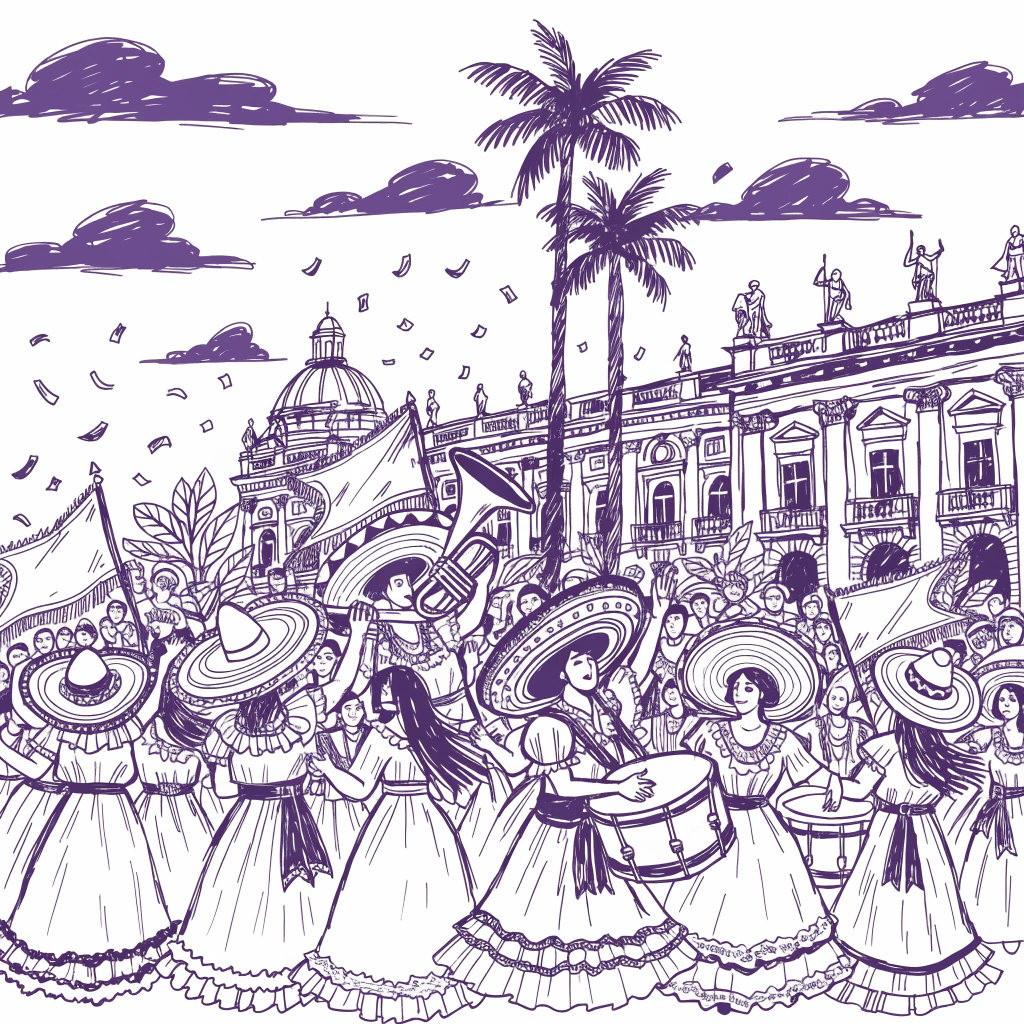
Independence Day in Mexico
Mexico celebrates Independence Day on September 16th. People start the party on September 15th at night. It is a very big holiday for everyone.
In the evening, many people go to the city center. They wear green, white, and red clothes. These are the colors of the Mexican flag. Families walk together and listen to music.
A leader shouts "¡Viva México!" and rings a big bell. People eat traditional food like tacos and watch bright fireworks in the sky. It is a very happy time for every family in Mexico.
문법 스포트라이트
패턴: Present Simple (Third Person Singular)
"Mexico celebrates Independence Day on September 16th."
We use the present simple for facts and schedules. When the subject is a single thing like 'Mexico', we add -s to the verb.
패턴: Plural Nouns
"These are the colors of the Mexican flag."
To talk about more than one thing, we usually add -s to the noun. For example, one color becomes many colors.
이해도를 테스트하세요
10 질문 · A1 초급 · 무료 미리보기 1회
이 기사에서 배운 내용을 테스트하세요. 모든 질문에 답하여 XP를 획득하세요!
When is the official Independence Day in Mexico?
문제별 결과
When is the official Independence Day in Mexico?
내 답변:
정답: September 16th
People wear blue and yellow clothes for the holiday.
내 답변:
정답: 거짓
What is a 'flag'?
내 답변:
정답: A piece of cloth with country colors
A leader shouts and rings a big _____.
내 답변:
정답: bell
멕시코의 특별한 날: 독립기념일
멕시코 독립기념일은 멕시코 사람들에게 아주 특별하고 중요한 날입니다. 이 날은 멕시코가 스페인으로부터 자유를 찾기 시작한 날을 기념합니다. 공식적인 독립기념일은 9월 16일이지만, 축제는 9월 15일 밤부터 시작됩니다. 사람들은 이 날을 매우 자랑스럽게 생각합니다.
1810년, 미겔 이달고 신부님은 돌로레스라는 작은 마을에서 교회의 종을 크게 울렸습니다. 그리고 그는 사람들에게 스페인의 지배에서 벗어나 독립하자고 말했습니다. 이것을 '돌로레스의 함성'이라고 부릅니다. 멕시코는 약 300년 동안 스페인의 지배를 받았습니다. 그래서 멕시코 사람들은 자유를 매우 원했습니다.
독립기념일이 되면 멕시코의 많은 사람들은 가족과 친구들과 함께 모입니다. 맛있는 전통 음식을 먹고, 멕시코 국기 색깔로 집과 길거리를 예쁘게 장식합니다. 밤에는 아름다운 불꽃놀이도 합니다. 멕시코 사람들은 이 날을 행복하게 축하하며, 나라의 역사와 자유를 다시 생각합니다.
문법 스포트라이트
패턴: -(으)ㅁ (명사형 어미)
"이 날은 멕시코가 스페인으로부터 자유를 찾기 시작한 날을 기념합니다."
동사나 형용사 뒤에 붙어 명사처럼 쓰이게 합니다. 여기서는 '시작하다'를 '시작함'처럼 명사로 만들거나, 더 자연스럽게 '-기 시작하다'와 같은 형태로 사용되어 '시작한'처럼 관형사형으로 쓰일 수 있습니다. 문장에서 '시작한 날'은 '시작하다'라는 동작이 명사 '날'을 꾸며주는 역할을 합니다.
패턴: -고 (연결 어미)
"그리고 그는 사람들에게 스페인의 지배에서 벗어나 독립하자고 말했습니다."
두 개 이상의 문장이나 절을 연결할 때 사용합니다. 앞 문장의 내용이 끝나고 다음 문장의 내용이 이어질 때 사용하며, 시간 순서나 단순한 나열을 나타냅니다. 예를 들어, '종을 울렸습니다. 그리고 말했습니다.'처럼 쓸 수 있습니다.
이해도를 테스트하세요
11 질문 · A2 초등급 · 무료 미리보기 1회
이 기사에서 배운 내용을 테스트하세요. 모든 질문에 답하여 XP를 획득하세요!
멕시코 독립기념일은 언제부터 축제가 시작됩니까?
문제별 결과
멕시코 독립기념일은 언제부터 축제가 시작됩니까?
내 답변:
정답: 9월 15일 밤
미겔 이달고 신부님은 돌로레스 마을에서 종을 울렸습니다.
내 답변:
정답: 참
다음 중 '지배'의 의미로 알맞은 것은 무엇입니까?
내 답변:
정답: 어떤 나라나 사람이 다른 나라나 사람을 힘으로 다스리는 것
멕시코는 약 300년 동안 스페인의 _____를 받았습니다.
내 답변:
정답: 지배
멕시코 독립기념일에 사람들은 무엇을 하지 않습니까?
내 답변:
정답: 학교에 가서 공부합니다.
Mexico's Night of Freedom: The Grito de Dolores
Mexico’s Independence Day is a vibrant celebration that captures the heart of the nation. Although the official holiday is September 16th, the festivities have always started on the night of the 15th. This event commemorates the beginning of Mexico's struggle for freedom from Spanish rule, which lasted for three hundred years.
The story began in 1810 in the small town of Dolores. A priest named Miguel Hidalgo y Costilla, who is now considered the father of the nation, took a brave step. He rang his church bell to gather the people and gave a powerful speech known as the 'Grito de Dolores.' This cry was a call for independence and justice. Today, this historic moment is remembered by millions of people across the globe.
Every year at 11:00 PM on September 15th, the President of Mexico stands on the balcony of the National Palace in Mexico City. The original bell, which was moved from Dolores, is rung once again. The President shouts '¡Viva México!' and the crowd responds with equal energy. This ceremony has been performed for many decades and remains a symbol of national pride.
In the streets, the atmosphere is electric. Cities are decorated with green, white, and red lights. Families gather to eat traditional food like 'Chiles en Nogada,' a dish that represents the colors of the Mexican flag. People also enjoy folk music and dancing. It is a time when the history of the country is celebrated with joy and respect. If you ever visit Mexico during this time, you will see how much the people value their hard-won liberty.
문법 스포트라이트
패턴: Passive Voice
"Today, this historic moment is remembered by millions of people across the globe."
The passive voice is used here because the action (remembering) is more important than who is doing it. It is formed using the verb 'to be' plus the past participle.
패턴: Relative Clauses
"A priest named Miguel Hidalgo y Costilla, who is now considered the father of the nation, took a brave step."
The relative clause 'who is now considered the father of the nation' provides extra information about the subject. It is introduced by the relative pronoun 'who' because it refers to a person.
이해도를 테스트하세요
11 질문 · B1 중급 · 무료 미리보기 1회
이 기사에서 배운 내용을 테스트하세요. 모든 질문에 답하여 XP를 획득하세요!
When do the independence celebrations actually begin in Mexico?
문제별 결과
When do the independence celebrations actually begin in Mexico?
내 답변:
정답: On the night of September 15th
The original bell from the town of Dolores is still used in the ceremony today.
내 답변:
정답: 참
What does 'struggle' mean in the context of the article?
내 답변:
정답: A long and difficult effort for freedom
The President of Mexico _____ '¡Viva México!' from the balcony.
내 답변:
정답: shouts
Who is known as the father of the Mexican nation?
내 답변:
정답: Miguel Hidalgo y Costilla
멕시코의 독립 정신: '돌로레스의 외침'
멕시코 독립기념일은 단순히 하루의 공휴일을 넘어섭니다. 이는 스페인 식민 통치로부터의 자유를 쟁취하기 위한 투쟁을 기념하는, 국가적 자부심이 폭발하는 이틀간의 축제입니다. 공식적인 기념일은 9월 16일이지만, 그 전야인 9월 15일 저녁부터 진정한 축제가 시작됩니다. 멕시코 국민들은 이 기간 동안 조국의 독립 정신을 기리며 깊은 유대감을 형성합니다.
이 역사적인 축제의 기원은 1810년으로 거슬러 올라갑니다. 당시 멕시코는 약 300년 동안 스페인의 가혹한 식민 통치 아래 놓여 있었으며, 원주민과 크리올(스페인계 백인) 사이의 불평등은 극에 달했습니다. 이러한 억압적인 상황 속에서 과나후아토 주의 작은 마을 돌로레스에서 미겔 이달고 이 코스티야 신부는 교회의 종을 울리고 '돌로레스의 외침'(Grito de Dolores)으로 알려진 감동적인 연설을 했습니다. 그는 스페인으로부터의 독립과 정의로운 사회 건설을 호소하며, 억압받던 국민들에게 자유를 쟁취하자고 촉구했습니다. 이 외침은 단순한 연설을 넘어, 당시 멕시코인들의 마음에 독립의 불꽃을 지피는 강력한 촉매제가 되었고, 수많은 이들이 그의 부름에 응답하여 독립 전쟁에 참여하게 만들었습니다.
매년 9월 15일 밤, 멕시코 전역의 광장과 시청에서는 이달고 신부의 '외침'을 재현하는 '엘 그리토'(El Grito) 행사가 성대하게 열립니다. 특히 수도 멕시코시티의 중앙 광장인 소칼로에서는 대통령이 직접 발코니에 나와 독립 영웅들의 이름을 하나하나 호명하고, 군중은 이에 열광적으로 화답하며 '비바 멕시코'(¡Viva México!)를 거듭 외칩니다. 이 순간은 멕시코 국민들에게 깊은 감동과 뜨거운 애국심을 불러일으키며, 국가적 정체성을 재확인하는 중요한 의식으로 자리 잡았습니다. 밤새도록 이어지는 불꽃놀이, 마리아치 밴드의 전통 음악, 다채로운 춤 공연, 그리고 타코, 포솔레 등 풍성한 전통 음식들이 이 축제 분위기를 더욱 고조시킵니다. 거리는 멕시코 국기의 색깔인 녹색, 흰색, 빨간색으로 물들고, 모든 이들이 한마음으로 조국의 독립을 축하합니다.
멕시코 독립기념일은 단순히 과거의 영광스러운 순간을 회상하는 것을 넘어섭니다. 이는 현대 멕시코가 어떠한 고난과 투쟁을 거쳐 형성되었는지를 상기시키고, 미래를 향한 희망과 국민적 단결의 메시지를 전달하는 중요한 의미를 지닙니다. 스페인 통치로부터의 독립은 멕시코가 자주적인 국가로서 스스로의 운명을 개척하는 결정적인 첫걸음이었으며, 그 독립 정신은 오늘날까지도 멕시코인들의 삶 속에 깊이 뿌리내려 있습니다. 이 기념일은 자유와 주권의 소중함을 되새기는 동시에, 다양한 지역과 계층의 공동체 결속력을 강화하는 중요한 역할을 수행합니다. 따라서 멕시코 독립기념일은 단순한 축제 이상의 숭고한 의미를 지니며, 멕시코 국민의 자긍심과 독립 정신을 상징하는 가장 중요한 국경일 중 하나로 영원히 기억될 것입니다.
문법 스포트라이트
패턴: -을/를 넘어(서)
"멕시코 독립기념일은 단순히 하루의 공휴일을 넘어섭니다."
이 표현은 어떤 것이 단순한 범주나 기대를 초월하여 더 큰 의미나 중요성을 가짐을 나타냅니다. 'A를 넘어선 B'는 'B는 A보다 더 크거나 중요하다'는 의미로 사용됩니다. 주로 명사 뒤에 붙어 쓰입니다.
패턴: -에 걸쳐
"그는 300년에 걸친 스페인의 식민 지배에 종지부를 찍고 자유를 쟁취하자고 국민들에게 호소했습니다."
이 표현은 어떤 기간이나 공간에 걸쳐 어떤 일이 발생하거나 지속됨을 나타낼 때 사용됩니다. 주로 시간 명사나 장소 명사 뒤에 붙어 '그 기간/장소 동안'이라는 의미를 더합니다.
패턴: -으로/로 알려진
"미겔 이달고 이 코스티야 신부는 교회의 종을 울리고 '돌로레스의 외침'(Grito de Dolores)으로 알려진 감동적인 연설을 했습니다."
이 표현은 어떤 대상이 특정 이름이나 사실로 대중에게 잘 알려져 있음을 나타낼 때 사용됩니다. 명사 뒤에 '으로/로'가 붙고 그 뒤에 '알려진'이 와서 뒤의 명사를 수식합니다.
이해도를 테스트하세요
11 질문 · B2 중상급 · 무료 미리보기 1회
이 기사에서 배운 내용을 테스트하세요. 모든 질문에 답하여 XP를 획득하세요!
멕시코 독립기념일이 국가적 자부심이 폭발하는 '이틀간의 축제'라고 불리는 주된 이유는 무엇입니까?
문제별 결과
멕시코 독립기념일이 국가적 자부심이 폭발하는 '이틀간의 축제'라고 불리는 주된 이유는 무엇입니까?
내 답변:
정답: 9월 15일 저녁부터 축제가 시작되기 때문에
미겔 이달고 신부는 1810년 9월 16일 돌로레스에서 '돌로레스의 외침'을 선포했습니다.
내 답변:
정답: 거짓
'촉매제'는 다음 중 어떤 의미에 가장 가깝습니까?
내 답변:
정답: 변화를 빠르게 일으키는 계기
멕시코 독립기념일은 단순한 축제 이상의 _________ 의미를 지니며, 멕시코 국민의 자긍심과 독립 정신을 상징합니다.
내 답변:
정답: 숭고한
멕시코 독립기념일 축제에서 볼 수 없는 것은 무엇입니까?
내 답변:
정답: 스페인 국기 게양
The Clarion Call of Liberty: A Nuanced Analysis of Mexico’s Independence
Seldom does a national holiday encapsulate the collective psyche of a people as profoundly as Mexico’s Independence Day. To the uninitiated, the festivities of September 15th and 16th might appear to be a mere explosion of color and pyrotechnics. However, beneath the surface lies a multifaceted commemoration of emancipation that challenges the very vestiges of colonial identity. It was in the early hours of September 16, 1810, that Miguel Hidalgo y Costilla, a parish priest in the small town of Dolores, uttered the 'Grito de Dolores.' This clarion call acted as the ultimate catalyst for the burgeoning insurgent movement against Spanish hegemony, marking the definitive commencement of a decade-long struggle for autonomy.
The transition from colonial subjugation to sovereign statehood was by no means a linear progression. Rather, it was a convoluted struggle characterized by shifting alliances and ideological fractures. Central to this narrative is the figure of Hidalgo, whose radical proclamation of liberty sought to dismantle three centuries of European dominance. What remains particularly striking to modern historians is the populist nature of the uprising; it wasn't merely an orchestrated political coup by the elite, but a visceral reclamation of land and dignity by the marginalized indigenous and mestizo masses. This grassroots involvement underscored a burgeoning national consciousness that transcended class boundaries.
In contemporary Mexico, the 'Grito' is reenacted annually with solemnity and fervor from the balcony of the National Palace in Mexico City. This ritualistic performance serves as a potent reminder of the inherent fragility of independence. Not only does the President echo Hidalgo’s historical cry, but the collective response of the populace also reaffirms a shared cultural idiosyncrasy that defines the nation. This celebration is inextricably linked to the concept of 'Mexicanidad,' a complex identity forged in the fires of revolution and tempered by the ongoing pursuit of social justice. The atmosphere is one of profound historical resonance, where the past and present converge in a singular moment of national unity.
Critically analyzing the event reveals a nuanced duality that is often overlooked in simplified historical accounts. While the official narrative emphasizes a unified front against oppression, the historical reality of the independence movement was marked by intense internal dissent and conflicting visions for the nation's future. The eventual achievement of independence in 1821, following the entry of the Army of the Three Guarantees into Mexico City, did not immediately rectify the systemic inequalities rooted in the colonial era. Consequently, the modern celebration functions as both a nostalgic look at a heroic past and a forward-looking aspiration for a more equitable future.
The perpetuation of these traditions ensures that the spirit of the insurgency remains a living component of the national discourse, rather than a stagnant historical artifact. It is through this lens that we see the true significance of the holiday: it is a rejection of historical amnesia. By celebrating the 'Grito,' Mexicans are not just honoring a date, but are participating in a continuous dialogue about what it means to be a free and sovereign people.
Ultimately, Mexico’s Independence Day transcends the boundaries of simple patriotism. It is a sophisticated tapestry of historical memory, social critique, and cultural pride. Through the lens of this holiday, one can observe the enduring resilience of a nation that continues to navigate its complex post-colonial legacy while fiercely guarding its hard-won sovereignty. The echoes of the bell rung in Dolores continue to vibrate through the halls of history, reminding the world that the quest for liberty is an ongoing endeavor.
문법 스포트라이트
패턴: Negative Inversion
"Seldom does a national holiday encapsulate the collective psyche of a people as profoundly as Mexico’s Independence Day."
When using negative or restrictive adverbs like 'seldom' or 'rarely' at the beginning of a sentence for emphasis, the auxiliary verb is placed before the subject.
패턴: It-Cleft Sentence
"It was in the early hours of September 16, 1810, that Miguel Hidalgo y Costilla, a parish priest, uttered the 'Grito de Dolores.'"
Cleft sentences are used to focus on a specific piece of information. The structure 'It is/was [emphasized part] that/who...' highlights the specific time or person.
패턴: Nominalisation
"The transition from colonial subjugation to sovereign statehood was by no means a linear progression."
This involves turning verbs or adjectives into nouns (e.g., 'subjugation' instead of 'subjugating'). This creates a more formal, academic tone typical of C1 level writing.
이해도를 테스트하세요
12 질문 · C1 고급 · 무료 미리보기 1회
이 기사에서 배운 내용을 테스트하세요. 모든 질문에 답하여 XP를 획득하세요!
What does the author suggest about the 'Grito de Dolores' in the context of the insurgent movement?
문제별 결과
What does the author suggest about the 'Grito de Dolores' in the context of the insurgent movement?
내 답변:
정답: It served as the primary trigger for the revolution.
The author argues that Mexico's path to independence was straightforward and lacked internal conflict.
내 답변:
정답: 거짓
Which word best describes a deep, instinctive feeling as mentioned in the text?
내 답변:
정답: Visceral
The transition from colonial _____ to sovereign statehood was characterized by ideological fractures.
내 답변:
정답: subjugation
According to the article, how does the modern 'Grito' ceremony function for the Mexican people?
내 답변:
정답: As a reaffirmation of a unique shared identity and social justice pursuit.
The independence movement was officially concluded in 1821.
내 답변:
정답: 참
멕시코 독립기념일: '돌로레스의 외침'이 남긴 역사적 메아리
매년 9월 16일, 멕시코는 스페인 식민 통치로부터의 독립을 기념하는 가장 중요한 국경일인 독립기념일을 맞이합니다. 그러나 이 기념일의 진정한 서막은 전야인 9월 15일 밤에 울려 퍼지는 '돌로레스의 외침(Grito de Dolores)'에서 시작된다고 해도 과언이 아닙니다. 이 이틀간의 축제는 단순한 국가적 경축일을 넘어, 멕시코 민족 정체성의 근간을 이루는 역사적 사건의 재현이자, 자유를 향한 불굴의 의지를 상징하는 의례라 할 수 있을 것입니다.
19세기 초, 멕시코는 약 300년에 걸친 스페인의 식민 지배 하에 놓여 있었습니다. 이 기간 동안 원주민과 메스티소는 사회적, 경제적, 정치적으로 심각한 차별을 받았으며, 스페인 본토 출신인 '페닌술라레스'만이 모든 특권을 누리는 불평등한 구조가 고착화되었습니다. 이러한 억압적인 상황 속에서 독립을 향한 열망은 멕시코 전역에 걸쳐 서서히 끓어오르고 있었습니다. 프랑스 혁명과 미국 독립 혁명의 성공은 이러한 열망에 불을 지피는 촉매제가 되었고, 지식인 계층과 일부 성직자들 사이에서는 새로운 국가 건설에 대한 논의가 활발히 전개되었습니다.
그 결정적인 전환점은 1810년 9월 16일 새벽, 과나후아토 주의 작은 마을 돌로레스에서 미겔 이달고 이 코스티야 신부에 의해 마련되었습니다. 그는 자신의 본당 성당 종을 울리며 마을 사람들을 모았고, 스페인 식민 정부에 맞서 봉기를 촉구하는 격정적인 연설을 했습니다. 이것이 바로 전설적인 '돌로레스의 외침'입니다. 이달고 신부는 스페인에 대한 충성 거부, 식민 지배 종식, 그리고 멕시코인들의 자유와 평등을 주장하며 민중의 분노를 폭발시켰습니다. 비록 그가 구체적인 독립 목표나 체계적인 계획을 제시하지는 못했을지라도, 그의 이 선언은 멕시코 독립 전쟁의 도화선이 되었고, 수많은 민중이 봉기하여 독립군에 합류하는 계기가 되었습니다.
이달고 신부의 외침은 단순한 정치적 선언을 넘어, 억압받던 민중의 응축된 감정을 대변하는 상징적 행위였습니다. 그의 연설은 당시 식민 지배의 부조리함과 민족의 자주성을 향한 깊은 열망을 동시에 담고 있었으며, 이는 이후 멕시코 독립운동의 정신적 지주 역할을 하게 됩니다. '돌로레스의 외침'은 즉각적인 독립을 가져오지는 못했으나, 멕시코인들의 마음속에 자유와 주권에 대한 씨앗을 심었고, 이는 결국 1821년 멕시코 독립으로 결실을 맺는 데 지대한 영향을 미쳤습니다.
오늘날 멕시코 전역에서는 9월 15일 밤이 되면 대통령부터 각 지역의 시장에 이르기까지 모든 공공기관장이 이달고 신부의 외침을 재현합니다. 수많은 인파가 모인 광장에서 국기를 흔들며 'Viva México!'를 외치고, 불꽃놀이와 마리아치 음악, 그리고 전통 음식과 함께 밤새 축제를 즐깁니다. 이 의식은 단순한 기념 행사를 넘어, 멕시코 국민들이 과거의 희생을 기억하고 현재의 자유와 주권을 소중히 여기며 미래를 향해 나아가겠다는 다짐을 새롭게 하는 중요한 문화적 장치로 기능합니다.
멕시코 독립기념일은 단지 과거의 한 사건을 회상하는 날이 아닙니다. 그것은 민족의 정체성을 재확인하고, 불평등과 억압에 맞서 싸웠던 선조들의 용기를 기리며, 자유와 주권이라는 보편적 가치를 끊임없이 성찰하는 기회입니다. '돌로레스의 외침'은 시대를 초월하여 오늘날에도 멕시코인들에게 깊은 울림을 주며, 그들의 역사적 숙명과 미래를 향한 희망을 동시에 일깨우는 강력한 메시지로 남아 있을 것입니다. 이는 비단 멕시코만의 이야기가 아니라, 자유와 독립을 열망하는 모든 민족에게 보편적인 감동을 선사하는 인류 보편의 서사라 해도 무방할 것입니다.
문법 스포트라이트
패턴: ~라고 해도 과언이 아니다
"이 이틀간의 축제는 단순한 국가적 경축일을 넘어, 멕시코 민족 정체성의 근간을 이루는 역사적 사건의 재현이자, 자유를 향한 불굴의 의지를 상징하는 의례라 할 수 있을 것입니다."
이 표현은 어떤 진술이나 평가가 사실과 일치하며, 전혀 과장된 것이 아님을 강조할 때 사용됩니다. 즉, '~라고 말해도 전혀 틀리지 않다'는 의미를 전달하여 주장의 설득력을 높이는 역할을 합니다. 주로 문어체나 격식 있는 상황에서 사용됩니다.
패턴: ~에 다름 아니다
"이 이틀간의 축제는 단순한 국가적 경축일을 넘어, 멕시코 민족 정체성의 근간을 이루는 역사적 사건의 재현이자, 자유를 향한 불굴의 의지를 상징하는 의례라 할 수 있을 것입니다."
이 문법은 'A는 B와 마찬가지다', 'A는 곧 B이다'와 같이, 앞의 내용이 뒤의 내용과 본질적으로 같거나 다름없음을 강조할 때 쓰입니다. 주로 명사나 명사구 뒤에 붙어, 어떤 사안의 중요성이나 본질을 강력하게 피력하는 역할을 합니다. 문어체에서 자주 볼 수 있습니다.
패턴: ~는 셈이다
"그의 연설은 당시 식민 지배의 부조리함과 민족의 자주성을 향한 깊은 열망을 동시에 담고 있었으며, 이는 이후 멕시코 독립운동의 정신적 지주 역할을 하게 되는 셈입니다."
이 문법은 어떤 상황이나 결과가 '~와 마찬가지이다' 또는 '~라고 할 수 있다'는 의미를 나타냅니다. 직접적인 사실은 아니지만, 사실상 그와 같다고 판단하거나 간주할 때 사용합니다. 주로 앞선 내용에 대한 결론이나 평가를 내릴 때 쓰이며, 문장의 의미를 정리해주는 역할을 합니다.
이해도를 테스트하세요
12 질문 · C2 마스터 · 무료 미리보기 1회
이 기사에서 배운 내용을 테스트하세요. 모든 질문에 답하여 XP를 획득하세요!
다음 중 '돌로레스의 외침'이 일어난 시기와 장소로 올바른 것은 무엇입니까?
문제별 결과
다음 중 '돌로레스의 외침'이 일어난 시기와 장소로 올바른 것은 무엇입니까?
내 답변:
정답: 1810년 9월 16일 새벽, 돌로레스
미겔 이달고 신부는 '돌로레스의 외침'을 통해 스페인 식민 정부에 대한 봉기를 촉구했다.
내 답변:
정답: 참
어떤 현상이나 상태, 구조 등이 변하지 않고 굳어져서 지속되는 것을 의미하는 단어는 무엇입니까?
내 답변:
정답: 고착화되다
멕시코 독립기념일은 단순한 국가적 경축일을 넘어, 멕시코 민족 정체성의 ______ 이루는 역사적 사건의 재현이다.
내 답변:
정답: 근간을
멕시코 독립기념일의 진정한 서막이 시작된다고 언급된 행사는 무엇입니까?
내 답변:
정답: 돌로레스의 외침
'페닌술라레스'는 스페인 식민 통치 기간 동안 멕시코에서 사회적, 경제적 차별을 받던 계층을 일컫는 말이다.
내 답변:
정답: 거짓

