









gorgon en 30 secondes
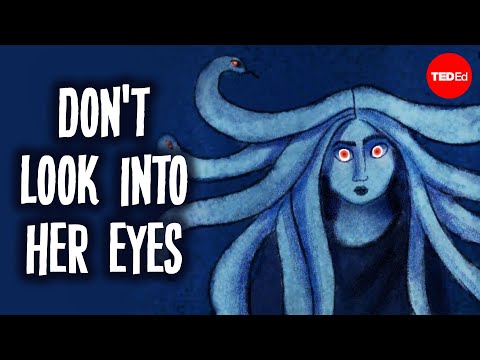
- A gorgon is a mythological female monster with snakes for hair and a gaze that turns people into stone, most famously Medusa.
- Figuratively, the word is a derogatory term for a woman who is seen as exceptionally fierce, frightening, or physically unattractive.
- The term is used in literature, art history, and pop culture, often carrying a sense of ancient dread or intimidating power.
- Derived from the Greek word for 'terrible,' it also appears in biological names for certain types of coral and sea fans.
- Mythological Origin
- The word comes from the Greek 'gorgos', meaning 'dreadful' or 'terrible'. In the myths, they were the daughters of Phorcys and Ceto.
The museum curator explained how the ancient shield was adorned with the face of a gorgon to ward off evil spirits.
- Figurative Application
- Describing a strict headmistress or a particularly harsh female supervisor as a gorgon emphasizes her intimidating and unyielding nature.
The old landlady was a total gorgon, scaring away any tenant who dared to complain about the heating.
- Symbolism
- The gorgon's head, or 'Gorgoneion', was a popular apotropaic amulet used to turn away evil, appearing on everything from coins to temple pediments.
Athena wore the gorgon's head on her aegis to strike fear into her enemies.
The sea fan is a type of gorgon coral that sways gently in the ocean currents.
- Descriptive Usage
- Use 'gorgon' to emphasize a lack of empathy or a frightening physical presence. It works best in writing that aims for a dramatic or slightly archaic tone.
She stood at the door like a gorgon, refusing entry to anyone without an invitation.
- Artistic Context
- 'The pediment of the temple featured a central gorgon to ward off evil spirits.'
Her gorgon-like features were softened only by the dim light of the candles.
- Literary Usage
- 'He felt as though he were facing a gorgon, his limbs turning to lead as she spoke.'
The critic described the actress's performance as having a gorgon intensity that captivated the audience.
The ancient text warns of the gorgon's blood, which could both kill and heal.
- Pop Culture
- In the movie 'Clash of the Titans,' the gorgon Medusa is the central antagonist that Perseus must defeat.
'Watch out for the gorgon's glare!' the gamer shouted to his teammates.
- Academic Context
- The professor noted that the gorgon was one of the earliest examples of the 'apotropaic' function in art.
The essay explored the gorgon as a manifestation of patriarchal anxiety.
- Journalistic Usage
- The editorial described the Prime Minister as a gorgon who petrified her cabinet into submission.
The documentary featured stunning footage of the gorgon corals in the Caribbean.
The poet compared the city's traffic to a gorgon, freezing everyone in their tracks.
- Mythological Accuracy
- Avoid saying 'The gorgon sang a song.' Gorgons don't sing to lure people; they petrify them with a look.
Incorrect: The gorgon flew over the ship and snatched the bread. (This describes a harpy.)
- Gendered Usage
- Remember that 'gorgon' is a gendered term. Using it for a man is usually incorrect unless you are making a very specific, unconventional point.
Incorrect: He was a real gorgon of a boss. (Better: He was a real tyrant of a boss.)
- Phonetic Confusion
- 'Gorgon' and 'Demogorgon' are different. The latter is a deity or demon, often associated with the underworld, and popularized by 'Stranger Things'.
Incorrect: I'd like a salad with gorgon dressing. (Correct: Gorgonzola dressing.)
Correct: The gorgon's image was carved into the stone lintel.
- Comparison: Gorgon vs. Fury
- A 'gorgon' is terrifying and petrifying; a 'fury' (from the Erinyes) is relentlessly vengeful and angry. Use 'gorgon' for a cold, scary presence and 'fury' for active, raging anger.
Instead of calling her a gorgon, the novelist described her as a 'formidable matriarch'.
- Comparison: Gorgon vs. Medusa
- 'Medusa' is a specific individual; 'gorgon' is the species. Use 'Medusa' when referring to the specific myth and 'gorgon' when speaking generally or figuratively.
The supervisor's gorgon-like silence was more effective than any shouted reprimand.
- Comparison: Gorgon vs. Ogre
- An 'ogre' is usually male, physically massive, and eats people. A 'gorgon' is female, uses a magical gaze, and turns people to stone. Both imply monstrosity but through different means.
The ancient ruins were guarded by a gorgon whose legend kept the villagers away for centuries.
The actress portrayed the gorgon not as a villain, but as a tragic figure cursed by the gods.
How Formal Is It?
Le savais-tu ?
The 'Gorgoneion' (gorgon's head) was so popular in the ancient world that it appeared on the armor of Alexander the Great and was used as a 'keep out' sign on baker's ovens to stop people from peeking at the bread.
Guide de prononciation
- Pronouncing it as 'gor-GONE' (rhyming with bone).
- Pronouncing it as 'gor-GAN' (rhyming with pan).
- Adding an extra 'i' like 'gor-gi-on'.
- Confusing the 'g' sounds; both are hard 'g's like in 'go'.
- Missing the 'r' sound in American English.
Niveau de difficulté
Common in literature and mythology, but requires cultural knowledge.
Hard to use correctly without sounding overly dramatic or offensive.
Rarely used in casual speech; sounds very formal or literary.
Recognizable in fantasy contexts and academic lectures.
Quoi apprendre ensuite
Prérequis
Apprends ensuite
Avancé
Grammaire à connaître
Nouns used as adjectives
The gorgon stare (using the noun 'gorgon' to modify 'stare').
Proper vs. Common Nouns
Capitalize 'Gorgon' when referring to the specific mythological group, but use lowercase for figurative use.
Adjective derivation
Adding '-ian' to create 'gorgonian'.
Similes with 'like'
She stood there like a gorgon.
Compound adjectives
A gorgon-headed monster.
Exemples par niveau
The gorgon has snakes on her head.
La gorgone a des serpents sur la tête.
Simple subject-verb-object structure.
Do not look at the gorgon's eyes.
Ne regarde pas les yeux de la gorgone.
Imperative sentence.
The gorgon is a scary monster.
La gorgone est un monstre effrayant.
Use of the adjective 'scary' to describe the noun.
She turns people into stone.
Elle transforme les gens en pierre.
Present simple for a general fact.
The hero killed the gorgon.
Le héros a tué la gorgone.
Past simple tense.
Is the gorgon real?
Est-ce que la gorgone est réelle ?
Question form with 'to be'.
I see a gorgon in the book.
Je vois une gorgone dans le livre.
Prepositional phrase 'in the book'.
The gorgon is very big.
La gorgone est très grande.
Adverb 'very' modifying the adjective 'big'.
Medusa is the most famous gorgon.
Méduse est la gorgone la plus célèbre.
Superlative 'the most famous'.
Gorgons lived in ancient Greece.
Les gorgones vivaient en Grèce antique.
Past simple with a time reference.
Her hair was made of many snakes.
Ses cheveux étaient faits de nombreux serpents.
Passive voice 'was made of'.
The gorgon's face was very ugly.
Le visage de la gorgone était très laid.
Possessive 's.
People were afraid of the gorgon.
Les gens avaient peur de la gorgone.
Adjective phrase 'afraid of'.
He used a mirror to see the gorgon.
Il a utilisé un miroir pour voir la gorgone.
Infinitive of purpose 'to see'.
There are three gorgons in the story.
Il y a trois gorgones dans l'histoire.
There are + plural noun.
The gorgon's stare can turn you to stone.
Le regard de la gorgone peut vous transformer en pierre.
Modal verb 'can' for ability.
The old woman was often called a gorgon by the neighborhood children.
La vieille femme était souvent appelée une gorgone par les enfants du quartier.
Passive voice with an agent.
Perseus managed to cut off the gorgon's head.
Persée a réussi à couper la tête de la gorgone.
Verb 'managed to' followed by an infinitive.
The gorgon motif appears on many ancient shields.
Le motif de la gorgone apparaît sur de nombreux boucliers anciens.
Present simple for a general truth.
She gave him a gorgon-like look that made him stop talking.
Elle lui a lancé un regard de gorgone qui l'a fait arrêter de parler.
Compound adjective 'gorgon-like'.
In the movie, the gorgon was a terrifying creature with wings.
Dans le film, la gorgone était une créature terrifiante avec des ailes.
Prepositional phrase 'with wings'.
The gorgon's sisters were immortal, but Medusa was not.
Les sœurs de la gorgone étaient immortelles, mais Méduse ne l'était pas.
Contrast using 'but'.
Calling someone a gorgon is a very strong insult.
Traiter quelqu'un de gorgone est une insulte très forte.
Gerund 'Calling' as the subject.
The statue of the gorgon stood at the entrance of the temple.
La statue de la gorgone se dressait à l'entrée du temple.
Past simple 'stood'.
The headmistress was a total gorgon who ruled the school with fear.
La directrice était une véritable gorgone qui dirigeait l'école par la peur.
Relative clause 'who ruled...'.
The myth of the gorgon has been interpreted in many different ways.
Le mythe de la gorgone a été interprété de nombreuses manières différentes.
Present perfect passive.
Her gorgonian stare seemed to freeze the very air in the room.
Son regard gorgonien semblait geler l'air même de la pièce.
Adjective 'gorgonian' derived from the noun.
The hero had to be careful not to look directly at the gorgon.
Le héros devait faire attention à ne pas regarder directement la gorgone.
Negative infinitive 'not to look'.
Ancient Greeks used the gorgon's image as an apotropaic symbol.
Les anciens Grecs utilisaient l'image de la gorgone comme symbole apotropaïque.
Use of technical vocabulary 'apotropaic'.
The novel describes the antagonist as a modern-day gorgon.
Le roman décrit l'antagoniste comme une gorgone des temps modernes.
Compound noun 'modern-day'.
Gorgon corals are beautiful but fragile parts of the reef.
Les coraux gorgones sont des parties magnifiques mais fragiles du récif.
Adjective usage in a biological context.
She was a gorgon of a woman, tall and terrifyingly thin.
C'était une femme de type gorgone, grande et d'une maigreur terrifiante.
Appositive phrase 'of a woman'.
The critic's review was a gorgon's gaze, turning the director's hopes to stone.
La critique du critique était un regard de gorgone, transformant les espoirs du réalisateur en pierre.
Metaphorical use of 'gorgon's gaze'.
Feminist scholars often reclaim the gorgon as a symbol of female power.
Les chercheuses féministes se réapproprient souvent la gorgone comme symbole du pouvoir féminin.
Adverb 'often' modifying the verb 'reclaim'.
The architectural detail featured a grotesque gorgon mask above the door.
Le détail architectural présentait un masque de gorgone grotesque au-dessus de la porte.
Complex noun phrase 'grotesque gorgon mask'.
He felt gorgonized by her intense and unblinking scrutiny.
Il se sentait pétrifié par son examen intense et sans ciller.
Use of the rare verb 'gorgonized'.
The gorgon sisters, Stheno and Euryale, were said to be immortal.
On disait que les sœurs gorgones, Sthéno et Euryale, étaient immortelles.
Parenthetical insertion of names.
Her reputation as a gorgon preceded her, making everyone nervous.
Sa réputation de gorgone la précédait, rendant tout le monde nerveux.
Participial phrase 'making everyone nervous'.
The poet utilized the gorgon imagery to convey a sense of paralyzing fear.
Le poète a utilisé l'imagerie de la gorgone pour transmettre un sentiment de peur paralysante.
Verb 'utilized' for formal register.
The Gorgoneion was a common feature on ancient Greek pottery.
Le Gorgoneion était une caractéristique commune sur la poterie grecque antique.
Proper noun 'Gorgoneion'.
The political landscape was dominated by a gorgon whose influence was as petrifying as it was pervasive.
Le paysage politique était dominé par une gorgone dont l'influence était aussi pétrifiante qu'omniprésente.
Correlative conjunction 'as... as'.
In Ovid's retelling, the gorgon's curse is a tragic consequence of divine jealousy.
Dans le récit d'Ovide, la malédiction de la gorgone est une conséquence tragique de la jalousie divine.
Possessive 'Ovid's' and 'gorgon's'.
The sheer gorgonian intensity of the performance left the audience in a state of stunned silence.
L'intensité purement gorgonienne de la performance a laissé le public dans un état de silence stupéfait.
Adjective 'gorgonian' used for abstract intensity.
She navigated the corporate world like a gorgon, turning every obstacle into a stepping stone.
Elle a navigué dans le monde de l'entreprise comme une gorgone, transformant chaque obstacle en un tremplin.
Simile 'like a gorgon' with a play on 'stone'.
The artifact was identified as a rare example of a gorgon-themed apotropaion.
L'artéfact a été identifié comme un exemple rare d'un apotropaion sur le thème de la gorgone.
Technical term 'apotropaion'.
To look upon the gorgon of truth is to risk losing one's comforting illusions.
Regarder la gorgone de la vérité, c'est risquer de perdre ses illusions réconfortantes.
Infinitive phrase as subject and complement.
The artist's depiction of the gorgon subverted traditional notions of beauty and horror.
La représentation de la gorgone par l'artiste a subverti les notions traditionnelles de beauté et d'horreur.
Verb 'subverted' in a critical context.
The gorgon motif in the film serves as a metaphor for the protagonist's repressed trauma.
Le motif de la gorgone dans le film sert de métaphore au traumatisme refoulé du protagoniste.
Present simple for literary analysis.
Collocations courantes
Phrases Courantes
— Acting in a terrifying or petrifying manner.
She stood at the door like a gorgon, waiting for him to return.
— A very frightening or ugly face.
He was shocked by the face of a gorgon staring back at him.
— A symbol of terror or a protective amulet.
The gorgon's head was used to frighten enemies in battle.
— Being so scared that one cannot move.
The witness was petrified by a gorgon of a prosecutor.
— Referring to the specific mythological group.
The three gorgons were daughters of ancient sea gods.
— Resembling a gorgon in appearance or behavior.
The building had a gorgon-like appearance with its twisted pillars.
— To overcome a terrifying or difficult obstacle.
He felt he had to slay the gorgon of his own anxiety.
— A substance with magical properties in myth.
Legends say gorgon's blood could bring the dead back to life.
— Referring to hair that looks like snakes or is very messy.
Her hair was a wild mess, like a gorgon's hair in the wind.
— The most common way to identify the specific creature.
The gorgon Medusa was eventually killed by Perseus.
Souvent confondu avec
A harpy is a bird-woman who steals; a gorgon is a snake-woman who petrifies.
A siren lures people with songs; a gorgon scares people with her look.
A fury represents active vengeance; a gorgon represents paralyzing terror.
Expressions idiomatiques
— To face a terrifying danger directly.
He had to look the gorgon of bankruptcy in the eye.
Literary— To be paralyzed with fear or shock.
When she heard the news, she was turned to stone.
Common— A very complicated or terrifying problem (similar to Gordian knot).
The legal case was a gorgon's knot of conflicting evidence.
Rare— To stop someone in their tracks with a look.
The teacher could gorgonize any student with a single glance.
Literary— A way to see a dangerous truth without being destroyed by it.
Art is the gorgon's mirror that lets us face reality.
Academic— A terrifying or chilling laugh.
The villain's gorgon's laughter echoed through the hall.
Literary— A powerful defense that scares off attackers.
His wealth was the shield of the gorgon that protected him.
Metaphorical— A cold, unfeeling, or cruel heart.
She had a gorgon's heart and felt no pity for the poor.
Literary— To act in an intentionally frightening or harsh way.
She had to play the gorgon to get the workers to listen.
InformalFacile à confondre
People think they are the same thing.
Medusa is one specific individual; gorgon is the name of the species or group of three sisters. All Medusas are gorgons (in that story), but not all gorgons are Medusa.
Medusa was the only mortal gorgon.
Similar sound.
Gorgonzola is a type of Italian blue cheese; a gorgon is a mythological monster. They have no linguistic connection.
I love gorgonzola on my pizza, but I hate gorgons in my nightmares.
Similar sound and both are monsters.
A demogorgon is a powerful deity or demon (often associated with the underworld or 'Stranger Things'); a gorgon is specifically a Greek snake-haired woman.
The demogorgon from the show is much scarier than a classical gorgon.
Both are mythological monsters used as insults for women.
A dragon is a giant lizard; a gorgon is a woman with snakes. Figuratively, a dragon is just fierce, while a gorgon is scary and 'ugly'.
The headmistress was more of a dragon than a gorgon.
Both have many heads/snakes.
A hydra is a multi-headed water serpent; a gorgon is a woman with snakes for hair. Cutting off a hydra's head makes two more grow; cutting off a gorgon's head kills her.
Hercules fought the hydra, but Perseus fought the gorgon.
Structures de phrases
The [noun] is a [adjective] gorgon.
The monster is a scary gorgon.
Gorgons have [noun] for hair.
Gorgons have snakes for hair.
She was called a gorgon because [reason].
She was called a gorgon because she was so mean.
The [noun] was like a gorgon, [verb-ing] everyone.
The boss was like a gorgon, terrifying everyone.
Her [adjective] [noun] was a gorgon's gaze.
Her icy stare was a gorgon's gaze.
The [noun] was gorgonized by [noun].
The crowd was gorgonized by her powerful voice.
To [verb] is to face the gorgon of [abstract noun].
To tell the truth is to face the gorgon of reality.
The [noun] served as a gorgonian [noun].
The statue served as a gorgonian guardian.
Famille de mots
Noms
Verbes
Adjectifs
Apparenté
Comment l'utiliser
Rare in daily speech, common in specific genres (fantasy, classics).
-
Calling a man a gorgon.
→
Calling a man a tyrant or an ogre.
Gorgons are specifically female in mythology and the figurative usage follows this rule.
-
Thinking gorgons have wings but no snakes.
→
Gorgons always have snakes for hair; wings are optional in some versions.
The defining feature of a gorgon is the snake-hair and the gaze, not the wings.
-
Using 'gorgon' to mean a beautiful but dangerous woman.
→
Using 'siren' for a beautiful but dangerous woman.
Gorgons are typically described as hideous or terrifying, while sirens use beauty and song to lure victims.
-
Spelling it 'Gorgan'.
→
Gorgon.
The suffix is -on, derived from the Greek -o.
-
Confusing Medusa with the species name.
→
Medusa is the name; gorgon is the type of monster.
It's like saying 'the human John' vs 'the John human'.
Astuces
Be Careful with Gender
Only use 'gorgon' for women. Using it for a man is historically and linguistically incorrect and will confuse native speakers.
Use 'Gorgonian' for Adjectives
If you want to describe a stare or a look, 'gorgonian' sounds more sophisticated than 'gorgon-like'. For example: 'His gorgonian gaze petrified the room.'
Connect to 'Stone'
When using 'gorgon' as a metaphor, try to include words like 'stone', 'freeze', 'petrify', or 'icy' to strengthen the imagery.
Understand the Aegis
In mythology, the goddess Athena wore the gorgon's head on her shield (the Aegis). Knowing this helps you understand the word's link to protection.
Sea Fans
If you are a diver, remember that 'gorgonians' are sea fans. It's a great way to remember the word in a non-scary context.
The Double 'O'
Remember the word has two 'o's: G-O-R-G-O-N. Don't spell it with an 'a' at the end.
Look for Allusions
When you see 'gorgon' in a poem, look for other Greek myth words nearby. It's usually part of a larger classical reference.
Pronunciation
The 'g' is always hard, like in 'gold'. Never pronounce it with a 'j' sound like 'George'.
Gorgon = Gone
If you look at her, your life is 'gone' because you're a statue. This simple rhyme helps you remember her power.
Check the Tone
Before calling someone a gorgon, ask yourself if you want to be that mean. It's a very strong and personal insult.
Mémorise-le
Moyen mnémotechnique
Think of 'Gore' + 'Gone'. If you see a gorgon, there will be 'gore' and you will be 'gone' (turned to stone). Also, 'Gorgon' sounds like 'Gorgonzola' cheese, which is 'stony' and 'veiny' like snakes.
Association visuelle
Imagine a woman with a head full of writhing green snakes. Every time she looks at something, it turns into a grey, cold statue. The snakes are hissing the word 'Gorgon'.
Word Web
Défi
Try to write a sentence describing a very strict boss using the word 'gorgon' and the word 'petrified'. Then, try to use 'gorgonian' to describe a piece of art.
Origine du mot
The word 'gorgon' enters English from the Latin 'Gorgon', which in turn comes from the Ancient Greek 'Gorgō'. The Greek root is 'gorgos', meaning 'dreadful', 'terrible', or 'fierce'. It has been used in English since the 14th century.
Sens originel : In its original Greek context, it referred specifically to the three mythological sisters with snake hair and a petrifying gaze.
Indo-European > Hellenic > Greek > Latin > English.Contexte culturel
Be careful: calling a woman a 'gorgon' is highly gendered and can be seen as misogynistic, as it historically targets women's appearance and authority.
In British literature, 'gorgon' is a classic trope for the 'stern headmistress' or 'mean aunt'. In American pop culture, it's mostly associated with fantasy movies and games.
Pratique dans la vie réelle
Contextes réels
Mythology Classes
- the three gorgon sisters
- Medusa's decapitation
- Perseus and the gorgon
- serpentine hair
Art History
- the Gorgoneion motif
- apotropaic function
- gorgon mask
- classical iconography
Literary Criticism
- gorgon archetype
- petrifying gaze
- monstrous feminine
- symbol of paralysis
Marine Biology
- gorgonian corals
- sea fans
- branching structure
- marine invertebrates
Figurative Insults
- a real gorgon
- gorgon of a woman
- icy gorgon stare
- terrifying presence
Amorces de conversation
"Have you ever seen the famous painting of the gorgon Medusa by Caravaggio?"
"Why do you think the gorgon is such a popular monster in modern video games?"
"In some stories, the gorgon is a victim rather than a villain. What do you think?"
"If you had to describe a 'gorgon' in modern life, what kind of person would that be?"
"Do you know the names of the other two gorgon sisters besides Medusa?"
Sujets d'écriture
Describe a time you felt 'petrified' by someone's gaze, as if they were a gorgon.
Write a short story from the perspective of a gorgon who is tired of turning people to stone.
How has the image of the gorgon changed from ancient times to modern feminist interpretations?
If you were a hero like Perseus, what modern 'gorgon' would you want to defeat?
Reflect on why the 'gorgon' is almost always depicted as female. What does this say about society?
Questions fréquentes
10 questionsIn traditional Greek mythology, no. The gorgons were three sisters: Medusa, Stheno, and Euryale. However, in some modern fantasy games or books, creators might invent male versions, but this is not part of the original myth.
According to Ovid, Medusa was originally a beautiful woman who was cursed by the goddess Athena. Athena turned her hair into snakes as a punishment after Medusa was raped by Poseidon in Athena's temple.
When used for a real person, yes, it is almost always an insult. It suggests the woman is terrifying or repulsive. However, in art history or mythology, it is a neutral descriptive term.
It is a rare verb that means to have a paralyzing or mesmerizing effect on someone, similar to how a gorgon turns people to stone with a look. For example: 'She gorgonized the audience with her powerful performance.'
In most myths, gorgons are immune to their own gaze, but they can be affected by their reflection. This is how Perseus defeated Medusa—by looking at her reflection in his shield.
A Gorgoneion is a special amulet or image showing a gorgon's head. In ancient times, it was believed to have 'apotropaic' powers, meaning it could ward off evil spirits and bad luck.
No. Medusa was mortal and could be killed. Her sisters, Stheno and Euryale, were immortal. Medusa is the only one who was originally a human in some versions of the myth.
Gorgonian corals, also known as sea fans, are a type of marine animal. They are named after gorgons because their branching, flexible skeletons look like the snakes on a gorgon's head.
Use it to describe a woman who is very strict, scary, or unyielding.
It is not very common in daily conversation. It is a C1 level word, meaning it is mostly found in literature, academic writing, or specialized contexts like mythology and biology.
Teste-toi 200 questions
Describe a mythological gorgon in three sentences.
Well written! Good try! Check the sample answer below.
Use the word 'gorgon' in a sentence to describe a mean character.
Well written! Good try! Check the sample answer below.
Explain the difference between a gorgon and a siren.
Well written! Good try! Check the sample answer below.
Write a short paragraph about Perseus and Medusa.
Well written! Good try! Check the sample answer below.
How can the word 'gorgon' be used as a metaphor in a business context?
Well written! Good try! Check the sample answer below.
Discuss the symbolic meaning of the gorgon's head in ancient art.
Well written! Good try! Check the sample answer below.
Create a dialogue where one person uses the word 'gorgon' as an insult.
Well written! Good try! Check the sample answer below.
Describe the physical appearance of a gorgon using at least three adjectives.
Well written! Good try! Check the sample answer below.
Why is Medusa considered a tragic figure by some modern writers?
Well written! Good try! Check the sample answer below.
Write a sentence using the verb 'gorgonize'.
Well written! Good try! Check the sample answer below.
Explain the etymology of the word 'gorgon'.
Well written! Good try! Check the sample answer below.
What is an apotropaic symbol? Use 'gorgon' in your answer.
Well written! Good try! Check the sample answer below.
Describe a 'gorgon stare' and its effect on a person.
Well written! Good try! Check the sample answer below.
Write a sentence about gorgonian corals.
Well written! Good try! Check the sample answer below.
How does the gorgon myth relate to the concept of 'the gaze'?
Well written! Good try! Check the sample answer below.
Summarize the story of Medusa in 50 words.
Well written! Good try! Check the sample answer below.
Use 'gorgon-like' to describe a building or landscape.
Well written! Good try! Check the sample answer below.
Why is 'gorgon' a gendered term?
Well written! Good try! Check the sample answer below.
Compare the gorgon to the hydra.
Well written! Good try! Check the sample answer below.
Write a poem of four lines featuring a gorgon.
Well written! Good try! Check the sample answer below.
Pronounce 'gorgon' correctly.
Read this aloud:
Tu as dit :
Speech recognition is not supported in your browser. Try Chrome or Edge.
Explain the myth of Medusa in your own words.
Read this aloud:
Tu as dit :
Speech recognition is not supported in your browser. Try Chrome or Edge.
Describe a 'gorgon' character from a movie you've seen.
Read this aloud:
Tu as dit :
Speech recognition is not supported in your browser. Try Chrome or Edge.
Why might calling someone a 'gorgon' be offensive?
Read this aloud:
Tu as dit :
Speech recognition is not supported in your browser. Try Chrome or Edge.
Use 'gorgon' in a sentence about a difficult situation.
Read this aloud:
Tu as dit :
Speech recognition is not supported in your browser. Try Chrome or Edge.
Discuss the use of the gorgon as a protective symbol.
Read this aloud:
Tu as dit :
Speech recognition is not supported in your browser. Try Chrome or Edge.
How would you describe a 'gorgon stare' to someone?
Read this aloud:
Tu as dit :
Speech recognition is not supported in your browser. Try Chrome or Edge.
Compare a gorgon to another mythological monster.
Read this aloud:
Tu as dit :
Speech recognition is not supported in your browser. Try Chrome or Edge.
Explain the biological term 'gorgonian'.
Read this aloud:
Tu as dit :
Speech recognition is not supported in your browser. Try Chrome or Edge.
What are the synonyms for 'gorgon'?
Read this aloud:
Tu as dit :
Speech recognition is not supported in your browser. Try Chrome or Edge.
Tell a short story about a hero facing a gorgon.
Read this aloud:
Tu as dit :
Speech recognition is not supported in your browser. Try Chrome or Edge.
Why do you think the gorgon myth is still popular today?
Read this aloud:
Tu as dit :
Speech recognition is not supported in your browser. Try Chrome or Edge.
How do you pronounce 'gorgonize'?
Read this aloud:
Tu as dit :
Speech recognition is not supported in your browser. Try Chrome or Edge.
What does the word 'gorgon' imply about a person's appearance?
Read this aloud:
Tu as dit :
Speech recognition is not supported in your browser. Try Chrome or Edge.
Describe the Versace logo and its connection to the gorgon.
Read this aloud:
Tu as dit :
Speech recognition is not supported in your browser. Try Chrome or Edge.
Is there a similar monster in your culture's mythology?
Read this aloud:
Tu as dit :
Speech recognition is not supported in your browser. Try Chrome or Edge.
How would you use 'gorgon' in a formal academic presentation?
Read this aloud:
Tu as dit :
Speech recognition is not supported in your browser. Try Chrome or Edge.
What is the difference between 'gorgon' and 'Medusa'?
Read this aloud:
Tu as dit :
Speech recognition is not supported in your browser. Try Chrome or Edge.
Describe a 'gorgon' using only three words.
Read this aloud:
Tu as dit :
Speech recognition is not supported in your browser. Try Chrome or Edge.
Why is the gorgon's gaze so scary?
Read this aloud:
Tu as dit :
Speech recognition is not supported in your browser. Try Chrome or Edge.
Listen to the description of a monster and identify if it is a gorgon.
Identify the word 'gorgon' in a sentence about ancient Greece.
Listen for the figurative use of 'gorgon' in a story.
Distinguish between 'gorgon' and 'gorgonzola' in a sentence.
Listen to a lecture on art history and note the use of 'Gorgoneion'.
Identify the tone of a speaker calling someone a 'gorgon'.
Listen for the word 'gorgonian' in a documentary about the ocean.
Listen to a poem and identify the gorgon imagery.
Listen for the pronunciation of the hard 'g' in 'gorgon'.
Identify the mythological context in a conversation about gorgons.
Listen for the names of the three gorgon sisters.
Listen for the word 'petrified' in relation to a gorgon.
Identify the difference between a literal and figurative gorgon in a podcast.
Listen for the word 'apotropaic' in a museum guide audio.
Listen to a character in a game warning about a gorgon.
/ 200 correct
Perfect score!
Summary
The word 'gorgon' bridges the gap between ancient mythology and modern insult; while it literally describes a snake-haired monster like Medusa, it is most commonly used today to describe a woman whose presence is terrifying or petrifying. For example: 'The headmistress was a total gorgon.'
- A gorgon is a mythological female monster with snakes for hair and a gaze that turns people into stone, most famously Medusa.
- Figuratively, the word is a derogatory term for a woman who is seen as exceptionally fierce, frightening, or physically unattractive.
- The term is used in literature, art history, and pop culture, often carrying a sense of ancient dread or intimidating power.
- Derived from the Greek word for 'terrible,' it also appears in biological names for certain types of coral and sea fans.
Be Careful with Gender
Only use 'gorgon' for women. Using it for a man is historically and linguistically incorrect and will confuse native speakers.
Use 'Gorgonian' for Adjectives
If you want to describe a stare or a look, 'gorgonian' sounds more sophisticated than 'gorgon-like'. For example: 'His gorgonian gaze petrified the room.'
Connect to 'Stone'
When using 'gorgon' as a metaphor, try to include words like 'stone', 'freeze', 'petrify', or 'icy' to strengthen the imagery.
Understand the Aegis
In mythology, the goddess Athena wore the gorgon's head on her shield (the Aegis). Knowing this helps you understand the word's link to protection.
Exemple
In the myth, Perseus must slay the gorgon Medusa.
Contenu associé
Voir dans les vidéos
Plus de mots sur Culture
creon
C2Creon est le souverain de Thèbes dans la mythologie grecque, célèbre pour son conflit avec Antigone.
ethnic
B2Un membre d'un groupe ethnique est une personne qui appartient à un groupe ayant sa propre culture.
wukong’s
B1La forme possessive de Wukong, utilisée pour désigner ce qui appartient au Roi Singe.
germanic
B2Relatif à la famille de langues comprenant l'anglais et l'allemand. L'anglais est une langue germanique.
hercules
C1Hercule est un héros de la mythologie romaine célèbre pour sa force surhumaine.
moroccan
A2Relatif au Maroc, à ses habitants ou à sa culture. Un Marocain est un citoyen du Maroc.
daedalus
B2Dédale était un inventeur et architecte légendaire de la mythologie grecque, célèbre pour avoir conçu le Labyrinthe.
oedipus’
C1Oedipus' est la forme possessive du nom Oedipe, utilisée pour désigner ce qui lui appartient ou ce qui lui est associé.
turkish
A1Relatif à la Turquie, à ses habitants ou à leur langue.
imp
B2Un imp est un petit démon malicieux dans le folklore.

