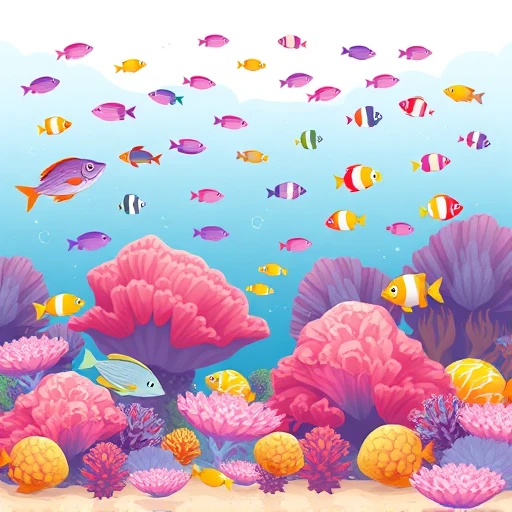
reef 30秒で
- A reef is an underwater ridge of rock, coral, or sand located near the surface of the sea, often supporting diverse marine life.
- Reefs are ecologically vital as they provide habitats for many species and protect coastlines from erosion and storm damage.
- In maritime terms, reefs are significant hazards to navigation because they are shallow and can cause ships to run aground.
- Common types include coral reefs, rocky reefs, and artificial reefs, each serving different biological and environmental purposes.
A reef is a complex and fascinating geological and biological feature found in the world's oceans. At its most basic level, a reef is a ridge or barrier of rock, coral, or sand that sits just beneath or at the surface of the water. While many people immediately think of the vibrant, colorful coral reefs found in tropical waters, the term actually encompasses a much broader range of underwater structures. Geologically, a reef is any solid structure that rises from the sea floor and poses a potential hazard to navigation because it is shallow enough for ships to strike. Biologically, however, reefs are often the most diverse ecosystems on the planet, frequently referred to as the 'rainforests of the sea.' They provide essential habitats for thousands of species of fish, mollusks, crustaceans, and other marine organisms. People use the word 'reef' in various contexts, ranging from scientific discussions about marine biology and environmental conservation to recreational conversations about scuba diving, snorkeling, and surfing. In the maritime world, the word carries a historical weight, often associated with shipwrecks and the dangers of coastal navigation. In modern environmental discourse, 'reef' is frequently mentioned in the context of climate change, specifically regarding coral bleaching and the loss of biodiversity. Understanding a reef requires looking at it both as a physical obstacle and a living, breathing community of organisms that supports the health of the entire ocean.
- Biological Definition
- A living structure created by calcium carbonate-secreting organisms, primarily corals, which build upon the skeletons of their ancestors over thousands of years.
The divers spent hours exploring the vibrant reef, marveling at the sheer variety of life clinging to the coral walls.
- Geological Definition
- A submerged ridge of rock or sand that can be found in both salt and fresh water, often formed by volcanic activity or erosion.
Ancient maritime charts were marked with warnings about the hidden reef that had claimed dozens of merchant vessels.
Beyond the natural world, the term 'reef' is also used in the context of 'artificial reefs.' These are man-made structures, such as sunken ships, old tires, or specifically designed concrete blocks, placed on the ocean floor to encourage marine life to settle and grow. This practice is often used to restore damaged ecosystems or to create new spots for recreational fishing and diving. The word is also used as a verb in sailing, meaning to reduce the area of a sail by folding or rolling part of it, though this is a distinct technical usage. When using the word as a noun, it is important to distinguish between the different types of reefs: fringing reefs (which grow near the coastline), barrier reefs (which are separated from the shore by a lagoon), and atolls (circular reefs surrounding a central lagoon). Each type has its own unique characteristics and ecological importance. In popular culture, reefs are often depicted as magical, colorful underwater kingdoms, as seen in films like 'Finding Nemo.' However, in reality, they are fragile environments that require careful protection. The word 'reef' thus bridges the gap between the beauty of nature and the harsh realities of environmental science and maritime safety.
- Artificial Reef
- A human-made underwater structure, typically built to promote marine life in areas with a generally featureless bottom, to control erosion, block ship passage, block the use of trawling nets, or improve surfing.
The government decided to sink the retired battleship to create an artificial reef for local tourism.
Surfers often flock to the outer reef where the waves break with incredible power and precision.
Climate change and rising sea temperatures are causing widespread bleaching of the coral reef.
Using the word 'reef' effectively involves understanding its grammatical role as a countable noun and its common associations with marine and environmental themes. In most cases, 'reef' refers to a specific physical location or structure. Because it is a countable noun, it requires an article (a, an, the) or can be used in the plural form (reefs). It is frequently paired with adjectives that describe its composition, health, or location. For example, 'coral reef' is the most common compound noun, but you might also hear 'rocky reef,' 'shallow reef,' 'deep-sea reef,' or 'pristine reef.' When writing about reefs, verbs like 'explore,' 'protect,' 'damage,' 'survey,' and 'inhabit' are often used to describe human or animal interaction with these structures. In a scientific or academic context, you might use more technical verbs like 'accrete' (to grow by accumulation) or 'calcify.' In a maritime context, the verb 'strike' or 'hit' is common when discussing ships. The word 'reef' can also function as part of a larger noun phrase, such as 'reef conservation,' 'reef ecology,' or 'reef fish.' When describing the visual aspects of a reef, sensory language is key; writers often use words like 'vibrant,' 'teeming,' 'labyrinthine,' and 'fragile' to convey the atmosphere of the underwater environment. It is also important to note the distinction between the noun 'reef' and the verb 'to reef,' which is used in sailing to describe shortening a sail. While the noun is much more common in everyday English, the verb is essential for nautical terminology. In figurative language, 'reef' is sometimes used to represent a hidden danger or an obstacle that is not immediately visible, though this is less common than its literal usage. To master the use of 'reef,' one should practice incorporating it into sentences that reflect its dual nature as both a beautiful natural wonder and a potential maritime hazard.
- Descriptive Usage
- Using adjectives to provide detail about the reef's appearance or state.
The pristine reef was a kaleidoscope of colors, teeming with life that had never seen a human before.
- Action-Oriented Usage
- Using verbs to describe activities taking place on or around the reef.
Marine biologists are working tirelessly to restore the damaged reef by planting nursery-grown corals.
The captain carefully navigated the vessel through the narrow channel, avoiding the jagged reef on the starboard side.
Many species of shark use the outer reef as a hunting ground during the night.
The documentary highlighted the devastating impact of plastic pollution on the local reef system.
The word 'reef' is a staple in several specific domains, each providing a different nuance to its meaning. One of the most common places you will encounter the word is in nature documentaries and educational programming. Narrators like David Attenborough often speak about the 'wonders of the reef,' focusing on the intricate relationships between the organisms that live there. In these contexts, 'reef' is synonymous with biodiversity and natural beauty. Another frequent setting for the word is in news reports and scientific articles concerning environmental issues. Terms like 'coral bleaching,' 'ocean acidification,' and 'reef degradation' are common in discussions about climate change. Here, the word takes on a more urgent and somber tone, representing a fragile ecosystem under threat. If you are a fan of travel and adventure, you will see 'reef' mentioned constantly in brochures and websites for tropical destinations. Scuba diving and snorkeling tours are often marketed around the opportunity to 'explore the reef.' In the world of surfing, 'reef break' is a technical term used to describe a wave that breaks over a coral reef or rock seabed, as opposed to a 'beach break' where the wave breaks over sand. Surfers often discuss the 'sharpness of the reef' or the 'danger of the reef' when talking about world-class waves like Pipeline in Hawaii or Teahupo'o in Tahiti. In maritime and historical contexts, 'reef' appears in stories of exploration and shipwreck. Nautical charts and lighthouse records are filled with references to reefs that have historically endangered sailors. You might also hear the word in casual conversation among people who live in coastal areas, where 'the reef' might refer to a local fishing spot or a well-known geographical landmark. Finally, in the aquarium hobbyist community, 'reef tank' refers to a specialized type of saltwater aquarium that focuses on keeping live corals and other invertebrates, requiring complex lighting and filtration systems. In all these instances, the word 'reef' serves as a focal point for human interest in the ocean, whether for its beauty, its danger, its scientific value, or its recreational potential.
'Tonight on Blue Planet, we journey to the heart of the Great Barrier Reef to witness the annual coral spawning.'
'The surfer took a heavy fall on the reef, resulting in several deep cuts on his back.'
'Scientists are monitoring the reef for signs of recovery after the recent heatwave.'
'We booked a glass-bottom boat tour to see the reef without getting wet.'
'Maintaining a healthy reef tank requires precise control over water chemistry and lighting.'
While 'reef' is a relatively straightforward word, there are several common mistakes that learners and even native speakers occasionally make. One of the most frequent errors is a spelling or pronunciation confusion with the word 'wreath.' A 'wreath' (pronounced with a 'th' sound) is a circular arrangement of flowers or leaves, often used as a decoration or a memorial. In contrast, 'reef' ends with a sharp 'f' sound. Confusing these two can lead to nonsensical sentences like 'We placed a reef on the grave' or 'The ship hit a wreath.' Another common mistake involves the plural form. Many people assume that because 'leaf' becomes 'leaves' and 'thief' becomes 'thieves,' the plural of 'reef' should be 'reeves.' However, 'reef' follows the standard rule for most words ending in 'f' where you simply add an 's,' making the correct plural 'reefs.' Using 'reeves' is incorrect and can be confusing, as 'reeve' is also an archaic English term for a local official or overseer. There is also a conceptual mistake where people use 'reef' and 'coral' interchangeably. While many reefs are made of coral, not all of them are. A reef can be made of rock, sand, or even sunken man-made objects. Therefore, saying 'the coral' when you mean the entire underwater structure might be technically inaccurate in certain contexts. Additionally, learners sometimes confuse 'reef' with 'shelf' (as in continental shelf) or 'bank' (as in sandbank). While these are all underwater features, a reef is specifically a ridge that is near the surface and often hazardous. A 'shelf' is a much larger, flatter area extending from a continent, and a 'bank' is usually a broader, more gradual elevation of the sea floor. Finally, in the context of sailing, the verb 'to reef' is often misunderstood. It does not mean to sail near a reef, but rather to reduce the size of the sails to handle strong winds. Misusing this term in a nautical setting can lead to significant communication errors. To avoid these mistakes, it is helpful to associate 'reef' with its 'f' sound and its physical nature as a solid, shallow ridge.
- Spelling/Pronunciation Confusion
- Confusing 'reef' /riːf/ with 'wreath' /riːθ/.
Incorrect: The ship was damaged when it struck a wreath. (Should be 'reef')
- Pluralization Error
- Incorrectly using 'reeves' instead of 'reefs'.
Incorrect: Australia is famous for its many beautiful reeves. (Should be 'reefs')
Incorrect: We went snorkeling on the leaf. (A common typo for 'reef')
To enrich your vocabulary, it is useful to understand words that are similar to 'reef' but carry different shades of meaning. The most common alternative is 'coral reef,' which is more specific. However, if you are talking about underwater structures in general, you might use words like 'shoal,' 'bank,' 'bar,' or 'atoll.' A 'shoal' is a natural submerged ridge, bank, or bar that consists of, or is covered by, sand or other unconsolidated material, and rises from the bed of a body of water to near the surface. Unlike a reef, which is usually solid (rock or coral), a shoal is often made of loose material. A 'bank' is a larger area of elevated sea floor, often found in the open ocean, like the Grand Banks of Newfoundland. A 'bar' (or sandbar) is a long, narrow ridge of sand or silt built up by the action of waves and currents, typically found at the mouth of a river or along a coastline. An 'atoll' is a specific type of reef: a ring-shaped coral reef, island, or series of islets which surrounds a body of water called a lagoon. In a more general sense, you might use 'underwater ridge' or 'submerged rocks.' When discussing the biological aspect, you might refer to a 'marine ecosystem' or a 'coral colony.' In maritime navigation, a reef might be called a 'hazard' or an 'obstruction.' Understanding these distinctions allows you to be more precise in your descriptions. For instance, a surfer might prefer a 'reef break' for its consistency, while a fisherman might look for a 'shoal' where certain types of fish congregate. A scientist studying the formation of islands would specifically use the word 'atoll.' By choosing the right word, you can convey more information about the composition, shape, and location of the underwater feature you are describing.
- Reef vs. Shoal
- A reef is typically solid (rock/coral), while a shoal is usually made of loose material like sand or gravel.
- Reef vs. Atoll
- A reef is a general term for the structure; an atoll is a specific ring-shaped reef surrounding a lagoon.
- Reef vs. Sandbar
- A sandbar is temporary and shifting, whereas a reef is a more permanent geological or biological fixture.
While the reef provided a stable home for the anemones, the nearby shoal was constantly reshaped by the tides.
How Formal Is It?
豆知識
The sailing term 'to reef' and the geographical term 'reef' share the same origin because they both relate to the idea of a 'rib' or a fold.
発音ガイド
- Pronouncing it like 'wreath' /riːθ/ with a 'th' sound.
- Pronouncing it like 'leaf' /liːf/ if the 'r' is not clear.
- Adding an extra syllable like 'ree-fu'.
- Using a short 'i' sound like 'rif'.
- Confusing the plural 'reefs' with 'reeves'.
難易度
The word itself is easy, but it often appears in complex scientific or environmental texts.
Simple to use, but remember the plural 'reefs' and the 'f' ending.
Easy to pronounce, just avoid the 'th' sound of 'wreath'.
Clear sound, but context is needed to distinguish from 'wreath' or 'leaf'.
次に学ぶべきこと
前提知識
次に学ぶ
上級
知っておくべき文法
Plural of nouns ending in -f
Reef -> Reefs (Note: Unlike leaf -> leaves)
Compound Nouns
Coral reef, barrier reef (Noun + Noun)
Prepositions of Place
On the reef, in the reef, over the reef
Articles with Proper Nouns
The Great Barrier Reef (Always use 'The')
Adjective Order
A beautiful, colorful coral reef (Opinion, Color, Material)
レベル別の例文
The fish lives in the reef.
Le poisson vit dans le récif.
Use 'the' before 'reef' to talk about a specific one.
I see a big reef.
Je vois un grand récif.
'A' is used before 'big' because it starts with a consonant.
The reef has many colors.
Le récif a beaucoup de couleurs.
'Has' is the third person singular of 'to have'.
We like the reef.
Nous aimons le récif.
Simple subject-verb-object structure.
The water is blue over the reef.
L'eau est bleue au-dessus du récif.
'Over' is a preposition of place.
Is the reef beautiful?
Le récif est-il beau ?
Question form using the verb 'to be'.
There are many reefs in the sea.
Il y a beaucoup de récifs dans la mer.
Plural form 'reefs'.
Look at the reef!
Regarde le récif !
Imperative form for giving a command or suggestion.
The boat hit a hidden reef.
Le bateau a heurté un récif caché.
'Hidden' is an adjective describing the reef.
We went snorkeling on the coral reef.
Nous avons fait du snorkeling sur le récif de corail.
'On' is the preposition used for being above the reef.
The reef is home to many sharks.
Le récif abrite de nombreux requins.
'Home to' is a common phrase meaning 'a place where something lives'.
You can see the reef from the plane.
On peut voir le récif depuis l'avion.
'Can' expresses possibility.
The reef protects the beach from big waves.
Le récif protège la plage des grosses vagues.
Present simple for a general fact.
Don't touch the coral on the reef.
Ne touchez pas au corail sur le récif.
Negative imperative.
The Great Barrier Reef is very famous.
La Grande Barrière de Corail est très célèbre.
Proper noun capitalization.
They are studying the health of the reef.
Ils étudient la santé du récif.
Present continuous for an ongoing action.
The reef acts as a natural barrier against storms.
Le récif agit comme une barrière naturelle contre les tempêtes.
'Acts as' means 'functions as'.
Many species of fish rely on the reef for survival.
De nombreuses espèces de poissons dépendent du récif pour leur survie.
'Rely on' is a phrasal verb meaning 'depend on'.
Pollution is a major threat to the local reef.
La pollution est une menace majeure pour le récif local.
'Threat to' is the standard prepositional pairing.
The divers explored the deep parts of the reef.
Les plongeurs ont exploré les parties profondes du récif.
Past simple for a completed action.
The reef was formed over thousands of years.
Le récif s'est formé sur des milliers d'années.
Passive voice 'was formed'.
If we don't protect the reef, it will disappear.
Si nous ne protégeons pas le récif, il disparaîtra.
First conditional (if + present simple, will + verb).
The reef is teeming with life during the day.
Le récif fourmille de vie pendant la journée.
'Teeming with' means 'full of'.
The tour guide explained the history of the reef.
Le guide touristique a expliqué l'histoire du récif.
Reporting an action in the past.
Rising sea temperatures are causing the reef to bleach.
La hausse des températures de la mer provoque le blanchissement du récif.
'Cause something to do something' structure.
The reef ecosystem is incredibly fragile and easily disrupted.
L'écosystème du récif est incroyablement fragile et facilement perturbé.
Adverbs 'incredibly' and 'easily' modifying adjectives.
Artificial reefs are being created to support marine biodiversity.
Des récifs artificiels sont créés pour soutenir la biodiversité marine.
Present continuous passive.
The ship's captain was blamed for hitting the well-marked reef.
Le capitaine du navire a été blâmé pour avoir heurté le récif bien balisé.
'Blamed for' followed by a gerund (-ing).
Surfers prefer the reef break because it produces consistent waves.
Les surfeurs préfèrent le reef break car il produit des vagues régulières.
Compound noun 'reef break'.
The reef provides significant economic benefits through tourism.
Le récif offre des avantages économiques importants grâce au tourisme.
'Through' used to show the means or method.
Researchers are monitoring the reef's recovery after the storm.
Les chercheurs surveillent le rétablissement du récif après la tempête.
Possessive 'reef's'.
The reef's structure is primarily composed of calcium carbonate.
La structure du récif est principalement composée de carbonate de calcium.
'Composed of' is a formal way to say 'made of'.
The intricate symbiosis within the reef is a marvel of nature.
La symbiose complexe au sein du récif est une merveille de la nature.
'Within' emphasizes the internal relationships.
Ocean acidification poses an existential threat to coral reefs globally.
L'acidification des océans représente une menace existentielle pour les récifs coralliens à l'échelle mondiale.
'Poses a threat' is a formal collocation.
The reef serves as a critical nursery for numerous pelagic species.
Le récif sert de nurserie critique pour de nombreuses espèces pélagiques.
'Serves as' is more formal than 'is'.
Legislative measures are required to mitigate the damage to the reef.
Des mesures législatives sont nécessaires pour atténuer les dommages causés au récif.
'Mitigate' is a high-level verb for 'reduce'.
The reef's degradation has profound implications for coastal communities.
La dégradation du récif a des implications profondes pour les communautés côtières.
'Profound implications' is an academic phrase.
The atoll is a unique type of reef that forms around a lagoon.
L'atoll est un type unique de récif qui se forme autour d'un lagon.
Relative clause 'that forms around a lagoon'.
The sheer scale of the reef system is difficult to comprehend.
L'ampleur même du système récifal est difficile à comprendre.
'Sheer' used to emphasize size.
The reef's resilience is being tested by unprecedented heatwaves.
La résilience du récif est mise à l'épreuve par des vagues de chaleur sans précédent.
Passive voice with 'being tested'.
The reef's architectural complexity facilitates a high degree of niche partitioning.
La complexité architecturale du récif facilite un degré élevé de partitionnement des niches.
Highly technical biological terminology.
Anthropogenic stressors are fundamentally altering the reef's composition.
Les agents de stress anthropiques modifient fondamentalement la composition du récif.
'Anthropogenic' is a C2-level academic term.
The fossilized reef provides a chronological record of sea-level fluctuations.
Le récif fossilisé fournit un enregistrement chronologique des fluctuations du niveau de la mer.
'Chronological record' is a precise academic phrase.
The reef acts as a carbon sink, sequestering atmospheric CO2 over geological timescales.
Le récif agit comme un puits de carbone, séquestrant le CO2 atmosphérique sur des échelles de temps géologiques.
'Sequestering' and 'geological timescales' are advanced terms.
The reef's demise would precipitate a catastrophic collapse of the local food web.
La disparition du récif précipiterait un effondrement catastrophique de la chaîne alimentaire locale.
'Precipitate' used as a verb meaning 'cause to happen suddenly'.
Effective reef management necessitates a multi-disciplinary approach.
Une gestion efficace des récifs nécessite une approche multidisciplinaire.
'Necessitates' is a formal alternative to 'requires'.
The reef is a palimpsest of biological activity spanning millennia.
Le récif est un palimpseste d'activité biologique s'étendant sur des millénaires.
'Palimpsest' is a sophisticated literary metaphor.
The reef's vibrant hues are a byproduct of the symbiotic zooxanthellae.
Les teintes vibrantes du récif sont un sous-produit des zooxanthelles symbiotiques.
Specific biological terminology ('zooxanthellae').
よく使う組み合わせ
よく使うフレーズ
— To go snorkeling or diving to see the underwater life.
We plan to explore the reef during our trip to Belize.
— To take actions to prevent damage to the reef ecosystem.
New laws were passed to protect the reef from overfishing.
— Sunscreen that does not contain chemicals harmful to coral.
Always use reef-safe sunscreen when swimming in the ocean.
— A phrase often used to describe the high biodiversity of a reef.
The reef was teeming with life, from tiny shrimp to large rays.
— Located at or above the reef structure.
The waves were breaking perfectly on the reef.
— Away from the reef, usually in deeper water.
The boat dropped anchor just off the reef.
— The overall condition and vitality of a reef ecosystem.
Scientists are concerned about the declining reef health.
— A collection of connected reefs in a specific area.
The Mesoamerican Reef is the second largest reef system in the world.
— The process of repairing a damaged reef.
Reef restoration projects often involve transplanting coral.
— The shallow, horizontal part of a reef that is often exposed at low tide.
We walked across the reef flat to reach the deeper water.
よく混同される語
A wreath is a circle of flowers; a reef is an underwater rock.
A leaf is part of a plant; a reef is in the ocean.
A reeve is an old word for an official; reefs are underwater structures.
慣用句と表現
— Literally, to reduce sail area; figuratively, to be more cautious or reduce one's ambitions.
With the economy slowing down, the company had to reef its sails and cut spending.
nautical/figurative— A danger or obstacle that is not immediately apparent.
The new contract had several hidden reefs that only the lawyers noticed.
figurative— To fail or be stopped by a significant obstacle.
The negotiations ran aground on the reef of budget disagreements.
figurative— A large number of difficulties.
The project faced a reef of problems from the very beginning.
informal— Extremely sharp or dangerous (often used for rocks or coral).
Be careful, the rocks here are as sharp as a reef.
descriptive— A variation of 'between a rock and a hard place'; having two difficult choices.
He was stuck between the reef and the deep blue sea, with no easy way out.
literary— A barrier of silence or lack of communication.
Her questions were met with a reef of silence from the board.
poetic— To encounter a sudden, major problem.
The startup's plans struck a reef when their main investor pulled out.
figurative— Surrounded or restricted by reefs; figuratively, trapped by obstacles.
The island was reef-bound, making it difficult for large ships to dock.
nautical— To successfully navigate a dangerous situation.
The team managed to weather the reef of the first quarter and stay profitable.
figurative間違えやすい
Both are shallow underwater areas.
A reef is usually solid (rock/coral), while a shoal is often loose sand or gravel. Reefs are generally more permanent.
The reef was made of coral, but the shoal was just a pile of sand.
Both refer to elevated parts of the sea floor.
A bank is usually a much larger, broader area, often in deeper water. A reef is a narrower ridge near the surface.
The Grand Banks are huge, but this reef is just a small ridge.
An atoll is a type of reef.
A reef is the general term for the structure. An atoll is specifically a ring-shaped reef that surrounds a lagoon.
All atolls are reefs, but not all reefs are atolls.
Both are underwater ridges.
A bar (or sandbar) is usually made of sand and is often temporary or shifting. A reef is solid and more permanent.
The sandbar shifted after the storm, but the rocky reef stayed the same.
Both are underwater features.
A continental shelf is a massive, flat area extending from a continent. A reef is a specific ridge or barrier.
The reef sits on the edge of the continental shelf.
文型パターン
The [noun] is [adjective].
The reef is pretty.
There is a [noun] in the [noun].
There is a reef in the sea.
The [noun] acts as a [noun].
The reef acts as a barrier.
[Gerund] is [adjective] to the [noun].
Polluting is harmful to the reef.
The [noun] of the [noun] has [adjective] [noun].
The degradation of the reef has serious consequences.
The [noun] necessitates a [adjective] [noun].
Reef management necessitates a holistic approach.
We [verb] the [noun] to [verb].
We explored the reef to see fish.
Despite the [noun], the [noun] [verb].
Despite the storm, the reef remained intact.
語族
名詞
動詞
形容詞
関連
使い方
Common in environmental, travel, and maritime contexts.
-
Using 'reeves' as the plural.
→
reefs
The word 'reef' follows the standard 's' pluralization rule, unlike 'leaf' or 'thief'.
-
Confusing 'reef' with 'wreath'.
→
reef
A wreath is a decoration; a reef is an underwater structure. They sound similar but are very different.
-
Saying 'the coral' when referring to the whole structure.
→
the reef
Coral is the animal/material; the reef is the entire structure which may include rock and sand.
-
Misspelling as 'ref'.
→
reef
'Ref' is short for referee. 'Reef' needs the double 'e' for the long vowel sound.
-
Using 'reef' to mean any shallow water.
→
shoal or shallows
A reef specifically refers to a ridge or barrier, not just any shallow area.
ヒント
Learn the Types
To sound more advanced, learn the three main types of reefs: fringing, barrier, and atoll. This shows a deeper understanding of the subject.
Plural Rule
Remember that 'reefs' is the only correct plural. Don't let other words like 'leaves' or 'thieves' confuse you into saying 'reeves'.
The 'F' Sound
Make sure the 'f' at the end of 'reef' is clear and sharp. This helps distinguish it from 'wreath' which has a soft 'th' sound.
Environmental Awareness
When using 'reef' in an essay, try to connect it to broader themes like biodiversity or climate change for more impact.
Double 'E'
Don't forget the double 'e'. Spelling it as 'ref' would change the word entirely (short for referee).
Sailing Context
If you are reading a book about sailing, remember that 'reefing the sails' has nothing to do with hitting rocks!
Maritime Hazard
In historical contexts, 'reef' almost always implies danger. Use it when talking about shipwrecks or difficult journeys.
Use Color Words
When writing about reefs, pair the word with color adjectives like 'vibrant', 'azure', or 'kaleidoscopic' to create a better image.
Biogenic vs Geogenic
For academic writing, use 'biogenic reef' for coral reefs and 'geogenic reef' for those made of rock.
Reef-Safe
The term 'reef-safe' is becoming very common in travel and beauty industries. It's a great compound adjective to know.
暗記しよう
記憶術
Think of a 'Reef' as a 'Relief' for fish. It's where they go to find a home and stay safe.
視覚的連想
Imagine a bright, colorful underwater wall made of coral, with a ship carefully sailing around it to avoid hitting the sharp edges.
Word Web
チャレンジ
Try to write three sentences about a reef: one about its beauty, one about its danger to ships, and one about why we should protect it.
語源
The word 'reef' comes from the Middle Dutch word 'rif', which means 'rib' or 'reef'. It entered English in the 14th century. The connection to 'rib' likely comes from the appearance of a reef as a series of ridges or 'ribs' sticking up from the sea floor.
元の意味: A ridge of rock or sand in the sea.
Germanic文化的な背景
When discussing reefs, be mindful of the environmental crisis they face; for many, it is a sad and urgent topic.
The Great Barrier Reef is a major point of pride and environmental concern in Australia and the wider English-speaking world.
実生活で練習する
実際の使用場面
Environmental Science
- coral bleaching
- reef restoration
- marine biodiversity
- ecosystem health
Travel and Tourism
- snorkeling tour
- scuba diving
- glass-bottom boat
- explore the reef
Maritime Navigation
- hazard to navigation
- strike a reef
- nautical chart
- hidden danger
Surfing
- reef break
- sharp coral
- shallow water
- consistent waves
Biology
- reef fish
- coral polyps
- symbiotic relationship
- habitat loss
会話のきっかけ
"Have you ever been snorkeling or diving on a coral reef?"
"What do you think is the biggest threat to reefs today?"
"Would you like to visit the Great Barrier Reef one day?"
"Do you think artificial reefs are a good way to help the ocean?"
"What kind of animals would you expect to see on a tropical reef?"
日記のテーマ
Describe what you think it would feel like to swim through a vibrant, colorful reef for the first time.
Write about the importance of protecting our oceans, specifically focusing on the role of reefs.
Imagine you are a sailor in the 1700s who has just spotted a dangerous reef. Describe the scene.
If you could create an artificial reef, what would you use to build it and why?
Reflect on how the health of the reef is a reflection of the health of our entire planet.
よくある質問
10 問No, not all reefs are made of coral. While coral reefs are the most famous, reefs can also be made of rock, sand, or even man-made materials like sunken ships (artificial reefs). A reef is defined by its physical structure and location near the water's surface, not just its biological makeup.
The main difference is the material. A reef is typically a solid, stable structure made of rock or coral. A shoal is usually a shallow area made of loose material like sand, silt, or gravel that can be shifted by currents and tides. Both are hazards to ships, but reefs are more permanent.
Reefs are incredibly important because they support a huge variety of marine life, providing food and shelter for about 25% of all ocean species. They also act as natural barriers that protect coastlines from erosion and damage caused by large waves and storms. Additionally, they are important for local economies through fishing and tourism.
While some parts of a reef (called the reef flat) may be exposed at low tide, walking on a reef is generally discouraged. Coral is very fragile and can be easily killed by being stepped on. Furthermore, reefs can be very sharp and may be home to dangerous animals like stonefish or sea urchins, making it unsafe for humans.
Coral bleaching happens when the water gets too warm, causing the coral to get stressed and expel the tiny algae (zooxanthellae) that live in its tissues and give it color. This leaves the coral looking white or 'bleached.' If the water stays too warm for too long, the coral can die, which destroys the reef ecosystem.
An artificial reef is a man-made structure placed on the ocean floor to mimic the functions of a natural reef. They are often made from sunken ships, old concrete, or specially designed structures. They are used to create new habitats for fish, promote biodiversity, and sometimes to improve surfing conditions or prevent coastal erosion.
The largest reef in the world is the Great Barrier Reef, located off the coast of Queensland, Australia. It is so large that it can be seen from space and is made up of over 2,900 individual reefs and 900 islands, stretching for over 2,300 kilometers (1,400 miles).
Coral reefs form when free-swimming coral larvae attach to submerged rocks or other hard surfaces along the edges of islands or continents. As the corals grow and expand, they deposit calcium carbonate, which forms a hard skeleton. Over thousands of years, these skeletons build up to create the massive structures we call reefs.
Yes, in sailing, 'reef' is a verb that means to reduce the area of a sail by folding or rolling part of it. This is done to make the boat easier to handle in strong winds. While this is a very different meaning from the underwater structure, both words share a common linguistic history related to the idea of a 'rib' or 'fold'.
You can help protect reefs by reducing your carbon footprint to fight climate change, using reef-safe sunscreen when swimming, never touching or stepping on coral, and supporting organizations that work on reef conservation. Also, being careful about the seafood you eat and avoiding plastic waste can help keep the oceans healthy for reefs.
自分をテスト 200 問
Describe a coral reef using at least three adjectives.
Well written! Good try! Check the sample answer below.
Explain why reefs are important for coastal protection.
Well written! Good try! Check the sample answer below.
Write a short story about a ship that encounters a hidden reef.
Well written! Good try! Check the sample answer below.
Discuss the impact of climate change on reef ecosystems.
Well written! Good try! Check the sample answer below.
Compare and contrast a natural reef with an artificial reef.
Well written! Good try! Check the sample answer below.
What are the benefits of reef-safe sunscreen?
Well written! Good try! Check the sample answer below.
Describe the different types of reefs (fringing, barrier, atoll).
Well written! Good try! Check the sample answer below.
Write a persuasive paragraph about why we should fund reef restoration.
Well written! Good try! Check the sample answer below.
How does ocean acidification affect coral calcification?
Well written! Good try! Check the sample answer below.
Imagine you are a marine biologist. Write a diary entry about a day on the reef.
Well written! Good try! Check the sample answer below.
Write a travel brochure for a destination famous for its reefs.
Well written! Good try! Check the sample answer below.
Explain the metaphor of a 'hidden reef' in a business context.
Well written! Good try! Check the sample answer below.
What can individuals do to help protect the Great Barrier Reef?
Well written! Good try! Check the sample answer below.
Describe the relationship between coral and zooxanthellae.
Well written! Good try! Check the sample answer below.
Write a poem about the colors of a tropical reef.
Well written! Good try! Check the sample answer below.
Discuss the ethical considerations of building artificial reefs.
Well written! Good try! Check the sample answer below.
How do reefs contribute to global biodiversity?
Well written! Good try! Check the sample answer below.
Write a news report about a major coral bleaching event.
Well written! Good try! Check the sample answer below.
Explain the sailing term 'to reef a sail' and why it is used.
Well written! Good try! Check the sample answer below.
What is the cultural significance of reefs to indigenous people?
Well written! Good try! Check the sample answer below.
Describe a reef to a friend who has never seen one.
Read this aloud:
あなたの回答:
Speech recognition is not supported in your browser. Try Chrome or Edge.
Talk about why we should protect the ocean's reefs.
Read this aloud:
あなたの回答:
Speech recognition is not supported in your browser. Try Chrome or Edge.
Explain the difference between a reef and a beach.
Read this aloud:
あなたの回答:
Speech recognition is not supported in your browser. Try Chrome or Edge.
Discuss your favorite sea animal that lives in a reef.
Read this aloud:
あなたの回答:
Speech recognition is not supported in your browser. Try Chrome or Edge.
Tell a story about a diving adventure on a reef.
Read this aloud:
あなたの回答:
Speech recognition is not supported in your browser. Try Chrome or Edge.
Explain the concept of coral bleaching in simple terms.
Read this aloud:
あなたの回答:
Speech recognition is not supported in your browser. Try Chrome or Edge.
Talk about the Great Barrier Reef and its importance.
Read this aloud:
あなたの回答:
Speech recognition is not supported in your browser. Try Chrome or Edge.
Discuss the pros and cons of artificial reefs.
Read this aloud:
あなたの回答:
Speech recognition is not supported in your browser. Try Chrome or Edge.
Explain why sailors are afraid of reefs.
Read this aloud:
あなたの回答:
Speech recognition is not supported in your browser. Try Chrome or Edge.
Talk about the importance of reef-safe products.
Read this aloud:
あなたの回答:
Speech recognition is not supported in your browser. Try Chrome or Edge.
Describe the colors and life you might see on a reef.
Read this aloud:
あなたの回答:
Speech recognition is not supported in your browser. Try Chrome or Edge.
Discuss how climate change is affecting the ocean.
Read this aloud:
あなたの回答:
Speech recognition is not supported in your browser. Try Chrome or Edge.
Explain the sailing term 'to reef' to a beginner.
Read this aloud:
あなたの回答:
Speech recognition is not supported in your browser. Try Chrome or Edge.
Talk about a documentary you saw about the ocean.
Read this aloud:
あなたの回答:
Speech recognition is not supported in your browser. Try Chrome or Edge.
Discuss the economic value of reefs for tourism.
Read this aloud:
あなたの回答:
Speech recognition is not supported in your browser. Try Chrome or Edge.
Explain the role of reefs in protecting the coast.
Read this aloud:
あなたの回答:
Speech recognition is not supported in your browser. Try Chrome or Edge.
Talk about the beauty of an atoll.
Read this aloud:
あなたの回答:
Speech recognition is not supported in your browser. Try Chrome or Edge.
Discuss the challenges of reef conservation.
Read this aloud:
あなたの回答:
Speech recognition is not supported in your browser. Try Chrome or Edge.
Explain the symbiosis in a reef ecosystem.
Read this aloud:
あなたの回答:
Speech recognition is not supported in your browser. Try Chrome or Edge.
Talk about the future of reefs in the next 50 years.
Read this aloud:
あなたの回答:
Speech recognition is not supported in your browser. Try Chrome or Edge.
Listen and identify: Which word is used to describe the line of coral? (Audio: The boat sailed past the reef.)
Listen and identify: What happened to the ship? (Audio: The ship struck a hidden reef.)
Listen and identify: What is the speaker protecting? (Audio: We must protect the coral reef.)
Listen and identify: What is the plural form used? (Audio: There are many reefs in this area.)
Listen and identify: What is the technical term used? (Audio: The atoll was beautiful.)
Listen and identify: What is the environmental issue? (Audio: Coral bleaching is a major concern.)
Listen and identify: What type of reef is mentioned? (Audio: It was a fringing reef.)
Listen and identify: What is the sailing action? (Audio: The crew had to reef the sails.)
Listen and identify: What is the compound adjective? (Audio: Use reef-safe sunscreen.)
Listen and identify: What is the metaphor? (Audio: The plan hit a hidden reef.)
Listen and identify: What is the biological term? (Audio: Zooxanthellae are essential for coral.)
Listen and identify: What is the geological term? (Audio: The reef is made of calcium carbonate.)
Listen and identify: What is the surfing term? (Audio: That was a perfect reef break.)
Listen and identify: What is the location? (Audio: We are at the Great Barrier Reef.)
Listen and identify: What is the descriptive phrase? (Audio: The reef is teeming with life.)
/ 200 correct
Perfect score!
Summary
A reef is a shallow underwater structure made of rock or coral that acts as both a vibrant biological habitat and a potential maritime hazard. For example: 'The Great Barrier Reef is a massive ecosystem that protects the Australian coast.'
- A reef is an underwater ridge of rock, coral, or sand located near the surface of the sea, often supporting diverse marine life.
- Reefs are ecologically vital as they provide habitats for many species and protect coastlines from erosion and storm damage.
- In maritime terms, reefs are significant hazards to navigation because they are shallow and can cause ships to run aground.
- Common types include coral reefs, rocky reefs, and artificial reefs, each serving different biological and environmental purposes.
Learn the Types
To sound more advanced, learn the three main types of reefs: fringing, barrier, and atoll. This shows a deeper understanding of the subject.
Plural Rule
Remember that 'reefs' is the only correct plural. Don't let other words like 'leaves' or 'thieves' confuse you into saying 'reeves'.
The 'F' Sound
Make sure the 'f' at the end of 'reef' is clear and sharp. This helps distinguish it from 'wreath' which has a soft 'th' sound.
Environmental Awareness
When using 'reef' in an essay, try to connect it to broader themes like biodiversity or climate change for more impact.