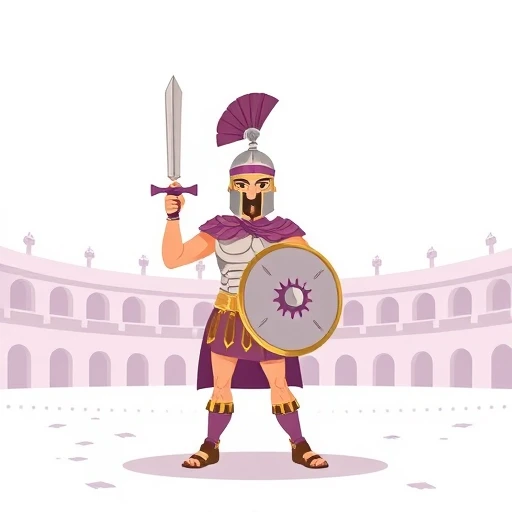
spartacus 30秒で
- Spartacus was a Thracian gladiator who led the Third Servile War, the most famous slave revolt in the history of the ancient Roman Republic.
- His leadership and tactical skill allowed a diverse group of escaped slaves to defeat multiple Roman legions, posing a significant threat to Rome.
- The rebellion was eventually crushed by the Roman generals Crassus and Pompey, but Spartacus's legacy as a symbol of freedom has endured for millennia.
- In modern culture, the name is used metaphorically to represent the underdog, collective solidarity, and the universal struggle against systemic oppression and injustice.
The term Spartacus primarily refers to the historical figure who became the most famous leader of a slave rebellion in the Roman Republic. In modern English usage, the name has transcended its historical roots to become a powerful archetype for the 'underdog' or the 'liberator' who stands up against an overwhelming and oppressive system. When people use the name Spartacus today, they are often invoking the spirit of resistance, collective solidarity, and the fight for human dignity against institutionalized cruelty. It is a name that carries the weight of history, representing the struggle of the disenfranchised against the powerful elite of ancient Rome, specifically during the Third Servile War. This historical event was not merely a small riot but a significant military challenge that forced the Roman Senate to deploy its most capable generals, including Crassus and Pompey. The name is used in academic settings to discuss Roman social structures, in political discourse to symbolize revolution, and in popular culture to celebrate the heroic individual who inspires others to seek freedom.
- Historical Identity
- Spartacus was a Thracian who served in the Roman army before being sold into slavery as a gladiator. His background as a trained soldier provided him with the tactical knowledge necessary to lead a successful insurgency.
The historian explained that Spartacus managed to unite thousands of disparate slaves into a cohesive fighting force that defeated several Roman legions.
Beyond the history books, the name is frequently used as a metaphor for leadership in the face of certain defeat. It appears in literature and film as a shorthand for the ultimate rebel. The famous phrase 'I am Spartacus' has become a cultural touchstone, used to demonstrate solidarity where a group of people take collective responsibility to protect an individual. This usage is common in social movements and team-building contexts where the emphasis is on unity over individualism. In a broader sense, the name is used to describe any movement that seeks to break the chains of servitude, whether those chains are literal, economic, or psychological. The legacy of Spartacus is one of hope for the oppressed and a warning to the oppressors that the desire for liberty is an inextinguishable human trait.
- Symbolic Usage
- In political theory, Spartacus is often cited as a proto-revolutionary figure, representing the first major organized labor strike or class struggle in Western history.
During the protest, the speaker invoked the name of Spartacus to remind the workers of their collective power against the corporation.
The name also appears in various professional domains. In sports, a team might be described as having a 'Spartacus spirit' if they are fighting against the odds. In technology, 'Spartacus' has been used as a codename for projects that aim to disrupt established markets or liberate data from proprietary silos. The name's versatility stems from its clear association with the transition from bondage to agency. It is a name that resonates across languages and cultures, often being translated or adapted into local legends of resistance. Understanding the name requires an appreciation for both the brutal reality of the Roman arena and the idealistic aspirations of the Enlightenment thinkers who rediscovered his story centuries later.
- Cinematic Influence
- The 1960 film directed by Stanley Kubrick solidified the modern visual image of the hero, emphasizing the themes of brotherhood and sacrifice that define the name today.
Many people only know Spartacus through the lens of Hollywood, which often romanticizes his tactical brilliance and tragic end.
The professor noted that the real Spartacus likely never intended to overthrow the entire Roman state, but simply to lead his followers to safety.
In the novel, the protagonist is compared to Spartacus because of his refusal to accept the unjust laws of his society.
Using the name Spartacus in a sentence requires an understanding of whether you are referring to the historical individual or using the name as a symbolic reference. When referring to the historical figure, the name functions as a proper noun and is usually the subject of sentences describing the Third Servile War. For example, 'Spartacus led his army toward the Alps in an attempt to escape Italy.' In this context, the name is associated with military verbs like 'led,' 'commanded,' 'rebelled,' and 'defeated.' It is important to capitalize the name as it is a specific person's name. When using it symbolically, the name often appears in comparisons or metaphors, frequently preceded by the indefinite article 'a' to indicate a type of person. For instance, 'Every generation needs a Spartacus to challenge the status quo.' Here, the name represents the qualities of courage and leadership in the face of oppression.
- Historical Subject
- Spartacus was eventually cornered by the Roman legions under the command of Marcus Licinius Crassus in Lucania.
The documentary detailed how Spartacus escaped from the gladiatorial school in Capua with only a few dozen followers.
In academic writing, the name is often used in the possessive form to describe the movement he led. Phrases like 'Spartacus's rebellion' or 'the Spartacus revolt' are standard. Note that the possessive can be written as Spartacus' or Spartacus's depending on the style guide being followed, though 'Spartacus's' is often preferred for clarity in modern American English. In more casual or rhetorical contexts, the name is used to evoke a sense of shared identity. The famous line 'I am Spartacus' is a classic example of using the name to express solidarity. In a sentence, you might say, 'When the manager tried to blame one employee, the whole team stood up in a Spartacus-like display of unity.' This adjectival use (Spartacus-like) is a common way to describe actions that mirror the historical rebellion's themes of collective protection and defiance.
- Metaphorical Application
- The whistleblower was hailed as a modern Spartacus for exposing the corruption within the multi-national corporation.
He didn't just want to be a leader; he wanted to be a Spartacus for the digital age, freeing information from corporate control.
Furthermore, the name can be used in the plural to refer to a group of rebels or those inspired by his example. 'The world is full of little Spartacuses waiting for their moment to rise.' This usage treats the name as a common noun representing a category of people. In literature, the name is often paired with words like 'myth,' 'legend,' 'legacy,' and 'uprising.' For example, 'The legacy of Spartacus continues to inspire novelists and filmmakers alike.' When constructing sentences, consider the emotional resonance you wish to achieve. Using the name suggests a high-stakes struggle and a noble cause. It is rarely used for trivial matters. If you are describing a simple disagreement, the name might sound overly dramatic. However, if you are describing a life-altering fight for justice, it is perfectly appropriate.
- Possessive Forms
- The primary sources for Spartacus's life are primarily Roman historians who may have been biased against him.
We must remember the lesson of Spartacus: that even the most powerful empire can be shaken by those it seeks to enslave.
The play depicts Spartacus not as a simple warrior, but as a philosopher of freedom.
Is there a Spartacus among us who is willing to speak the truth to power?
You are most likely to encounter the word Spartacus in educational, cultural, and political contexts. In a history classroom, the name is central to discussions about the Roman Republic's internal crises and the nature of ancient slavery. Teachers use his story to illustrate the social tensions that eventually led to the fall of the Republic. In this setting, you will hear it alongside terms like 'gladiator,' 'servile war,' 'legion,' and 'crucifixion.' It is a staple of the Latin and Ancient History curricula. Beyond the classroom, the name is a fixture in the world of cinema and television. The 1960 film starring Kirk Douglas is a classic that is frequently referenced in film studies and pop culture trivia. More recently, the Starz television series 'Spartacus: Blood and Sand' brought the name back into the public consciousness, focusing on the visceral and violent reality of the gladiatorial games.
- Political Rhetoric
- Politicians often use the name to frame themselves as champions of the common people against a 'corrupt' or 'out-of-touch' establishment.
In his speech, the senator referred to the grassroots movement as a 'modern-day Spartacus moment' for the working class.
In the realm of politics and social activism, the name is used as a powerful rhetorical device. It is often invoked during strikes, protests, and movements for civil rights. Activists might refer to a 'Spartacus moment' when a group of people collectively decides to resist an unjust order. This was notably seen in recent years in the United States during judicial confirmation hearings, where a senator's self-description as 'Spartacus' became a viral meme, illustrating how the name is embedded in the modern political lexicon. You will also hear the name in discussions about labor rights and the history of socialism. Figures like Karl Marx and Rosa Luxemburg admired Spartacus, and the 'Spartacus League' (Spartakusbund) was a famous revolutionary movement in early 20th-century Germany. This historical connection ensures that the name remains relevant in leftist political thought.
- Sports and Competition
- The name is frequently used for sports teams, fitness programs, and endurance races to evoke the strength and resilience of a gladiator.
The coach told the players they needed to show the heart of Spartacus if they wanted to come back from a twenty-point deficit.
In addition to these serious contexts, you will find the name in the names of businesses, software, and even astronomical objects. There are gyms named Spartacus, project management tools, and even a minor planet. In these cases, the name is chosen for its associations with strength, leadership, and breaking through barriers. In literature, authors often use the name as an allusion to signal a character's rebellious nature or their role as a liberator. If you are reading a novel about a dystopian future, keep an eye out for characters who are compared to Spartacus. Finally, the name is a common answer in crossword puzzles and trivia games, usually clued as 'Famous gladiator' or 'Leader of a slave revolt.' Its presence in general knowledge quizzes confirms its status as one of the most recognizable names from antiquity.
- Academic Discourse
- In sociology, the 'Spartacus effect' is sometimes used to describe the phenomenon of a group adopting a single identity to protect its members.
The professor's lecture on Roman social hierarchy focused heavily on the impact of Spartacus on the Roman psyche.
I saw a documentary on the History Channel that questioned whether Spartacus actually died on the battlefield.
The local gym is running a 'Spartacus Challenge' to see who can perform the most burpees in five minutes.
One of the most frequent mistakes people make regarding Spartacus is confusing the historical reality with the Hollywood dramatization. While the 1960 film is a masterpiece, it takes significant liberties with the facts. For example, the famous 'I am Spartacus' scene never actually happened; historical accounts suggest that Spartacus likely died in battle and his body was never identified, rather than being captured and crucified with his men. Another common error is misidentifying his origin. Many people assume he was Roman because he fought in Rome, but he was actually a Thracian, a region in the Balkans. This distinction is important because his status as a 'foreigner' or 'barbarian' in the eyes of Rome played a role in how he was treated and how his rebellion was perceived by the Roman elite. Misunderstanding his motivations is also common; he wasn't necessarily a social reformer seeking to end slavery as an institution, but rather a man trying to lead his people to freedom outside of Roman borders.
- Historical Accuracy
- Mistake: Thinking Spartacus was a Roman citizen. Correction: He was a Thracian who was enslaved by the Romans.
Students often mistakenly believe that Spartacus wanted to abolish slavery for everyone in the world.
Linguistically, a common mistake is the misspelling of the name. It is often spelled 'Sparticus' or 'Sparticus' with an 'i' instead of the correct 'a.' This is likely due to the phonetic similarity to words like 'justice' or 'malice.' Another linguistic error is the incorrect use of the possessive form. As mentioned earlier, while both Spartacus' and Spartacus's are technically acceptable, using 'Spartacus' without any apostrophe when indicating possession is a grammatical error. Furthermore, people sometimes confuse Spartacus with other famous gladiators or rebels, such as Crixus or Oenomaus, who were his lieutenants. While they were important, Spartacus was the primary leader and the name that history has remembered most vividly. In casual conversation, using the name to describe a very minor act of defiance can come across as hyperbolic or 'cringe-worthy' if the comparison is too far-fetched.
- Spelling and Grammar
- Mistake: Spelling the name as 'Sparticus'. Correction: The correct spelling is 'Spartacus', derived from the Greek 'Spartakos'.
The editor corrected the author's use of 'Spartacus rebellion' to 'Spartacus's rebellion' for consistency.
Another mistake is oversimplifying the rebellion as a purely 'good vs. evil' conflict. Historical accounts from the Roman side, while biased, describe the devastation and fear the rebellion caused among the civilian population of Italy. To view Spartacus solely as a modern-day hero without acknowledging the brutal context of ancient warfare is to miss the complexity of the period. Finally, some people mistakenly believe that Spartacus was the only slave to ever rebel against Rome. In fact, there were two other 'Servile Wars' before his, though his was the most threatening. Understanding that he was part of a larger pattern of resistance helps to place him in the correct historical framework. When writing or speaking about him, always ensure you are distinguishing between the man, the myth, and the metaphor.
- Contextual Confusion
- Mistake: Assuming Spartacus was the first slave to rebel against Rome. Correction: He led the Third Servile War; two others preceded it.
It is a common error to think that Spartacus was a contemporary of Julius Caesar's later years, but he actually lived slightly earlier.
Don't confuse Spartacus with the Spartans; while the names sound similar, they refer to very different people and cultures.
The speaker's attempt to call himself Spartacus was seen as arrogant rather than inspiring by the audience.
While Spartacus is a unique proper noun, several words and names can serve as alternatives or related concepts depending on the context. If you are looking for a general term for someone who rebels against authority, 'insurgent,' 'rebel,' or 'mutineer' are strong choices. 'Insurgent' often carries a more modern, political connotation, while 'rebel' is a broad term that can apply to anyone from a teenager to a revolutionary leader. 'Mutineer' is specifically used for someone who rebels against military or naval authority, which is fitting given Spartacus's military background. If you want to emphasize the aspect of leadership among the oppressed, 'liberator' or 'emancipator' are excellent alternatives. 'Liberator' suggests someone who sets others free from any kind of bond, while 'emancipator' is most famously associated with figures like Abraham Lincoln and the ending of legal slavery.
- Comparison: Spartacus vs. Rebel
- Spartacus implies a specific historical archetype of a slave-turned-leader, whereas 'rebel' is a generic term for anyone who defies authority.
The journalist described the protest leader as a modern Spartacus, but 'insurgent' might have been a more neutral term.
In a more symbolic sense, you might use the term 'underdog' to describe someone who is fighting against a much more powerful opponent. While Spartacus was an underdog, the term is much broader and can apply to sports, business, or personal struggles. Another related term is 'martyr,' especially when discussing the end of his rebellion and the fate of his followers. A martyr is someone who suffers or dies for a cause, and the story of Spartacus is often framed as a heroic sacrifice for the ideal of freedom. If you are looking for other historical figures to compare him to, names like 'William Wallace' (the Scottish rebel) or 'Toussaint Louverture' (the leader of the Haitian Revolution) are often mentioned in the same breath. These figures share the 'Spartacus' narrative of a leader rising from an oppressed class to challenge a powerful empire.
- Comparison: Spartacus vs. Gladiator
- A gladiator is a professional fighter in ancient Rome; Spartacus was a gladiator, but he is remembered for the rebellion he led after escaping the arena.
While many gladiators sought fame and fortune, Spartacus sought only his freedom.
For a more literary or poetic alternative, you might use 'the breaker of chains.' This phrase evokes the same imagery as the Spartacus story without using the name itself. In political theory, the term 'proletarian hero' is sometimes used to describe him, emphasizing his status as a member of the lowest social class. When choosing an alternative, consider the specific nuance you want to convey. If you want to highlight the military skill, 'tactician' or 'commander' might be appropriate. If you want to highlight the social impact, 'iconoclast' or 'revolutionary' might fit better. Ultimately, no other word carries the exact same historical and cultural baggage as 'Spartacus,' which is why the name remains so prevalent in our language today.
- Comparison: Spartacus vs. Revolutionary
- A revolutionary seeks to change the entire system of government; Spartacus primarily sought to escape the system, though his actions were revolutionary in nature.
The author argued that Spartacus was more of a reluctant leader than a true revolutionary.
He was no Spartacus; he was just a man with a loud voice and no plan.
The story of Spartacus is the ultimate underdog tale.
How Formal Is It?
豆知識
Despite his fame, we have no record of what Spartacus actually looked like; all statues and paintings are based on artistic imagination.
発音ガイド
- Pronouncing it as 'Spar-TEE-cus' (incorrect stress).
- Pronouncing it as 'Spar-ti-cus' (using an 'i' sound instead of 'a').
- Omitting the 's' at the end.
- Adding an extra syllable like 'Spar-ta-cu-us'.
- Confusing the 'a' in the middle with an 'o' sound.
難易度
The name itself is easy, but the historical context can be complex.
Spelling the name correctly and using the possessive form can be tricky.
Pronunciation is straightforward once you know where the stress is.
Easily recognizable in most contexts due to its distinct sound.
次に学ぶべきこと
前提知識
次に学ぶ
上級
知っておくべき文法
Proper Nouns as Common Nouns
He is a real Spartacus. (Using the name to describe a type of person.)
Possessive of Names ending in S
Spartacus's sword or Spartacus' sword.
Appositives
Spartacus, the famous gladiator, led the revolt.
Articles with Proper Nouns
The Spartacus I know wouldn't give up. (Specifying a version of the person.)
Capitalization
Always capitalize Spartacus as it is a specific name.
レベル別の例文
Spartacus was a brave man.
Spartacus était un homme courageux.
Proper noun used as a subject.
He was a gladiator in Rome.
Il était gladiateur à Rome.
Past tense of the verb 'to be'.
Spartacus wanted to be free.
Spartacus voulait être libre.
Verb 'want' followed by an infinitive.
Many people followed Spartacus.
Beaucoup de gens ont suivi Spartacus.
Simple past tense.
Is Spartacus a hero?
Est-ce que Spartacus est un héros ?
Interrogative sentence structure.
I saw a movie about Spartacus.
J'ai vu un film sur Spartacus.
Direct object of the verb 'saw'.
Spartacus was not a Roman.
Spartacus n'était pas un Romain.
Negative sentence with 'was not'.
His story is very old.
Son histoire est très ancienne.
Possessive adjective 'his'.
Spartacus led a big rebellion against Rome.
Spartacus a mené une grande rébellion contre Rome.
Irregular past tense of 'lead'.
He escaped from a gladiator school.
Il s'est échappé d'une école de gladiateurs.
Preposition 'from' used for origin.
The Roman army was afraid of Spartacus.
L'armée romaine avait peur de Spartacus.
Adjective phrase 'afraid of'.
He was a slave before he became a leader.
Il était esclave avant de devenir un chef.
Conjunction 'before' connecting two clauses.
Spartacus fought for his freedom.
Spartacus s'est battu pour sa liberté.
Preposition 'for' showing purpose.
Do you know the story of Spartacus?
Connaissez-vous l'histoire de Spartacus ?
Present simple question.
He was born in a place called Thrace.
Il est né dans un endroit appelé Thrace.
Passive voice 'was born'.
Spartacus died in a great battle.
Spartacus est mort dans une grande bataille.
Simple past tense.
Spartacus organized thousands of slaves into an army.
Spartacus a organisé des milliers d'esclaves en une armée.
Verb 'organize' with a direct object.
The rebellion of Spartacus is called the Third Servile War.
La rébellion de Spartacus est appelée la troisième guerre servile.
Passive voice 'is called'.
He was a brilliant tactician who defeated many generals.
C'était un brillant tacticien qui a vaincu de nombreux généraux.
Relative clause starting with 'who'.
Spartacus's goal was to reach the Alps.
Le but de Spartacus était d'atteindre les Alpes.
Possessive form 'Spartacus's'.
The Romans were surprised by how strong Spartacus was.
Les Romains ont été surpris par la force de Spartacus.
Noun clause 'how strong Spartacus was'.
Many movies have been made about Spartacus.
De nombreux films ont été réalisés sur Spartacus.
Present perfect passive.
Spartacus is a symbol of the fight against injustice.
Spartacus est un symbole de la lutte contre l'injustice.
Prepositional phrase 'against injustice'.
He proved that even slaves could challenge the empire.
Il a prouvé que même les esclaves pouvaient défier l'empire.
Modal verb 'could' for possibility/ability.
Spartacus's uprising forced Rome to take the slave threat seriously.
Le soulèvement de Spartacus a forcé Rome à prendre la menace des esclaves au sérieux.
Causative structure 'forced [someone] to [do something]'.
The legacy of Spartacus has inspired countless political movements.
L'héritage de Spartacus a inspiré d'innombrables mouvements politiques.
Present perfect tense.
Historians debate the true intentions of Spartacus.
Les historiens débattent des véritables intentions de Spartacus.
Present simple for general truths.
Spartacus managed to maintain discipline among his diverse followers.
Spartacus a réussi à maintenir la discipline parmi ses partisans divers.
Verb 'manage' followed by an infinitive.
The name Spartacus evokes images of strength and defiance.
Le nom Spartacus évoque des images de force et de défi.
Transitive verb 'evoke'.
Crassus was the general who finally defeated Spartacus.
Crassus était le général qui a finalement vaincu Spartacus.
Defining relative clause.
Spartacus's story is often romanticized in modern literature.
L'histoire de Spartacus est souvent romancée dans la littérature moderne.
Adverb 'often' modifying a passive verb.
He remains one of the most iconic figures of the ancient world.
Il reste l'une des figures les plus emblématiques du monde antique.
Superlative adjective 'most iconic'.
The historiography of Spartacus is complicated by the lack of primary sources from the rebels' perspective.
L'historiographie de Spartacus est compliquée par le manque de sources primaires du point de vue des rebelles.
Complex noun phrase as subject.
Spartacus's rebellion exposed the systemic vulnerabilities of the Roman slave-based economy.
La rébellion de Spartacus a exposé les vulnérabilités systémiques de l'économie romaine basée sur l'esclavage.
Attributive adjectives 'systemic' and 'slave-based'.
In political theory, Spartacus is often cited as a precursor to modern revolutionary thought.
En théorie politique, Spartacus est souvent cité comme un précurseur de la pensée révolutionnaire moderne.
Passive voice with an adverbial of frequency.
The myth of Spartacus was instrumental in the cultural identity of the Spartakusbund in Germany.
Le mythe de Spartacus a joué un rôle déterminant dans l'identité culturelle du Spartakusbund en Allemagne.
Adjective 'instrumental' followed by a prepositional phrase.
Spartacus's tactical ingenuity allowed him to outmaneuver superior Roman forces for years.
L'ingéniosité tactique de Spartacus lui a permis de surpasser des forces romaines supérieures pendant des années.
Verb 'allow' with an object and infinitive.
The cinematic portrayal of Spartacus reflects the political anxieties of the era in which it was produced.
La représentation cinématographique de Spartacus reflète les angoisses politiques de l'époque à laquelle elle a été produite.
Relative clause 'in which it was produced'.
Spartacus's ultimate failure does not diminish his status as a champion of human dignity.
L'échec ultime de Spartacus ne diminue pas son statut de champion de la dignité humaine.
Negative sentence with 'does not diminish'.
The sheer scale of the Spartacus revolt necessitated an unprecedented military response from Rome.
L'ampleur même de la révolte de Spartacus a nécessité une réponse militaire sans précédent de la part de Rome.
Adjective 'unprecedented' modifying 'military response'.
The enduring allure of Spartacus lies in his transformation from a historical footnote into a universal symbol of resistance.
L'attrait durable de Spartacus réside dans sa transformation d'une note de bas de page historique en un symbole universel de résistance.
Prepositional phrase 'from... into...'.
Scholars scrutinize the degree to which Spartacus's actions were motivated by ideology versus pragmatic survival.
Les chercheurs examinent dans quelle mesure les actions de Spartacus étaient motivées par l'idéologie par rapport à la survie pragmatique.
Complex interrogative clause 'the degree to which'.
Spartacus's insurrection served as a catalyst for the eventual consolidation of power by the First Triumvirate.
L'insurrection de Spartacus a servi de catalyseur à l'éventuelle consolidation du pouvoir par le premier triumvirat.
Noun 'catalyst' used metaphorically.
The appropriation of Spartacus by various regimes illustrates the malleability of historical narratives.
L'appropriation de Spartacus par divers régimes illustre la malléabilité des récits historiques.
Gerund 'appropriation' as the subject.
Spartacus's legacy is inextricably linked to the broader discourse on the ethics of rebellion.
L'héritage de Spartacus est inextricablement lié au discours plus large sur l'éthique de la rébellion.
Adverb 'inextricably' modifying the participle 'linked'.
The silence of the subaltern is nowhere more evident than in the lack of contemporary accounts from Spartacus's own camp.
Le silence du subalterne n'est nulle part plus évident que dans l'absence de récits contemporains du propre camp de Spartacus.
Comparative structure 'nowhere more... than'.
Spartacus epitomizes the tragic hero whose noble aspirations are thwarted by the inexorable machinery of state power.
Spartacus incarne le héros tragique dont les nobles aspirations sont contrecarrées par la machine inexorable du pouvoir d'État.
Relative clause with 'whose'.
To invoke Spartacus is to summon a ghost that continues to haunt the conscience of every empire.
Invoquer Spartacus, c'est invoquer un fantôme qui continue de hanter la conscience de chaque empire.
Infinitive phrase as subject and complement.
よく使う組み合わせ
よく使うフレーズ
— A declaration of solidarity where individuals claim a shared identity to protect one another.
When the teacher asked who broke the window, every student said, 'I am Spartacus.'
— Showing a strong and brave refusal to obey a powerful authority.
The small company showed a Spartacus-like defiance against the industry giant.
— A phenomenon where a group acts as one to resist an external threat.
The team's success was due to the Spartacus effect of mutual support.
— A poetic way to describe achieving freedom from long-term oppression.
The nation is finally breaking the chains of Spartacus and moving toward democracy.
— To suddenly and powerfully rebel against a difficult situation.
He rose like Spartacus to defend his family's honor.
— The enduring memory of a rebellion that still influences the present.
The ghost of Spartacus still haunts the halls of the old prison.
— A symbol of military resistance and the fight for liberty.
The logo featured Spartacus's sword as a sign of strength.
— Following the example of a famous rebel or liberator.
The young activist felt she was walking in the footsteps of Spartacus.
— The romanticized and potentially inaccurate version of the historical events.
We must separate the Spartacus myth from the actual historical records.
— An appeal for a strong leader to emerge from the oppressed.
The editorial was a call to Spartacus for the modern working class.
よく混同される語
Spartans were citizens of the Greek city-state Sparta; Spartacus was a Thracian gladiator in Rome.
A physical condition, completely unrelated but phonetically slightly similar to the first syllable.
A common noun, sometimes confused in very early learning stages due to the 'spar' sound.
慣用句と表現
— To take responsibility for one's own liberation or success.
You can't wait for a hero; you have to be your own Spartacus.
informal— To make a dramatic and public stand against authority.
He's pulling a Spartacus by refusing to sign the unfair contract.
slang— A situation where one must choose between safety in slavery or danger in freedom.
The employees faced the Spartacus choice: keep their jobs or speak out.
literary— The feeling of being overshadowed by a great predecessor or a heavy legacy.
The new leader struggled to live outside of Spartacus's shadow.
literary— To act the part of a hero or rebel, sometimes used mockingly.
Stop playing Spartacus and just follow the instructions for once.
informal— A psychological need to constantly rebel or lead others in a struggle.
His Spartacus complex makes it hard for him to work in a corporate environment.
informal— A risky move intended to spark a larger movement or rebellion.
The leak was a Spartacus gambit designed to bring down the government.
political— To discover the inner strength to resist something difficult.
In the middle of the crisis, she finally found her Spartacus.
motivational— A tragic but noble conclusion to a struggle.
The project met a Spartacus's end—noble in intent but ultimately failed.
literary— The highest level of courage and leadership in a rebellion.
The new movement failed to meet the Spartacus standard of unity.
formal間違えやすい
Similar sounding names and both associated with ancient warriors.
Spartans were a specific group of people from a Greek city; Spartacus was an individual man in Rome.
The Spartan army was famous for its discipline, while Spartacus was famous for his rebellion.
He was another leader in the same rebellion.
Crixus was a Gaul and often had different tactical ideas than Spartacus.
Crixus wanted to stay and fight in Italy, but Spartacus wanted to leave.
Similar sounding name and involved in the same war.
Crassus was the Roman general who defeated Spartacus.
Crassus used his wealth to fund the army that eventually stopped Spartacus.
Phonetically similar first two syllables.
A spatula is a kitchen tool; Spartacus is a historical hero.
I used a spatula to flip the eggs, not a Spartacus.
Both relate to Roman games and have similar starting sounds.
A spectacle is a public show; Spartacus was a performer in those shows.
The gladiator fight was a grand spectacle, and Spartacus was its star.
文型パターン
Spartacus was [adjective].
Spartacus was brave.
Spartacus led a [noun].
Spartacus led a rebellion.
He is remembered as [noun phrase].
He is remembered as a hero of the people.
The story of Spartacus illustrates [abstract noun].
The story of Spartacus illustrates the desire for freedom.
Spartacus's legacy is characterized by [noun phrase].
Spartacus's legacy is characterized by his defiance of Roman power.
To invoke the name of Spartacus is to [verb phrase].
To invoke the name of Spartacus is to challenge the status quo.
Spartacus, who was a [noun], [verb past].
Spartacus, who was a gladiator, escaped his captors.
Not only was Spartacus a [noun], but he was also a [noun].
Not only was Spartacus a warrior, but he was also a leader.
語族
名詞
形容詞
関連
使い方
The word is moderately frequent in general English but very frequent in historical and political contexts.
-
Sparticus
→
Spartacus
The name uses an 'a' in the middle, not an 'i'.
-
Thinking he was a Roman citizen.
→
He was a Thracian slave.
Spartacus was a foreigner captured and enslaved by Rome.
-
Saying he was crucified.
→
He died in battle.
While his followers were crucified, Spartacus himself died fighting.
-
Confusing him with a Spartan.
→
He was a gladiator in Rome.
Spartans were from Greece; Spartacus lived in Italy.
-
Using the name for small arguments.
→
Use it for major struggles.
The name carries heavy historical weight and can sound silly if used for minor things.
ヒント
Capitalize Always
Since Spartacus is a proper noun, always start it with a capital letter, even when using it metaphorically.
History vs. Myth
Be careful when using movie facts in a history essay; the 1960 film changed many details for dramatic effect.
Use 'Servile'
When discussing the war, the term 'Servile War' is the academic way to refer to the rebellion.
Possessive Clarity
Choose either 'Spartacus's' or 'Spartacus'' and be consistent throughout your writing.
Stress the First
Remember to put the emphasis on 'SPAR' to sound natural when speaking.
The Underdog
Use the name to describe someone fighting a much larger power to capture the right nuance.
Solidarity
The phrase 'I am Spartacus' is perfect for showing that a group is united and won't betray one of its members.
Thracian Roots
Remembering he was Thracian helps explain why he was considered an outsider in Rome.
Active Verbs
Pair the name with strong verbs like 'rebelled,' 'organized,' or 'challenged' for better impact.
Connect to Others
Linking Spartacus to other rebels like William Wallace can help you remember his role in history.
暗記しよう
記憶術
Think of a 'SPAR' (a fight) and a 'TACTIC' (a plan) to remember SPAR-TA-cus, the fighter with a plan.
視覚的連想
Imagine a man in a gladiator helmet holding a broken chain in one hand and a sword in the other.
Word Web
チャレンジ
Try to use the name Spartacus in a sentence about a modern social movement without using the word 'gladiator'.
語源
The name is the Latinized form of the Greek name 'Spartakos'. It was a common name in the region of Thrace, which is modern-day Bulgaria, Greece, and Turkey.
元の意味: The exact meaning is debated, but it is likely related to the city of Sparta or the 'Spartoi' (the sown men) of Greek mythology.
Indo-European (via Thracian and Greek).文化的な背景
While generally positive, be aware that in some historical contexts, the rebellion was extremely violent and caused much suffering.
In the US and UK, the name is most strongly associated with the 1960 film and the concept of 'standing up to be counted'.
実生活で練習する
実際の使用場面
History Class
- Third Servile War
- Roman Republic
- slave uprising
- gladiatorial school
Political Discussion
- fight against oppression
- voice for the voiceless
- revolutionary leader
- standing in solidarity
Film Studies
- cinematic icon
- heroic archetype
- the 'I am Spartacus' scene
- historical epic
Sports/Fitness
- gladiator workout
- unbreakable spirit
- fighting against the odds
- leader on the field
Literature
- tragic hero
- symbol of liberty
- rebel protagonist
- breaking the chains
会話のきっかけ
"Have you ever seen the classic movie about Spartacus starring Kirk Douglas?"
"Do you think Spartacus is more of a historical figure or a legendary myth?"
"If you were in a 'Spartacus moment' at work, would you stand up for your colleagues?"
"Why do you think the story of a slave from 2,000 years ago is still so popular today?"
"How would you describe a 'modern-day Spartacus' in today's society?"
日記のテーマ
Write about a time when you had to be like Spartacus and stand up against something you felt was unfair.
If Spartacus were alive today, what cause do you think he would be fighting for and why?
Reflect on the phrase 'I am Spartacus.' What does collective solidarity mean to you in your personal life?
Compare the historical Spartacus with the version we see in movies. Which one is more inspiring to you?
Imagine you are a follower of Spartacus. Write a letter home explaining why you decided to join the rebellion.
よくある質問
10 問Yes, Spartacus was a real historical figure. He was a Thracian gladiator who led a major slave revolt against the Roman Republic from 73 to 71 BC. Most of what we know comes from Roman historians like Plutarch and Appian.
No, that famous line is from the 1960 movie. In the film, his followers say it to protect him. In reality, historical records suggest he likely died in battle and his body was never found.
Spartacus died during the final battle against the forces of Crassus in 71 BC. While the movie shows him being crucified, historians believe he fell on the battlefield fighting bravely.
He is famous because his story represents the universal struggle for freedom. He was an underdog who managed to challenge the most powerful empire in the world at the time, which makes for a very compelling and inspiring narrative.
He was from Thrace, an area that covers parts of modern-day Bulgaria, Greece, and Turkey. He was not Roman by birth but was enslaved by the Romans.
At its peak, his army is estimated to have had between 70,000 and 120,000 people, including escaped gladiators, slaves, and some poor free laborers.
It was the third and most significant of a series of slave revolts against the Roman Republic. It is specifically the war led by Spartacus.
It is not a common first name for people, but it is very common as a name for businesses, sports teams, and characters in fiction to evoke strength and rebellion.
The Spartacus League (Spartakusbund) was a Marxist revolutionary movement organized in Germany during World War I, named after the gladiator to symbolize their fight for the working class.
It is spelled S-P-A-R-T-A-C-U-S. A common mistake is to put an 'i' in the middle, but it is definitely an 'a'.
自分をテスト 200 問
Describe the historical significance of Spartacus in your own words.
Well written! Good try! Check the sample answer below.
Write a sentence using 'Spartacus' as a metaphor for a modern leader.
Well written! Good try! Check the sample answer below.
Explain the meaning of the phrase 'I am Spartacus.'
Well written! Good try! Check the sample answer below.
Compare Spartacus to another historical rebel you know.
Well written! Good try! Check the sample answer below.
Why do you think the story of Spartacus is still popular in movies today?
Well written! Good try! Check the sample answer below.
Write a short dialogue where someone uses the name Spartacus metaphorically.
Well written! Good try! Check the sample answer below.
Summarize the Third Servile War in three sentences.
Well written! Good try! Check the sample answer below.
What qualities made Spartacus a great leader?
Well written! Good try! Check the sample answer below.
How did the Roman perspective of Spartacus differ from the modern perspective?
Well written! Good try! Check the sample answer below.
Write a journal entry from the perspective of a follower of Spartacus.
Well written! Good try! Check the sample answer below.
Explain why the name Spartacus is a 'proper noun'.
Well written! Good try! Check the sample answer below.
What is the 'Spartacus effect' in a social context?
Well written! Good try! Check the sample answer below.
Discuss the role of Thrace in Spartacus's identity.
Well written! Good try! Check the sample answer below.
Write a review of a fictional book titled 'The Return of Spartacus'.
Well written! Good try! Check the sample answer below.
How does the story of Spartacus relate to the concept of the 'underdog'?
Well written! Good try! Check the sample answer below.
Describe the scene of the gladiators' escape from Capua.
Well written! Good try! Check the sample answer below.
Why is it important to spell Spartacus correctly?
Well written! Good try! Check the sample answer below.
What can modern social movements learn from Spartacus?
Well written! Good try! Check the sample answer below.
Write a sentence using 'Spartacus's' in the possessive form.
Well written! Good try! Check the sample answer below.
Is Spartacus a hero or a villain? Defend your answer.
Well written! Good try! Check the sample answer below.
Pronounce the word 'Spartacus' correctly, emphasizing the first syllable.
Read this aloud:
あなたの回答:
Speech recognition is not supported in your browser. Try Chrome or Edge.
Explain who Spartacus was in three simple sentences.
Read this aloud:
あなたの回答:
Speech recognition is not supported in your browser. Try Chrome or Edge.
How would you use the name Spartacus to describe a brave friend?
Read this aloud:
あなたの回答:
Speech recognition is not supported in your browser. Try Chrome or Edge.
Discuss why the story of Spartacus is considered a 'tragic' one.
Read this aloud:
あなたの回答:
Speech recognition is not supported in your browser. Try Chrome or Edge.
What does the phrase 'I am Spartacus' mean to you personally?
Read this aloud:
あなたの回答:
Speech recognition is not supported in your browser. Try Chrome or Edge.
Summarize the Third Servile War for a history podcast.
Read this aloud:
あなたの回答:
Speech recognition is not supported in your browser. Try Chrome or Edge.
Why do you think Spartacus is a 'B1' level vocabulary word?
Read this aloud:
あなたの回答:
Speech recognition is not supported in your browser. Try Chrome or Edge.
If you were a Roman senator, how would you describe Spartacus?
Read this aloud:
あなたの回答:
Speech recognition is not supported in your browser. Try Chrome or Edge.
What is the difference between a 'Spartan' and 'Spartacus'?
Read this aloud:
あなたの回答:
Speech recognition is not supported in your browser. Try Chrome or Edge.
How has the image of Spartacus changed over time?
Read this aloud:
あなたの回答:
Speech recognition is not supported in your browser. Try Chrome or Edge.
Describe a 'Spartacus moment' you have seen in a movie or real life.
Read this aloud:
あなたの回答:
Speech recognition is not supported in your browser. Try Chrome or Edge.
Why is it important to capitalize proper nouns like Spartacus?
Read this aloud:
あなたの回答:
Speech recognition is not supported in your browser. Try Chrome or Edge.
What are some common mistakes people make when talking about Spartacus?
Read this aloud:
あなたの回答:
Speech recognition is not supported in your browser. Try Chrome or Edge.
How would you explain the 'Spartacus League' to a student?
Read this aloud:
あなたの回答:
Speech recognition is not supported in your browser. Try Chrome or Edge.
Do you think Spartacus's rebellion was doomed from the start? Why?
Read this aloud:
あなたの回答:
Speech recognition is not supported in your browser. Try Chrome or Edge.
What is the 'Servile War' in simple terms?
Read this aloud:
あなたの回答:
Speech recognition is not supported in your browser. Try Chrome or Edge.
How does the story of Spartacus inspire you?
Read this aloud:
あなたの回答:
Speech recognition is not supported in your browser. Try Chrome or Edge.
What would you ask Spartacus if you could meet him?
Read this aloud:
あなたの回答:
Speech recognition is not supported in your browser. Try Chrome or Edge.
Why is Crassus an important part of the Spartacus story?
Read this aloud:
あなたの回答:
Speech recognition is not supported in your browser. Try Chrome or Edge.
Is Spartacus a good name for a gym? Why?
Read this aloud:
あなたの回答:
Speech recognition is not supported in your browser. Try Chrome or Edge.
Listen to the description: 'He was a Thracian gladiator.' Who is being described?
Listen for the year: 'The rebellion began in seventy-three BC.' When did it start?
Listen for the general's name: 'Crassus was the one who finally stopped him.' Who stopped him?
Listen for the location: 'They escaped from a school in Capua.' Where did they escape from?
Listen for the phrase: 'The crowd shouted, "I am Spartacus!"' What did they shout?
Listen for the term: 'This was the Third Servile War.' What was the war called?
Listen for the origin: 'Spartacus was a Thracian by birth.' Where was he born?
Listen for the outcome: 'He died on the battlefield.' How did he die?
Listen for the number: 'Six thousand rebels were crucified.' How many were crucified?
Listen for the adjective: 'He was a brilliant tactician.' What kind of tactician was he?
Listen for the road name: 'The crosses were placed along the Appian Way.' What was the road called?
Listen for the movie star: 'Kirk Douglas played the lead role.' Who played Spartacus?
Listen for the goal: 'They wanted to reach the Alps.' Where did they want to go?
Listen for the mountain: 'They camped on Mount Vesuvius.' Which mountain was it?
Listen for the symbolic meaning: 'He is a symbol of liberation.' What is he a symbol of?
/ 200 correct
Perfect score!
Summary
Spartacus is more than a historical figure; he is a powerful archetype of the 'liberator' who stands up against overwhelming odds. For example, a worker who leads a strike against a massive corporation might be called a 'modern-day Spartacus.'
- Spartacus was a Thracian gladiator who led the Third Servile War, the most famous slave revolt in the history of the ancient Roman Republic.
- His leadership and tactical skill allowed a diverse group of escaped slaves to defeat multiple Roman legions, posing a significant threat to Rome.
- The rebellion was eventually crushed by the Roman generals Crassus and Pompey, but Spartacus's legacy as a symbol of freedom has endured for millennia.
- In modern culture, the name is used metaphorically to represent the underdog, collective solidarity, and the universal struggle against systemic oppression and injustice.
Capitalize Always
Since Spartacus is a proper noun, always start it with a capital letter, even when using it metaphorically.
History vs. Myth
Be careful when using movie facts in a history essay; the 1960 film changed many details for dramatic effect.
Use 'Servile'
When discussing the war, the term 'Servile War' is the academic way to refer to the rebellion.
Possessive Clarity
Choose either 'Spartacus's' or 'Spartacus'' and be consistent throughout your writing.