









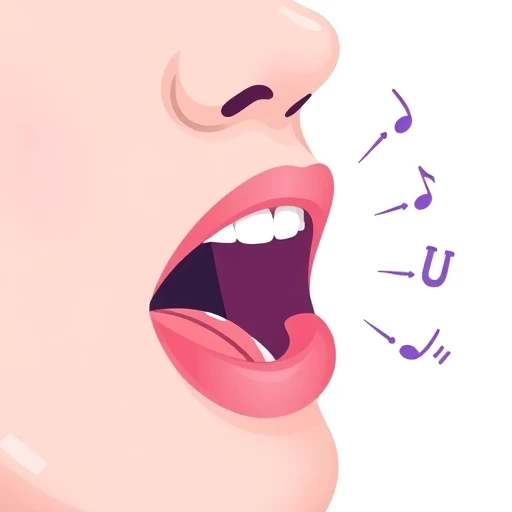
At the A1 level, pronunciation is simply 'how you say a word.' When you learn a new word like 'hello' or 'apple,' you need to know how to make the right sounds so people understand you. At this stage, you focus on very basic sounds. For example, the 'h' in 'hello' or the 'a' in 'apple.' You might find some sounds difficult because they are not in your first language. Teachers will help you by saying the word slowly, and you repeat it. This is called 'modeling.' You don't need to worry about being perfect. The most important thing is that people can understand what you are trying to say. You might use a dictionary that has a small 'play' button to hear the sound. This is a great way to learn. You will also learn that some letters in English are silent, like the 'k' in 'know.' This is part of learning pronunciation. Just remember: listen carefully and try your best to copy the sound.
At the A2 level, you start to notice that pronunciation is more than just individual sounds. You begin to learn about 'word stress.' This means that one part of a word is louder or longer than the others. For example, in the word 'banana,' the middle part 'na' is the strongest: ba-NA-na. If you stress the wrong part, it can be hard for people to understand you. You also start to learn about the different ways to pronounce the '-ed' ending in past tense verbs, like 'walked' (sounds like 't'), 'played' (sounds like 'd'), and 'wanted' (sounds like 'id'). This is a very important part of A2 pronunciation. You might still have a strong accent from your home country, and that is okay! The goal at A2 is to be 'intelligible,' which means people can understand you most of the time without having to ask you to repeat yourself too often. You can practice by listening to short songs or watching videos and trying to say the words at the same time as the speaker.
At the B1 level, pronunciation becomes a key tool for expressing meaning more clearly. You are now moving beyond just being understood; you are starting to use pronunciation to show your feelings or to emphasize important information. This involves 'sentence stress' and 'intonation.' Sentence stress is when you make the most important words in a sentence louder. For example, in 'I want the RED one,' you emphasize 'red' to show which one you mean. Intonation is the way your voice goes up and down. At B1, you learn that a rising voice at the end of a sentence often means you are asking a question. You also become more aware of 'connected speech.' This is when words run together in natural conversation, like 'going to' becoming 'gonna' or 'want to' becoming 'wanna.' While you don't have to speak like this, understanding it helps your listening skills. You are also expected to correctly pronounce most common words and have a good grasp of the phonetic alphabet (IPA) to help you learn new words independently.
At the B2 level, your pronunciation should be clear and natural. You have a high degree of control over the sounds of the language, and your accent does not interfere with communication. You are able to use a wide range of intonation patterns to convey subtle meanings, such as irony, sarcasm, or enthusiasm. You are also very comfortable with 'connected speech' phenomena like elision (dropping sounds) and assimilation (changing sounds to match the next word). For example, you understand that 'handbag' often sounds like 'hambag' in fast speech. At this level, you can handle more complex word stress patterns in long, academic, or technical words. You are also able to recognize and adapt to different regional accents, even if you don't use them yourself. Your goal at B2 is to sound fluent and confident, and you should be able to correct your own pronunciation mistakes when you notice them. You might use pronunciation as a way to build rapport with others, adjusting your style to match the person you are talking to.
At the C1 level, pronunciation is a sophisticated instrument that you use with precision and flexibility. You have full command of the phonological system of the language. Your speech is characterized by a natural rhythm and flow, and you use stress and intonation expertly to highlight nuances of meaning and to guide the listener through complex arguments. You are fully aware of the social and cultural implications of different pronunciations and can choose to use more formal or informal styles depending on the situation. At this level, you can easily understand almost any regional or social accent, and you are rarely, if ever, misunderstood. You might even be able to mimic different accents for effect or to better integrate into a specific community. Your pronunciation is not just about being 'correct'; it is about being 'effective' and 'persuasive.' You can use pauses, volume, and pitch to create a powerful impact on your audience, whether you are giving a presentation or engaging in a high-level debate. You are also likely to be interested in the finer points of phonetics and phonology as a way to further refine your skills.
At the C2 level, your pronunciation is indistinguishable from that of a highly articulate native speaker. You possess a complete and effortless mastery of all aspects of the language's sound system. This includes the most subtle nuances of intonation, the most complex patterns of word and sentence stress, and the full range of connected speech features. You can use pronunciation to convey the finest shades of meaning, emotion, and attitude, often in ways that are so subtle they are only noticed by other expert speakers. You have a deep, intuitive understanding of how pronunciation varies across different contexts, regions, and social groups, and you can navigate these variations with ease. At this level, pronunciation is no longer a 'skill' you are practicing; it is a seamless part of your identity as a speaker. You may even be an authority on the subject, capable of coaching others or analyzing the phonetic features of the language at a professional level. Your speech is not only clear and intelligible but also aesthetically pleasing and highly persuasive, reflecting a profound connection to the music and rhythm of the language.
pronunciation in 30 Seconds
- Pronunciation is the physical act of producing speech sounds to communicate words clearly and accurately within a specific language system.
- It involves more than just sounds; it includes word stress, sentence rhythm, and the rising and falling tones of intonation.
- Correct pronunciation is vital for being understood, though having a regional accent is perfectly normal and acceptable in most contexts.
- The word is a noun, while 'pronounce' is the verb. A common mistake is misspelling it as 'pronounciation' by adding an extra 'o'.
The term pronunciation refers to the complex physiological and cognitive process of producing the specific sounds that constitute a language. It is not merely about making noise; it is about the precise coordination of the breath, vocal cords, tongue, teeth, and lips to create phonemes that are recognizable to other speakers of that language. In the realm of linguistics, pronunciation encompasses several sub-components: individual sounds (vowels and consonants), word stress (which syllable is emphasized), sentence stress (which words in a sentence are emphasized), and intonation (the rise and fall of the voice). Understanding pronunciation is fundamental because even if a speaker possesses a vast vocabulary and perfect grammar, incorrect pronunciation can lead to significant breakdowns in communication. People use this word most frequently in educational settings, such as when learning a second language, or in professional contexts where clarity of speech is paramount for safety or efficiency.
- Phonetic Accuracy
- This refers to the degree to which a speaker produces the individual sounds of a language according to established norms. For example, the difference between the 'th' sound in 'think' and 'this' is a matter of phonetic accuracy.
- Prosody
- Prosody involves the rhythm, stress, and intonation of speech. It is the 'music' of the language that helps convey emotion, irony, or the difference between a question and a statement.
- Intelligibility
- This is the most critical aspect of pronunciation for learners. It is not about sounding like a native speaker, but about being understood by others without causing them undue effort.
In everyday life, we encounter the concept of pronunciation when we meet someone with a name we haven't heard before, or when we travel to a region with a distinct dialect. It is a social marker that can indicate a person's geographic origin, social class, or level of education, though modern linguistic theory emphasizes that no single pronunciation is inherently 'better' than another. However, in 'Standard' versions of languages, such as Received Pronunciation (RP) in the UK or General American in the US, there are codified rules that are taught in schools and used in broadcasting. These standards provide a common ground for speakers from diverse backgrounds to communicate effectively. When people discuss pronunciation, they are often looking for the 'correct' way to say a word, often consulting dictionaries that use the International Phonetic Alphabet (IPA) to provide an objective guide to sound production.
The teacher spent thirty minutes explaining the correct pronunciation of the French word 'écureuil' to the confused students.
I often use an online dictionary to check the pronunciation of technical terms before I give a presentation.
Her pronunciation was so clear that everyone in the large hall could understand her perfectly.
Many English learners find the pronunciation of the letter 'r' to be one of the most difficult challenges.
The software includes a feature that allows you to record your own pronunciation and compare it to a native speaker.
Furthermore, the study of pronunciation is a scientific field known as phonology. Linguists analyze how sounds function within a particular language system. For instance, in English, the 'p' sound in 'pin' is aspirated (accompanied by a puff of air), while the 'p' in 'spin' is not. Most native speakers are unaware of these subtle differences, yet they apply them instinctively. For a learner, mastering these nuances is what leads to a more 'natural' sounding pronunciation. Beyond the physical mechanics, pronunciation also carries emotional weight. Mispronouncing a name can be seen as a sign of disrespect, whereas making an effort to pronounce it correctly demonstrates cultural sensitivity and care. In the digital age, pronunciation guides are more accessible than ever, with audio clips available at the click of a button, helping to bridge the gap between written text and spoken reality.
Using the word pronunciation correctly requires an understanding of its grammatical role as a noun and the common verbs and adjectives that accompany it. It is most frequently used as the object of verbs like 'improve,' 'practice,' 'check,' or 'master.' For example, 'I need to improve my pronunciation if I want to work in radio.' It can also be the subject of a sentence, as in 'Pronunciation is often the hardest part of learning English.' When describing someone's pronunciation, we use adjectives like 'flawless,' 'impeccable,' 'clear,' 'distinct,' or conversely, 'poor,' 'unintelligible,' or 'thick' (often used to describe a heavy accent that affects pronunciation).
- Verb Collocations
- Common verbs include: affect, correct, demonstrate, emphasize, listen to, model, and refine. Example: 'The teacher modeled the correct pronunciation for the class.'
- Adjective Collocations
- Common adjectives include: accurate, approximate, British, American, standard, non-standard, and phonetic. Example: 'He has a very standard American pronunciation.'
- Prepositional Phrases
- We often use 'pronunciation of' followed by a word or language. Example: 'The pronunciation of 'thorough' is difficult for many.'
In more formal or academic writing, 'pronunciation' might be used in the context of linguistics or pedagogy. You might see sentences like, 'The study examines the impact of phonetic training on the pronunciation of L2 learners.' Here, 'L2' refers to a second language. In casual conversation, the word is often used when asking for help: 'How is the pronunciation of this word?' or 'Can you help me with my pronunciation?' It is important to note that 'pronunciation' is the noun, while 'pronounce' is the verb. A common mistake is to say 'pronounciation' (with an extra 'o' and 'u' in the middle), but the correct spelling and sound omit the 'o' found in 'pronounce'.
The actor worked with a dialect coach to perfect his pronunciation for the role of the Scottish king.
There are several different pronunciations of the word 'either,' and both are considered correct.
If you are unsure about the pronunciation, you can look it up in the dictionary's phonetic guide.
His pronunciation of the local dialect was so good that he was mistaken for a resident.
The automated voice system failed to recognize my pronunciation of the city name.
In summary, 'pronunciation' is a versatile noun that can describe the general quality of someone's speech or the specific way a single word is articulated. It is an essential term for anyone involved in language learning, public speaking, or communications. By paying attention to the verbs and adjectives that commonly go with it, you can use the word more naturally and accurately in your own writing and speaking. Whether you are discussing the nuances of a foreign language or the regional variations of your own, 'pronunciation' is the key term for describing how we turn written symbols into audible meaning.
The word pronunciation is ubiquitous in environments where language is being taught, analyzed, or used professionally. Perhaps the most common place to hear it is in a classroom. Teachers frequently use it when introducing new vocabulary, saying things like, 'Let's practice the pronunciation of this new word together.' In this context, it is a tool for instruction. You will also hear it in language labs, where students use software to record and analyze their own speech. Beyond the classroom, the word is a staple of the media and entertainment industry. Actors, news anchors, and radio presenters often discuss pronunciation with coaches to ensure they are meeting the standards of their audience or the requirements of a specific character.
- Language Learning Apps
- Apps like Duolingo or Babbel constantly use the term to guide users through speaking exercises and phonetic drills.
- Public Speaking Seminars
- In workshops for executives or politicians, coaches emphasize pronunciation as a key component of 'presence' and 'authority'.
- International Business
- In global companies, colleagues might discuss the pronunciation of names to ensure they are being respectful to international partners.
You will also encounter the word in the digital world. Search engines and digital assistants like Siri, Alexa, and Google Assistant are built on complex pronunciation models. When these systems fail to understand a user, the issue is often framed as a 'pronunciation error.' Furthermore, YouTube is home to thousands of 'pronunciation channels' dedicated solely to showing people how to say difficult words, from brand names like 'Porsche' and 'Hermès' to complex scientific terms. These videos often get millions of views, highlighting a widespread public interest in 'correct' speech. In a more academic or scientific setting, you might hear the word in a doctor's office or a research lab. Medical professionals must master the pronunciation of thousands of Latin-based terms to communicate accurately with their peers. Similarly, scientists discussing new discoveries must agree on a standard pronunciation for new elements or species.
'Please pay attention to the pronunciation of the ending -ed in these past tense verbs,' the instructor said.
The podcast host apologized for the potential mis-pronunciation of the guest's name at the start of the episode.
In the movie, the spy's cover was blown because his pronunciation of the local slang was slightly off.
The GPS system has a setting that allows you to choose between different regional pronunciations.
During the spelling bee, the contestant asked for the pronunciation of the word to help them identify the roots.
Finally, the word is a common topic in social discussions about identity and culture. People often debate the 'right' way to pronounce words like 'scone,' 'pecan,' or 'caramel,' with the different pronunciations serving as a point of regional pride. In these cases, the word 'pronunciation' is at the heart of a conversation about where we come from and how our speech defines us. Whether it's a formal lecture on phonetics or a friendly argument over a dessert, 'pronunciation' is a word that touches on the very essence of human communication and social connection.
The word pronunciation itself is frequently the subject of errors, both in its spelling and its own pronunciation. The most common spelling mistake is adding an 'o' after the first 'n', making it 'pronounciation'. This happens because the verb form is 'pronounce', which does contain the 'ou' sound and spelling. However, in the noun form, the 'o' is dropped, and the sound changes from /aʊ/ (as in 'house') to /ʌ/ (as in 'sun'). Another common error is misplacing the stress. In 'pronounce', the stress is on the second syllable (pro-NOUNCE). In 'pronunciation', the primary stress shifts to the fourth syllable (pro-nun-ci-A-tion), with a secondary stress on the second syllable. Failing to make this shift can make the word sound awkward or difficult to understand.
- Spelling Error: 'Pronounciation'
- This is the #1 mistake. Always remember that the 'o' from 'pronounce' disappears in the noun form. Think of 'nun' in the middle of the word.
- Confusion with 'Accent'
- Many people say 'I have a bad pronunciation' when they mean 'I have a strong accent.' Pronunciation refers to the correctness of individual words, while accent refers to the overall sound of your speech.
- Over-correction
- Sometimes learners try so hard to pronounce every single letter that they sound robotic. In English, many letters are silent or reduced to a 'schwa' sound (/ə/).
Beyond the word itself, there are common mistakes people make *regarding* pronunciation in general. One major mistake is assuming that English is a phonetic language where every word is pronounced exactly as it is spelled. Because of its history, English has many 'irregular' spellings (like 'colonel', 'knight', or 'through'). Relying solely on spelling to determine pronunciation is a recipe for error. Another mistake is ignoring word stress. In English, changing the stress can change the meaning of a word (e.g., 'RE-cord' is a noun, 're-CORD' is a verb). Learners often focus so much on individual sounds that they forget the rhythm of the whole word. Lastly, many people believe they must achieve a 'perfect' native-like pronunciation to be successful. In reality, as long as your pronunciation is clear and intelligible, you are communicating effectively.
Incorrect: 'I need to work on my pronounciation.' Correct: 'I need to work on my pronunciation.'
Incorrect: 'He has a very strong pronunciation.' Correct: 'He has a very strong accent.'
Incorrect: 'The pronunciation of the word 'debt' is /debt/.' Correct: 'The pronunciation of 'debt' is /det/ (the 'b' is silent).'
Incorrect: 'I can't understand his pronounce.' Correct: 'I can't understand his pronunciation.'
Incorrect: 'Is this the right sound of this word?' Correct: 'Is this the correct pronunciation of this word?'
In conclusion, while 'pronunciation' is a common word, it is also a minefield of potential errors. By focusing on the correct spelling (no 'o'!), the correct stress (on the fourth syllable), and the distinction between pronunciation and accent, you can avoid the most common pitfalls. Furthermore, by accepting that English spelling is often non-phonetic and that intelligibility is more important than perfection, you can approach the task of improving your pronunciation with more confidence and less stress. Remember, even native speakers struggle with the pronunciation of certain words, so you are in good company!
While pronunciation is the most general and common term for how words are spoken, there are several other words that describe similar concepts but with different nuances. Understanding these alternatives can help you be more precise in your communication. The most closely related terms are 'articulation,' 'enunciation,' and 'diction.' While they are often used interchangeably in casual speech, they have distinct meanings in the fields of linguistics, music, and public speaking. For instance, 'articulation' focuses on the physical movement of the speech organs, while 'enunciation' focuses on the clarity and distinctness of each sound. 'Diction' is a broader term that can refer to both the choice of words and the way they are spoken.
- Articulation vs. Pronunciation
- Articulation is the physical act of producing sounds. Pronunciation is the socially accepted way of saying a word. You can have good articulation but still have the wrong pronunciation if you say the wrong sounds for a specific word.
- Enunciation vs. Pronunciation
- Enunciation is about clarity. If you mumble, you have poor enunciation, even if your pronunciation (the sounds you are attempting) is correct.
- Diction vs. Pronunciation
- Diction refers to the style of speaking and the choice of words. In singing, diction is the clear pronunciation of lyrics so the audience can understand them.
Other related terms include 'inflection,' which refers to the change in the pitch or tone of the voice, and 'accent,' which refers to the distinctive mode of pronunciation of a particular nation, locality, or social class. 'Phonetics' is the scientific study of speech sounds, and 'phonology' is the study of how those sounds are organized in a particular language. When you are looking for a more informal alternative, you might use 'delivery' or 'speech.' For example, 'His delivery was very clear' or 'He has a very fast way of speech.' However, 'pronunciation' remains the most accurate word when you are specifically talking about the way a word is sounded out.
The singer's diction was so poor that I couldn't understand a single word of the song.
The speech therapist worked on the child's articulation of the 's' sound.
Please enunciate your words clearly so the microphone can pick them up.
The inflection in her voice suggested that she was asking a question, not making a statement.
Her accent is a beautiful blend of French and English influences.
In summary, while 'pronunciation' is the workhorse of the language, knowing these alternatives allows you to be more nuanced. Whether you are describing a singer's diction, a child's articulation, or a politician's enunciation, each word offers a slightly different perspective on the act of speaking. By choosing the right word for the right context, you demonstrate a deeper understanding of the complexities of human communication. However, for most everyday situations, 'pronunciation' remains the most direct and effective way to talk about how we say what we say.
How Formal Is It?
Fun Fact
The spelling of 'pronunciation' changed in the 16th century to more closely match its Latin roots, which is why the 'o' from 'pronounce' (which came from French) was dropped in the noun form.
Pronunciation Guide
- Saying 'pro-NOUN-ci-a-tion' (adding an 'o' sound like in the verb 'pronounce').
- Putting the stress on the wrong syllable, like the first or second.
- Spelling it with an 'o' as 'pronounciation'.
- Mumbling the middle syllables 'ci-a'.
- Pronouncing the 'c' as a 'k' sound.
Difficulty Rating
The word is easy to recognize once you know it, but the spelling can be tricky.
The spelling 'pronunciation' vs 'pronounce' is a very common trap for all levels.
The word itself has five syllables and a specific stress pattern that can be hard to master.
It is usually clear in context, though it can be confused with 'enunciation' in fast speech.
What to Learn Next
Prerequisites
Learn Next
Advanced
Grammar to Know
Word Stress in Nouns vs. Verbs
'RE-cord' (noun) vs. 're-CORD' (verb).
Silent Letters
The 'b' in 'comb' or the 'p' in 'psychology'.
The Schwa Sound /ə/
The 'a' in 'about' or the 'e' in 'the'.
Voiced vs. Voiceless Consonants
The difference between 's' in 'bus' and 'z' in 'buzz'.
Intonation in Questions
Rising pitch at the end of 'Are you coming?'
Examples by Level
How do you say this word?
¿Cómo se dice esta palabra?
Basic question structure using 'how'.
Listen to the pronunciation.
Escucha la pronunciación.
Imperative sentence for giving instructions.
My pronunciation is not good.
Mi pronunciación no es buena.
Subject + verb 'to be' + adjective.
Please repeat the word.
Por favor, repite la palabra.
Polite request using 'please'.
The 'k' is silent in 'know'.
La 'k' es muda en 'know'.
Describing a phonetic rule.
I like your pronunciation.
Me gusta tu pronunciación.
Subject + verb 'like' + possessive adjective + noun.
Is my pronunciation correct?
¿Es correcta mi pronunciación?
Interrogative form of the verb 'to be'.
Check the pronunciation online.
Consulta la pronunciación en línea.
Imperative sentence for a suggestion.
The pronunciation of 'banana' has stress on the second part.
La pronunciación de 'banana' tiene el acento en la segunda parte.
Focusing on word stress.
He has a very clear pronunciation.
Él tiene una pronunciación muy clara.
Using 'clear' as a descriptive adjective.
We practiced the pronunciation of past tense verbs.
Practicamos la pronunciación de los verbos en pasado.
Past simple tense 'practiced'.
Don't worry about your accent, just focus on pronunciation.
No te preocupes por tu acento, solo enfócate en la pronunciación.
Negative imperative 'don't worry'.
The dictionary shows the pronunciation using symbols.
El diccionario muestra la pronunciación usando símbolos.
Present simple tense 'shows'.
I find the pronunciation of 'th' very difficult.
Encuentro la pronunciación de 'th' muy difícil.
Verb 'find' + object + adjective.
She improved her pronunciation by listening to music.
Ella mejoró su pronunciación escuchando música.
Using 'by + -ing' to show method.
There are two common pronunciations for this word.
Hay dos pronunciaciones comunes para esta palabra.
'There are' for plural existence.
Correct pronunciation is essential for effective communication.
La pronunciación correcta es esencial para una comunicación efectiva.
Using 'essential' for emphasis.
He mastered the pronunciation of difficult technical terms.
Él dominó la pronunciación de términos técnicos difíciles.
Verb 'mastered' indicating high achievement.
The teacher corrected my pronunciation of the word 'schedule'.
El profesor corrigió mi pronunciación de la palabra 'schedule'.
Verb 'corrected' in the past tense.
I use an app to record and check my pronunciation.
Uso una aplicación para grabar y verificar mi pronunciación.
Using 'to + infinitive' to show purpose.
The pronunciation of English vowels can be quite tricky.
La pronunciación de las vocales en inglés puede ser bastante complicada.
Using 'can be' to show possibility.
She has a slight French accent, but her pronunciation is perfect.
Ella tiene un ligero acento francés, pero su pronunciación es perfecta.
Contrast using 'but'.
We need to focus on the pronunciation of word endings.
Necesitamos enfocarnos en la pronunciación de los finales de las palabras.
'Need to' + base verb.
The actor's pronunciation of the local dialect was very impressive.
La pronunciación del dialecto local por parte del actor fue muy impresionante.
Possessive 'actor's'.
The speaker's pronunciation was so clear that no subtitles were needed.
La pronunciación del orador era tan clara que no se necesitaron subtítulos.
'So... that' construction for result.
Regional variations in pronunciation can sometimes lead to confusion.
Las variaciones regionales en la pronunciación a veces pueden llevar a confusión.
Modal 'can' for general possibility.
She worked with a coach to refine her pronunciation for the broadcast.
Ella trabajó con un entrenador para refinar su pronunciación para la transmisión.
Verb 'refine' for making small improvements.
The pronunciation guide at the back of the book is very helpful.
La guía de pronunciación al final del libro es muy útil.
Compound noun 'pronunciation guide'.
His pronunciation of the vowel sounds was slightly off, but still intelligible.
Su pronunciación de los sonidos vocálicos estaba un poco mal, pero aún era inteligible.
'Off' used as an adjective meaning incorrect.
Many learners struggle with the pronunciation of the 'r' sound in English.
Muchos estudiantes luchan con la pronunciación del sonido 'r' en inglés.
'Struggle with' + noun phrase.
The software analyzes your pronunciation and gives you a score.
El software analiza tu pronunciación y te da una puntuación.
Present simple for software functions.
There is a subtle difference in the pronunciation of 'ship' and 'sheep'.
Hay una diferencia sutil en la pronunciación de 'ship' y 'sheep'.
Adjective 'subtle' for small differences.
The nuances of English pronunciation can take years to fully master.
Los matices de la pronunciación en inglés pueden tardar años en dominarse por completo.
Noun 'nuances' for small, important details.
His flawless pronunciation allowed him to pass for a native speaker.
Su pronunciación impecable le permitió pasar por un hablante nativo.
'Pass for' meaning to be accepted as something else.
The study explores how social class affects the pronunciation of certain phonemes.
El estudio explora cómo la clase social afecta la pronunciación de ciertos fonemas.
Academic verb 'explores'.
The singer's impeccable diction and pronunciation were praised by the critics.
La dicción y pronunciación impecables del cantante fueron elogiadas por los críticos.
Passive voice 'were praised'.
She used her pronunciation to subtly signal her regional identity.
Ella usó su pronunciación para señalar sutilmente su identidad regional.
Adverb 'subtly' modifying the verb 'signal'.
The complexity of English pronunciation is due to its diverse linguistic roots.
La complejidad de la pronunciación en inglés se debe a sus diversas raíces lingüísticas.
'Due to' for explaining cause.
He gave a lecture on the historical evolution of English pronunciation.
Dio una conferencia sobre la evolución histórica de la pronunciación en inglés.
Compound noun 'historical evolution'.
The debate centered on whether there is a 'correct' standard for pronunciation.
El debate se centró en si existe un estándar 'correcto' para la pronunciación.
'Centered on whether' for a focused discussion.
The actor's chameleonic ability to adapt his pronunciation to any dialect is legendary.
La capacidad camaleónica del actor para adaptar su pronunciación a cualquier dialecto es legendaria.
Adjective 'chameleonic' for extreme adaptability.
The phonetic intricacies of the language's pronunciation are a testament to its rich history.
Las intrincadezas fonéticas de la pronunciación del idioma son un testimonio de su rica historia.
'Testament to' meaning proof of something.
She articulated the argument with such precise pronunciation that every syllable resonated.
Articuló el argumento con una pronunciación tan precisa que cada sílaba resonó.
'Such... that' for high degree and result.
The sociolinguistic implications of pronunciation variations are profound and far-reaching.
Las implicaciones sociolingüísticas de las variaciones de pronunciación son profundas y de gran alcance.
Adjectives 'profound' and 'far-reaching'.
His mastery of the language's prosody and pronunciation was truly awe-inspiring.
Su dominio de la prosodia y la pronunciación del idioma fue realmente impresionante.
Noun 'prosody' for the rhythm and intonation of speech.
The subtle shifts in her pronunciation betrayed her true origins despite her efforts to hide them.
Los sutiles cambios en su pronunciación delataron sus verdaderos orígenes a pesar de sus esfuerzos por ocultarlos.
Verb 'betrayed' meaning to reveal something unintentionally.
The linguistic atlas provides a comprehensive overview of regional pronunciations across the continent.
El atlas lingüístico proporciona una visión general completa de las pronunciaciones regionales en todo el continente.
Adjective 'comprehensive' for thoroughness.
The poet's use of rhyme and pronunciation created a hauntingly beautiful auditory experience.
El uso de la rima y la pronunciación por parte del poeta creó una experiencia auditiva inquietantemente bella.
Adverb 'hauntingly' modifying 'beautiful'.
Common Collocations
Common Phrases
— Be careful about how you say words. Used as advice or a warning.
Watch your pronunciation when you speak to the director; he is very particular.
— Something that depends on how it is said or interpreted.
Whether you call it a 'scone' or a 'scon' is just a matter of pronunciation.
— Practice to make your speech clearer.
You really need to work on your pronunciation of the 'th' sound.
— A list or section that shows how to say words.
The travel book has a helpful pronunciation guide for common phrases.
— Asking for the correct way to say something.
How is the pronunciation of your last name?
— The way English is spoken by educated people in a specific country.
He was taught Standard English pronunciation in school.
— A small, accidental mistake in speaking.
It was just a slip of pronunciation, but it changed the meaning of the sentence.
— To make your speech exactly right.
This app will help you perfect your pronunciation in just thirty days.
— The way people in a specific area say words.
The regional pronunciation of 'water' varies greatly across the United States.
— Problems or challenges in saying words correctly.
Many students have pronunciation difficulties with the letter 'L'.
Often Confused With
Accent is the overall sound of a person's speech, while pronunciation is how they say specific words.
Enunciation is about the clarity of speech, while pronunciation is about the correctness of the sounds.
Articulation is the physical act of making sounds, while pronunciation is the social standard for those sounds.
Idioms & Expressions
— To struggle to pronounce a word or to speak clearly.
The word was so long that I tripped over my tongue trying to say it.
informal— To stop oneself from saying something, though not directly about pronunciation.
I had to bite my tongue to keep from correcting his pronunciation.
neutral— Directly and clearly, often related to the clarity of what was said.
He didn't say it in so many words, but his pronunciation suggested he was unhappy.
neutral— To have a shared understanding, though often used metaphorically.
Even though their pronunciation was different, they still spoke the same language of music.
neutral— A small mistake in speaking.
Calling him by his brother's name was just a slip of the tongue.
neutral— When you can almost remember a word but can't quite say it.
The correct pronunciation was on the tip of my tongue, but I just couldn't get it out.
neutral— Be careful about what you say or how you say it (often regarding politeness).
Watch your mouth; that kind of pronunciation is considered very rude here.
informal— Be on your best behavior, which can include speaking clearly and politely.
When you meet the ambassador, make sure to mind your P's and Q's and watch your pronunciation.
formal— Information passed from person to person through speaking.
The correct pronunciation of the secret password was only passed on by word of mouth.
neutral— To speak very quickly, which often affects pronunciation.
She was so excited that she started talking a mile a minute, and her pronunciation became very messy.
informalEasily Confused
It is the verb form and has a different spelling and sound.
'Pronounce' has an 'o' and the stress is on the second syllable. 'Pronunciation' has no 'o' and the stress is on the fourth syllable.
I can't pronounce this word, so I need to check its pronunciation.
Both relate to how we speak.
Enunciation is about being clear and not mumbling. Pronunciation is about using the right sounds for a word.
His pronunciation was correct, but his enunciation was so poor I couldn't hear him.
Both involve the mouth and sounds.
Articulation is the physical movement of the tongue and lips. Pronunciation is the linguistic standard.
The speech therapist worked on his articulation to improve his overall pronunciation.
Both refer to speaking style.
Diction includes word choice and clarity. Pronunciation is specifically about the sounds of words.
The actor's diction was excellent, including his perfect pronunciation of the difficult script.
People often use them interchangeably.
An accent is a regional or social way of speaking. Pronunciation is the way a specific word is said.
He has a British accent, but his pronunciation of American slang is very good.
Sentence Patterns
How do you say [word]?
How do you say 'apple'?
His pronunciation is [adjective].
His pronunciation is very clear.
I need to improve my pronunciation of [sound/word].
I need to improve my pronunciation of the 'th' sound.
The pronunciation of [word] varies by [region].
The pronunciation of 'either' varies by region.
The [adjective] pronunciation was [adjective].
The flawless pronunciation was highly impressive.
Mastering the [linguistic term] of pronunciation is [adjective].
Mastering the prosody of pronunciation is a lifelong task.
Check the pronunciation in [source].
Check the pronunciation in the dictionary.
There are [number] pronunciations for [word].
There are two pronunciations for this word.
Word Family
Nouns
Verbs
Adjectives
Related
How to Use It
Common in educational and professional contexts.
-
Spelling it as 'pronounciation'.
→
pronunciation
The 'o' from the verb 'pronounce' is dropped in the noun form. This is the most common error for learners and native speakers alike.
-
Stressing the second syllable: pro-NUN-ci-a-tion.
→
pro-nun-ci-A-tion
The primary stress in this five-syllable word should be on the fourth syllable, 'a'. Stressing the second syllable is a common mistake.
-
Pronouncing every letter in a word.
→
Using silent letters and the schwa sound.
English is not a phonetic language. Trying to pronounce the 'k' in 'know' or the 'w' in 'write' is a common mistake for beginners.
-
Confusing 'pronunciation' with 'accent'.
→
Using the terms correctly.
Saying 'I have a bad pronunciation' when you mean you have a strong accent can be confusing. Focus on the clarity of individual words.
-
Ignoring intonation in questions.
→
Using a rising pitch at the end.
In English, your voice should usually go up at the end of a yes/no question. If you don't do this, people might not realize you are asking a question.
Tips
Shadowing
Listen to a native speaker and repeat what they say immediately after them. This helps you mimic their rhythm, stress, and intonation, which are key parts of pronunciation.
Use the IPA
Learn the basic symbols of the International Phonetic Alphabet. It will help you understand exactly how to say any word you find in a dictionary, even if the spelling is confusing.
Record Yourself
Use your phone to record yourself speaking. When you listen back, you will notice mistakes that you don't hear while you are actually talking. Compare your recording to a native speaker.
Watch Mouth Movements
Watch videos of native speakers and pay close attention to how they move their lips and tongue. Pronunciation is a physical skill, and seeing the movements can help you copy them.
Focus on Stress
Don't just focus on individual sounds. Pay attention to which part of the word is stressed. Correct word stress is often more important for being understood than perfect sounds.
Aim for Clarity, Not Perfection
Your goal should be to be understood, not to sound like a native speaker. A clear accent is part of your identity and is perfectly acceptable in all professional and social settings.
Slow Down
When you are practicing a difficult word, say it very slowly at first. Break it into syllables (pro-nun-ci-a-tion) and then gradually speed up as you get more comfortable.
Online Audio Dictionaries
Always use dictionaries that have audio buttons. Hearing the word is much more effective than just reading a phonetic guide. Sites like Forvo show you how real people say words.
Talk to Others
The best way to test your pronunciation is to talk to people. If they understand you, you are doing well! Don't be afraid to ask for feedback from friends or teachers.
Sing Along
Music is a great way to practice the rhythm and flow of a language. Sing along to your favorite songs and try to match the singer's pronunciation and intonation exactly.
Memorize It
Mnemonic
Remember: 'Pronunciation' has a 'NUN' in it, and nuns are very strict about how you speak! 'Pronounce' has a 'NOUN' in it.
Visual Association
Imagine a nun pointing to a chalkboard with the word 'PRONUNCIATION' written on it, emphasizing the 'NUN' in the middle.
Word Web
Challenge
Try to say the word 'pronunciation' five times fast without making it sound like 'pronounciation'. Then, try to use it in three different sentences about your favorite hobby.
Word Origin
The word 'pronunciation' comes from the Latin word 'pronuntiatio', which is the noun form of the verb 'pronuntiare'.
Original meaning: In Latin, 'pronuntiare' meant 'to announce,' 'to proclaim,' or 'to declaim.' It is composed of 'pro-' (forth) and 'nuntiare' (to report or announce).
It belongs to the Italic branch of the Indo-European language family, entering English via Old French 'prononciation'.Cultural Context
Be careful when correcting others. Focus on 'intelligibility' rather than 'perfection' to avoid sounding elitist or discouraging to learners.
In the UK, 'Received Pronunciation' (RP) was once the only acceptable way to speak on the BBC, but now a wide variety of regional accents are heard.
Practice in Real Life
Real-World Contexts
Language Classroom
- Repeat after me.
- Watch the stress.
- Is this sound voiced?
- Check the IPA.
Public Speaking
- Project your voice.
- Enunciate clearly.
- Practice your delivery.
- Check difficult names.
Travel
- How do locals say this?
- I'm sorry, I mispronounced that.
- Can you say it slowly?
- Is the 'h' silent?
Acting/Drama
- Adopt a regional accent.
- Work with a dialect coach.
- Perfect the vowels.
- Maintain the rhythm.
Medical/Technical
- The Latin pronunciation is...
- Standardize the terminology.
- Avoid ambiguity.
- Learn the Greek roots.
Conversation Starters
"What is the most difficult word for you to pronounce in English?"
"Do you think having a 'perfect' pronunciation is important for a language learner?"
"How does someone's pronunciation affect your first impression of them?"
"Are there any words in your native language that foreigners always mispronounce?"
"Do you prefer British or American pronunciation when you are learning English?"
Journal Prompts
Describe a time when a mispronunciation led to a funny or embarrassing situation.
How do you feel when someone corrects your pronunciation? Does it help or bother you?
Write about the different accents or pronunciations you hear in your own country.
What strategies do you use to improve your pronunciation of difficult words?
Reflect on why English pronunciation is so different from its spelling.
Frequently Asked Questions
10 questionsThis is a common question! The word 'pronounce' came into English from Old French, which used the 'ou' spelling. However, in the 16th century, scholars changed the spelling of the noun 'pronunciation' to more closely match its original Latin root, 'pronuntiatio', which did not have the 'o'. This created the spelling difference we see today.
In many cases, yes, there is a standard pronunciation found in dictionaries. However, many words have multiple 'correct' pronunciations depending on the region (e.g., British vs. American English) or even personal preference. Linguists generally focus on 'intelligibility'—whether you can be understood—rather than a single 'correct' way.
The best way to improve is through a combination of listening and practicing. Try 'shadowing' native speakers, using pronunciation apps, learning the International Phonetic Alphabet (IPA) to understand sounds, and recording yourself to identify areas for improvement. Consistency is key!
Not at all! Everyone has an accent. An accent is simply a reflection of where you are from or your social background. Your pronunciation is only considered 'bad' if it makes it difficult for others to understand you. Many people with strong accents have excellent, clear pronunciation.
The International Phonetic Alphabet (IPA) is a system of symbols where each symbol represents a specific sound. Learning it can be very helpful because English spelling is often not phonetic. The IPA provides a reliable guide to how any word should be pronounced, regardless of its spelling.
Silent letters are usually 'ghosts' from the past. They often represent sounds that used to be pronounced hundreds of years ago but have since disappeared from speech, while the spelling remained the same. For example, the 'k' in 'knight' was once pronounced!
Word stress is the emphasis placed on a specific syllable in a word. In English, it is very important because stressing the wrong syllable can make a word unrecognizable or even change its meaning (like 'PRE-sent' the noun vs. 'pre-SENT' the verb).
No, reading alone is not enough because English spelling is not a reliable guide to sound. You must listen to the language being spoken and practice making the sounds yourself. Combining reading with audio is the most effective approach.
Neither is 'better' than the other. They are simply different regional standards. Which one you choose to learn usually depends on your personal goals, where you live, or which version of English you find easier to understand.
While there are some general rules, the best way is to check a dictionary. Most dictionaries use a small mark (') before the stressed syllable in their phonetic guide. Over time, you will start to recognize common patterns in English word stress.
Test Yourself 201 questions
Write a sentence using the word 'pronunciation' to describe a teacher.
Well written! Good try! Check the sample answer below.
Describe how you practice your pronunciation.
Well written! Good try! Check the sample answer below.
Write a short dialogue where someone asks for the pronunciation of a word.
Well written! Good try! Check the sample answer below.
Explain the difference between 'pronounce' and 'pronunciation'.
Well written! Good try! Check the sample answer below.
Write a sentence about a difficult word you learned to pronounce.
Well written! Good try! Check the sample answer below.
Why is pronunciation important in a job interview?
Well written! Good try! Check the sample answer below.
Write a tip for someone who wants to improve their pronunciation.
Well written! Good try! Check the sample answer below.
Describe a regional pronunciation from your country.
Well written! Good try! Check the sample answer below.
Write a sentence using 'mispronunciation'.
Well written! Good try! Check the sample answer below.
How does pronunciation affect your listening skills?
Well written! Good try! Check the sample answer below.
Write a sentence about a silent letter.
Well written! Good try! Check the sample answer below.
What is your favorite English word to pronounce? Why?
Well written! Good try! Check the sample answer below.
Write a sentence about the importance of word stress.
Well written! Good try! Check the sample answer below.
Describe the role of a dialect coach.
Well written! Good try! Check the sample answer below.
Write a sentence about the IPA.
Well written! Good try! Check the sample answer below.
How can music help with pronunciation?
Well written! Good try! Check the sample answer below.
Write a sentence about a 'thick' accent.
Well written! Good try! Check the sample answer below.
What is the most common pronunciation mistake in your native language?
Well written! Good try! Check the sample answer below.
Write a sentence using the word 'articulation'.
Well written! Good try! Check the sample answer below.
Why do some words have two pronunciations?
Well written! Good try! Check the sample answer below.
Say the word 'pronunciation' clearly, emphasizing the fourth syllable.
Read this aloud:
You said:
Speech recognition is not supported in your browser. Try Chrome or Edge.
Pronounce the word 'schedule' in two different ways.
Read this aloud:
You said:
Speech recognition is not supported in your browser. Try Chrome or Edge.
Say a sentence about your favorite food, focusing on clear pronunciation.
Read this aloud:
You said:
Speech recognition is not supported in your browser. Try Chrome or Edge.
Practice the 'th' sound by saying 'The thin thief thought of thirty things.'
Read this aloud:
You said:
Speech recognition is not supported in your browser. Try Chrome or Edge.
Say the word 'banana' with the correct word stress.
Read this aloud:
You said:
Speech recognition is not supported in your browser. Try Chrome or Edge.
Explain what 'pronunciation' means in your own words.
Read this aloud:
You said:
Speech recognition is not supported in your browser. Try Chrome or Edge.
Say the word 'pronunciation' three times fast.
Read this aloud:
You said:
Speech recognition is not supported in your browser. Try Chrome or Edge.
Pronounce these three words: 'ship', 'sheep', 'chip'.
Read this aloud:
You said:
Speech recognition is not supported in your browser. Try Chrome or Edge.
Ask a question about the pronunciation of a difficult word.
Read this aloud:
You said:
Speech recognition is not supported in your browser. Try Chrome or Edge.
Say a sentence using the word 'intonation'.
Read this aloud:
You said:
Speech recognition is not supported in your browser. Try Chrome or Edge.
Pronounce the past tense of 'walk', 'play', and 'want'.
Read this aloud:
You said:
Speech recognition is not supported in your browser. Try Chrome or Edge.
Say the word 'comfortable' with the correct stress.
Read this aloud:
You said:
Speech recognition is not supported in your browser. Try Chrome or Edge.
Practice the 'r' sound by saying 'Red lorry, yellow lorry.'
Read this aloud:
You said:
Speech recognition is not supported in your browser. Try Chrome or Edge.
Say a sentence about why pronunciation is important.
Read this aloud:
You said:
Speech recognition is not supported in your browser. Try Chrome or Edge.
Pronounce the word 'mispronunciation' correctly.
Read this aloud:
You said:
Speech recognition is not supported in your browser. Try Chrome or Edge.
Say the word 'education' and identify the stressed syllable.
Read this aloud:
You said:
Speech recognition is not supported in your browser. Try Chrome or Edge.
Explain the difference between 'read' (present) and 'read' (past).
Read this aloud:
You said:
Speech recognition is not supported in your browser. Try Chrome or Edge.
Say a sentence using 'connected speech' (e.g., 'I'm gonna go').
Read this aloud:
You said:
Speech recognition is not supported in your browser. Try Chrome or Edge.
Pronounce the word 'etymology' correctly.
Read this aloud:
You said:
Speech recognition is not supported in your browser. Try Chrome or Edge.
Give a short tip for improving pronunciation.
Read this aloud:
You said:
Speech recognition is not supported in your browser. Try Chrome or Edge.
Listen to the word: [audio: pronunciation]. Which syllable is stressed?
Listen to the sentence: 'His pronunciation is excellent.' What is the adjective?
Listen to the word: [audio: pronounce]. Is this a noun or a verb?
Listen to the two sounds: /i:/ and /ɪ/. Which one is in the word 'sheep'?
Listen to the sentence: 'I need a pronunciation guide.' What does the person need?
Listen to the word: [audio: debt]. Is the 'b' sound heard?
Listen to the intonation: 'Are you ready?' Is the pitch rising or falling at the end?
Listen to the word: [audio: banana]. Which syllable is loudest?
Listen to the sentence: 'She improved her pronunciation.' What did she improve?
Listen to the word: [audio: knight]. What is the first sound you hear?
Listen to the word: [audio: record]. Is it stressed on the first or second syllable?
Listen to the sentence: 'Watch your pronunciation.' Is this a command or a question?
Listen to the word: [audio: articulation]. How many syllables do you hear?
Listen to the sentence: 'His accent is strong.' Does this mean his pronunciation is bad?
Listen to the word: [audio: pronunciation]. Does it have an 'o' sound in the middle?
/ 201 correct
Perfect score!
Summary
Pronunciation is the bridge between written language and spoken communication. Mastering it ensures your message is received exactly as intended, minimizing confusion. Example: 'The word 'read' has two different pronunciations depending on whether it is present or past tense.'
- Pronunciation is the physical act of producing speech sounds to communicate words clearly and accurately within a specific language system.
- It involves more than just sounds; it includes word stress, sentence rhythm, and the rising and falling tones of intonation.
- Correct pronunciation is vital for being understood, though having a regional accent is perfectly normal and acceptable in most contexts.
- The word is a noun, while 'pronounce' is the verb. A common mistake is misspelling it as 'pronounciation' by adding an extra 'o'.
Shadowing
Listen to a native speaker and repeat what they say immediately after them. This helps you mimic their rhythm, stress, and intonation, which are key parts of pronunciation.
Use the IPA
Learn the basic symbols of the International Phonetic Alphabet. It will help you understand exactly how to say any word you find in a dictionary, even if the spelling is confusing.
Record Yourself
Use your phone to record yourself speaking. When you listen back, you will notice mistakes that you don't hear while you are actually talking. Compare your recording to a native speaker.
Watch Mouth Movements
Watch videos of native speakers and pay close attention to how they move their lips and tongue. Pronunciation is a physical skill, and seeing the movements can help you copy them.
![Learn English With Disney Movies | Monsters Inc. [Intermediate Level]](https://sublearn.com/storage/thumbnails/EKxTwv682nU.jpg)

