walden in 30 Seconds
- A proper noun referring to Walden Pond in Massachusetts, USA.
- The title of Henry David Thoreau's 1854 book about simple living.
- A metaphor for a lifestyle of self-reliance and nature-focused solitude.
- A symbol of resistance against consumerism and the 'rat race' of society.
The term Walden is primarily a proper noun that functions as a powerful cultural touchstone in English literature and philosophy. At its most literal level, it refers to Walden Pond, a deep glacial kettle hole located in Concord, Massachusetts, in the United States. However, the word carries a weight far beyond its geographical coordinates. It is synonymous with the seminal work of Henry David Thoreau, titled Walden; or, Life in the Woods, published in 1854. This book chronicles Thoreau's two-year, two-month, and two-day experiment in simple living. Consequently, when people use the word today, they are often referring to a specific ideology: the pursuit of self-reliance, transcendentalist thought, and a deliberate distancing from the complexities of industrial society. It represents the quintessential American ideal of finding spiritual fulfillment through nature rather than material wealth. In modern conversation, calling a place or an experience a 'Walden' implies a sanctuary of peace, a return to basics, and a rejection of the frantic pace of contemporary life.
- Geographic Origin
- A 61-acre pond in Concord, Massachusetts, formed by retreating glaciers over 10,000 years ago.
- Literary Significance
- The title of Henry David Thoreau's masterwork, which is a foundational text for environmentalism and the 'back-to-the-land' movement.
- Metaphorical Usage
- Refers to any state of intentional solitude, minimalism, or a spiritual retreat into the natural world to find one's true self.
After months of working sixty-hour weeks in the city, Sarah decided she needed her own Walden and rented a small cabin in the mountains without Wi-Fi.
The usage of Walden is deeply rooted in the concept of 'deliberate living.' Thoreau famously wrote, 'I went to the woods because I wished to live deliberately, to front only the essential facts of life.' This sentiment is what people evoke when they use the term. It is not merely about being alone; it is about being alone with a purpose—to strip away the 'superfluities' of life. In environmental circles, Walden is a symbol of conservation. In psychological contexts, it might represent a 'mental Walden,' a place of inner quietude. The word is frequently used in discussions about minimalism, digital detoxing, and sustainable living. It serves as a shorthand for the belief that human beings are most authentic when they are in harmony with the natural environment. When a journalist describes a tech mogul's remote estate as a 'high-tech Walden,' they are highlighting the irony of using immense wealth to simulate the simplicity that Thoreau achieved with a few basic tools and a small plot of land.
The documentary explores the modern Walden movement, where young professionals are trading their laptops for organic farming.
Furthermore, Walden is often contrasted with the 'noise' of society. It is the silence of the woods versus the roar of the locomotive—a machine that Thoreau himself watched pass by his cabin, symbolizing the encroachment of the Industrial Revolution. To speak of Walden is to speak of resistance. It is a resistance against the pressure to consume, to conform, and to lose oneself in the 'quiet desperation' that Thoreau believed characterized the lives of most men. In academic settings, Walden is analyzed through the lens of Transcendentalism, a philosophical movement that emphasizes the inherent goodness of people and nature. Adherents believe that society and its institutions have corrupted the purity of the individual, and that self-reliance is the path to true independence. Thus, Walden is not just a book or a pond; it is a manifesto for the soul. It encourages the reader or the speaker to evaluate what is truly necessary for a meaningful life.
His philosophy of 'digital Walden' suggests that we should spend at least one day a week completely disconnected from all electronic devices.
Visiting the actual Walden Pond can be a pilgrimage for those who find inspiration in Thoreau's writings on civil disobedience and nature.
In conclusion, the word Walden serves as a bridge between the physical world and the world of ideas. It reminds us of the importance of introspection and the value of the wilderness. Whether used in a literary critique, a travel guide, or a conversation about lifestyle choices, it carries an aura of intellectual depth and moral earnestness. It is a word for those who seek to 'suck out all the marrow of life' and live in a way that is authentic to their own values, regardless of societal expectations. As we move further into a hyper-connected, technology-driven era, the relevance of Walden only grows, serving as a constant reminder of the quiet pond and the simple cabin that once held the secrets to a life well-lived.
The architect designed the house to be a 'urban Walden,' incorporating natural light and indoor gardens to create a sense of isolation from the city noise.
Using the word Walden correctly requires an understanding of its dual nature as both a specific location and a broad metaphor. Because it is a proper noun, it should always be capitalized. When referring to the physical location, it is typically used with the word 'Pond,' as in 'Walden Pond.' When referring to the book, it is often italicized: Walden. However, in metaphorical usage, it can stand alone or be used as an adjective (often hyphenated, like 'Walden-like' or 'Walden-esque'). To use it effectively, consider the context of simplicity, nature, and self-reflection. It is most commonly used in the possessive form when describing someone's personal journey toward a simpler life, such as 'finding her own Walden.' This implies that the person is creating a space or a lifestyle that mirrors Thoreau's experiment. Below are various ways to integrate this rich term into your vocabulary across different registers and contexts.
- As a Destination
- Refers to the physical trip to the pond in Massachusetts. Example: 'We spent the afternoon hiking around Walden.'
- As a Literary Reference
- Refers to the text itself. Example: 'Walden remains one of the most influential books in American literature.'
- As a Metaphor for Simplicity
- Refers to a lifestyle choice. Example: 'She sold her car and moved to a yurt, seeking a modern-day Walden.'
The professor asked us to write an essay on how Walden influenced the modern environmental movement.
In more complex sentence structures, Walden can serve as the subject of a philosophical inquiry. For instance, 'The spirit of Walden is often invoked by those who feel overwhelmed by the digital age.' Here, 'the spirit of Walden' acts as a collective noun for the values of peace and presence. You might also see it used in comparative structures: 'His apartment, though small and sparsely furnished, was his Walden in the middle of Manhattan.' This use of the word as a common noun (though still capitalized) highlights the personal nature of the sanctuary. It suggests that Walden is not a place you go to, but a place you create. When using it as an adjective, you might say, 'The cabin had a very Walden-esque feel, with its wood-burning stove and lack of electricity.' This helps the listener immediately visualize a rustic, intentional, and perhaps slightly austere environment. It is a powerful way to convey a lot of descriptive information with a single word.
Many people visit Walden Pond to see the replica of Thoreau's cabin and reflect on his message of self-reliance.
Contextualizing Walden within a sentence often involves pairing it with verbs of discovery or creation. Phrases like 'discovering one's Walden,' 'building a Walden,' or 'escaping to Walden' are common. It can also be used to critique modern life: 'In our quest for more, we have forgotten the lessons of Walden.' This positions the word as a moral compass. Furthermore, in academic or literary discussions, you might use it to describe a genre or a specific type of narrative: 'The author's latest memoir is a Walden for the twenty-first century, focusing on mental health and mindfulness.' This indicates that the memoir follows the structure of a retreat and subsequent enlightenment. By using Walden in these ways, you demonstrate a high level of cultural literacy and an ability to use literary allusions to enrich your communication. It is a word that invites the listener to think more deeply about the relationship between the individual and the world.
Is it possible to find a Walden in the age of social media, where we are never truly alone?
The minimalist movement owes a great debt to the principles laid out in Walden.
Finally, consider the emotional resonance of the word. It often carries a sense of nostalgia or longing for a simpler time. Sentences like 'He looked at the sunset and felt a sudden, sharp desire for his own Walden' evoke a universal human need for peace. It can also be used humorously or ironically: 'My 'Walden' lasted about three hours until I realized there was no coffee and the mosquitoes were biting.' This shows an awareness of the difficulty of Thoreau's ideal. Whether used seriously or lightheartedly, Walden remains a versatile and evocative term that allows for a nuanced exploration of what it means to live a good life. By mastering its use, you can speak more eloquently about nature, philosophy, and the human condition.
The developer named the new luxury complex 'Walden Estates,' much to the annoyance of local historians.
The word Walden is a staple in several specific environments, ranging from the academic to the popular. You are most likely to encounter it in educational settings, particularly in high school and university English literature courses across the United States and beyond. It is a fundamental part of the American literary canon, so students often discuss it in the context of the 19th-century Transcendentalist movement. In these classrooms, 'Walden' is not just a book title but a shorthand for a set of values: individualism, nature-worship, and social critique. Beyond the classroom, you will hear it frequently in the 'tiny house' and 'minimalism' communities. Bloggers, YouTubers, and authors who advocate for living with less often cite Thoreau's experiment as their primary inspiration. They might refer to their small homes as 'modern Waldens' or discuss 'Walden-inspired living' as a way to cope with modern stress.
- Academic Discourse
- Used in lectures about American Romanticism, environmental history, and political philosophy (specifically civil disobedience).
- Environmental Activism
- Invoked by conservationists to emphasize the spiritual value of preserving wild spaces from development.
- Lifestyle Media
- Found in magazines like 'Kinfolk' or 'Dwell,' where the aesthetic of simple, nature-focused living is celebrated.
In the podcast episode, the host discussed how Walden provides a blueprint for escaping the 'rat race' of corporate life.
Another common place to hear the word is in travel and tourism contexts related to New England. Walden Pond is a State Reservation and a National Historic Landmark, attracting over half a million visitors annually. Tour guides and park rangers use the word constantly to describe the site's history and Thoreau's legacy. You might also hear it in political discussions. Because Thoreau was a staunch abolitionist and wrote 'Civil Disobedience' while living at Walden, the word is often linked to social justice and the ethics of protesting against an unjust government. Activists might refer to 'the Walden tradition' of standing up for one's principles. In the world of technology, ironically, you might hear 'Walden' used in the names of software or apps designed to help people focus or meditate. These products use the name to evoke a sense of calm and clarity, promising a 'digital Walden' for the distracted user.
The environmentalist's speech at the rally was a powerful call to protect our forests, citing Walden as a reminder of what we stand to lose.
In pop culture, the word occasionally pops up in movies and television shows, usually to signal that a character is intellectual, brooding, or seeking a major life change. For example, in the film Dead Poets Society, the students meet in a cave to read poetry, an act that is very much in the spirit of Walden. Even in music, songwriters sometimes use the word to symbolize a place of escape or a return to innocence. It has become a kind of cultural shorthand that doesn't require much explanation for an educated audience. If a character in a sitcom says, 'I'm going Walden for the weekend,' the audience understands they are going to a remote cabin to be alone. This widespread recognition makes it a very efficient word for communicating complex ideas about solitude and nature. Whether it's in a serious documentary or a casual conversation about weekend plans, Walden remains a vibrant and frequently used term in the English-speaking world.
The travel blogger's video titled 'My Week at Walden' went viral, sparking a debate about the ethics of 'glamping' versus true simple living.
During the philosophy seminar, we debated whether Walden is a work of non-fiction or a carefully constructed literary persona.
Lastly, you will encounter Walden in the world of psychology and self-help. The idea of a 'Walden of the mind' is a common therapeutic concept, referring to a mental space where one can find peace regardless of external circumstances. B.F. Skinner, the famous psychologist, even wrote a utopian novel titled Walden Two, which explored how a society could be engineered based on behavioral principles. This further expanded the word's reach into the social sciences. So, whether you are reading a classic novel, watching a documentary on climate change, or browsing a self-improvement blog, the word Walden is likely to appear, carrying with it over 150 years of philosophical and cultural history.
The therapist suggested that he create a 'mental Walden' to retreat to when his anxiety became overwhelming.
Despite its fame, the word Walden is frequently misunderstood or misused in several ways. One of the most common mistakes is a misunderstanding of the physical reality of Thoreau's experience. Many people assume that Walden Pond was in the middle of a vast, untouched wilderness, hundreds of miles from civilization. In reality, it was only about two miles from the center of Concord, and Thoreau often walked into town to visit friends or have dinner with his mother. Using 'Walden' to describe a situation of total, extreme isolation from all human contact is technically inaccurate, although it is a common metaphorical exaggeration. Another frequent error is confusing 'Walden' with 'Waldorf.' While both names have Germanic roots, Waldorf usually refers to the Waldorf-Astoria hotel or the Waldorf education system, which are entirely different concepts. Misspelling the word as 'Waldon' or 'Walden' (lowercase) is also a common slip-up for learners.
- The 'Isolation' Myth
- Mistake: Thinking Walden was a remote wilderness. Fact: It was a woodlot near a busy town.
- The 'Hermit' Misconception
- Mistake: Labeling Thoreau as a hermit who hated people. Fact: He hosted many visitors at his cabin.
- Confusing with 'Waldorf'
- Mistake: Using 'Waldorf' when you mean 'Walden.' Fact: Waldorf is a hotel/education system; Walden is a pond/book.
Incorrect: He moved to a waldorf cabin to be alone. Correct: He moved to a Walden-like cabin to be alone.
Another mistake involves the tone in which the word is used. Sometimes, people use 'Walden' in a way that sounds overly pretentious or elitist. Because Thoreau's writing can be dense and his philosophy demanding, using the word to describe a simple camping trip might come across as 'trying too hard' to sound intellectual. It is important to match the weight of the word to the significance of the experience. Furthermore, some people mistakenly believe that Walden is a fictional place, like Narnia or Middle-earth. It is crucial to remember that it is a real, physical location that you can visit today. Using it in a sentence like 'I wish Walden was a real place' would be a factual error. Additionally, some readers mistake the book's message as being purely about nature, ignoring its strong political and social critiques. To use the word 'Walden' only in the context of trees and water is to miss half of its meaning.
Incorrect: I'm going to my walden for the weekend. Correct: I'm going to my Walden for the weekend. (Always capitalize proper nouns!)
There is also the mistake of over-simplifying the philosophy. Walden is not just about 'being poor' or 'hating technology.' It is about 'economy'—a word Thoreau uses as the title of his first chapter. He was interested in the cost of things in terms of 'the amount of life' required to get them. Misusing the term to mean just 'cheap living' ignores the deep spiritual and philosophical inquiry at the heart of the work. Finally, be careful with the pronunciation. It is 'WALL-den,' not 'WAHL-den' (like 'whale'). While this is a minor point, correct pronunciation helps in academic and literary circles. By avoiding these common pitfalls, you can use the word Walden with the precision and respect it deserves, showing that you truly understand the legacy of Thoreau's work.
The student's claim that Thoreau lived at Walden to escape his taxes was only partially correct; it was also a protest against the Mexican-American War.
Don't confuse the 'Walden' philosophy with 'survivalism.' One is about spiritual growth, the other is about physical survival.
In summary, the most frequent mistakes involve historical inaccuracies, confusion with similar-sounding words, and a failure to appreciate the philosophical depth of the term. By keeping in mind that Walden is a real place, a specific book, and a complex set of ideas, you can avoid these errors. Whether you are writing an essay, engaging in a debate, or simply describing a quiet weekend in the woods, using 'Walden' correctly will enhance your credibility and clearly communicate your meaning.
The critic argued that the new movie was a 'superficial Walden,' focusing on the scenery but ignoring the social critique.
While Walden is a unique term with a specific set of associations, there are several other words and phrases that can be used depending on the context. If you are focusing on the aspect of being alone, words like solitude or seclusion might be appropriate. However, 'Walden' implies a much more positive and intentional state than 'isolation.' If you are talking about a place of peace, sanctuary, retreat, or haven are excellent alternatives. For the philosophical side of Walden, you might use terms like transcendentalism or asceticism, though the latter often implies a more religious or extreme form of self-denial than Thoreau practiced. Below is a detailed comparison of Walden with some of its closest synonyms and related concepts.
- Walden vs. Solitude
- Solitude is the state of being alone. Walden is the *choice* to be alone in nature for the purpose of self-improvement and philosophical inquiry.
- Walden vs. Hermitage
- A hermitage is often a religious dwelling for a monk. Walden is secular and focused on the individual's relationship with the natural world.
- Walden vs. Minimalism
- Minimalism is a modern lifestyle movement about owning fewer things. Walden is the 19th-century philosophical foundation for that movement.
While he enjoyed the solitude of the desert, he missed the intellectual stimulation of his Walden-like study at home.
In literary contexts, you might compare Walden to other 'nature writing' classics. For example, A Sand County Almanac by Aldo Leopold or Desert Solitaire by Edward Abbey are often called 'modern Waldens.' These books share the same focus on the environment and the human place within it. If you want to describe the act of simplifying one's life without the literary baggage, you could use the phrase downshifting or simple living. These are more neutral and less tied to a specific historical figure. However, they lack the poetic and historical resonance that 'Walden' provides. Another interesting alternative is the Japanese concept of Shinrin-yoku (forest bathing), which shares Walden's belief in the healing power of nature, though it is more focused on health than on social critique or self-reliance.
The architect's design was a perfect sanctuary, a modern Walden made of glass and steel.
When discussing the social or political aspects, you might use non-conformity or civil disobedience. These terms capture the 'resistance' side of Walden. If you are describing a person who lives like Thoreau, you might call them a naturalist or a philosopher-recluse. However, 'Walden' is unique because it combines all these elements—nature, solitude, philosophy, and social critique—into a single, powerful proper noun. It is a 'bundled' concept. By understanding these alternatives, you can choose the word that best fits your specific meaning. If you want to emphasize the beauty of the woods, go with 'sylvan retreat.' If you want to emphasize the rejection of consumerism, go with 'simple living.' But if you want to evoke the whole complex, beautiful, and challenging legacy of Henry David Thoreau, only 'Walden' will do.
Her blog, 'The Urban Walden,' focuses on minimalism and sustainability in a big city.
Is his move to the country a genuine search for transcendence, or just a temporary escape from his responsibilities?
In conclusion, while there are many words that touch upon the themes of Walden, none of them fully capture its unique blend of history, literature, and philosophy. By using Walden, you are tapping into a rich cultural vein that resonates with anyone who has ever felt the need to 'simplify, simplify.' Whether you are comparing it to 'solitude,' 'minimalism,' or 'transcendentalism,' Walden remains the gold standard for describing the intentional, nature-focused life. Understanding these nuances will help you communicate more effectively and appreciate the depth of this extraordinary word.
The poet described the forest as her 'green Walden,' a place where she could finally hear her own thoughts.
How Formal Is It?
Fun Fact
Walden Pond was actually owned by Ralph Waldo Emerson, Thoreau's friend and mentor, who allowed Thoreau to build his cabin there.
Pronunciation Guide
- Pronouncing it like 'whale-den'.
- Pronouncing it like 'wal-den' with a short 'a' as in 'apple'.
- Mumbling the second syllable.
- Confusing it with 'Waldorf'.
- Putting the stress on the second syllable.
Difficulty Rating
The book itself is very difficult, but the word is easy to recognize.
Simple to spell, but requires context to use metaphorically.
Easy to pronounce once learned.
Can be confused with other words if not heard clearly.
What to Learn Next
Prerequisites
Learn Next
Advanced
Grammar to Know
Capitalization of Proper Nouns
Walden must always be capitalized.
Italicizing Book Titles
I am reading *Walden*.
Using Nouns as Adjectives
He has a Walden cabin.
Possessive Proper Nouns
Walden's influence is huge.
Hyphenating Compound Adjectives
A Walden-like experience.
Examples by Level
Walden is a beautiful pond.
Walden est un bel étang.
Proper noun, used as a subject.
He lives in a Walden cabin.
Il vit dans une cabane de type Walden.
Used as an adjective here.
I like the book Walden.
J'aime le livre Walden.
Direct object of the verb 'like'.
Walden is very quiet.
Walden est très calme.
Predicate adjective 'quiet' describes Walden.
Is Walden in America?
Est-ce que Walden est en Amérique ?
Interrogative sentence.
They go to Walden Pond.
Ils vont à l'étang de Walden.
Prepositional phrase 'to Walden Pond'.
Nature is at Walden.
La nature est à Walden.
Simple locative use.
Walden means simple life.
Walden signifie vie simple.
Defining the concept.
Thoreau wrote Walden a long time ago.
Thoreau a écrit Walden il y a longtemps.
Past tense verb 'wrote'.
Many people visit Walden Pond every year.
Beaucoup de gens visitent l'étang de Walden chaque année.
Present simple for habitual action.
He wants to find his own Walden.
Il veut trouver son propre Walden.
Metaphorical use as a common noun.
Walden is a famous place for hikers.
Walden est un endroit célèbre pour les randonneurs.
Noun phrase 'famous place'.
The book Walden teaches us about nature.
Le livre Walden nous enseigne sur la nature.
Subject-verb agreement.
She stayed in a small Walden-style house.
Elle a séjourné dans une petite maison de style Walden.
Compound adjective.
Is Walden Pond near the city?
L'étang de Walden est-il près de la ville ?
Preposition 'near'.
I am reading Walden for my class.
Je lis Walden pour mon cours.
Present continuous tense.
Thoreau's experiment at Walden lasted two years.
L'expérience de Thoreau à Walden a duré deux ans.
Possessive 'Thoreau's'.
Living at Walden helped him think clearly.
Vivre à Walden l'a aidé à penser clairement.
Gerund phrase as subject.
The spirit of Walden is about self-reliance.
L'esprit de Walden concerne l'autosuffisance.
Abstract noun 'spirit'.
I need a Walden break from my phone.
J'ai besoin d'une pause Walden de mon téléphone.
Noun used as an attributive modifier.
Walden is a symbol of the simple life.
Walden est un symbole de la vie simple.
Linking verb 'is'.
He described his time at Walden in great detail.
Il a décrit son temps à Walden avec beaucoup de détails.
Prepositional phrase 'in great detail'.
We discussed Walden in our literature group.
Nous avons discuté de Walden dans notre groupe de littérature.
Past tense 'discussed'.
Her garden is her personal Walden.
Son jardin est son Walden personnel.
Metaphorical identification.
Walden challenges the idea that wealth brings happiness.
Walden remet en question l'idée que la richesse apporte le bonheur.
Transitive verb 'challenges'.
The author's Walden-esque retreat was very productive.
La retraite de type Walden de l'auteur a été très productive.
Suffix '-esque' to form an adjective.
Transcendentalism is the philosophy behind Walden.
Le transcendantalisme est la philosophie derrière Walden.
Complex noun 'Transcendentalism'.
She sought a Walden of her own in the countryside.
Elle a cherché un Walden à elle à la campagne.
Direct object with 'of her own'.
Walden Pond is now a protected historical site.
L'étang de Walden est désormais un site historique protégé.
Passive construction 'is protected'.
The book Walden is often paired with Civil Disobedience.
Le livre Walden est souvent associé à La Désobéissance Civile.
Verb 'paired' with preposition 'with'.
His lifestyle was a modern critique of the Walden ideal.
Son mode de vie était une critique moderne de l'idéal de Walden.
Genitive 'Walden ideal'.
We must preserve the Walden woods for future generations.
Nous devons préserver les bois de Walden pour les générations futures.
Modal verb 'must'.
Walden serves as a manifesto for intentional living.
Walden sert de manifeste pour une vie intentionnelle.
Phrasal verb 'serves as'.
The paradox of Walden is that Thoreau was never truly alone.
Le paradoxe de Walden est que Thoreau n'a jamais été vraiment seul.
Noun 'paradox' followed by a 'that' clause.
Ecocritics often analyze Walden through a modern lens.
Les écocritiques analysent souvent Walden à travers un prisme moderne.
Specialized term 'Ecocritics'.
His 'urban Walden' was a soundproof room in the city center.
Son 'Walden urbain' était une pièce insonorisée au centre-ville.
Oxymoron 'urban Walden'.
Walden emphasizes the spiritual over the material.
Walden met l'accent sur le spirituel plutôt que sur le matériel.
Contrast using 'over'.
The legacy of Walden is visible in today's green movements.
L'héritage de Walden est visible dans les mouvements écologistes d'aujourd'hui.
Abstract noun 'legacy'.
Thoreau's prose in Walden is both poetic and polemical.
La prose de Thoreau dans Walden est à la fois poétique et polémique.
Adjectives 'poetic' and 'polemical'.
The site of Walden has become a place of secular pilgrimage.
Le site de Walden est devenu un lieu de pèlerinage laïque.
Present perfect 'has become'.
Walden encapsulates the quintessence of American Transcendentalism.
Walden résume la quintessence du transcendantalisme américain.
High-level verb 'encapsulates'.
The ontological questions raised in Walden remain unanswered.
Les questions ontologiques soulevées dans Walden restent sans réponse.
Academic adjective 'ontological'.
Critics argue that Walden is a carefully curated persona.
Les critiques soutiennent que Walden est un personnage soigneusement élaboré.
Participle 'curated' as an adjective.
The seasonal structure of Walden mirrors the cycle of rebirth.
La structure saisonnière de Walden reflète le cycle de la renaissance.
Metaphorical verb 'mirrors'.
To invoke Walden is to signal a rejection of the industrial zeitgeist.
Invoquer Walden, c'est signaler un rejet du zeitgeist industriel.
Infinitive phrases as subject and complement.
The intertextuality between Walden and Eastern philosophy is profound.
L'intertextualité entre Walden et la philosophie orientale est profonde.
Technical term 'intertextuality'.
Walden's 'Economy' chapter deconstructs the cost of labor.
Le chapitre 'Économie' de Walden déconstruit le coût du travail.
Literary theory verb 'deconstructs'.
He found a Walden in the silence of the deep-sea abyss.
Il a trouvé un Walden dans le silence des abysses sous-marins.
Highly metaphorical application.
Common Collocations
Common Phrases
— To find a place or way of life that is simple and peaceful.
After the divorce, he focused on finding his Walden.
— A mental state of peace and clarity that doesn't depend on location.
Meditation helps her create a Walden of the mind.
— Returning to a simpler, more natural way of living.
The movement encourages people to go back to Walden.
— The perfect version of a simple, self-reliant life.
Many try to achieve the Walden ideal but find it difficult.
— A place that feels like Thoreau's cabin.
They spent their honeymoon in a Walden-like retreat.
— The philosophical teachings of Thoreau's book.
We should all remember the lessons of Walden.
— The history of nature writing and environmentalism.
She is a writer in the Walden tradition.
— A period of time spent without using technology.
I'm going on a digital Walden this weekend.
Often Confused With
A hotel or education system, not a pond or book.
A common surname (like the family that owns Walmart).
Walden is a specific place, while wilderness is a general term.
Idioms & Expressions
— To live with purpose and awareness, a core phrase from Walden.
He quit his job to live deliberately.
philosophical— The most famous advice from Walden, meaning to reduce complexity.
When life gets stressful, just remember: simplify, simplify.
informal— To act independently of others (from 'stepping to a different drummer').
She always marches to a different drummer.
neutral— The state of most people's lives according to Thoreau.
He felt he was living a life of quiet desperation.
literary— To live life to the fullest and most essential.
He traveled the world to suck the marrow out of life.
literary— To deal with the most important parts of existence.
In the woods, he could finally front the essential facts of life.
philosophical— A shorthand for a simple, nature-based existence.
She's trading her office for a life in the woods.
neutral— Often used to evoke the Walden setting.
He bought a cabin in the woods to finish his novel.
neutral— The ability to depend on oneself, a key Walden theme.
The school teaches self-reliance through outdoor skills.
neutral— Returning to the simplest form of something, similar to the Walden goal.
Let's get back to basics and focus on our health.
informalEasily Confused
Similar sound and Germanic root.
Waldorf is associated with luxury (hotels) or specific schooling; Walden is about simplicity and nature.
He stayed at the Waldorf, but he dreamed of Walden.
Similar spelling.
Walton is a name; Walden is a place/book title.
The Waltons are rich, but Walden is about being poor and happy.
Very similar pronunciation.
Weldon is a name or a place name; Walden is the specific pond in Concord.
His name is Weldon, but he lives near Walden.
Similar sound.
A warden is a person in charge of a prison or park; Walden is a pond.
The park warden at Walden Pond was very helpful.
Rare name, similar sound.
Wilden is a name; Walden is the literary reference.
Is the author's name Wilden or Walden?
Sentence Patterns
Walden is [adjective].
Walden is quiet.
I like [proper noun].
I like Walden.
He wants to find his own [proper noun].
He wants to find his own Walden.
The [noun] of Walden is [adjective].
The philosophy of Walden is interesting.
Walden serves as a [noun] for [gerund].
Walden serves as a blueprint for living simply.
To [verb] Walden is to [verb] [noun].
To invoke Walden is to signal a rejection of society.
It was a [proper noun]-like [noun].
It was a Walden-like cabin.
In the [noun] of Walden, we find [noun].
In the pages of Walden, we find wisdom.
Word Family
Nouns
Adjectives
Related
How to Use It
Common in literary, environmental, and lifestyle contexts.
-
walden
→
Walden
It is a proper noun and must be capitalized.
-
I went to the Walden.
→
I went to Walden Pond.
Usually, we add 'Pond' when referring to the place.
-
He lived in a waldorf cabin.
→
He lived in a Walden cabin.
Waldorf is a hotel; Walden is the pond/book.
-
Walden is a fictional story.
→
Walden is a non-fiction book.
It is based on a real experiment by a real person.
-
Thoreau was a total hermit at Walden.
→
Thoreau lived a simple life at Walden but had visitors.
He wasn't completely isolated; he still saw people.
Tips
Capitalize It
Always remember that Walden is a proper noun. Even when you use it as a metaphor, keep the 'W' capitalized.
Pair with 'Pond'
When talking about the location, usually say 'Walden Pond' to be clear.
Use '-esque'
Adding '-esque' is a great way to turn Walden into an adjective to describe a cozy, simple room or cabin.
Mention Thoreau
If you use the word in an essay, mentioning Henry David Thoreau will show you know the history.
Think 'Simple'
Whenever you use Walden, think of the word 'simple.' That is the heart of its meaning.
Wall, not Whale
Pronounce the first part like 'wall' (the thing in a house). It sounds more natural.
Start Small
If you want to read the book, start with the chapter called 'Where I Lived, and What I Lived For.' It's the most famous part.
Personal Walden
You can call any place your 'personal Walden' if it's where you go to be quiet and think.
Two Years
Remember he lived there for about two years. This helps you explain the 'Walden experiment' to others.
Italicize Titles
If you are writing about the book specifically, use italics: *Walden*.
Memorize It
Mnemonic
Think of a 'Wall' of trees in a 'Den' (a cozy place). Wall + Den = Walden.
Visual Association
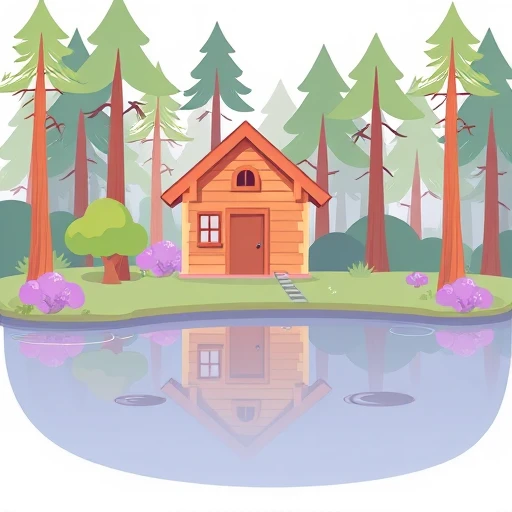
Imagine a small wooden cabin sitting perfectly still next to a clear blue pond surrounded by green trees.
Word Web
Challenge
Try to use 'Walden' in a sentence about your favorite quiet place this week.
Word Origin
The name Walden is of Old English origin. It is a topographic name for someone who lived in a 'wooded valley'.
Original meaning: Derived from 'weald' (forest/wood) and 'denu' (valley).
Germanic / Old English.Cultural Context
No major sensitivities, but be aware that for some, it represents a privileged form of 'playing at being poor'.
It is a core part of the American literary curriculum. Most Americans will recognize the name even if they haven't read the book.
Practice in Real Life
Real-World Contexts
Literature Class
- Thoreau's themes in Walden
- The structure of Walden
- Symbolism in Walden
- Walden as a memoir
Environmentalism
- The Walden legacy
- Preserving Walden
- Nature in Walden
- Walden and ecology
Minimalism
- A modern Walden
- Walden-inspired living
- The economy of Walden
- Simplifying like Walden
Travel
- Visiting Walden Pond
- Hiking at Walden
- The Walden reservation
- Thoreau's cabin site
Psychology
- A mental Walden
- Solitude at Walden
- Walden and mindfulness
- The Walden effect
Conversation Starters
"Have you ever felt the need to escape to your own Walden?"
"What do you think Thoreau would say about our modern smartphones?"
"Is it possible to live a 'Walden' life in a big city?"
"Which part of the Walden philosophy do you find most challenging?"
"If you could build a cabin anywhere for a Walden experiment, where would it be?"
Journal Prompts
Describe what your personal Walden would look like and what you would do there.
Thoreau said 'Simplify, simplify.' What are three things in your life you could simplify today?
Write about a time you felt a deep connection to nature, similar to the descriptions in Walden.
Do you think solitude is necessary for self-discovery? Why or why not, in the context of Walden?
If you had to live in a small cabin for two years, what five books would you take with you?
Frequently Asked Questions
10 questionsYes, Walden Pond is a real lake located in Concord, Massachusetts. It is a popular spot for swimming and hiking today.
The book was written by Henry David Thoreau and published in 1854. It is one of the most famous works in American literature.
It describes something that is simple, rustic, and focused on nature, similar to the lifestyle Thoreau lived at the pond.
Mostly, yes. He lived in a small cabin he built himself, but he often visited friends in the nearby town of Concord.
It is important because it teaches us about environmentalism, minimalism, and the value of thinking for ourselves.
Yes, the language is from the 19th century and the ideas are very deep, but many people find it very rewarding.
The original cabin is gone, but there is a very accurate replica near the pond that you can walk inside.
The main message is to 'simplify' your life so you can focus on what is truly important, like nature and your own thoughts.
It is about 61 acres, which is medium-sized for a pond. It is famous for being very deep and clear.
Not in a traditional way, but it is very spiritual. It focuses on finding God or a higher truth through nature.
Test Yourself 200 questions
Describe what a 'modern Walden' would look like for you.
Well written! Good try! Check the sample answer below.
Write a short paragraph about why people still read Walden today.
Well written! Good try! Check the sample answer below.
If you lived at Walden Pond, what would you miss most about the city?
Well written! Good try! Check the sample answer below.
Explain the phrase 'simplify, simplify' in your own words.
Well written! Good try! Check the sample answer below.
Compare the Walden lifestyle with your current lifestyle.
Well written! Good try! Check the sample answer below.
Write a letter to Thoreau asking him about his time at Walden.
Well written! Good try! Check the sample answer below.
Describe a place you know that is 'Walden-esque'.
Well written! Good try! Check the sample answer below.
What are the benefits of solitude, according to the Walden philosophy?
Well written! Good try! Check the sample answer below.
Write a poem about Walden Pond.
Well written! Good try! Check the sample answer below.
Do you think Thoreau's experiment was a success? Why or why not?
Well written! Good try! Check the sample answer below.
How does the book Walden influence environmentalism?
Well written! Good try! Check the sample answer below.
Describe a 'digital Walden' experience you have had.
Well written! Good try! Check the sample answer below.
What does 'self-reliance' mean to you in the context of Walden?
Well written! Good try! Check the sample answer below.
Write a review of the book Walden for a school newspaper.
Well written! Good try! Check the sample answer below.
How can someone find a Walden in a busy city?
Well written! Good try! Check the sample answer below.
Describe the physical setting of Walden Pond in autumn.
Well written! Good try! Check the sample answer below.
What are the main themes of Thoreau's Walden?
Well written! Good try! Check the sample answer below.
Write a dialogue between two people discussing the Walden experiment.
Well written! Good try! Check the sample answer below.
Is Walden still relevant in the 21st century? Argue your point.
Well written! Good try! Check the sample answer below.
Summarize the 'Economy' chapter of Walden.
Well written! Good try! Check the sample answer below.
Talk about a time you wanted to escape to a place like Walden.
Read this aloud:
You said:
Speech recognition is not supported in your browser. Try Chrome or Edge.
Explain the concept of Walden to a friend who has never heard of it.
Read this aloud:
You said:
Speech recognition is not supported in your browser. Try Chrome or Edge.
Discuss the pros and cons of living in a small cabin for two years.
Read this aloud:
You said:
Speech recognition is not supported in your browser. Try Chrome or Edge.
Pronounce the word 'Walden' correctly in a sentence.
Read this aloud:
You said:
Speech recognition is not supported in your browser. Try Chrome or Edge.
Debate whether Thoreau was a 'real' hermit or not.
Read this aloud:
You said:
Speech recognition is not supported in your browser. Try Chrome or Edge.
Describe your ideal 'personal Walden'.
Read this aloud:
You said:
Speech recognition is not supported in your browser. Try Chrome or Edge.
How does the idea of Walden apply to modern minimalism?
Read this aloud:
You said:
Speech recognition is not supported in your browser. Try Chrome or Edge.
Talk about the importance of nature in your life.
Read this aloud:
You said:
Speech recognition is not supported in your browser. Try Chrome or Edge.
Explain the phrase 'different drummer' and how it relates to Walden.
Read this aloud:
You said:
Speech recognition is not supported in your browser. Try Chrome or Edge.
What would you bring with you to a Walden experiment today?
Read this aloud:
You said:
Speech recognition is not supported in your browser. Try Chrome or Edge.
Discuss the impact of Walden on environmental activism.
Read this aloud:
You said:
Speech recognition is not supported in your browser. Try Chrome or Edge.
Talk about a book that changed your perspective, like Walden changed others'.
Read this aloud:
You said:
Speech recognition is not supported in your browser. Try Chrome or Edge.
How can we 'simplify' our lives in the digital age?
Read this aloud:
You said:
Speech recognition is not supported in your browser. Try Chrome or Edge.
Describe Walden Pond based on what you have learned.
Read this aloud:
You said:
Speech recognition is not supported in your browser. Try Chrome or Edge.
Is the Walden ideal possible for everyone, or just the wealthy?
Read this aloud:
You said:
Speech recognition is not supported in your browser. Try Chrome or Edge.
Talk about the relationship between solitude and creativity.
Read this aloud:
You said:
Speech recognition is not supported in your browser. Try Chrome or Edge.
Summarize the main points of Thoreau's philosophy.
Read this aloud:
You said:
Speech recognition is not supported in your browser. Try Chrome or Edge.
What is the most famous quote from Walden? Say it and explain it.
Read this aloud:
You said:
Speech recognition is not supported in your browser. Try Chrome or Edge.
Discuss the irony of Thoreau's mother doing his laundry.
Read this aloud:
You said:
Speech recognition is not supported in your browser. Try Chrome or Edge.
If you could visit Walden Pond, what would you do there?
Read this aloud:
You said:
Speech recognition is not supported in your browser. Try Chrome or Edge.
Listen to a recording of a passage from Walden. What is the main idea?
Listen to a podcast about Thoreau. Where did he go to college?
Listen to a travel guide for Walden Pond. How deep is the water?
Listen to a discussion on Transcendentalism. Name one other author mentioned.
Listen to the pronunciation of 'Walden'. Repeat it three times.
Listen to a song about nature. Does it mention Walden?
Listen to a lecture on 'Economy' in Walden. What is Thoreau's definition of cost?
Listen to an interview with a minimalist. How do they use the word Walden?
Listen to a news report about conservation at Walden Pond.
Listen to a reading of 'Solitude'. What sounds does Thoreau hear?
Listen to a description of the replica cabin. What furniture is inside?
Listen to a poem about Walden. What is the central metaphor?
Listen to a debate about Thoreau's politics. What war did he protest?
Listen to a child's story about a man in the woods. Is it Walden?
Listen to the sound of Walden Pond (water/birds). Describe it.
/ 200 correct
Perfect score!
Summary
Walden is more than a place; it is a philosophy of 'deliberate living' that encourages us to strip away life's unnecessary complexities to find our true selves in nature. Example: 'In our digital age, finding a Walden is harder but more necessary than ever.'
- A proper noun referring to Walden Pond in Massachusetts, USA.
- The title of Henry David Thoreau's 1854 book about simple living.
- A metaphor for a lifestyle of self-reliance and nature-focused solitude.
- A symbol of resistance against consumerism and the 'rat race' of society.
Capitalize It
Always remember that Walden is a proper noun. Even when you use it as a metaphor, keep the 'W' capitalized.
Pair with 'Pond'
When talking about the location, usually say 'Walden Pond' to be clear.
Use '-esque'
Adding '-esque' is a great way to turn Walden into an adjective to describe a cozy, simple room or cabin.
Mention Thoreau
If you use the word in an essay, mentioning Henry David Thoreau will show you know the history.