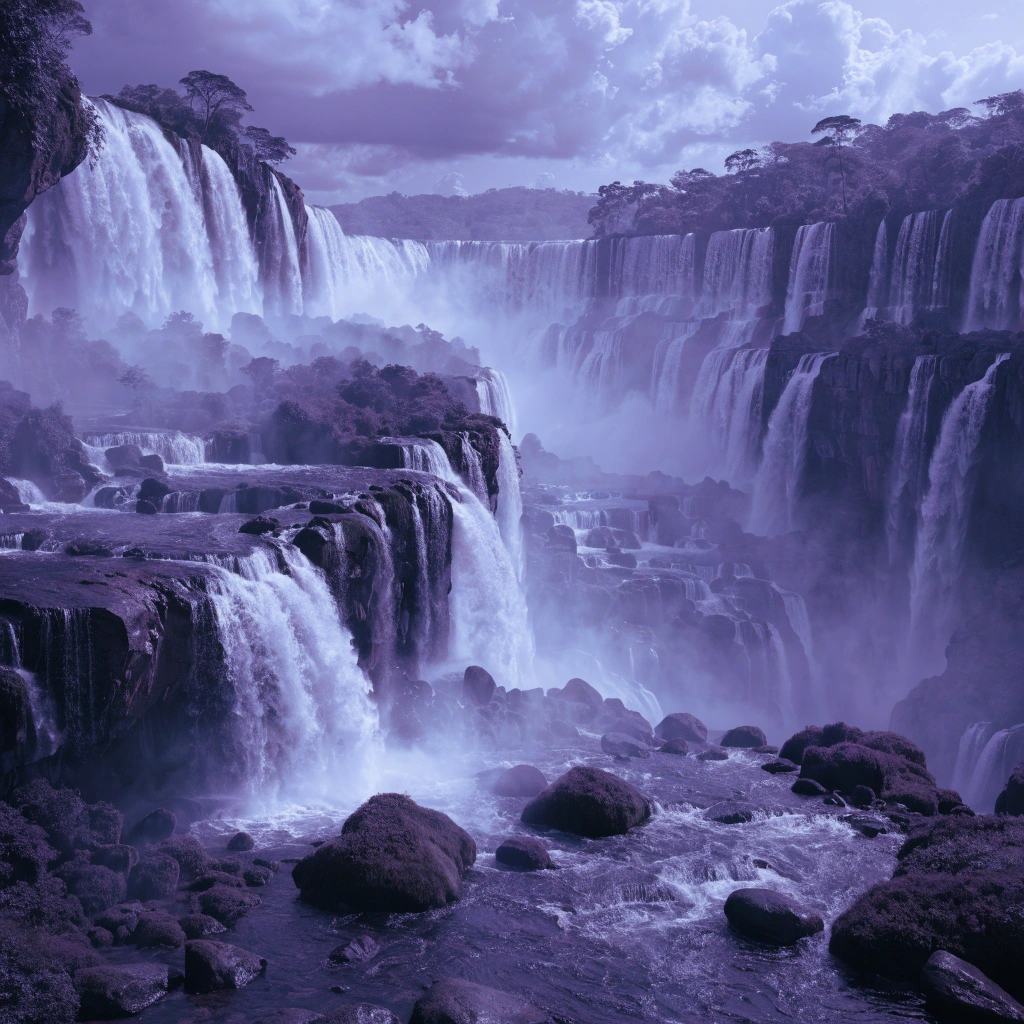
The Big Waterfalls of Iguazu
Iguazu Falls is a very big waterfall. It is in Brazil and Argentina. The water is very loud and beautiful. The name Iguazu means "big water."
Many people visit this place every year. There are many green trees and birds in the forest. You can see many waterfalls here. One part is the Devil's Throat. It is very tall and famous.
You can walk on paths or take a boat. The water is cold but the sun is hot. It is a wonderful place for a holiday.
Gramática em destaque
Padrão: Present Simple 'to be'
"Iguazu Falls is a very big waterfall."
We use 'is' for singular subjects and 'are' for plural subjects to state facts. In this sentence, it describes what the falls are.
Padrão: Modal Verb 'can'
"You can see many waterfalls here."
We use 'can' to talk about things that are possible. It is followed by the base form of the verb without 'to'.
Teste sua compreensão
10 perguntas · A1 Iniciante · 1 pré-visualização grátis
Teste o que aprendeu neste artigo. Responda todas as perguntas para ganhar XP!
Where is Iguazu Falls located?
Quer finalizar o quiz?
9 perguntas a mais estão esperando por você. Cadastre-se grátis para desbloquear o quiz completo e ganhar XP!
Cadastrar grátisJá tem conta? Entrar
Detalhamento das perguntas
Where is Iguazu Falls located?
Sua resposta:
Resposta correta: Brazil and Argentina
The water at the falls is very quiet.
Sua resposta:
Resposta correta: Falso
What does 'famous' mean?
Sua resposta:
Resposta correta: Known by many people
You can walk on _____ to see the waterfalls.
Sua resposta:
Resposta correta: paths
The Amazing Iguazu Falls
Iguazu Falls is a famous natural wonder on the border of Brazil and Argentina. The name comes from the Guarani language. In this language, 'I' means water and 'guazu' means big. It is one of the biggest waterfall systems in the world. It is wider than the Victoria Falls in Africa.
Long ago, the local people told a famous legend about the falls. A god wanted to marry a beautiful woman named Naipí. However, she loved a man named Tarobá. They tried to escape in a boat, but the god was very angry. He changed the river and created the huge waterfalls to stop them.
Today, many tourists visit the falls because the views are beautiful. You can walk on bridges or take a boat to see the water. The forest around the falls is also special. It is home to many birds and animals. It is more exciting than a normal park because nature is everywhere.
Gramática em destaque
Padrão: Comparatives
"It is wider than the Victoria Falls in Africa."
We use comparatives to compare two things. For short adjectives, we add '-er' and use 'than' after the adjective.
Padrão: Past Simple
"A god wanted to marry a beautiful woman named Naipí."
We use the past simple to talk about actions that finished in the past. For regular verbs, we add '-ed' to the base form.
Teste sua compreensão
11 perguntas · A2 Elementar · 1 pré-visualização grátis
Teste o que aprendeu neste artigo. Responda todas as perguntas para ganhar XP!
Where are the Iguazu Falls located?
Quer finalizar o quiz?
10 perguntas a mais estão esperando por você. Cadastre-se grátis para desbloquear o quiz completo e ganhar XP!
Cadastrar grátisJá tem conta? Entrar
Detalhamento das perguntas
Where are the Iguazu Falls located?
Sua resposta:
Resposta correta: On the border of Brazil and Argentina
The word 'guazu' means big in the Guarani language.
Sua resposta:
Resposta correta: Verdadeiro
What is a 'wonder'?
Sua resposta:
Resposta correta: Something very beautiful and surprising
The name comes from the Guarani _____.
Sua resposta:
Resposta correta: language
Who was Tarobá in the legend?
Sua resposta:
Resposta correta: Naipí's lover
The Majestic Wonder of Iguazu Falls
Iguazu Falls, which is located on the border between Brazil and Argentina, is one of the most spectacular natural wonders on Earth. The name 'Iguazu' comes from the indigenous Guarani words 'y' and 'guasu'. This name simply means 'big water', and it is a perfect description for this massive system of cataracts. The falls are surrounded by the lush Atlantic Forest, a region that is famous for its incredible biodiversity.
The falls have been recognized as a UNESCO World Heritage site for many years. The entire system consists of approximately 275 individual drops, spanning nearly three kilometers in width. The most famous part is known as the 'Devil's Throat', where a huge amount of water falls into a deep canyon. It is often said that the sound of the crashing water can be heard from several kilometers away.
According to an ancient legend, the falls were created by a powerful deity. The story tells of a beautiful woman named Naipí, who fled with her mortal lover, Tarobá, in a canoe. The deity was so angry that he sliced the river to stop them, creating the permanent waterfalls we see today.
In modern times, the boundary between the two countries is managed carefully. Tourism has increased significantly in recent years, but conservation efforts are in place to protect the environment. Visitors are encouraged to walk along the special paths to enjoy the view without damaging the forest. It is truly a place where the power of nature is felt by everyone who visits.
Gramática em destaque
Padrão: Relative Clauses
"Iguazu Falls, which is located on the border between Brazil and Argentina, is one of the most spectacular natural wonders on Earth."
Non-defining relative clauses provide extra information about a noun using 'which' or 'who'. They are separated by commas and are common in descriptive writing.
Padrão: Present Perfect Passive
"The falls have been recognized as a UNESCO World Heritage site for many years."
This is formed using 'have/has been' + past participle. It describes an action that started in the past and continues to be true, focusing on the receiver of the action.
Teste sua compreensão
11 perguntas · B1 Intermediário · 1 pré-visualização grátis
Teste o que aprendeu neste artigo. Responda todas as perguntas para ganhar XP!
Where is Iguazu Falls located?
Quer finalizar o quiz?
10 perguntas a mais estão esperando por você. Cadastre-se grátis para desbloquear o quiz completo e ganhar XP!
Cadastrar grátisJá tem conta? Entrar
Detalhamento das perguntas
Where is Iguazu Falls located?
Sua resposta:
Resposta correta: On the border of Brazil and Argentina
The name 'Iguazu' means 'Small River' in the Guarani language.
Sua resposta:
Resposta correta: Falso
What does 'deity' mean?
Sua resposta:
Resposta correta: A god or goddess
The most famous part of the waterfalls is called the Devil's _____.
Sua resposta:
Resposta correta: Throat
Why was the deity in the legend angry?
Sua resposta:
Resposta correta: Because Naipí fled with her lover
The Sublime Majesty of Iguazu Falls: A Natural Masterpiece
Deep within the lush Atlantic Forest, on the border where Brazil meets Argentina, lies the sprawling Iguazu Falls. Known locally as Cataratas do Iguaçu, this immense waterfall system is widely considered one of the most spectacular natural wonders on Earth. The name 'Iguazu' originates from the indigenous Guarani words 'y', meaning water, and 'guasu', meaning big. While the description is simple, the reality of the site is incredibly intricate, consisting of approximately 275 individual drops that span nearly three kilometers in width.
Legend and history are deeply intertwined within this landscape. According to Guarani mythology, a deity planned to marry a beautiful woman named Naipí, who instead fled with her mortal lover in a canoe. In a fit of rage, the deity sliced the river, creating the waterfalls to condemn the lovers to an eternal fall. Beyond these captivating myths, the falls hold significant ecological value. They were designated as a UNESCO World Heritage site in 1986, primarily due to the unrivaled biodiversity found in the surrounding rainforest. This ecosystem provides a habitat for various endangered species, including the giant otter and the jaguar.
From an analytical perspective, Iguazu Falls offers a fascinating study in the balance between tourism and conservation. While the site attracts millions of visitors annually, which boosts the local economy, it also necessitates rigorous management to prevent environmental degradation. Visitors often stand in awe at the 'Devil’s Throat' (Garganta del Diablo), a U-shaped cliff where the water’s roar is deafening. It is said that upon seeing Iguazu, former US First Lady Eleanor Roosevelt exclaimed, 'Poor Niagara!', highlighting the sheer scale of this South American marvel.
Furthermore, the sheer power of the water is not merely a visual spectacle; it is a testament to the raw energy of nature. If the surrounding forest had not been protected by international agreements, much of this unique flora and fauna might have vanished by now. Consequently, the preservation of Iguazu is not only a matter of national pride for Brazil and Argentina but also a global responsibility. Rarely can one witness such a harmonious, yet powerful, display of natural forces. As we move forward into an era of climate uncertainty, protecting such sublime locations becomes increasingly vital for future generations to experience the same sense of wonder.
Gramática em destaque
Padrão: Passive Voice
"They were designated as a UNESCO World Heritage site in 1986."
The passive voice is used here to focus on the falls (the object) rather than the organization that gave them the status. It is formed using 'were' + the past participle 'designated'.
Padrão: Third Conditional
"If the surrounding forest had not been protected by international agreements, much of this unique flora and fauna might have vanished by now."
This structure describes a hypothetical situation in the past. It uses 'if' + past perfect, followed by 'might have' + past participle to show a possible past outcome that did not happen.
Padrão: Negative Inversion
"Rarely can one witness such a harmonious, yet powerful, display of natural forces."
When a sentence starts with a negative or restrictive adverb like 'rarely', the auxiliary verb 'can' comes before the subject 'one'. This is used for formal emphasis.
Teste sua compreensão
11 perguntas · B2 Intermediário superior · 1 pré-visualização grátis
Teste o que aprendeu neste artigo. Responda todas as perguntas para ganhar XP!
What is the primary reason the falls were named a UNESCO World Heritage site?
Quer finalizar o quiz?
10 perguntas a mais estão esperando por você. Cadastre-se grátis para desbloquear o quiz completo e ganhar XP!
Cadastrar grátisJá tem conta? Entrar
Detalhamento das perguntas
What is the primary reason the falls were named a UNESCO World Heritage site?
Sua resposta:
Resposta correta: The unique biodiversity of the surrounding forest
Eleanor Roosevelt believed Niagara Falls was more impressive than Iguazu Falls.
Sua resposta:
Resposta correta: Falso
What does the word 'intricate' mean in the context of the article?
Sua resposta:
Resposta correta: Highly detailed and complex
The name Iguazu comes from the _____ words for 'water' and 'big'.
Sua resposta:
Resposta correta: indigenous
According to the text, what is a major challenge for the management of the falls?
Sua resposta:
Resposta correta: Balancing tourism with environmental conservation
Cataratas do Iguaçu: O Esplendor Natural e a Lenda que o Cerca
No coração da exuberante Mata Atlântica, na fronteira entre o Brasil e a Argentina, jazem as Cataratas do Iguaçu, uma das mais espetaculares maravilhas naturais do nosso planeta. É a grandiosidade de suas quedas, a sobrepujante beleza que desafia a compreensão humana, que anualmente atrai milhões de visitantes, seduzidos pela promessa de um espetáculo inigualável. A etimologia do nome 'Iguaçu', de origem Guarani, é por si só um testemunho da simplicidade e da força do fenômeno: 'y' significa água e 'guasu' remete a grande. Uma descrição concisa, porém perfeitamente adequada, para um sistema de quedas d'água que se estende por quase três quilômetros de largura.
A lenda, intrínseca à cultura local, narra a trágica história de um deus que, enfurecido pela fuga de Naipí – uma bela mulher destinada a ser sua esposa – com seu amado mortal Tarobá em uma canoa, fendeu a terra, criando as cataratas e condenando os amantes a uma queda eterna. Seria, pois, um equívoco reduzir tal complexidade natural e cultural a uma mera atração turística; é um santuário ecológico e um repositório de narrativas ancestrais que moldam a identidade da região.
A observação da magnitude das Cataratas, seja do lado brasileiro, com suas panorâmicas deslumbrantes, seja do lado argentino, que oferece uma imersão mais próxima às quedas, revela a diversidade de perspectivas sobre um mesmo fenômeno. A Garganta do Diabo, ponto culminante do conjunto, é onde a força da natureza se manifesta em sua plenitude mais avassaladora, com um volume de água que desafia a imaginação e um estrondo que ecoa pela floresta, um lembrete constante da potência geológica que a delineou.
Além da imponente beleza aquática, o ecossistema circundante é um paraíso de biodiversidade. A Mata Atlântica, bioma ao qual as cataratas estão entrelaçadas, é um dos mais ricos e ameaçados do mundo, servindo de lar para inúmeras espécies de fauna e flora. A presença de tucanos, quatis e uma miríade de borboletas é uma constante, contribuindo para a experiência sensorial que vai muito além da visão das quedas. A preservação deste patrimônio natural é uma responsabilidade coletiva, cuja negligência teria repercussões globais.
É imperativo reconhecer que o turismo sustentável e a conscientização ambiental são as molas propulsoras para a perpetuação desse tesouro. A visita às Cataratas do Iguaçu não é apenas um passeio turístico; é uma oportunidade de reflexão sobre a interconexão entre a natureza e a cultura, sobre a efemeridade da existência humana diante da perenidade da Terra. A experiência é transformadora, um convite à admiração e ao respeito por um dos mais grandiosos espetáculos que a natureza nos oferece, um paradigma da beleza selvagem e intocada.
Gramática em destaque
Padrão: Nominalização (Transformação de Verbos/Adjetivos em Substantivos)
"A observação da magnitude das Cataratas, seja do lado brasileiro, com suas panorâmicas deslumbrantes, seja do lado argentino, que oferece uma imersão mais próxima às quedas, revela a diversidade de perspectivas sobre um mesmo fenômeno."
A nominalização consiste em transformar verbos ou adjetivos em substantivos, enriquecendo a linguagem e tornando-a mais formal. No exemplo, 'observar' (verbo) virou 'observação' (substantivo), e 'magnífico' (adjetivo) virou 'magnitude' (substantivo), permitindo construir frases mais densas e complexas.
Padrão: Orações Cleft (Frases Cindidas)
"É a grandiosidade de suas quedas, a sobrepujante beleza que desafia a compreensão humana, que anualmente atrai milhões de visitantes, seduzidos pela promessa de um espetáculo inigualável."
As frases cindidas, ou 'cleft sentences', são usadas para dar ênfase a uma parte específica da oração. Geralmente seguem a estrutura 'É X que Y...', destacando 'X'. Neste caso, a ênfase recai sobre a 'grandiosidade' e 'beleza' das quedas como o fator de atração.
Padrão: Inversão Sintática para Ênfase ou Estilo
"Seria, pois, um equívoco reduzir tal complexidade natural e cultural a uma mera atração turística; é um santuário ecológico e um repositório de narrativas ancestrais que moldam a identidade da região."
A inversão sintática altera a ordem natural das palavras na frase (sujeito-verbo-objeto), frequentemente para dar maior destaque a um elemento ou para um efeito estilístico. No exemplo, 'Seria um equívoco, pois...' foi invertido para 'Seria, pois, um equívoco...', conferindo um tom mais formal e enfático à crítica.
Teste sua compreensão
12 perguntas · C1 Avançado · 1 pré-visualização grátis
Teste o que aprendeu neste artigo. Responda todas as perguntas para ganhar XP!
Qual é a principal característica que o artigo destaca sobre as Cataratas do Iguaçu?
Quer finalizar o quiz?
11 perguntas a mais estão esperando por você. Cadastre-se grátis para desbloquear o quiz completo e ganhar XP!
Cadastrar grátisJá tem conta? Entrar
Detalhamento das perguntas
Qual é a principal característica que o artigo destaca sobre as Cataratas do Iguaçu?
Sua resposta:
Resposta correta: A grandiosidade e beleza natural que atraem milhões de visitantes.
A lenda Guarani sobre as Cataratas do Iguaçu envolve um deus enfurecido que as criou após a fuga de uma mulher com seu amado.
Sua resposta:
Resposta correta: Verdadeiro
O que significa 'sobrepujante' no contexto do artigo?
Sua resposta:
Resposta correta: Que excede ou ultrapassa em grandeza.
A Garganta do Diabo é o ponto ______ do conjunto das Cataratas, onde a força da natureza se manifesta em sua plenitude.
Sua resposta:
Resposta correta: culminante
Segundo o artigo, qual a importância do ecossistema circundante às Cataratas?
Sua resposta:
Resposta correta: É um paraíso de biodiversidade, lar de muitas espécies.
O artigo sugere que a preservação das Cataratas do Iguaçu é uma responsabilidade exclusiva do governo brasileiro.
Sua resposta:
Resposta correta: Falso
The Sublime Dichotomy of the Iguazu Falls: An Ontological Exploration of Hydraulic Grandeur
Seldom has the human spirit encountered a spectacle so profoundly humbling as the Iguazu Falls. Nestled within the verdant embrace of the Atlantic Forest on the border between Brazil and Argentina, this hydraulic behemoth transcends mere geographical classification, manifesting instead as a visceral testament to the indomitable forces of nature. To witness the Iguazu is not merely to observe a topographical anomaly; rather, it is to engage with the sublime—a state where beauty and terror coalesce in a cacophony of white water and mist. The nomenclature itself, derived from the indigenous Guarani words 'y' and 'guasu', meaning 'big water', is perhaps the only instance where linguistic simplicity suffices to describe a phenomenon of such staggering complexity. Spanning nearly three kilometers, the falls comprise an intricate archipelago of cascades, the most formidable of which is the Garganta del Diablo, or Devil’s Throat.
Were one to traverse the precarious catwalks that extend over the precipice, the sensory assault would be immediate. The sheer volume of water—averaging some 1,500 cubic meters per second—creates a microclimate of perpetual rain and iridescent rainbows. Yet, beneath this empirical data lies a primordial narrative. Legend posits that the falls were birthed from divine indignation. It is said that a deity, spurned by a mortal woman named Naipí who fled with her lover Tarobá, cleaved the riverbed in a fit of rage, condemning the pair to an eternal fall. While such mythological explanations may be dismissed by the modern rationalist as mere folklore, they encapsulate the visceral impact the site has upon the human psyche. The legend serves as a metaphor for the raw, unbridled power that characterizes the Atlantic Forest’s most iconic feature, suggesting that the falls are not a static monument but a living, breathing entity.
From an ecological perspective, the Iguazu Falls represent a critical confluence of biodiversity. The surrounding rainforest, though fragmented elsewhere, remains relatively intact here, providing a sanctuary for species that would otherwise face extinction. However, the intersection of conservation and mass tourism presents a complex ethical quandary. Should the preservation of the site’s integrity be prioritized over the accessibility that fosters global appreciation? It is axiomatic that the influx of millions of visitors necessitates a robust infrastructure, yet this very development threatens the ephemeral stillness of the forest. Academic hedging is required when discussing the long-term sustainability of such sites; while current management strategies appear effective, the encroaching pressures of climate change and regional deforestation cast a long shadow over the falls’ future sovereignty.
Ultimately, the Iguazu Falls demand a shift in perspective. They challenge the anthropocentric view that nature is a resource to be harnessed. Instead, they stand as a reminder of our own insignificance. The roar of the water, a constant and deafening presence, renders human speech redundant, forcing a contemplative silence. In this space, the distinction between the observer and the observed begins to blur. Whether viewed through the lens of geology, mythology, or environmental science, the falls remain an enigma—a transient yet eternal display of gravity’s indomitable will. To stand at the edge of the Devil’s Throat is to look into the abyss and find, surprisingly, not a void, but a profound fullness of being.
Gramática em destaque
Padrão: Inversion with Negative Adverbials
"Seldom has the human spirit encountered a spectacle so profoundly humbling as the Iguazu Falls."
When 'seldom' or other negative adverbs start a sentence, the auxiliary verb is placed before the subject. This is used in formal English to create emphasis or a dramatic tone.
Padrão: Inverted Conditionals (Second Conditional)
"Were one to traverse the precarious catwalks that extend over the precipice, the sensory assault would be immediate."
This structure replaces 'If one were to traverse...' by omitting 'if' and placing the verb 'were' at the beginning. It is highly formal and common in academic or literary writing.
Padrão: Subjunctive Mood for Hypothetical Situations
"Should the preservation of the site’s integrity be prioritized over the accessibility that fosters global appreciation?"
The use of 'should' at the start of the question functions as a formal conditional structure, exploring a theoretical or ethical debate regarding future actions.
Teste sua compreensão
12 perguntas · C2 Domínio · 1 pré-visualização grátis
Teste o que aprendeu neste artigo. Responda todas as perguntas para ganhar XP!
What does the author suggest about the name 'Iguazu'?
Quer finalizar o quiz?
11 perguntas a mais estão esperando por você. Cadastre-se grátis para desbloquear o quiz completo e ganhar XP!
Cadastrar grátisJá tem conta? Entrar
Detalhamento das perguntas
What does the author suggest about the name 'Iguazu'?
Sua resposta:
Resposta correta: It is one of the few times simple language effectively describes the site.
The author argues that mythological explanations of the falls are completely irrelevant to modern visitors.
Sua resposta:
Resposta correta: Falso
Which word is synonymous with 'self-evident' in the context of the article?
Sua resposta:
Resposta correta: Axiomatic
The author describes the falls as an 'intricate _____ of cascades'.
Sua resposta:
Resposta correta: archipelago
What is the primary 'ethical quandary' mentioned in the text?
Sua resposta:
Resposta correta: The balance between ecological conservation and tourist access.
The author believes the falls remind humans of their own power and dominance over nature.
Sua resposta:
Resposta correta: Falso

