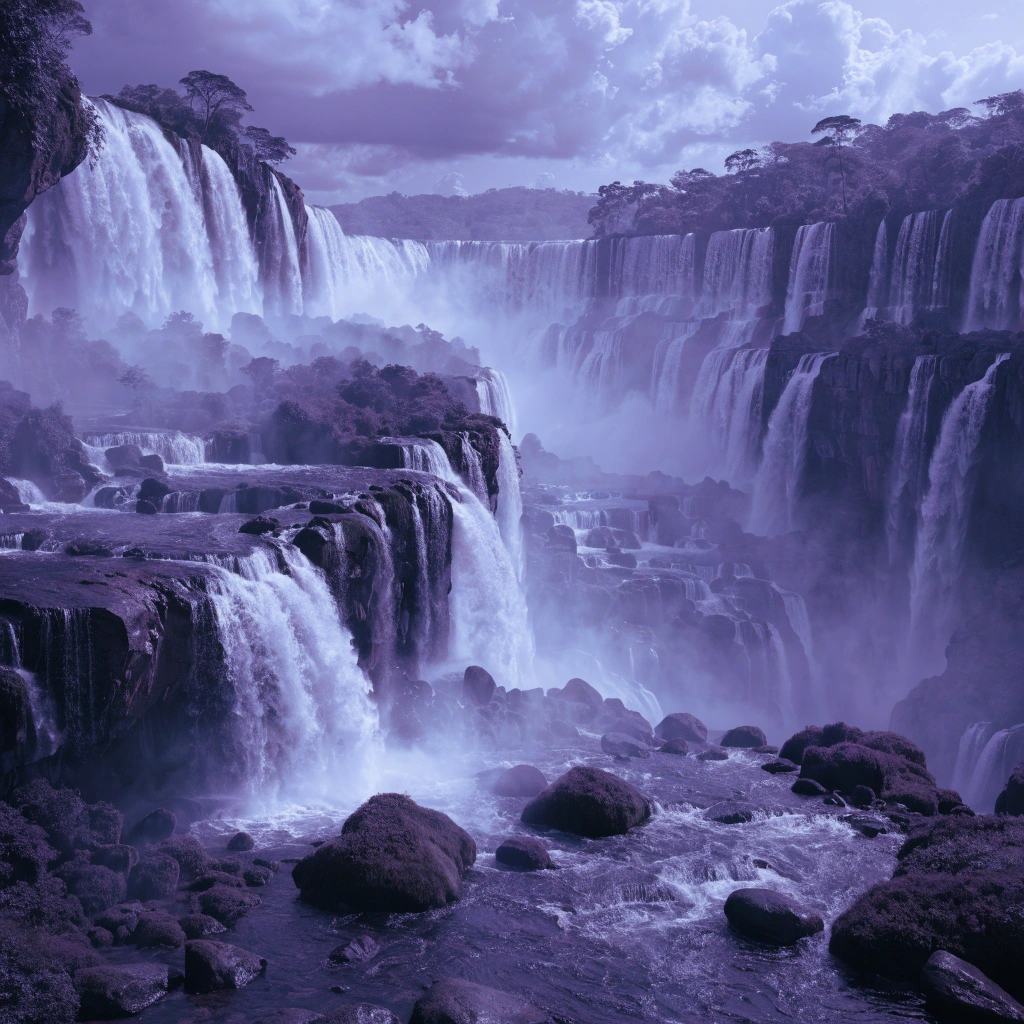
The Big Waterfalls of Iguazu
Iguazu Falls is a very big waterfall. It is in Brazil and Argentina. The water is very loud and beautiful. The name Iguazu means "big water."
Many people visit this place every year. There are many green trees and birds in the forest. You can see many waterfalls here. One part is the Devil's Throat. It is very tall and famous.
You can walk on paths or take a boat. The water is cold but the sun is hot. It is a wonderful place for a holiday.
语法聚焦
句型: Present Simple 'to be'
"Iguazu Falls is a very big waterfall."
We use 'is' for singular subjects and 'are' for plural subjects to state facts. In this sentence, it describes what the falls are.
句型: Modal Verb 'can'
"You can see many waterfalls here."
We use 'can' to talk about things that are possible. It is followed by the base form of the verb without 'to'.
测试你的理解
10 个问题 · A1 初学 · 1 次免费预览
测试你从这篇文章中学到的知识。回答所有问题即可获得经验值!
题目详情
Where is Iguazu Falls located?
你的回答:
正确答案: Brazil and Argentina
The water at the falls is very quiet.
你的回答:
正确答案: 错误
What does 'famous' mean?
你的回答:
正确答案: Known by many people
You can walk on _____ to see the waterfalls.
你的回答:
正确答案: paths
The Amazing Iguazu Falls
Iguazu Falls is a famous natural wonder on the border of Brazil and Argentina. The name comes from the Guarani language. In this language, 'I' means water and 'guazu' means big. It is one of the biggest waterfall systems in the world. It is wider than the Victoria Falls in Africa.
Long ago, the local people told a famous legend about the falls. A god wanted to marry a beautiful woman named Naipí. However, she loved a man named Tarobá. They tried to escape in a boat, but the god was very angry. He changed the river and created the huge waterfalls to stop them.
Today, many tourists visit the falls because the views are beautiful. You can walk on bridges or take a boat to see the water. The forest around the falls is also special. It is home to many birds and animals. It is more exciting than a normal park because nature is everywhere.
语法聚焦
句型: Comparatives
"It is wider than the Victoria Falls in Africa."
We use comparatives to compare two things. For short adjectives, we add '-er' and use 'than' after the adjective.
句型: Past Simple
"A god wanted to marry a beautiful woman named Naipí."
We use the past simple to talk about actions that finished in the past. For regular verbs, we add '-ed' to the base form.
测试你的理解
11 个问题 · A2 基础 · 1 次免费预览
测试你从这篇文章中学到的知识。回答所有问题即可获得经验值!
Where are the Iguazu Falls located?
题目详情
Where are the Iguazu Falls located?
你的回答:
正确答案: On the border of Brazil and Argentina
The word 'guazu' means big in the Guarani language.
你的回答:
正确答案: 正确
What is a 'wonder'?
你的回答:
正确答案: Something very beautiful and surprising
The name comes from the Guarani _____.
你的回答:
正确答案: language
Who was Tarobá in the legend?
你的回答:
正确答案: Naipí's lover
The Majestic Wonder of Iguazu Falls
Iguazu Falls, which is located on the border between Brazil and Argentina, is one of the most spectacular natural wonders on Earth. The name 'Iguazu' comes from the indigenous Guarani words 'y' and 'guasu'. This name simply means 'big water', and it is a perfect description for this massive system of cataracts. The falls are surrounded by the lush Atlantic Forest, a region that is famous for its incredible biodiversity.
The falls have been recognized as a UNESCO World Heritage site for many years. The entire system consists of approximately 275 individual drops, spanning nearly three kilometers in width. The most famous part is known as the 'Devil's Throat', where a huge amount of water falls into a deep canyon. It is often said that the sound of the crashing water can be heard from several kilometers away.
According to an ancient legend, the falls were created by a powerful deity. The story tells of a beautiful woman named Naipí, who fled with her mortal lover, Tarobá, in a canoe. The deity was so angry that he sliced the river to stop them, creating the permanent waterfalls we see today.
In modern times, the boundary between the two countries is managed carefully. Tourism has increased significantly in recent years, but conservation efforts are in place to protect the environment. Visitors are encouraged to walk along the special paths to enjoy the view without damaging the forest. It is truly a place where the power of nature is felt by everyone who visits.
语法聚焦
句型: Relative Clauses
"Iguazu Falls, which is located on the border between Brazil and Argentina, is one of the most spectacular natural wonders on Earth."
Non-defining relative clauses provide extra information about a noun using 'which' or 'who'. They are separated by commas and are common in descriptive writing.
句型: Present Perfect Passive
"The falls have been recognized as a UNESCO World Heritage site for many years."
This is formed using 'have/has been' + past participle. It describes an action that started in the past and continues to be true, focusing on the receiver of the action.
测试你的理解
11 个问题 · B1 中级 · 1 次免费预览
测试你从这篇文章中学到的知识。回答所有问题即可获得经验值!
题目详情
Where is Iguazu Falls located?
你的回答:
正确答案: On the border of Brazil and Argentina
The name 'Iguazu' means 'Small River' in the Guarani language.
你的回答:
正确答案: 错误
What does 'deity' mean?
你的回答:
正确答案: A god or goddess
The most famous part of the waterfalls is called the Devil's _____.
你的回答:
正确答案: Throat
Why was the deity in the legend angry?
你的回答:
正确答案: Because Naipí fled with her lover
The Sublime Majesty of Iguazu Falls: A Natural Masterpiece
Deep within the lush Atlantic Forest, on the border where Brazil meets Argentina, lies the sprawling Iguazu Falls. Known locally as Cataratas do Iguaçu, this immense waterfall system is widely considered one of the most spectacular natural wonders on Earth. The name 'Iguazu' originates from the indigenous Guarani words 'y', meaning water, and 'guasu', meaning big. While the description is simple, the reality of the site is incredibly intricate, consisting of approximately 275 individual drops that span nearly three kilometers in width.
Legend and history are deeply intertwined within this landscape. According to Guarani mythology, a deity planned to marry a beautiful woman named Naipí, who instead fled with her mortal lover in a canoe. In a fit of rage, the deity sliced the river, creating the waterfalls to condemn the lovers to an eternal fall. Beyond these captivating myths, the falls hold significant ecological value. They were designated as a UNESCO World Heritage site in 1986, primarily due to the unrivaled biodiversity found in the surrounding rainforest. This ecosystem provides a habitat for various endangered species, including the giant otter and the jaguar.
From an analytical perspective, Iguazu Falls offers a fascinating study in the balance between tourism and conservation. While the site attracts millions of visitors annually, which boosts the local economy, it also necessitates rigorous management to prevent environmental degradation. Visitors often stand in awe at the 'Devil’s Throat' (Garganta del Diablo), a U-shaped cliff where the water’s roar is deafening. It is said that upon seeing Iguazu, former US First Lady Eleanor Roosevelt exclaimed, 'Poor Niagara!', highlighting the sheer scale of this South American marvel.
Furthermore, the sheer power of the water is not merely a visual spectacle; it is a testament to the raw energy of nature. If the surrounding forest had not been protected by international agreements, much of this unique flora and fauna might have vanished by now. Consequently, the preservation of Iguazu is not only a matter of national pride for Brazil and Argentina but also a global responsibility. Rarely can one witness such a harmonious, yet powerful, display of natural forces. As we move forward into an era of climate uncertainty, protecting such sublime locations becomes increasingly vital for future generations to experience the same sense of wonder.
语法聚焦
句型: Passive Voice
"They were designated as a UNESCO World Heritage site in 1986."
The passive voice is used here to focus on the falls (the object) rather than the organization that gave them the status. It is formed using 'were' + the past participle 'designated'.
句型: Third Conditional
"If the surrounding forest had not been protected by international agreements, much of this unique flora and fauna might have vanished by now."
This structure describes a hypothetical situation in the past. It uses 'if' + past perfect, followed by 'might have' + past participle to show a possible past outcome that did not happen.
句型: Negative Inversion
"Rarely can one witness such a harmonious, yet powerful, display of natural forces."
When a sentence starts with a negative or restrictive adverb like 'rarely', the auxiliary verb 'can' comes before the subject 'one'. This is used for formal emphasis.
测试你的理解
11 个问题 · B2 中高级 · 1 次免费预览
测试你从这篇文章中学到的知识。回答所有问题即可获得经验值!
What is the primary reason the falls were named a UNESCO World Heritage site?
题目详情
What is the primary reason the falls were named a UNESCO World Heritage site?
你的回答:
正确答案: The unique biodiversity of the surrounding forest
Eleanor Roosevelt believed Niagara Falls was more impressive than Iguazu Falls.
你的回答:
正确答案: 错误
What does the word 'intricate' mean in the context of the article?
你的回答:
正确答案: Highly detailed and complex
The name Iguazu comes from the _____ words for 'water' and 'big'.
你的回答:
正确答案: indigenous
According to the text, what is a major challenge for the management of the falls?
你的回答:
正确答案: Balancing tourism with environmental conservation
The Sublimity of Iguazu: A Confluence of Myth, Ecology, and Geopolitical Stewardship
The sheer magnitude of the Iguazu Falls, situated at the intersection of Brazil and Argentina, defies simple categorization. This geological marvel, sprawling across nearly three kilometers of the Atlantic Forest, represents a profound confluence of primordial power and ecological fragility. Rarely does a landscape so perfectly mirror the turbulence of its origin myths as these cataracts do. According to indigenous Guarani legend, the falls were birthed from the sudden, vengeful wrath of a deity whose intended bride, Naipí, fled with her mortal lover, Tarobá, in a canoe. The resulting abyss, created to sever their escape route, remains a visceral reminder of indomitable passion and divine retribution.
From a purely geological perspective, it is the convergence of basaltic layers and tectonic shifts that has sculpted this labyrinthine network of approximately 275 distinct drops. The most formidable of these, the 'Devil’s Throat' (Garganta do Diabo), serves as the staggering centerpiece of the entire system. Here, the juxtaposition of the verdant, humid Atlantic Forest against the violent white water creates an aesthetic tension that is both haunting and sublime. Not only does the spray create perpetual rainbows that dance across the mist, but it also sustains a unique microclimate essential for the survival of endemic flora and fauna, such as the Great Dusky Swift, which nests behind the falling curtains of water.
However, the preservation of the surrounding Atlantic Forest—a global biodiversity hotspot—faces significant contemporary challenges. The commodification of such raw natural power through mass tourism necessitates a delicate equilibrium between economic gain and ecological integrity. While modern infrastructure provides unprecedented accessibility to the falls, the potential for ecological degradation remains a precarious concern for environmentalists. The stewardship of this UNESCO World Heritage site requires more than mere physical maintenance; it demands a nuanced understanding of how human intrusion impacts the ephemeral beauty of the ecosystem.
Furthermore, the management of the falls serves as a testament to successful transboundary cooperation. The shared administration of the park by Brazil and Argentina highlights how natural wonders can transcend political boundaries, fostering a collective responsibility for environmental protection. What remains most striking to the observer is the visceral roar of the water, a sound that effectively obliterates the trivialities of modern life. In the face of such grandeur, one is forced to reconsider the human place within the natural order, moving beyond simple observation toward a more profound sense of ecological responsibility. The falls are not merely a static monument to the past, but a living, breathing entity that continues to evolve under the watchful eyes of those committed to its survival.
语法聚焦
句型: Inversion for Emphasis
"Rarely does a landscape so perfectly mirror the turbulence of its origin myths as these cataracts do."
Inversion occurs when the auxiliary verb comes before the subject, typically after negative or restrictive adverbs like 'rarely'. It is used in formal writing to add dramatic emphasis.
句型: Cleft Sentence
"It is the convergence of basaltic layers and tectonic shifts that has sculpted this labyrinthine network."
Cleft sentences use the structure 'It is/was + [emphasized part] + that/who...' to focus on a specific piece of information. Here, it emphasizes the geological cause of the falls.
句型: Nominalisation
"The commodification of such raw natural power through mass tourism necessitates a delicate equilibrium."
Nominalisation involves turning verbs or adjectives into nouns (e.g., 'commodification'). This allows for more abstract, objective, and dense academic phrasing characteristic of C1 level English.
测试你的理解
12 个问题 · C1 高级 · 1 次免费预览
测试你从这篇文章中学到的知识。回答所有问题即可获得经验值!
What is the primary tension discussed regarding the management of Iguazu Falls?
题目详情
What is the primary tension discussed regarding the management of Iguazu Falls?
你的回答:
正确答案: The balance between tourism revenue and ecological preservation.
The article suggests that the falls are a static monument that has finished evolving.
你的回答:
正确答案: 错误
Which word describes something that is impossible to defeat or subdue?
你的回答:
正确答案: Indomitable
The deity created the _____ to prevent Naipí and Tarobá from escaping.
你的回答:
正确答案: abyss
What does the author imply about the sound of the falls?
你的回答:
正确答案: It makes the concerns of daily life seem unimportant.
The Great Dusky Swift is an example of a bird that lives behind the waterfalls.
你的回答:
正确答案: 正确
The Sublime Dichotomy of the Iguazu Falls: An Ontological Exploration of Hydraulic Grandeur
Seldom has the human spirit encountered a spectacle so profoundly humbling as the Iguazu Falls. Nestled within the verdant embrace of the Atlantic Forest on the border between Brazil and Argentina, this hydraulic behemoth transcends mere geographical classification, manifesting instead as a visceral testament to the indomitable forces of nature. To witness the Iguazu is not merely to observe a topographical anomaly; rather, it is to engage with the sublime—a state where beauty and terror coalesce in a cacophony of white water and mist. The nomenclature itself, derived from the indigenous Guarani words 'y' and 'guasu', meaning 'big water', is perhaps the only instance where linguistic simplicity suffices to describe a phenomenon of such staggering complexity. Spanning nearly three kilometers, the falls comprise an intricate archipelago of cascades, the most formidable of which is the Garganta del Diablo, or Devil’s Throat.
Were one to traverse the precarious catwalks that extend over the precipice, the sensory assault would be immediate. The sheer volume of water—averaging some 1,500 cubic meters per second—creates a microclimate of perpetual rain and iridescent rainbows. Yet, beneath this empirical data lies a primordial narrative. Legend posits that the falls were birthed from divine indignation. It is said that a deity, spurned by a mortal woman named Naipí who fled with her lover Tarobá, cleaved the riverbed in a fit of rage, condemning the pair to an eternal fall. While such mythological explanations may be dismissed by the modern rationalist as mere folklore, they encapsulate the visceral impact the site has upon the human psyche. The legend serves as a metaphor for the raw, unbridled power that characterizes the Atlantic Forest’s most iconic feature, suggesting that the falls are not a static monument but a living, breathing entity.
From an ecological perspective, the Iguazu Falls represent a critical confluence of biodiversity. The surrounding rainforest, though fragmented elsewhere, remains relatively intact here, providing a sanctuary for species that would otherwise face extinction. However, the intersection of conservation and mass tourism presents a complex ethical quandary. Should the preservation of the site’s integrity be prioritized over the accessibility that fosters global appreciation? It is axiomatic that the influx of millions of visitors necessitates a robust infrastructure, yet this very development threatens the ephemeral stillness of the forest. Academic hedging is required when discussing the long-term sustainability of such sites; while current management strategies appear effective, the encroaching pressures of climate change and regional deforestation cast a long shadow over the falls’ future sovereignty.
Ultimately, the Iguazu Falls demand a shift in perspective. They challenge the anthropocentric view that nature is a resource to be harnessed. Instead, they stand as a reminder of our own insignificance. The roar of the water, a constant and deafening presence, renders human speech redundant, forcing a contemplative silence. In this space, the distinction between the observer and the observed begins to blur. Whether viewed through the lens of geology, mythology, or environmental science, the falls remain an enigma—a transient yet eternal display of gravity’s indomitable will. To stand at the edge of the Devil’s Throat is to look into the abyss and find, surprisingly, not a void, but a profound fullness of being.
语法聚焦
句型: Inversion with Negative Adverbials
"Seldom has the human spirit encountered a spectacle so profoundly humbling as the Iguazu Falls."
When 'seldom' or other negative adverbs start a sentence, the auxiliary verb is placed before the subject. This is used in formal English to create emphasis or a dramatic tone.
句型: Inverted Conditionals (Second Conditional)
"Were one to traverse the precarious catwalks that extend over the precipice, the sensory assault would be immediate."
This structure replaces 'If one were to traverse...' by omitting 'if' and placing the verb 'were' at the beginning. It is highly formal and common in academic or literary writing.
句型: Subjunctive Mood for Hypothetical Situations
"Should the preservation of the site’s integrity be prioritized over the accessibility that fosters global appreciation?"
The use of 'should' at the start of the question functions as a formal conditional structure, exploring a theoretical or ethical debate regarding future actions.
测试你的理解
12 个问题 · C2 精通 · 1 次免费预览
测试你从这篇文章中学到的知识。回答所有问题即可获得经验值!
What does the author suggest about the name 'Iguazu'?
题目详情
What does the author suggest about the name 'Iguazu'?
你的回答:
正确答案: It is one of the few times simple language effectively describes the site.
The author argues that mythological explanations of the falls are completely irrelevant to modern visitors.
你的回答:
正确答案: 错误
Which word is synonymous with 'self-evident' in the context of the article?
你的回答:
正确答案: Axiomatic
The author describes the falls as an 'intricate _____ of cascades'.
你的回答:
正确答案: archipelago
What is the primary 'ethical quandary' mentioned in the text?
你的回答:
正确答案: The balance between ecological conservation and tourist access.
The author believes the falls remind humans of their own power and dominance over nature.
你的回答:
正确答案: 错误

