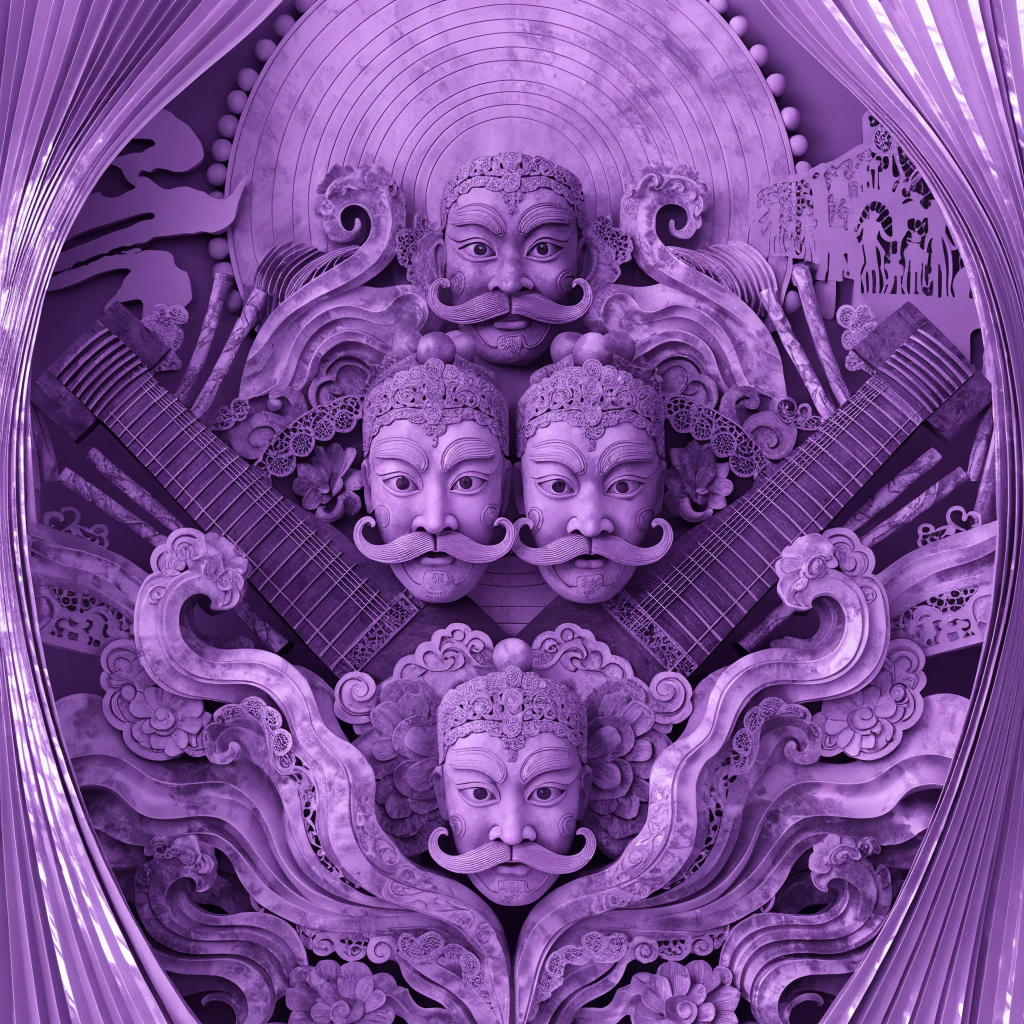
A Special Chinese Art: Kunqu Opera
Kunqu Opera is a famous art from China. It is very old. People call it the 'mother' of Chinese opera. It comes from Suzhou.
The actors wear beautiful clothes. They wear many colors like red, blue, and gold. Their faces have bright makeup. They sing and dance on the stage. The music is slow and soft.
People love Kunqu Opera because it is very elegant. It tells stories about love and history. Today, many young people learn this art. It is a special part of Chinese culture.
Gramática em destaque
Padrão: Present Simple (be)
"Kunqu Opera is a famous art from China."
We use 'is' with singular subjects to describe a fact. It tells us what something is or where it is from.
Padrão: Present Simple (Action Verbs)
"The actors wear beautiful clothes."
We use the base form of the verb (wear) with plural subjects like 'actors'. This describes things that happen regularly.
Teste sua compreensão
10 perguntas · A1 Iniciante · 1 pré-visualização grátis
Teste o que aprendeu neste artigo. Responda todas as perguntas para ganhar XP!
Where does Kunqu Opera come from?
Quer finalizar o quiz?
9 perguntas a mais estão esperando por você. Cadastre-se grátis para desbloquear o quiz completo e ganhar XP!
Cadastrar grátisJá tem conta? Entrar
Detalhamento das perguntas
Where does Kunqu Opera come from?
Sua resposta:
Resposta correta: Suzhou
The music in Kunqu Opera is very fast.
Sua resposta:
Resposta correta: Falso
What does 'famous' mean?
Sua resposta:
Resposta correta: Many people know it
The actors sing and _____ on the stage.
Sua resposta:
Resposta correta: dance
Kunqu: The Mother of Chinese Opera
Kunqu Opera is one of the oldest and most beautiful types of drama in China. It began more than 600 years ago in a place called Kunshan, near Suzhou. Many people call it the "Mother" of Chinese opera because it is older than Peking Opera and helped it grow.
In the past, Kunqu was the most popular art in China for over 200 years. It is famous for its "Three Perfections." These are the elegant words, the soft music, and the graceful dancing. The actors wear very bright and colorful costumes. They move their bodies slowly and use their hands to show feelings.
Today, Kunqu is still very important. It is more difficult to learn than other operas because the music is complex. However, many students want to study it. In 2001, UNESCO said that Kunqu is a masterpiece of human history. It is a wonderful way to learn about Chinese culture and traditional stories.
Gramática em destaque
Padrão: Past Simple (Irregular)
"It began more than 600 years ago in a place called Kunshan."
The past simple is used for finished actions in the past. Many verbs are irregular, so 'begin' becomes 'began' instead of adding -ed.
Padrão: Comparatives
"It is older than Peking Opera and helped it grow."
We use comparatives to compare two things. For short adjectives like 'old', we add -er and the word 'than'.
Teste sua compreensão
11 perguntas · A2 Elementar · 1 pré-visualização grátis
Teste o que aprendeu neste artigo. Responda todas as perguntas para ganhar XP!
Where did Kunqu opera first begin?
Quer finalizar o quiz?
10 perguntas a mais estão esperando por você. Cadastre-se grátis para desbloquear o quiz completo e ganhar XP!
Cadastrar grátisJá tem conta? Entrar
Detalhamento das perguntas
Where did Kunqu opera first begin?
Sua resposta:
Resposta correta: Kunshan
Kunqu Opera is younger than Peking Opera.
Sua resposta:
Resposta correta: Falso
What is a 'costume'?
Sua resposta:
Resposta correta: Special clothes for actors
The actors wear very bright and _____ costumes.
Sua resposta:
Resposta correta: colorful
Why is Kunqu difficult to learn?
Sua resposta:
Resposta correta: The music is complex
Kunqu Opera: The Mother of Chinese Theater
Kunqu Opera is one of the oldest and most beautiful forms of drama in China. It has been performed for more than 600 years, and it is often called the "Mother" of all Chinese operas. This art form started in the Kunshan region, which is near the city of Suzhou. During the Ming Dynasty, it became the most popular type of theater in the country.
The performance is famous for its "Three Perfections": poetic language, complex music, and graceful movements. The songs are usually accompanied by a bamboo flute, which creates a very soft and peaceful sound. The actors wear colorful costumes and use delicate gestures to tell stories about love, history, and legends. Because the movements are so elegant, the opera often looks like a beautiful, slow-motion dance.
However, learning Kunqu is not easy. Performers have to train for many years to master the difficult singing techniques and physical movements. In the past, these skills were passed down from teachers to students through many generations. This ensured that the tradition stayed alive even when times were difficult.
In 2001, Kunqu was recognized by UNESCO as a masterpiece of oral and intangible heritage. Since then, many efforts have been made to protect this ancient tradition. Today, new plays are being written, and younger audiences are starting to appreciate the art. Although it is an ancient tradition, Kunqu still has a special place in modern Chinese culture. It continues to fascinate people who enjoy traditional music and storytelling.
Gramática em destaque
Padrão: Present Perfect
"It has been performed for more than 600 years."
The present perfect is used here to describe an action that started in the past and continues to the present day. It is formed using 'has/have' plus the past participle.
Padrão: Passive Voice
"Kunqu was recognized by UNESCO as a masterpiece."
The passive voice is used when the focus is on the action or the person/thing receiving the action. It is formed using the verb 'to be' and the past participle.
Teste sua compreensão
11 perguntas · B1 Intermediário · 1 pré-visualização grátis
Teste o que aprendeu neste artigo. Responda todas as perguntas para ganhar XP!
Where did Kunqu Opera originally start?
Quer finalizar o quiz?
10 perguntas a mais estão esperando por você. Cadastre-se grátis para desbloquear o quiz completo e ganhar XP!
Cadastrar grátisJá tem conta? Entrar
Detalhamento das perguntas
Where did Kunqu Opera originally start?
Sua resposta:
Resposta correta: Kunshan
Kunqu Opera is a relatively new art form in China.
Sua resposta:
Resposta correta: Falso
What does 'graceful' mean?
Sua resposta:
Resposta correta: Moving in a smooth and attractive way
The songs in Kunqu are usually accompanied by a bamboo _____.
Sua resposta:
Resposta correta: flute
What are the 'Three Perfections' of Kunqu?
Sua resposta:
Resposta correta: Language, music, and movements
The Elegance of Kunqu: Unveiling the Mother of Chinese Opera
Kunqu Opera, often referred to as the "Mother of Chinese Operas," represents one of the oldest and most sophisticated theatrical traditions in the world. Having originated in the Kunshan region near Suzhou during the late 14th century, it eventually ascended to its zenith during the Ming Dynasty. For over two centuries, it reigned as the dominant dramatic form, influencing virtually every subsequent genre of Chinese theater, including the famous Peking Opera. Its historical significance cannot be overstated, as it provided the structural and musical foundation for much of China's performing arts heritage.
What distinguishes Kunqu is its unique synthesis of the "Three Perfections": poetic language, complex musical orchestration, and highly stylized movement. Unlike more modern forms, the scripts of Kunqu are celebrated for their literary refinement, often utilizing classical poetry that requires a deep understanding of Chinese history and philosophy. Consequently, it has historically been associated with the literati and the social elite. The music is characterized by the soft, melodic tones of the bamboo flute, which provides a soulful accompaniment to the performers' delicate vocals. This orchestration creates an atmosphere of profound emotional depth, allowing the audience to experience the subtle nuances of the characters' inner lives.
Furthermore, the physical performance is a masterclass in symbolic expression. Every gesture, from the flick of a long silk sleeve to the specific placement of a foot, conveys a precise emotion or narrative detail. This intricate choreography ensures that the audience remains captivated, even when the plot unfolds at a leisurely pace. The training required for performers is notoriously rigorous, often beginning in early childhood. Students must master not only vocal techniques but also acrobatics and symbolic dance. This holistic approach ensures that a single performer can embody a wide range of characters, from scholars to warriors.
Despite these challenges, Kunqu has experienced a significant revival in recent decades. In 2001, it was recognized by UNESCO as a Masterpiece of the Oral and Intangible Heritage of Humanity. This prestigious designation has spurred international interest and local preservation efforts. Today, contemporary troupes are working tirelessly to balance tradition with modern sensibilities, ensuring that this ancient legacy continues to thrive in a globalized world. Ultimately, Kunqu remains a fundamental pillar of Chinese cultural identity, offering a window into the aesthetic values of a bygone era.
Gramática em destaque
Padrão: Passive Voice
"Kunqu is celebrated for its unique synthesis of the 'Three Perfections'."
The passive voice (is + past participle) is used here to focus on the art form rather than the people who celebrate it, which is typical of academic writing.
Padrão: Participle Phrases
"Having originated in the Kunshan region near Suzhou during the late 14th century, it eventually ascended..."
A perfect participle phrase ('Having' + past participle) is used to indicate an action that was completed before the action in the main clause.
Padrão: Relative Clauses with 'which'
"...the bamboo flute, which provides a soulful accompaniment to the performers' delicate vocals."
A non-defining relative clause is used to provide extra information about the flute without being essential to the sentence's core meaning.
Teste sua compreensão
11 perguntas · B2 Intermediário superior · 1 pré-visualização grátis
Teste o que aprendeu neste artigo. Responda todas as perguntas para ganhar XP!
Why is Kunqu Opera often called the 'Mother of Chinese Operas'?
Quer finalizar o quiz?
10 perguntas a mais estão esperando por você. Cadastre-se grátis para desbloquear o quiz completo e ganhar XP!
Cadastrar grátisJá tem conta? Entrar
Detalhamento das perguntas
Why is Kunqu Opera often called the 'Mother of Chinese Operas'?
Sua resposta:
Resposta correta: It influenced almost every subsequent genre of Chinese theater.
Kunqu Opera training usually begins when performers are adults.
Sua resposta:
Resposta correta: Falso
What is the meaning of 'intricate' as used in the article?
Sua resposta:
Resposta correta: Very complicated or detailed
UNESCO recognized Kunqu as a Masterpiece of the Oral and Intangible _____ of Humanity.
Sua resposta:
Resposta correta: Heritage
Which instrument is primarily responsible for the melodic tones in Kunqu?
Sua resposta:
Resposta correta: The bamboo flute
The Ethereal Echoes of Kunshan: Navigating the Zenith of Kunqu Opera
Seldom has a performance medium commanded such profound cultural hegemony as Kunqu Opera, the venerable 'Mother' of Chinese theatrical arts. Emerging from the Kunshan region during the twilight of the Yuan Dynasty, Kunqu’s trajectory toward the zenith of imperial favor was marked by an unprecedented refinement of literary and musical standards. Unlike the more percussive and populist iterations of opera that followed, Kunqu is defined by its 'Three Perfections': its sophisticated literary libretti, its hauntingly lyrical musicality, and its stylized, balletic choreography. To witness a Kunqu performance is to observe the sublimation of human emotion into a highly codified aesthetic language, where every flick of a sleeve and every nuanced vocal modulation carries centuries of philosophical weight.
The ascension of Kunqu to its status as the dominant national drama during the Ming Dynasty was not merely a matter of artistic merit but a reflection of the era’s intellectual zeitgeist. It was the scholar-bureaucrat class that championed its development, infusing the scripts with complex poetic metaphors and esoteric historical allusions. Consequently, the language of Kunqu remains a demanding feat for the modern spectator, requiring a degree of classical literacy that is increasingly rare in a globalized society. This inherent complexity presents a paradox for contemporary practitioners: how does one maintain the artistic fidelity of a 600-year-old tradition while ensuring its continued relevance in a fast-paced, digital world?
The 'Kunqiang' musical system, characterized by its long, lingering notes and intricate woodwind accompaniment, demands a vocal control that few contemporary singers can master. Training often begins in early childhood, involving the rigorous conditioning of the body to achieve a state of 'relaxed tension.' This physical discipline allows the actor to convey profound internal turmoil through the most subtle of gestures. Such dedication is a rebuttal to the modern penchant for instant gratification. The preservation of such an esoteric art form necessitates a delicate balance between traditional fidelity and contemporary accessibility.
In recent decades, there has been a notable resurgence of interest in Kunqu, catalyzed in part by its recognition by UNESCO as a Masterpiece of the Oral and Intangible Heritage of Humanity. However, this revival is not without its critics. Some argue that the institutionalization and subsequent commodification of Kunqu for the tourism industry risk diluting its ethereal beauty, transforming a profound spiritual experience into a mere spectacle. Others contend that without such modernization, the art form would inevitably drift into obsolescence. The synthesis of these opposing viewpoints is essential for the future of the craft.
The enduring appeal of Kunqu lies in its ability to transcend the temporal. It is the delicate interplay between the rigorous structure of the music and the fluid grace of the performers that allows for such visceral storytelling. Whether depicting the tragic yearning of 'The Peony Pavilion' or the historical gravitas of 'The Palace of Eternal Life,' Kunqu remains a testament to the enduring power of refined art. Ultimately, the preservation of Kunqu necessitates more than just funding; it requires an ongoing intellectual engagement with its past and a courageous exploration of its future.
Gramática em destaque
Padrão: Negative Inversion
"Seldom has a performance medium commanded such profound cultural hegemony as Kunqu Opera."
Inversion is used here by placing a negative adverb ('Seldom') at the beginning of the sentence followed by an auxiliary verb ('has'). This structure is used for rhetorical emphasis and is a hallmark of formal, advanced English.
Padrão: Cleft Sentences
"It was the scholar-bureaucrat class that championed its development..."
An 'It-cleft' sentence is used to focus on a specific piece of information (the scholar-bureaucrat class). It emphasizes the subject that performed the action rather than the action itself.
Padrão: Nominalization
"The institutionalization and subsequent commodification of Kunqu for the tourism industry risk diluting its ethereal beauty..."
Nominalization involves turning verbs or adjectives into nouns (e.g., 'institutionalize' to 'institutionalization'). This creates a more academic, dense, and sophisticated tone, focusing on abstract concepts.
Teste sua compreensão
12 perguntas · C1 Avançado · 1 pré-visualização grátis
Teste o que aprendeu neste artigo. Responda todas as perguntas para ganhar XP!
What is the primary reason the author considers Kunqu a 'demanding feat' for modern audiences?
Quer finalizar o quiz?
11 perguntas a mais estão esperando por você. Cadastre-se grátis para desbloquear o quiz completo e ganhar XP!
Cadastrar grátisJá tem conta? Entrar
Detalhamento das perguntas
What is the primary reason the author considers Kunqu a 'demanding feat' for modern audiences?
Sua resposta:
Resposta correta: The high level of classical literacy required to understand the libretti
Kunqu Opera reached its peak popularity during the Yuan Dynasty.
Sua resposta:
Resposta correta: Falso
Which word best describes the 'Three Perfections' of Kunqu?
Sua resposta:
Resposta correta: Synthesis
The author argues that Kunqu's revival is criticized by some who fear its _____ for tourism.
Sua resposta:
Resposta correta: commodification
What does the 'Three Perfections' refer to in the context of the article?
Sua resposta:
Resposta correta: Literary language, musical scores, and choreography
The author believes that funding alone is sufficient for the preservation of Kunqu.
Sua resposta:
Resposta correta: Falso
The Aesthetic Primacy of Kunqu: An Ontological Analysis of China’s 'Mother Opera'
The genesis of Kunqu Opera, frequently heralded as the 'Mother of a Hundred Operas,' is inextricably linked to the sophisticated cultural milieu of the Kunshan region during the twilight of the Yuan Dynasty. To characterize Kunqu merely as a theatrical genre would be to commit a reductive fallacy; it is, rather, a multi-dimensional synthesis of poetry, music, and dance that represents the very zenith of Chinese aesthetic sensibilities. Should one examine the structural integrity of its compositions, one finds a rigorous adherence to the 'Three Perfections'—a tripartite excellence encompassing refined literary language, complex musical scores, and highly stylized physical performance. This scholarly orientation ensures that Kunqu remains an intellectual pursuit as much as an auditory one.
The literary dimension of Kunqu is perhaps its most formidable aspect. The librettos, often penned by the literati of the Ming and early Qing dynasties, are replete with archaic metaphors and philosophical ruminations. Were a modern spectator to approach these texts without a profound grasp of classical Chinese literature, the sheer density of the allusion might prove impenetrable. The prose is not merely functional; it is ontological, seeking to map the ephemeral nuances of human emotion onto the broader canvas of cosmic order. This depth of meaning requires a discerning audience, one capable of appreciating the subtle interplay between text and subtext.
Musically, Kunqu is defined by its melismatic vocal delivery, where a single syllable may be elongated across a series of fluid, undulating notes. This technique, known as 'shuimo qiang' or 'water-polished singing,' demands a level of breath control and tonal precision that few contemporary vocalists can master. The accompaniment, typically led by the 'dizi' (bamboo flute), provides a heterophonic texture that mirrors the singer’s contours. It is this auditory elegance that allowed Kunqu to maintain its dominance for over two centuries, transcending regional boundaries to become the quintessential courtly entertainment for the elite.
The third pillar of this artistic triumvirate is the graceful, highly codified choreography. Every gesture, from the subtle flick of a 'water sleeve' to the intricate footwork of a scholar-hero, is governed by a rigorous set of conventions. These movements are not merely decorative; they serve as a physical manifestation of the character’s internal psychological state. To witness a seasoned performer is to see a masterclass in semiotic communication, where the tilt of a head conveys more than a thousand words of dialogue. This synthesis of motion and meaning necessitates a lifelong commitment to the craft, often beginning in early childhood.
However, the trajectory of Kunqu has not been without its vicissitudes. By the late 19th century, the rise of more populist forms, such as Peking Opera, began to eclipse Kunqu’s scholarly austerity. The genre faced an existential threat during the mid-20th century, as political upheavals sought to dismantle traditional hierarchies. Yet, the resilience of Kunqu is a testament to its intrinsic value. Not only has it survived, but it has also experienced a significant resurgence following its designation by UNESCO as a Masterpiece of the Oral and Intangible Heritage of Humanity in 2001.
Today, the challenge lies in reconciling the preservation of Kunqu’s historical purity with the exigencies of a globalized audience. While some connoisseurs argue for a rigid adherence to traditional staging, others posit that innovation is necessary to prevent the art form from becoming a mere museum piece. Regardless of the path chosen, Kunqu continues to serve as a vital link to China’s pre-modern intellectual heritage. It remains a poignant reminder that true art is never truly ephemeral; it merely awaits the right cultural climate to bloom once more. Through the lens of Kunqu, we witness the enduring power of a tradition that, despite its historical fragility, continues to resonate with profound clarity.
Gramática em destaque
Padrão: Inversion with Negative/Restrictive Adverbials
"Not only has it survived, but it has also experienced a significant resurgence."
When a sentence starts with 'Not only', the subject and auxiliary verb are inverted. This is used for emphasis in formal or literary writing.
Padrão: Subjunctive/Conditional Inversion
"Should one examine the structural integrity of its compositions, one finds a rigorous adherence to the 'Three Perfections'."
The word 'Should' replaces 'If' in a formal conditional clause (Should one examine = If one should examine). It makes the condition sound more hypothetical and scholarly.
Padrão: Mixed Conditional with 'Were'
"Were a modern spectator to approach these texts without a profound grasp of classical Chinese literature, the sheer density of the allusion might prove impenetrable."
Using 'Were [subject] to [verb]' is a highly formal way of expressing a hypothetical present or future condition, emphasizing the unlikely or formal nature of the scenario.
Teste sua compreensão
12 perguntas · C2 Domínio · 1 pré-visualização grátis
Teste o que aprendeu neste artigo. Responda todas as perguntas para ganhar XP!
What does the author suggest by calling Kunqu's literary language 'ontological'?
Quer finalizar o quiz?
11 perguntas a mais estão esperando por você. Cadastre-se grátis para desbloquear o quiz completo e ganhar XP!
Cadastrar grátisJá tem conta? Entrar
Detalhamento das perguntas
What does the author suggest by calling Kunqu's literary language 'ontological'?
Sua resposta:
Resposta correta: It seeks to explore the nature of being and human existence.
Kunqu Opera's decline in the 19th century was partly due to the popularity of Peking Opera.
Sua resposta:
Resposta correta: Verdadeiro
What is the meaning of 'vicissitudes' as used in the text?
Sua resposta:
Resposta correta: The natural changes and shifts in fortune over time.
The technique of singing a single syllable over multiple notes is described as _____ delivery.
Sua resposta:
Resposta correta: melismatic
Which instrument is identified as the primary accompaniment in Kunqu?
Sua resposta:
Resposta correta: The Dizi
The article argues that Kunqu should be kept strictly as a 'museum piece' without any innovation.
Sua resposta:
Resposta correta: Falso

