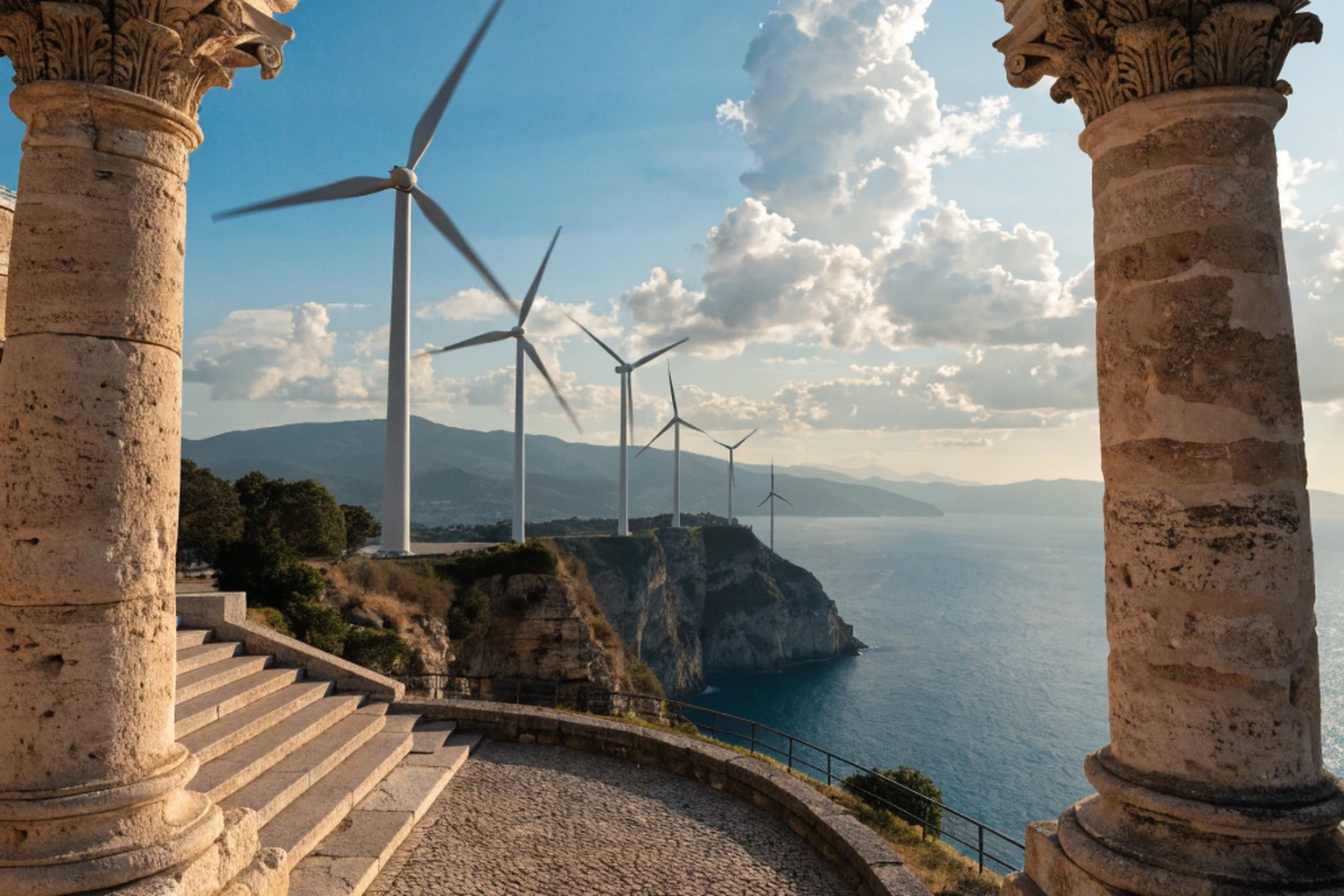
Italy is a Green Country
Italy is a beautiful country in Europe. It is famous for old buildings and art. But today, Italy is different. It is a green country.
Italy uses the sun and the wind to make power. This is green energy. Many people have green jobs now. They build new machines. These machines help the environment.
Italy is a leader in the European Union. It uses less oil and more clean energy. This energy comes from nature. It is good for our planet. Italy is proud of its green future.
Gramática em destaque
Padrão: Present Simple (to be)
"Italy is a beautiful country in Europe."
We use 'is' with singular subjects like Italy to describe facts. It is the basic form of the verb 'to be'.
Padrão: Present Simple (Action Verbs)
"Italy uses the sun and the wind to make power."
We add an 's' to the verb 'use' because Italy is a singular third-person subject (it). This shows a general truth.
Teste sua compreensão
10 perguntas · A1 Iniciante · 1 pré-visualização grátis
Teste o que aprendeu neste artigo. Responda todas as perguntas para ganhar XP!
What does Italy use to make power?
Quer finalizar o quiz?
9 perguntas a mais estão esperando por você. Cadastre-se grátis para desbloquear o quiz completo e ganhar XP!
Cadastrar grátisJá tem conta? Entrar
Detalhamento das perguntas
What does Italy use to make power?
Sua resposta:
Resposta correta: The sun and the wind
Italy is a leader in the European Union.
Sua resposta:
Resposta correta: Verdadeiro
What does 'planet' mean?
Sua resposta:
Resposta correta: A round object in space like Earth
Italy is a _____ country.
Sua resposta:
Resposta correta: green
Italy's Green Energy Revolution
Italy is famous for its history and beautiful art. But today, the country is changing in a new way. Italy is becoming a leader in green energy. In the past, Italy did not have much oil or gas. Because of this, it needed to find new ways to make electricity for its people.
Now, Italy uses the sun and the wind to create power. It is sunnier in the south, so there are many solar panels there. The wind is also stronger in the mountains and near the sea. These natural sources are better for the planet than old fuels like coal.
Italy is also better at recycling than many other countries in Europe. This is called a "circular economy." People use things again and do not waste them. This green revolution is very important for the environment and the future. It shows that a modern country can be green and successful at the same time.
Gramática em destaque
Padrão: Past Simple (Negative)
"In the past, Italy did not have much oil or gas."
We use 'did not' + the base verb to talk about things that were not true in the past. It is the same for all subjects (I, you, he, she, it, we, they).
Padrão: Comparatives
"These natural sources are better for the planet than old fuels like coal."
We use comparatives to look at the differences between two things. 'Better' is the irregular comparative form of the adjective 'good'.
Teste sua compreensão
11 perguntas · A2 Elementar · 1 pré-visualização grátis
Teste o que aprendeu neste artigo. Responda todas as perguntas para ganhar XP!
Why did Italy need to find new ways to make electricity?
Quer finalizar o quiz?
10 perguntas a mais estão esperando por você. Cadastre-se grátis para desbloquear o quiz completo e ganhar XP!
Cadastrar grátisJá tem conta? Entrar
Detalhamento das perguntas
Why did Italy need to find new ways to make electricity?
Sua resposta:
Resposta correta: Because it did not have much oil or gas
Italy is a leader in green energy today.
Sua resposta:
Resposta correta: Verdadeiro
What is a 'circular economy'?
Sua resposta:
Resposta correta: Using things again and not wasting them
Italy is also _____ at recycling than many other countries.
Sua resposta:
Resposta correta: better
Where are many solar panels located in Italy?
Sua resposta:
Resposta correta: In the south
Italy's Green Energy Revolution
Italy, which is globally famous for its historical landmarks and classical art, has started a new and exciting journey. For many years, the country has imported most of its energy because it has very few fossil fuels. However, this situation has changed recently as the nation moves toward a greener future. Today, Italy has become a leader in the European Union for renewable energy and circular economy practices.
Solar panels are now seen on the roofs of many old buildings, and large wind farms have been built in the windy southern regions. These projects are supported by the government to reduce pollution and protect the environment. Furthermore, the circular economy, which focuses on reusing and recycling materials, is growing quickly. Many Italian companies have discovered that being green is not only good for the planet but also good for business.
This economic transition is not just about environmental necessity. It is also about creating a modern economy. Thousands of new jobs have been created in the green sector over the last decade. People who work in these industries are helping to build a cleaner world for the next generation. Italy has shown that a country with a long history can also have a very modern and sustainable future. This revolution proves that innovation can happen anywhere, even in places surrounded by ancient history.
Gramática em destaque
Padrão: Present Perfect
"Italy has become a leader in the European Union for renewable energy."
The present perfect is used here to describe an action that started in the past and is still true or relevant now. It is formed using 'has/have' plus the past participle.
Padrão: Passive Voice
"Thousands of new jobs have been created in the green sector."
The passive voice is used when the action itself is more important than who did it. It is formed with the verb 'to be' and the past participle.
Teste sua compreensão
11 perguntas · B1 Intermediário · 1 pré-visualização grátis
Teste o que aprendeu neste artigo. Responda todas as perguntas para ganhar XP!
Why did Italy traditionally import most of its energy?
Quer finalizar o quiz?
10 perguntas a mais estão esperando por você. Cadastre-se grátis para desbloquear o quiz completo e ganhar XP!
Cadastrar grátisJá tem conta? Entrar
Detalhamento das perguntas
Why did Italy traditionally import most of its energy?
Sua resposta:
Resposta correta: It has very few fossil fuel reserves
Italy is currently a leader in the EU for recycling and renewable energy.
Sua resposta:
Resposta correta: Verdadeiro
What does 'sustainable' mean?
Sua resposta:
Resposta correta: Able to continue without damaging the environment
Large wind farms have been built in the windy _____ regions of Italy.
Sua resposta:
Resposta correta: southern
What is a 'circular economy' focused on?
Sua resposta:
Resposta correta: Reusing and recycling materials
Italy's Green Renaissance: Leading the Way in Sustainability
Italy is globally celebrated for its Renaissance heritage, yet a different kind of transformation is currently unfolding across the Mediterranean peninsula. Driven by a historic lack of domestic fossil fuels, Italy has been compelled to pioneer sustainable alternatives, positioning itself as a frontrunner in the European Union’s green transition. This shift is not merely an environmental response; it represents a strategic economic overhaul aimed at long-term resilience and energy independence. By blending its historical ingenuity with cutting-edge technology, the nation is demonstrating that economic growth and environmental preservation can indeed go hand in hand.
One of the most significant pillars of this revolution is the rapid expansion of solar and wind infrastructure. Southern regions, such as Sicily and Puglia, which benefit from abundant sunlight and coastal winds, have become hubs for renewable energy production. However, the transition has not been without its challenges. Integrating these intermittent sources into the national grid requires sophisticated technology and substantial investment. To address this, the Italian government has implemented various incentives to encourage private investment and modernize the existing energy infrastructure. The European Union’s Green Deal has also acted as a catalyst, providing a framework for Italy’s ambitious targets.
Furthermore, Italy has achieved remarkable success in the circular economy sector. It currently boasts one of the highest recycling rates in Europe, effectively turning waste into a valuable resource. This approach, which reduces the country’s dependence on imported raw materials, minimizes the environmental footprint of its manufacturing sector. Innovative startups are emerging, focusing on bio-plastics and sustainable fashion, proving that traditional industries can adapt to modern ecological standards. In the northern industrial heartlands, factories are being repurposed to accommodate sustainable manufacturing processes, ensuring the 'Made in Italy' brand signifies ecological responsibility.
Despite these advancements, the path forward remains complex. Critics argue that bureaucratic hurdles often slow down the implementation of large-scale projects. Nevertheless, the momentum gained over the last decade suggests that Italy is committed to its decarbonization goals. As the global community looks toward a post-carbon future, Italy’s proactive stance provides a compelling model for other industrialized nations. The integration of digital technologies is further optimizing energy distribution, ensuring that supply meets demand even when weather conditions fluctuate, solidifying Italy's role as a modern green powerhouse.
Gramática em destaque
Padrão: Present Perfect Passive
"Italy has been compelled to pioneer sustainable alternatives."
This pattern is used to describe an action that happened at an unspecified time in the past and has a result in the present, focusing on the receiver of the action. It is formed using 'has/have + been + past participle'.
Padrão: Non-defining Relative Clauses
"Southern regions, such as Sicily and Puglia, which benefit from abundant sunlight and coastal winds, have become hubs for renewable energy production."
These clauses provide extra information about a noun but are not essential for the sentence to make sense. They are always separated by commas and usually start with 'which' or 'who'.
Padrão: Participle Phrases for Result/Method
"By blending its historical ingenuity with cutting-edge technology, the nation is demonstrating that economic growth and environmental preservation can indeed go hand in hand."
Using 'By + -ing' at the start of a sentence explains the method used to achieve a particular result. It makes the writing more academic and concise.
Teste sua compreensão
11 perguntas · B2 Intermediário superior · 1 pré-visualização grátis
Teste o que aprendeu neste artigo. Responda todas as perguntas para ganhar XP!
What was the primary motivation for Italy to innovate in renewable energy?
Quer finalizar o quiz?
10 perguntas a mais estão esperando por você. Cadastre-se grátis para desbloquear o quiz completo e ganhar XP!
Cadastrar grátisJá tem conta? Entrar
Detalhamento das perguntas
What was the primary motivation for Italy to innovate in renewable energy?
Sua resposta:
Resposta correta: A lack of domestic fossil fuel reserves
Italy currently has one of the lowest recycling rates in the European Union.
Sua resposta:
Resposta correta: Falso
Which word describes an energy source that is not available all the time, like wind or sun?
Sua resposta:
Resposta correta: Intermittent
Critics argue that _____ hurdles often slow down the implementation of large-scale projects.
Sua resposta:
Resposta correta: bureaucratic
Which regions in Italy have become hubs for renewable energy?
Sua resposta:
Resposta correta: Southern regions like Sicily and Puglia
The Renaissance of Renewables: Italy’s Strategic Pivot to a Circular Economy
While Italy is globally celebrated for its historic landmarks and classical art, it is quietly emerging as a modern powerhouse in the global transition toward a green economy. As a nation with historically limited fossil fuel reserves, Italy has long been motivated to innovate in the renewable energy sector. Today, it stands as a leader within the European Union for renewable energy production and circular economy practices. This economic transformation is not merely an environmental necessity; it represents a profound paradigm shift in how the nation conceptualizes industrial growth and resource management. It is the scarcity of domestic fossil fuel reserves that has historically catalyzed Italy’s drive for energy independence, pushing the Mediterranean nation to spearhead innovative solutions in geothermal, solar, and hydroelectric power.
Not only has Italy expanded its solar and wind infrastructure, but it has also established itself as a frontrunner in circular economy practices, particularly in the recycling of industrial materials. The precariousness of global energy markets has served as a potent impetus for the Italian government to accelerate its decarbonization efforts. Consequently, the burgeoning green sector is now a cornerstone of the national economy, attracting significant investment and fostering a new generation of high-tech startups. However, the integration of these renewable technologies into the national grid necessitates a profound restructuring of existing infrastructure, a multifaceted challenge that requires both political will and technological ingenuity.
Furthermore, the ubiquitous presence of small and medium-sized enterprises (SMEs) in Italy has allowed for a decentralized approach to green innovation. These firms are increasingly adopting circular models, where waste from one process becomes the raw material for another, thereby enhancing the resilience of the local supply chain. Despite these advancements, the transition is not without its detractors. Critics argue that the rapid shift away from traditional manufacturing could lead to temporary economic instability. Nevertheless, the overarching consensus among policymakers is that the long-term benefits of a sustainable, low-carbon economy far outweigh the short-term costs of transition. As Italy continues to refine its national energy and climate plan, it serves as a compelling case study for other nations aiming to decouple economic growth from environmental degradation. The successful implementation of these strategies underscores the importance of viewing environmental policy not as a constraint, but as a catalyst for systemic innovation and long-term prosperity.
Gramática em destaque
Padrão: Cleft Sentences
"It is the scarcity of domestic fossil fuel reserves that has historically catalyzed Italy’s drive for energy independence."
Cleft sentences are used to focus on a specific part of the sentence. They start with 'It is/was' followed by the emphasized element and a relative clause starting with 'that' or 'who'.
Padrão: Inversion
"Not only has Italy expanded its solar and wind infrastructure, but it has also established itself as a frontrunner in circular economy practices."
When using negative or restrictive expressions like 'Not only' at the beginning of a sentence, the subject and auxiliary verb are inverted to create emphasis and formal tone.
Padrão: Nominalisation
"The successful implementation of these strategies underscores the importance of viewing environmental policy not as a constraint."
Nominalisation involves turning verbs or adjectives into nouns (e.g., 'implement' to 'implementation'). This is a hallmark of C1 academic writing to create a more formal and concise style.
Teste sua compreensão
12 perguntas · C1 Avançado · 1 pré-visualização grátis
Teste o que aprendeu neste artigo. Responda todas as perguntas para ganhar XP!
What was the primary historical motivator for Italy's shift toward green energy?
Quer finalizar o quiz?
11 perguntas a mais estão esperando por você. Cadastre-se grátis para desbloquear o quiz completo e ganhar XP!
Cadastrar grátisJá tem conta? Entrar
Detalhamento das perguntas
What was the primary historical motivator for Italy's shift toward green energy?
Sua resposta:
Resposta correta: A lack of domestic fossil fuel resources
The article suggests that Italy is a leader in recycling industrial materials within the EU.
Sua resposta:
Resposta correta: Verdadeiro
What does 'precariousness' refer to in the text?
Sua resposta:
Resposta correta: The instability and uncertainty of markets
The integration of renewable technologies into the national _____ requires restructuring infrastructure.
Sua resposta:
Resposta correta: grid
How do Italian small and medium-sized enterprises (SMEs) contribute to the green economy?
Sua resposta:
Resposta correta: By adopting circular models where waste is reused
Critics of the green energy transition are concerned about potential economic instability.
Sua resposta:
Resposta correta: Verdadeiro
The Renaissance of Sustainability: Deciphering Italy’s Paradigmatic Shift in Green Energy
To the uninitiated observer, Italy remains a perennial museum of antiquity, yet beneath the veneer of its Renaissance splendor lies a burgeoning infrastructure of ecological resilience. This metamorphosis is not merely an exercise in environmental altruism; rather, it represents a pragmatic response to a historical dearth of indigenous fossil fuels. Were the nation to have remained tethered exclusively to traditional hydrocarbons, its economic sovereignty would undoubtedly have been compromised in an increasingly volatile global market. Consequently, Italy has positioned itself as a vanguard of the circular economy, demonstrating that the preservation of heritage and the pursuit of technological innovation are not mutually exclusive but are, in fact, concomitant imperatives.
Central to this transition is the heuristic model of the circular economy, in which Italy currently leads its European counterparts. By prioritizing the recycling of industrial materials and the transmutation of organic waste into bio-energy, the Italian state has effectively decoupled economic growth from resource exhaustion. It is imperative that the state foster an environment where such nascent technologies can flourish without the stifling influence of bureaucratic inertia. Indeed, the proliferation of geothermal and solar initiatives across the peninsula suggests that a profound paradigm shift is underway, one that challenges the long-held assumption that industrialization must necessarily lead to environmental degradation.
One might posit that Italy's geographical constraints have acted as a catalyst for its ingenuity. The scarcity of coal and oil deposits precipitated a reliance on hydroelectric and, more recently, solar power. However, this transition is not without its detractors. Critics argue that the aesthetic integrity of the Tuscan landscape, inter alia, is threatened by the encroachment of wind turbines and solar arrays. This tension between the preservation of cultural landscapes and the necessity of energy independence creates a complex dialectic that policymakers must navigate with extreme delicacy. It is often suggested that for the green revolution to be truly successful, it must be integrated into the existing cultural fabric rather than imposed upon it.
Furthermore, the economic implications of this green pivot are manifold. The burgeoning sector has given rise to a new class of specialized labor, requiring a workforce proficient in high-tech manufacturing and sustainable engineering. While some traditional sectors face inevitable decline, the green economy offers a robust alternative that could potentially revitalize the Mezzogiorno—the historically underdeveloped southern regions. It is arguably the case that the decentralization of energy production could empower local communities, fostering a sense of agency that was previously absent in the era of centralized, fossil-fuel-driven utilities.
In conclusion, Italy’s journey toward a green economy is a testament to the power of necessity as an engine for innovation. By harnessing its natural resources and leveraging its historical penchant for design and engineering, the nation is redefining what it means to be an industrial power in the twenty-first century. Whether this trajectory can be sustained amidst shifting political tides remains to be seen, but the foundations for a sustainable future have undeniably been laid. The Italian experience serves as a compelling case study for other nations, proving that even a country steeped in tradition can emerge as a leader in the global quest for ecological equilibrium.
Gramática em destaque
Padrão: Inverted Second/Third Conditional
"Were the nation to have remained tethered exclusively to traditional hydrocarbons, its economic sovereignty would undoubtedly have been compromised."
This structure uses 'Were' + subject + to have + past participle to replace 'If the nation had remained'. It is used in formal or academic contexts to express a hypothetical past situation and its result.
Padrão: The Mandative Subjunctive
"It is imperative that the state foster an environment where such nascent technologies can flourish."
The verb 'foster' is in the subjunctive mood (base form) following the adjective 'imperative'. This is used to express necessity, suggestions, or requirements.
Padrão: Academic Hedging with 'One might posit'
"One might posit that Italy's geographical constraints have acted as a catalyst for its ingenuity."
Hedging is used to express caution or to avoid making overly dogmatic claims. 'One might posit' introduces a theoretical suggestion without asserting it as an absolute fact.
Teste sua compreensão
12 perguntas · C2 Domínio · 1 pré-visualização grátis
Teste o que aprendeu neste artigo. Responda todas as perguntas para ganhar XP!
What does the author identify as the primary driver for Italy's green energy transition?
Quer finalizar o quiz?
11 perguntas a mais estão esperando por você. Cadastre-se grátis para desbloquear o quiz completo e ganhar XP!
Cadastrar grátisJá tem conta? Entrar
Detalhamento das perguntas
What does the author identify as the primary driver for Italy's green energy transition?
Sua resposta:
Resposta correta: The historical lack of domestic fossil fuel reserves
According to the text, Italy is currently a leader in circular economy practices within Europe.
Sua resposta:
Resposta correta: Verdadeiro
Which word is synonymous with 'coming into existence'?
Sua resposta:
Resposta correta: Nascent
Italy has positioned itself as a _____ of the circular economy, leading the way for others.
Sua resposta:
Resposta correta: vanguard
What is the 'complex dialectic' mentioned in the third paragraph?
Sua resposta:
Resposta correta: The tension between cultural preservation and energy independence
The author suggests that industrialization must always result in environmental degradation.
Sua resposta:
Resposta correta: Falso

