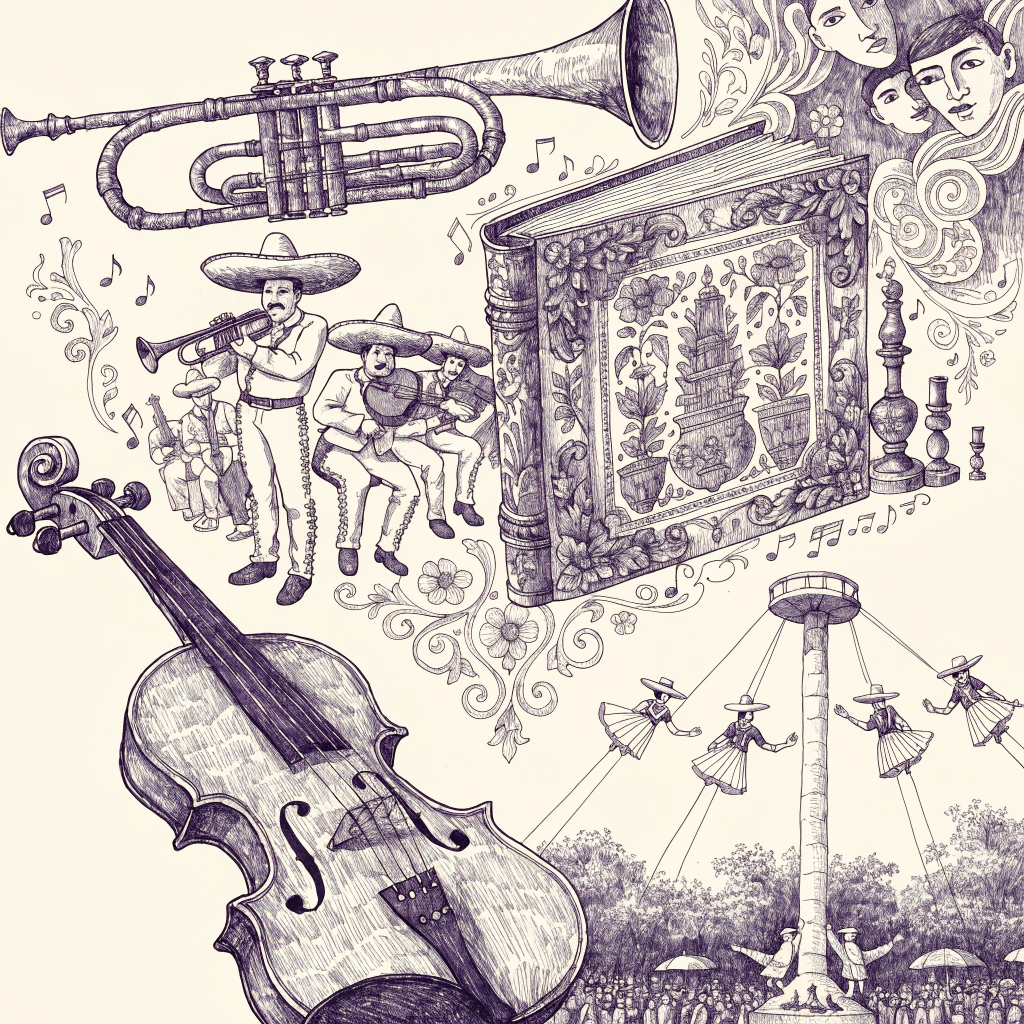
The Flying Men of Mexico
The Voladores are from Mexico. They have a special dance. It is a very old tradition. Five men go up a very tall pole. The pole is thirty meters high.
One man sits at the top. He plays music. He has a flute and a small drum. The other four men tie ropes to their legs. They jump and fly in the air. They look like birds.
The men wear beautiful red and white clothes. This dance is for the rain. It is a beautiful ceremony. People love to see the flyers in the sky.
Gramática em destaque
Padrão: Present Simple (to be)
"The Voladores are from Mexico."
We use 'are' with plural subjects like 'the Voladores'. It describes a fact or a state about who they are or where they are from.
Padrão: Adjectives before Nouns
"The men wear beautiful red and white clothes."
In English, we put describing words like 'beautiful' and 'red' before the noun 'clothes'. This helps the reader imagine the object clearly.
Teste sua compreensão
10 perguntas · A1 Iniciante · 1 pré-visualização grátis
Teste o que aprendeu neste artigo. Responda todas as perguntas para ganhar XP!
Where are the Voladores from?
Quer finalizar o quiz?
9 perguntas a mais estão esperando por você. Cadastre-se grátis para desbloquear o quiz completo e ganhar XP!
Cadastrar grátisJá tem conta? Entrar
Detalhamento das perguntas
Where are the Voladores from?
Sua resposta:
Resposta correta: Mexico
There are ten men on the pole.
Sua resposta:
Resposta correta: Falso
What does 'tall' mean?
Sua resposta:
Resposta correta: Having a great height
One man sits at the _____.
Sua resposta:
Resposta correta: top
A Dança dos Voladores: Uma Antiga Tradição Mexicana
A Cerimônia Ritual dos Voladores é uma tradição muito antiga do México. Ela é também conhecida como a 'Dança dos Voadores'. Esta dança vem de um tempo antes dos espanhóis chegarem ao país e é muito especial.
Os Voladores são homens corajosos que sobem em um mastro de mais de 20 metros de altura. No topo, um músico toca uma flauta e um pequeno tambor. Depois, quatro outros homens se amarram com cordas nos pés e saltam do mastro. Eles descem girando lentamente em volta do mastro, como se estivessem voando.
Esta cerimônia começou como um ritual para pedir aos deuses que mandassem chuva. As pessoas queriam que a terra fosse fértil e produzisse muita comida. É uma dança que representa a descida dos deuses à terra.
Hoje, a dança é uma celebração importante da cultura Totonaca, um povo indígena do México, especialmente na região de Veracruz. É um espetáculo incrível que mostra a história, a fé e a coragem deste povo. Muitas pessoas visitam o México para ver os Voladores.
Gramática em destaque
Padrão: O Pretérito Perfeito Simples
"Esta cerimônia começou como um ritual para pedir aos deuses que mandassem chuva."
Usamos o pretérito perfeito simples para falar de ações que aconteceram e terminaram no passado. É um tempo verbal que mostra um evento completo e pontual.
Padrão: O Pretérito Imperfeito
"As pessoas queriam que a terra fosse fértil e produzisse muita comida."
Usamos o pretérito imperfeito para falar de ações habituais no passado, ou de ações que estavam acontecendo sem um fim definido. Também serve para descrever situações no passado.
Teste sua compreensão
11 perguntas · A2 Elementar · 1 pré-visualização grátis
Teste o que aprendeu neste artigo. Responda todas as perguntas para ganhar XP!
Qual é o principal objetivo da Cerimônia dos Voladores?
Quer finalizar o quiz?
10 perguntas a mais estão esperando por você. Cadastre-se grátis para desbloquear o quiz completo e ganhar XP!
Cadastrar grátisJá tem conta? Entrar
Detalhamento das perguntas
Qual é o principal objetivo da Cerimônia dos Voladores?
Sua resposta:
Resposta correta: Pedir chuva e fertilidade.
Quatro homens sobem no mastro para tocar flauta e tambor.
Sua resposta:
Resposta correta: Falso
O que significa a palavra 'antiga'?
Sua resposta:
Resposta correta: Velha, de muito tempo
Os Voladores são homens _____. Eles não têm medo.
Sua resposta:
Resposta correta: corajosos
Onde a Cerimônia dos Voladores é mais famosa?
Sua resposta:
Resposta correta: No México
A Dança dos Voadores: Uma Tradição Mexicana Que Voa Alto
A Cerimônia Ritual dos Voladores, também conhecida como "Dança dos Voadores", é uma das mais impressionantes tradições pré-hispânicas do México. Ela combina habilidade acrobática com um profundo simbolismo espiritual e tem cativado espectadores por gerações. Embora seja praticada por vários grupos étnicos na Mesoamérica, é mais famosa pela sua associação com o povo Totonaca, da região de Papantla, no estado de Veracruz.
Essa tradição ancestral tem sido preservada por séculos e se originou como um ritual de fertilidade. Acreditava-se que a dança apaziguava os deuses e trazia chuva em tempos de seca severa, garantindo boas colheitas. Os participantes, chamados Voladores, sobem em um poste alto, que pode ter até 30 metros de altura. Quatro deles se amarram pelos pés a cordas que estão cuidadosamente enroladas no topo do poste. Um quinto homem, o caporal, permanece no topo, tocando uma flauta e um pequeno tambor, abençoando os quatro pontos cardeais.
Ao som hipnotizante da música, os quatro Voladores se lançam de costas do topo do poste. Eles começam a girar lentamente, desenrolando as cordas e descendo em espiral até o chão de forma graciosa e controlada. Cada um deles completa 13 voltas, o que, multiplicado pelos quatro voadores, soma 52 voltas. Este número tem um grande significado no calendário mesoamericano, representando um ciclo de 52 anos e a renovação da vida.
A cerimônia simboliza a descida dos deuses do céu à terra, pedindo fertilidade e prosperidade para a comunidade. É uma representação vívida da conexão entre o céu e a terra, e um pedido contínuo por harmonia na natureza. Os Voladores realizam esse ato de fé, coragem e devoção para manter viva uma parte essencial de sua identidade cultural. É uma experiência cultural única que tem atraído a atenção de muitas pessoas ao redor do mundo e tem sido reconhecida como Patrimônio Cultural Imaterial da Humanidade pela UNESCO.
Gramática em destaque
Padrão: Presente Perfeito Composto (Ter + Particípio)
"Essa tradição ancestral tem sido preservada por séculos..."
Usamos o Presente Perfeito Composto para falar de ações que começaram no passado e continuam até o presente, ou que têm um resultado no presente. Ele é formado com o verbo "ter" no presente mais o particípio do verbo principal.
Padrão: Voz Passiva Analítica
"...e tem sido reconhecida como Patrimônio Cultural Imaterial da Humanidade pela UNESCO."
A voz passiva analítica é usada quando o sujeito da frase sofre a ação, em vez de realizá-la. Ela é formada com o verbo "ser" (ou "estar") mais o particípio do verbo principal. Neste caso, "tem sido" é uma combinação do Presente Perfeito com a voz passiva.
Teste sua compreensão
11 perguntas · B1 Intermediário · 1 pré-visualização grátis
Teste o que aprendeu neste artigo. Responda todas as perguntas para ganhar XP!
A Cerimônia dos Voladores é mais famosa por qual povo?
Quer finalizar o quiz?
10 perguntas a mais estão esperando por você. Cadastre-se grátis para desbloquear o quiz completo e ganhar XP!
Cadastrar grátisJá tem conta? Entrar
Detalhamento das perguntas
A Cerimônia dos Voladores é mais famosa por qual povo?
Sua resposta:
Resposta correta: Totonaca
A dança dos Voladores era para pedir neve aos deuses.
Sua resposta:
Resposta correta: Falso
O que significa 'poste' no contexto do artigo?
Sua resposta:
Resposta correta: Um objeto vertical alto e fino
Cada Volador completa _____ voltas enquanto desce.
Sua resposta:
Resposta correta: treze
Qual é o significado do número 52 no calendário mesoamericano?
Sua resposta:
Resposta correta: Um ciclo de renovação da vida
The Soaring Tradition: Understanding the Ritual Ceremony of the Voladores
The Ritual Ceremony of the Voladores, commonly referred to as the 'Dance of the Flyers', represents one of Mexico's most profound cultural treasures. This ancient pre-Hispanic tradition, which has been preserved for centuries, combines breathtaking physical skill with intricate spiritual symbolism. Although it is practiced by several ethnic groups across Mesoamerica, it is most closely associated with the Totonac people of Papantla, located in the state of Veracruz.
Historically, the ceremony is believed to have originated as a fertility ritual. According to legend, a severe drought once devastated the region, threatening the survival of the community. In an attempt to appease the gods and bring rain to the parched earth, the elders instructed five young men to perform a ritual at the top of a tall pole. This 'cosmic dance' was intended to symbolize the descent of the gods and the renewal of life.
The performance itself is a marvel of coordination and bravery. It begins with the participants, dressed in vibrant costumes, climbing a pole that can reach heights of up to 30 meters. One performer stays at the summit, playing a flute and a small drum while standing on a tiny platform. Meanwhile, the other four flyers, tied by ropes, launch themselves backward into the air. As they descend, they circle the pole exactly 13 times each, totaling 52 revolutions—a number that corresponds to the cycle of the ancient Mesoamerican calendar.
From a contemporary perspective, the ceremony has evolved from a local religious rite into a globally recognized symbol of indigenous identity. In 2009, UNESCO inscribed the ritual on the Representative List of the Intangible Cultural Heritage of Humanity. This recognition highlights the importance of protecting such traditions in an era of rapid globalization. Critics argue that tourism has commercialized the practice; however, many community members believe that the increased visibility ensures the survival of their ancestral knowledge.
In conclusion, the Ritual Ceremony of the Voladores serves as a powerful testament to the resilience of Totonac culture. It is not merely a spectacle for observers but a profound expression of the relationship between humanity and the natural world. By maintaining this tradition, the Totonac people continue to honor their history while navigating the complexities of the modern world.
Gramática em destaque
Padrão: Passive Voice with Infinitive
"the ceremony is believed to have originated as a fertility ritual."
This structure is used to report general beliefs or historical theories. It combines the passive 'is believed' with a perfect infinitive 'to have originated' to refer to a past action.
Padrão: Non-defining Relative Clause
"Totonac people of Papantla, located in the state of Veracruz."
This clause adds extra information about a specific noun (Papantla) that is already identified. It is separated from the main sentence by commas.
Padrão: Contrastive Discourse Markers
"Critics argue that tourism has commercialized the practice; however, many community members believe..."
The word 'however' is used to introduce a statement that contrasts with or contradicts what has been previously mentioned, common in formal writing.
Teste sua compreensão
11 perguntas · B2 Intermediário superior · 1 pré-visualização grátis
Teste o que aprendeu neste artigo. Responda todas as perguntas para ganhar XP!
What was the primary original purpose of the Voladores ceremony?
Quer finalizar o quiz?
10 perguntas a mais estão esperando por você. Cadastre-se grátis para desbloquear o quiz completo e ganhar XP!
Cadastrar grátisJá tem conta? Entrar
Detalhamento das perguntas
What was the primary original purpose of the Voladores ceremony?
Sua resposta:
Resposta correta: To ask the gods for rain during a drought
The number of total revolutions performed by the flyers has a connection to the ancient calendar.
Sua resposta:
Resposta correta: Verdadeiro
What does 'resilience' mean in the context of the article?
Sua resposta:
Resposta correta: The ability of a culture to survive and recover
The pole used in the ceremony can reach _____ of up to 30 meters.
Sua resposta:
Resposta correta: heights
Which organization recognized the ritual as part of the world's intangible heritage?
Sua resposta:
Resposta correta: UNESCO
The Cosmic Descent: Navigating the Sanctity and Commodification of the Voladores Ritual
Deeply rooted in the Totonac culture of Papantla, Veracruz, the Ritual Ceremony of the Voladores stands as a testament to Mesoamerican spiritual endurance. Rarely does a tradition so viscerally bridge the chasm between the terrestrial and the celestial. This 'Dance of the Flyers' is not merely an acrobatic feat; it is a profound cosmological supplication. Historically, the ceremony emerged during a period of catastrophic drought, intended to appease the gods and beckon the life-giving rains. By launching themselves from a thirty-meter pole, the participants enact a symbolic descent of the gods to the earth, a performance that requires both physical bravery and spiritual purity.
What the ceremony fundamentally represents is a cosmic petition for fertility and equilibrium. At the heart of the ritual is the pole, representing the axis mundi, the center of the universe. Atop this precipice stands the caporal, playing a flute and drum—a melody that echoes the voices of birds and the whispers of the divine. Four flyers, tied by ropes, launch themselves into the void, spinning thirteen times each to reach a collective total of fifty-two—the number of years in the Great Century of the Mesoamerican calendar. This meticulous synchronicity is not for the faint of heart; it is a calculated risk taken in service of communal well-being.
It is this profound spiritual resonance that earned the ceremony its place on the UNESCO Intangible Cultural Heritage list. However, the preservation of such traditions is fraught with modern complexities. The increasing commodification of the ritual for tourism purposes has sparked a nuanced debate regarding the potential diminution of its sanctity. While some argue that global visibility ensures the survival of the practice, others contend that the transition from a sacred rite to a commercial spectacle risks diluting its original spiritual intent. In tourist hubs, the ritual is often stripped of its temporal context, performed multiple times a day for audiences who may lack the cultural literacy to grasp its gravity.
Furthermore, the socio-economic resilience of the Totonac people is inextricably linked to the survival of this rite. The transmission of knowledge from elders to the youth involves more than just physical training; it requires an immersion in an ancestral worldview that emphasizes reciprocity with nature. Before the pole is even erected, the participants perform rituals to ask the earth for forgiveness, reflecting a worldview where nature is a sentient entity. Despite the pressures of globalization, the Voladores continue to assert their identity through this aerial dance. Only by acknowledging the profound historical weight of the ceremony can an outsider truly appreciate the courage of those who defy gravity to maintain their link with the heavens. Ultimately, the Ritual Ceremony of the Voladores remains a vibrant vestige of a world that refuses to be forgotten.
Gramática em destaque
Padrão: Inversion with Negative Adverbials
"Rarely does a tradition so viscerally bridge the chasm between the terrestrial and the celestial."
When using negative or restrictive adverbials like 'rarely' or 'seldom' at the start of a sentence for emphasis, the auxiliary verb moves before the subject. This creates a formal and dramatic tone suitable for advanced writing.
Padrão: Pseudo-cleft Sentences
"What the ceremony fundamentally represents is a cosmic petition for fertility and equilibrium."
Pseudo-clefts use a 'what-clause' to focus on specific information. It is used here to emphasize the underlying meaning of the ritual rather than the physical act itself.
Padrão: Nominalization
"The increasing commodification of the ritual for tourism purposes has sparked a nuanced debate."
Nominalization involves turning verbs (commodify) into nouns (commodification). This allows for a higher density of information and a more objective, academic tone characteristic of C1 English.
Teste sua compreensão
12 perguntas · C1 Avançado · 1 pré-visualização grátis
Teste o que aprendeu neste artigo. Responda todas as perguntas para ganhar XP!
What was the original primary purpose of the Voladores ritual?
Quer finalizar o quiz?
11 perguntas a mais estão esperando por você. Cadastre-se grátis para desbloquear o quiz completo e ganhar XP!
Cadastrar grátisJá tem conta? Entrar
Detalhamento das perguntas
What was the original primary purpose of the Voladores ritual?
Sua resposta:
Resposta correta: To petition the gods for rain during a drought
The number of spins performed by the flyers corresponds to the Mesoamerican calendar cycle.
Sua resposta:
Resposta correta: Verdadeiro
Which word describes the process of turning a sacred tradition into a commercial product?
Sua resposta:
Resposta correta: Commodification
The ceremony is considered a vibrant _____ of an ancient world that persists today.
Sua resposta:
Resposta correta: vestige
According to the article, what is a negative consequence of tourism on the ritual?
Sua resposta:
Resposta correta: It risks reducing the ritual's spiritual sanctity
The participants ask the earth for forgiveness before beginning the ritual.
Sua resposta:
Resposta correta: Verdadeiro
Celestial Descent: The Ontological and Cosmological Significance of the Voladores Ceremony
The Ritual Ceremony of the Voladores, an ancient Mesoamerican rite, transcends mere spectacle to inhabit a realm of profound ontological significance. Emerging from the Totonac heartlands of Papantla, it serves as a testament to humanity's perennial desire to harmonize with the celestial order. Legend dictates that during a period of catastrophic desiccation, the elders sought a means to propitiate the rain gods. Thus, the 'Dance of the Flyers' was born—a vertical supplication that bridges the terrestrial and the divine.
The structure itself is an axial representation of the universe. A towering pole, meticulously selected and consecrated, functions as an axis mundi. Were one to scrutinize the geometry of the rite, one would find a sophisticated mapping of time and space. Four flyers, representing the cardinal directions, descend from the summit, while a fifth—the caporal—remains atop, playing a flute and drum. This central figure acts as the spiritual anchor, ensuring the cosmic equilibrium remains undisturbed. It is imperative that the flyer maintain an unwavering focus to prevent a catastrophic lapse in synchronicity.
As the flyers launch themselves into the void, tethered only by ropes, they perform thirteen rotations each. The resulting fifty-two circles are no mere coincidence; they correspond precisely to the cycles of the Mesoamerican calendar. The descent is a vertiginous display of faith, where the physical body becomes a vessel for communal salvation. To the uninitiated, it may appear as a daring feat of acrobatics; however, to the practitioner, it is a primordial reenactment of the descent of the gods. Had the ancient Totonac elders not devised this celestial bridge, the spiritual link to the rain deities might have been severed during those early droughts.
The process begins with the selection of the tree, a task fraught with ritualistic gravity. The dancers must seek permission from the forest spirits, offering prayers and incense to the chosen timber before its felling. This ensures the pole is not merely a piece of wood but a consecrated conduit between realms. The costumes, vibrant with red and yellow hues, symbolize the blood of the flyers and the radiance of the sun, respectively. Each element, from the embroidery to the placement of the feathers, is meticulously curated to reflect a specific cosmological truth.
Furthermore, the rhythmic cadence of the caporal’s flute is said to mimic the song of birds, acting as a sonic bridge that invites the deities to witness the human struggle. The music is not incidental; it is the heartbeat of the ceremony. Without this auditory guide, the flyers would lose their connection to the temporal world. The psychological state of the participants is one of meditative transcendence, achieved through rigorous physical training and spiritual cleansing.
In the contemporary era, the ceremony faces the dual pressures of globalization and cultural commodification. While UNESCO's recognition as Intangible Cultural Heritage has bolstered preservation efforts, it also risks the reification of the ritual for touristic consumption. Nevertheless, the Totonac people maintain that the ceremony's efficacy lies in its spiritual sincerity. Should the ritual ever lose its sacred intentionality, it would cease to be a living tradition and become a hollow artifact. It might be argued that the survival of the Voladores depends not on the height of the pole, but on the depth of the belief held by those who still dare to fly.
Gramática em destaque
Padrão: Inversion in Conditionals (Second Conditional)
"Were one to scrutinize the geometry of the rite, one would find a sophisticated mapping of time and space."
This formal structure replaces 'If one were to scrutinize'. It is used in C2 academic writing to lend a more scholarly and hypothetical tone to the discourse.
Padrão: The Subjunctive Mood
"It is imperative that the flyer maintain an unwavering focus to prevent a catastrophic lapse in synchronicity."
The base form 'maintain' is used after adjectives of urgency or importance. It emphasizes the necessity of the action without using 'should' or 'must'.
Padrão: Inversion in Conditionals (Third Conditional)
"Had the ancient Totonac elders not devised this celestial bridge, the spiritual link to the rain deities might have been severed."
This replaces 'If the ancient Totonac elders had not devised'. It is a high-level literary device used to discuss hypothetical past events and their consequences.
Teste sua compreensão
12 perguntas · C2 Domínio · 1 pré-visualização grátis
Teste o que aprendeu neste artigo. Responda todas as perguntas para ganhar XP!
What primary purpose did the Voladores ritual serve in its original context?
Quer finalizar o quiz?
11 perguntas a mais estão esperando por você. Cadastre-se grátis para desbloquear o quiz completo e ganhar XP!
Cadastrar grátisJá tem conta? Entrar
Detalhamento das perguntas
What primary purpose did the Voladores ritual serve in its original context?
Sua resposta:
Resposta correta: A fertility rite to end a severe drought
The 52 rotations performed by the flyers are purely aesthetic and hold no mathematical significance.
Sua resposta:
Resposta correta: Falso
What does 'reification' refer to in the context of the article?
Sua resposta:
Resposta correta: The turning of a sacred ritual into a commercial object
The towering pole used in the ceremony functions as an _____ mundi, representing the center of the universe.
Sua resposta:
Resposta correta: axis
What role does the 'caporal' play during the descent?
Sua resposta:
Resposta correta: He remains atop the pole playing music
The Totonac people believe the ritual's power is tied to the spiritual sincerity of the participants.
Sua resposta:
Resposta correta: Verdadeiro

